Best GPTZero Alternatives (Free and Paid, With API Options)
29 min read
There is no single best GPTZero alternative. In our same-text test of 8 tools on November 16, 2026, Copyleaks was the strongest free web checker; Copyleaks, Pangram, and Winston AI left our human sample unflagged, and Pangram offered the most complete self-serve detection API.
Phrasly's own web AI Detector, run separately on November 18, 2026, also labeled the human sample human and caught all three AI samples. Phrasly makes it, so it is listed but not ranked.
The best GPTZero alternative depends on whether you need an API or a web checker. A developer wiring detection into a product needs different things than a student whose own essay just got flagged.
This guide is for developers and content teams who need a detection API other than GPTZero's, and for anyone who hit GPTZero's free limits or got flagged on their own writing. We mark which tools offer public API access, and whether that access is self-serve or sales-led.
Phrasly publishes this post and makes the Phrasly API. No detector score is proof that a person did or did not use AI, so treat every result here as a signal, not a verdict.
Add AI Detection to Your Product with the Phrasly API
The Phrasly API returns a label, AI and Human percentages, and a 0 to 1 score for every sentence, according to Phrasly's API docs.
GPTZero Alternatives Compared at a Glance
Read the two API columns first, because they decide whether any of these GPTZero alternatives can plug into your product at all. "Public API" splits self-serve access, where you sign up and get a key, from sales-led access through a contact form or Enterprise plan.
"API pricing public" means rates are published on the vendor's site without a sales call, and free web limits are per check, in characters or words exactly as each vendor states them.
Need AI and plagiarism checks together? Among sites like GPTZero, Originality.ai and Copyleaks include plagiarism checking on their paid plans, according to their pricing pages. GPTZero, QuillBot and Winston AI also offer one, and detection scores sit in the test results section.
Tool | Free web limit | Signup required | Sentence highlighting | Plagiarism check too | Public API | API pricing public | As of |
GPTZero (baseline) | 3 Basic Scans logged out in our test; free account showed 10,000 credits | No for the first 3 scans | Yes | Yes (Plagiarism tab) | Yes, keys from dashboard (API listing) | No (pricing page shows View Pricing / Contact Sales) | Nov 16, 2026 |
Originality.ai | 100 one-time free credits (1 credit = 100 words); 100-word minimum | No | Yes | Yes | Enterprise plan | Plan price yes; API rates not listed | Nov 16, 2026 |
Copyleaks | Free web checker; cap not stated | No | Yes | Yes (paid plans) | Sales-led | No | Nov 16, 2026 |
Winston AI | 14-day trial, 2,000 credits | Yes | Yes | Advanced plan and up | Self-serve, 2,000 free API credits | Yes, 1 credit per word | Nov 18, 2026 |
Sapling | First 2,000 characters per check | No | Yes | Not listed | Self-serve, free trial key | Partly (detector rate not listed) | Nov 16, 2026 |
ZeroGPT | 15,000 characters per check | No | Yes | Limited similarity scan (Quetext, Mar 2026) | Pay-as-you-go API listed | No per-call rates published | Nov 16, 2026 |
Pangram Labs | 20 checks a day | Yes, in our test | Yes | Similarity report locked on free plan | Self-serve, prepaid credits | Yes, $0.05 per 100 words | Nov 16, 2026 |
QuillBot | 1,200 words per check | Yes, in our test | Yes | Separate plagiarism tool | No public API found | Not applicable | Nov 16, 2026 |
Phrasly AI Detector (web) | 2,000 words per check (vendor claim) | No, per Phrasly | Yes (AI Highlights toggle) | Separate Plagiarism Checker | Through the Phrasly API (next row) | See next row | Nov 18, 2026 |
Phrasly API | Not applicable (API only) | Business plan account | Yes, 0 to 1 score per sentence (Phrasly docs) | No plagiarism API (Phrasly docs) | Business plan credits | Plan minimum yes ($100 a month incl. $100 credits); detection rate not listed | Nov 18, 2026 |
Access and features only, no detection scores. Row order is not a ranking. Checked on official vendor pages, or the dated source named in each tool section, on November 16, 2026; limits change, verify before buying. Signup was tested while logged out in a private window.
GPTZero sits in row one as the baseline for every comparison, and this GPTZero review covers how its scoring works.
Why Look for a GPTZero Alternative?
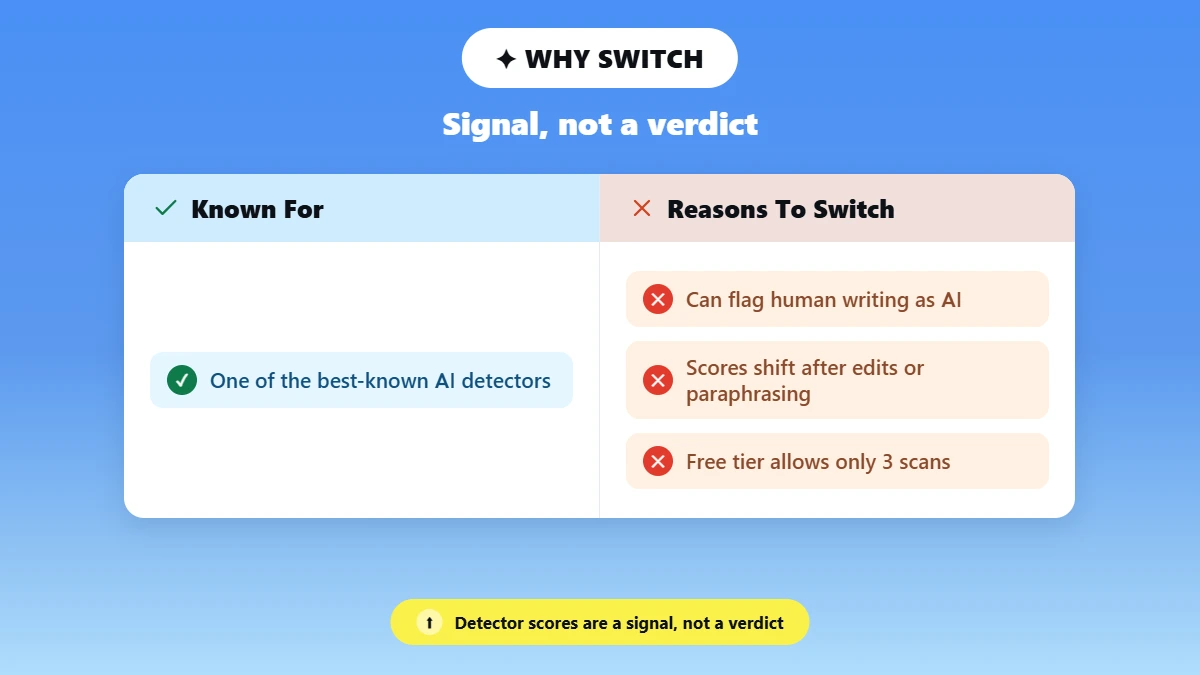
GPTZero is one of the best-known AI detectors, but like every detector, it can flag human writing, and its scores can shift once AI text is edited or paraphrased.
So is GPTZero accurate enough to prove who wrote a draft? No. Its score tracks patterns, such as how predictable the wording is and how much sentence length varies, which plain human prose shares too.
Readers usually say:
False positives: "It flagged an essay I wrote myself," the doubt behind how accurate GPTZero is.
Free limits: "I ran out of checks mid-draft." Is GPTZero free? Partly: in our November 16, 2026 test, it ran 3 Basic Scans logged out before asking for a login.
Reasons, not one number: "I want to see which sentences were flagged and why."
API needs: "We need different access terms, visible pricing, bulk processing, or request limits."
Non-native English writers have the most to lose.
A 2023 Stanford study by Liang et al. found seven GPT detectors labeled 61.22% of TOEFL essays by non-native English writers as AI-generated, on average.
Superhuman announced it "has agreed to acquire GPTZero" (Business Wire (Superhuman press release)), and says GPTZero will be built into Superhuman Go, its AI assistant across 1 million apps and websites.
If your team signs data agreements, ask whether API terms change once the deal closes.
How We Tested 8 GPTZero Alternatives on the Same Text
We ran the same four samples through GPTZero and 7 alternatives on one day, using each tool's free tier, and recorded every score as the tool displayed it.
Test date: November 16, 2026.
Samples: a human sample typed by the writer, a non-native English speaker; a raw AI sample from GPT-6, as selected in ChatGPT, on "how to manage your time during exam week"; that AI sample edited by hand with no humanizer or paraphraser; and a short sample, the first 86 words of the raw AI text.
Human sample note: the writer typed it after reading the raw AI draft, so it shares that draft's tip order, its 45-minute study timing and its Monday maths, Wednesday English example. Version history from the original typing session was not kept.
Version history
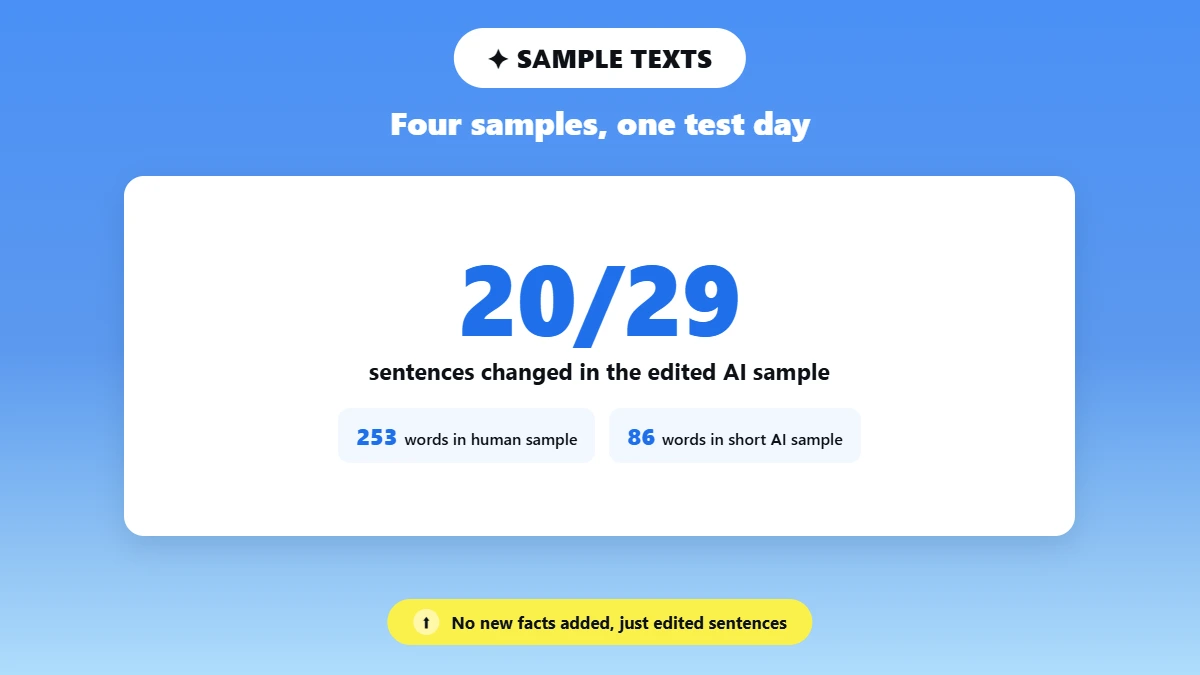
Hand edits: 20 of the 29 sentences in the edited sample were changed, mostly by splitting long sentences and cutting "However," and "especially." No new examples or facts were added.
Word counts: human 253, raw AI 260, edited AI 252, short 86. No sample is trimmed for one tool only.
Settings: free web tier for every tool. GPTZero, ZeroGPT, Copyleaks, Originality.ai, and Sapling ran logged out; Pangram, Winston AI (14-day trial), and QuillBot would not run logged out, so they ran on free accounts.
Phrasly: The Phrasly API was not tested because we had no Business API access. Phrasly's web AI Detector (Model 7.0) ran the same four samples on November 18, 2026, two days after the other tools, and it is reported separately because Phrasly makes it. The API endpoint is POST /api/v1/detect, which Phrasly says needs at least 50 words and accepts up to 15,000 characters per request.
Coverage: every tool, Copyleaks included, gets all four samples, once each.
False positive: the human sample counts as flagged if the top label is "AI" or "Mixed", or the AI score reaches 50%.
Catch: an AI sample counts as caught if the top label is "AI", "Mixed", or "Possibly AI", or the AI score reaches 50%. For Winston AI, which shows a human score, a human score under 50% counts as caught.
Language: all samples are English. Multilingual detection sits outside this method.
Scores reflect one test date, and detectors update their models often, so scores can change. We plan to rerun the test when GPTZero or any listed tool changes its free tier or model.
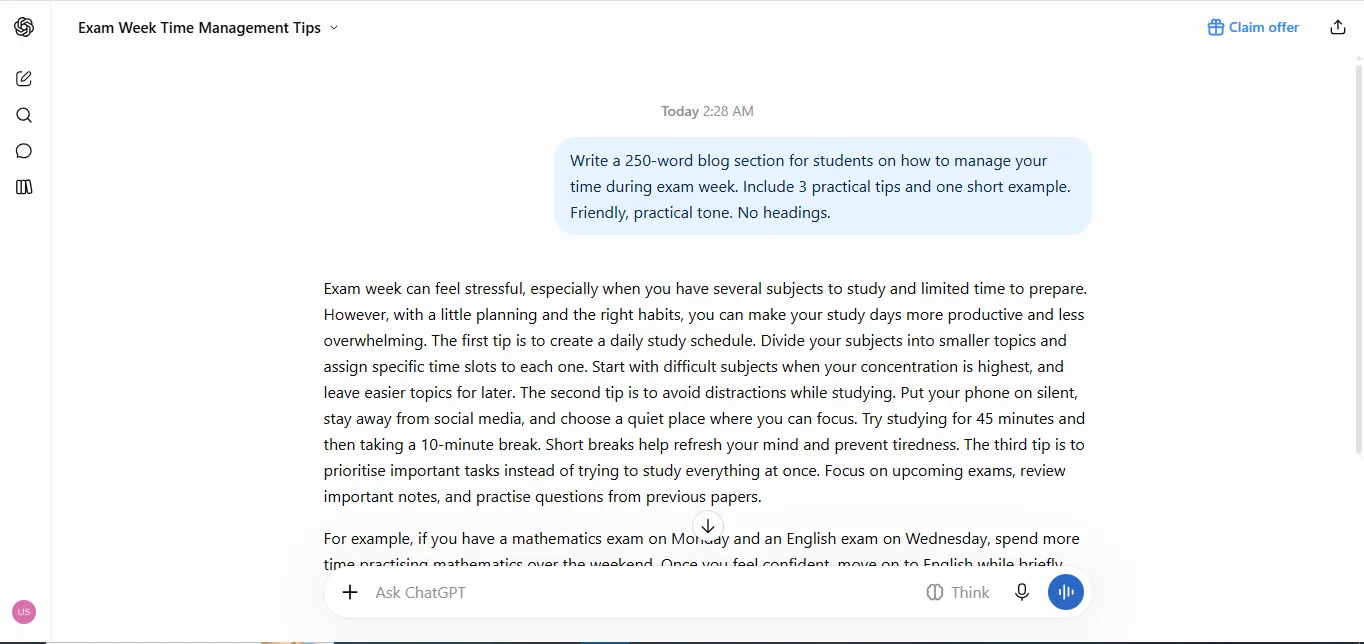
The prompt and reply that became the raw AI sample, November 16, 2026. The model was GPT-6, as selected in ChatGPT; the model name is not visible in this screenshot.
Sample Texts Used in the Test
Human sample (253 words, typed by a non-native English speaker after reading the raw AI draft):
Exam weeks are often filled with multiple exams to revise for and a lack of time. Here are some tips to help you maximise the time you have to revise and reduce stress. Firstly, plan out your day. Break each subject down into the key areas that you need to revise and plan your time accordingly. You should tackle more challenging subjects first in the day and work your way down to those you feel more comfortable with. Secondly, eliminate any distractions from your study environment. Switch your phone off or keep it on silent, avoid social media and sit somewhere that will allow you to concentrate. Aim to revise for approximately 45 minutes and then take a 10 minute break. This will ensure you don't feel fatigued. Thirdly, be selective about what you revise. Look at any upcoming exams, revise key points and complete past papers. If you know you have a maths paper on Monday and an English paper on Wednesday, you should focus on maths over the weekend. You can then revise English and continue to revise some maths each day. This will allow you to revise for both exams efficiently. You should also ensure you are sleeping and eating and drinking well. Don't pull all-nighters as this will reduce your ability to retain and recall information. Finally, don't worry if you do not stick to your plan - you can always modify it! Try to revise steadily over the exam week rather than leave it to the last day.
Raw AI sample (260 words, GPT-6, unedited):
Exam week can feel stressful, especially when you have several subjects to study and limited time to prepare. However, with a little planning and the right habits, you can make your study days more productive and less overwhelming. The first tip is to create a daily study schedule. Divide your subjects into smaller topics and assign specific time slots to each one. Start with difficult subjects when your concentration is highest, and leave easier topics for later. The second tip is to avoid distractions while studying. Put your phone on silent, stay away from social media, and choose a quiet place where you can focus. Try studying for 45 minutes and then taking a 10-minute break. Short breaks help refresh your mind and prevent tiredness. The third tip is to prioritise important tasks instead of trying to study everything at once. Focus on upcoming exams, review important notes, and practise questions from previous papers.
For example, if you have a mathematics exam on Monday and an English exam on Wednesday, spend more time practising mathematics over the weekend. Once you feel confident, move on to English while briefly reviewing mathematics each day. This approach helps you prepare for both subjects without unnecessary pressure. Remember to get enough sleep, eat healthy meals, and drink water throughout the day. Staying up all night may seem productive, but it can affect your concentration and memory. Most importantly, do not panic if your schedule changes. Adjust your plan and keep moving forward. Consistent effort, rather than last-minute cramming, can make exam week much easier.
Edited AI sample (252 words, edited sentences in bold):
Exam week can feel stressful when you have several subjects to study and limited time to prepare. You can make your study days more productive and less overwhelming with a little planning and the right habits. The first tip is to create a daily study schedule.
Divide your subjects into smaller topics. Assign specific time slots to each one. Start with difficult subjects when your concentration is highest. Leave easier topics for later. The second tip is to avoid distractions while studying. Put your phone on silent. Stay away from social media. Choose a quiet place where you can focus. Try studying for 45 minutes. Then take a 10-minute break. Short breaks help refresh your mind and prevent tiredness. The third tip is to prioritise important tasks instead of trying to study everything at once. Focus on upcoming exams. Review important notes. Practise questions from previous papers.
For example, if you have a mathematics exam on Monday and an English exam on Wednesday, spend more time practising mathematics over the weekend. Once you feel confident, move on to English. Also, briefly review mathematics each day. This approach helps you prepare for both subjects without unnecessary pressure. Remember to get enough sleep. Eat healthy meals and drink water throughout the day. Staying up all night may seem productive, but it can affect your concentration and memory. Most importantly, do not panic if your schedule changes. Adjust your plan. Keep moving forward. Consistent effort, rather than last-minute cramming, can make exam week much easier.
Short sample (86 words, the first 86 words of the raw AI sample):
Exam week can feel stressful, especially when you have several subjects to study and limited time to prepare. However, with a little planning and the right habits, you can make your study days more productive and less overwhelming. The first tip is to create a daily study schedule. Divide your subjects into smaller topics and assign specific time slots to each one. Start with difficult subjects when your concentration is highest, and leave easier topics for later. The second tip is to avoid distractions while studying.
Same-Text Test Results and False Positives
Three of the 8 tools labeled our human sample as AI: ZeroGPT, Sapling, and Originality.ai. Every tool caught the raw, edited, and short AI samples wherever it could run them.
Test plan:
Date: November 16, 2026
Samples: fully human (written by a non-native English speaker), raw AI (GPT-6), AI text edited by a person (sentence splits and cut transitions), and a short 86-word sample.
Settings: free web tier for every tool; logged out except Pangram, Winston AI, and QuillBot, which required an account.
Tools and versions: GPTZero (baseline, Model 5.0b), ZeroGPT, Copyleaks, Pangram 4.1, Originality.ai (Originality 5.0), Winston AI v5.2, Sapling and QuillBot (Model v7.1.0). Phrasly API was not tested; Phrasly's web AI Detector (Model 7.0) ran on November 18, 2026.
Runs: one per sample per tool
Pass rules: the false positive and catch rules published in the method section.
Phrasly limit: the API needs at least 50 words, so a sample under 50 words cannot run there. Phrasly makes this product.
Tool | Human sample | Raw AI | Edited AI | Short sample | False positive on human sample | Notes |
GPTZero (baseline) | Human, 38% AI | AI, 100% | AI, 100% | AI, 100% | No | Basic Scan logged out; short sample ran as an Advanced Scan logged in, after 3 logged-out scans |
ZeroGPT | 100% AI | 100% AI | 100% AI | 100% AI | Yes* | Free web, logged out |
Copyleaks | 0% AI | 100% AI | 100% AI | 100% AI | No | Free web, logged out, sensitivity 2 of 3 |
Pangram | Mostly Human, 1% AI | AI Generated, 100% | AI Generated, 100% | Possibly AI, 100% | No | Free account; warned "less accurate on short text" |
Originality.ai | 90% Likely AI | 96% Likely AI | 95% Likely AI | Not run (100-word minimum) | Yes* | Free credits, no account |
Winston AI | 100% human score | 0% human score | 0% human score | 0% human score | No | 14-day trial account; shows a human score |
Sapling | 99.7% AI | 99.9% AI | 99.2% AI | 99.6% AI | Yes* | Free web, logged out |
QuillBot | 34% AI | 100% AI | 80% AI | 100% AI | No | Free account; human sample ran with English (UK) selected |
Phrasly AI Detector (web, not ranked) | Human, 0% AI (0 of 18 sentences) | 100% AI (19 of 19) | 100% AI (24 of 24) | 100% AI (6 of 6) | No | Model 7.0; run November 18, 2026; Phrasly makes this tool |
Each cell shows the tool's own label and score as displayed, with no conversion to a common scale. Each row is a single reading, not a success rate. Tested November 16, 2026. The human sample follows the AI draft's outline, so treat these flags with the sample note in the method section in mind.
ZeroGPT (100% AI), Sapling (99.7%), and Originality.ai (90%) labeled our human sample as AI. Copyleaks, Pangram, Winston AI, QuillBot (34%), and GPTZero (38%, labeled Human) did not flag it. One human sample, written after reading an AI draft, cannot show which tool is an AI detector with low false positives.
It is not a false positive rate, and this AI detection statistics roundup shows how widely published rates vary.
On the hand-edited AI sample, GPTZero returned AI, 100%. Every tool still caught it, though QuillBot's score fell from 100% to 80%, and the edits were light.
That is one data point on whether AI detectors catch paraphrased text.
Not a rule.
On the 86-word short sample, Originality.ai would not run because it needs at least 100 words. Pangram labeled it "Possibly AI" with a warning that short text is less accurate, and GPTZero showed a similar under-100-words warning.
University of Minnesota guidance, citing Liang et al. 2023 and Gegg-Harrison and Quarterman 2024, treats detection scores as estimates of likelihood, not proof.
That gap explains why AI detectors give different results on the same edited text.
Independent research shows the same pattern.
A 2026 University of Notre Dame study found GPTZero and Pangram flagged 8.9% and 14.9% of human-written research abstracts from 2023 to 2025, against 0% for abstracts from 2013 to 2015, though the authors note some recent abstracts may include AI help.
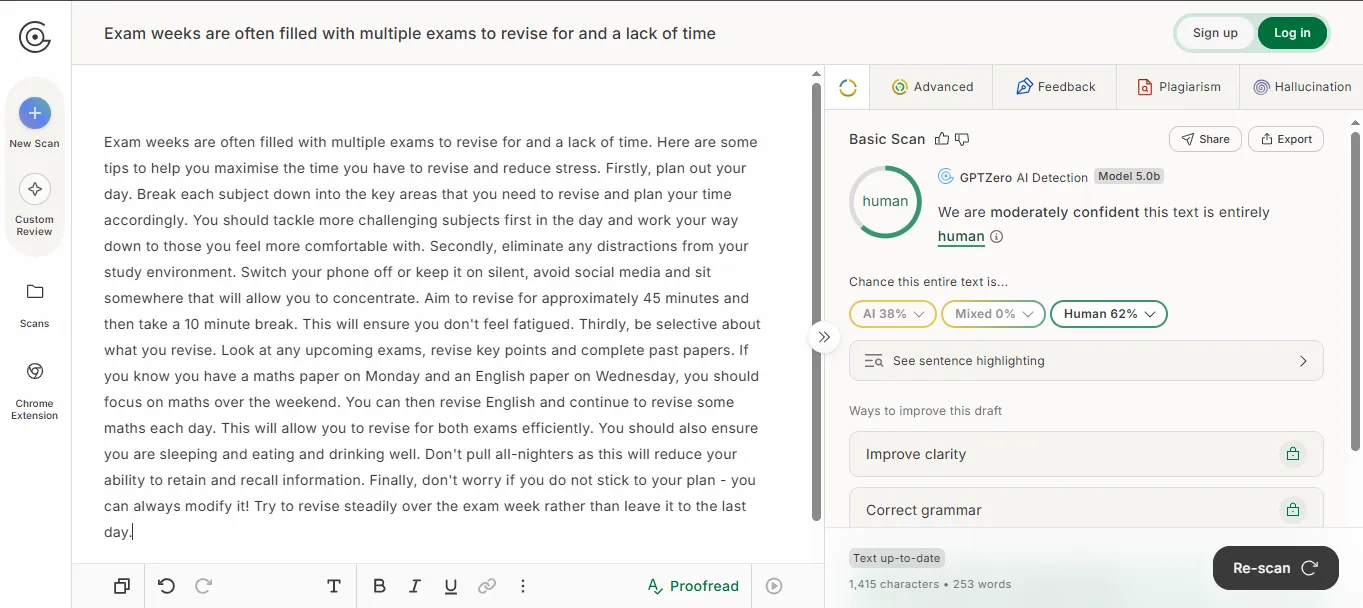
GPTZero (Model 5.0b, Basic Scan, logged out) was "moderately confident" the human sample is human: 38% AI, 62% human.
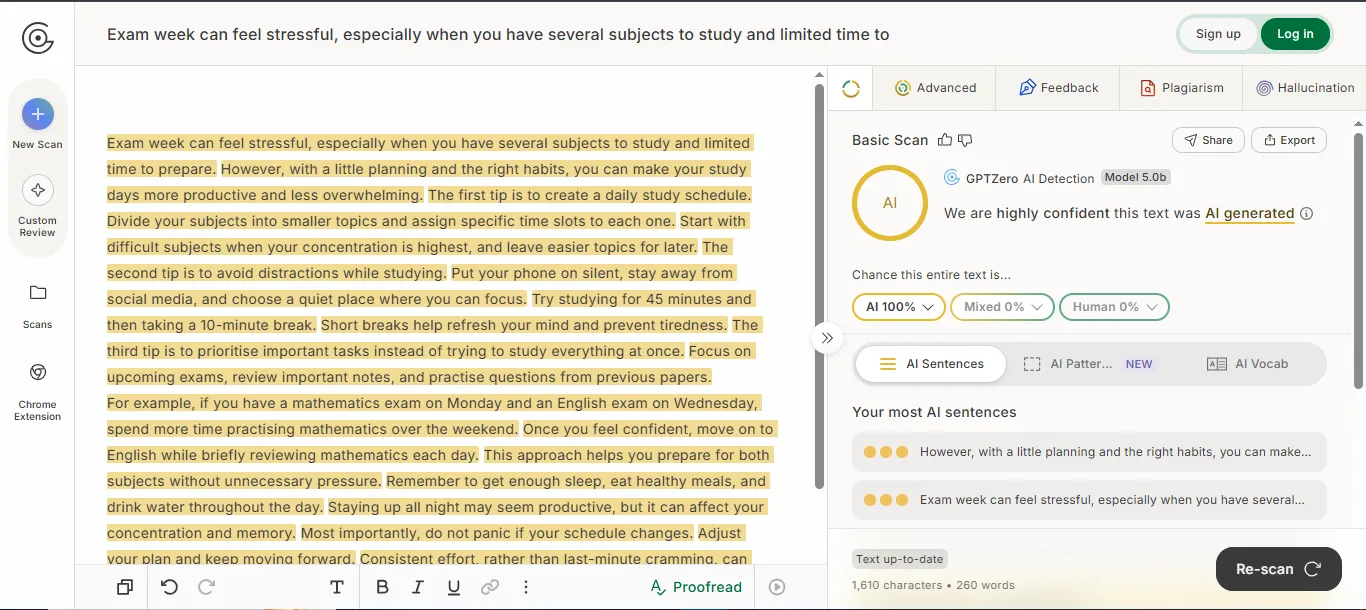
GPTZero rated the raw GPT-6 sample 100% AI and highlighted every sentence.
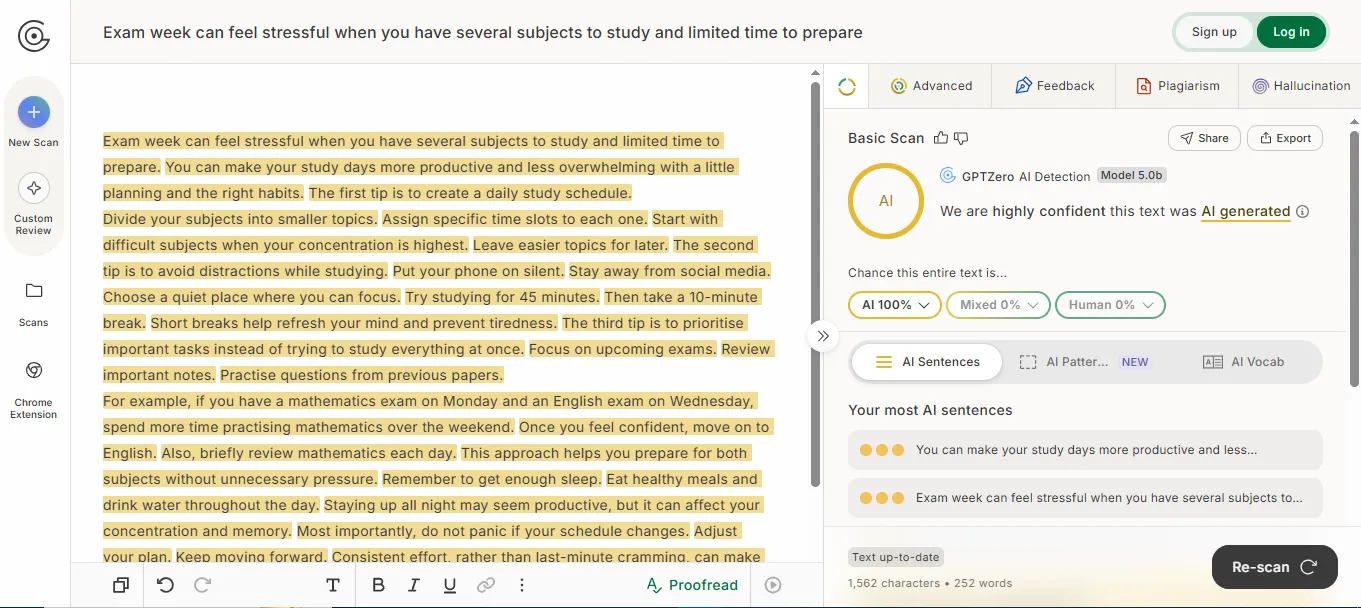
The hand-edited sample still scored 100% AI in GPTZero.
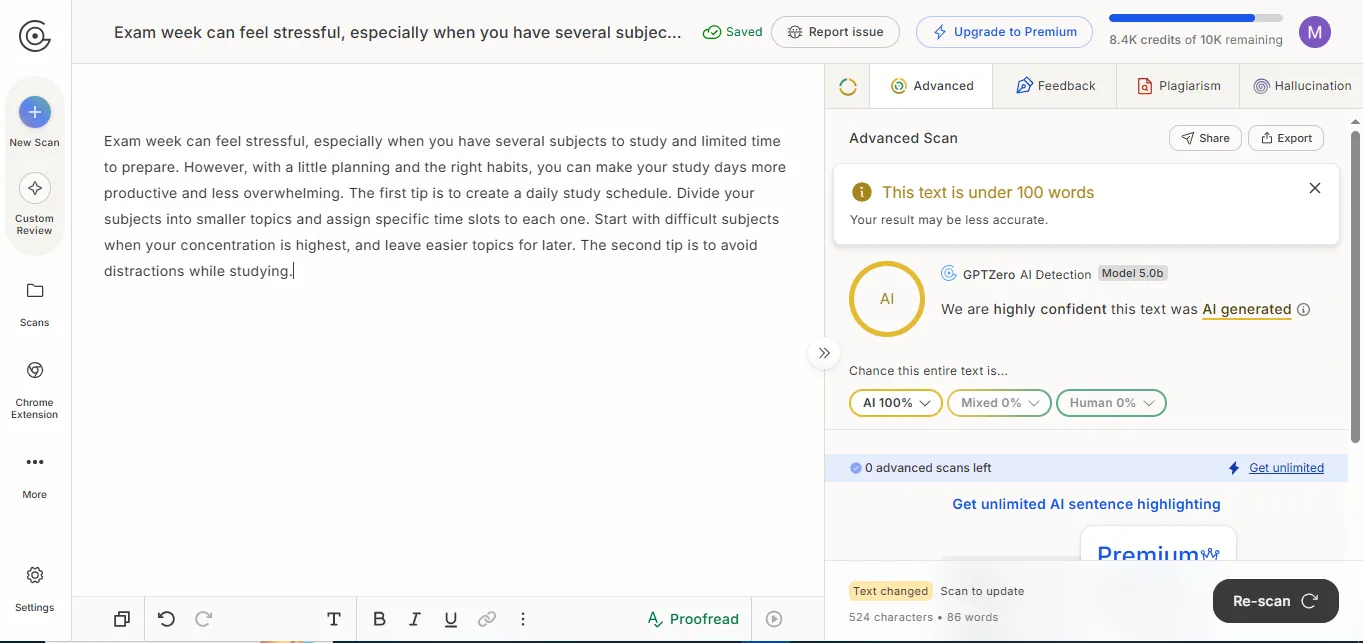
GPTZero rated the 86-word short sample 100% AI. This one ran as an Advanced Scan while logged in, after the 3 logged-out scans, and warned that text under 100 words is less accurate.
The 8 Best GPTZero Alternatives, Reviewed
Unlike best free GPTZero alternatives 2025 lists, these tools follow our same-day test order. Tools that left the human sample unflagged and caught every AI sample come first, ordered by how easy free access was; the rest follow by how strongly they flagged the human sample.
Phrasly comes last and unranked: its API was not tested, and Phrasly makes its own web detector.
1. Copyleaks: Best for Schools and Multilingual Checks
Copyleaks is best for schools and teams that check writing in more than one language, because it lists AI detection in "30+ languages" (Copyleaks pricing, checked November 16, 2026) and scored our human sample 0% AI.
Free web limit: the free web checker ran every sample logged out; Copyleaks does not state a per-check cap on the page.
API: sales-led; Copyleaks says to contact sales for API access, and API pricing is not public. Personal plans start at $16.99 a month, or $13.99 a month billed yearly. (pricing as of November 16, 2026)
Our test results: 0% AI on the human sample and 100% AI on the raw, edited, and short samples.
Main limitation: the API needs a sales call, so you cannot test it with a self-serve key.
Sentence highlighting appears on the free web tier, where AI text is shaded in the result.
Vendor and third-party accuracy figures for it disagree, so weigh our human-sample line first, then read this Copyleaks vs GPTZero comparison.
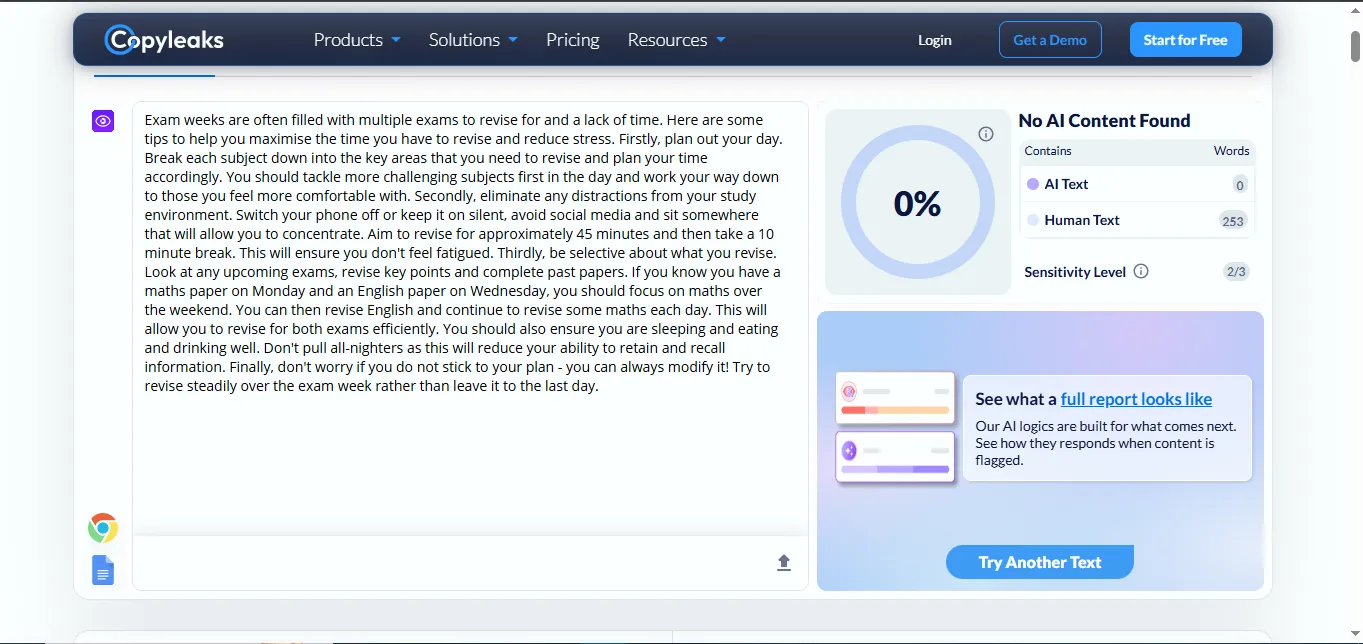
Copyleaks found no AI content in the human sample: 0 AI words, 253 human words.
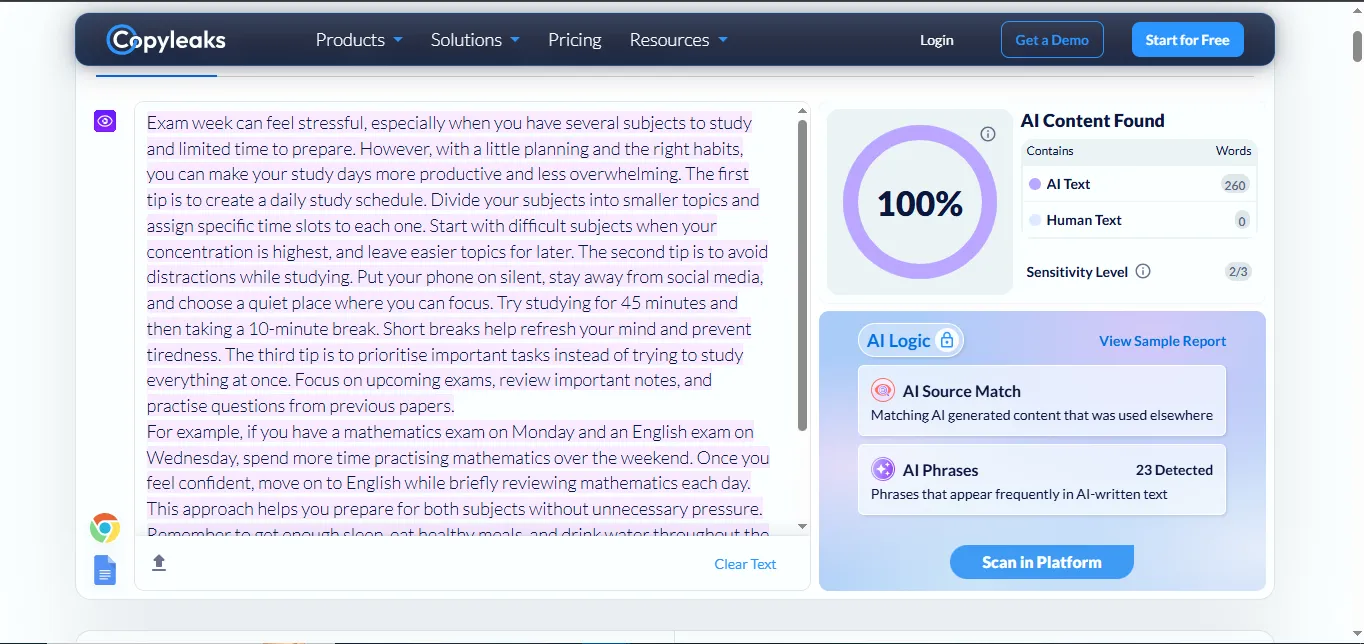
Copyleaks flagged all 260 words of the raw AI sample and listed 23 AI phrases.
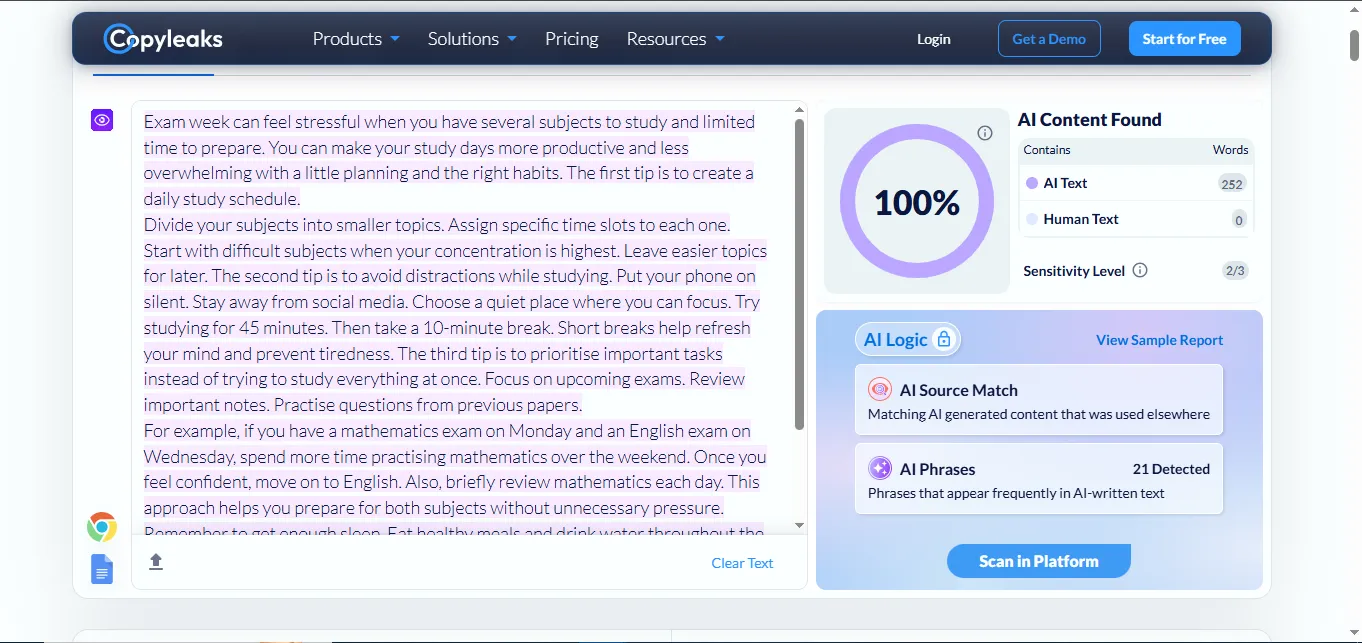
Copyleaks flagged all 252 words of the hand-edited sample.
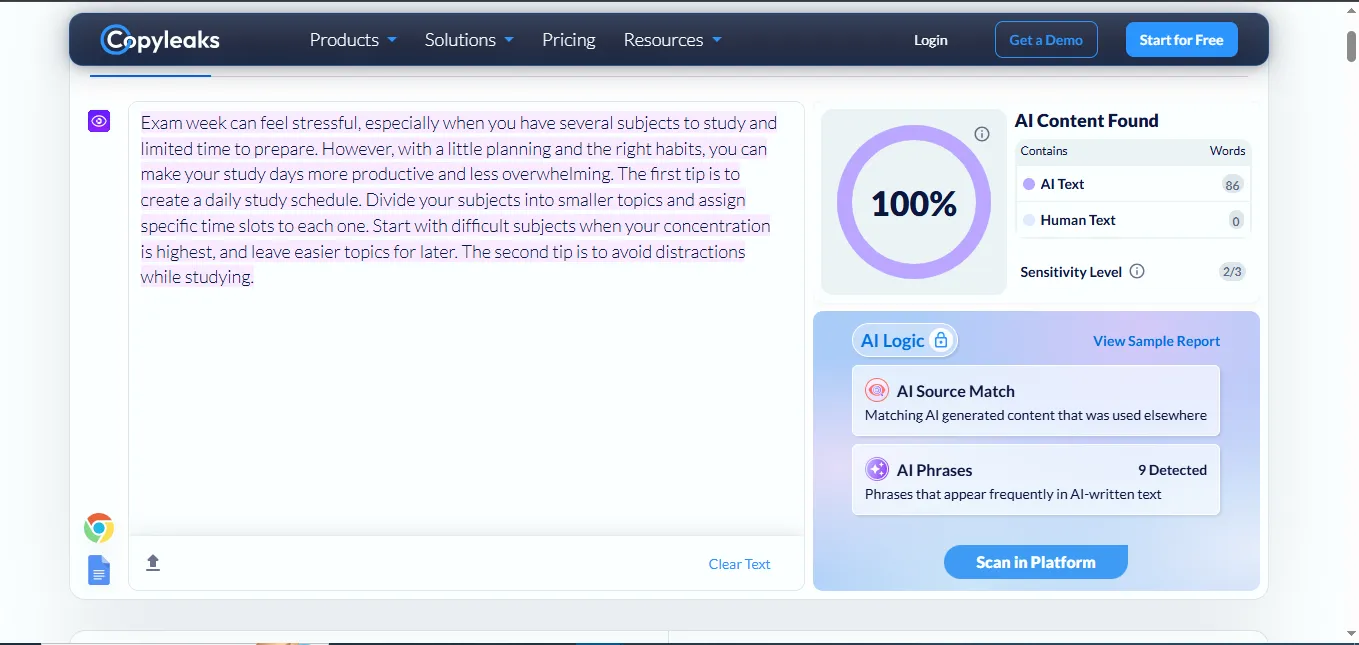
Copyleaks flagged all 86 words of the short sample.
2. Pangram: Best for Low False Positives
Pangram is best for teams that put a low false positive rate first, because it rated our human sample "Mostly Human" at 1% AI while labeling every AI sample as AI.
Free web limit: 20 free credits a day on the free plan (Layer3 Labs, November 8, 2026); it would not run logged out in our test.
API: self-serve with prepaid credits at $0.05 per 100 words, plus a 20% discount on the bulk text API (Pangram API). (Pricing as of November 16, 2026)
Our test results: Mostly Human, 1% AI on the human sample; AI Generated, 100% on the raw and edited samples; Possibly AI, 100% on the short sample.
Main limitation: it needs an account, and its similarity report is locked on the free plan.
Sentence highlighting appears on the free tier, through a Highlight toggle on each result. A clean result on one human sample would still not make it the best ai detector for every job, and the 2026 Notre Dame study above found Pangram flagged 14.9% of recent human abstracts.
Skip Pangram if you need a plagiarism check besides the AI score on the free plan.
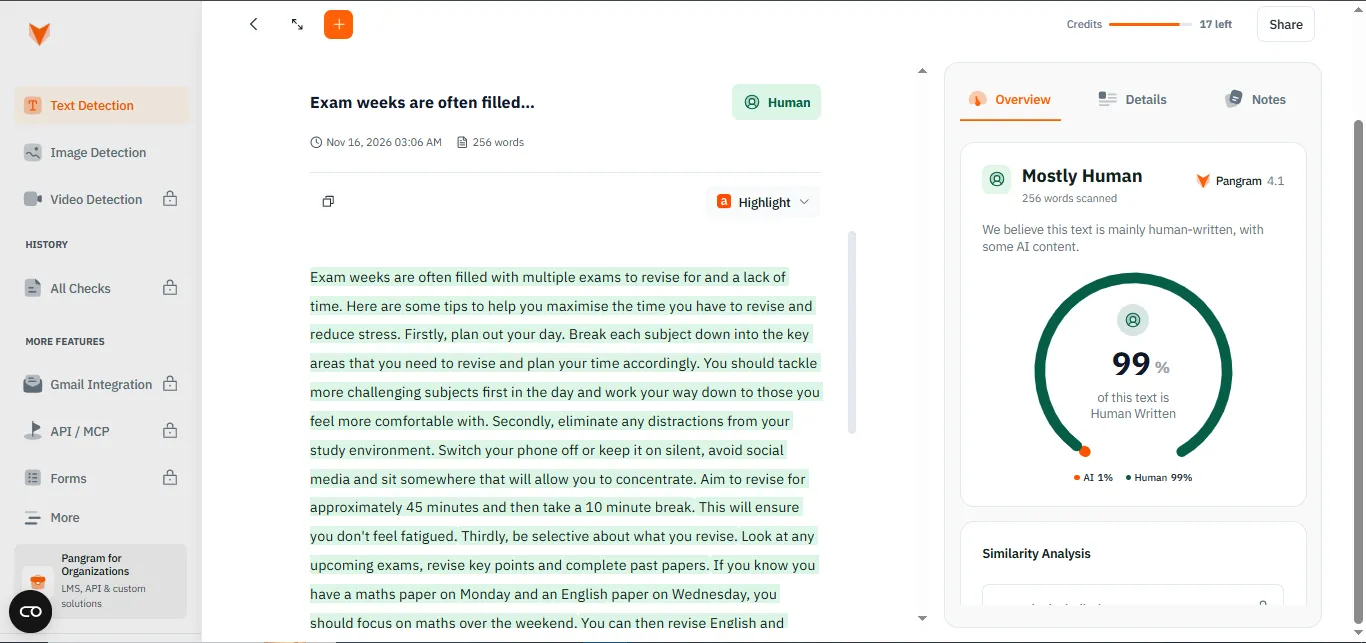
Pangram 4.1 rated the human sample "Mostly Human": 99% human, 1% AI.
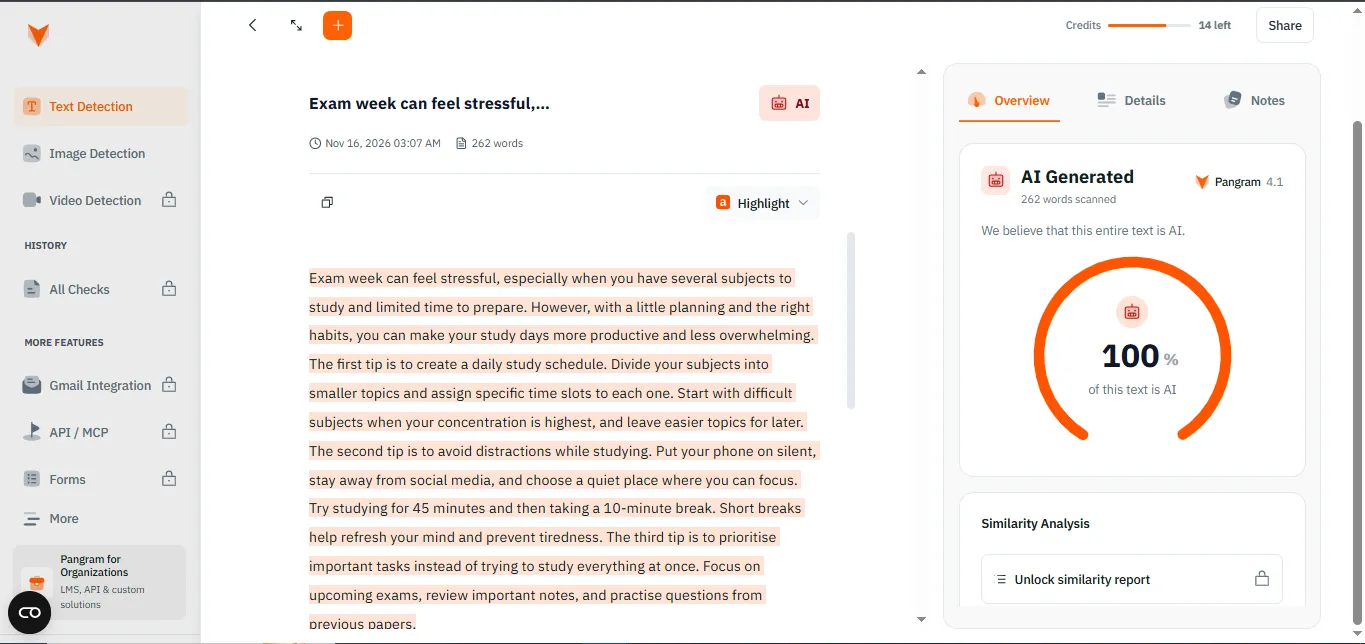
Pangram labeled the raw AI sample "AI Generated," 100% AI.
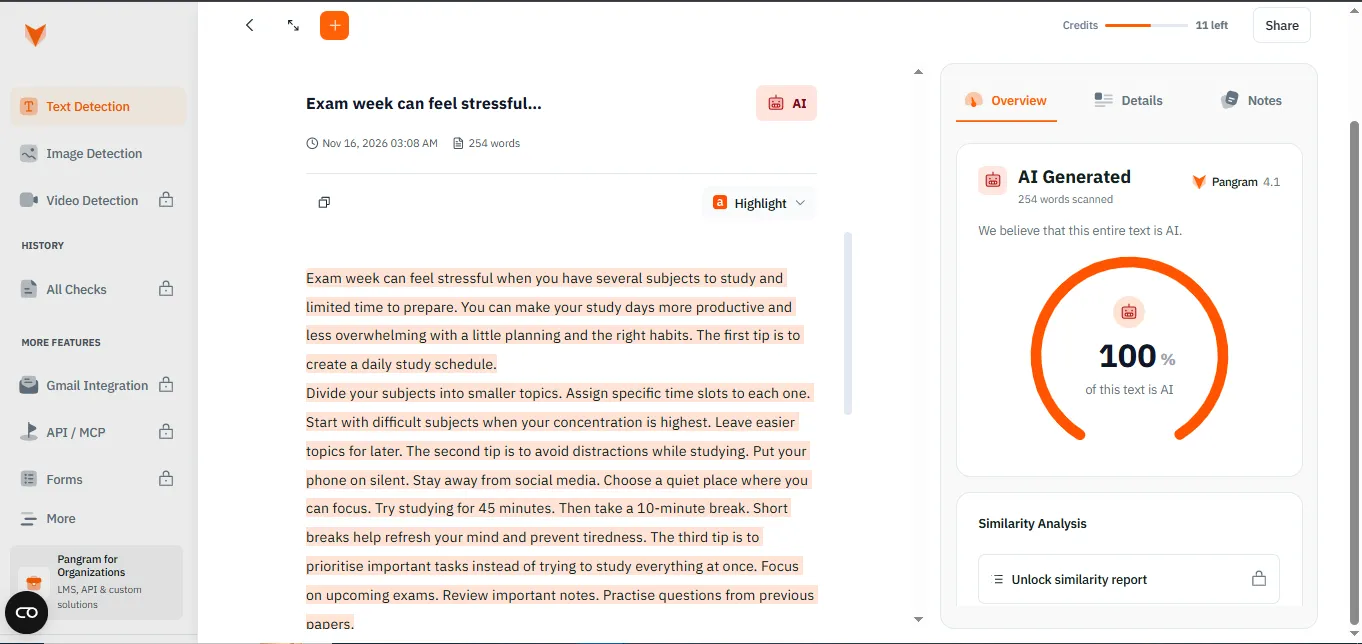
The hand-edited sample was also "AI Generated," 100% AI.
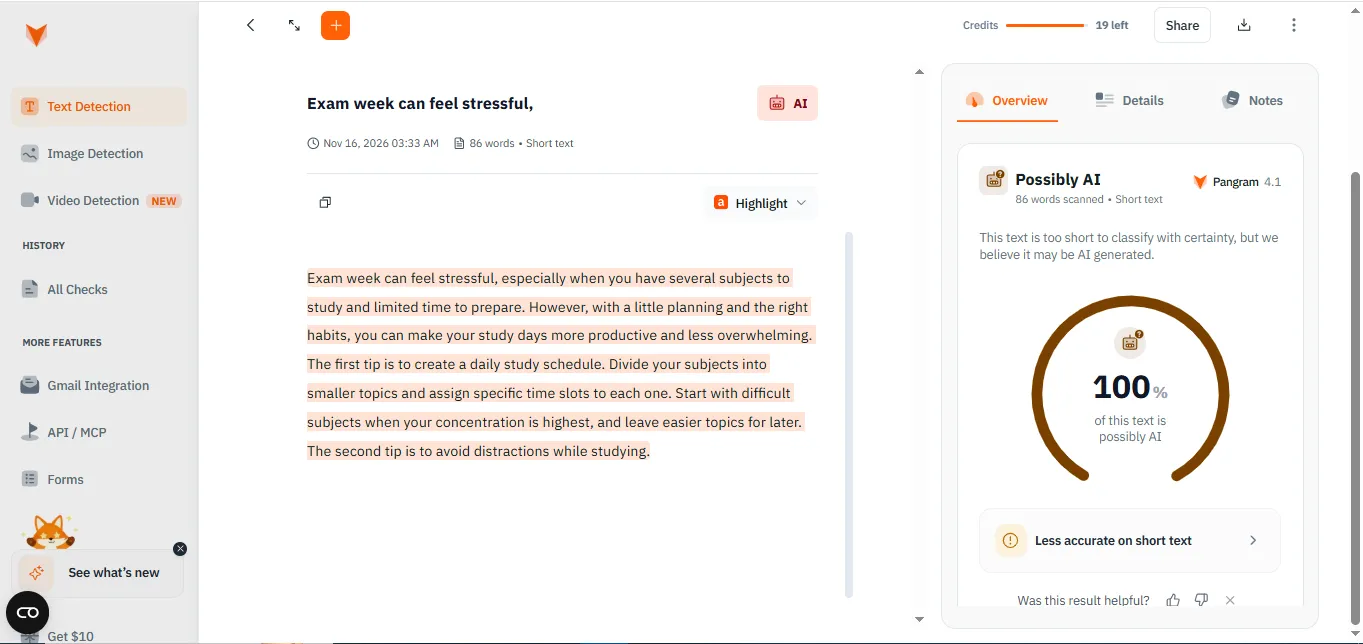
On the 86-word sample, Pangram said "Possibly AI" and warned it is less accurate on short text.
3. Winston AI: Best for a Two-Week Trial with Sentence Colors
Winston AI is best for small teams that want to try a detector for two weeks before paying, because its trial gave a clear 100% human score on our human sample and 0% on every AI sample.
Free web limit: a 14-day trial with 2,000 credits, not an ongoing free tier (Winston AI help center).
API: self-serve: sign up on the developer dashboard for 2,000 free credits with no card, then pay 1 credit per word for AI detection and 2 for plagiarism (Winston AI API docs). (pricing as of November 18, 2026)
Our test result: 100% human score on the human sample; 0% human score on the raw, edited, and short samples.
Main limitation: the free access is a trial, not an ongoing free tier, and paid plans start at $18 a month or $120 a year.
Sentence highlighting appears on the trial, with colors running from AI-generated to human-written. Winston shows a human score rather than an AI score, so read it the other way round.
Before you commit credits, compare its features with this Winston AI vs GPTZero breakdown.
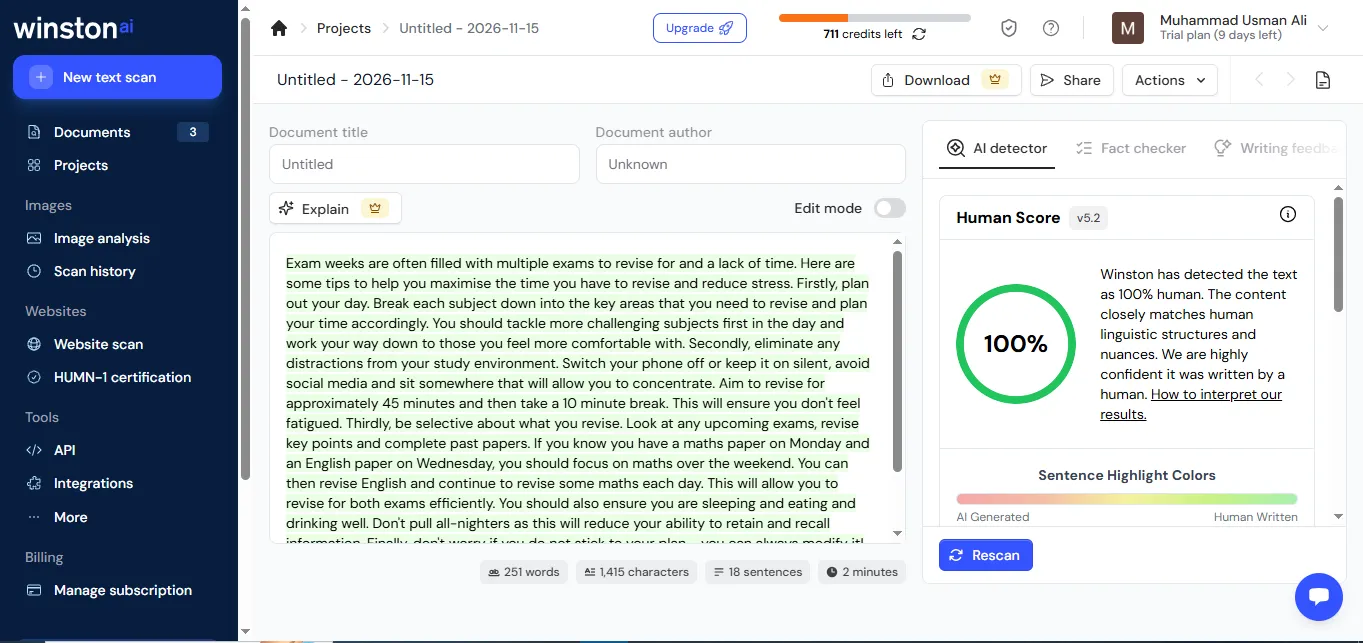
Winston AI (v5.2, trial) gave the human sample a 100% human score. The account name is blurred.
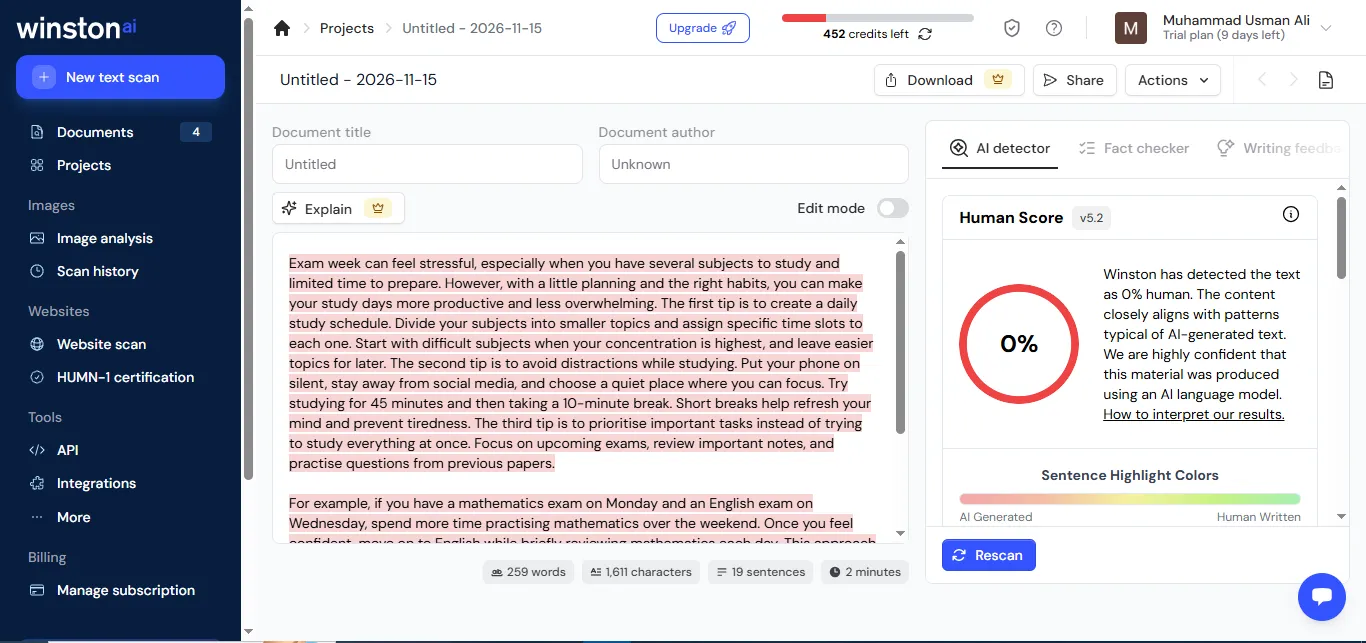
The raw AI sample got a 0% human score.
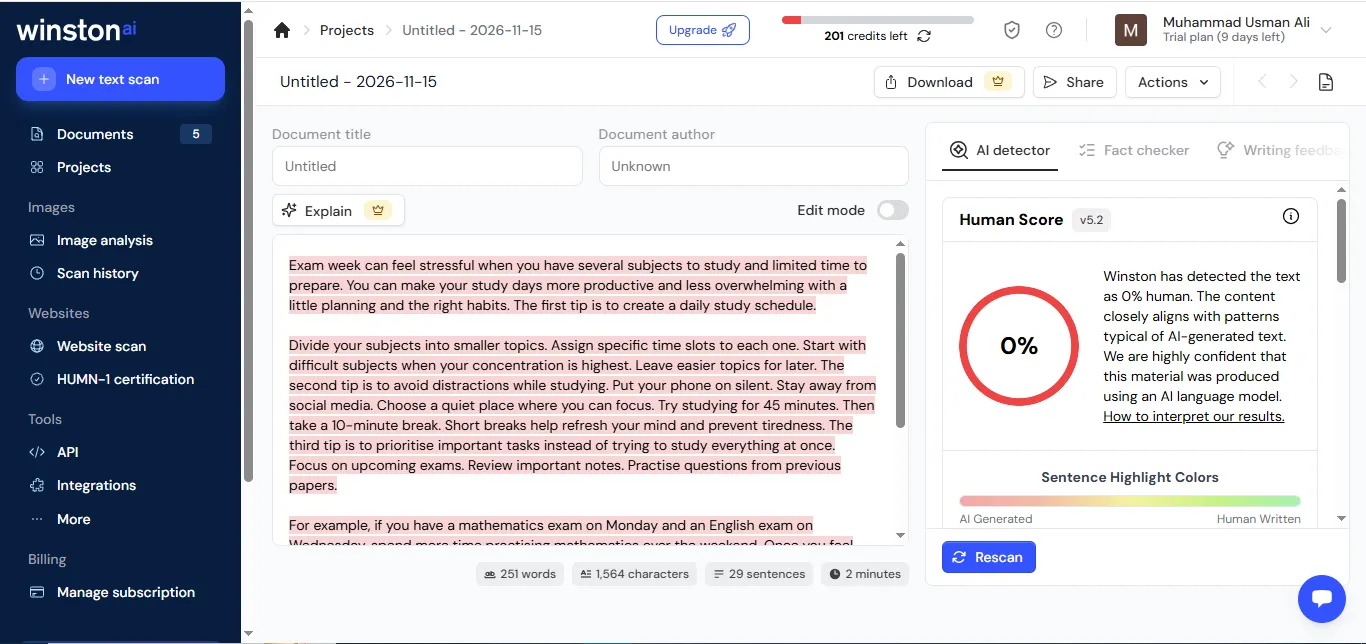
The hand-edited sample also got a 0% human score.
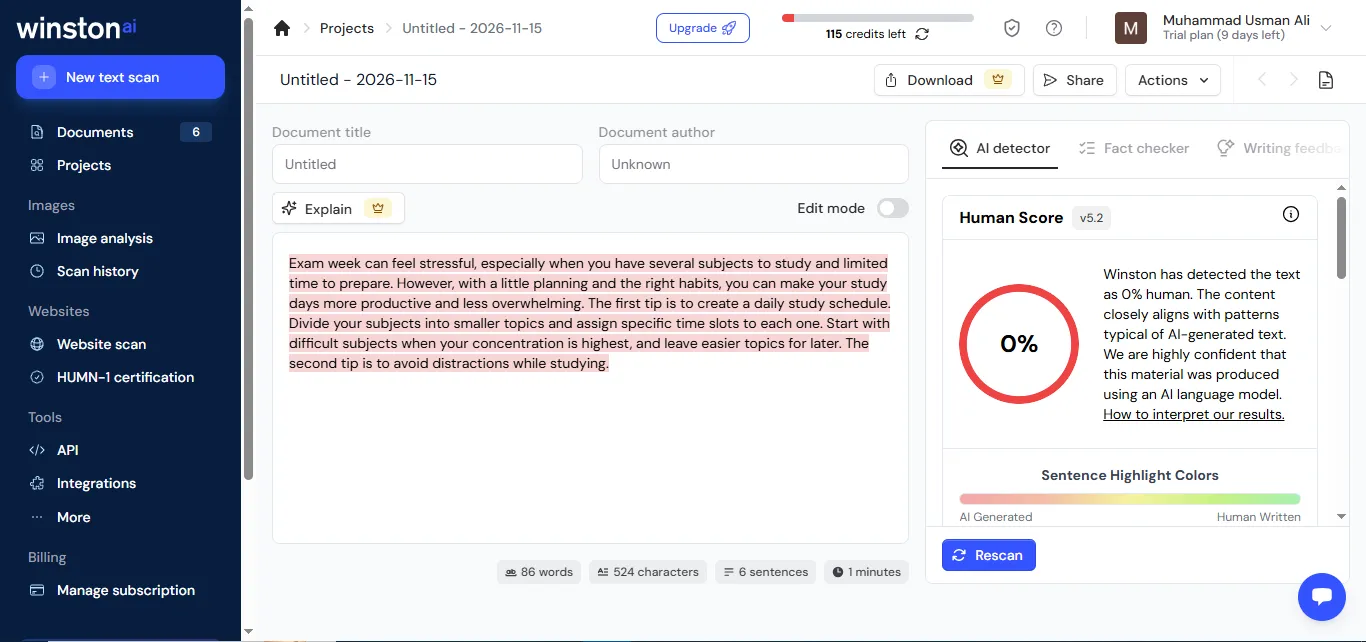
The 86-word short sample scored 0% human.
4. QuillBot: Best for Quick Free Checks with No API Needed
QuillBot is among the free alternatives to gptzero for students and writers who check a few paragraphs at a time, because it gives a breakdown of AI-generated, AI-refined, and human-written text.
Free web limit: 1,200 words per check, shown on the QuillBot AI Detector page; it required a login in our test.
API: no public AI detection API on its detector page.
Our test result: 34% AI on the human sample (not flagged); 100% on the raw and short samples; 80% on the edited sample.
Main limitation: the edited sample dropped to 80%, the biggest drop of any tool, and there is no API.
Sentence highlighting appears on the free tier, with labels such as "Overly polished" and "Predictable structure" on flagged lines. Its Chrome extension also lists an AI Detector among its features.
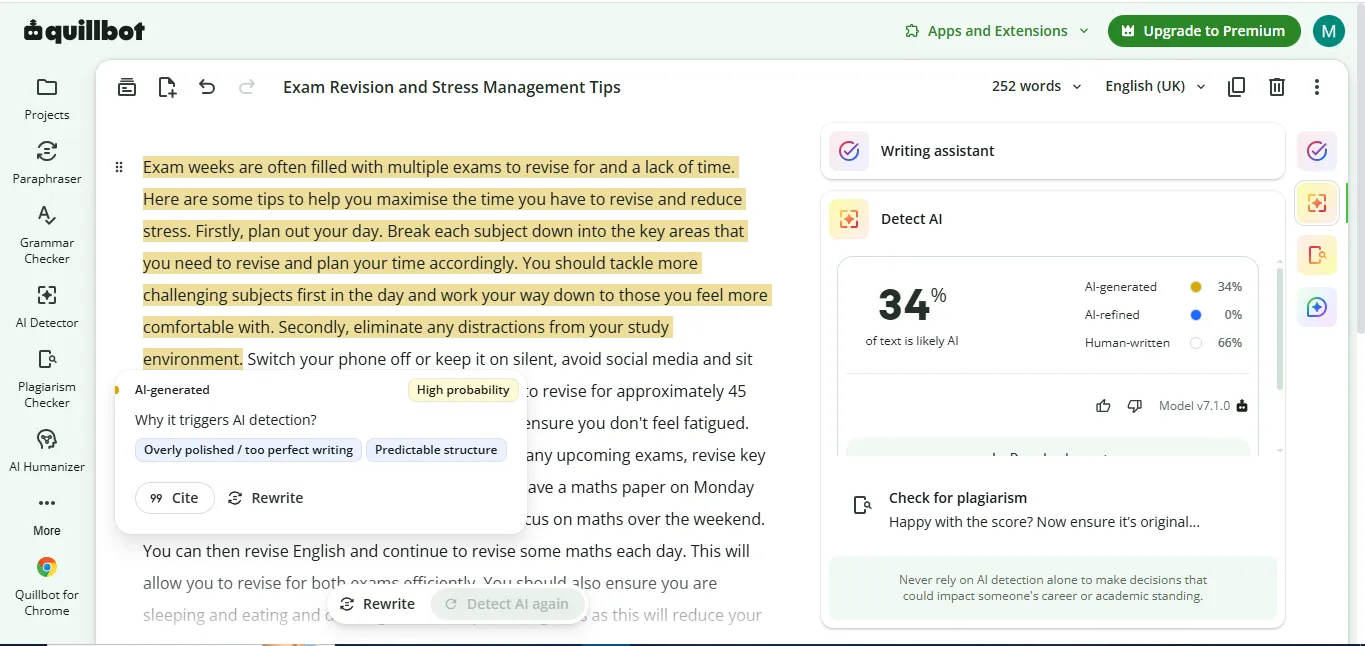
QuillBot (Model v7.1.0) rated the human sample 34% likely AI and highlighted its opening sentences.
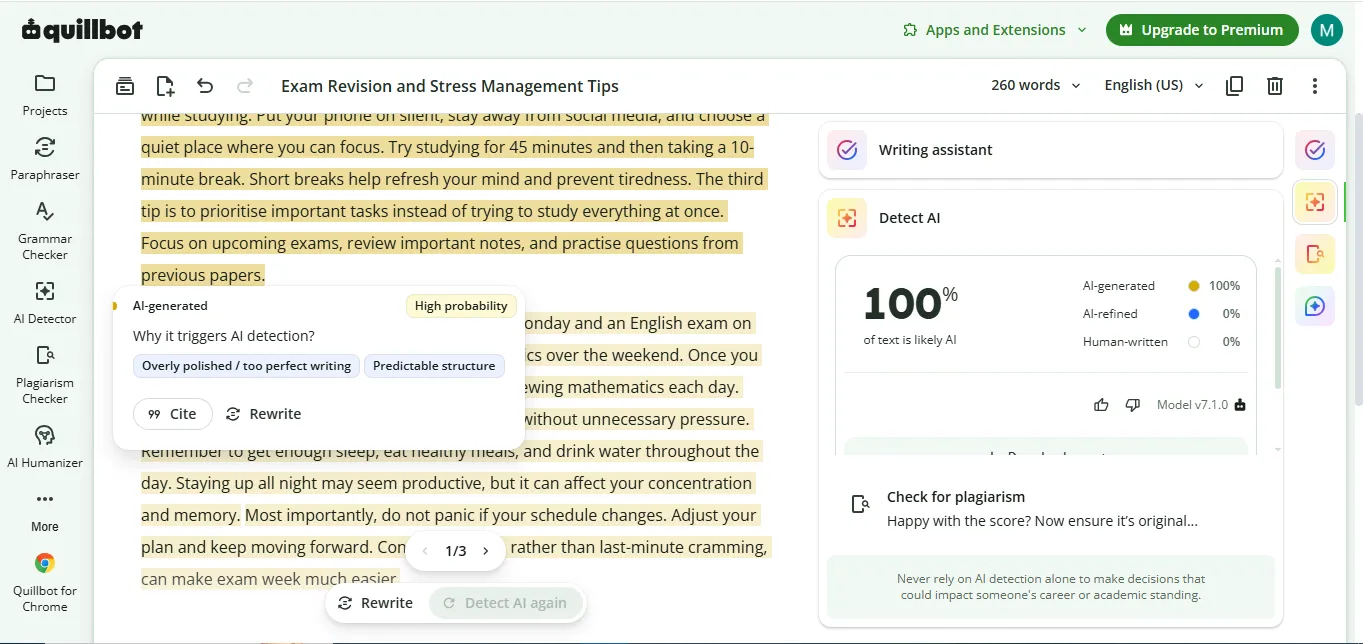
The raw AI sample scored 100% likely AI.
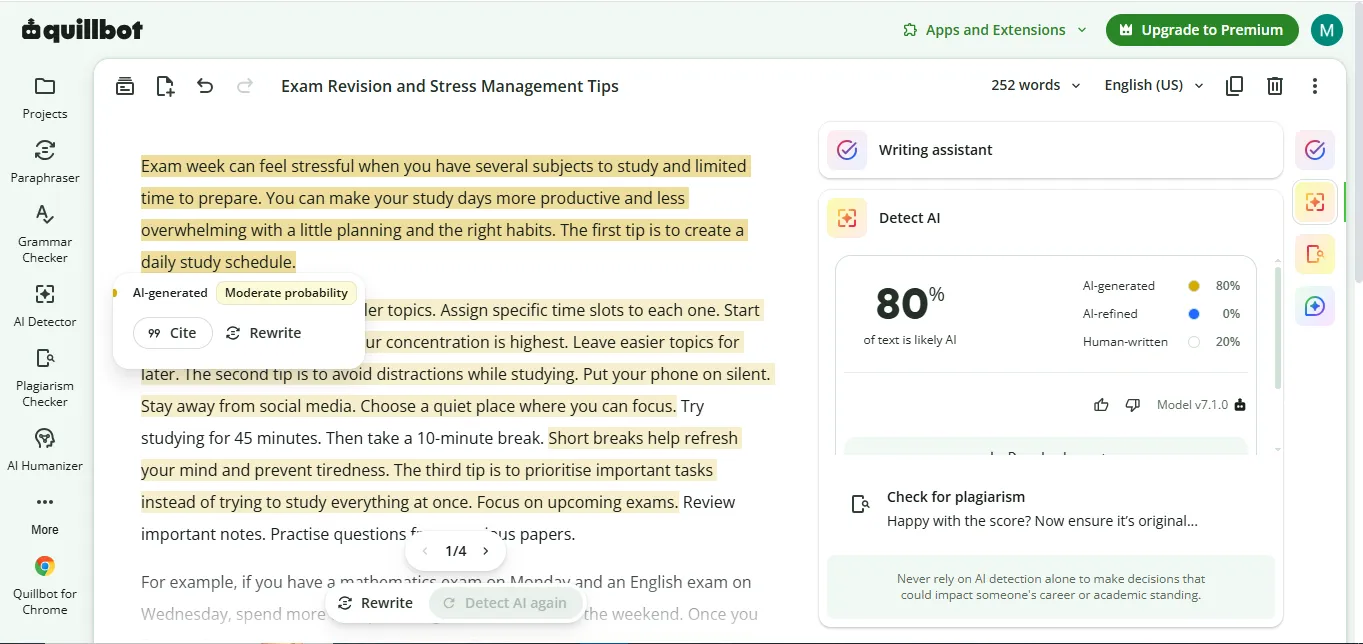
The hand-edited sample dropped to 80% likely AI, with 20% read as human-written.
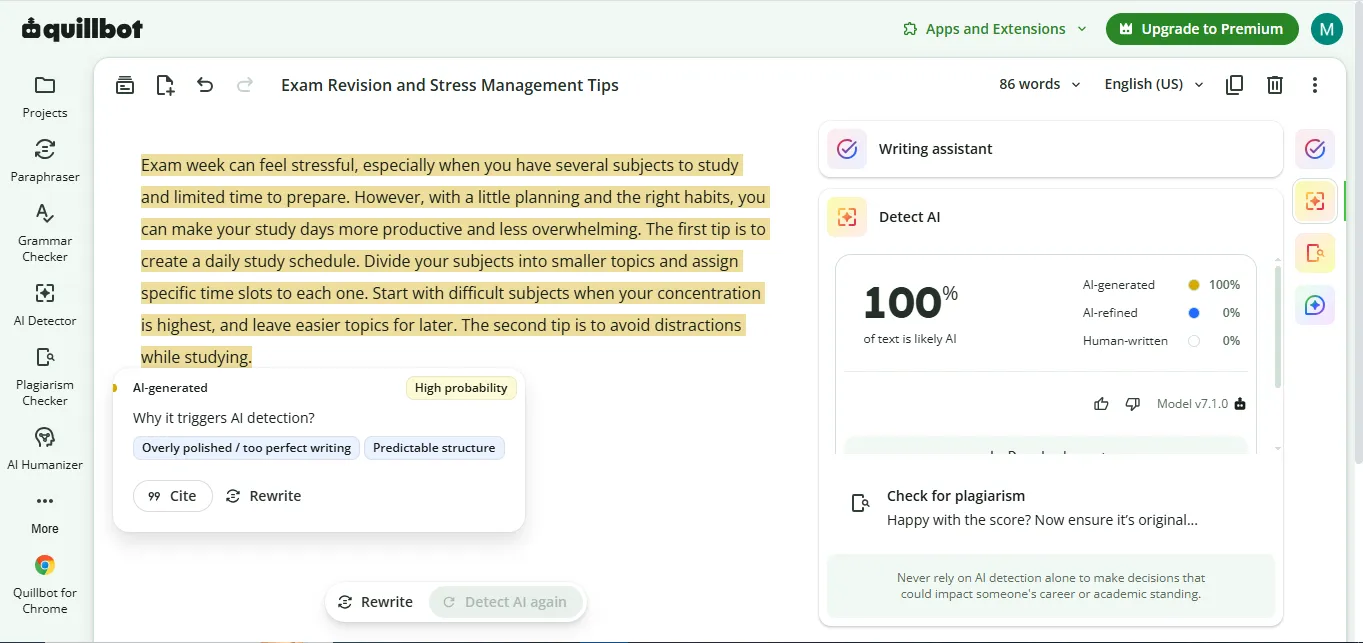
The 86-word short sample scored 100% likely AI.
5. Originality.ai: Best for Publishers Who Need Plagiarism Checks Too
Originality.ai is the pick for publishers who want AI detection and plagiarism checking in one account, because every plan, free included, lists both (Originality.ai pricing).
Free web limit: 100 one-time free credits, where 1 credit covers 100 words, with a 100-word minimum per scan. The pricing page also lists 60 credits a day, so check which applies.
API: included on the Enterprise plan, at $179 a month or $136.58 a month billed yearly; API rates are not listed separately. (pricing as of November 16, 2026)
Our test result: 90% Likely AI on the human sample (flagged); 96% and 95% on the raw and edited samples; the short sample would not run.
Main limitation: it flagged our human sample at 90%, and it will not scan text under 100 words.
For blog content, Turnitin is sold only to institutions (Turnitin help center), which leaves Originality.ai and Copyleaks as the two tools here pairing AI detection with plagiarism checks on every paid plan.
Sentence highlighting appears on the free tier, with likely AI text shaded. Skip it if you only need an occasional free check.
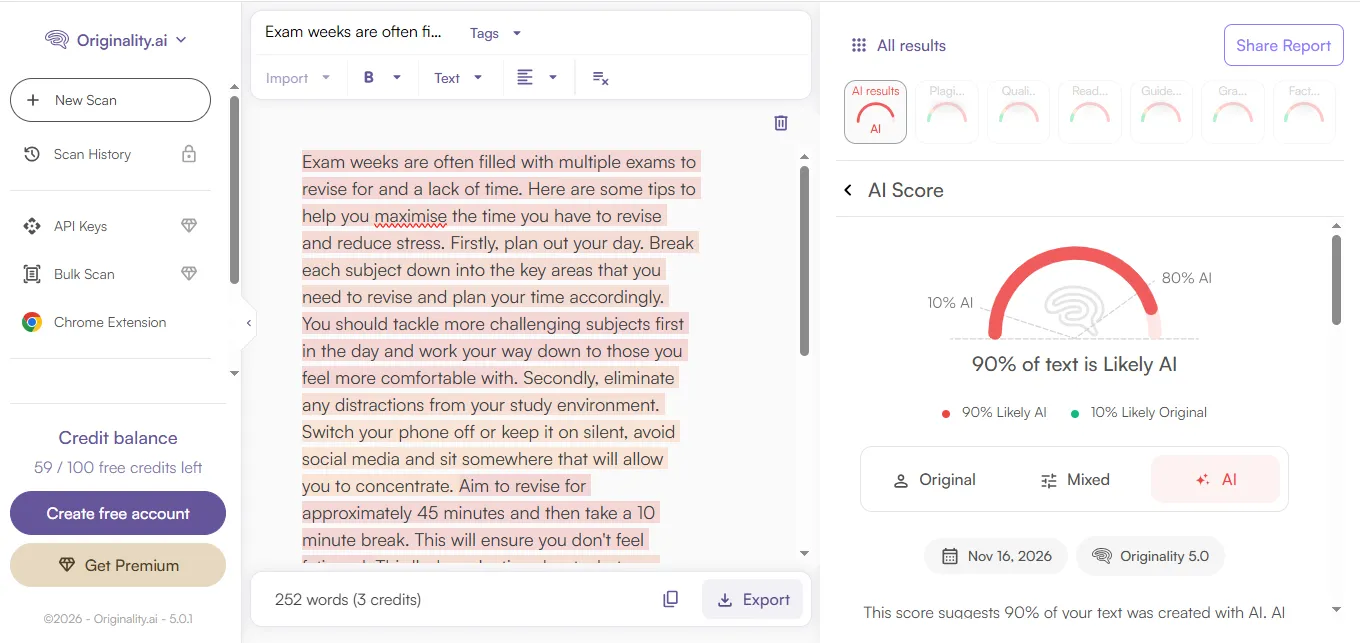
Originality.ai (Originality 5.0) rated the human sample 90% Likely AI, a flag under our rules.
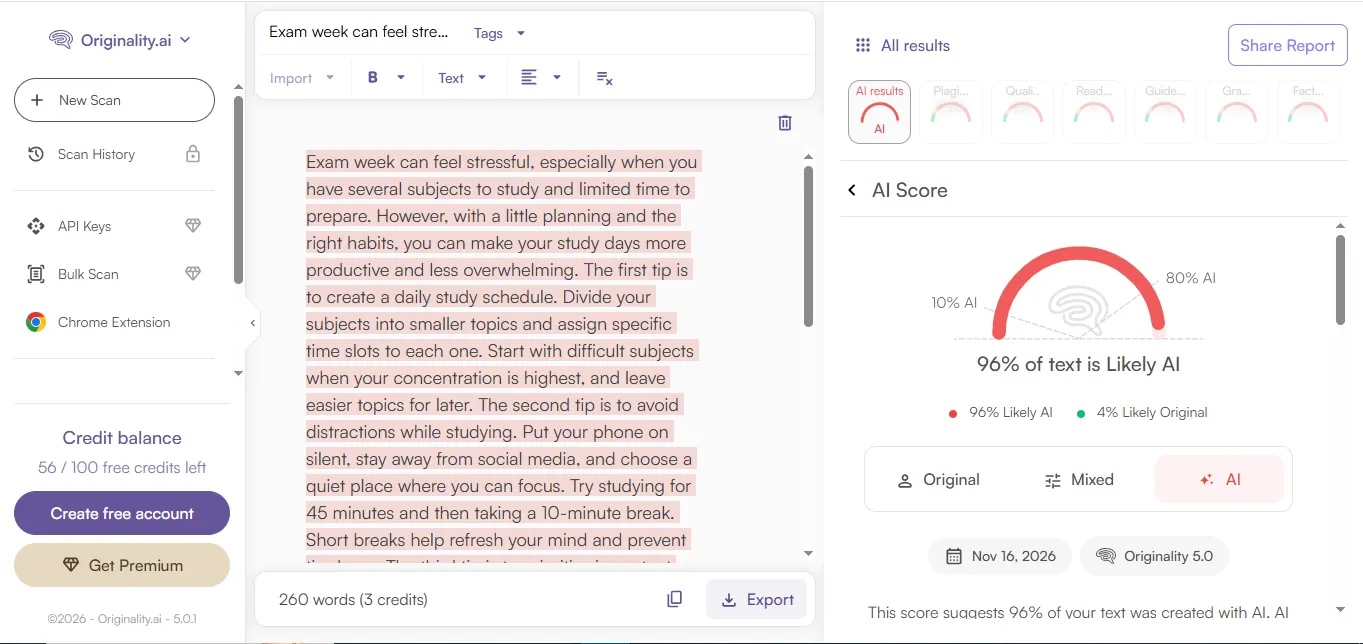
The raw AI sample scored 96% Likely AI.
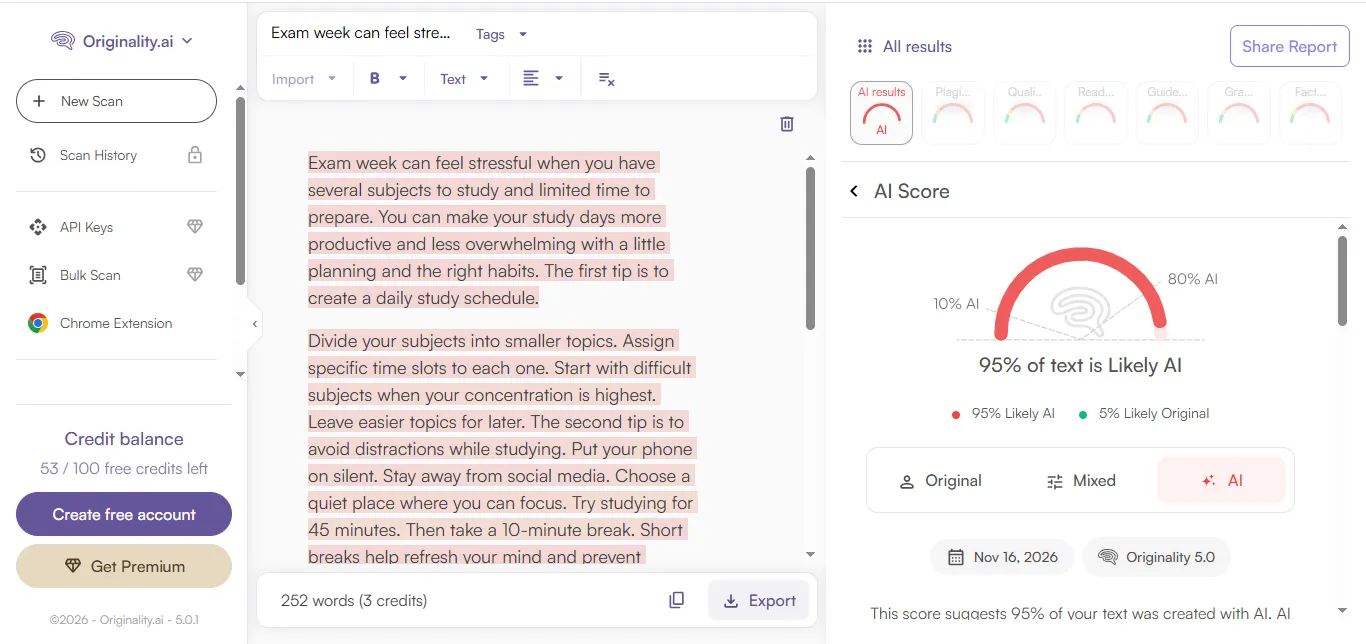
The hand-edited sample scored 95% Likely AI.
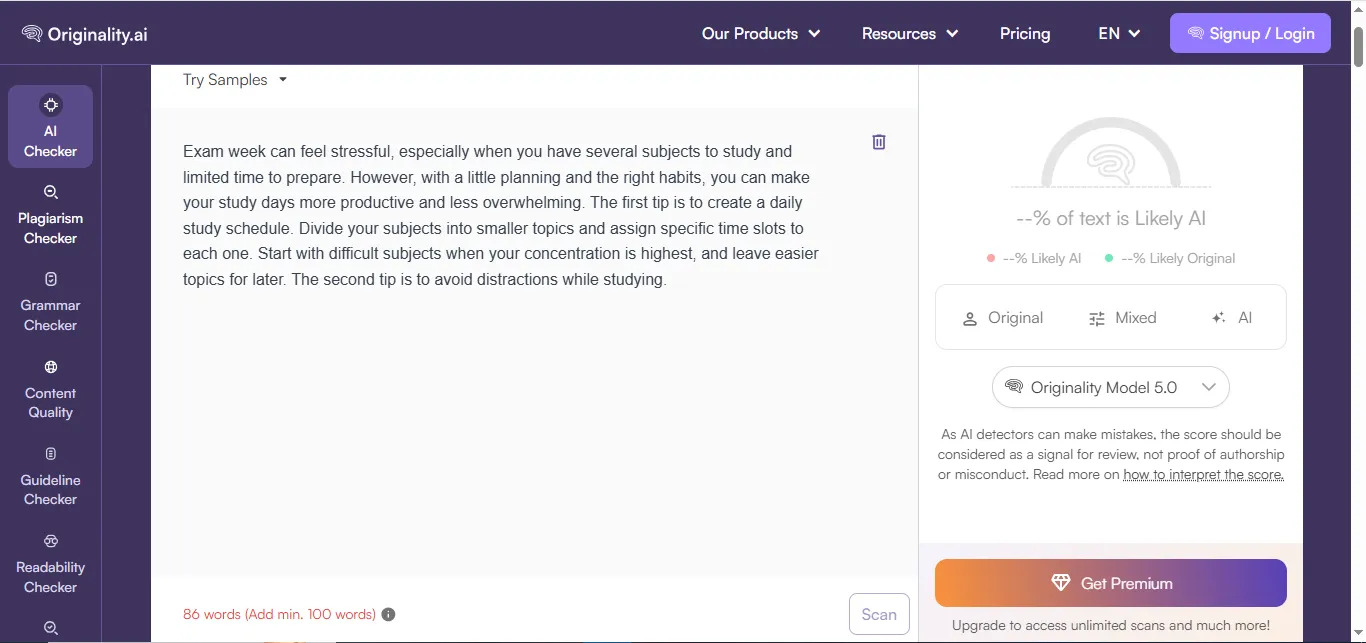
Originality.ai would not scan the 86-word short sample: "Add min. 100 words."
6. Sapling: Best for Trying a Free API Key
Among alternatives to GPTZero, Sapling is the one to test if you want an API key before paying anything, because trial keys need no credit card (Sapling API pricing).
Free web limit: the first 2,000 characters per check, logged out (Sapling AI Detector).
API: trial keys get 50,000 characters every 24 hours and 250,000 a month before you subscribe; Sapling publishes rates for other endpoints but not for the AI detector. (pricing as of November 16, 2026)
Our test results: 99.7% AI on the human sample (flagged); 99.9%, 99.2%, and 99.6% on the raw, edited, and short samples.
Main limitation: it flagged our human sample at 99.7%, and its detector API rate needs a sales email.
Sentence highlighting appears on the free tier, and a "Show sentence scores" option gives each sentence its own score.
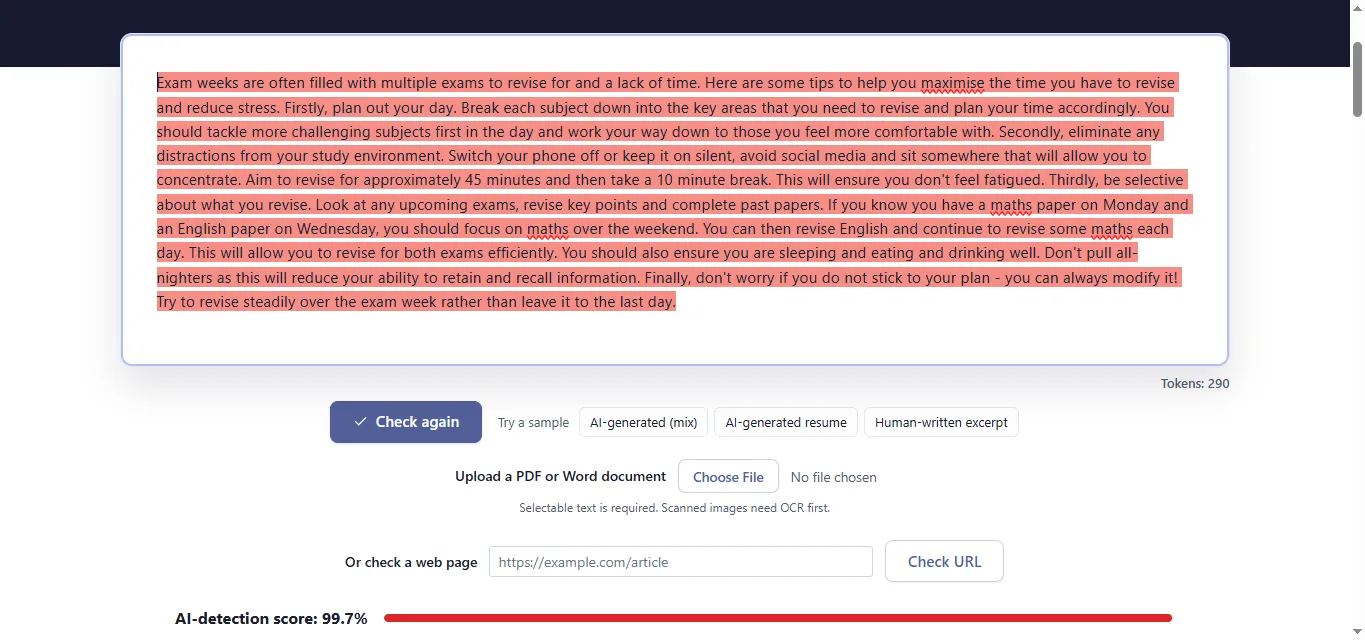
Sapling rated the human sample 99.7% AI and highlighted every sentence.
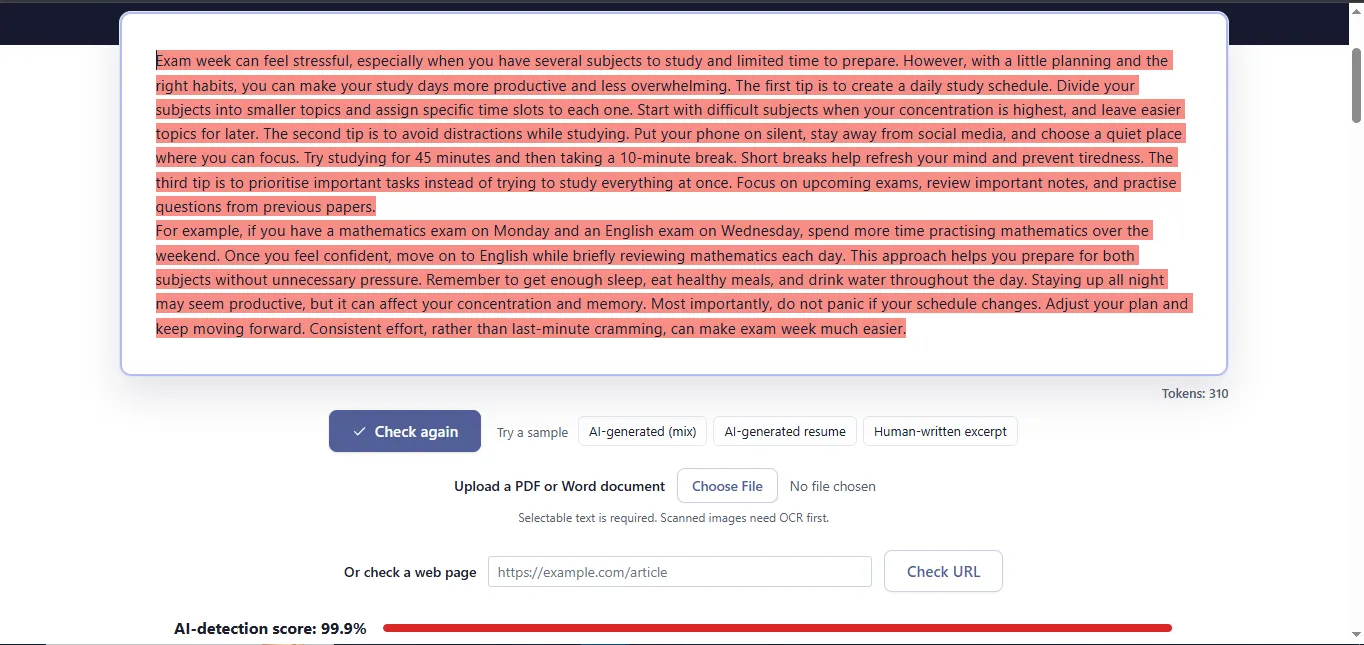
The raw AI sample scored 99.9% AI.
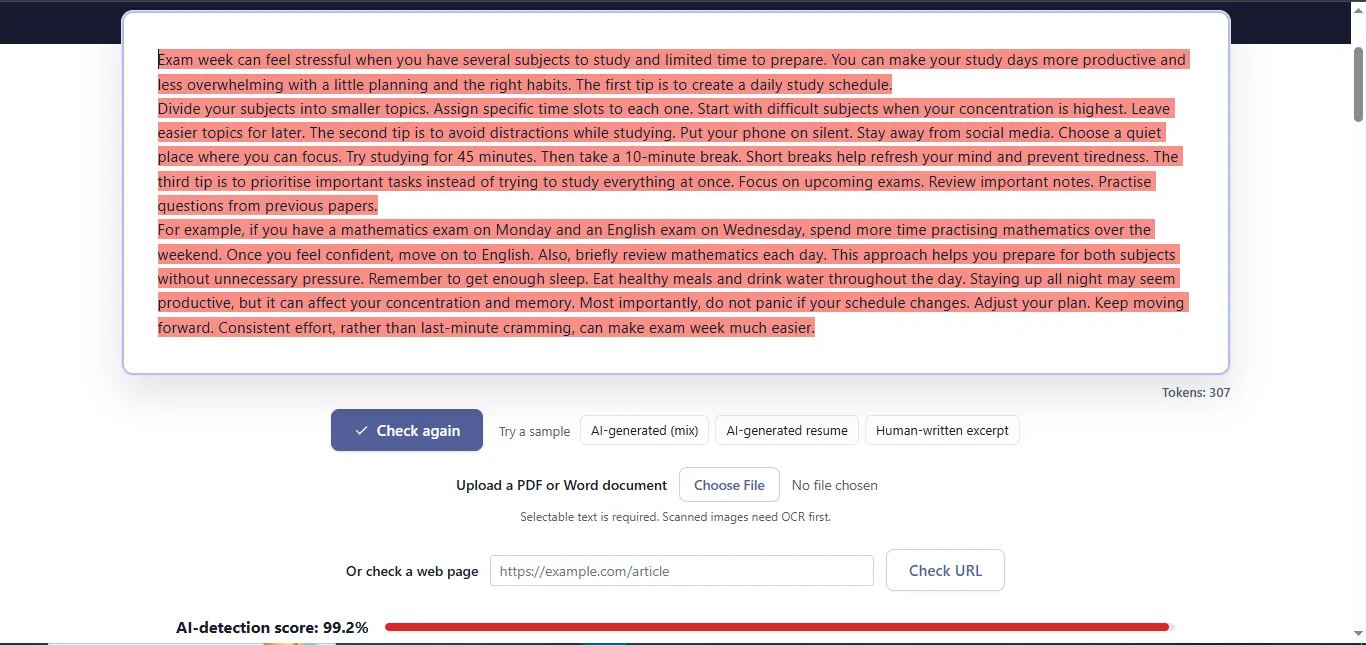
The hand-edited sample scored 99.2% AI.
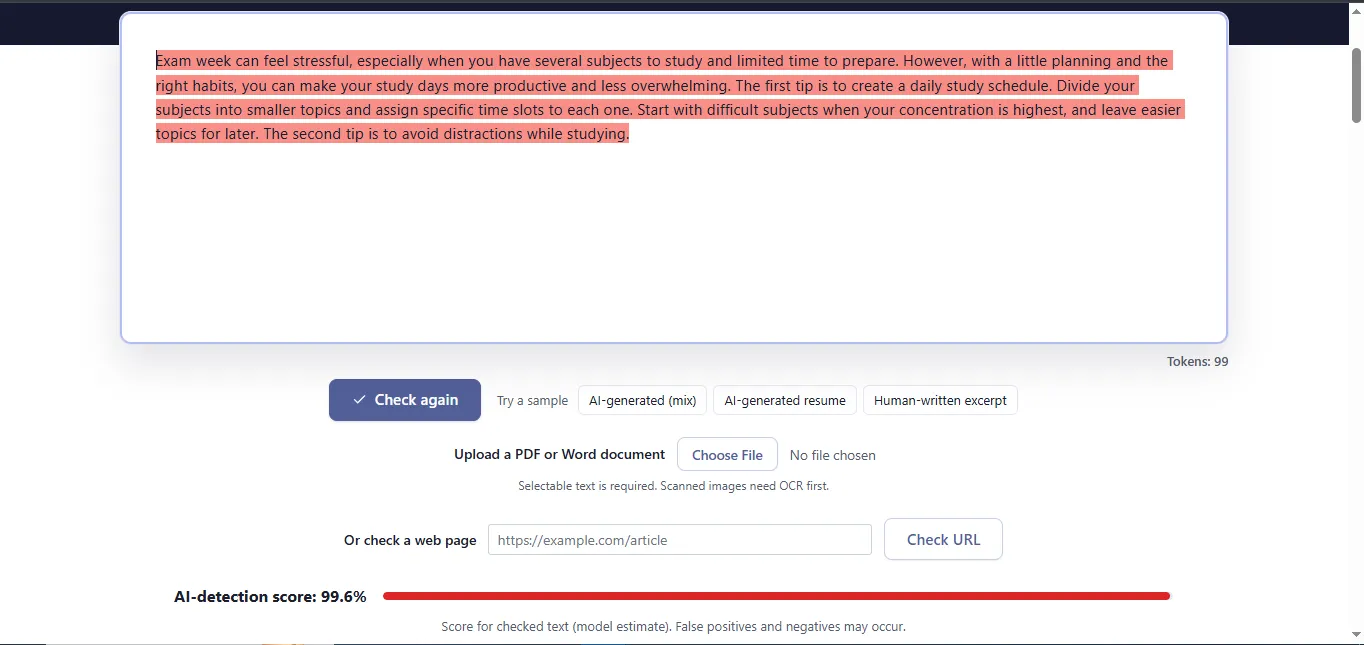
The 86-word short sample scored 99.6% AI.
7. ZeroGPT: Best for Long Free Checks Without Paying
ZeroGPT is the free GPTZero alternative to try when your text is too long for other free tiers, because it accepts 15,000 characters per check with no account (FrontDesk Review, checked November 1, 2026).
Free web limit: 15,000 characters per check with no account; it ran all four samples logged out in our test.
API: a pay-as-you-go API is listed, but no per-call rates are published. Pro costs $14.99 a month, or $8.99 a month billed yearly. (Pricing as of November 1, 2026, per FrontDesk Review)
Our test result: 100% AI on all four samples, including the human sample.
Main limitation: it labeled our human sample 100% AI, the strongest flag of any tool, so do not treat its score alone as evidence.
Sentence highlighting appears on the free tier, in yellow.
For a head-to-head on the two most confused names, see this GPTZero vs ZeroGPT guide.
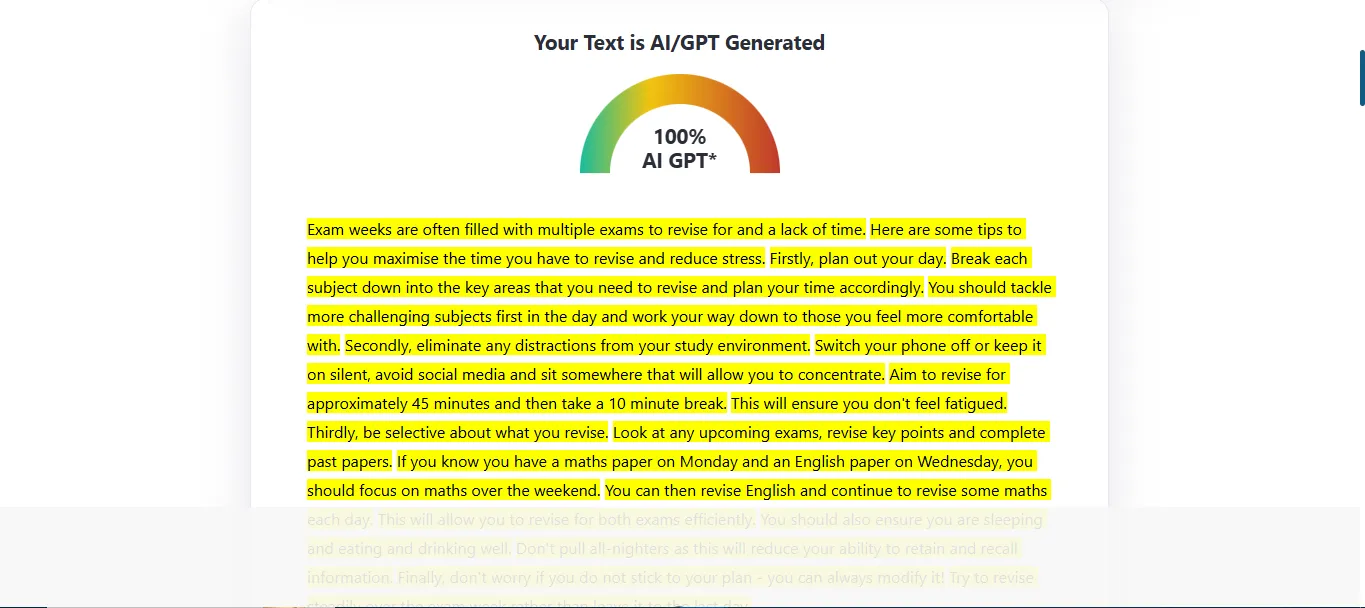
ZeroGPT labeled the human sample "Your Text is AI/GPT Generated," 100% AI GPT.
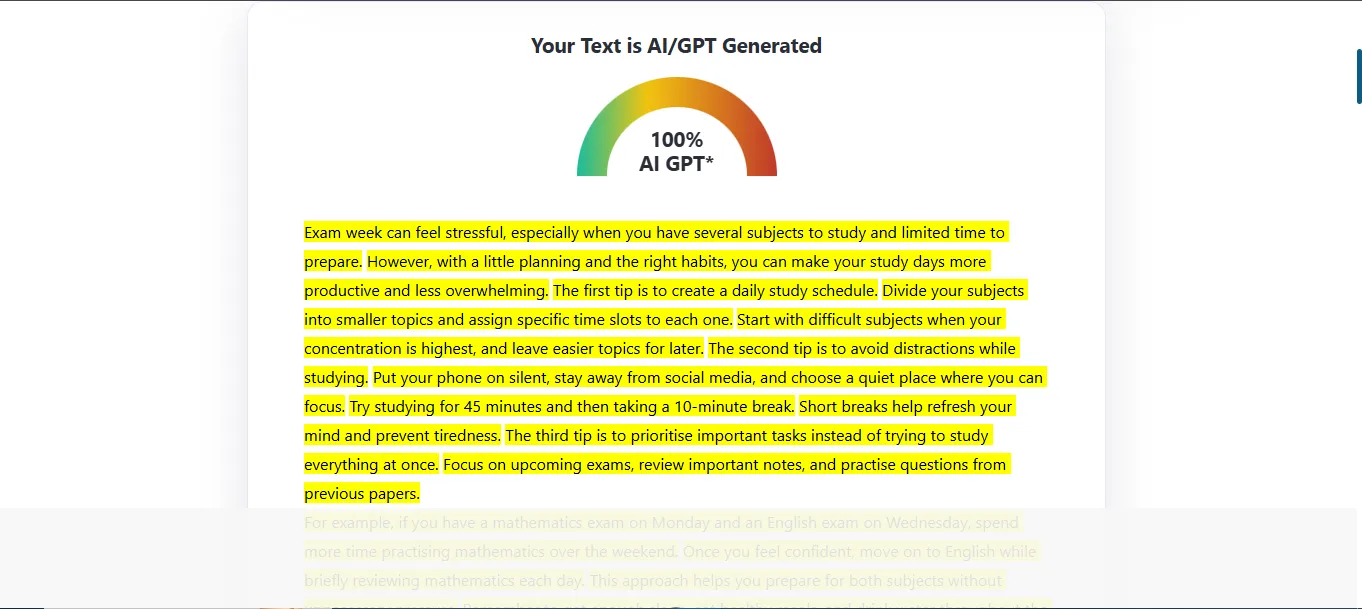
The raw AI sample scored 100% AI GPT.
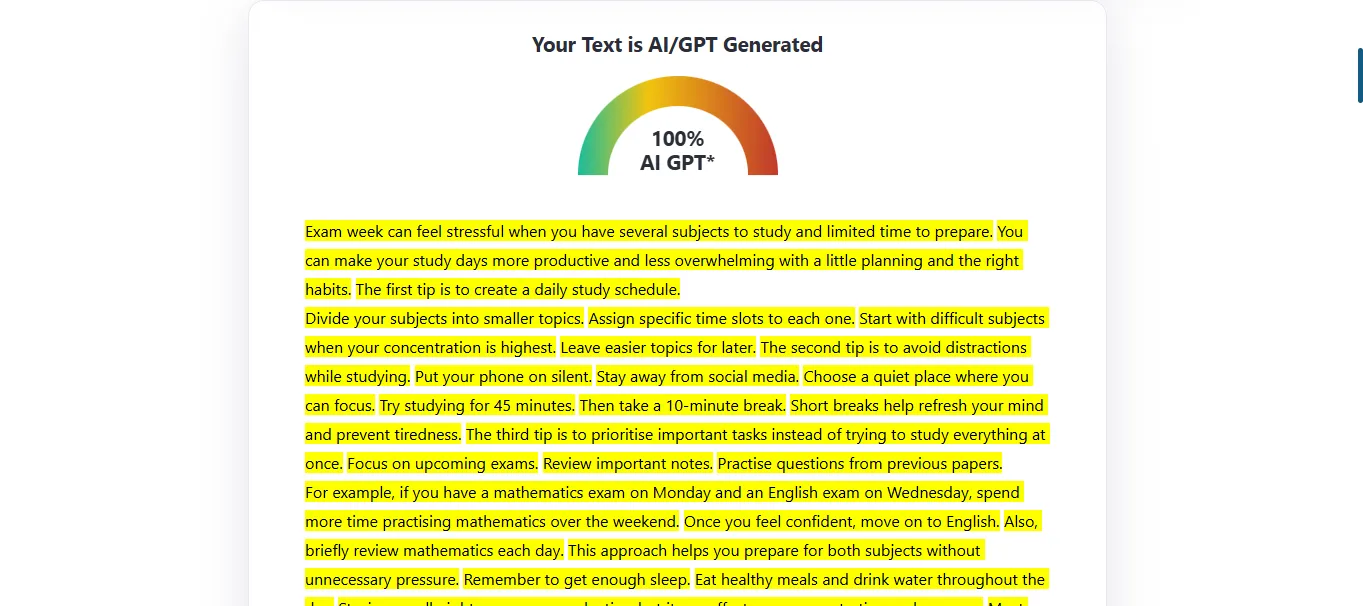
The hand-edited sample scored 100% AI GPT.
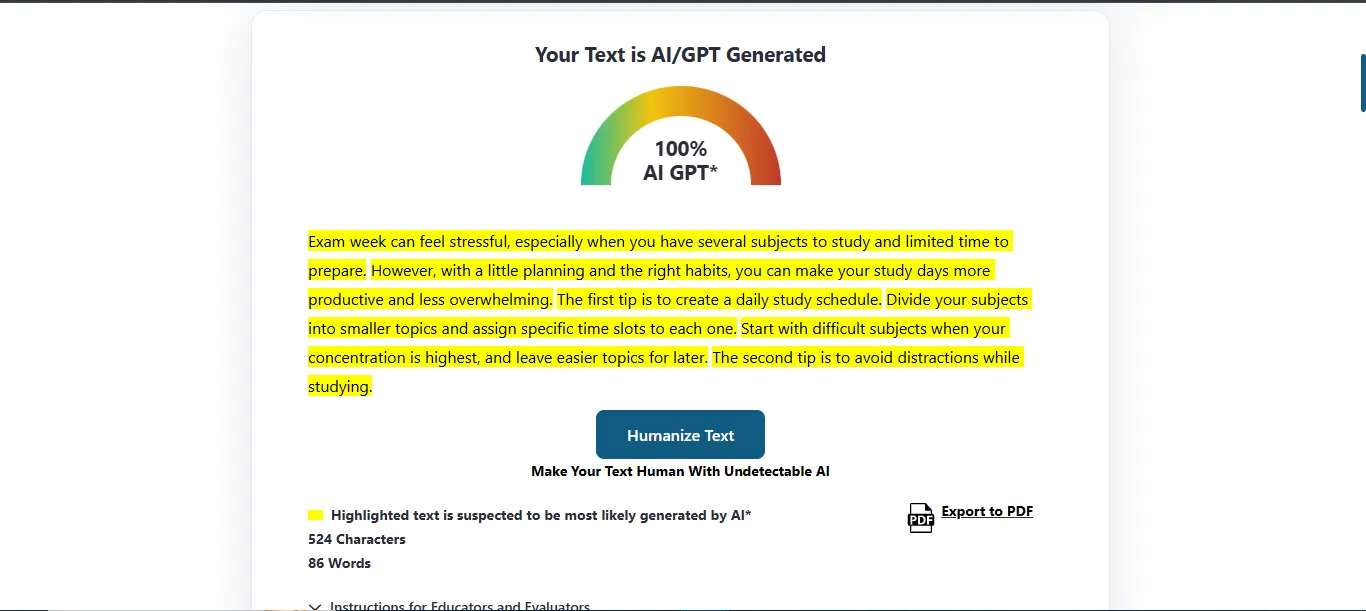
The 86-word short sample scored 100% AI GPT.
Not Ranked: Phrasly, Best for Sentence-Scored Detection by API
Phrasly makes this tool. It suits developers and content teams who want sentence-level scores returned in the response, not viewed in a browser.
Free web limit: the web AI Detector ran all four samples; the API is a separate Business product.
API: runs on Phrasly Business plan credits, with a $100 monthly minimum that includes $100 of credits (Phrasly API guide, October 2026). The detection rate is not listed, and Phrasly's pricing page sends API and enterprise buyers to sales. (pricing as of November 18, 2026)
Our test result: the API was not tested. The web AI Detector (Model 7.0), run on November 18, 2026, labeled the human sample as human with 0 of 18 sentences flagged, and rated the raw, edited, and short samples 100% AI with every sentence flagged.
Main limitation: a per-request minimum length, so short snippets will not run on the API (limits in the API section below). Phrasly's docs list no plagiarism endpoint, and there is no public per-word detection rate.
Those web results match the three cleanest tools in our test. Phrasly makes the detector. The results panel also shows predicted "third-party AI scores"; we cropped them out because they are Phrasly's estimates, not those tools' real results.
According to Phrasly Business (API docs), the Detect endpoint returns a label of AI, Might be AI or Human, AI and Human confidence percentages from 0 to 100, flagged chunks, and a 0 to 1 AI score for every sentence, so sentence-level highlighting comes through the API output only.
Phrasly says it builds its own models, trained on over a million pages of human writing and run in-house in the US, and that your data stays on its own servers with no third-party AI providers.
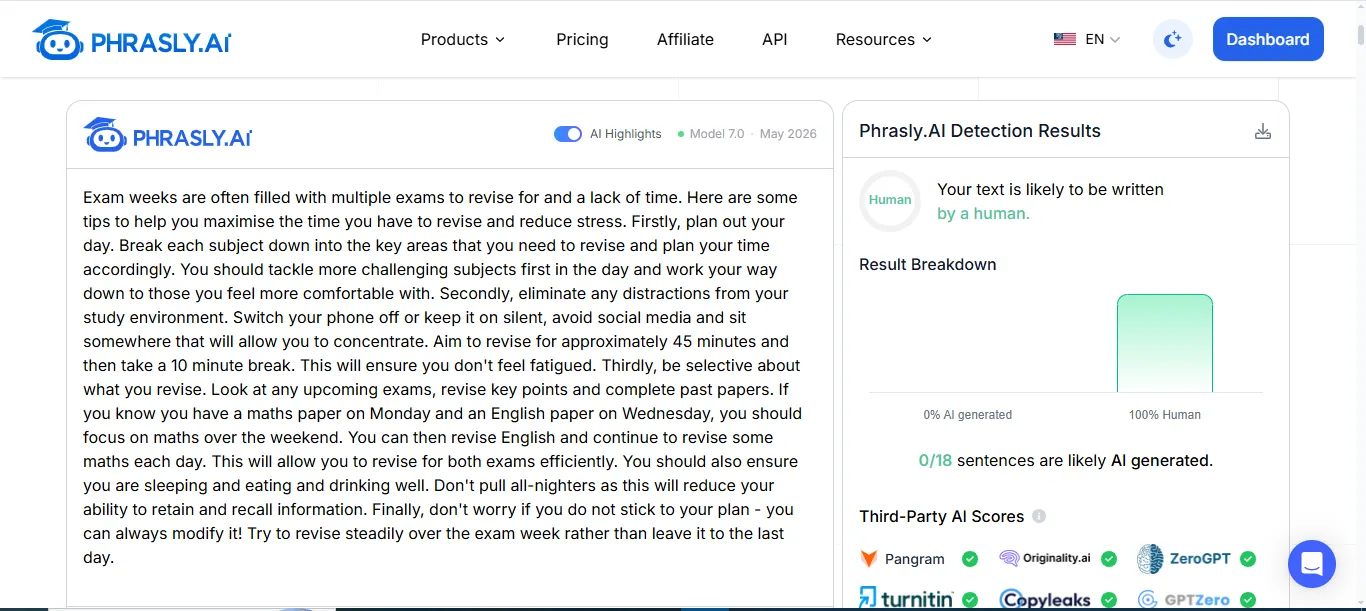
Phrasly's web AI Detector (Model 7.0) labeled the human sample human: 0 of 18 sentences likely AI. Run November 18, 2026.
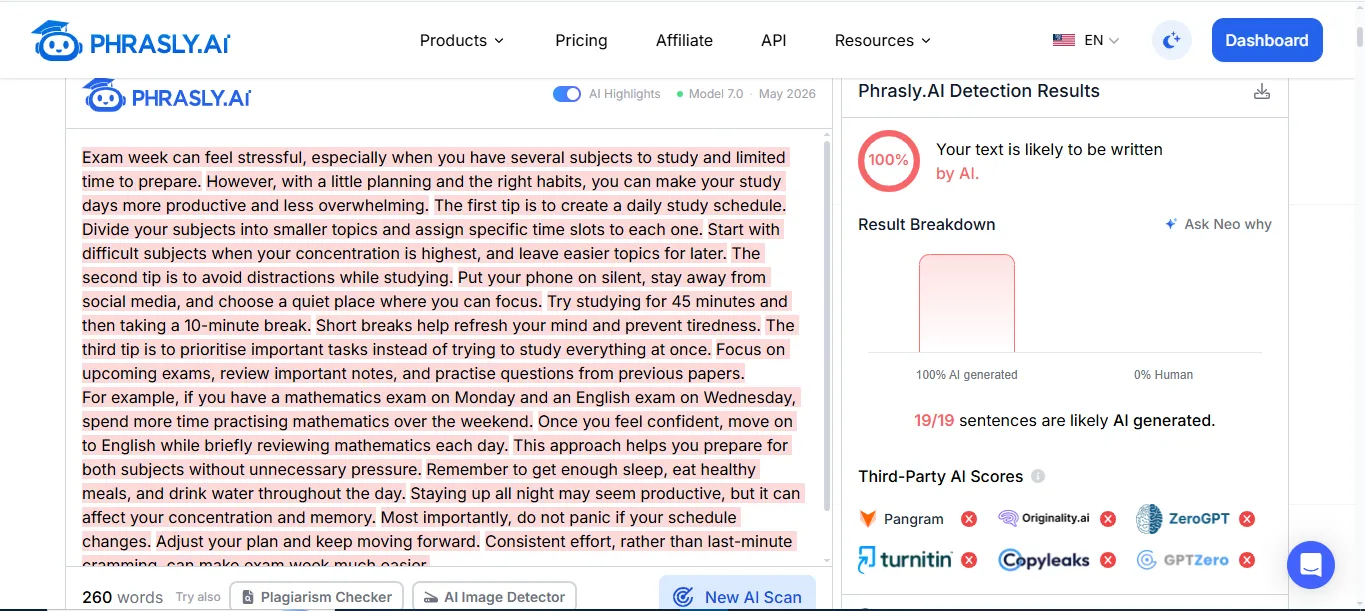
The raw AI sample scored 100% AI, with 19 of 19 sentences flagged.
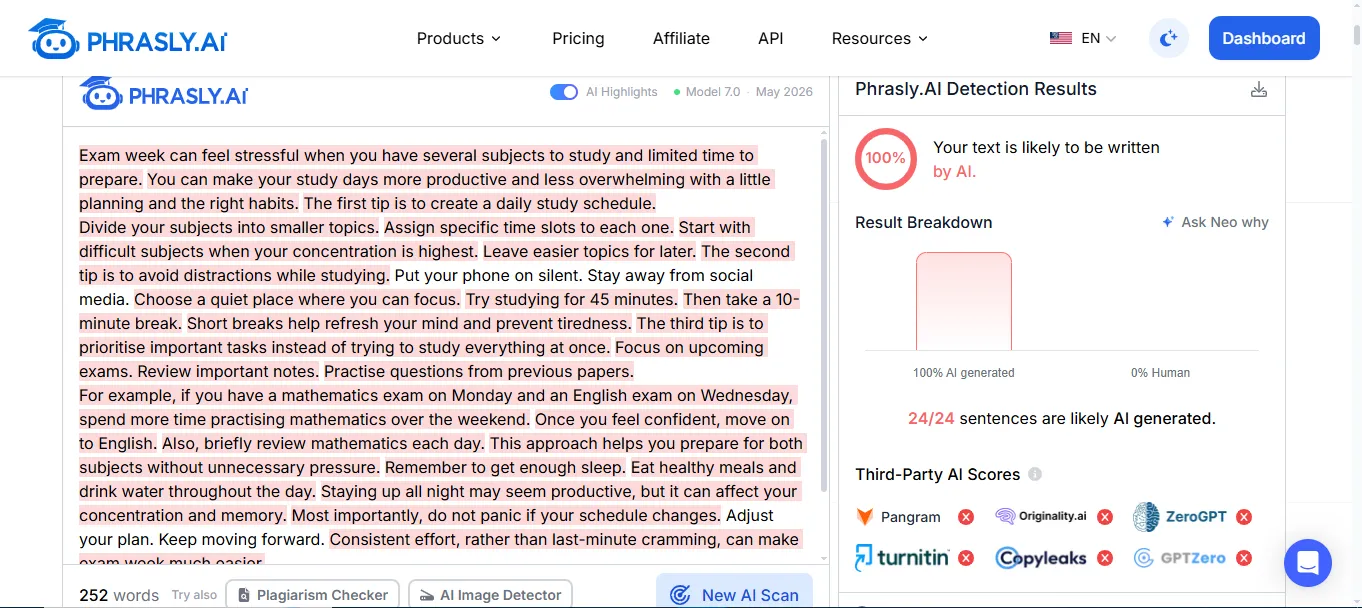
The hand-edited sample scored 100% AI, with 24 of 24 sentences flagged.
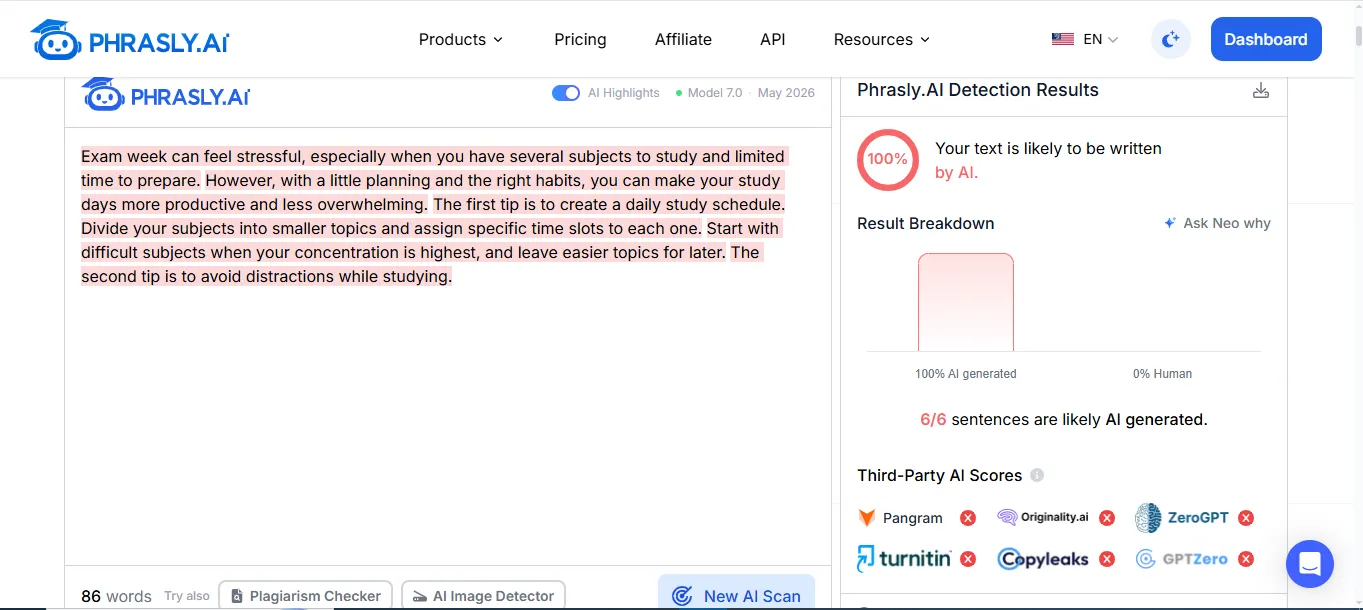
The 86-word short sample scored 100% AI, with 6 of 6 sentences flagged.
GPTZero Alternatives with an API
GPTZero already offers API access with sentence-level results (its API returns a probability for each sentence, per the GPTZero API listing), so most teams switch for the terms rather than the feature.
For plans, endpoints, keys and error codes side by side, see our GPTZero API vs Phrasly API comparison.
You look for an alternative to GPTZero when you need different access rules, pricing you can see without a sales call, bulk handling, higher request limits, or a plagiarism detection endpoint besides the AI score.
Self-serve APIs: Pangram, Winston AI, Sapling, GPTZero and ZeroGPT.
Sales or Enterprise APIs: Copyleaks and Originality.ai on its Enterprise plan; QuillBot has no public API.
Every line follows one order: access, pricing public, request limits, sentence scores, bulk, plagiarism endpoint. Fields as of November 16, 2026.
If any of these terms are new, our guide to how an AI detection API works explains requests, JSON responses and sentence-level scores.
GPTZero (baseline): keys from the dashboard; API rates not on the pricing page, which shows View Pricing and Contact Sales; free tier with limited monthly words; sentence scores yes; batch access on paid tiers; plagiarism endpoint not confirmed.
Phrasly API: access Business plan account; pricing Business plan credits, $100 monthly minimum including $100 of credits; per-word detection rate not listed; 50 words minimum and 15,000 characters’ maximum per request; sentence scores yes, 0 to 1 per sentence; bulk CSV upload of up to 100 documents; plagiarism endpoint none. Phrasly's docs also list responses under 2 seconds and English as the primary language. Vendor claims, and Phrasly publishes this blog.
Pangram: self-serve with prepaid credits; public, $0.05 per 100 words; buy $5 to $2,000 in credits; sentence highlighting in the app; bulk text API at 20% off; plagiarism endpoint not listed.
Winston AI: self-serve from the developer dashboard; rates public at 1 credit per word for AI detection; 2,000 free credits to start; sentence scores and bulk not stated in the API introduction; plagiarism endpoint yes, 2 credits per word (Winston AI API docs).
ZeroGPT: pay-as-you-go API listed; per-call rates not published; up to 150,000 characters per detection on the Max plan; sentence scores in the web tool; bulk and plagiarism endpoint not confirmed.
Sapling: self-serve trial key with no card; rates published for other endpoints, not the detector; trial caps of 50,000 characters a day and 250,000 a month, then 10 million a day by default; sentence scores yes; bulk not confirmed; no plagiarism endpoint listed.
Originality.ai: Enterprise plan; plan price public at $179 a month, API rates not listed; 1.5 million words a month on Enterprise; sentence highlighting in the app; bulk scan on paid plans; plagiarism included.
Copyleaks: sales-led; pricing not public; limits set in a custom plan; sentence highlighting in the app; LMS integration through sales; plagiarism included.
QuillBot: no public AI detection API found on its detector page.
Turnitin AI writing detection is left off this list because it is available only through an institutional or organizational subscription (Turnitin help center).
Our Turnitin API guide explains who can get a key and why individual developers cannot.
Pilot the API on your own content type before you integrate. Use product copy, essays, or support replies, and include samples you know a person wrote.
If detection is one stage of a larger publishing workflow, our guide to humanizing AI content at scale shows where a detector check fits between editing and the CMS push.
Then confirm the retention terms for submitted text and the rate limits at your expected volume. If you are weighing Pangram, ZeroGPT and GPTZero, trust whichever leaves your known human samples unflagged in your own pilot.
Pricing is accurate as of the date this article was written and is subject to change. Confirm the current price on the tool's official pricing page before purchasing.
Build Detection into Your Own Stack
Send a sample of your own content through the Phrasly API and see the response format before you commit.
How to Choose a GPTZero Alternative for Your Use?
Pick by who you are: the right tool for a developer is rarely the right one for a student.
Developer or content team: Start with a self-serve API that shows its pricing publicly and avoids flagging the human sample. Pangram fits both in our test. Sapling offers a free trial key, but it flagged our human sample at 99.7%. Compare every field in the API section above.
Student checking your own work: Pick the tool with the most generous free tier and sentence highlighting. Copyleaks scored our human sample at 0% AI, ran logged out, and highlights text. If you get flagged on your own writing, keep your drafts and version history as evidence, revise in your own words, then recheck.
For more options, see this AI checker for students guide.
Teacher: The best GPTZero alternative for teachers is often the one your school already licenses. Turnitin's AI writing detection is available only through an institutional subscription (Turnitin help center), so ask about access and LMS integration. Scores estimate likelihood rather than prove authorship (University of Minnesota). Treat any score as one signal besides a conversation with the student.
See this AI detectors for teachers guide and the GPTZero vs Turnitin breakdown in Turnitin vs GPTZero.
Writer or publisher: Choose by edited-sample behavior, favoring tools with a plagiarism check. Originality.ai and Copyleaks both include one, though Originality.ai flagged our human sample at 90%.
GPTZero alternative, no sign-up: Copyleaks, ZeroGPT, Sapling and Originality.ai ran logged out on November 16, 2026, and GPTZero allowed 3 Basic Scans before asking for a login.
Before pasting unpublished or student work into any free checker or API, read how it stores submitted text.
Pick a Detector and Check Fairly
If your GPTZero free allowance ran out, use Copyleaks as your GPTZero alternative, free of signup. For the fewest flags on human writing, pick Copyleaks, Pangram or Winston AI, which all left our human sample unflagged.
For detection inside your own pipeline, start with Pangram, the self-serve API with published rates.
A flag on someone's own writing should open a conversation.
Ready to test the Phrasly API on the content your team already publishes?
Frequently Asked Questions
Is GPTZero free?
Partly! In our November 16, 2026 test, GPTZero ran 3 Basic Scans while logged out, then asked for a login, and our free account showed 10,000 credits with no Advanced Scans left.
Its pricing page did not list plan prices when we checked, so compare tools by cost per 1,000 words, not headline plan price.
Is there a better free alternative to GPTZero?
Not always! In our same-text test, Copyleaks was the free tool that scored the human sample 0% AI and caught every AI sample, logged out, while Pangram did the same on a free account with 20 free credits a day.
Judge "better" by how rarely a tool flags human writing first.
Is GPTZero accurate?
Not always! GPTZero labeled our human sample as human and caught every AI sample, but a 2026 Notre Dame study found it flagged 8.9% of recent human abstracts, while a 2025 Chicago Booth paper put its false positives below 1%.
Formal or non-native English writing can be wrongly flagged.
Is Turnitin's AI detector more accurate than GPTZero?
Not proven! Turnitin's AI detection is available only through institutional subscriptions, not individual credits (Turnitin help center), so most teachers, students, and writers cannot test it themselves.
A fair verdict needs the same text run through both. As an individual, test detectors you can access on writing you know is human.
Can GPTZero detect paraphrased AI text?
Not always! In our test, GPTZero still scored our hand-edited AI sample 100% AI, but those edits were light, mostly split sentences. Heavier paraphrasing is harder for detectors to flag.
Phrasly's API docs say its Detect endpoint scores every sentence from 0 to 1, which shows whether a flag rests on a few sentences.

Written by
Muhammad Usman Ali
Pakistan
Muhammad Usman Ali is an experienced SEO content writer with 3+ years of professional writing experience. He specializes in AI tools, AI detection technologies, and search engine optimized content.