Solvely AI Humanizer Review (2026): Tested on a Real Essay Draft
21 min read
The Solvely AI humanizer is a Solvely study app feature that rewrites ChatGPT, Claude or Gemini text to sound more human, with paid plans from $1.99 for the first week, then $8.99 a week, or $67.99 a year (checked November 12, 2026).
We ran one ChatGPT-drafted essay (584 words, 5 APA in-text citations, 5 references) through Solvely’s free and paid humanizer and four AI detectors.
Free use showed no readable output. In paid runs, meaning held in 6 of 12 paragraphs, Academic style kept 2 of 5 citations, each output needed 2.4 to 2.5 fixes per 100 words, and GPTZero’s best result was 60% human.
Copyleaks and Originality.ai still scored both outputs, mostly AI. This Solvely humanizer review helps you decide whether to pay for Pro or switch tools.
Want to test your own text? Phrasly AI Humanizer lets you try up to 500 words below without signing up, so check every citation it returns.
Solvely AI Humanizer Claims vs What Our Essay Test Found
We checked six claims Solvely makes about its humanizer on the web version at solvely.ai, and gave each one a plain verdict. Each claim below shows Solvely’s own wording, what happened to the same essay, and one label.
We did not edit any output, so you can check every result against the source essay linked below. Where Solvely showed its own scores or badges, we report them as Solvely’s claims, not as detector results.
Input: one ChatGPT essay on whether universities should allow AI tools for assignments, with 584 words of body text, 5 APA 7 in-text citations, one direct quote with a page number, two technical terms and a 5-entry reference list. Read the prompt, essay and all outputs.
Settings tested: free runs used tone Academic and strength Balanced. Paid runs used the default Style “Original”, then Style “Academic”. Natural, Simple, Informal, Light and Strong were not tested.
Access: logged out, a free Google account, then the $1.99 one-week plan bought from the humanizer paywall.
Detectors: GPTZero (Model 5.0b, free account), Copyleaks (free web tool), Originality.ai (model 5.0, free credits) and Solvely’s built-in AI detector. Turnitin was not tested, because we had no legitimate institutional access.
Setup: November 12, 2026 (Copyleaks and Originality.ai on November 13), Windows laptop, Google Chrome. Run 1 was logged out, runs 2 and 3 used a free account, and runs 4 and 5 used the paid plan. Each text was humanized once and scanned once.
Readability: Flesch Reading Ease score, plus a count of every fix we had to make (see 1d).
📊 How We Labeled Each Claim: Every claim gets one label: Holds up, Partly holds up, Does not hold up, or Not tested. Each label sits under a number from our own run.
Claim | Solvely's wording on solvely.ai | Our result | Verdict |
|---|---|---|---|
1a. Free, about 500 words a day | “Humanize AI text for free - up to 500 words per day with no account needed” (humanizer page) | No readable output at 844, 329 or 101 words, logged out or signed in | Does not hold up |
1b. Academic Mode keeps citations intact | “It preserves your citations, technical terminology, and argument structure” (humanizer page, Academic Mode section) | Citations kept 2 of 5 in Academic style, 4 of 5 in Original style | Does not hold up |
1c. Your meaning stays the same | "while keeping your original meaning" (humanizer page subtitle) | Meaning kept in 6 of 12 paragraphs in both styles | Partly holds up |
1d. Reads like a human wrote it | "Rewrite naturally, not just synonym swaps" (sign-up panel) | Readable, but 29 to 31% longer, with mixed spelling and repeated content | Partly holds up |
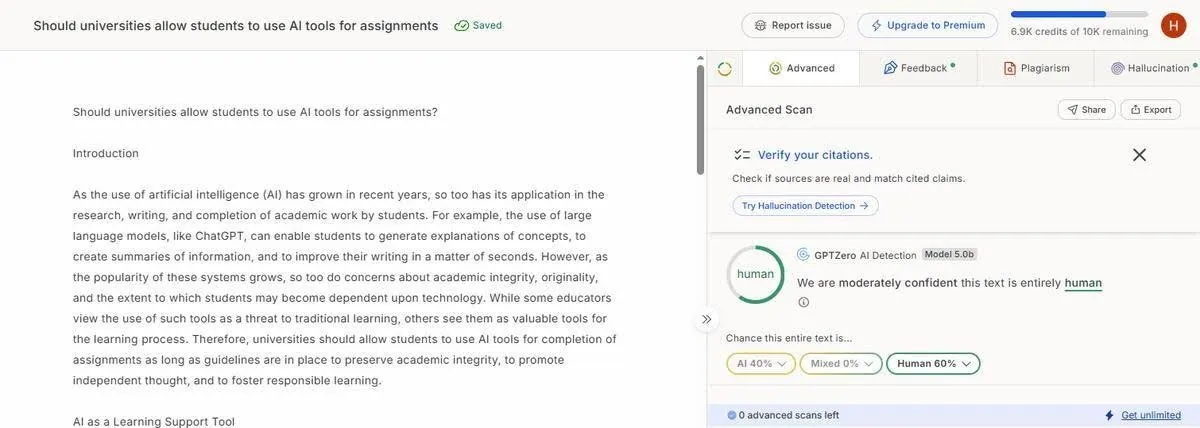
1e. Passes GPTZero and other detectors | "100% undetectable now" (paywall) | GPTZero: Original 100% AI, Academic 60% human; Copyleaks 100% AI and Originality.ai 92 to 93% AI on both | Does not hold up |
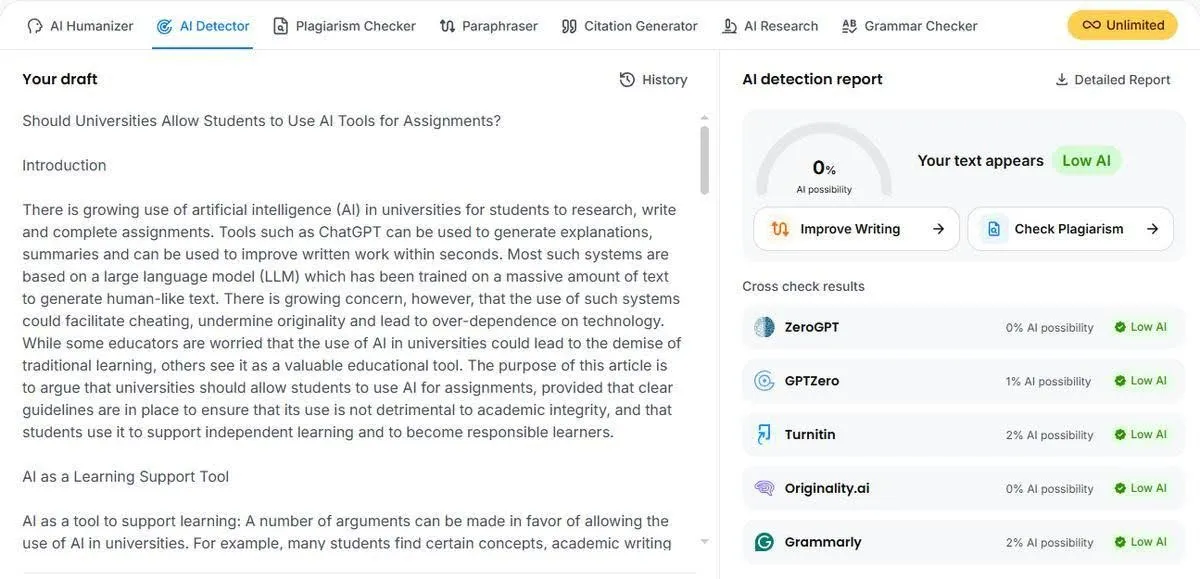
1f. Built-in detector shows when text is safe | "Double-checked by multiple models" (result screen) | Right on raw AI and human text; 0% AI on its own output that GPTZero and Copyleaks scored 100% AI and Originality.ai 93% AI | Partly holds up |
1a. Claim 1: 'Free, About 500 Words a Day'
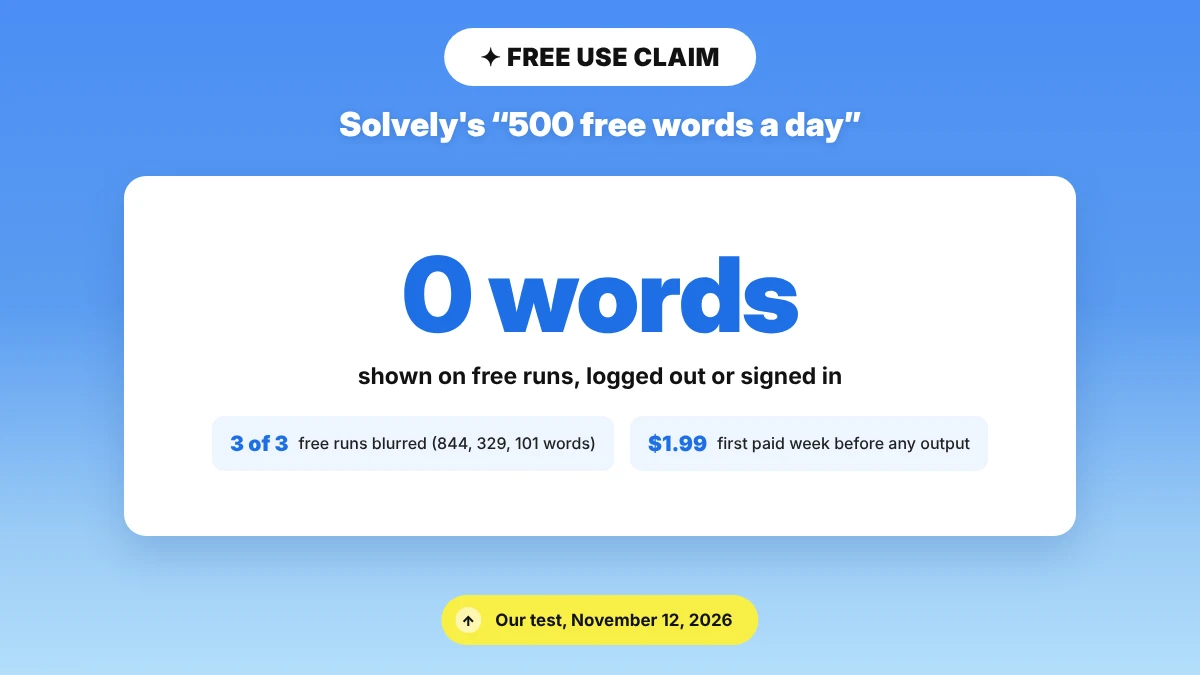
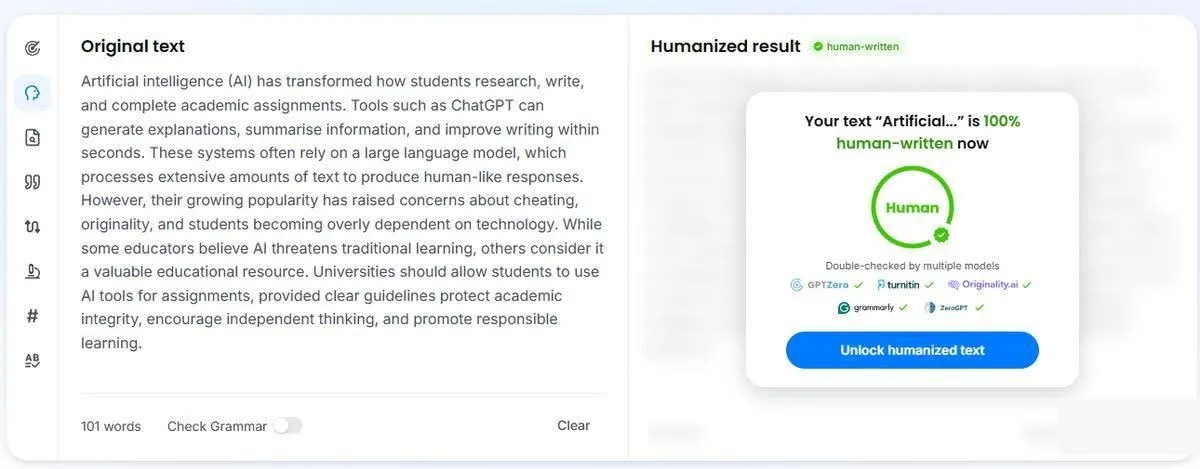
Solvely’s humanizer page says you can “Humanize AI text for free - up to 500 words per day with no account needed”, with “no catches”. So, is Solvely AI free? On November 12, 2026, the humanizer ran for free, but it never showed us the result.
Works Without an Account / Full Output Shown: It runs, then blurs the output under a “100% human-written” badge and asks you to sign up.
Word Limit per Request: None shown before or after the run.
Academic Locked on Free: No lock on the Academic tone, but the output itself was locked.
Daily Reset: Not observable, because no words were ever released.
The same happened at 844, 329 and 101 words, logged out and on a free Google account, so Solvely AI free use never covered even one paragraph. Every route ended at a plan picker before a single word was shown.
Verdict: Does Not Hold Up (web version, on our test date).
Who This Matters For: Anyone hoping to humanize a short discussion post without paying.
1b. Claim 2: 'Academic Mode Keeps Citations Intact'
Solvely’s humanizer page says Academic Mode “preserves your citations, technical terminology, and argument structure.” So, will humanizing your paper with Solvely mess up your citations and reference list? In our run, the Academic style did, and the default Original style did better.
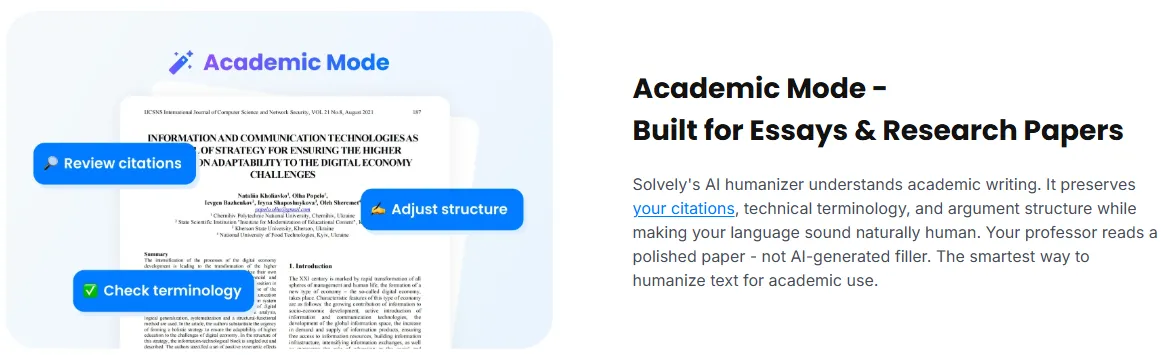
Alt text: solvely ai humanizer academic mode claim to preserve citations and argument structure
Caption: Solvely’s humanizer page says Academic Mode preserves citations, terminology and argument structure. Captured November 13, 2026.
In-Text Citations Kept: 2 of 5 in Academic style, against 4 of 5 in Original. Kasneci et al. (2023) and Cotton et al. (2024) kept their names and years in both. Dwivedi was dropped in both, and Tlili and Miao and Holmes only in Academic.
Direct Quote Kept Verbatim: Yes in Original. No in Academic, which removed the quote marks (see the example below), and many schools treat that as a plagiarism issue.
Technical Terms: Both kept in both styles.
Reference List Preservation: All 5 untouched in Original. In Academic, 3 were untouched, 2 lost their APA citation formatting and none were dropped, but Dwivedi lost its year.
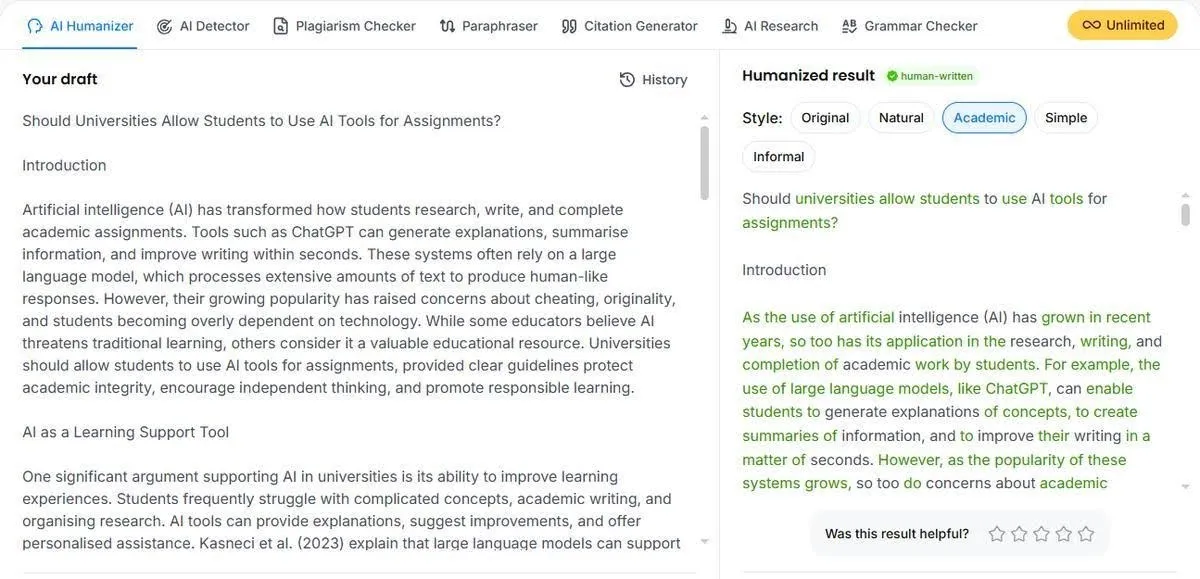
Before: Cotton et al. (2024) identify several educational benefits, including “increased student engagement, collaboration, and accessibility” (p. 228).
After (Academic style): Cotton et al. (2024) identify several benefits of using AI for education, such as increased student engagement, collaboration, and accessibility (p. 228).
Our guide to the AI humanizer for academic writing covers how to protect citations before you submit.
Verdict: Does Not Hold Up.
Who This Matters For: Anyone submitting an APA or MLA paper with a reference list.
1c. Claim 3: 'Your Meaning Stays the Same'
Solvely promises to keep “your original meaning”, and its Academic Mode adds “argument structure”. To check for meaning drift, we labeled each of the essay’s 12 body paragraphs after the Solvely humanizer rewrote it: kept, softened (a detail lost), changed (a point added, removed or made stronger) or lost.
Original Style (Default): 6 kept, 2 softened, 4 changed, 0 lost.
Academic Style: 6 kept, 2 softened, 4 changed, 0 lost, but in different paragraphs.
Dropped Qualifiers: One in each style. Both turned “might submit AI-generated assignments” into a certainty: “will not be learning anything” (Original) and “will lead to more cheating” (Academic).
Flipped Claims: None.
The worst drift was in Original style, which dropped the essay’s key rule and repeated the next paragraph in its place.
Original: Students should be permitted to use AI for brainstorming, proofreading, and understanding concepts but should not submit entirely AI-written assignments as original work.
Original style: To help universities to balance the use of innovative technologies with the need to ensure academic honesty, a human-centred approach to the use of AI in education is required.
Verdict: Partly holds up.
Who this matters for: anyone whose grade depends on the argument, not just the wording.
1d. Claim 4: 'It Reads Like a Human Wrote It'
Is the Solvely AI humanizer good at sounding human? Partly: it made the ChatGPT draft easier to read, but neither output was ready to submit, and both ran about 30% longer. For this Solvely AI humanizer review, we counted every edit each output needed, leaving citations to Claim 2.
Meaning Drift: 6 in Original, 6 in Academic, such as “might submit” becoming “will not be learning anything”.
Wrong Register: 4 and 3, such as “look up words they don’t know” in an academic essay.
Awkward Synonyms: 1 and 2, such as “the demise of traditional learning”.
Broken Transitions: 2 and 4, such as “In summary,” opening a new point.
Grammar or Punctuation: 3 and 2, such as mixing US “favor” with UK “whilst”.
Repeated Phrasing: 4 and 4, such as “can be used” twice in one sentence.
Mode | Total fixes | Fixes per 100 words | Readability score |
|---|---|---|---|
Original (default) | 20 | 2.4 | 40.8 |
Academic | 21 | 2.5 | 39.1 |
Raw ChatGPT draft (baseline) | Not applicable | Not applicable | 6.9 |
Readability uses the Flesch Reading Ease score (0 to 100, higher is easier to read), counted on essay paragraphs only.
Before: One significant argument supporting AI in universities is its ability to improve learning experiences. Students frequently struggle with complicated concepts, academic writing, and organising research.
After (Original style): AI as a tool to support learning: A number of arguments can be made in favor of allowing the use of AI in universities. For example, many students find certain concepts, academic writing and organization of research difficult.
Detectors look at perplexity and burstiness, meaning how predictable the words are and how much sentence length varies, which is why humanizers mix short and long sentences.
Verdict: Partly Holds Up. The original style needed the fewest fixes (20), one fewer than Academic.
Who This Matters For: Anyone with a strict word count.
1e. Claim 5: 'Passes GPTZero and Other Detectors'
Text | GPTZero | Originality.ai | Copyleaks | Turnitin |
|---|---|---|---|---|
Raw ChatGPT essay (before Solvely) | 0% human (AI 100%) | 4% original (96% AI) | 0% human (100% AI) | Not tested: no legitimate access |
Solvely humanized, Original style | 0% human (AI 100%) | 7% original (93% AI) | 0% human (100% AI) | Not tested: no legitimate access |
Solvely humanized, Academic style | 60% human (AI 40%) | 8% original (92% AI) | 0% human (100% AI) | Not tested: no legitimate access |
One re-humanize run | Not tested | Not tested | Not tested | Not tested |
Scans run Nov 12 to 13, 2026, on the same 849-word ChatGPT essay. We scanned one Solvely output per style and did not regenerate them.
Solvely called our text “100% undetectable now” before we paid, and labeled both outputs “human-written” after. So we checked the two questions students ask most.
Does the Solvely AI humanizer get an essay past GPTZero and other detectors? Not in our test.
All three detectors still flagged both outputs as mostly AI, close to the raw draft, which fits the wider question of do AI humanizers actually work.
Does the Solvely AI humanizer get an essay past Turnitin? We could not test Turnitin AI writing detection, because we had no legitimate access.
📌 A Trustpilot reviewer says re-humanizing gets Solvely to “95% human easily” on GPTZero. A Nov 7, 2026 review by Jozef Gherman, CEO of competitor StealthGPT, says GPTZero 5.0b still scored a Solvely output 100% AI. Our run matched the second report.
So, can AI humanizers really bypass AI detectors, and is there an AI humanizer that actually works every time? Detector results vary by tool and over time, and no AI detection score is a guarantee.
GPTZero Result
The best GPTZero score was 60% human for Academic style, and the worst was 0% human for Original style, the same as the raw draft. We did not run the re-humanize button, so we cannot say whether it changes the score.
Academic’s better score also came with 3 dropped citations (see 1b), and the gap between tools shows why AI detectors give different results.
Originality.ai and Copyleaks Results
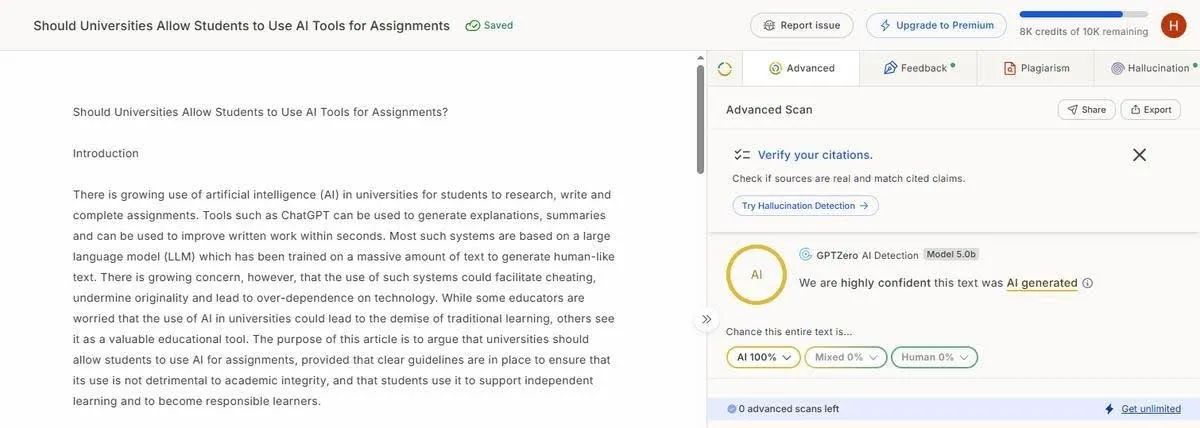
The humanized AI Solvely flow moved Originality.ai by only 3 to 4 points and did not move Copyleaks at all. The biggest gap between tools was the Academic output: 60% human on GPTZero but 100% AI on Copyleaks.
Turnitin Result
Not tested: no legitimate access. The Turnitin figures inside Solvely’s app are Solvely’s own estimates, so they do not answer the Solvely AI humanizer Turnitin question. See the Turnitin section below.
Verdict: Does not hold up. Solvely said our text was “100% undetectable”, but real GPTZero, Originality.ai and Copyleaks all still flagged both outputs as mostly AI.
Who this matters for: Anyone told a humanizer guarantees a detector result.
1f. Claim 6: 'Solvely's AI Detector Shows When Text Is Safe'
Text | Solvely detector | GPTZero |
|---|---|---|
Raw ChatGPT draft | 93.3% AI | 100% AI |
Best Solvely humanized output (Original style) | 0% AI | 100% AI |
200-word paragraph typed from scratch (our 181-word human sample, typos kept) | 0% AI | Not tested |
Solvely detector scans run Nov 12, 2026 on Solvely Pro. GPTZero scans used Model 5.0b.
Solvely’s detector page says it “analyzes your text against ZeroGPT, Turnitin, and GPTZero at the same time.” In our runs, the Solvely AI detector pointed the right way on raw ChatGPT text and human writing.
The miss was its own output: 0% AI, with “GPTZero 1%” shown beside it, while real GPTZero scored the same text 100% AI. MPG ONE reports that Solvely confirmed these cross-check figures are its own estimates.
Trustpilot reviews report the opposite problem: Solvely’s detector rating its own humanized text as more AI than raw ChatGPT, and typed-from-scratch writing scoring about 70% AI, which one reviewer reads as bait to sell Pro. Our run matched neither, with no false positives on our human sample.
No third-party checker reproduces a Turnitin score, including the Turnitin figure Solvely shows, so treat free AI checkers for students as a rough signal only.
Verdict: Partly Holds Up. It read raw AI and human text correctly, but called its own output safe when real GPTZero scored it 100% AI.
Who This Matters For: Anyone using one tool to both humanize and check their own text.
How Much Does Solvely AI Cost?
Solvely AI has a free Starter plan, and the Pro plan costs $12.99 a month or $67.99 a year on the web (checked November 12 to 13, 2026). The weekly plan starts at $3.99, or $1.99 from the humanizer offer, then renews at $8.99 a week.
Solvely shows $0.57, $0.43 and $0.18 a day for weekly, monthly and yearly, but $0.57 matches only the $3.99 first week. After renewal, $8.99 a week is about $1.28 a day.
Web prices showed in US dollars in our test, and App Store prices are set by country.
2a. Solvely Starter: What the Free Plan Includes
Solvely AI free use is limited. The Starter plan lists “2 solves” for the homework solver, with no reset period shown, and our free humanizer runs released no words (see 1a).
Solvely’s detector page advertises “Unlimited Free AI Detection, No Sign-Up Required”, which we did not test. No card was needed for the free account, but the paid first week needed one.
2b. Solvely Pro Plans: Weekly, Monthly and Yearly Prices
Plan | Web price | App Store price | Effective cost per year |
|---|---|---|---|
Weekly | $3.99 first week ($1.99 from the humanizer offer), then $8.99 | $6.99 | Web about $462; App Store $363.48 (52 x $6.99) |
Monthly | $12.99 | $12.99 | $155.88 on both |
6 months | Not offered on the web | $38.99 | App Store $77.98 |
Yearly | $67.99 | $46.99 | Web $67.99; App Store $46.99 |
Weekly billing adds up to about $462 a year ($3.99 plus 51 weeks at $8.99), against $155.88 for 12 monthly payments and $67.99 yearly, which matches Solvely’s “Save 56%” label.
A Solvely AI subscription includes up to 6,000 words per humanizer run, unlimited humanizations, document uploads, the AI detector and Solvely’s study tools.
⚠️ Prices and plans were checked on November 12, 2026 and change often. Check Solvely's pricing page before you pay.
2c. Cancel Your Solvely Subscription Before the Trial Renews
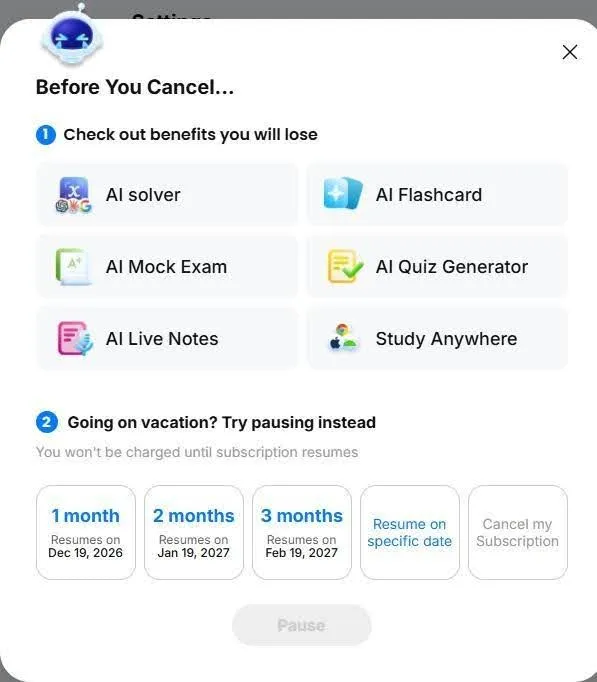
The $3.99 first week renews at $8.99 a week unless you cancel. Here is how to cancel a Solvely AI subscription, wherever you paid:
Web: Click your name (bottom left) to open Settings, click Manage, choose “Cancel my Subscription” (a grey tile next to the pause offers), add feedback, then click Next.
iPhone or iPad: Settings, your name, Subscriptions, Solvely, Cancel Subscription.
Android: Google Play, profile, Payments and subscriptions, Subscriptions, Solvely, Cancel.
We tested the web path on November 12. It took three screens, offered a pause twice, and kept access until the paid week ended.
Refunds depend on where you paid. Solvely’s Terms call fees “non-refundable, including after cancellation”, yet checkout listed a “Money-Back Guarantee”, and our refund email got only a promise to look into it by November 13. App Store and Google Play refunds go through Apple or Google.
Screenshot your cancellation and renewal date. The billing complaints in the legit check below show why.
What Solvely Is: Study App, Chrome Extension, Detector and Writing Tools
Solvely is a student study app, mainly a homework solver, and the AI humanizer Solvely sells is one feature inside it. The app is run by Aignite Inc., and its humanizer page says it is “Trusted by 24M+ users” (a company claim).
Solvely AI Extension: A Chrome browser extension for screenshot solving, free to install, with 100,000 users.
Solvely AI Detector: Scores text and shows cross-check figures; included in Pro, with free use advertised but not tested (see 1f).
Paraphrasing Tool: Rewrites text without aiming at detector scores; included in Pro. Here is how a humanizer differs from a paraphrasing tool.
Plagiarism Checker: Checks text for copied passages; included in Pro.
Citation Generator: Builds references; included in Pro.
Solvely’s “Up to 95% accurate” claim on its pricing page describes homework answers, not the humanizer or the detector.
Solvely Legit Check: Ratings, Billing Complaints and Honor Code
Is Solvely legit? It is a real company with a working product and not a scam, but billing is the weak spot.
💡 On November 12, 2026, the Chrome Web Store listing showed 100,000 users and a 4.5 rating from 205 ratings. Trustpilot showed a 3.8 TrustScore from 53 reviews, with 66% five-star and 30% one-star.
The one-star reviews mostly describe trouble finding the cancel option and unanswered support emails, though Solvely has replied to 92% of negative reviews. Fifty-three reviews is a small sample, so read them as a pattern, not proof.
The Solvely Honor Code bans “using AI outputs to impersonate your own original work on assessments”, which covers submitting humanized text and matches your school’s academic integrity policy.
📍 Solvely’s privacy policy lets it use your data “to train, fine-tune, or improve AI models” where consent and the law allow, and says inputs and outputs may be “posted publicly”, without your name. It sets no time limit for keeping pasted text, so keep unpublished theses and graded essays out of any tool until you have read its policy.
Real Company and Contact: Yes (Aignite Inc., [email protected]).
Clear Refund Policy: No (see 2c).
Honest Free-Tier Wording: No (see 1a).
Easy Cancellation Path: Partly (see 2c).
Turnitin, GPTZero and Your Professor: What a Humanizer Cannot Fix
Yes, a professor can often tell, and not mainly because of a detector score. Turnitin, GPTZero and Solvely’s built-in checker each give a probability, not proof, and our Claim 5 and Claim 6 results show how far apart they can be. That is why the Solvely AI humanizer and Turnitin question is only part of the risk.
Turnitin AI writing detection added AI bypasser detection in August 2025, and Turnitin says it will “flag if a student has likely used an AI bypasser to ‘humanize’ their AI-generated content.”
It also checks for AI paraphrasing tools, works in English only with the Turnitin Originality add-on, and has no published detection rate.
For the wider picture, read Does Turnitin Detect ChatGPT?
Professors also notice human signals that no humanizer changes:
A sudden voice shift from your earlier essays or in-class writing
No drafts, outlines or version history in Google Docs or Word
Citation errors, such as wrong page numbers, sources that do not support the sentence, or references you never opened
Claims you cannot explain or defend in a short conversation
Your school’s academic integrity policy matters more than any score. Some policies and honor codes treat humanizer use itself as misconduct, even when the ideas are your own. Check your course syllabus and your university’s policy page before using any humanizer, Solvely included.
Solvely Humanizer vs Undetectable AI, QuillBot and Other Alternatives
The better alternative depends on whether you need a standalone humanizer, citation handling or a large free allowance. Solvely’s humanizer sits inside a homework-help app, while most rivals are standalone writing tools.
If you are asking what is the best humanizer AI free option for a short paragraph, compare the free allowance column first. Then compare citation handling, because that is where Solvely lost the most in our test.
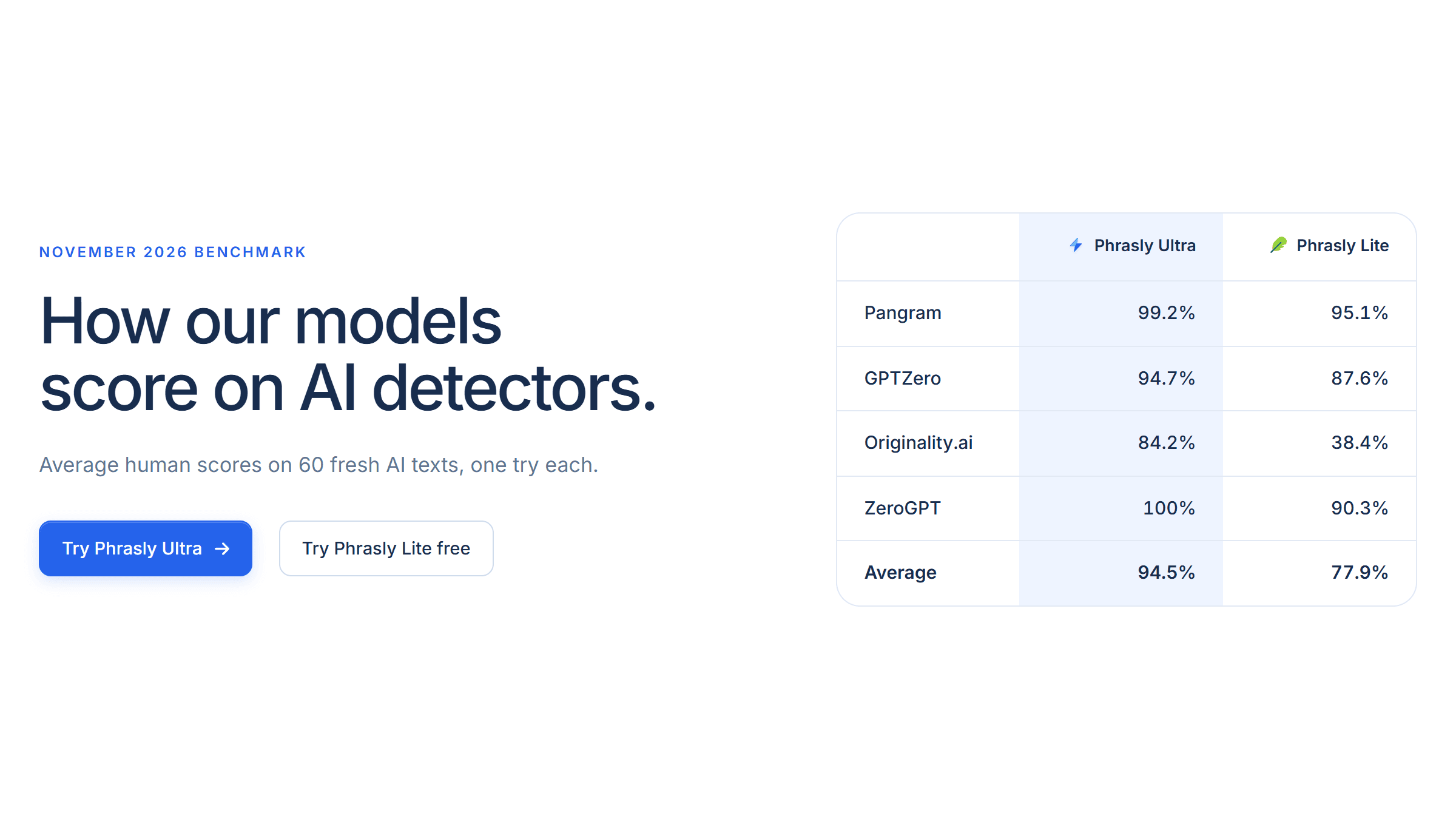
We also ran a 117-word extract through Phrasly AI Humanizer, which we make, on two models, as a side check only; we did not score it with the 1d rubric.
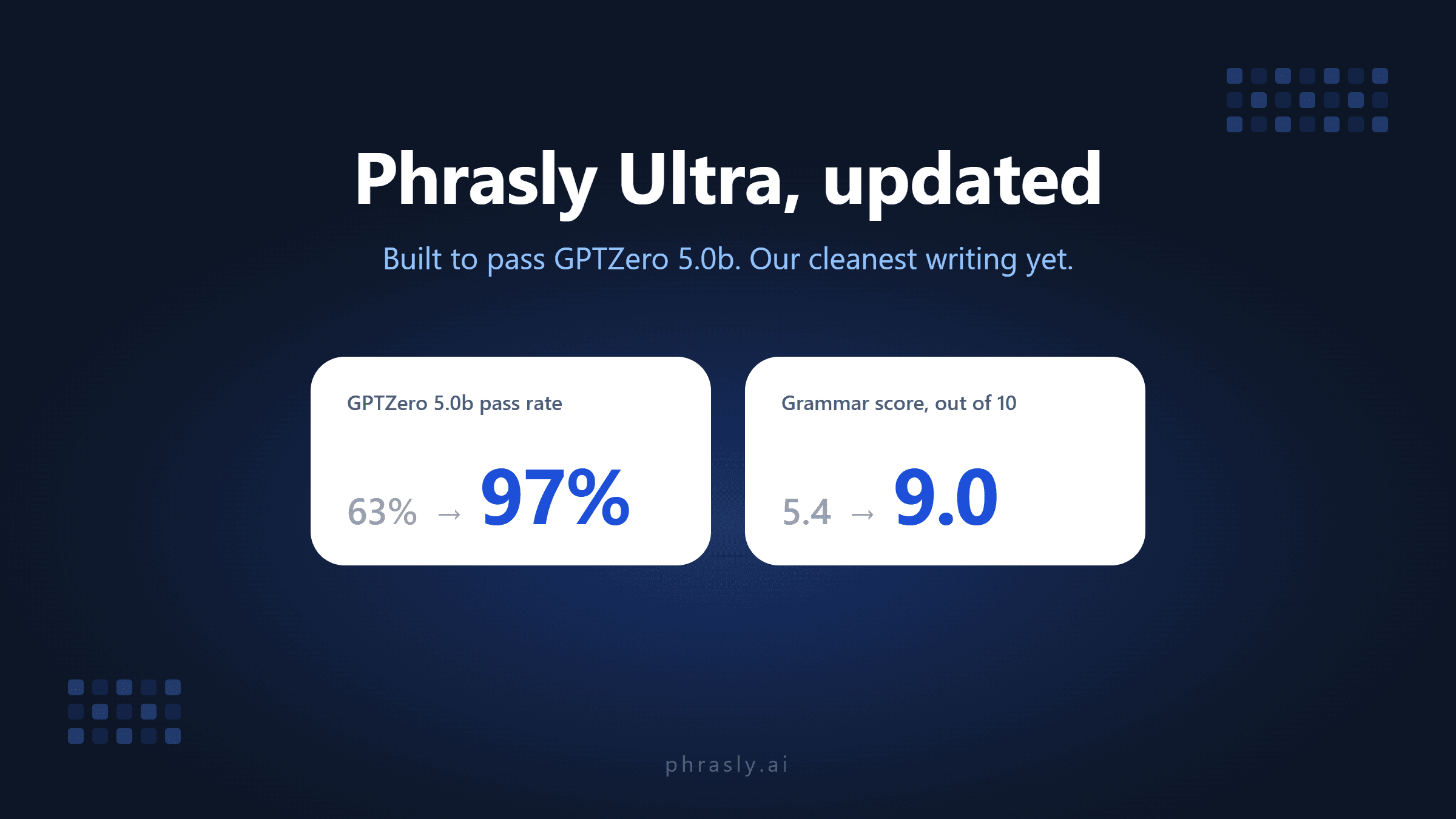
On Ultra, the default, both citation years stayed correct, but “different learning abilities” became “learning difficulties” and GPTZero scored it 100% AI. On Balanced, GPTZero scored it 100% human, but both citation years broke, as in “(20 23)”, so neither was ready to submit unchecked.
Tool | Best for | Free allowance | Academic or citation mode | Built-in detector | Starting price |
|---|---|---|---|---|---|
Solvely AI Humanizer | Students already paying for Solvely's study tools | Advertises 500 words a day with no account; our free runs gave no readable output | Academic style, Pro only; dropped 3 of 5 citations in our test | Yes | $3.99 first week, then $8.99/week; $12.99/month; $67.99/year |
Undetectable AI | Standalone humanizing | Free trial; word limit not shown on pricing page | Not listed on pricing page | Yes | $9.99/month for 10,000 words ($5/month billed yearly) |
QuillBot | Paraphrasing and grammar in one tool | Paraphrase up to 125 words; humanizer limit not shown | Not listed on pricing page | Yes | $4.17/month billed yearly |
WriteHuman | Short rewrites with a set number of requests | No free plan shown on pricing page | Not listed | Yes | $12/month billed yearly ($20 monthly) |
Phrasly AI Humanizer | Short extracts with citations checked by hand | 1 guest use a day (500 words); 10 a day on the Lite model with an account (2,500 words each) | No citation mode; Ultra kept citations, Balanced broke both years (our 117-word run) | Yes | $2 paid 3-day trial, then $39.99/month; or $20/month bought directly ($10.99/month billed yearly) |
Grammarly | Editing and tone help across apps | Basic plan at no cost; humanizer limit not shown | Not listed | Yes | $12/month billed yearly ($30 monthly) |
Prices and allowances checked on official sites as of November 13, 2026.
Undetectable AI: A standalone humanizer, unlike Solvely’s study-app bundle, with a trial instead of a daily allowance. See our Phrasly vs Undetectable AI comparison.
QuillBot: Mainly a paraphrasing tool with a humanizer added, and its yearly Premium costs less than Solvely’s yearly plan. We did not test its citation handling.
WriteHuman: A standalone humanizer sold by requests per month (80 on Basic), not by a daily word allowance like the 500 words Solvely advertises.
Phrasly AI Humanizer: Our own tool and, unlike Solvely, a standalone humanizer. We tested it on a short extract only, so check citations and meaning by hand.
Grammarly: An editing suite first, with a humanizer added, while Solvely is a homework app first.
Copyleaks: Best known as an AI detector, not a humanizer.
Choose Solvely or an Alternative Based on How You Write
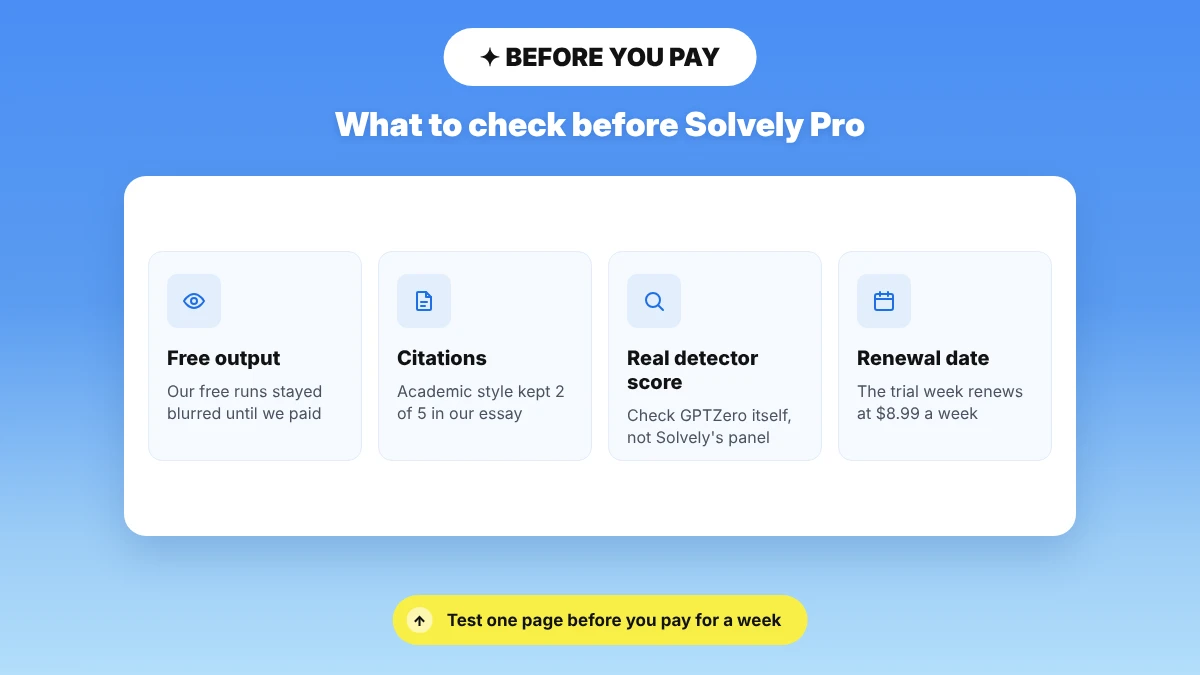
Solvely is worth paying for only if you already use its study tools; for the humanizer alone, our humanizer Solvely AI results point to a Solvely alternative.
Light Free Use: Solvely’s free tier gave no readable output (Claim 1), so plan on a paid week or another tool.
Already Paying for Solvely: The humanizer comes with Pro, but the $3.99 first week renews at $8.99 a week, so cancel if you only need it once (Claim 1 and 2c).
Citation-Heavy Papers: Academic style kept 2 of 5 citations (Claim 2) and changed the meaning in 6 places (Claim 3), so test any tool on one page first.
Want Ranked Options: See the best AI humanizer tools, compared on readability like Claim 4.
Want Fewer Fixes on Long Drafts: Solvely’s outputs needed 20 and 21 fixes (Claims 3 and 4). Try Phrasly AI Humanizer on one section, then check it against Claims 2 and 3.
Run Your Next Draft Through Phrasly AI Humanizer 📝
Paste one section of your draft into Phrasly AI Humanizer, then compare the output with your sources line by line. Check every citation, quote and page number before you keep it. That is how to humanize AI content without losing what your essay says.
Review the result against your school’s academic integrity policy before you submit anything.
🚀 Try Phrasly AI Humanizer: Paste a section of your draft and compare the rewrite with your sources.
FAQ
Is the Solvely AI Humanizer Free?
No, not in our test. The Solvely AI humanizer page advertises 500 free words a day, but on November 12, 2026, every free run at 844, 329 and 101 words stayed blurred until we bought a plan (see Claim 1).
Does the Solvely AI Humanizer Get an Essay Past Turnitin?
We could not test Turnitin, and no humanizer can promise a Turnitin result. GPTZero, Copyleaks and Originality.ai still scored Solvely’s default output 93 to 100% AI, and Turnitin has checked for humanizer use since August 2025 (see Claim 5 and the Turnitin section).
Will Solvely Change My Citations and Reference List?
Yes, it changed ours. Academic style kept 2 of 5 in-text citations, dropped the quotation marks from a direct quote and pushed 2 references out of APA. The default Original style kept 4 of 5 citations and every reference (see Claim 2).
Can My Professor Tell I Used Solvely?
Often, yes, even without a detector. Professors notice voice shifts, missing drafts, citation errors and claims you cannot explain. Solvely’s own Honor Code bans passing AI output off as original work, and many school policies treat humanizer use as misconduct (see the Turnitin section).
Is Solvely AI Legit and Safe to Pay For?
Yes, Solvely is a real company, Aignite Inc., but billing is the risk. The first week renews at $8.99 a week, its Terms call fees non-refundable, and cancelling took us three screens. Trustpilot shows 3.8 from 53 reviews (see the legit check).
What Is a Better Solvely Alternative for Academic Writing?
It depends on your need. If you are asking what is the best humanizer AI free option, start with QuillBot’s free plan; for a standalone tool, see Undetectable AI (comparison above). For how humanize AI content works without a tool, see ways to humanize AI text yourself.

Written by
Hasnain
Karachi, Pakistan
I help businesses grow with SEO-friendly blog posts, landing pages, and long-form content. With 3+ years of experience, I deliver clear, original, and well-researched writing that drives results.