Copyleaks vs GPTZero: Which AI Detector Is More Accurate? (2026)
15 min read
Were you pasting the same essay into both detectors and getting vastly different scores? You are not crazy.
We ran four known-origin papers through both detectors that were 100% human, 100% AI, a 50/50 human/AI hybrid, and a typically edited AI generated draft. This was done to compare Copyleaks vs GPTZero with facts rather than vendor claims.
Both scans were done on August 19, 2026.
In our four-document test, GPTZero flagged raw, untouched AI text more decisively. Copyleaks produced fewer false positives on genuinely human writing. So which is more accurate, Copyleaks or GPTZero isn't a single-number answer.
It depends on whether you're a student protecting a grade, an educator running institutional checks, or a team scanning content at scale. We'll break down exactly why below.
Curious where your writing lands? Try the Phrasly AI detector below, then keep reading for the full breakdown.
Copyleaks Vs GPTZero: Quick Verdict
Here's the summary before you read the full breakdown.
Test | Copyleaks | GPTZero | Winner |
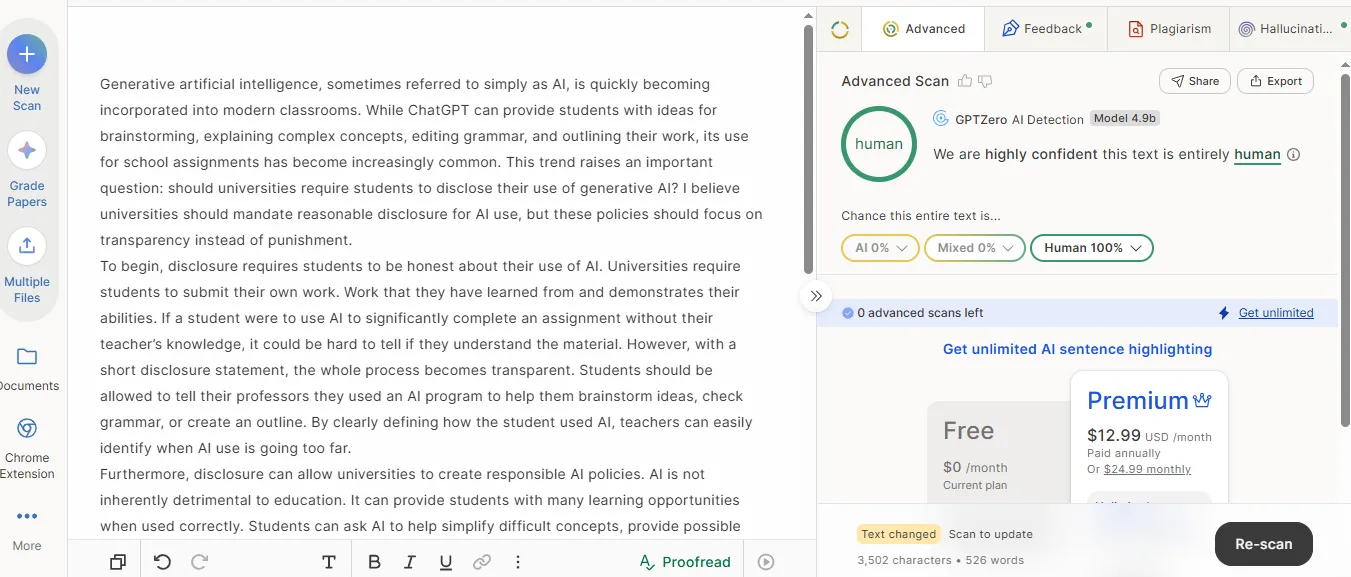
100% human writing | ❌ 100% AI (complete false positive: 526/526 words) | ✅ 100% human, high confidence | GPTZero |
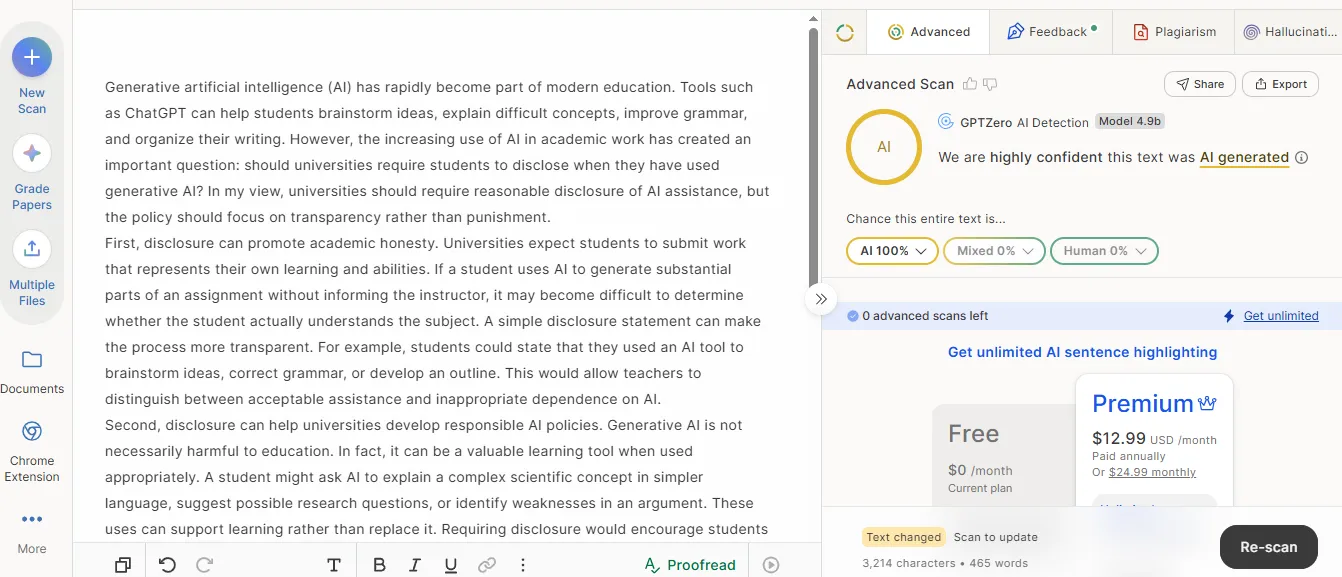
100% raw AI writing | ✅ 100% AI (465/465 words) | ✅ 100% AI, high confidence | Tie! Both correct |
50/50 human + AI blend | ❌ 100% AI (502/502 words. Missed the human half entirely | ⚠️ Leaned human (92% human / 5% AI / 3% mixed). Missed the AI half | Neither! Both missed the blend |
Normally edited AI | ⚠️ 100% AI (389/389 words: no edit/mix nuance) | ✅ Mixed 97% / "AI Polished": correctly identified human editing | GPTZero |
Best for students: Copyleaks, because it produced no false positives on our clean human sample. The single worst outcome for an honest student is being wrongly accused.
Best for educators: GPTZero, due to its authorship-verification workflow and stronger performance after ordinary editing.
Best free option: GPTZero's free tier. If you just need an occasional single scan.
So is Copyleaks better than GPTZero? Not universally! Copyleaks or GPTZero is really a "better for what" question.
Ready to check your own writing? Run a free scan now.
How We Tested Copyleaks and GPTZero?
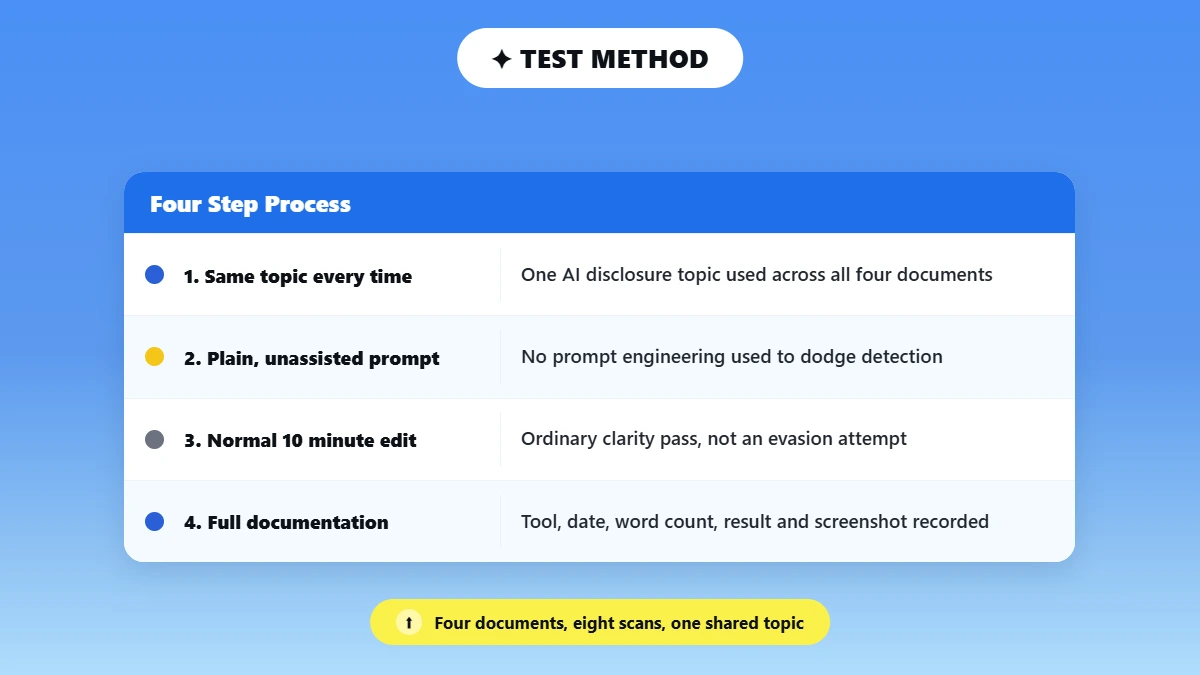
We kept the test small, transparent, and repeatable. Four documents, eight scans total, all built around one topic: "Should universities require students to disclose generative AI assistance?" (~500 words each).
Retaining the same topic for every sample allows direct comparison of human/AI/mixed/edited side-by-side.
The rules we followed:
The AI sample came from a plain, unassisted prompt (no prompt engineering to dodge detection). The "edited" sample got a normal 10-minute editorial pass for clarity and flow, not an evasion attempt.
We recorded the tool, scan date, word count, exact result, and a screenshot for every single scan. We didn't decide a winner in advance. The numbers above are simply what came back.
Test 1: Human-Written Content
This is the highest-stakes test for the Copyleaks vs GPTZero false positives question. It produced our starkest result. We scanned a 546-word, fully human-written essay.
We scanned "Do Universities Have to Require Students to Disclose Generative AI Use?" through both tools on the same day.
GPTZero (Model 4.9b) called it correctly. "We are highly confident this text is entirely human," with a breakdown of AI 0% / Mixed 0% / Human 100%.
Copyleaks got it completely wrong. 100% AI Content Found, with all 526 words classified as AI Text and 0 words as Human Text (Sensitivity Level 2/3).
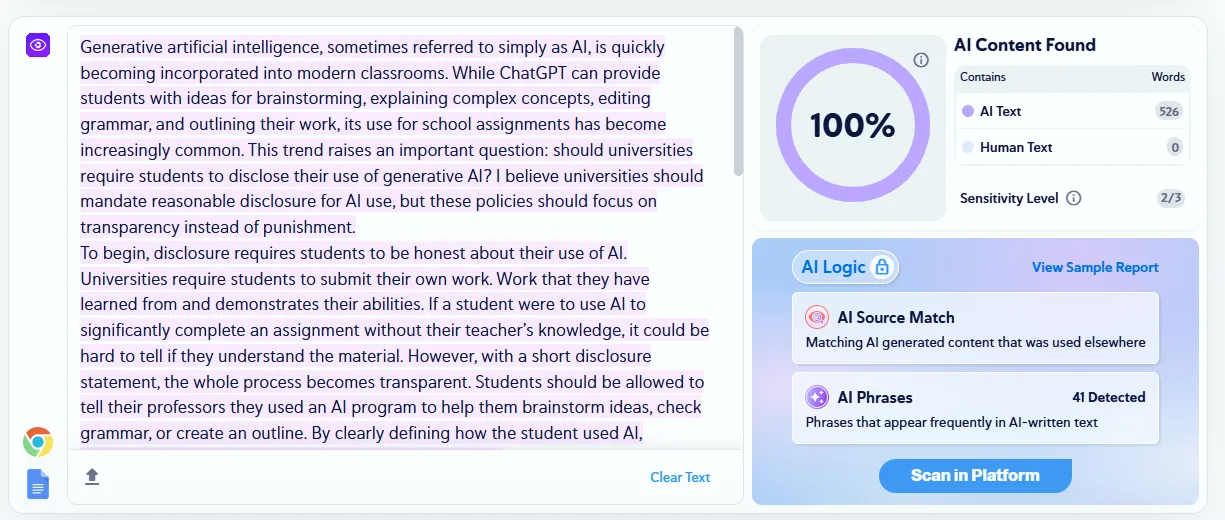
Its AI Logic panel even reported an "AI Source Match" and 41 detected "AI Phrases".
Why False Positives Matter Most?
A false positive doesn't just annoy a writer. For a student, it can trigger an academic-integrity conversation over text they wrote themselves. Our test shows this isn't a hypothetical.
A clean, fully human 526-word essay was flagged as 100% AI by Copyleaks, with zero words attributed to a human author. Formulaic structure, simple vocabulary, or non-native phrasing can all nudge a detector toward an incorrect AI call.
If you're wondering why your essay is being detected as AI when you wrote it yourself, this breaks down the common causes.
Test 2: Raw AI Content
For this condition, we generated a fresh 465-word passage on the same topic: "Should Universities Require Students to Disclose Generative AI Assistance?" We used a plain, unassisted prompt, then scanned the untouched output through both tools.
GPTZero (Model 4.9b) called it correctly. "We are highly confident this text was AI-generated," with a breakdown of AI 100% / Mixed 0% / Human 0%.
Copyleaks also called it correctly. 100% AI Content Found, with all 465 words classified as AI Text and 0 as Human Text (Sensitivity Level 2/3). Plus, an AI Source Match and 47 detected AI Phrases.
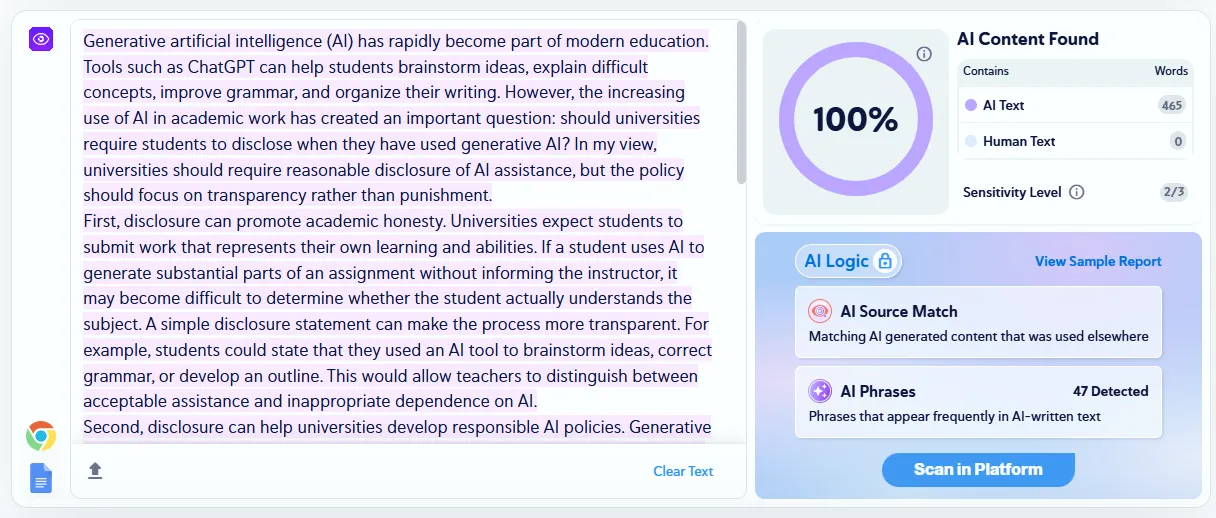
As you can see in the unedited, raw AI text, both detectors performed flawlessly with no discord between them. This is what every vendor benchmarks themselves against.
It's the best-case scenario for any detector, which is why raw-AI accuracy numbers mean very little. What matters is when that text gets edited or mixed with human text, which we will get into next.
Test 3: 50/50 Human + AI Content
This is the differentiator most comparisons skip. Mixed and hybrid AI-and-human text detection. We combined half of the human passage from Test 1 with half of the AI passage from Test 2 into one 502-word document. We scanned it through both tools.
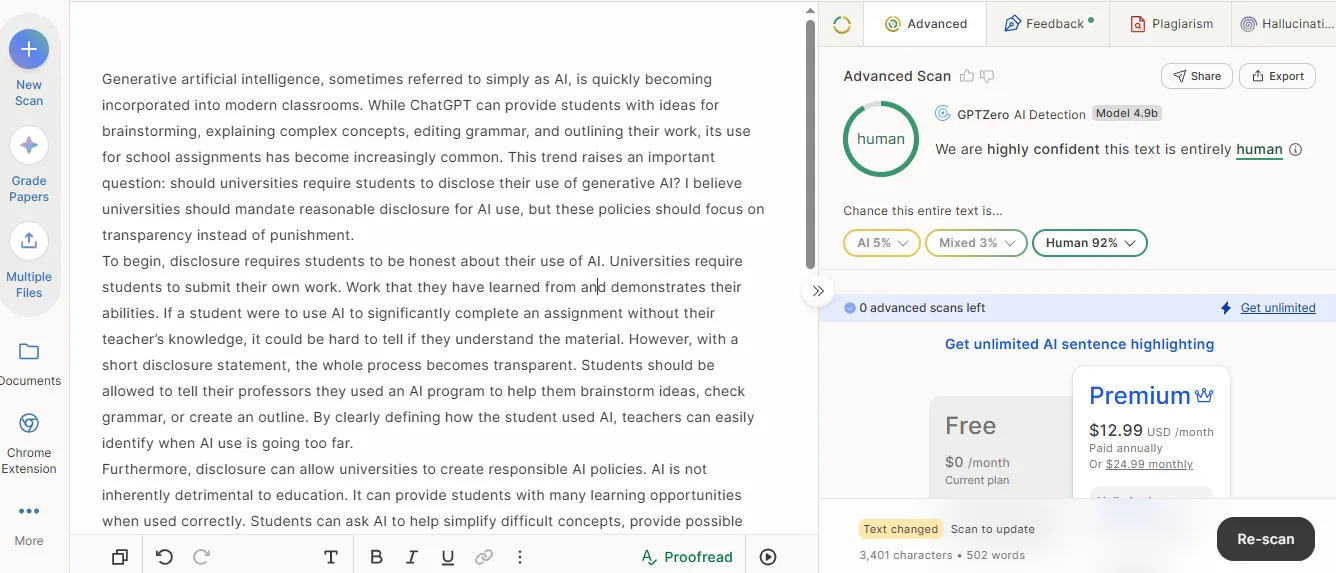
GPTZero still labeled the overall verdict "human". "We are highly confident this text is entirely human," with a breakdown of AI 5% / Mixed 3% / Human 92%. That 5% AI plus 3% mixed shows it picked up on some signal that the text wasn't purely human.
But it never called the document mixed outright. Its overall call heavily undercounts the roughly 50% of the text that was actually AI-written.
Copyleaks missed it the other direction. 100% AI Content Found, with all 502 words classified as AI Text and 0 as Human Text (Sensitivity Level 2/3). Plus 47 detected AI Phrases.
It didn't just fail to flag the blend. It reclassified the genuinely human half of the document as AI. The same failure mode we saw in Test 1.
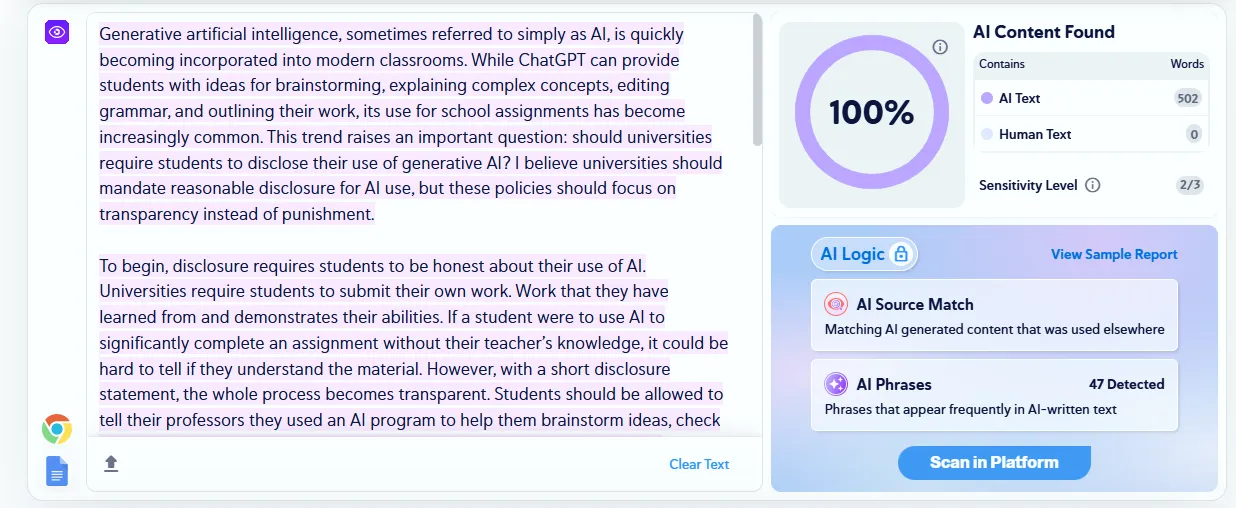
Neither tool correctly recognized this document as a mix. The errors ran in opposite directions. GPTZero's single "human" verdict swallowed the AI half. Copyleaks' single "AI" verdict swallowed the human half.
Notably, this is the second test in a row where Copyleaks classified genuinely human writing as 100% AI.
For anyone editing AI drafts by hand, which is how most people actually use AI, this is arguably the most realistic test condition of the four.
Test 4: Normally Edited AI
For the last condition, we took the raw AI passage from Test 2. Gave it a normal ~10-minute editorial pass, trimming filler, tightening a few sentences, and cutting some transition phrases. Scanned the 389-word result through both tools.
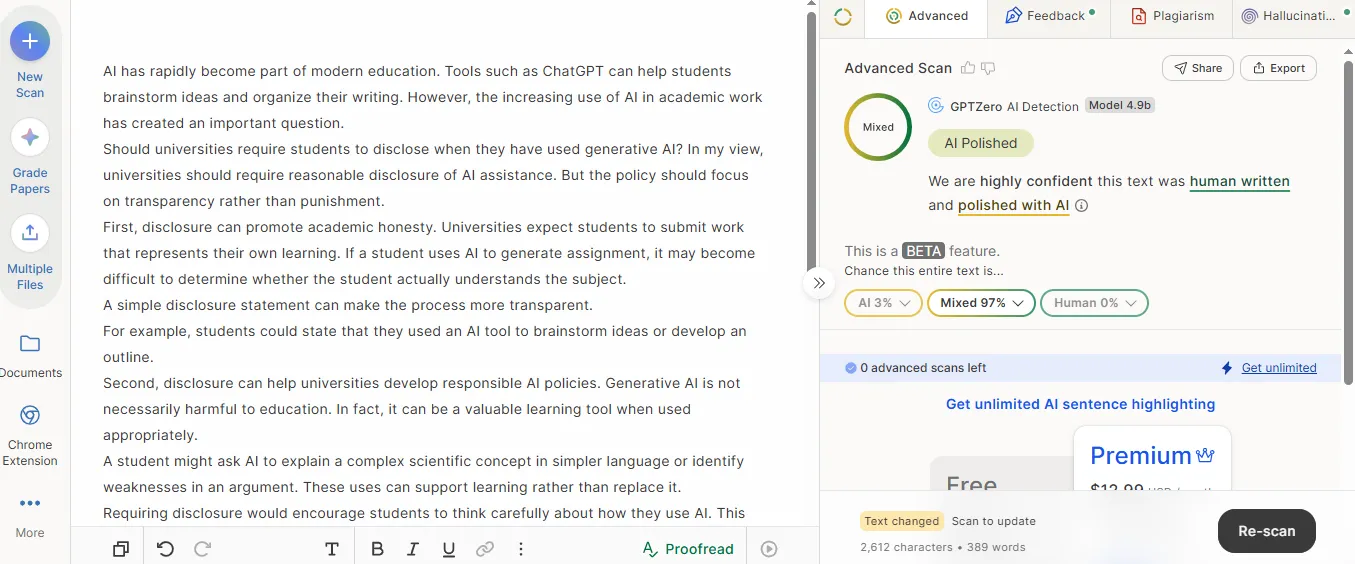
GPTZero gave the most nuanced read of the entire test. Using its (beta) "AI Polished" feature, it reported: "We are highly confident this text was human-written and polished with AI,".
With a breakdown of AI 3% / Mixed 97% / Human 0%. That's a strikingly accurate call. This is exactly what happened to the document.
Copyleaks scored it 100% AI Content Found. With all 389 words classified as AI Text and 0 as Human Text (Sensitivity Level 2/3). Plus 46 detected AI Phrases. That's not unreasonable.
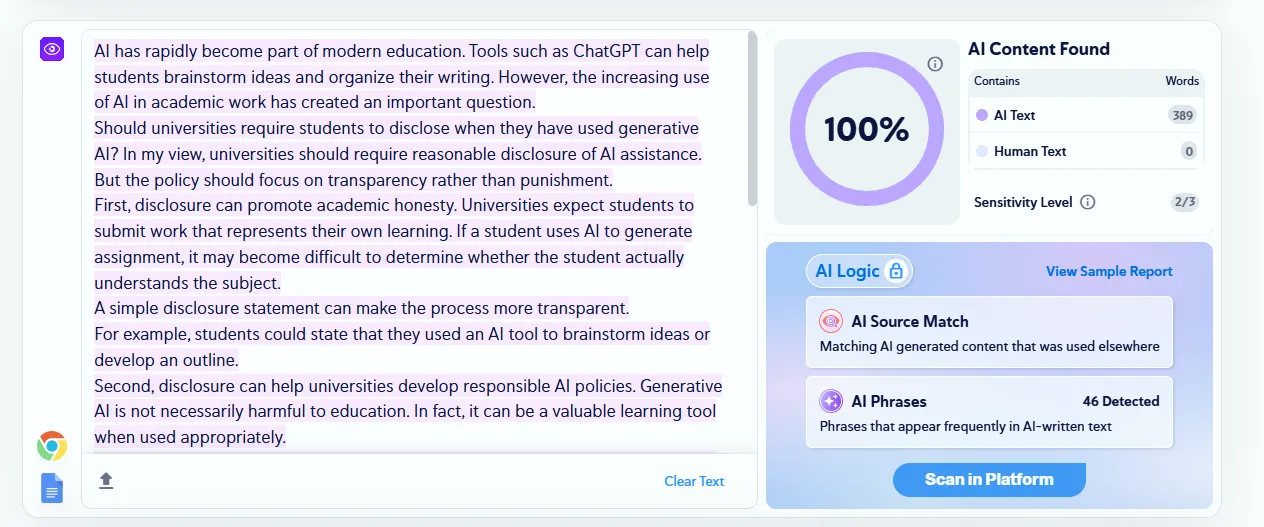
Since the text did originate from AI. But it offers no signal that the passage had been edited at all, unlike GPTZero's mixed/polished read.
This is the one test where GPTZero's extra category: Mixed actually paid off. Ordinary human editing is how most people really use AI.
GPTZero's beta feature was built specifically to catch that middle case. Copyleaks' binary-feeling AI/Human read got the origin right. But it missed the nuance entirely.
Why Do Copyleaks and GPTZero Give Different Scores?
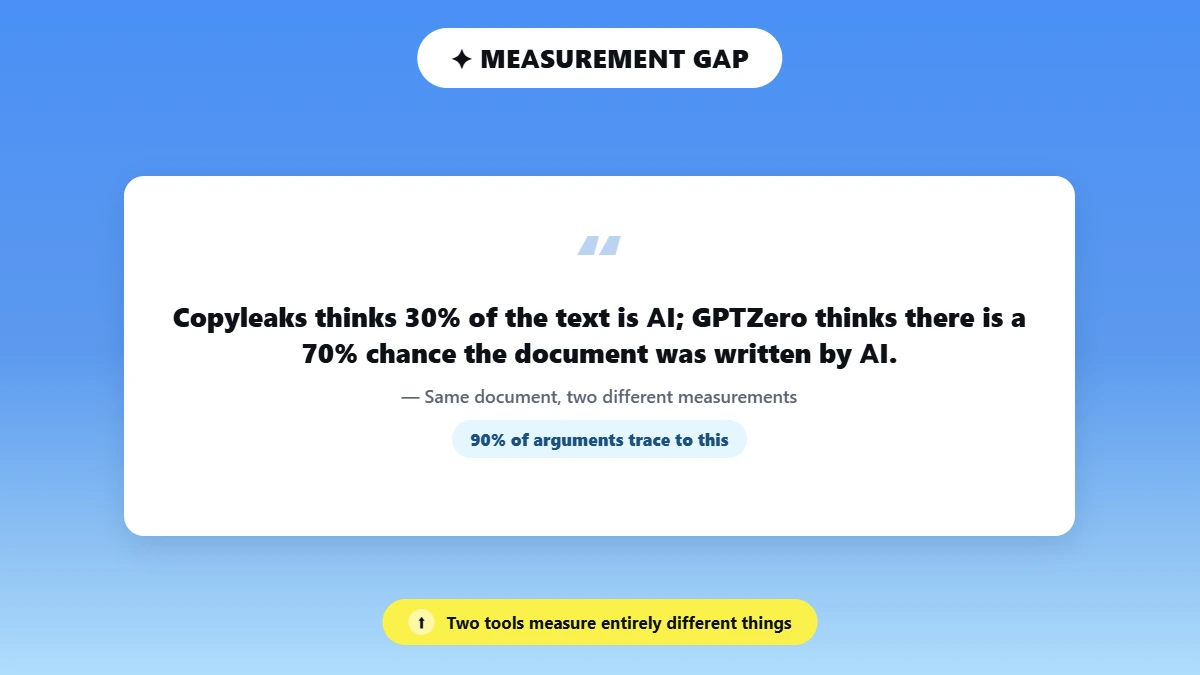
Copyleaks and GPTZero percentages are not the same measurement. Because the two tools work differently under the hood.
See this explainer on how AI detectors work for the mechanics.
Comparing them digit-for-digit is invalid. GPTZero's percentage is roughly the model's probability that the entire document was AI-authored.
A 6% score means "about a 6% chance this is AI".
Copyleaks' percentage is the share of the text it identified as likely AI. A 50% score means roughly half the document was flagged.
For example:
So if Copyleaks detects 30% and GPTZero detects 70% on the same document, we can't say that GPTZero "detected twice as much AI".
The truth is: Copyleaks thinks 30% of the text is AI; GPTZero thinks there is a 70% chance that the document was written by AI. This one misunderstanding is behind 90% of the GPTZero vs Copyleaks arguments you see online.
The two tools measure slightly different things, and they can contradict each other.
That's why it's helpful to scan with a third independent tool like Phrasly's free AI Detector to determine if a flag is tool-specific or consistent among detectors.
However, just because you scan something three times doesn't mean you have proof of who wrote it. Think of every score as expressing probability, not providing a verdict.
Copyleaks Vs GPTZero Accuracy: What Independent Research Shows
On Copyleaks vs GPTZero accuracy, the vendors themselves disagree. GPTZero cites a 99.3% accuracy figure from its own 3,000-sample benchmark.
While Copyleaks claims over 99% accuracy in its own testing. Both numbers should be read as contested. Each company is benchmarking its own product.
Independent studies are less optimistic.
Research published in June 2026 in the peer-reviewed journal International Journal for Educational Integrity evaluated 160 files: human-written, AI-written, human/AI collaboratively written ("hybrid"), and human-edited AI ("humanized AI") across GPTZero, Copyleaks, Turnitin, and Pangram.
It found all tools had trouble with hybrid and humanized documents. The study authors recommend "detector output should not be used as sole or primary evidence for consequential decisions."
An independent 2025 arXiv research study focused on DeepSeek-generated text discovered Copyleaks did best on raw AI-written text and basic paraphrased AI-written text, but scores suffered across the board when AI texts were heavily humanized.
The RAID benchmark, created specifically to challenge vendors who claimed >99% detection by using easy-to-pass conditions in their tests, showed all vendors' solutions’ robustness drops sharply when faced with harder, more realistic testing.
Copyleaks was ranked as the overall strongest vendor in Business Insider's independent 60-document, 480-scan test. The best free option they identified was GPTZero.
The pattern across every independent source:
GPTZero accuracy and Copyleaks accuracy both shift. It depends on the dataset, the AI model used, and how much the text was edited. No single headline number should decide your pick.
For entity-level detail on either tool, see this full Copyleaks review and GPTZero review.
Features, Pricing & Ease of Use
On Copyleaks vs GPTZero pricing and feature depth, the two tools solve overlapping but distinct problems.
Copyleaks leans into enterprise-grade integrity tooling and AI Logic detection across 30+ languages. While GPTZero leans into Writing Replay and authorship verification built for classrooms.
Factor | Copyleaks | GPTZero |
AI detection | Yes | Yes |
Plagiarism checking | Yes | Yes |
Sentence/section analysis | Yes | Yes |
Multilingual | 30+ AI-detection languages | Multilingual, major languages |
LMS / institution use | Strong | Strong (Canvas/Classroom) |
Google Docs / browser | Yes | Yes |
API | Yes | Yes |
Distinctive feature | AI Logic; enterprise tooling | Writing Replay / authorship verification |
Free tier | Limited | Yes |
Pricing (Verify Before You Buy)
Copyleaks Personal runs roughly $13.99/mo billed annually (around 300k words/credits).
While GPTZero's Premium plan is roughly $12.99/mo. Its Professional plan is roughly $24.99/mo, alongside a free tier.
Pricing changes often on both sides. Always confirm current numbers on each vendor's pricing page before you buy. A tool that's "more accurate in our test" and a tool that's "the better product for your workflow" are genuinely different questions.
Pricing is often the deciding factor between them.
Which Is Better for Students?
For Copyleaks vs GPTZero for students: our live test points to GPTZero.
A false positive is the single worst outcome a student can face. A wrongly flagged essay can trigger an academic-integrity review over work that's entirely your own.
If you want a broader look at options built for this exact situation, see this guide to AI checkers for students.
Here's what our full four-test run showed:
Copyleaks flagged 100% human writing as AI twice. On the pure human sample, and again on the human half of a 50/50 blend.
GPTZero never produced a hard false-positive verdict on human writing in any of the four tests.
GPTZero also correctly identified normally edited AI text as human-written and AI-polished. Via its beta "AI Polished" feature. Copyleaks scored the same text a flat 100% AI.
GPTZero's one weak spot: it undercounted the AI portion of the 50/50 blend. So it isn't flawless either.
If your institution mandates a certain tool, then you might not have a choice, but if you do, this tradeoff is reason to heavily favor minimizing false positives.
It's crucial to recall that a four-document test represents a significant signal, rather than a generalized accuracy rate for the entire platform.
Which Is Better for Educators & Institutions?
For educators and institutions, GPTZero's authorship-verification and Writing Replay features give administrators more to work with than a single percentage score. It integrates cleanly with Canvas and Google Classroom.
Copyleaks counters with broader language coverage. Copyleaks has deeper enterprise/LMS integrity tooling for larger institutions. Either way, the June 2026 study's caution is worth repeating to any policy committee.
Detector output should not be the sole evidence in a misconduct decision.
What to Do If Copyleaks Says Your Text Is AI (Avoiding False Flags)
If you're searching for how to avoid Copyleaks from saying my/your text is AI, you're not alone. Our own test proves it happens even to clean, fully human writing. Twice over (once on a pure human sample, once on the human half of a mixed document).
Formulaic writing, basic vocabulary, un-native wording, and texts that are over-reliant on templates can all cause your self-written text to false flag. You can make your writing undetectable by simply following these straightforward techniques:
Keep your drafts and version history. A visible writing process is the strongest proof of authorship you can offer.
Vary your sentence rhythm. Add specific, concrete detail. Overly uniform phrasing is a common false-positive trigger.
Run a second, independent detector to see whether the flag is tool-specific or consistent across tools.
If you drafted with AI assistance, revise it thoroughly in your own voice. So the final version genuinely reads as you wrote it.
Got an AI-assisted passage that keeps failing? Try Phrasly's AI Humanizer to tweak your original writing until it sounds more natural in your voice (sort of like editing your writing, not tricking Copyleaks).
No detector or rewrite tool can ensure a passing score, and they shouldn't be.
Is Phrasly an Alternative to GPTZero and Copyleaks?
At this point, if you've read this far, you've seen them both in action side-by-side, you've seen independent testing, and you've seen where they each succeed and fail.
For a free alternative to Copyleaks and GPTZero, Phrasly's AI Detector is a genuinely useful third option.
It has a free plan, trial, and is unlimited. So it costs nothing to double-check a flagged document.
If you want to weigh even more options, this roundup of the best AI checker tools compares the wider field beyond just these two.
Want a Third Opinion? Try a Free Scan
Copyleaks and GPTZero scan for different signals and sometimes contradict each other. So if Copyleaks flags a text, running a 3rd-party scan can help you determine if it's a Copyleaks-specific flag or if other detectors see it too.
IMPORTANT: Keep in mind that no detector - Phrasly, Copyleaks, GPTZero, or otherwise can infallibly determine authorship of text. Think of all scores as likelihoods, not judgments.
Final Verdict: Copyleaks or GPTZero?
With all four test conditions complete, the honest answer to whether Copyleaks is better than GPTZero is: not on the metric that matters most to most readers.
Across our test, GPTZero never produced a hard false positive on human writing. GPTZero correctly caught raw AI, and its beta "AI Polished" feature correctly identified an edited-AI passage as human-written and AI-polished.
The single most realistic scenario most people will encounter.
Its one miss was undercounting the AI half of a 50/50 blend. Copyleaks also caught raw AI correctly. But mislabeled genuinely human writing as 100% AI in two of four tests (Test 1 and the human half of Test 3).
Copyleaks offered no edit/mix nuance on Test 4. It still brings real strengths: broader language coverage and deeper enterprise/LMS tooling.
So Copyleaks or GPTZero? Use the matrix below.
Use case | Pick |
Students (avoiding false positives) | ✅ GPTZero (confirmed by live test) |
Educators (authorship verification) | ✅ GPTZero |
Catching AI-polished / lightly edited drafts | ✅ GPTZero ("AI Polished" beta feature) |
Businesses / content teams at scale | ⚖️ Depends: weigh false-positive risk vs. Copyleaks' broader tooling |
Multilingual workflows | ✅ Copyleaks (30+ languages) |
Free, occasional checking | ✅ GPTZero (free tier) |
👊 Bottom line: Across all four conditions, GPTZero was the more trustworthy tool in this test. Not because it's flawless. It still undercounted AI in a mixed document. But because its errors were the safer kind.
It was the only one of the two to correctly recognize edited AI content for what it was. Copyleaks matched GPTZero on raw AI. But its pattern of flagging genuine human writing as 100% AI twice is the more serious failure for anyone facing an academic-integrity or hiring decision.
✅ GPTZero for avoiding false alarms and catching AI-polished text.
✅ Both detectors for catching obvious, unedited AI.
❌ Neither tool for reliably catching a genuine human-AI blend.
❌ Don't treat either tool's score as proof on its own, in a high-stakes decision.
The four-document test is a strong signal, not a certified benchmark.
Frequently Asked Questions
Is Copyleaks or GPTZero more accurate?
In aggregate across all four conditions of our test, GPTZero was more accurate and substantially more reliable than Copyleaks. In every case, both products accurately flagged plain, unedited AI-generated text.
However, Copyleaks labeled genuinely human writing as 100% AI-generated in two of the four tests we conducted, while GPTZero emitted no hard false positives and correctly flagged edited AI text through its beta "AI Polished" feature.
Accuracy can also shift by dataset and document type according to independent research we've cited, so take this exercise as one data point and not the be-all-end-all metric.
Which has fewer false positives, GPTZero or Copyleaks?
GPTZero! Across all four tests, Copyleaks scored 100% human writing as 100% AI twice. Once on a pure human sample and once on the human half of a mixed document.
While GPTZero never produced a hard false-positive verdict on human-authored text.
Why do Copyleaks and GPTZero give different AI scores?
They measure different things. GPTZero's percentage is a probability that the whole document is AI-authored. It includes a separate "Mixed" category for AI-polished text.
Copyleaks' percentage is the share of the text it flagged as AI. Copyleaks has no equivalent mixed/edited category. The two numbers aren't directly comparable.
Can GPTZero and Copyleaks detect mixed human and AI writing?
It depends on the type of mix. Neither tool reliably caught a 50/50 human-AI blend. Copyleaks scored it 100% AI. GPTZero leaned heavily human.
But on normally edited AI text (AI-drafted, then human-polished), GPTZero's beta "AI Polished" feature correctly identified the mix at 97% confidence. While Copyleaks scored it a flat 100% AI with no nuance.
Which AI detector is better for students? For educators?
Students are safer with GPTZero. Given its lower false-positive rate on human writing across all four tests. Educators may also prefer GPTZero for its authorship-verification, "AI Polished" detection, and classroom-integration features.
Is there a free alternative to GPTZero and Copyleaks?
Yes! Phrasly's AI Detector has a free tier, a trial, and is unlimited, and works well as a third opinion when the two paid tools disagree.
How do I avoid Copyleaks saying my text is AI?
Keep your draft history as proof of process. Vary sentence rhythm. Run a second detector to check consistency. Thoroughly revise any AI-assisted draft in your own voice before submitting it.

Written by
Muhammad Usman Ali
Pakistan
Muhammad Usman Ali is an experienced SEO content writer with 3+ years of professional writing experience. He specializes in AI tools, AI detection technologies, and search engine optimized content.