AI Detection Statistics 2026: Accuracy, False Positives and AI Use
13 min read
Before you quote an AI detection figure in an essay or a research paper, you need to know which kind of study it came from. AI detection statistics in 2026 come from three kinds of studies, and each kind answers a different question:
🎯 Performance: how well detectors sort human, AI and mixed writing in research datasets
🚩 False positives: how often detectors label writing that people produced themselves as AI
✍️ AI use: how often students rely on AI tools for writing and schoolwork
No single accuracy rate covers the whole field of AI text detection statistics, because each study measures something different. Each finding below lists its source and two dates, when it was published and when its data was collected, so a 2023 result never passes as a 2026 one.
Phrasly publishes this guide and also offers an AI detector.
Check Your Text With Our Free AI Detector
Study averages cannot predict how a detector will read your draft, so paste a passage you can share safely and treat the result as an estimate. The detector gives you three free checks, and a free account then keeps it free with unlimited use.
What Are the Key AI Detection Statistics for 2026?
The key AI detection statistics for 2026 come from separate studies, and each one measures a single thing, such as detector accuracy on academic texts or student AI use. One accuracy figure cannot describe every tool, language or type of writing, so each figure below keeps its source, population (who was tested) and test date.
The table lists six findings from four primary sources. Preprints stay out of it because no journal has reviewed them yet.
Finding | Value | Population or test | Published / measured | Source |
|---|---|---|---|---|
Macro-average accuracy, three-class test | Turnitin 0.61; Originality 0.69 | 192 human, AI and hybrid academic texts | Feb 2026 / Jan to May 2025 | |
Accuracy by genre | Turnitin: humanities 0.86, science 0.51. Originality: humanities 0.96, science 0.58 | Same study, genre subsets | Feb 2026 / Jan to May 2025 | Hadra et al., IJEI |
Used generative AI to help with assessed work | 94% | 1,054 UK full-time undergraduates | Mar 2026 / Dec 2025 | |
Directly included AI-generated text in assessed work | 12% (8% in 2025, 3% in 2024) | Same survey | Mar 2026 / Dec 2025 | HEPI and Kortext |
Used chatbots for schoolwork help | 54% | 1,458 US teens aged 13 to 17 | Feb 2026 / Sep to Oct 2025 | |
Mean false-positive rate on TOEFL essays | About 61% | 91 TOEFL essays, seven detectors | 2023 (historical) |
Every figure was checked against its original source in October 2026. Detector products change after a study ends, so each accuracy figure describes the tool versions tested at the time.
💡 Cite one row at a time. Each row counts a different group of people or texts, so an average of these rows, or a figure that merges the UK and US surveys, describes something no study measured.
What Does Each AI Detection Metric Actually Measure?
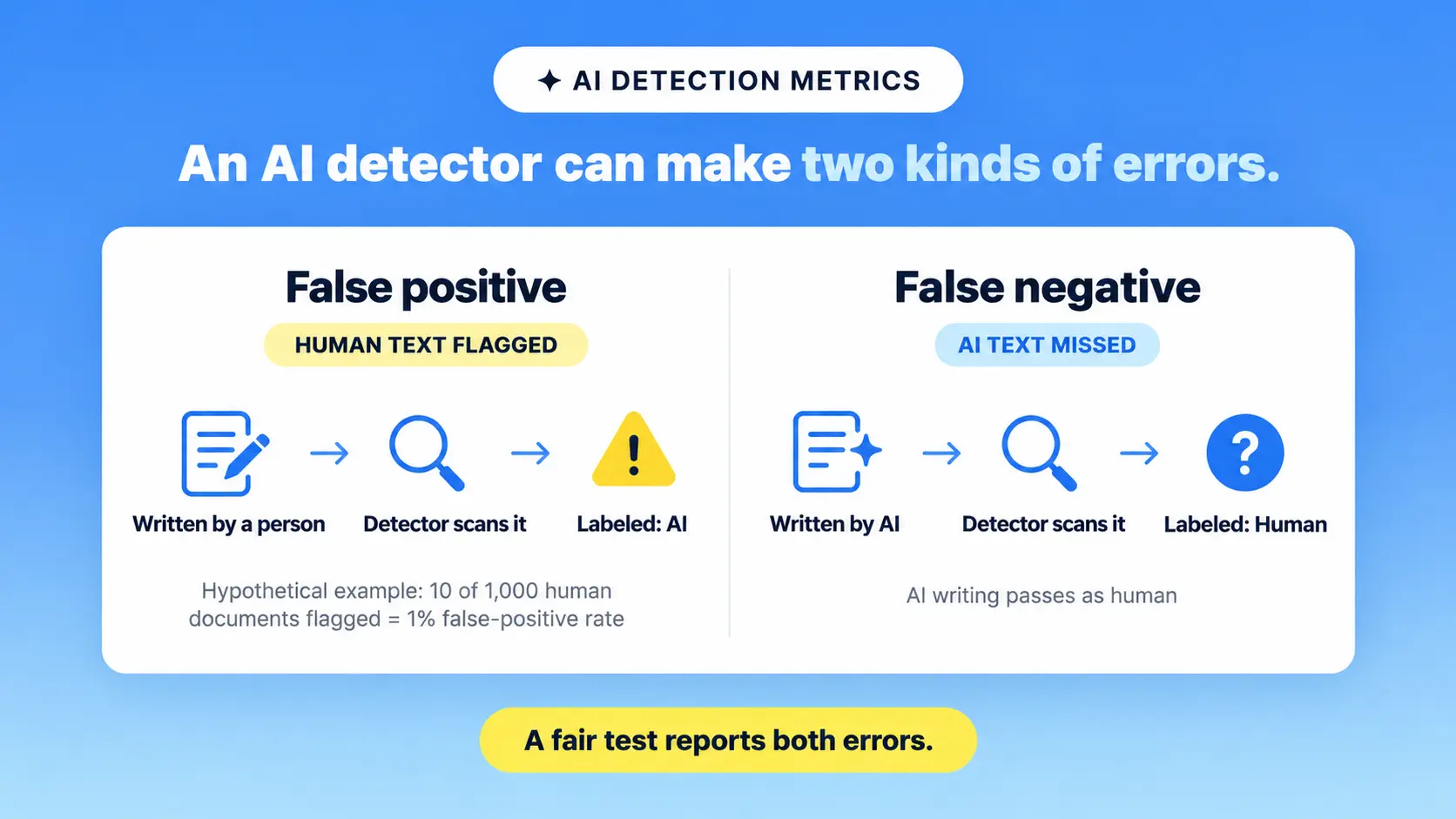
Accuracy is the share of correct labels a detector gives in a defined test, and a false-positive rate measures how often it flags known human writing as AI. Recall measures how much known AI writing the detector catches. The score a detector shows on one document is a separate measurement, and every tool defines that score in its own way.
Metric | What it measures | Question it answers |
|---|---|---|
Accuracy | Share of all test texts the detector labeled correctly | How often was the label right overall? |
Recall (sensitivity) | Share of texts in one class that the detector labeled correctly | How much AI writing did it catch? |
False-positive rate | Share of known human texts labeled as AI | How often does human writing get flagged? |
Precision | Share of AI labels that were correct | When the tool says AI, how often is it right? |
F1 score | One number that balances precision and recall | Does the detector do well on both? |
Definitions follow standard classification terms used in the studies cited on this page; checked October 2026.
🧮 Hypothetical example: a test includes 1,000 documents that people wrote themselves. If a detector flags 10 of them as AI, its false-positive rate in that test is 1%. These numbers show the math only and describe no real tool.
A false negative is the opposite error: AI-written text that a detector labels as human. A detector that flags less often usually produces fewer false positives and more false negatives, and that trade-off shapes how AI detector accuracy is evaluated in a fair test.
What Does Independent Research Show About AI Detector Accuracy?
Independent research shows that AI detector accuracy depends heavily on the test. Turnitin reached a macro-average accuracy of 0.61 and Originality reached 0.69 in a peer-reviewed study published in February 2026, which tested both tools on human, AI and hybrid academic texts. The tests ran in 2025, so the figures describe the tool versions of that period.
The 2026 academic detector evaluation by Hadra, Cambridge and Mesbah in the International Journal for Educational Integrity tested 192 texts in four equal groups:
📝 48 essays by EFL students, meaning students who learn English as a foreign language
📰 48 professional texts written by people
🤖 48 texts generated by GPT-4.1 or Claude 3 Opus
🔀 48 hybrid texts built as 50/50 human and AI mixtures
The authors created the dataset and ran the experiments between January and May 2025. They turned each tool's percentage score into one of three labels:
✅ Human: a score from 0 to 20%
⚠️ Hybrid: a score from 21 to 79%
🚫 AI-generated: a score of 80% or higher
A different cutoff would move texts between labels and change every result. The study also reports macro averages, which give each group equal weight before averaging, so the hybrid group counts as much as the larger human group. Macro-average recall reached 0.51 for Turnitin and 0.60 for Originality, and both tools scored below 0.55 on macro-average F1.
Source or test | Detector | Reported metric | Population | Observation date | Limitation |
|---|---|---|---|---|---|
Hadra et al., 2026 | Turnitin | Macro-average accuracy 0.61; recall 0.51 | 192 academic texts | Jan to May 2025 | Two tools only; fixed 50/50 hybrids |
Hadra et al., 2026 | Originality | Macro-average accuracy 0.69; recall 0.60 | 192 academic texts | Jan to May 2025 | Two tools only; fixed 50/50 hybrids |
8 open-source and 4 closed-source detectors | Robustness across models, domains and attacks | Over 6 million AI generations | Published Aug 2024 | Research benchmark; older tool versions |
Figures checked against each paper in October 2026. The table records what each study measured and ranks no tool.
⚠️ Keep the metric label when you cite this study. Write "Turnitin reached 0.61 macro-average accuracy in a three-class test run in 2025" and avoid the shorter claim "Turnitin is 61% accurate," which the study never made.
Why Can’t Percentages From Different Studies Rank Detectors?
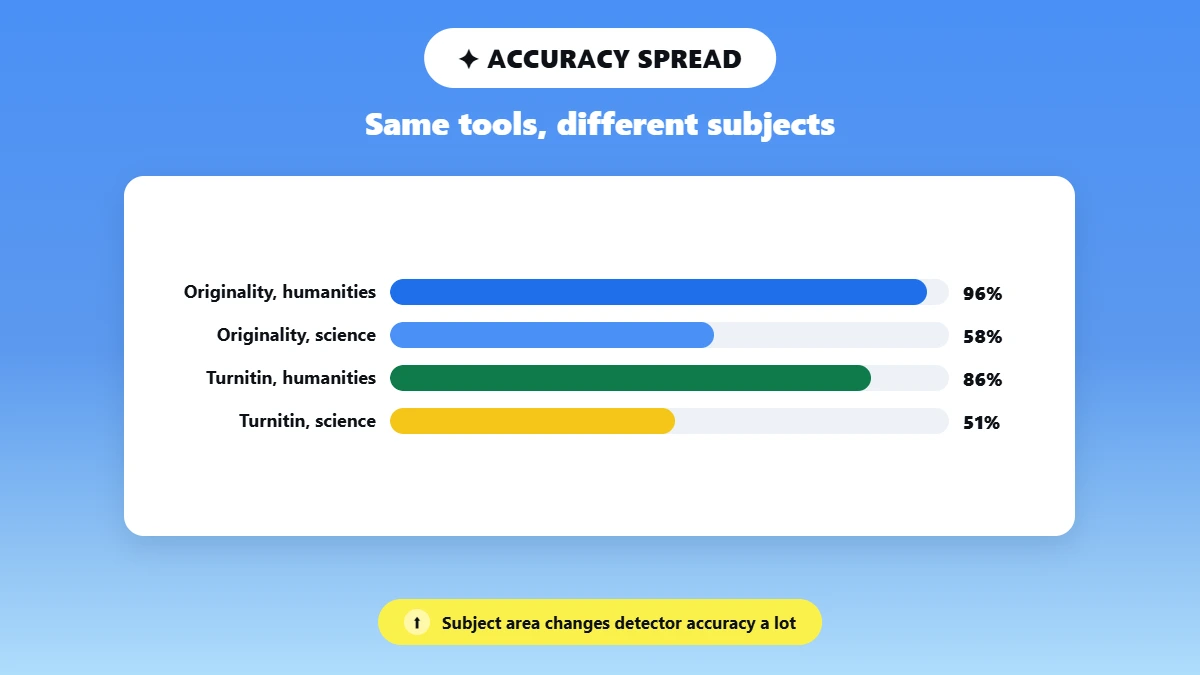
Percentages from different studies cannot rank detectors because each study uses its own texts, labels and score cutoffs. The 2026 study shows how much the text alone changes a result: Originality scored 0.96 on humanities texts and 0.58 on science texts, and Turnitin moved from 0.86 to 0.51, with the same tools and the same cutoffs.
How Large Is a Serious Detection Benchmark?
The RAID benchmark by Dugan and colleagues shows the scale of a serious test, because it built over 6 million AI generations from:
🧠 11 generator models
📚 8 writing domains
🛠️ 11 adversarial attacks, meaning deliberate edits that try to fool a detector
🎛️ 4 decoding strategies, meaning settings that control how a model picks its words
The authors tested 12 detectors and found that current detectors were easily fooled by attacks, changes in word-picking settings and AI models the detectors had never seen. These numbers describe the size of one benchmark and never work as a 2026 success rate.
🔍 Want to see how a detector reads writing you know well? Use a passage you wrote yourself, because one result shows how the check works and cannot prove accuracy. 👇
What Do False-Positive Statistics Show About Human Writing?
False-positive statistics show that detectors can flag human writing as AI, and the risk falls unevenly across writers. A 2023 Stanford-led study found that seven detectors flagged non-native English TOEFL essays as AI about 61% of the time on average. That figure describes 2023 tools and one dataset, and no verified rate covers every detector in use today.
The historical TOEFL detector-bias study by Liang and colleagues, published in Patterns, compared 91 TOEFL essays with 88 essays by US eighth graders. The detectors labeled the eighth-grade essays almost perfectly, while the TOEFL essays produced three different figures that people often mix up:
Measure | Figure | What it means |
|---|---|---|
Average false-positive rate per detector | About 61% | The mean share of TOEFL essays each detector flagged as AI |
Flagged by all seven detectors | 18 of 91 (19.78%) | Unanimous AI label from every tool |
Flagged by at least one detector | 89 of 91 (97.80%) | An any-tool rate, which describes no single tool |
Values from the authors' manuscript of Liang et al. (2023); checked October 2026. The tools tested were 2023 versions.
💡 Agreement between detectors can still be wrong. All seven tools labeled 18 essays as AI, and people wrote every one of them.
The 2026 academic study also tested EFL student writing: Originality labeled every professional text correctly but misclassified several EFL student texts, a gap the authors reported as a borderline trend (p = 0.058). Turnitin showed no statistically significant difference between the EFL and professional groups.
📌 Publisher research: Phrasly's 30,000-essay ZeroGPT test, published in September 2025, ran 37,874 human essays written between 2010 and 2021 through ZeroGPT and found that 26.4% were flagged as AI. Phrasly ran this test on one tool, and no independent team has reviewed it.
These results explain why AI detectors can misclassify writing by people who used no AI at all, and why a single flag needs a closer review before anyone acts on it.
How Does AI Editing or Mixed Authorship Affect Detection?
AI editing and mixed authorship make detection harder. Researchers treat fully AI-generated text, human writing that AI edited and blended documents as separate cases, and a detector that catches clean AI samples can miss the other two. A human-looking score cannot prove that no AI helped write a text.
The 2026 academic study built its hybrid texts as fixed 50/50 splits, and its authors note that real writing rarely follows fixed proportions.
🔬 Research update (preprint, July 2026): The ARB rewriting benchmark preprint by Perrone and Romano, posted to arXiv and not yet peer reviewed, matched 1,800 human source texts with AI versions from four freely available AI models. Two research detectors caught most directly generated text at a fixed 1% false-positive rate, and far less human text that an AI had rewritten:
FastDetectGPT: 91.2% of direct AI text and 30.8% of AI-rewritten human text
Binoculars: 93.5% of direct AI text and 15.1% of AI-rewritten human text
Both are research detectors, so these results show how much AI rewriting lowers detection and says nothing about commercial tools.
🔬 Research update (preprint, September 2026): The C-HAT-Bench Chinese-language preprint linked 5,000 human texts to more than 240,000 AI variants from six models and tested 21 detectors. Mean document-level AUROC, a score of how well a detector separates human and AI text across every cutoff, came out 12.0% lower when people and AI wrote together than when AI only continued a human’s opening lines. That is a relative AUROC drop, and the Chinese-language data may not transfer to English essays.
How Common Is AI-Assisted Student Writing in the Latest Surveys?
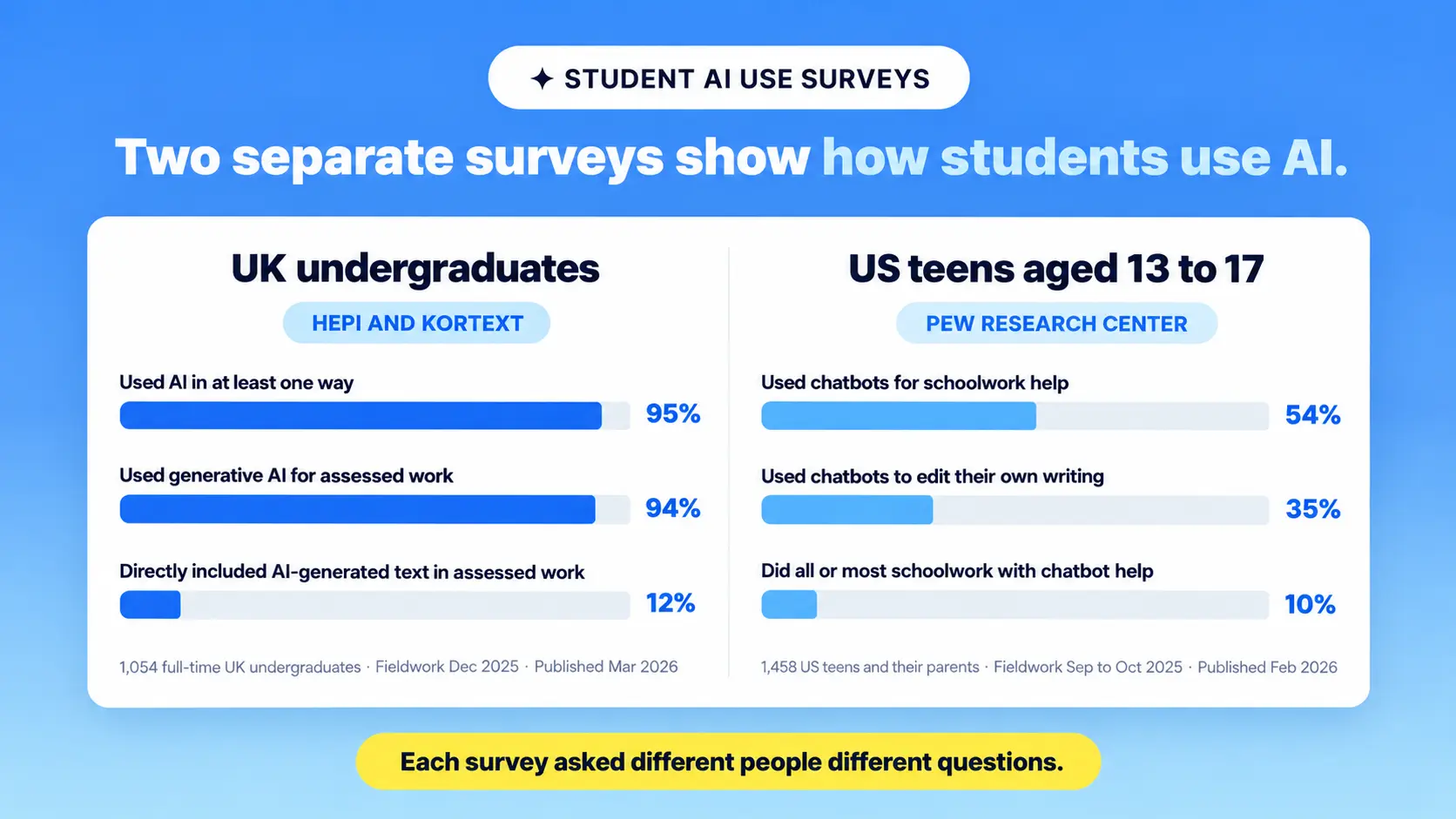
AI-assisted writing is now common among students. HEPI's 2026 UK survey found that 94% of full-time undergraduates used generative AI to help with assessed work, and Pew found that 54% of US teens had used chatbots for schoolwork help. Neither survey measures cheating or the use of AI detectors.
Savanta ran HEPI's original undergraduate survey for HEPI and its sponsor Kortext, and the Pew Research Center teen survey questioned teens and their parents online. The two surveys cover different people in different countries, so their figures stay in separate rows:
Survey | Group | Fieldwork / published | Finding | Figure |
|---|---|---|---|---|
HEPI and Kortext | 1,054 UK full-time undergraduates | Dec 2025 / Mar 2026 | Used AI in at least one way | 95% |
HEPI and Kortext | Same | Dec 2025 / Mar 2026 | Used generative AI to help with assessed work | 94% |
HEPI and Kortext | Same | Dec 2025 / Mar 2026 | Directly included AI-generated text in assessed work | 12% (8% in 2025, 3% in 2024) |
Pew Research Center | 1,458 US teens aged 13 to 17 | Sep to Oct 2025 / Feb 2026 | Used chatbots for schoolwork help | 54% |
Pew Research Center | Same | Sep to Oct 2025 / Feb 2026 | Used chatbots to help edit something they wrote | 35% |
Pew Research Center | Same | Sep to Oct 2025 / Feb 2026 | Did all or most schoolwork with chatbot help | 10% |
Figures checked on the HEPI and Pew report pages in October 2026.
The HEPI figure of 12% comes closest to measuring AI text inside student work, and it has risen every year since 2024. Students reported the figure themselves, and many courses permit some AI help.
Pew's 35% editing figure matters for detection, because AI-edited human writing is one of the cases where research detectors lose the most accuracy.
📊 Student AI use and detector adoption are separate measures. Readers who need adoption data can check which AI detectors universities use instead.
How Should You Interpret an AI Score on Your Own Text?
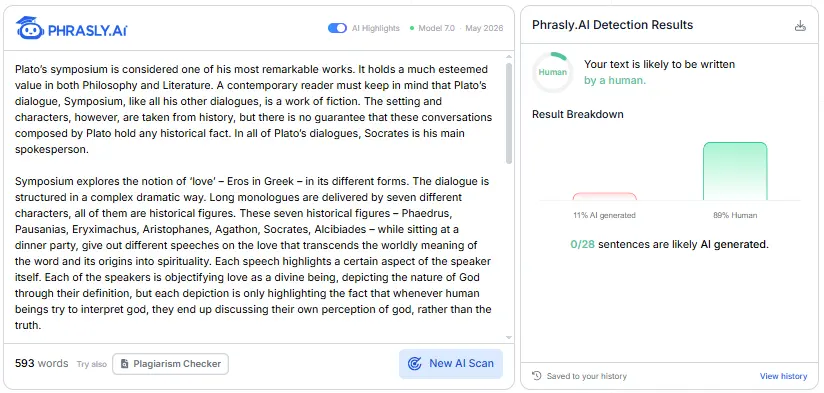
Treat an AI score as one tool's signal, and review it with your original text, drafts, sources and the AI-use rules you follow. A low score cannot certify rule compliance, and a high score cannot prove misconduct alone. Two detectors can give different scores for the same text because each uses its own model and score definition.
In our demonstration, Phrasly AI Detector labeled a human-written essay about Plato's Symposium as likely written by a human, with 0 of its 28 sentences flagged. One scan shows how the tool reports a result and cannot measure its false-positive rate.
A short review routine keeps the score in context:
📁 Keep the original. Save the text and any report you received before you change anything.
🔒 Use a safe sample. Paste a non-confidential or redacted passage, and check whether it is safe to paste an essay into an AI detector when the text is private.
📊 Read the score and highlights. Look at the number and any highlighted passages, and check how that tool defines its score.
🗂️ Compare it with your writing record. Match the result against your notes, drafts and version history.
🧑🏫 Ask for a human review. If someone disputes a report about your work, request a review from a person who can see your process.
🔁 Want another view of a flagged passage? Keep the original report and your drafting history, then use one more estimate to guide the review. 👇
A second detector adds another estimate, and it cannot replace your drafting record as evidence. Writers whose work has already been flagged can follow the steps for responding to an AI detector false positive, and readers who are choosing software can start with a comparison of AI checker tools.
How Were These Statistics Selected and Checked?
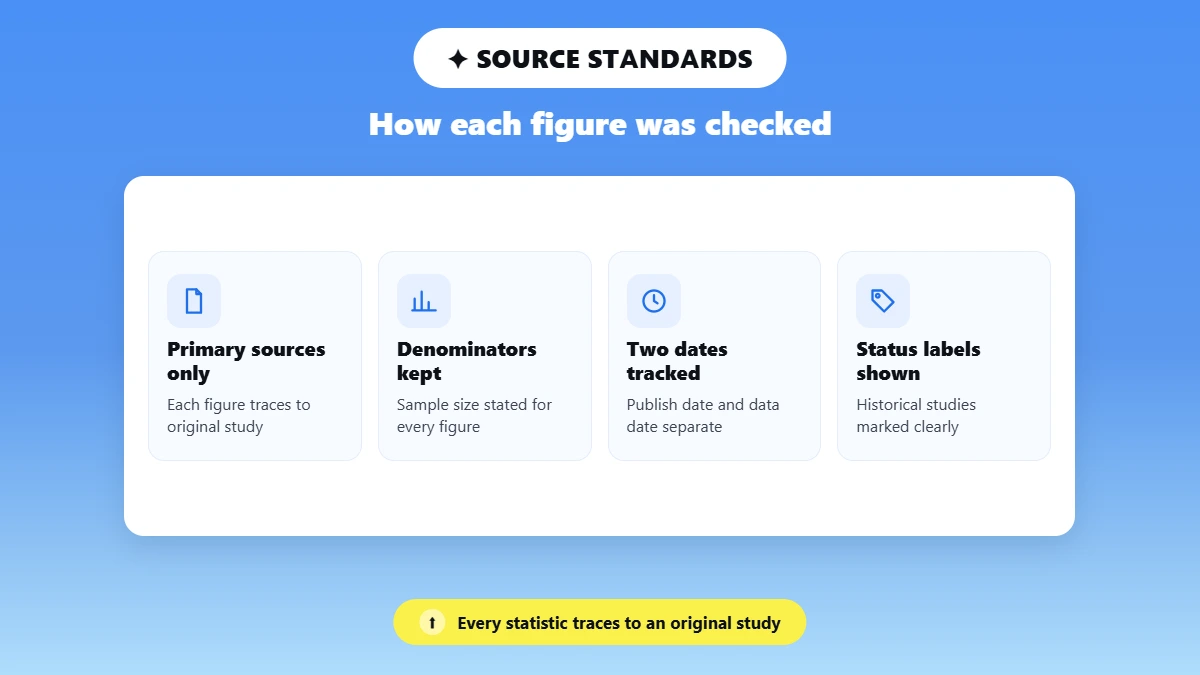
Every statistic here comes from an original study or survey that we opened and checked against its own methods section. Each source was reopened in October 2026, figures found only in commercial roundups were left out, and this page reports no new experiment of its own.
✅ Primary sources only: each figure links to the paper or survey that produced it.
✅ Denominators kept: each figure names its population and sample size.
✅ Two dates: the publication date and the data-collection date appear separately.
✅ Status labels: historical studies and preprints carry a visible label.
Frequently Asked Questions
Does a 20% AI score mean 20% of my essay was written by AI?
A 20% score means 20% of your essay looks AI-generated only on tools that report the share of AI-like text. Other detectors report a confidence level or one overall label, so check how your tool defines its score before you read it as a share of your writing.
Does 0% AI prove a text was written by a human?
A 0% score cannot prove human authorship, because detectors miss AI involvement, especially in edited or mixed writing. Drafts, notes and version history give stronger evidence of how a text was written.
Is there a safe or acceptable AI percentage?
No universal safe percentage exists. Your school's or client's AI-use rules decide what counts as acceptable, and the tool's scoring method decides what the number means. Read the policy first, then check how much AI detection is acceptable for the way scores are usually read.
Does agreement between detectors prove cheating?
Agreement between detectors does not prove cheating. Detectors can rely on similar signals and make the same mistake on the same text, as the 2023 TOEFL study showed with 18 human essays. Learn why AI detector scores differ, then review drafts and sources before you draw a conclusion.
Are 2026 statistics always based on tests run in 2026?
Many 2026 reports use older data. The HEPI and Pew surveys published in 2026 collected their answers in late 2025, and the 2026 detector study ran its tests in 2025. Check the data-collection date along with the publication year.
Can an AI detector score prove plagiarism?
Plagiarism checks and AI detection measure different things, so an AI score is no evidence of copying. AI detection estimates whether text looks machine-generated, while plagiarism checking compares text with existing sources. A clean plagiarism report also cannot rule out AI use.

Written by
Alina Shah
SEO Content Specialist · Karachi, Pakistan
She writes about AI so you don't have to guess. 8+ years in content strategy and editing. Now she puts AI writing tools and detection systems through real tests and shares what actually works.