Can AI Detectors Really Spot Paraphrased AI Text?
9 min read
Often yes, but not always, because paraphrasing changes the words a detector reads while rhythm and predictability patterns often survive.
In our same-day test, one QuillBot pass moved Phrasly AI Detector from “likely AI” (30%) to “a mix of AI and human” (19%), while GPTZero still scored the text 100% AI. So the myth that one paraphraser pass guarantees a clean result does not hold, and neither does the idea that detectors always win.
This guide walks through what paraphrasing changes, what it leaves behind, what research says about AI detector accuracy on paraphrased text, and how paraphrased AI text detection played out in our test.
If you already have a paraphrased draft, it is worth seeing where it stands before you read on.
Check a Paraphrased Draft With Free AI Detector 👇
What Actually Changes When You Paraphrase AI Text?
Paraphrasing changes the surface of the text, not the plan behind it. A paraphrasing tool swaps words for synonyms, reorders clauses, and splits or merges sentences. The ideas and their order stay where the AI put them.
So can ChatGPT be detected after paraphrasing? Often, yes. Synonym swapping can throw off a detector that scores single words, but it rarely fools one that reads sentence structure patterns across the whole passage.
Word Swaps vs Structural Rewrites
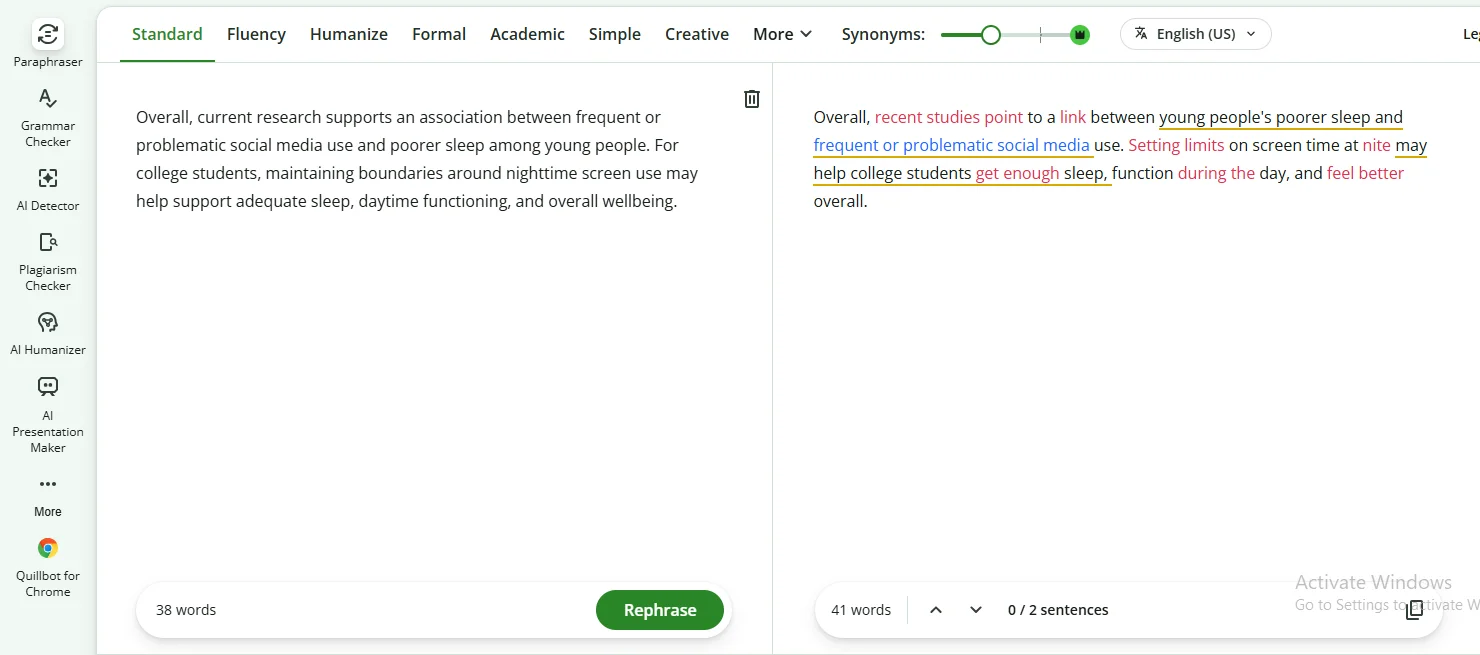
Word Swaps: change words but keep the sentence shape. QuillBot turned our “current research supports an association” into “recent studies point to a link.”
Structural Rewrites: change clause order, voice, or how sentences combine.
Tool Strength: heavier paraphrasers do both, so results vary by tool.
Where Meaning Can Drift
Synonym swapping can cause semantic meaning drift. In our sample, QuillBot changed “nighttime” to “nite” and “60 studies” to “60 research.” These are slips a grader or grammar checker can catch on their own, separate from any AI score.
So does heavy paraphrasing remove the AI footprint? It blurs the text fingerprint, but rarely erases it.
What Stays the Same: Structure, Rhythm, and Predictability
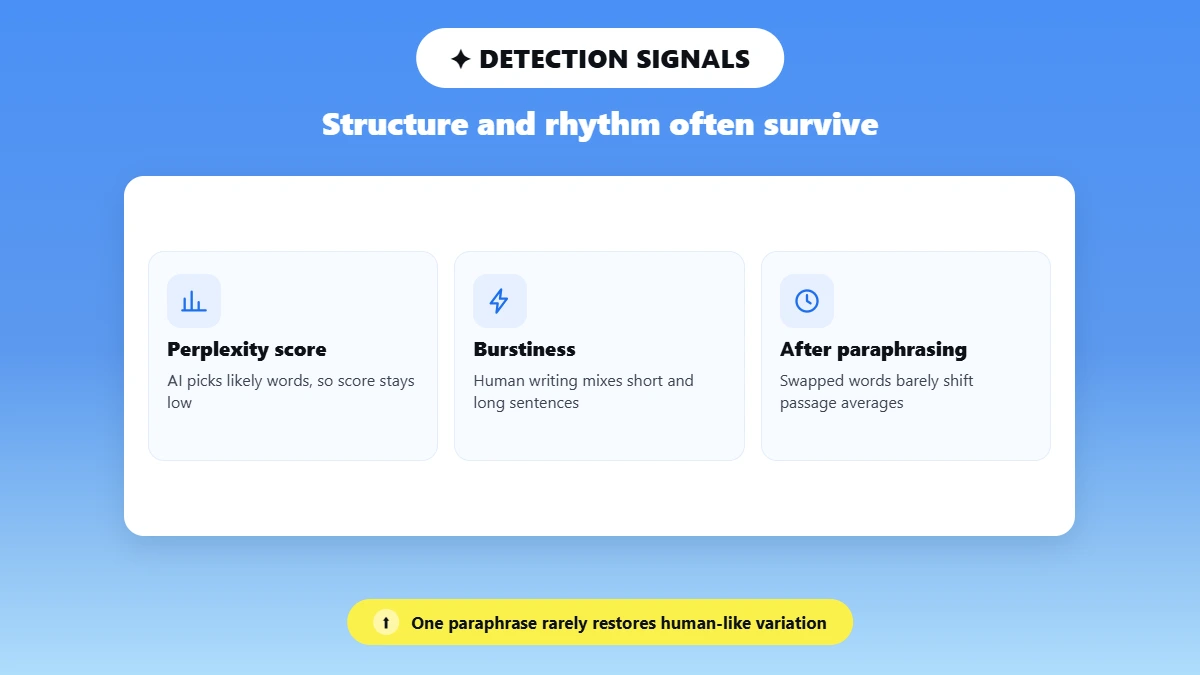
The statistical patterns of AI writing often survive a paraphrasing pass. Many detectors, and stylometric analysis in general, read sentence structure patterns across the whole passage rather than single words. Light paraphrasing barely touches those patterns.
Perplexity and Burstiness Explained
Perplexity Score: how predictable each next word is to a language model. AI text picks likely words, so its perplexity is low.
Burstiness: how much sentence length and complexity vary. Human writing tends to mix short and long sentences, while AI text stays even.
After Paraphrasing: a few swapped words barely move these passage-level averages, so one pass rarely restores human-like variation.
Why Sentence Rhythm Is Hard to Erase
Rhythm comes from sentence length and clause pacing, not individual word choice. Most consumer paraphrasing tools rework the sentence that already exists instead of rebuilding the paragraph.
So why do AI detectors still flag text after you use a paraphrasing tool? The signals they weigh most barely changed. Each detector also weighs these signals differently, which is one reason scores vary from tool to tool.
What the Research Says: From DIPPER to the Latest Studies
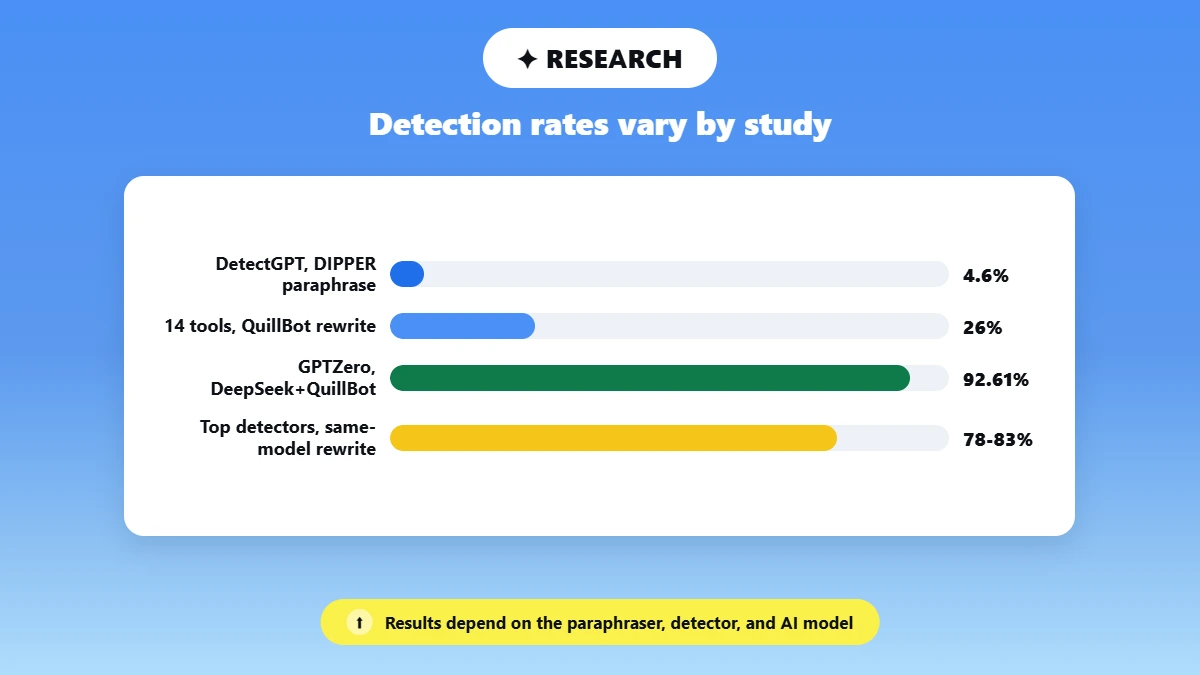
Research shows paraphrasing can sharply cut detection, but the drop depends on the paraphraser and the detector. Older studies set the baseline, and newer ones from 2025 and 2026 show the picture has shifted:
Krishna et al., NeurIPS 2023: DIPPER paraphrasing dropped DetectGPT’s accuracy from 70.3% to 4.6% at a 1% false positive rate.
Weber-Wulff et al., 2023: across 14 tools, AI text rewritten with QuillBot reached only 26% overall accuracy.
RAID Benchmark, 2024: over 6 million generations from 11 models, 8 domains, and 11 adversarial attacks.
Cheng et al., NeurIPS 2025: a simple paraphrase actually raised detection on two detectors, while detector-guided paraphrasing cut detection by an average of 87.88% across eight detectors.
Alshammari and Rao, 2025: after a QuillBot pass, GPTZero still gave DeepSeek text an average AI score of 92.61%. A humanize-mode rewrite lowered it to 52%.
Perrone and Romano, 2026: when AI text was rewritten by the same model, two top detectors still caught 78% to 83% of it at a 1% false positive rate.
Krishna et al.'s DIPPER Findings
DIPPER is an 11-billion-parameter research paraphraser, far stronger than most consumer tools. Its result shows how far one detector can fall in the lab, not that every detector fails.
What the RAID Benchmark Adds
RAID tests many detectors against many models and attacks at once, and found them “easily fooled by adversarial attacks”. At that scale, no single before-and-after example can stand in for every detector.
What Newer Studies Show
The 2025 and 2026 results point in one direction: a basic paraphrase is no longer enough to clear most modern detectors. In Cheng et al.’s tests, plain rewording sometimes made text easier to catch. The big drops came only from rewriting that was tuned against a specific detector.
The QuillBot study lines up with our own test below. GPTZero kept flagging paraphrased text with high confidence, and scores fell sharply only after heavier, humanizer-style rewriting.
So how accurate are detectors on paraphrased ChatGPT output? It depends on the year and the rewrite.
In Weber-Wulff’s 2023 test, only about one in four classifications was correct after a QuillBot pass. By 2025, GPTZero scored QuillBot-paraphrased text at over 90% AI on average, so results still shift with the tool, the paraphraser, and the model.
💡 Before you trust any study on paraphrased AI text, ask:
Which paraphraser? A research tool like DIPPER is far stronger than a free consumer tool.
Which detector and version? Detectors update often, so 2023 results may not hold today.
Which AI model wrote the text? Newer models write differently from the ones most studies used.
Our Test: Human, Raw AI, and Paraphrased AI Side by Side
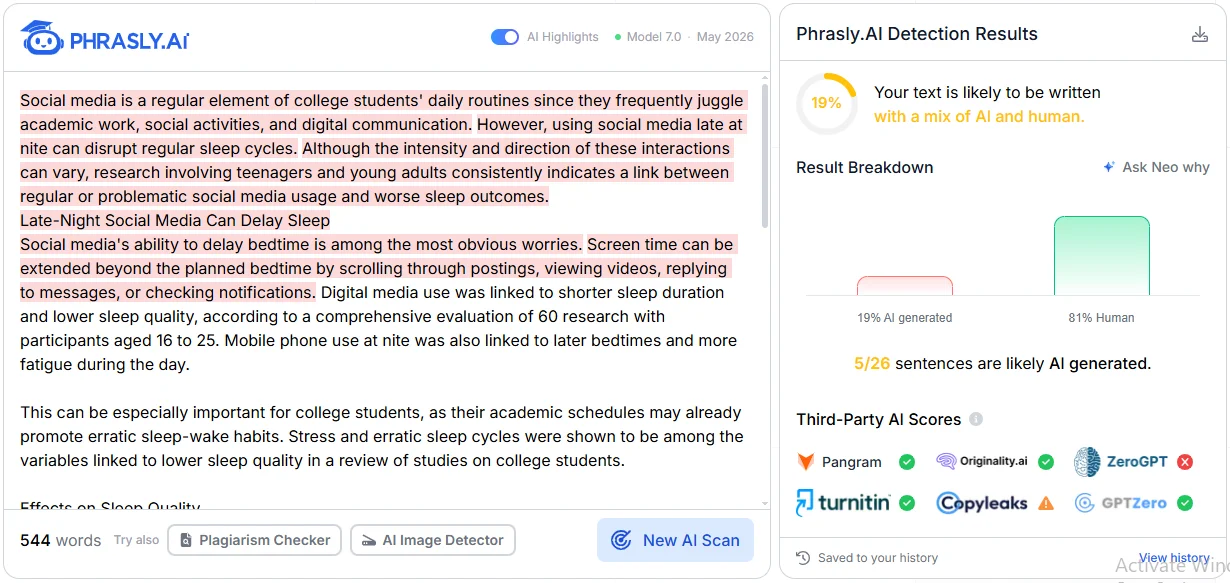
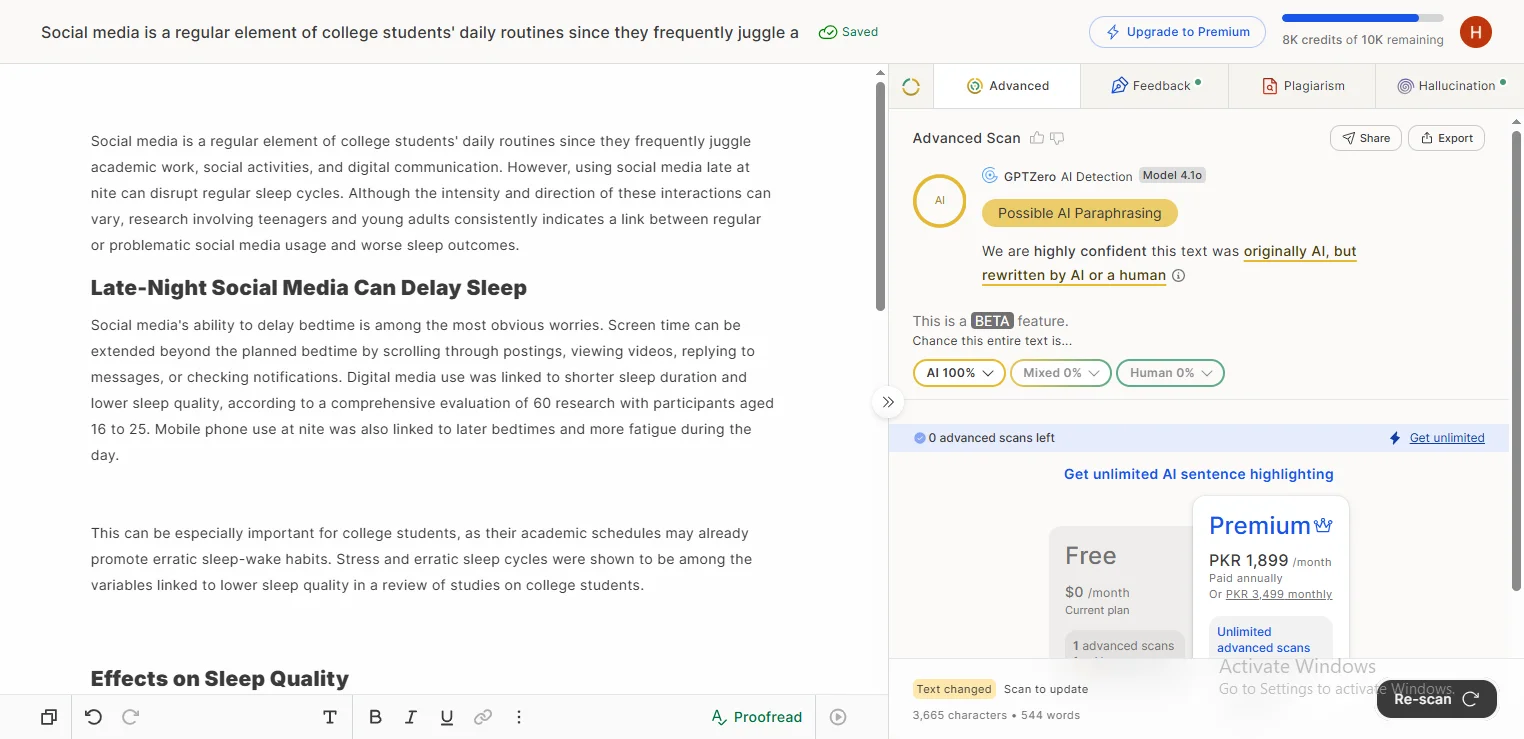
Both detectors got the human and raw AI samples right, then split on the paraphrased one. Phrasly AI Detector rated it “a mix of AI and human” instead of “likely AI.” GPTZero still scored it 100% AI and tagged it as possible AI paraphrasing.
The Three Samples We Used
On October 19, 2026, we scanned three samples on how social media affects college students’ sleep, once each in Phrasly AI Detector (Model 7.0) and GPTZero (Model 4.1o, Advanced Scan):
Human: an article written by a person, 640 words.
Raw AI: an unedited article by Claude on the same topic, 500 words.
Paraphrased AI: the Claude article after one pass of the QuillBot paraphrasing tool (free plan, Standard mode, one paragraph at a time because of its 100-word limit), 544 words.
What Each Detector Reported
Sample | Phrasly AI Detector | GPTZero | Flagged as AI? |
|---|---|---|---|
Human | 14% AI, likely human, 0 of 30 sentences flagged | 100% human | No, by both |
Raw AI | 30% AI, likely AI, 8 of 26 sentences flagged | 100% AI | Yes, by both |
Paraphrased AI | 19% AI, mix of AI and human, 5 of 26 sentences flagged | 100% AI, Possible AI Paraphrasing | Phrasly: partly. GPTZero: yes |
Paraphrasing changed word choice, not the topic, claims, or paragraph order, and cut Phrasly's flagged sentences from 8 to 5 without clearing the text.
Both tools are machine generated text classifiers that score patterns, not writing quality. An AI text humanizer vs AI detector is a different matchup, and so is AI humanizer vs paraphrasing tools, since we tested only a paraphraser.
Looking for a way to make AI text pass a detector without losing meaning? This test points the other way: the rewrite changed meaning in small places, and GPTZero still flagged it as 100% AI.
Disclosure: Phrasly publishes this article and makes one of the two detectors used. Each sample was scanned once, and we did not test Turnitin. One sample per type cannot give an accuracy rate or rank the tools.
Before you submit, run your own draft the same way: more than one detector, and a look at which sentences get flagged, not just the score.
🔍 Check Your Paraphrased Draft Before You Submit
Run it through Phrasly AI Detector, then compare the result with a second tool and your own notes.
Turnitin and QuillBot: What Actually Happens
Can Turnitin detect paraphrased AI text? It is built to. Turnitin added AI paraphrasing detection in July 2024 and AI humanizer detection in August 2025.
Turnitin's AI Paraphrase Layer
Coverage: Turnitin AI writing detection flags text changed by AI paraphrasers or bypassers, but only for English submissions.
Named Tools: does Turnitin detect AI paraphrasing tools like QuillBot or Spinbot by name? It says it cannot disclose which tools it covers.
Visibility: the report is for instructors, so students usually see no score.
For the full breakdown, see Can Turnitin Detect QuillBot?
QuillBot's Detection Behavior
Does Turnitin detect QuillBot every time? There is no independent test of today’s versions. The closest figure is Weber-Wulff’s 2023 study, where text run through the QuillBot paraphrasing tool was classified correctly only 26% of the time, averaged across 14 detectors, not Turnitin alone.
Will Turnitin flag your paper if you rewrite AI content yourself? It can, because Turnitin scores the final text, not who made the edits. Light rewording often leaves AI patterns in place.
For tool-by-tool results, see how QuillBot performs against AI detectors.
⚠️ A low score elsewhere is not a Turnitin forecast. Phrasly, GPTZero, and other public tools use their own models and thresholds, so no outside result can predict your school’s Turnitin report.
Why AI Detectors Disagree and How to Read a Score
Detectors disagree because each learned from different text, uses its own threshold, and weighs perplexity and burstiness differently. That is why AI detectors give different results on the same paraphrased paragraph, as our test showed.
So can AI detectors catch paraphrased AI content consistently across tools? Not yet. In the research above, one paraphrasing method sent a single detector from 70.3% to 4.6%, and RAID’s scale shows why no single score holds across every paraphrasing style.
The false positive rate matters too. One Stanford study found detectors biased against non-native English writers, which complicates academic integrity policy decisions.
Why Tools Score the Same Text Differently
Training Data: each model learned from its own mix of human and AI text.
Thresholds: each tool sets its own line for “likely AI.”
Sensitivity: some react more to paraphrasing patterns, others to raw AI patterns.
A Quick Checklist Before You Trust a Score
✅ Before you act on a detector score:
Run the text through more than one detector.
Check whether the tool shares a false positive rate.
Treat a borderline score as a reason for a human review process, not a verdict.
Confirm the detector supports your language.
Check Your Draft Before You Submit
A paraphrased draft can still be flagged, and a low score proves nothing on its own.
Keep your notes and version history, and learn how to protect yourself from AI detector false positives.
Need Another View of Your Draft?
Look at which sentences Phrasly flags, not only the overall number, and treat the result as one signal among several.
FAQs
Can AI Detectors Detect Paraphrased Text?
Often yes, but not every time. AI detectors can detect paraphrased text when its rhythm and predictability patterns survive, though scores usually drop compared with raw AI output. Detection is a probability, not a yes or no, and it varies by detector and by how heavily the text was reworded.
Can AI Be Detected If You Paraphrase It?
Often, yes. Light paraphrasing, like synonym swaps, rarely removes the patterns detectors read, and heavier restructuring lowers the odds without guaranteeing a pass. Detectors look at structure and burstiness across the whole passage, not just word choice, so surface edits are often not enough to change the result.
Can AI Detectors Catch Paraphrased AI Content?
They catch part of it. In 2023, 14 detectors averaged 26% accuracy on QuillBot-paraphrased text, and a research paraphraser called DIPPER cut one detector’s rate to 4.6%. GPTZero still flagged our QuillBot sample as 100% AI, so compare which AI checkers are most accurate.
Will Paraphrasing Avoid AI Detection?
Not reliably. If you are looking up how to avoid AI detection when paraphrasing, or the best AI paraphrasing tool to avoid detection, know that paraphrasing lowers a detector’s confidence rather than removing it. There is no dependable answer to how to make AI text undetectable, and Turnitin now checks English submissions for paraphrasing.
How Do AI Detectors Work on Paraphrased Content?
They use the same signals as for raw AI text: perplexity, burstiness, and sentence predictability, usually with lower confidence. Some add layers for paraphrasing, like Turnitin’s paraphrase check, GPTZero’s paraphrasing tag, and the meaning-based comparison the Copyleaks detection engine describes. These layers are new, so treat any result as one signal.

Written by
Hasnain
Karachi, Pakistan
I help businesses grow with SEO-friendly blog posts, landing pages, and long-form content. With 3+ years of experience, I deliver clear, original, and well-researched writing that drives results.