Winston AI Vs GPTZero: Accuracy, Features and Cost (2026)
11 min read
Winston AI vs GPTZero comes down to the report you need.
Winston AI suits reviewers who scan PDFs, images, or handwriting. And want a 0 to 100 Human Score. GPTZero suits students and educators who want a human, mixed, or AI label. A free plan and Writing Replay.
We ran the same AI, mixed, and human passages through both tools on the same day. Six scans in total, and report exactly what each one said.
Disclosure: Phrasly publishes this comparison and makes its own AI detector and humanizer. Phrasly was not part of the six scans.
Check Your Draft with Phrasly's Free AI Detector
Winston AI Vs GPTZero at a Glance
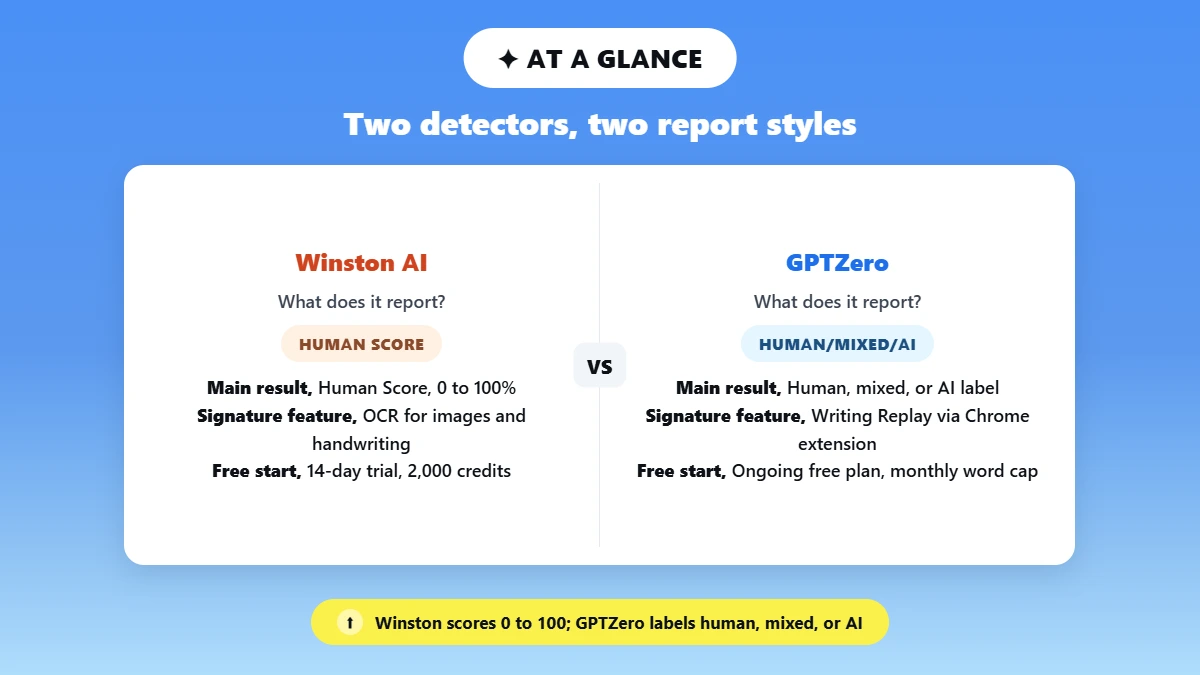
Both tools flag AI-like writing. But they report it differently.
Winston AI returns a Human Score from 0 to 100 with a sentence-level prediction map. It also reads scanned pages through OCR.
GPTZero labels a whole document as human, mixed, or AI with probabilities. And its Writing Replay shows how a draft was built.
| Winston AI | GPTZero |
Main result | Human Score (0 to 100%) | Human, mixed or AI label with class probabilities |
Review workflow | AI Prediction Map with highlighted sentences | Sentence highlighting |
Signature feature | Winston AI OCR for images and handwriting; plagiarism checking (2 credits per word) on the Essential (Plagiarism), Advanced and Elite plans; the standard Essential plan covers AI detection only | GPTZero Writing Replay, which records drafting in Google Docs via a free Chrome extension |
Free starting point | 14-day trial with 2,000 credits | Ongoing free plan with a monthly word cap |
Humanizer offered | ❌ No | ❌ No |
For deeper single-tool detail, see this Winston AI review and look at how accurate GPTZero is.
What Do Winston AI and GPTZero Scores Actually Mean?
A detector score is a confidence signal. Not a count of AI-written words.
Winston AI's Human Score shows how closely a document resembles human writing. GPTZero probabilities show how sure it is about a human, mixed, or AI label.
Different scales and categories are a big part of why AI detectors disagree.
According to Winston's help center, the Winston AI Human Score runs from 0 to 100%.
Near 100% reads as human-written. Near 0% reads as almost certainly AI.
Its AI Prediction Map colors each sentence in five bands. From AI Generated (0 to 20) to Human Written (80 to 100). Winston says the sentence map is less accurate than the overall score.
And treats 40 to 60% as inconclusive. So don't read the bands as whole-document verdicts.
GPTZero’s support guide to its results describes three document classes (HUMAN_ONLY, MIXED, and AI_ONLY).
A probability for each, and a high, medium, or low confidence category.
That third class is what people mean by a GPTZero mixed score. The web report may word things differently. So quote what your report actually shows.
GPTZero also says it stopped relying on perplexity and burstiness in autumn 2023. After moving to a deep-learning model.
Does a 50% Score Mean Half the Text Is AI?
No! A document that is half AI can get a confident AI label. A mixed label, or an uncertain score. Winston says an 80% human score means 80% confidence. Not 20% AI content.
For more, read how AI detectors work and what your AI detection score means.
How We Tested: 3 Samples, 6 Scans
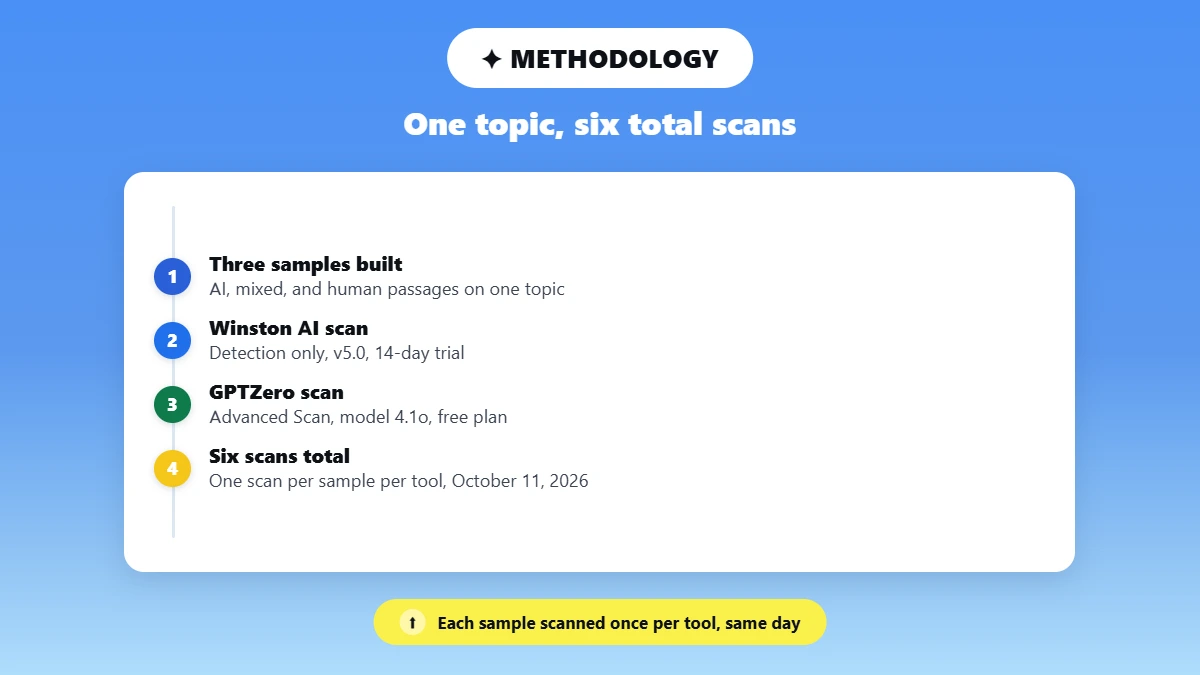
On October 11, 2026, we ran three passages on one topic.
The "Should small businesses adopt a four-day workweek?", through Winston AI and GPTZero once each. That made six scans in total. All on the same day.
Sample | Known provenance | Scans |
A1: AI | ChatGPT (GPT-6), one unedited generation, 501 words | 2 (one per tool) |
M1: Mixed | The first two paragraphs of H1, then the last two paragraphs of A1, joined at a paragraph boundary: 570 words | 2 |
H1: Human | Written by writer with no AI help, draft history kept, 629 words | 2 |
Winston ran in AI detection only. With plagiarism, fact-checking, and grading turned off, on Human Score v5.0 (14-day free trial). GPTZero ran its Advanced Scan, model 4.1o, on the Free plan.
Our samples ran 501 to 629 words, longer than our planned 350 to 450 but well above the 300 words Winston recommends for a confident result (Winston content guidance).
Each sample was scanned once per tool, with no reruns.
Limits: Three samples, one topic, one generator, English only. The mixed sample reuses the other two. These are demonstrations. Not accuracy rates, and no humanizer touched any sample.
Test Results: AI, Mixed, and Human Writing
Both tools got the clear-cut samples right.
Each flagged the AI passage and cleared the human passage with high confidence. They split on the mixed sample.
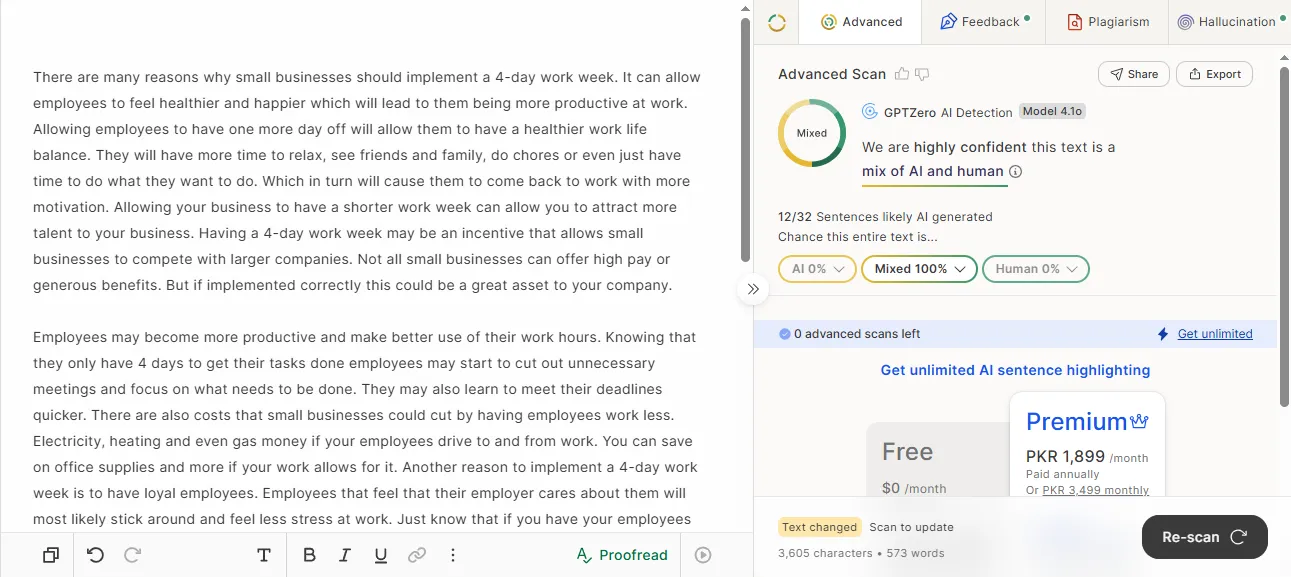
GPTZero labeled it “a mix of AI and human” with high confidence, while Winston returned an inconclusive 53% Human Score that it says could mean human, AI, or both.
Its sentence map, though, colored the human paragraphs green and the AI paragraphs red.
Sample | Detector | Native score and label | What happened |
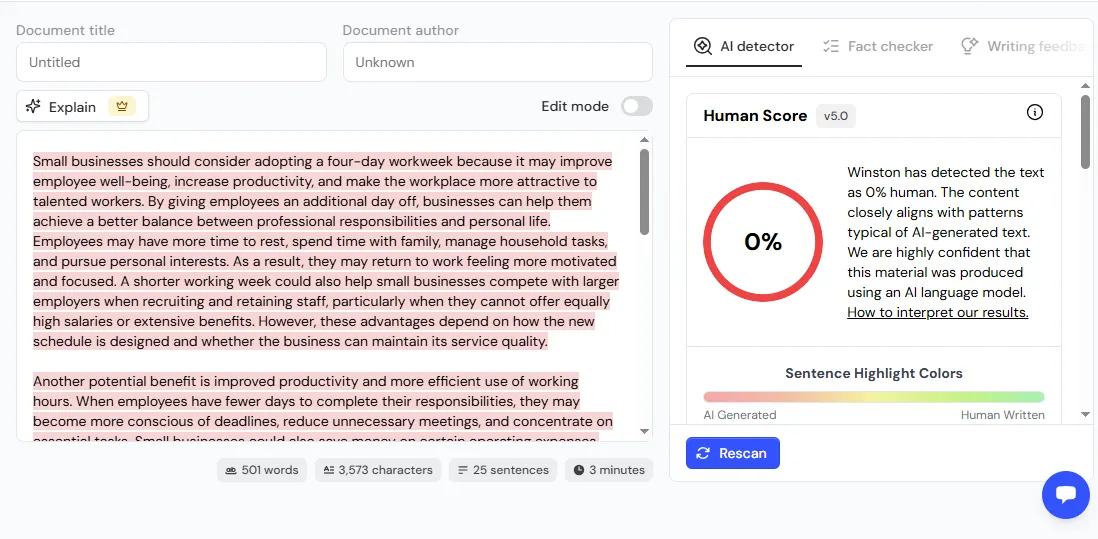
A1: AI | Winston AI | 0% Human Score (v5.0): “highly confident” AI-generated | ✅ Flagged AI; sentences highlighted red |
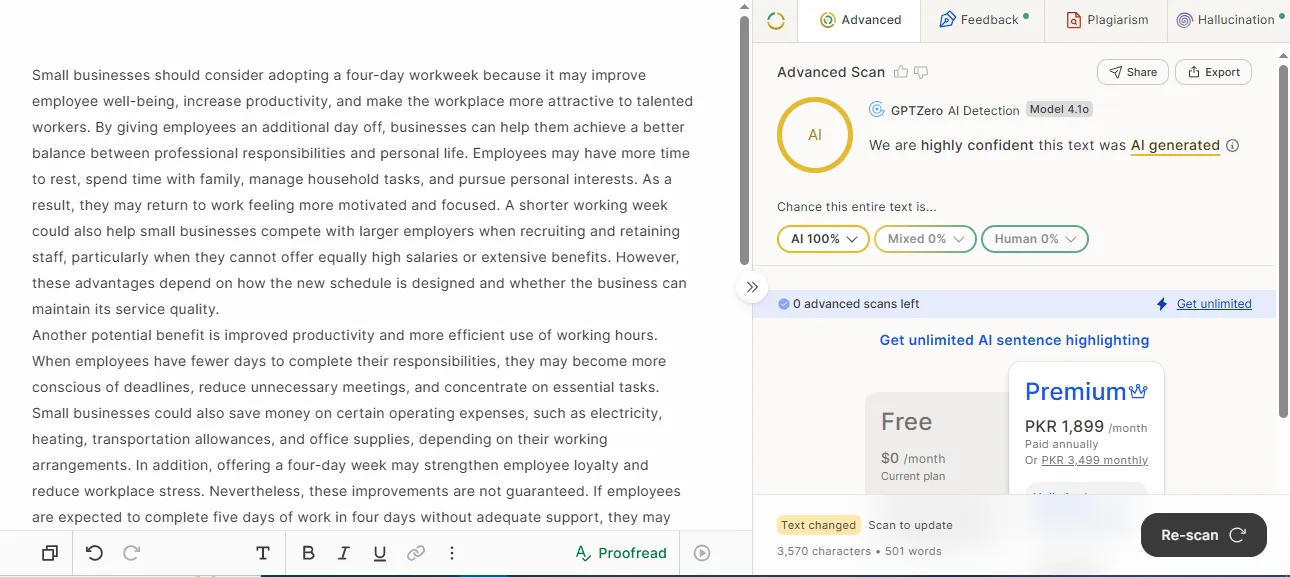
A1: AI | GPTZero | AI 100%, Mixed 0%, Human 0%: “highly confident” AI generated | ✅ Flagged AI |
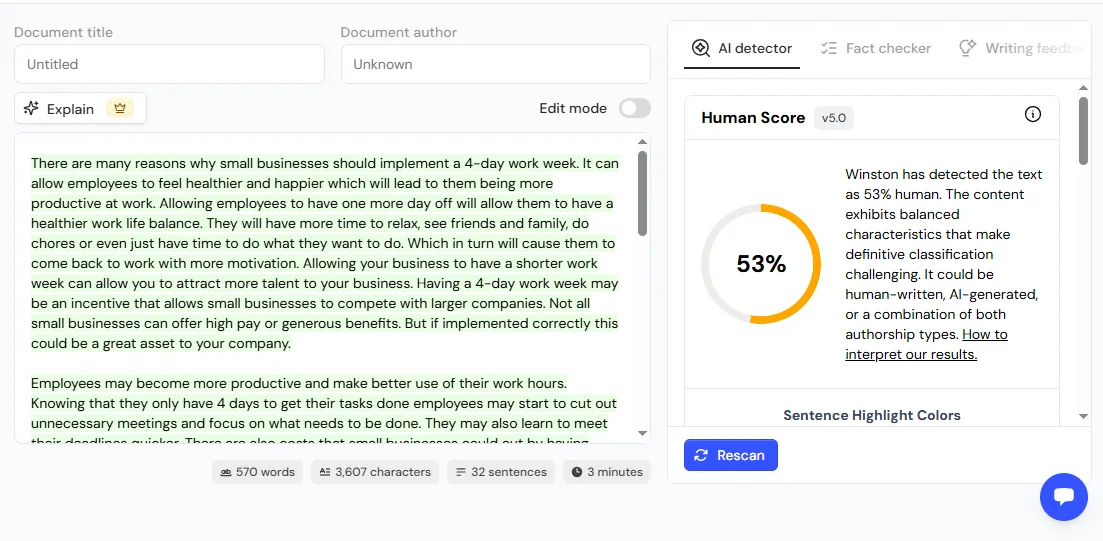
M1: Mixed | Winston AI | 53% Human Score: could be human, AI, or a combination | ⚠️ Uncertain score, inside Winston's own 40 to 60% inconclusive range; but human paragraphs highlighted green and AI paragraphs red |
M1: Mixed | GPTZero | Mixed 100%, AI 0%, Human 0%: “highly confident” mix; 12 of 32 sentences likely AI | ✅ Mixed label; sentence highlights locked on the Free plan |
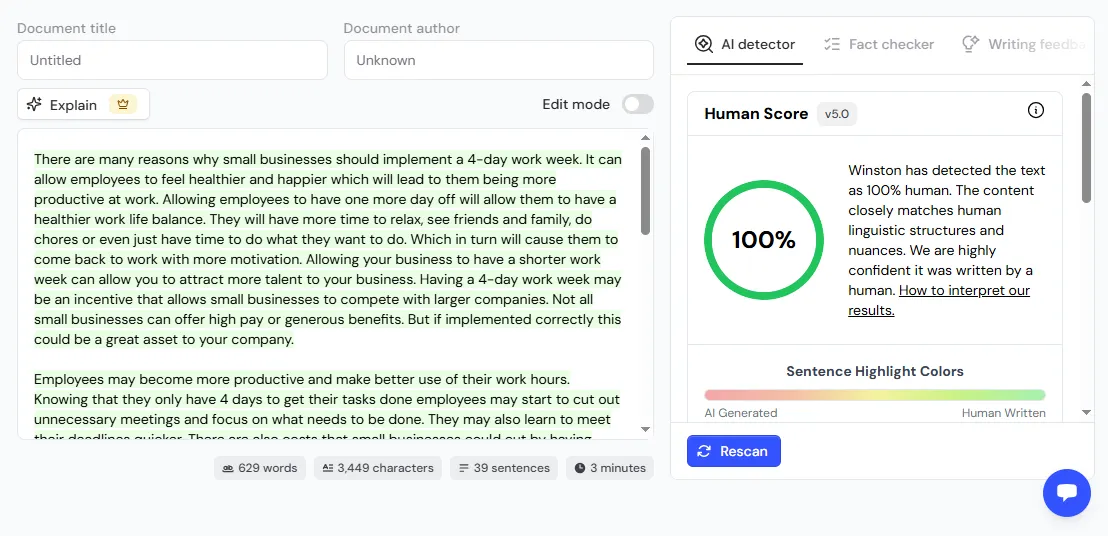
H1: Human | Winston AI | 100% Human Score: “highly confident” human | ✅ Human |
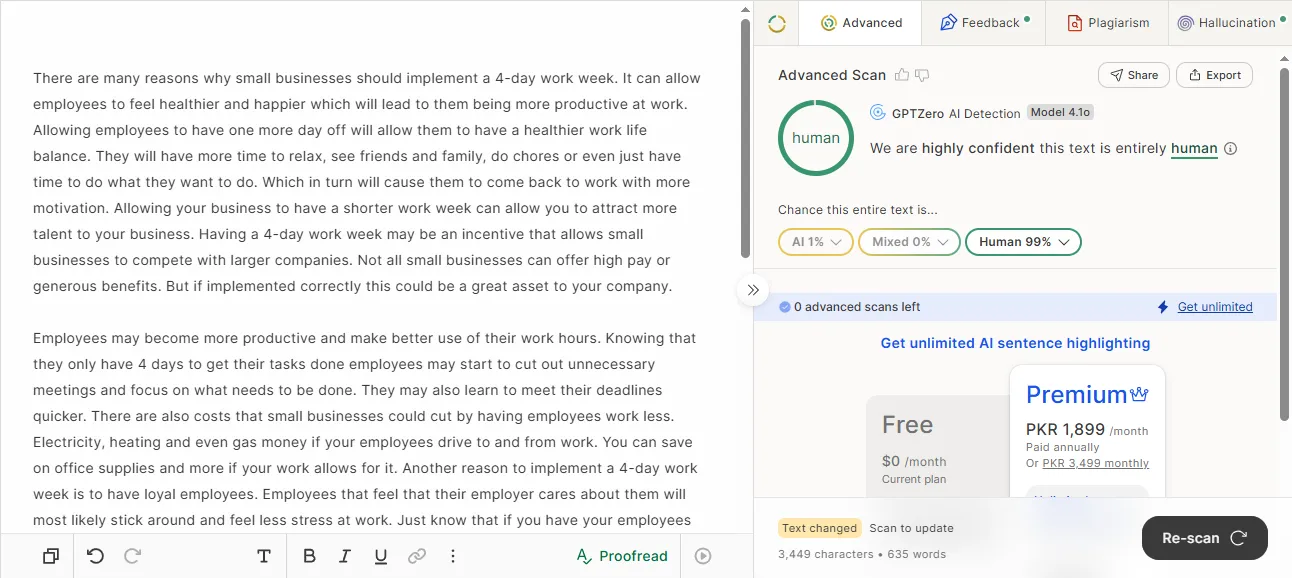
H1: Human | GPTZero | Human 99%, AI 1%, Mixed 0%: “highly confident” entirely human | ✅ Human |
Tested October 11, 2026, with frozen passages. One scan per sample per tool. Modes: Winston AI detection only (v5.0); GPTZero Advanced Scan (model 4.1o, Free plan).
AI-Generated Sample
On October 11, 2026, Winston AI returned a 0% Human Score for the AI sample, while GPTZero rated it 100% AI. Both received the same 501-word passage from ChatGPT (GPT-6).
This shows both tools catch an unedited, single-model AI essay with high confidence; it does not establish general accuracy.
A score under 100% confidence is not automatically wrong.
Mixed Sample
AI involvement: Both tools signaled it. GPTZero said 12 of 32 sentences were likely AI. And Winston's 53% score fell in the range it calls inconclusive.
Mixed label: Only GPTZero gave one, “a mix of AI and human”, with high confidence. Winston has no mixed class, but its explanation said the text could be a combination of both.
Paragraph boundary: Winston's sentence map shaded the human paragraphs (1 and 2) green and the AI paragraphs (3 and 4) red, so it located the boundary correctly even though its overall score was inconclusive.
GPTZero locks sentence highlighting on its Free plan.
So we couldn't check its boundary. This is where an AI detector for mixed content earns its keep. And closeness to 50% is not the test.
Human-Written Sample
Both tools gave a clear human signal. Winston scored the 629-word passage 100% human. And GPTZero rated it 99% human (1% AI), each with high confidence. Neither produced a false positive.
One human control cannot give a false-positive rate. This writer kept the full draft history.
Is Winston AI More Accurate Than GPTZero?
On our three samples, it's a tie on the clear-cut cases: Both tools flagged the AI passage. And cleared the human one with high confidence. On the mixed passage, GPTZero gave the clearer verdict, naming it a mix outright.
Winston's score was an inconclusive 53%, but its sentence map pinpointed the AI paragraphs, which GPTZero's Free plan couldn't show. Three samples can't crown a winner, so decide by workflow and cost.
Both vendors publish high accuracy figures. But neither benchmark tests these two tools against each other on the same text.
Keep two errors apart. A missed AI sample is a false negative. A flagged human sample is a false positive. Mixed-sample performance has three parts. AI involvement, the mixed label, and paragraph localization.
Vendor claims. Not independent facts. GPTZero’s February 5, 2026 benchmark reports 99.76% accuracy. A 0.08% false-positive rate for its model 4.3b. But Winston AI isn't in its comparison tables.
Winston's own comparison page claims 99.87% accuracy for Winston 5.0. Neither settles this pairing.
Independent research adds a caution.
An August 2026 preprint, "Why AI Detection Fails for Academic Integrity", found that lightly AI-edited abstracts could be flagged.
This blurs the line between assistance and authorship.
In this test of nine AI checkers, both tools were included.
Those were different samples. So they aren't merged with the six scans here.
When two reports disagree, run the same passage through Phrasly's AI checker as a third signal. Then compare the highlighted sentences. Not just the headline scores.
Winston AI Vs GPTZero Pricing and Free Plans
Winston AI starts with a 14-day trial of 2,000 credits. Then sells monthly credit plans where an AI scan costs one credit per word.
GPTZero has an ongoing free plan with a monthly word cap. And paid tiers for heavier use. Compare words or credits per month and billing period. Not just the headline price.
Cost question | Winston AI | GPTZero |
Free access | Winston AI free trial: 14 days, 2,000 credits | Free plan with 10,000 words a month |
Paid entry plan | Essential: 100,000 credits a month, monthly or yearly billing | Essential (150,000 words a month), Premium (300,000) and Professional (500,000) |
How usage is counted | Credits: 1 per word for AI detection, 2 per word for plagiarism | Words per month, with per-scan limits by plan |
Watch for | Temporary coupons on the live page; add-ons use more credits | Monthly vs annual pricing; features differ by tier |
We have left out dollar figures. Confirm current prices on each tool's pricing page.
🧮 What a Trial Actually Covers
A 1,500-word essay uses about 1,500 Winston credits for AI detection alone. So, the 2,000-credit trial covers roughly one full essay.
Check the GPTZero free plan limits the same way. Occasional self-checks may fit a free option. Teams should compare batch limits, report sharing, and the features they'll actually use.
Winston AI or GPTZero: Which Should You Choose?
Choose by workflow. Not by headline accuracy.
Winston AI fits reviewers who scan PDFs, images, or handwriting. And want plagiarism checking in the same credit pool.
GPTZero fits anyone who wants an ongoing free plan and a three-way label. Also a record of how a draft was written.
✅ Choose Winston AI if you scan PDFs, images, or handwriting (OCR), want plagiarism checks in the same credits. Or prefer a 0 to 100 score with a sentence map.
✅ Choose GPTZero if you want an ongoing free plan. A human, mixed, or AI label, or Writing Replay to show your drafting process. That's the case for GPTZero vs Winston AI when cost matters most.
⚠️ Don't rely on either alone when a grade or job is at stake. Drafts, notes, and the relevant AI policy matter more than one score.
👊 Weighing more tools? If your search was GPTZero vs Originality.ai vs Copyleaks vs Winston AI for 2026, start with this Copyleaks vs GPTZero comparison. We didn't run a four-tool test here.
What Should You Do When Winston AI and GPTZero Disagree?
Keep your text and both reports. Then compare what each score actually measures.
Read the highlighted sentences in context. Check your drafts and the relevant AI policy.
And revise only where it makes the writing clearer. Rewriting again and again to move a number rarely explains why the tools disagreed.
Save the exact text and both reports. Confirm both tools scanned the same passage.
Check each score's definition and any uncertainty label. Such as Winston's 40 to 60% range.
Read the highlighted passages in context. Templates, quotes, and generic phrasing often get flagged.
Review your drafts, notes, and version history. Plus, the AI-use policy that applies.
Revise only where it improves clarity or voice. And keep facts, citations, and the record of any assistance intact.
⚠️ Don't Chase the Number
Editing over and over to change a score can make writing worse without explaining anything.
If your own work keeps getting flagged, read why your essay is detected as AI.
If AI help is allowed and your draft still reads stiff, Phrasly AI Humanizer can smooth the wording. Review meaning, facts, and citations before you submit, and disclose assistance where required.
Phrasly vs Winston AI vs GPTZero: Which Workflow Fits?
This is a workflow comparison. Not an accuracy ranking.
Phrasly was not part of the six scans. Winston AI and GPTZero focus on detection. While Phrasly pairs a free AI detector with a separate AI Humanizer for permitted, AI-assisted drafts.
Decision factor | Phrasly | Winston AI | GPTZero |
Main job | Check a draft, then refine permitted AI-assisted wording | Score and scan documents, including images via OCR | Classify writing and show the drafting process |
Humanizer included | ✅ Yes, a separate AI Humanizer | ❌ No | ❌ No |
Free starting point | Free AI detector; humanizer on free accounts (standard model), with more on paid plans | 14-day trial, 2,000 credits | Free plan with a monthly word cap |
Evidence in this article | Product features only; no scan | Three scans | Three scans |
Best fit | Writers who want checking and revision in one place | Reviewers who scan PDFs, images or handwriting | Students and educators who want labels and draft history |
Limit to state | No accuracy or detector-result claims | Findings apply to the recorded inputs and version | Findings apply to the recorded inputs and version |
If you want to check and revise in one place, Phrasly is worth a look.
Frequently Asked Questions
Is Winston AI More Accurate Than GPTZero?
There's no universal answer from three samples. See the results table for exactly what each tool did on these AI, mixed, and human passages. Treat both vendors' accuracy figures as their own claims.
Can Winston AI and GPTZero Detect Mixed AI and Human Writing?
GPTZero has a dedicated mixed label. Winston AI shows a Human Score plus a sentence map. A source that's half AI doesn't have to score 50% in either tool. So, read the highlights. Not just the number.
Can Winston AI or GPTZero Flag Human Writing as AI?
Yes! Any detector can be wrong. In our test, neither tool did: both rated our human sample as human. Keep your draft history. So you can show how your work was written.
Is GPTZero the Same as ZeroGPT?
No! They're separate products from different companies. This GPTZero vs ZeroGPT comparison explains the differences.
Do Winston AI or GPTZero Scores Predict Turnitin?
No! They use different models and reports. So follow your school's submission policy. See how Turnitin handles ChatGPT text.
Does Winston AI or GPTZero Have a Humanizer?
No! Both focus on detection. Phrasly offers a separate AI Humanizer for drafts where AI help is permitted.
Is GPTZero Free, and Does Winston AI Have a Free Plan?
GPTZero has an ongoing free plan with a monthly word cap. Winston AI offers a 14-day trial with 2,000 credits rather than a permanent free plan.

Written by
Muhammad Usman Ali
Pakistan
Muhammad Usman Ali is an experienced SEO content writer with 3+ years of professional writing experience. He specializes in AI tools, AI detection technologies, and search engine optimized content.