Best AI Detector for Teachers (2026): 6 Tools Compared
14 min read
The best AI detector for teachers is usually the one your school already provides and approves. If that is Turnitin, start with its AI writing report; if your school uses another approved tool, check that first.
If your school provides nothing, or you need something beyond it, GPTZero and Pangram offer the most classroom features, Copyleaks suits LMS-based schools, and Phrasly and GPTinf are the simplest free options for a quick check.
Whatever you use, get approval before uploading student work, and treat any score as a signal, not proof. We ran the same four writing samples through five of these tools.
Check an Essay Excerpt With Free AI Detector 👇
Note: Only upload work your school allows. The result is a screening signal, not proof.
Which AI Detector Is Best for Your Teaching Situation?
The best AI detector depends on your teaching situation. Teachers with Turnitin already have a built-in AI report. Teachers without it who want Turnitin alternatives inside Google Classroom or Canvas can consider GPTZero, Pangram or Copyleaks. For a one-off free check of text you're allowed to upload, Phrasly and GPTinf are the easiest. Any score is a signal, not proof.
Your situation | Start with | Watch out for |
|---|---|---|
Your school already licenses Turnitin | Turnitin's AI writing report | Needs 300+ words of long-form prose, and the score is not proof |
You want checks inside Google Classroom or Canvas | GPTZero, Pangram or Copyleaks integrations (Vendor Listed) | May need school approval or admin setup |
You want a quick free check of one permitted excerpt | Phrasly or GPTinf | Upload only what your school allows |
You want to see how a document was written | GPTZero's Google Docs writing replay (Vendor Described) | Confirm the feature and plan tier before relying on it |
You teach multilingual writers | No universal winner; check each tool's supported languages | Review every flag with drafts and a conversation |
You grade short answers, code, poems or tables | Do not rely on a detector | Turnitin says it does not reliably detect these formats |
You do not have permission to upload student work | No tool; use drafts, version history and a conversation | Removing a name alone does not settle school policy |
How We Compared These AI Detectors
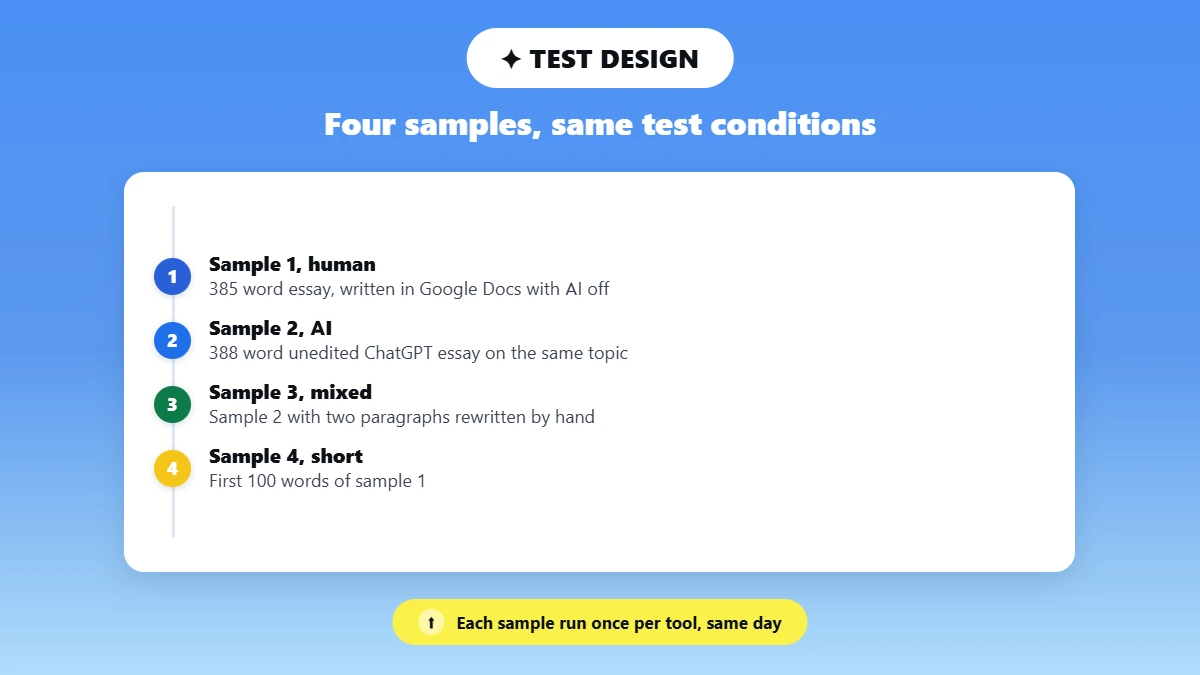
We tested five free AI detectors on September 28, 2026, using four writing samples and one check per sample per tool. Here is what we ran.
How We Compared
We ran the same four samples through the free versions of Phrasly, GPTZero, Pangram, Copyleaks and GPTinf.
Sample 1 (human): a 385-word essay on school phone bans, written in Google Docs with Grammarly, Smart Compose and all AI features off. Version history kept as proof.
Sample 2 (AI): an unedited 388-word ChatGPT (GPT-5.6 Luna) essay on the same topic, from a fixed 10th-grade prompt.
Sample 3 (mixed): Sample 2 with paragraphs 2 and 4 rewritten by hand; paragraphs 1, 3 and 5 unchanged (401 words).
Sample 4 (short answer): the first 100 words of Sample 1.
Each check ran once, and we recorded the headline result in the tool's own words. We did not test Turnitin, which is sold to institutions; its details come from Turnitin's guides. Four samples show how tools behave, not how accurate they are; for a wider view, see our 16-sample AI checker test of nine tools. Phrasly publishes this guide and makes one of the tools compared.
Throughout this guide we keep three kinds of claims apart: what we observed, what vendors say and what published research found. Our Phrasly test checks ran while signed in to a free account.
Six AI Detectors for Teachers Compared
In our small test, all five tools we ran labeled the human essay as human, but they split on the partly rewritten one.
Tool | Best fit | Free access | School / LMS use | What you get | Known limit |
|---|---|---|---|---|---|
Phrasly | Quick standalone check outside an LMS | Free; 3 checks without login, then asks you to log in | No LMS integration claimed | AI score and sentence highlighting (observed while signed in) | Get school approval before uploading student work |
GPTZero | Teachers who want classroom features | Free start; basic scans ran without login in our test | Vendor lists Google Classroom, Canvas, Google Docs, Chrome | Score plus writing replay (vendor-described) | Small false-positive rate in a 2026 peer-reviewed study |
Turnitin | Schools that already license it | Not sold to individuals | Inside institutional LMS setups | AI writing report, separate from Similarity | 300+ words of prose; no score shown for 1% to 19% |
Pangram | Teachers who want independent research behind a tool | Free credits; ran without login, credit count dropped each check | Vendor lists Canvas, Moodle, Google Classroom, browser extensions | Sentence-level results (vendor-described) | Its own accuracy figures are vendor claims |
Copyleaks | Schools wanting AI and plagiarism checks in the LMS | Up to 25,000 characters without login (vendor); ran without login | Vendor lists Canvas, D2L, Moodle, Blackboard, Schoology and more | AI detection plus plagiarism checking | Institutional pricing through sales |
GPTinf | Another free, no-account option | Free and unlimited with no signup (vendor); ran without login | No LMS integration found | Score it says is cross-checked against 8 detectors (vendor) | Not covered by the studies cited here |
Last verified: September 28, 2026. Vendor features and free limits change often, so check each tool's own page before you rely on them.
What Happened in Our Test
Each cell shows the tool's own label and main score, as recorded on September 28, 2026.
Sample | Phrasly | GPTZero | Pangram | Copyleaks | GPTinf |
|---|---|---|---|---|---|
S1 Human (385 words) | Likely written by a human (86% human) | Entirely human (100% human) | Human Written (100% human) | No AI Content Found | Very likely human-written(3% AI GPT) |
S2 AI (388 words) | Likely written by AI (100% AI; 22/22 sentences) | Mixed, AI Polished (98% mixed, 0% human) | AI Generated(100% AI) | AI Content Found (100%) | Very likely AI-generated (99% AI GPT) |
S3 Mixed (401 words) | Likely written by AI (48% AI, 52% human; 7/14 sentences) | Mix of AI and human (97% mixed; 11/14 sentences) | AI Generated (100% AI), noted as likely paraphrased or rewritten | AI Content Found (100%) | Very likely AI-generated (98% AI GPT) |
S4 Short (100 words) | Likely written by a human (11% AI, 89% human; 0/6 sentences flagged) | Entirely human (100% human) | Human Written (100% human), marked Confidence limited, short text | No AI Content Found (0%) | Very likely human-written(0% AI GPT) |
Three things stood out:
No tool falsely flagged the human samples. All five labeled both the essay and the 100-word short answer as human; only Pangram noted lower confidence on the short text.
The mixed essay split the tools. Phrasly and GPTZero reported a mix; Pangram, Copyleaks and GPTinf called it all AI, though Pangram noted it looked rewritten.
GPTZero called both AI samples mixed. It labeled the unedited ChatGPT essay "AI Polished", so its mixed result did not clearly separate edited from unedited text.
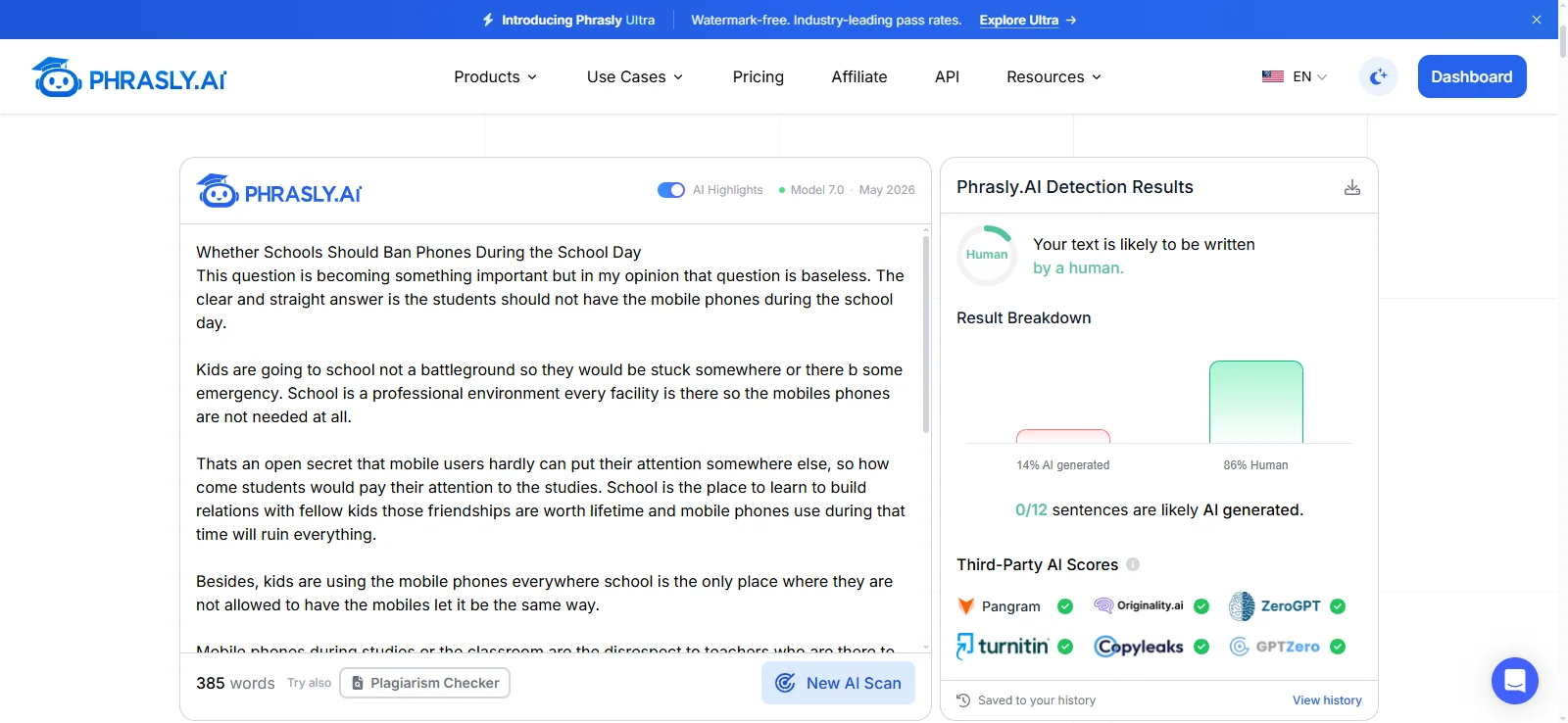
Phrasly AI Detector (Model 7.0) on Sample 1, the human-written essay: likely human, 86% human, 0 of 12 sentences flagged. Tested September 28, 2026, free account. 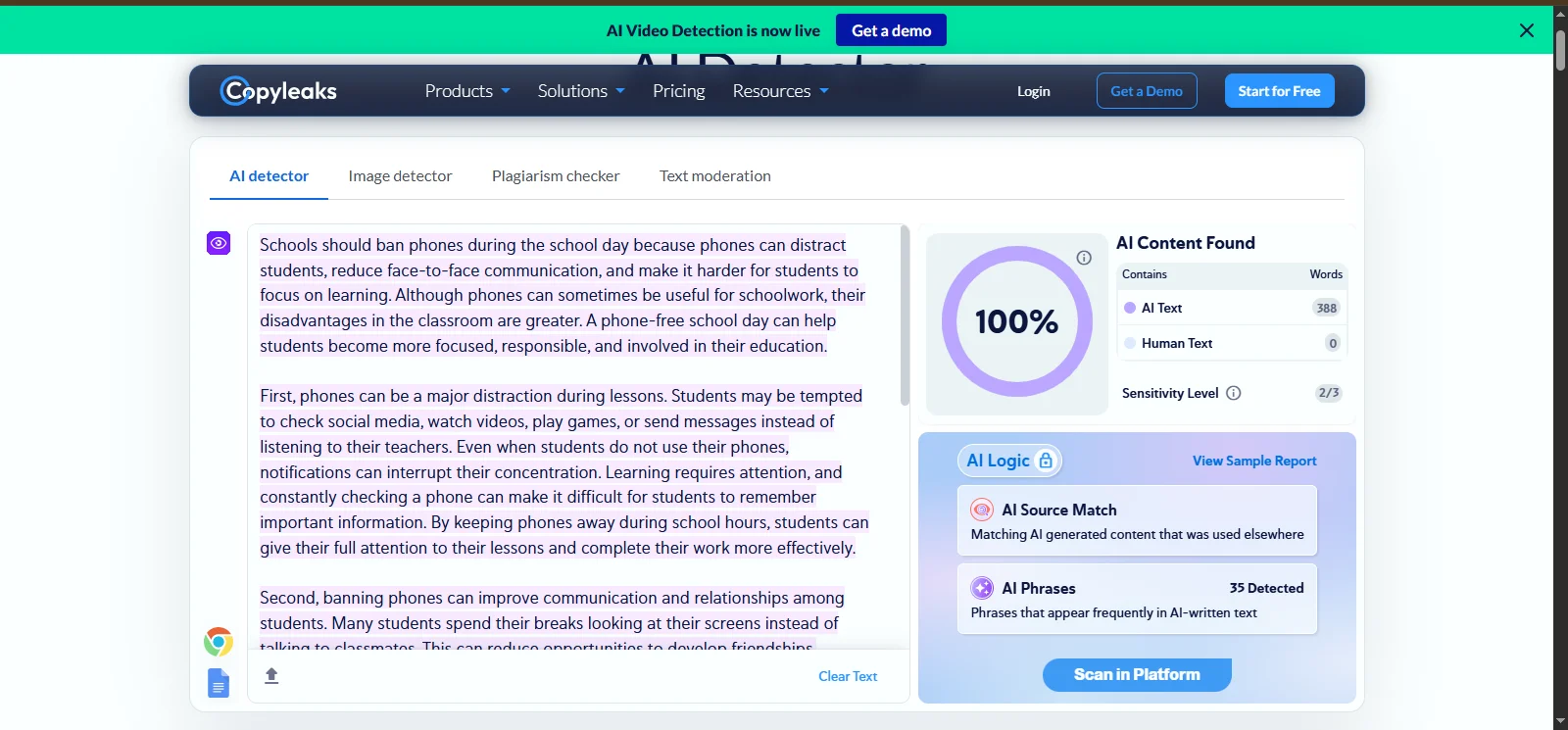
Copyleaks AI Detector on Sample 2, the unedited ChatGPT essay: AI Content Found, 100% AI, 388 of 388 words flagged. Tested September 28, 2026, free, no login. 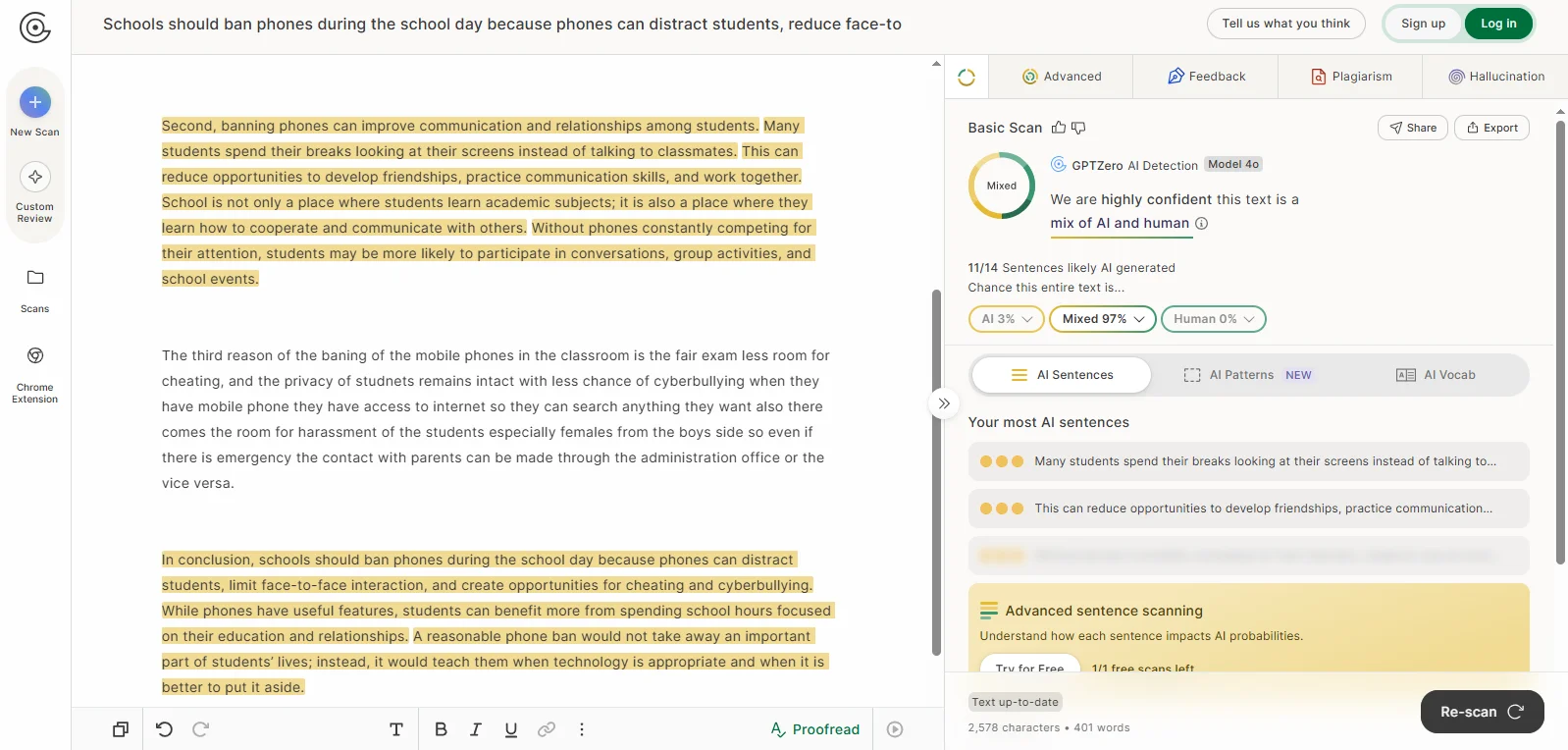
GPTZero (Model 4o) on Sample 3, the mixed essay: mix of AI and human, 97% mixed, 11 of 14 sentences likely AI. Tested September 28, 2026, free, no login.
Sample 1 (human) in Phrasly. Tested September 28, 2026, free account.
Sample 2 (unedited ChatGPT) in Copyleaks. Tested September 28, 2026, free, no login.
Sample 3 (mixed) in GPTZero. Tested September 28, 2026, free, no login.
Phrasly AI Detector: Best for a Quick Free Check
Phrasly's AI detector is a free, standalone checker for teachers who want a quick read on one excerpt outside their LMS, subject to school approval for student work.
When signed in, results show an AI score, a count of likely AI sentences and highlighted text.
In our test, it labeled both human samples human, the ChatGPT essay 100% AI and the mixed essay 48% AI.
Its limitation: it also highlighted one paragraph we had rewritten by hand.
Allowed to check student work with outside tools? Run a free Phrasly check on a short excerpt, and treat the result as a signal, not proof.
GPTZero: Best for Classroom Features
GPTZero is built around educator workflows. The company lists Google Classroom, Canvas, Google Docs and Chrome integrations, and describes a writing replay that shows how a Google Doc was written. Its educator page offers a free start without stating limits.
In our test, it was fully confident both human samples were human and gave the clearest highlights on the mixed essay. Its limitation: it labeled the unedited ChatGPT essay "AI Polished" rather than AI. To learn more about how it performs, see our GPTZero review.
Turnitin: Best If Your School Already Has It
Turnitin is sold to institutions, so most teachers use it through a school licence inside their LMS. We did not test it; these details come from Turnitin's own guide.
Its AI writing report is separate from the Similarity score and needs at least 300 words of qualifying long-form prose.
💡 Scores from 1% to 19% show as an asterisk, and the current guide lists English, Spanish, Japanese and Arabic. Its limitation, in Turnitin's own words: the report should not be the sole basis for action against a student.
Pangram: Best for Research-Backed Detection
Pangram lists educator integrations for Canvas, Moodle and Google Classroom, plus browser extensions, and shows sentence-level results.
It has independent research behind it: a 2026 peer-reviewed study found it placed 37 of 40 hybrid and 37 of 40 humanised papers in the expected range.
Its own higher accuracy figures are vendor claims. In our test, it labeled both human samples human and both AI samples 100% AI. Its limitation: it scored the mixed essay the same as pure AI, though it noted the text looked rewritten.
For a closer look at its features and results, read our Pangram AI detector review.
Copyleaks: Best for LMS-Integrated Schools
Copyleaks combines AI detection with plagiarism checking and lists LMS integrations including Canvas, D2L, Moodle, Blackboard and Schoology.
Its detector page says you can check up to 25,000 characters free without logging in.
In our test, it found no AI in either human sample and 100% AI in both AI samples. Its limitation: it did not separate the hand-edited essay from the unedited one.
Institutional pricing goes through sales. To see how it held up in a bigger test, check out our Copyleaks accuracy test.
GPTinf: Another Free No-Account Option
GPTinf says its detector is free and unlimited with no signup, and that its score is cross-checked against eight detection systems; both are vendor claims.
In our test, it labeled both human samples very likely human-written and both AI samples very likely AI-generated (99% and 98%).
Its limitation: it lists no LMS integration, and none of the studies cited in this guide included it.
If you want a fuller picture of how it works, take a look at our GPTinf AI detector review.
What Is the Best Free AI Detector for Teachers?
The best free AI detector for teachers is one your school allows you to use. For a quick standalone check, Phrasly offers free detection, and GPTinf and Copyleaks work without an account. GPTZero and Pangram have free starts with limits. Just remember that free does not mean approved.
In our September 2026 check, GPTinf, Copyleaks, GPTZero and Pangram all ran four checks without asking us to sign in. Pangram showed a credit counter that went down with each check, and GPTZero limited its advanced sentence scan to one free use.
Signed out, Phrasly allowed three checks and asked us to log in before a fourth; our test checks ran signed in to a free account.
Using a free tool on your own is different from your school buying one. A school contract usually comes with a data agreement and admin controls; a free web tool usually comes with click-through terms.
The U.S. Department of Education's 2014 student privacy guidance says free online services should go through the same or a similar approval process as paid ones, and that teachers and staff should not bypass internal controls.
⚠️ Removing a student's name does not settle every privacy or consent question, so check with your district first.
Can You Trust an AI Detector Score on Student Work?
Not on its own. A detector score is a starting point, not a verdict. Tools can flag human writing, miss edited AI text and disagree with each other. A 70% AI score does not mean a 70% chance the student cheated; it is the tool's guess at how much text looks AI-written.
If you're unsure how to read a result, see what an AI detection score means.
What Turnitin says. Its guide says the score is the share of qualifying prose the model flags, scores from 1% to 19% show as an asterisk, and the report should not be the only basis for action. It also does not reliably detect poetry, scripts, code, bullet points, tables or annotated bibliographies.
What a 2026 study found. A peer-reviewed study tested four tools on 160 university papers. Turnitin, Copyleaks and Pangram flagged 0% AI on human papers; GPTZero showed a small false-positive rate.
Pangram placed 37 of 40 hybrid and 37 of 40 humanised papers in the expected range. The papers came from universities, not K-12.
Why setup matters. A working paper by Brian Jabarian and Alex Imas, summarized by Chicago Booth Review in December 2025, found GPTZero, Originality.ai and Pangram kept false positives under 1% in its tests, but every detector struggled with passages under 50 words.
Its setup differs, so don't compare its numbers with the study above.
What our test adds. No tool falsely flagged our human essay or our 100-word short answer, but the tools split on the partly rewritten essay.
Multilingual writers. No study shows which detector is least likely to wrongly flag ESL students, because each study tested tools in a different way. So check every flag yourself by looking at the student's drafts and talking with them.
To learn other ways to spot AI, see how teachers check for AI.
What Should a Teacher Do After a Student's Essay Is Flagged?
Don't act on the score by itself. Check your AI policy, read the flagged passages, and compare drafts and version history. Then talk with the student in private and follow your school's process. A detector result alone should never lead to a penalty.
These five steps help you review a flag fairly before you decide anything:
Check the policy and the tool's limits. Confirm what AI use was allowed and whether the work fits the detector's length and format rules.
Read the flagged sentences, not just the score. Ask whether they are parts you'd expect the student to write themselves.
Compare drafts, version history and sources. An essay written bit by bit over several days looks very different from one pasted in all at once. To see what you can learn from edit records, read what Google Docs version history shows.
Invite a private, neutral explanation. Ask the student to walk you through how they made the work.
Follow your school's process and write it down. Note what the result shows and what it doesn't.
You don't have to take our word for it. Education authorities give teachers the same advice. Australia's higher-education regulator, TEQSA, puts it plainly: "The 'AI score' alone is insufficient to bring an allegation of misconduct."
Its guidance also says to look for evidence against AI use, not just for it. It is professional guidance, not U.S. law, but the point applies in any classroom.
That is why a calm conversation with the student often tells you more than the score.
How to Talk to the Student (And What to Say)
Keep the conversation private, calm and curious. You might open with:
"I'd like to understand one part of your submission better. Could you walk me through your drafts, your sources and how you built this argument?"
If you need to go further, these follow-ups keep the focus on the work:
"Which part of this was hardest to write?"
"Where did you find this source, and what did you take from it?"
"Can you explain this paragraph in your own words?"
Use these to understand how the work was made, not to catch the student out.
Flagged by your school's detector? If you're allowed to check the text with outside tools, get a free second opinion from Phrasly.
A second result can add context, but it does not prove who wrote the work.
How Should a School Choose an AI Detector?
When choosing AI detection for schools, think about student privacy first, not just the score. Check how the tool stores student work, sign a data agreement if needed, and make sure it works with your LMS, supports your students' languages and fits your budget before teachers start using it.
Use this checklist when comparing vendors:
Student data and approval: who can upload what, and who signs off.
A data processing agreement or contract covering student records.
Age requirements in the vendor's terms.
LMS integration and admin controls for how teachers use the tool.
Data retention and deletion terms for uploaded work.
Language support that matches your students.
Accessibility of the interface and the reports.
An audit trail for reviews and decisions.
Pricing based on real usage, not an estimate.
A teacher's quick free check with a tool like Phrasly is not the same as a school-wide contract, so keep the two decisions separate. GPTZero and Pangram say on their websites that they follow FERPA, the U.S. student privacy law.
📌 These are the companies' own claims, so your district should make the final call.
Start with the detector your school already provides and approves; if you need more, GPTZero, Pangram and Copyleaks fit LMS workflows, and Phrasly or GPTinf work for a quick free check of text you're allowed to upload.
❗ Our test showed why no single score should decide a case: five tools agreed on the human samples but split on the edited essay. Treat every result as a signal, not proof, and let drafts, version history and a conversation with the student do the rest.
Frequently Asked Questions
Does Google Classroom Have a Built-In AI Detector?
No. Google Classroom has no native AI detection as of our August 2026 review. Its Originality Reports check for copied text, not AI writing. Teachers add third-party tools such as GPTZero or Pangram, which list Classroom integrations. See our guide to the AI detector for Google Classroom.
Can an AI Detector Prove a Student Used ChatGPT?
No. A detector score is an estimate, not proof, and it cannot identify which AI model was used. Turnitin itself says its AI report should not be the sole basis for action against a student.
Can I Put Student Essays Into a Free AI Detector?
Only if your school or district has approved the tool. Removing a student's name does not settle consent or policy questions, and free tools should go through the same approval process as paid ones.
Why Do Two AI Detectors Give Different Results?
They use different models, training data and thresholds. In our test, the partly rewritten essay was labeled mixed by two tools and fully AI by three. Neither score proves authorship; drafts and process evidence matter more. Read more on whether AI detectors can be wrong.
Can Turnitin Check Short Answers?
No. Its AI report needs at least 300 words of long-form prose, and Turnitin says it does not reliably detect bullet points, tables, code or other short-form writing. The free tools in our test all accepted a 100-word answer, but research shows very short text is harder for every detector.

Written by
Hasnain
Karachi, Pakistan
I help businesses grow with SEO-friendly blog posts, landing pages, and long-form content. With 3+ years of experience, I deliver clear, original, and well-researched writing that drives results.