GPTZero vs ZeroGPT: Which AI Detector Is More Accurate?
17 min read
If you are comparing GPTZero vs ZeroGPT, the similar names can make the two tools seem more closely connected than they are. They are separate companies with different AI detection systems, features, reporting options, and workflows.
💡 GPTZero generally offers more detailed analysis for academic and professional use, while ZeroGPT focuses on quick checks and a broader set of writing tools.
This comparison puts both detectors through the same head-to-head test using identical samples to see how their results compare in practice. The test looks at human writing, raw AI-generated text, and lightly edited content, rather than relying only on marketing claims.
The GPTZero vs ZeroGPT comparison can continue, but adding another detector gives you one more result to consider. You can also try our AI detector for free and compare its results alongside GPTZero and ZeroGPT.
Try Phrasly Free AI Detector
GPTZero vs ZeroGPT: Quick Comparison
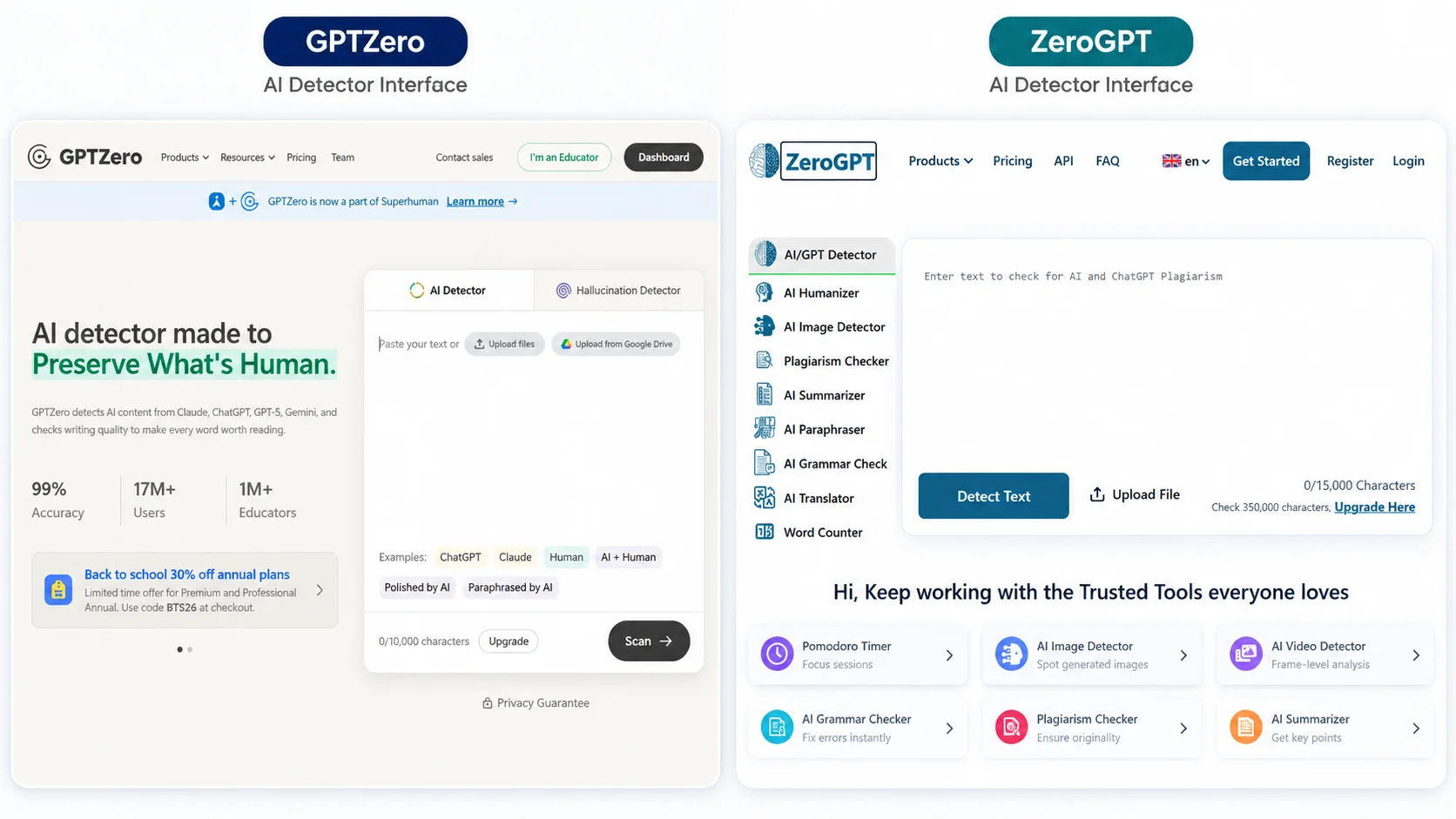
GPTZero vs ZeroGPT comes down to what you need from an AI detector. GPTZero is stronger on detailed analysis, sentence-level detection, and education or professional workflows, while ZeroGPT is built for quick checks and includes a wider set of writing tools.
In our test, both tools correctly identified the human and raw AI samples, while both classified the lightly edited sample as human. The additional short version of the raw AI sample was also classified as AI by both detectors.
Last tested: September 13, 2026
Factor | GPTZero | ZeroGPT |
Best for | Detailed academic and professional review | Quick checks and broader writing tools |
Free limit | ||
Results | Overall classification plus sentence-level analysis and highlights | AI percentage, sentence highlighting, and downloadable reports |
Integrations | Chrome, API, LMS, Google Classroom, Canvas and other workflow integrations | API and additional messaging and writing tools |
Multilingual | English, German, Portuguese, French and Spanish | English, French, German, Spanish, Italian and Portuguese |
Human sample in our test | Correctly classified as human, 0% AI | Correctly classified as human, 0% AI |
Raw AI sample in our test | Correctly classified as AI, 100% AI | Correctly classified as AI, 96.4% AI |
Mixed/lightly edited sample | Classified as human, 0% AI | Classified as human, 7.1% AI |
Overall verdict | Better fit for detailed analysis and structured workflows | Better fit for quick checks and a broader writing toolkit |
Our test does not establish that either detector is universally more accurate. Both tools agreed on the broad classification of all three core samples and the additional short AI sample, although their AI percentages differed across the raw AI and mixed samples and between the short and long AI versions.
Are GPTZero and ZeroGPT the Same Company?
No. GPTZero and ZeroGPT are separate and unaffiliated AI detection platforms. GPTZero was founded by Edward Tian and Alex Cui, with Tian developing its first version in 2022 before its public launch in January 2023.
GPTZero's own materials identify Tian as co-founder and CEO and Cui as co-founder and CTO.
ZeroGPT launched separately with a similar, reversed name, which can easily cause confusion. GPTZero describes itself as the original AI detection tool and says ZeroGPT appeared shortly afterward.
However, claims that ZeroGPT is a “copycat” should be treated as GPTZero's characterization, not as an established fact.
💡 For this comparison, the important point is simple: they are competing products, not two versions of the same service. Their similar names do not mean they share the same company, detection system, or results.
How We Tested GPTZero and ZeroGPT
We used the same three core text samples in both detectors on the same day: one verified human-written sample, one raw AI-generated sample, and one lightly edited mixed sample.
We also tested a shorter 137-word version of the raw AI sample to compare results by text length. Each version was submitted without changing a word between tools.
We recorded the displayed AI percentage, classification, and highlighted passages, then compared the results sample by sample. The initial test was run on September 13, 2026, with the raw AI sample retested on September 14, 2026 to check next-day consistency.
Test set: 3 core samples, 1 human, 1 raw AI, and 1 mixed/lightly edited, plus a short version of the raw AI sample.
Sample length: Approximately 660 words for the core samples; the short raw AI version was 137 words.
Rule: Identical text, same day, same sample order.
Models/plans: Tested using the basic free versions of GPTZero and ZeroGPT. GPTZero displayed AI Detection Model 4.9b; the specific underlying ZeroGPT model version was not recorded.
What we recorded: AI percentage, label, highlights, and screenshots.
Next-day retest: The original raw AI sample was tested again on September 14, 2026 using the same text and basic free versions.
Important limitation: This is a small practical comparison, not a statistical accuracy benchmark. The short-versus-long comparison and next-day consistency check each used only one raw AI sample.
GPTZero vs ZeroGPT Accuracy: Our Test Results
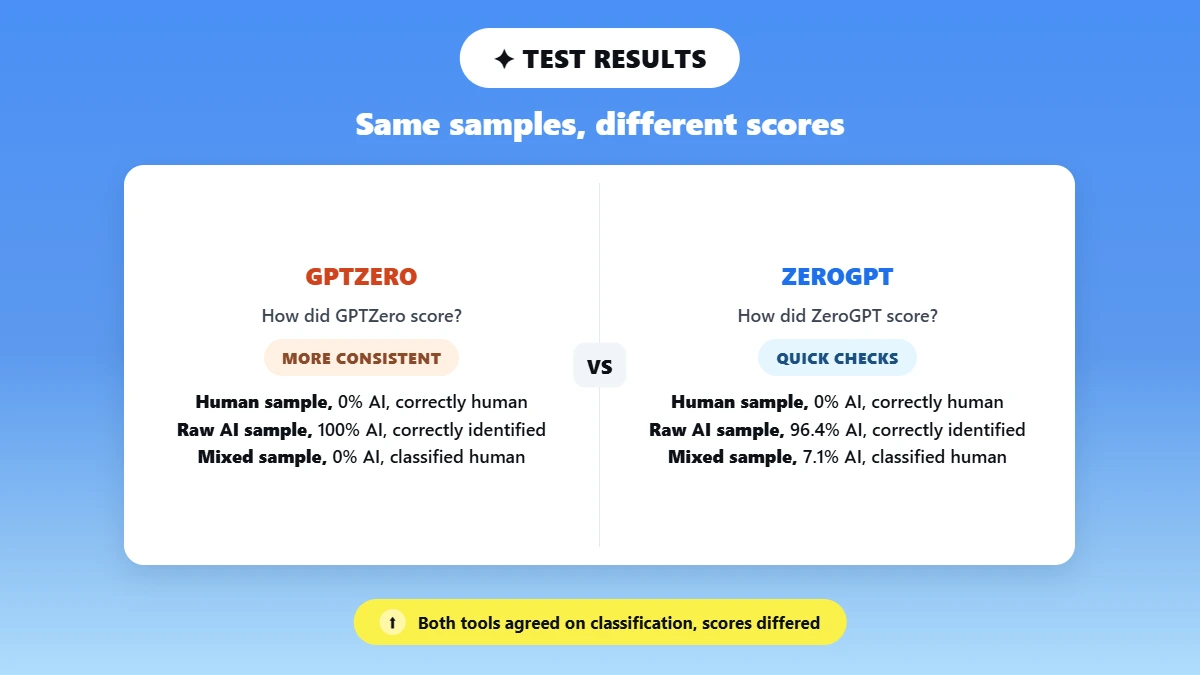
With three core samples and one additional short version, we cannot declare either detector universally more accurate.
However, our head-to-head test gives a useful comparison: both tools correctly classified the verified human sample as human and the raw AI sample as AI. They also classified the lightly edited sample as human.
The short raw AI version was also classified as AI by both tools. If you're specifically interested in GPTZero, read our GPTZero accuracy review. If you want to focus on ZeroGPT, see our Does ZeroGPT Work? review for a deeper look at its reliability and performance.
Sample | GPTZero | ZeroGPT | Finding |
S1: Human writing | 0% AI, Human | 0% AI, Human | Both correct |
S2: Raw AI | 100% AI | 96.4% AI, AI/GPT Generated | Both correct |
S3: Mixed/lightly edited | 0% AI, Human | 7.1% AI, Human | Both classified it as human |
S4: Short version of S2, 137 words | 100% AI | 94.2% AI, AI/GPT Generated | Both classified it as AI |
Summary of Test Findings
What we looked at | GPTZero | ZeroGPT | Better here |
Human sample: any false flag? | 0% AI, classified as Human | 0% AI, classified as Human | Tie |
Raw AI sample: caught? | 100% AI | 96.4% AI, AI/GPT Generated | Tie |
Mixed/lightly edited sample | 0% AI, classified as Human | 7.1% AI, classified as Human | Tie |
Short vs long | 137 words: 100% AI; 746 words: 100% AI | 137 words: 94.2% AI; 746 words: 96.4% AI | GPTZero, more consistent |
Next-day consistency | 100% AI → 100% AI | 96.4% AI → 96.4% AI | Tie |
Report usefulness | Sentence-level analysis and highlights | AI percentage, sentence highlighting, and downloadable reports | Depends on workflow |
Important: This summary reflects three core samples plus one short version of the raw AI sample. The short version was used only to examine the effect of passage length, while the raw AI sample was retested the following day to check consistency.
Catching Unedited AI Text
Both detectors successfully identified our raw AI sample as AI-generated. GPTZero returned 100% AI, while ZeroGPT returned 96.4% AI and labelled the text AI/GPT Generated.
Because we tested only one raw AI sample, this shows how the two tools behaved on this particular text, not their overall AI detection accuracy.
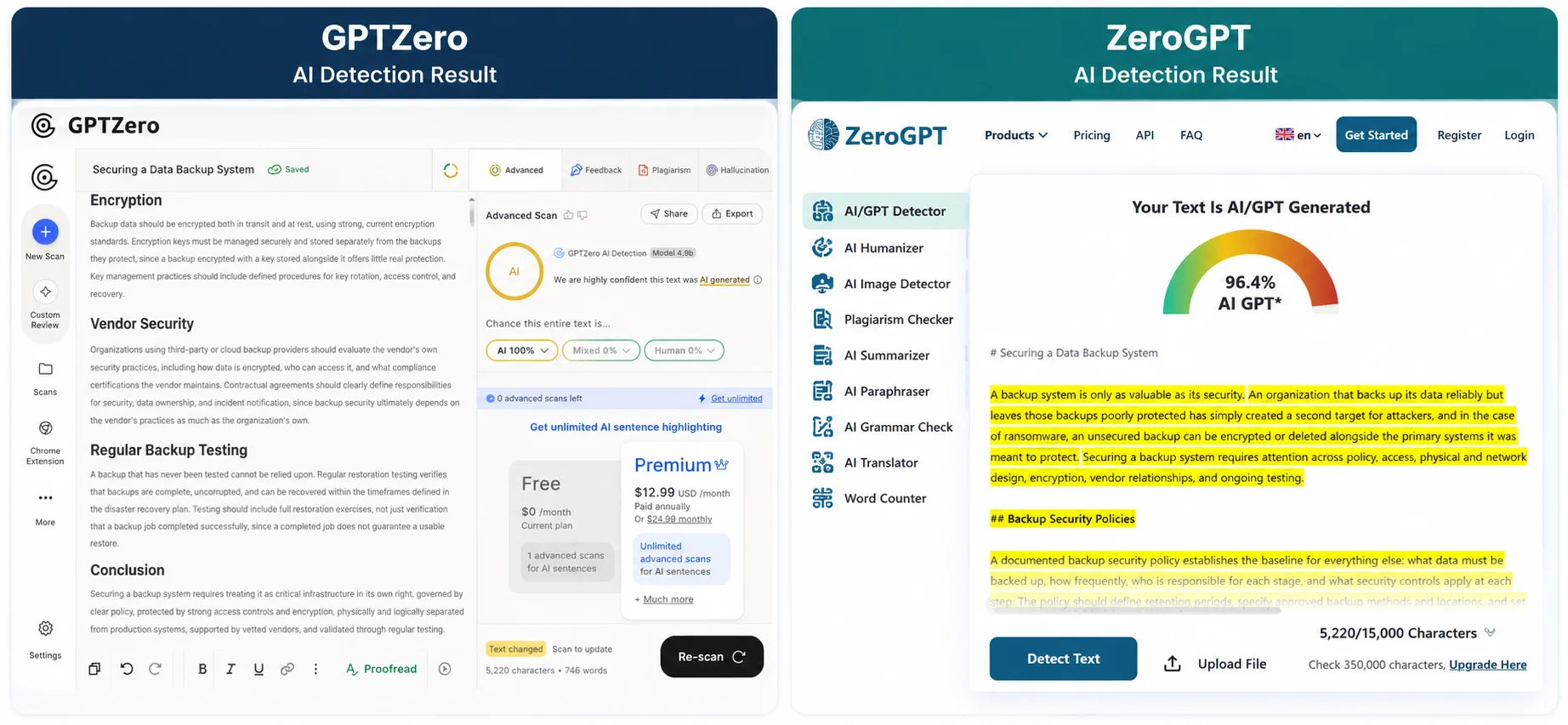
We also tested a 137-word version of the same raw AI sample. GPTZero again returned 100% AI, while ZeroGPT returned 94.2% AI. We did not test separate GPT, Claude, Gemini, or DeepSeek samples, so we cannot make model-by-model claims from this comparison.
Avoiding False Positives on Human Writing
This was one of the most important checks because a detector can create a serious problem when it labels genuinely human writing as AI-generated.
Our verified human sample received 0% AI from both GPTZero and ZeroGPT, and both classified it as human.
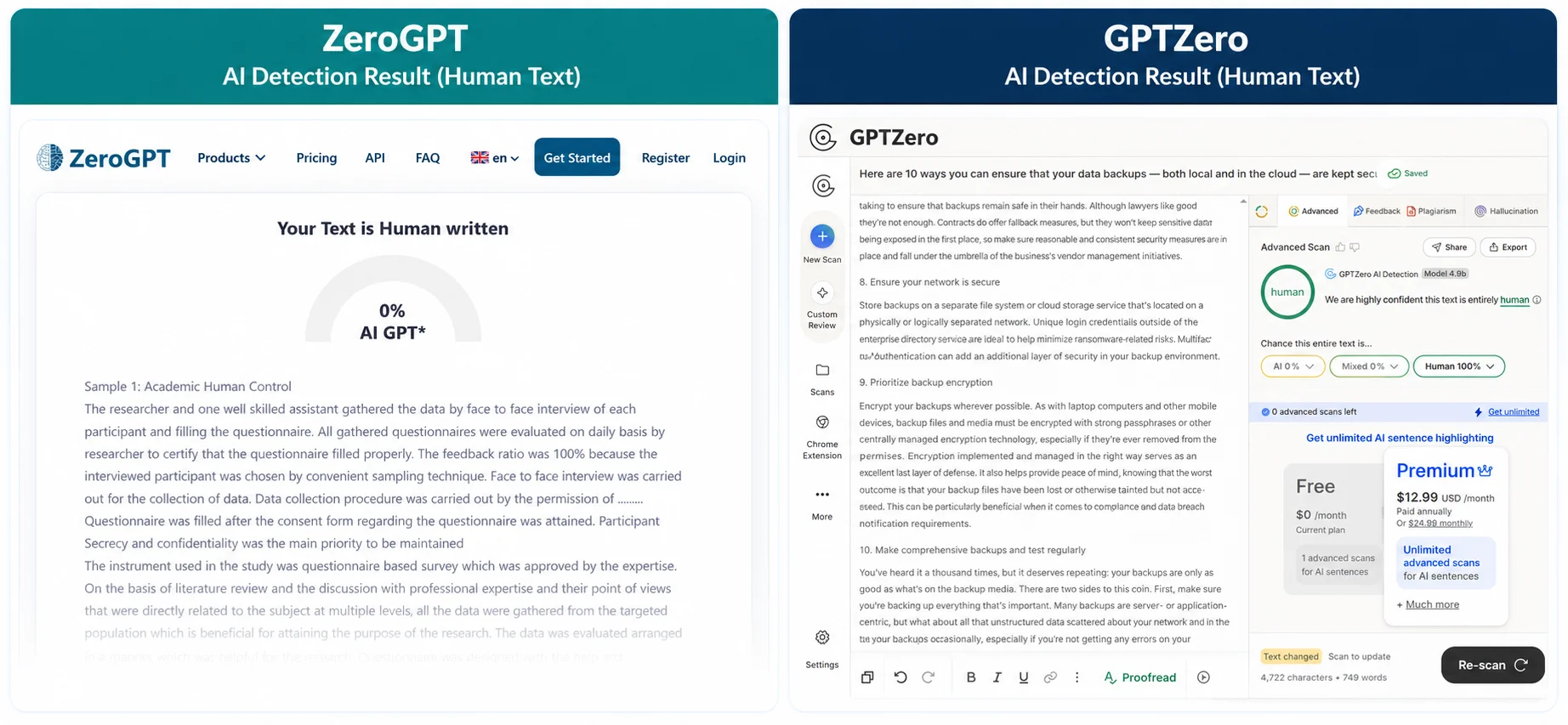
That is a positive result for both tools in this test. However, one human sample cannot establish their broader false-positive rates, especially across different authors, subjects, languages, or writing styles.
Mixed and Edited Text
Our lightly edited sample produced another useful result. GPTZero showed 0% AI and classified the text as human, while ZeroGPT showed 7.1% AI but still labelled it human.
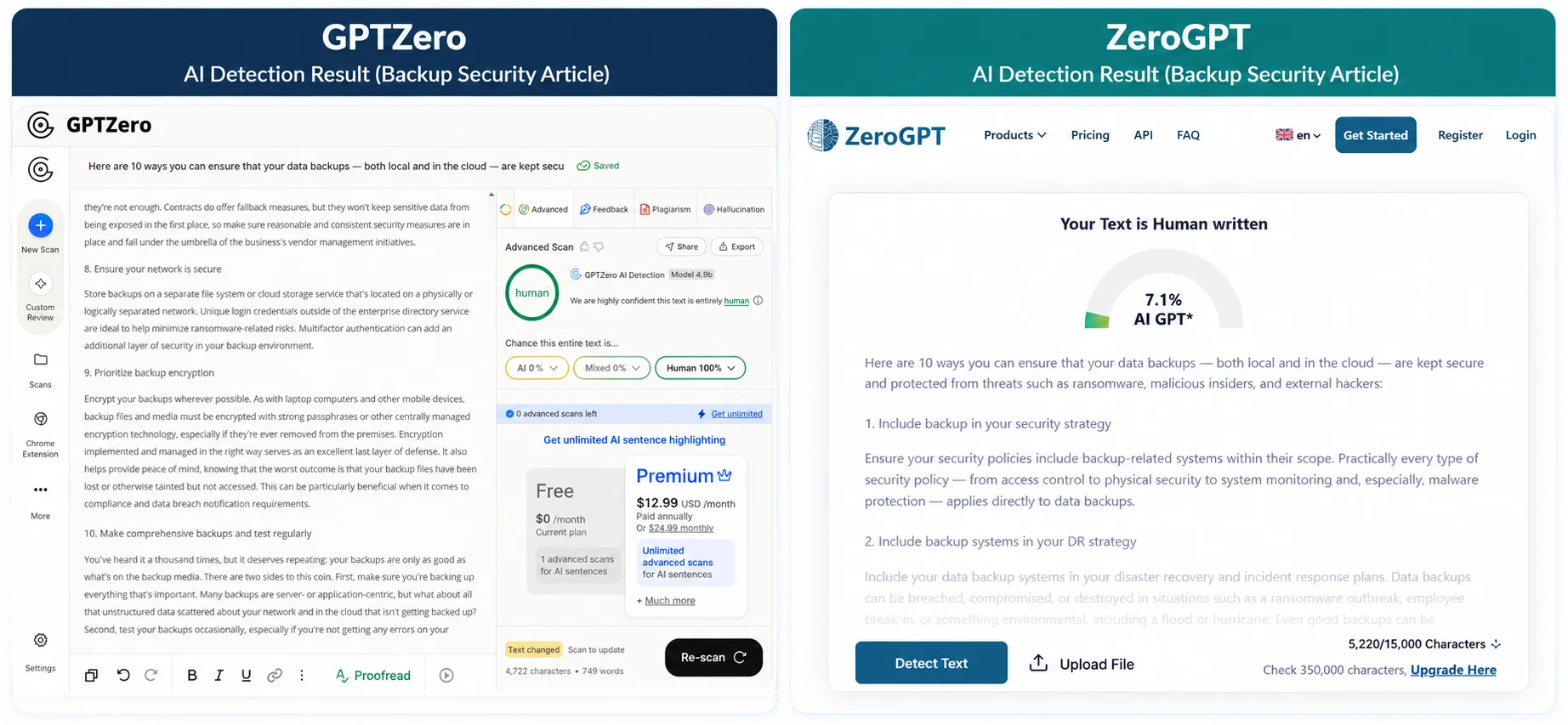
This illustrates why AI-assisted or edited writing should not automatically be treated the same way as fully AI-generated text. A percentage can indicate that a detector sees some AI-like characteristics without establishing how the text was produced or whether its use violated a particular policy.
Does Length Change the Result?
We compared the original 746-word raw AI sample with a 137-word version containing the same opening text. Both detectors classified both versions as AI-generated.
GPTZero returned 100% AI for both lengths, while ZeroGPT changed from 96.4% AI on the longer version to 94.2% on the shorter version.
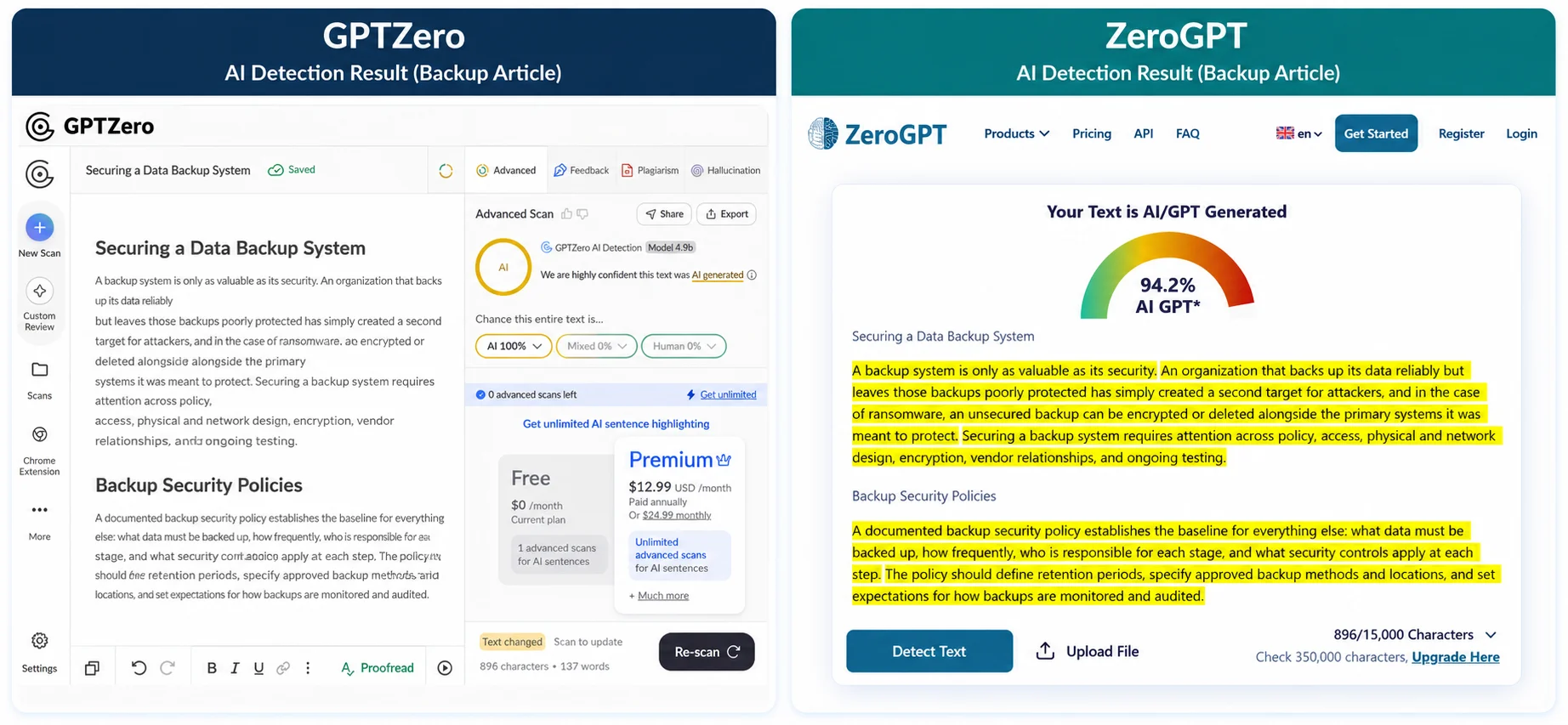
This suggests that passage length did not change the broad classification in this test, although it slightly changed ZeroGPT's displayed score.
Because we tested only one short-versus-long pair, this should not be treated as a general rule about how either detector responds to text length.
Next-Day Consistency
We retested the same 746-word raw AI sample one day later using the same basic free versions of both detectors. GPTZero returned 100% AI again, while ZeroGPT returned 96.4% AI again.
Both tools therefore produced the same displayed result on the raw AI sample across the two test days.
This indicates consistency for this particular sample and testing window, but it does not establish that detector scores will remain unchanged across different texts or longer periods.
So Which Is More Accurate, GPTZero or ZeroGPT?
In our test, neither tool clearly won on accuracy. Both correctly classified the human and raw AI samples, and both classified the lightly edited sample as human.
GPTZero was more consistent across the short and long AI versions, but the small test size is not enough to establish a universal accuracy winner.
A detector result is a signal, not a verdict on who owns or authored a piece of writing. Because different detectors can produce different scores, running the same passage through more than one tool can give you additional context before drawing conclusions.
Want another detector result? Run the same passage through Phrasly's free AI detector and compare the result with GPTZero and ZeroGPT.
Why Do GPTZero and ZeroGPT Give Different Scores?
GPTZero and ZeroGPT can give different scores because they use different detection systems, training data, model versions, thresholds, and scoring methods.
An AI percentage is not necessarily a direct measurement of how much of a document was written by AI. Text length, context, predictable phrasing, and human editing can also affect the result.
There are several reasons:
Different models and training data: Each detector is trained and tuned differently, so they may recognize different patterns as AI-like.
Different scoring thresholds: One tool may classify borderline text as human while another assigns it a higher AI likelihood.
Different meanings of percentages: A displayed percentage should not automatically be interpreted as the exact percentage of words or sentences produced by AI.
Text length and context: Longer passages give detectors more material to analyze, while shorter passages may provide less evidence.
Formulaic writing: Predictable wording, uniform sentence structure, and common transitions can make genuinely human writing appear more AI-like.
Mixed human and AI editing: A human-edited AI draft can produce a very different score from untouched AI output.
A Reddit discussion also shows how large these differences can be. In a 2023 discussion on r/MachineLearning, a user tested the same passage with ZeroGPT, GPTZero, and UNDETECTABLE AI. ZeroGPT scored it at 19% AI-generated, while GPTZero classified it as 84% AI and “Likely a mix of human and AI text.”
UNDETECTABLE AI classified the passage as human-written. This is a single user's test, not a controlled accuracy benchmark, but it illustrates how the same text can produce very different results across detectors.
Our own test shows a similar difference, although the scores were much closer. The raw AI sample scored 100% AI in GPTZero and 96.4% AI in ZeroGPT, while the lightly edited sample scored 0% AI in GPTZero and 7.1% AI in ZeroGPT.
The short version of the raw AI sample also produced different percentages, with 100% AI from GPTZero and 94.2% AI from ZeroGPT.
💡 These differences do not automatically mean that one detector is wrong. They show that AI detection scores depend on how each system interprets the same text.
For a deeper explanation, see how AI detectors work and can AI detectors be wrong.
GPTZero vs ZeroGPT Features
GPTZero and ZeroGPT both offer AI detection, but their feature sets differ. GPTZero focuses more on advanced detection and education workflows, while ZeroGPT combines detection with a broader range of writing tools. The comparison below covers currently verified features.
Feature | GPTZero | ZeroGPT |
Sentence-level highlighting | Yes | Yes |
File upload | Yes | Yes |
Batch checking | Yes | Yes |
Page-by-page scanning | Yes | Not prominently advertised |
Downloadable reports | Yes | Yes, PDF reports |
Writing-process / authorship features | Yes | Not prominently advertised |
Plagiarism checking | Yes | Yes |
Multilingual detection | Yes | Yes |
Browser extension | Yes, Chrome | Not confirmed |
LMS / education integration | LMS and Canvas | Not prominently advertised |
API | Yes | Yes |
Extra writing tools | Proofreading, expert feedback and review tools | Humanizer, paraphraser, summarizer, grammar checker, translator and plagiarism checker |
In short, GPTZero is more focused on detailed detection and structured education workflows, while ZeroGPT offers a broader all-in-one writing and detection toolkit. Feature breadth alone does not determine which detector is more accurate.
Note: Features, limits, and availability may vary by plan and can change over time. Check the current GPTZero and ZeroGPT product pages before choosing a plan or relying on a specific feature.
GPTZero vs ZeroGPT Pricing and Free Limits
Pricing and usage limits vary by plan. Both GPTZero and ZeroGPT offer free AI detection, while their paid plans provide higher limits and additional features.
ZeroGPT offers a larger free detection allowance, while GPTZero provides more structured scanning and reporting options on its paid plans.
Last checked: September 13, 2026
Factor | GPTZero | ZeroGPT |
Free plan | Yes, $0 | Yes, $0 |
Free usage | 10,000 words/month | 1,250,000 words/month |
Character limit per scan | 10,000 characters | 15,000 characters |
Paid plans | Premium, Professional | Pro, Plus, Max |
Monthly pricing | Varies by location | $9.99, $16.99, $20.99 |
Annual pricing | Varies by location | $119.88, $203.88, $251.88 |
Higher-volume use | Up to 500,000 words/month | Up to 7,500,000 words/month |
Batch checking | Up to 250 files | Up to 75 files |
Best for | Detailed analysis and education workflows | High-volume checks and broader writing tools |
GPTZero's current plans include Premium with 300,000 words/month and Professional with 500,000 words/month. Professional also supports up to 250 files in a batch and page-by-page scanning. ZeroGPT's paid plans increase detection limits and add batch checking and PDF reports.
Pricing is accurate as of the date this article was written and is subject to change. Confirm the current price on the tool’s official pricing page before purchasing.
Bottom line: For occasional checks, both free plans can be useful. ZeroGPT offers a substantially larger free allowance, while GPTZero is better suited to users who need more structured analysis and education-focused features.
Which Tool Has Better Privacy and Transparency?
Privacy is difficult to compare with a simple winner because the two services disclose different details about how submitted content is handled.
GPTZero provides clearer public documentation for API submissions, while ZeroGPT's policy provides general information about personal data collection, use, sharing, and retention. Neither service should be treated as completely private by default.
GPTZero's privacy policy, updated April 2, 2026, states that text and files submitted directly through its API are not stored by default or used for product improvement, unless the customer opts in to storage. Its FAQ separately explains how dashboard submissions are handled.
ZeroGPT's privacy policy states that it collects information such as account and contact details and uses collected information to operate, improve, and communicate about its services. It says personal information is not kept for longer than three months after an account is terminated, unless a longer period is required or permitted by law.
💡 Do not upload confidential, unpublished, personally identifiable, or commercially sensitive text unless you have reviewed the current privacy policies and your organisation's requirements.
Which AI Detector Should You Choose?
Is GPTZero better than ZeroGPT? For detailed academic or professional workflows, GPTZero is the stronger choice based on its reporting, education integrations, writing-process features, and our test.
ZeroGPT is better suited to quick checks and users who want AI detection alongside a broader collection of writing tools.
But before you decide, keep reading our comparison to see how the two tools perform side by side. If you want to explore more options beyond GPTZero and ZeroGPT, check out our guide to the best AI checker tools.
Reader | Recommended | Why |
Student, quick check | ZeroGPT | Free access and simple checking |
Educator, longer work | GPTZero | Stronger reporting and education workflow |
Writer, blog draft | ZeroGPT | Quick checks, highlights, and writing tools |
Institution / business | GPTZero | API, LMS integrations, reporting, and workflow options |
Got conflicting results | Neither alone | Use additional evidence, drafts, revision history, and writing context |
Our test did not produce a clear accuracy winner. Both tools correctly classified our human and raw AI samples, and both classified the lightly edited sample as human. GPTZero returned 0% AI for the edited sample, while ZeroGPT returned 7.1%.
Choose ZeroGPT if your priority is quick, accessible checking and additional writing tools. Choose GPTZero if you need deeper analysis, reporting, and structured education or professional workflows.
What Should You Do If a Detector Flags Your Writing?
A detector score is not proof that someone used AI. If your writing is flagged, preserve the original evidence before making changes, review the result in context, and check the relevant AI-use policy.
Even Turnitin can sometimes flag writing incorrectly, so a detector result should be treated as a signal rather than conclusive proof. See our guide on what to do if Turnitin says you used AI but you didn't for practical steps.
1. Do Not Treat the Score as Proof
AI detectors can produce both false positives and false negatives, and our own testing of more than 30,000 human essays showed that inaccurate AI flags are a common issue in AI detection. That is why a detector result should be treated as a score, not proof.
2. Save the Full Result
Keep the complete report, including the overall score, classification, and highlighted passages. Save it before making revisions.
3. Re-Test the Complete Document
If you need another check, submit the full document rather than relying on isolated sentences. Short excerpts can behave differently from longer passages.
4. Preserve Your Writing Evidence
Keep outlines, research notes, citations, earlier drafts, tracked changes, and version history. These can provide useful context about how the work developed.
5. Check the Relevant Policy
Review your school, university, employer, or publisher's rules on AI-assisted writing. What matters is not only what a detector reports, but whether the way you used AI was permitted.
6. Ask What Other Evidence Is Being Considered
If a flag has consequences, ask how the decision is being evaluated and whether your writing process, sources, drafts, or other evidence can be reviewed alongside the detector result.
7. Improve the Writing for Quality
If the text is repetitive, unclear, or overly generic, revise it for clarity, accuracy, and your intended voice, not simply to reach a lower detector score.
If you've done all of that and your draft still feels stiff, repetitive, or robotic, try running it through Phrasly's AI Humanizer once to improve its rhythm, clarity, and tone.
Review the changes carefully and make sure the final version still reflects your intended meaning and follows your school's or workplace's AI-use rules.
Final Verdict
For this comparison, GPTZero is the stronger overall choice for detailed analysis and structured academic or professional workflows, while ZeroGPT is the better option for free, high-volume checking and a broader writing toolkit.
In our test, neither detector clearly won on accuracy: both correctly identified the human and raw AI samples and classified the lightly edited sample as human.
They also tied on our human false-positive check, with both returning 0% AI. GPTZero was the feature and workflow winner, while ZeroGPT was the free-access winner.
For students and writers, ZeroGPT suits quick checks, while educators and institutions may benefit more from GPTZero's reporting and integrations.
Most importantly, no AI detector can prove authorship. Treat results as signals and review them alongside writing history, drafts, sources, and relevant policies.
Frequently Asked Questions
Is GPTZero better than ZeroGPT?
GPTZero is the better choice for detailed analysis and structured academic or professional workflows. ZeroGPT is more appealing for quick checks and users who want additional writing tools. Our three-sample test did not establish a universal accuracy winner, so the better option depends on your use case.
Which is more accurate, GPTZero or ZeroGPT?
Neither can be called universally more accurate from our small test. Both correctly identified our human and raw AI samples, and both classified our lightly edited sample as human. GPTZero returned 0% AI while ZeroGPT returned 7.1% on that edited sample.
Are GPTZero and ZeroGPT the same company?
No. GPTZero and ZeroGPT are separate AI detection platforms. They have similar names but operate as separate products with different features, detection systems, and workflows. Their naming similarity does not mean they share ownership or technology.
Can GPTZero and ZeroGPT give false positives?
Yes, both can potentially produce false positives. Our human sample was correctly classified by both, but that single result cannot establish their broader false-positive rates. A detector score should be considered alongside writing history, drafts, sources, and other relevant evidence.
Why do GPTZero and ZeroGPT give different scores?
They use different detection systems, models, thresholds, and scoring methods. The same text can therefore receive different percentages from each tool. Text length, predictable phrasing, writing style, and human editing can also influence the result.
Which detector is better for student essays?
GPTZero is the stronger fit for students who need detailed analysis, while ZeroGPT can be useful for quick checks and additional writing tools. For students, AI checkers can also be useful. If you don't know the difference between the two, read our guide on AI Checker vs AI Detector to understand which option is right for you.
Can I use GPTZero or ZeroGPT for free?
Yes, both offer free access, although usage limits apply. The available limits and features can change, so check each tool's current pricing page before relying on a particular free allowance. Paid plans generally provide greater scanning capacity and additional features.
Is GPTZero as reliable as Turnitin?
GPTZero and Turnitin serve different workflows, so their results should not be treated as directly interchangeable. Neither detector should be considered conclusive proof of authorship. If you are dealing with a disputed AI flag, review the relevant evidence and policy rather than relying on one score. For more context, see our article on Turnitin alternatives.

Written by
Hasnain
Karachi, Pakistan
I help businesses grow with SEO-friendly blog posts, landing pages, and long-form content. With 3+ years of experience, I deliver clear, original, and well-researched writing that drives results.