Turnitin API: Who Can Use It and What Developers Use Instead
11 min read
You can't buy a Turnitin API key on your own. Turnitin's official API, the Turnitin Core API (TCA), is a REST API for similarity checking in Turnitin and iThenticate. Only licensed institutions and approved integration partners can use it.
Each call sends an API key in an HTTP header, and an admin creates that key. Pricing is set by private contract, and Turnitin doesn't publish it.
Phrasly publishes this guide and sells an AI detection API. The Phrasly API checks AI writing only, not plagiarism or similarity. We checked every API doc cited here in November 2026.
This guide gives EdTech and LMS builders, school admins, publishers, students and solo developers their own official path, then compares the APIs developers use when Turnitin access isn't an option.
Need AI Writing Detection Inside Your Own Platform? 👇
What Is the Turnitin Core API (TCA)?
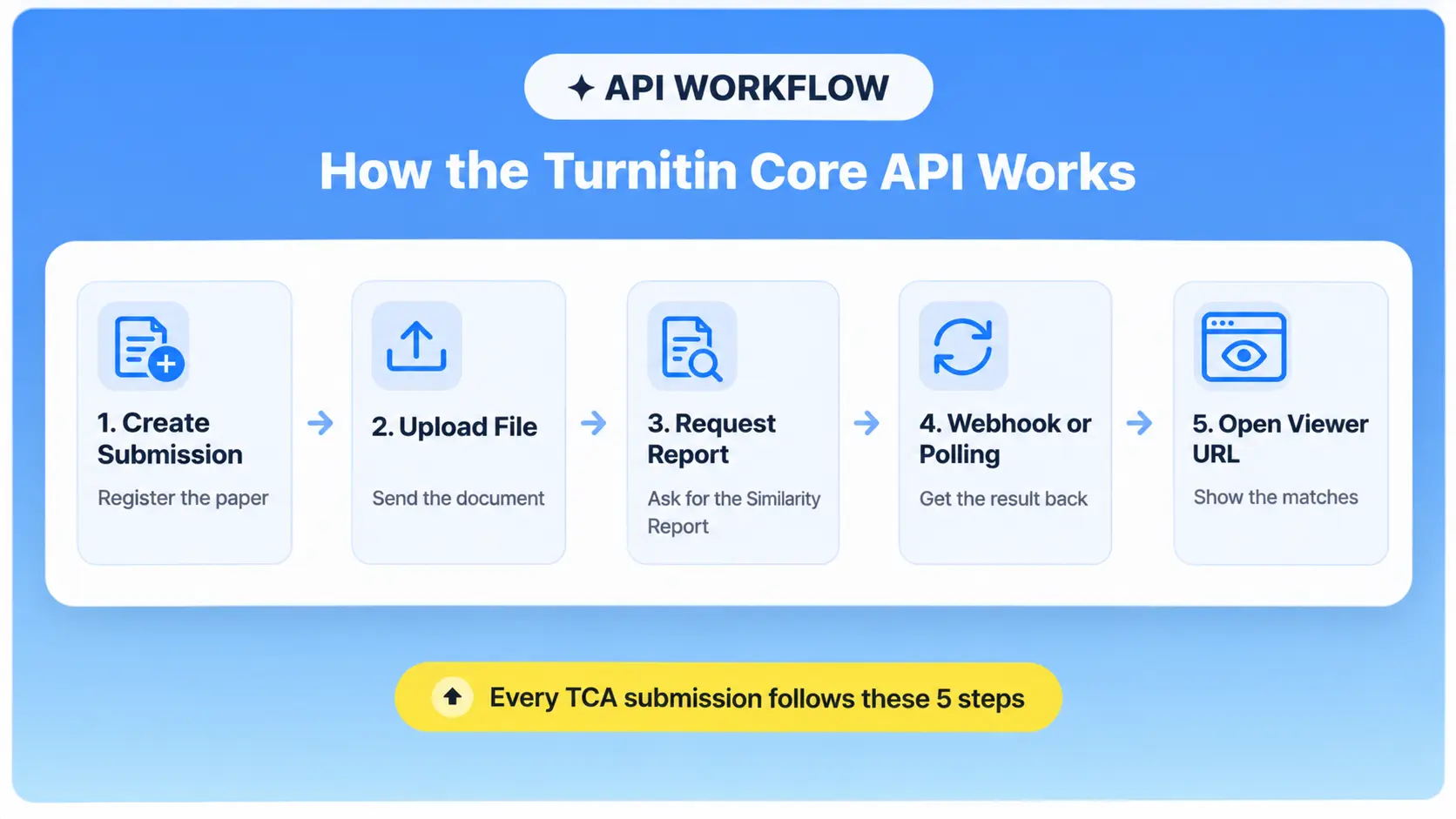
The Turnitin API most people mean is the Turnitin Core API (TCA), a REST API that sends documents to Turnitin and returns Similarity Reports. It works with Turnitin Similarity and iThenticate 2.0, according to the Turnitin API documentation. Every request carries an API key for authentication.
A TCA integration runs the same five steps for every document submission:
Create a submission record for the paper.
Upload the file to that submission.
Request a Similarity Report.
Get the result by webhook, a message Turnitin sends to your server, or by polling, which checks the status on a schedule.
Open the report through a viewer URL that shows every match.
If your school connects Moodle through the Turnitin Integrity plugin, the plugin runs these steps each time you submit. The similarity score then appears in the Moodle course, where your instructor opens the full report.
The Turnitin Access Path That Matches Your Role 🧭
Official Turnitin API access comes only through a technical partnership or an institution admin. Turnitin has no public signup page and no self-serve API key.
Turnitin API access by role
Reader type | Official path | What you get | Next step |
|---|---|---|---|
🏗️ EdTech or LMS builder | Turnitin technical partnership | Sandbox access to build against the TCA, then certification before launch | Path 1 (partnership) |
🏫 School or university admin | TCA scope and API key created in the Turnitin admin area (Similarity or SimCheck license) | One scope and key per integration | Path 2 (admin key) |
📚 Publisher | iThenticate through Turnitin sales, or Crossref Similarity Check for Crossref members | Manuscript similarity checking, with API access arranged through sales or Crossref | Path 1 (publisher route) |
🎓 Student | ❌ No key; use your school's Turnitin setup | Whatever your course and instructor have enabled | Students and solo developers section |
💻 Solo developer or freelancer | ❌ No key | Self-serve APIs from other vendors, matched to what they check | API comparison |
A solo developer can't get a key directly, so any Turnitin integration for a school needs that school's admin to create one. Students and solo developers can skip the admin walkthrough and go straight to the sections on individual access and the API comparison.
Path 1: A Turnitin Technical Partnership for LMS, EdTech and Publisher Platforms
A technical partnership is the only way a third-party product gets direct TCA access, and it's a separate process from a school buying a license. Software vendors start with the "Become a partner" form on Turnitin's developer site, and Turnitin's partner checklist lists the stages:
📝 Apply for a technical partnership through the partner form.
🧪 Get technical onboarding and a sandbox environment for testing.
🛠️ Build and test your integration against the TCA.
✅ Pass Turnitin's certification review before launch.
Turnitin sets the timeline during the application. The certification review checks that your build follows Turnitin's best practices, and it can trigger setup of your production account.
LTI integration is how a learning management system such as Moodle, Blackboard or Microsoft Teams connects Turnitin Feedback Studio for a school that already holds a license. A direct TCA build is what a partner does to add similarity checking to its own platform. Turnitin's checklist calls LTI fairly straightforward for LTI-compliant products, so an LMS usually takes that route, while an app that runs its own checks needs the TCA.
📚 The Publisher Route
Publishers use iThenticate or Crossref Similarity Check, which gives Crossref members access to iThenticate from a manuscript submission system through an API. Other publishers license iThenticate API access from Turnitin's sales team. Journal teams weighing both products can compare how iThenticate differs from Turnitin on audience and features.
Path 2: An Institution Admin Creates a TCA Scope and API Key
Only institutions with a Similarity or SimCheck license can create a TCA scope and API key, and each integration gets its own scope and key. Tools such as FeedbackFruits, Perusall and WISEflow ask for this key and your Turnitin API URL during setup.
Many admins can't find the API base URL at first, and WISEflow's help page tells them to get it from their Turnitin account manager.
Open Integrations in the Turnitin Admin Area
Turnitin's Custom API scope creation guide starts in the administrator area:
Sign in with an administrator account on your licensed institution.
Select the Integrations tab, which lists every active integration.
Select Generate TCA Scope in the top right.
Create a Scope for One Integration
One scope per integration lets you switch off one tool without breaking the others:
Name the scope after the tool, such as "FeedbackFruits", and select Next.
Name the API key and select Create and View.
Copy the key, which Turnitin shows as a "Secret" only once.
Create separate scopes for test environments, such as a sandbox.
Store the Key and Base URL Safely
Turnitin's setup guides tell admins never to share the key, so treat it the way you treat a password:
Keep the key in a password manager or secrets vault, never in email or shared docs.
Enter the key and base URL only in the integration's official setup screen.
Turn a leaked key Off or delete it under Integrations; a deleted key can't be restored.
What If the Base URL Isn't in the Admin Area?
Your base URL usually follows the format https://[your institution].turnitin.com/api, according to Turnitin's Moodle setup guide. If you can't confirm yours, contact your Turnitin account manager for it.
Students and Solo Developers Cannot Buy a Turnitin API Key
Turnitin doesn't sell individual licenses or single-use subscriptions, and it doesn't publish Turnitin API pricing because each institution's contract sets the price. You can see what schools pay in this breakdown of Turnitin AI detection costs.
For personal similarity checks, Turnitin points individuals to iThenticate credits instead. No student can send an essay through the API Turnitin gives schools, but three legitimate self-checks exist:
✋ Ask your instructor whether the course has a practice or draft submission set up.
✍️ Book a session with your school's writing center.
🔍 Run a rough self-check with an AI detector similar to Turnitin.
💡 Keep in Mind
Third-party checkers don't show the exact report your professor sees. Treat their score as a rough guide before you submit.
Solo developers who need their own access can use the self-serve APIs compared further on, and students can browse Turnitin alternatives for checking your own work.
Unofficial Wrappers Like r2dev2/Turnitin-API Carry Real Risk ⚠️
Unofficial Turnitin API wrappers exist on GitHub, and Turnitin doesn't build or support them. One example, r2dev2/Turnitin-API, calls itself an unofficial REST API and has users send their Turnitin email and password to a login endpoint on a third-party server.
⚠️ What You Risk With an Unofficial Wrapper
🔑 Your Turnitin username and password reach a server you don't control.
📜 Turnitin's End-User License Agreement bans scraping or gathering information from the service and using it for third-party commercial use.
🚫 The same agreement says your authorization ends automatically if you breach it, which puts the account at risk.
🛠️ You get no support, no service level and no uptime promise.
💥 The wrapper breaks whenever Turnitin changes its site or login flow.
Some resellers also sell "Turnitin API" access, an "API Turnitin checker" or student accounts, and they carry the same credential and terms risks. Turnitin sells only to institutions, so no reseller can offer an individual license that Turnitin itself doesn't sell.
AI writing results follow the same official access rules.
AI Writing Detection and the Turnitin API: What Official Docs Confirm
Turnitin's AI writing detection can reach Core API integrations, but only when the institution licenses Turnitin's Originality add-on. Turnitin's April 2023 release notes say the feature works for users who reach Similarity Reports "through an integration with a learning management system or Turnitin's Core API."
Turnitin's help center now says AI writing detection requires a license add-on, which the account manager prices and enables (checked November 2026). The public developer guides don't show how AI results come back through the TCA, because the full API reference requires a customer login.
📊 How Fast AI Writing Grew in Turnitin Submissions
Turnitin reports that about 15% of essay submissions to its products had more than 80% AI-generated writing between October 2025 and February 2026. That share was about 3% in 2023, according to Turnitin's May 2026 announcement.
Ask your Turnitin account manager to confirm AI writing access before you scope the integration. Access still runs through an approved integration with a dedicated scope and key.
Instructors read the AI score inside the Similarity Report, so it helps to know how Turnitin's AI writing indicator behaves in classrooms. Builders choosing a provider should also check how accurate AI detectors are and the latest AI detection statistics.
If your platform needs AI writing scores without a Turnitin license or add-on, the Phrasly API returns them through one REST endpoint.
Similarity and AI Writing APIs Developers Use Instead, Compared
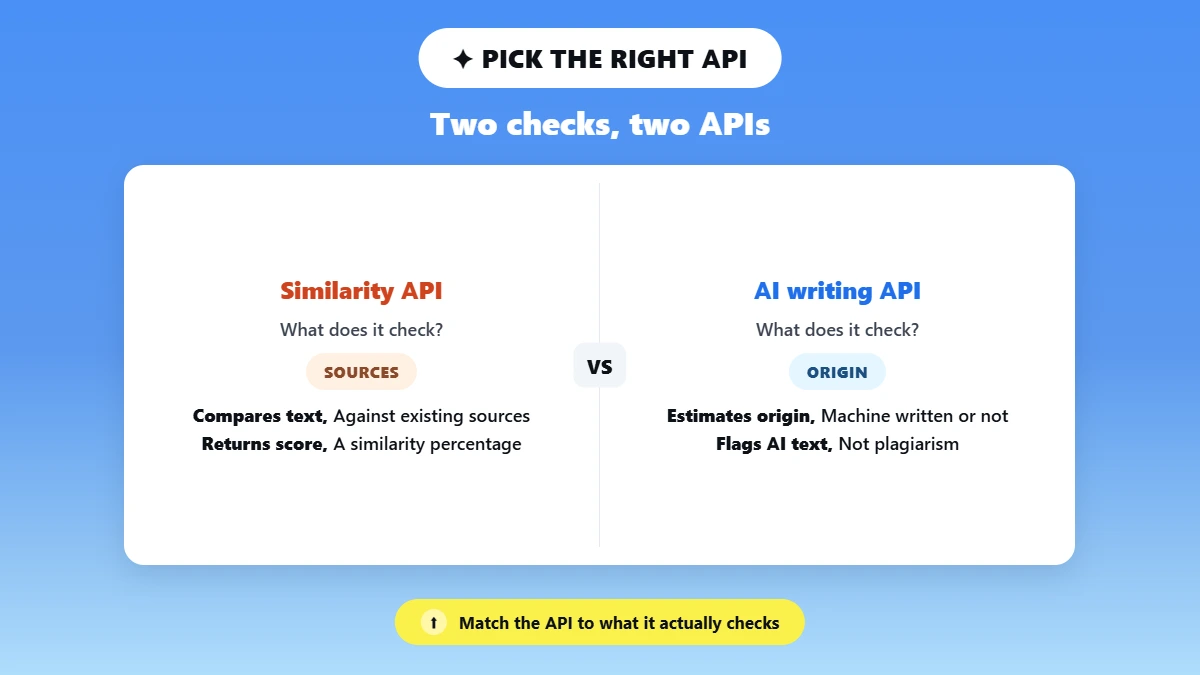
When a Turnitin API key isn't available, pick an API by what it checks first, because a plagiarism checker API and an AI writing detection API do different jobs. A similarity API compares text against existing sources and returns a similarity score. An AI writing API estimates whether a machine generated the text, and some products do both.
iThenticate is Turnitin's product for research and publishing. iThenticate 2.0 integrates through the Turnitin Core API, so the choice comes down to content: iThenticate for research manuscripts, Turnitin Similarity for student work.
API | What it checks | Access | Public pricing | Sentence-level results | Bulk |
|---|---|---|---|---|---|
Phrasly AI Detection API | 🤖 AI writing only (no plagiarism or similarity) | ✅ Self-serve Business plan | ✅ Per-word rates on business.phrasly.ai | ✅ AI score for every sentence | ✅ CSV scans of up to 100 documents in the dashboard |
Copyleaks API | 🔍 Plagiarism and 🤖 AI writing | ⚠️ Free sandbox for testing; production API through sales | ❌ API pricing through sales | ✅ Section-level results with word positions | ➖ Not listed on its API page |
GPTZero API | 🤖 AI writing | ✅ Self-serve API key from the dashboard | ✅ Published API plans | ✅ Sentence-level highlights | ✅ Multi-file uploads per request |
Originality.ai API | 🤖 AI writing and 🔍 plagiarism, plus fact and readability checks | ✅ Self-serve, Enterprise plan only | ✅ Published Enterprise plan price | ✅ Per-sentence AI scores | ✅ Batch scan endpoint |
iThenticate / Crossref Similarity Check | 🔍 Similarity; AI writing as a paid add-on for iThenticate | ⚠️ Turnitin license or Crossref membership | ⚠️ Crossref publishes member fees; others get a quote | ➖ Matched passages in the Similarity Report | ✅ Manuscript systems submit through the API |
Verified as of November 2026 on each provider's official pages. Access rules and prices can change, so check each provider's page before you buy.
Phrasly: fits teams that need AI writing detection with sentence-level scores and already have a similarity tool.
Copyleaks: fits platforms that want plagiarism and AI writing checks from one vendor, with results by webhook or polling.
GPTZero: fits teams that only want AI writing checks, with sentence-level highlights. See how the GPTZero API compares with the Phrasly API on price, limits and endpoints.
Originality.ai: fits publishers and agencies on its Enterprise plan that want AI, plagiarism and fact checks in one scan request.
iThenticate / Crossref Similarity Check: fits publishers and research workflows that need manuscript similarity checks.
Our Copyleaks vs GPTZero accuracy comparison compares two of these detectors directly. If you're new to the request and response cycle, start with how an AI detection API works.
Add AI Writing Detection to Your Platform With the Phrasly API
The Phrasly AI Detection API checks AI writing only, with no plagiarism or similarity checking. If you need both, pair it with a similarity API from the comparison table and use Phrasly for the AI half of what you'd want from a Turnitin AI API.
🔌 Endpoint: POST /api/v1/detect, with your API key in the x-api-key header, per the AI detection API docs.
📏 Limits: at least 50 words and up to 15,000 characters per request.
📊 Response: AI and Human percentages, a label of AI, Might be AI or Human, and a 0-to-1 AI score for each sentence.
💳 Billing: per word, from the API credits included in the Business plan.
✍️ Rewriting: the same key and credit balance also runs the Phrasly Humanizer API, which content and marketing platforms use to make AI drafts read more naturally. See how it compares in our roundup of AI humanizer APIs for developers.
Before you show those labels to users, decide what each one means in your product, and how to read AI detection scores helps with that.
Score AI writing inside your own product through one REST endpoint, and keep your similarity tool for source matching.
FAQs About the Turnitin API
Does Turnitin Have a Public API?
No public, self-serve Turnitin API exists. The Turnitin Core API is gated, and keys go only to approved technical partners or to licensed institutions through their admins.
How Much Does the Turnitin API Cost?
Turnitin doesn't publish API pricing. Access comes bundled into quote-based institutional licenses or negotiated partner agreements, so the cost depends on each contract, and schools start by requesting a quote.
Can I Get a Turnitin API Key as an Individual Developer?
Individual developers have no route to a key. Keys come only from a licensed institution's admin or a technical partnership, so solo builders turn to APIs that other vendors sell directly.
How Do I Integrate Turnitin With My LMS or Platform?
Schools and product builders take different routes. Schools connect Moodle, Blackboard or D2L through Turnitin's LTI 1.3 integrations, which is also how many AI detectors universities use reach their courses. Products need a technical partnership.
What Is the Difference Between the Turnitin Core API and the iThenticate API?
Both products now run on one API, because iThenticate 2.0 connects through the Turnitin Core API. The difference is the product: iThenticate checks research manuscripts for publishers, and Turnitin Similarity checks student work for schools.
Where Can I Check Turnitin API Status?
Turnitin's official status page shows API status for each region. You can subscribe there for email, text message, Slack or webhook alerts when Turnitin opens or resolves an incident.

Written by
Alina Shah
SEO Content Specialist · Karachi, Pakistan
She writes about AI so you don't have to guess. 8+ years in content strategy and editing. Now she puts AI writing tools and detection systems through real tests and shares what actually works.