Originality.ai vs GPTZero (2026): Same-Text Test, Pricing and Which to Use
29 min read
You pasted the same draft into Originality.ai and GPTZero and got two different answers. In our Originality.ai vs GPTZero test on November 18, 2026, both tools labeled a human essay and a raw AI essay correctly. On a mixed draft, only Originality.ai found the human paragraphs, while GPTZero labeled the whole text AI.
What we tested:
Three samples: one human essay, one raw Claude essay and one mixed human and AI draft
Same text, same day: both tools on default settings, with a screenshot for every score
Pricing and free limits: checked live on the test date
Privacy: each vendor's training and data retention policy, quoted
Short verdict: Publishers and SEO teams checking edited drafts should lean to Originality.ai. Teachers and students on a budget should lean to GPTZero. Either way, a detector score is a signal, not proof.
Check Your Own Draft With Phrasly's Free AI Detector 🔍
Originality.ai vs GPTZero: Short Verdict, Round Scorecard and Test Method
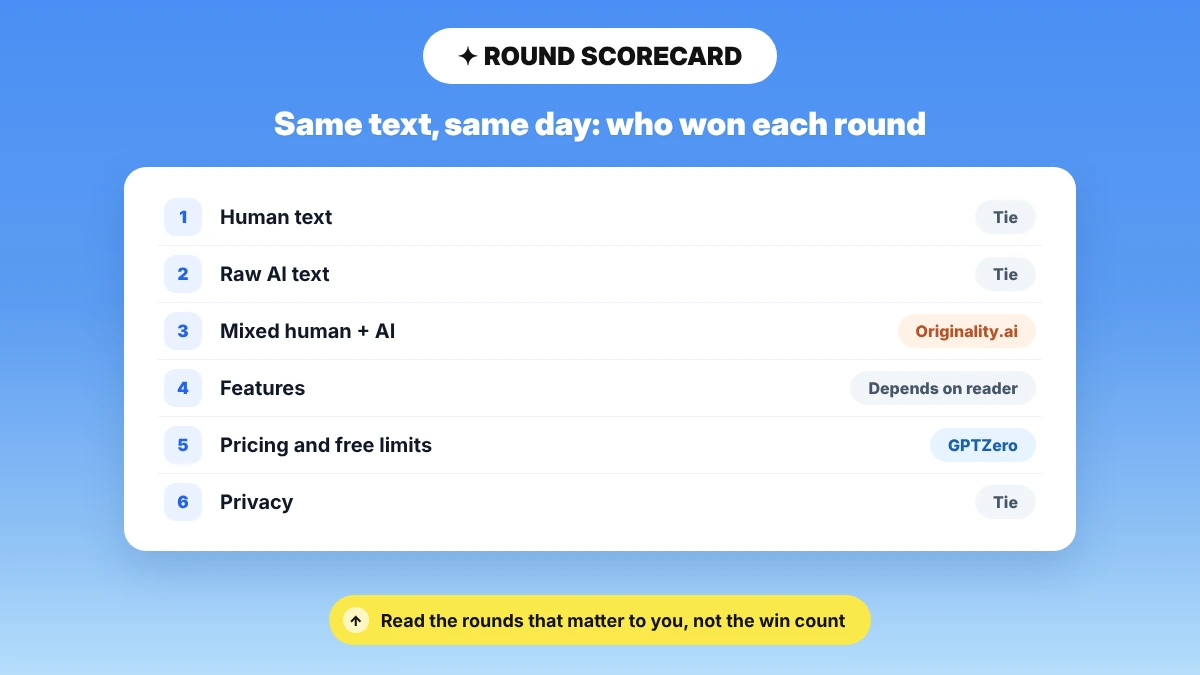
In our November 18, 2026 test, Originality.ai matched the known source of more samples than GPTZero, three to two, but the gap came from one sample: GPTZero labeled our mixed essay 100% AI.
In our GPTZero vs Originality AI test, the human text and raw AI rounds were ties, Originality.ai won on mixed text, GPTZero won on pricing, features depend on the reader and privacy was a tie. Publishers and SEO teams checking edited drafts should lean to Originality.ai. Teachers and students on a budget should lean to GPTZero.
Most reviews say Originality.ai suits publishers and paraphrased text, while GPTZero suits education, offers a free tier and produces fewer false positives.
Our scores confirmed GPTZero’s free tier, could not separate the two on false positives because neither flagged our human essay, and gave the mixed-text round to Originality.ai.
Each vendor publishes benchmarks it ran on its own tool, which builds in vendor benchmark bias, so this page relies on one same-day run of shared texts instead.
Round Scorecard From Our Same-Day Test
Round | Criterion | Originality.ai result | GPTZero result | Round winner |
|---|---|---|---|---|
1 | Human text (Sample A): fewest false flags | 97% Likely Original, label Original, 0 sentences flagged | Human 100%, label “entirely human”, 0 sentences flagged | Tie |
2 | Raw AI text (Sample B): correct AI label | 96% Likely AI, label AI | AI 100%, label AI | Tie |
3 | Mixed text (Sample C): paragraphs matched to the map | 5 of 5 paragraphs matched, label Mixed | 0 of 5 shown (no paragraph view on Free); whole text AI 100% | Originality.ai |
4 | Features beyond the AI score | Plagiarism, fact checking, API on Enterprise | LMS integration, multilingual, 250-file batches | Depends on reader |
5 | Pricing and free limits (checked live on test date) | 100 free credits once; costs more at agency volume | 10,000 free words a month; cheaper at agency volume | GPTZero |
6 | Privacy and data handling | Trains on scans unless you opt out | Trains with a user control; new owner (Superhuman) | Tie |
Scores come from one run per tool per sample at default settings on November 18, 2026. Download the raw scores: Originality.ai vs GPTZero scores (CSV).
Read the table by the rounds that matter to you, not by counting wins. Rounds 1 and 2 were ties because both tools handled the easy cases, so the real split comes from Round 3, where only one tool read a half-human draft correctly, and Round 5, where the other cost less at every volume we priced. Features and privacy did not settle it either way.
Pick This Tool If You Are...
Publishers and SEO teams: Originality.ai, the best AI detector for mixed drafts in our test, because it was the only tool that found the human paragraphs in our mixed essay (Round 3).
Teachers: GPTZero for its free tier and LMS integration (Rounds 4 and 5), with the caveat that its Free plan labeled our mixed essay 100% AI (Round 3).
Students: GPTZero, because its free 10,000 words a month cover about 20 essays of 500 words (Round 5), and it did not flag our human essay (Round 1).
Non-native English writers: neither tool flagged our human essay (Round 1), but we did not test non-native writing, so keep your drafts either way.
If you are a... | What matters most | Pick | Based on |
|---|---|---|---|
SEO agency running bulk scans | Bulk scanning, API, team seats, cost per word | GPTZero for cost; Originality.ai for mixed drafts and API | Rounds 3, 4 and 5 |
Solo blogger | Accuracy on human drafts, free or low-cost limits | GPTZero (free 10,000 words/mo) | Rounds 1 and 5 |
Teacher grading essays | Low false positives, LMS integration, writing report | GPTZero, plus a second check on any "AI" result | Rounds 1, 3 and 4 |
Student checking before submitting | Free access, clear labels, false-positive risk | GPTZero | Rounds 1 and 5 |
Developer needing an API | API docs, auth, rate limits | Both offer an API: Originality.ai on Enterprise; GPTZero’s is not on its plan cards, so compare docs first | Round 4 |
Non-native English writer | Lowest chance of flagging own writing | No difference in our test | Round 1 |
So should you use Originality.ai or GPTZero to check your blog content before publishing? If your drafts mix your own writing with AI help, Originality.ai showed you which paragraphs looked machine-written.
If you only need a quick yes or no on short posts, GPTZero's free allowance covers it.
How We Ran the Same-Day Test on Three Texts
Both tools scored the same three texts on the same day with default settings, every score has a screenshot, and the raw data can be downloaded. It is a small, dated run, not independent benchmark testing at scale, so read it as one real-world check you can repeat with your own texts.
Test date: November 18, 2026, one sitting.
Plan tier: Originality.ai free guest credits (100 credits); GPTZero Free account.
Detector versions shown: "Originality Model 5.0" (default; 5.0 Max not used) and "GPTZero AI Detection, Model 5.0b".
Sample A: human, 499 words, unpublished, typed by our writer Hasnain in a new Google Doc on test day before any scan, with version history kept.
Sample B: raw AI, 475 words, Claude Opus 5.5 (Medium effort), not edited. Opus 5.5 was the newest Claude model on test day, so treat this as a check on current Claude text, not GPT-5 detection or older Claude Sonnet 4 detection.
Sample C: mixed, 390 words: three Claude Opus 5.5 paragraphs and two hand-written paragraphs, alternating, with a paragraph map recorded before testing.
Runs: one run per tool per sample at default settings. No re-runs were needed.
Raw scores: Originality.ai vs GPTZero scores (CSV), with the test date, plan tiers, model and detector versions and every score.
📍 Phrasly makes an AI detector, which appears only after the head-to-head as a labeled second check.
Sample | Source | Word count | Model and version | Ground truth |
|---|---|---|---|---|
A | Unpublished essay by our writer | 499 | Not applicable | 100% human |
B | Raw output, no edits | 475 | Claude Opus 5.5 (Medium) | 100% AI |
C | Alternating AI and human paragraphs | 390 | Claude Opus 5.5 (Medium), same as B | Mixed, per paragraph map |
The full texts sit below, so you can paste them into either tool and compare your scores with ours.
Sample A: human essay (499 words)
Artificial Intelligence is a Double Edged Sword
Technology has been playing a defining role in our world since ages. All the battles, disputes and wars would eventually come to one single point who is better in technology. So no one should be in doubt about the importance of technology. Definitely we are getting better and better at technology as the time passes. We have come a long way. Now we are in the age of ai or I say the human subordinate which we are preparing to do the things a human can do in many places it has already replaced the humans.
You can observe everywhere everyone is talking about AI. Like the internet, AI has become a part of our daily routine. Most people without AI can not even function; they can not write a letter, an email, a social media post or anything creative. They are relying on artificial intelligence for even the basic tasks, let alone the complex things which people a decade ago would not have imagined to be automated.
This has added lots of value. The tasks that would take up to days or hours now can be done in minutes and seconds but as they say a coin has two sides if one side is so beneficial the other side could be otherwise. I mentioned that now the smallest things which humans used to do earlier without any assistance or without any problem are struggling to do as if there was no aid they would not survive a day. This is a thing of concern people are unable to figure out whether the ai is making them smart or dumb people are not using their brain relying on the judgement of ai whatever ai says they blindly follow without using their brain.
The people who were like mature in the age before the arrival of generative ai like chat gpt have developed their mattle and the mental cognitive capabilities to evolve when the ai is not there they might struggle for a few days but would go back to their normal routine of using their brain or their already developed skills would kick in but for the young people who have just started and from the beginning have relied on the ai could not even imagine a life without ai. So the ai have made them dumb they are not used to use their brain and use their cognitive skills which is going to cost them a big cost for the rest of their lives. Human brain is a marvel of nature the more you use the more it unfolds its capabilities of solving problems.
So i have a grave concern that people are rushing into ai so much everyhone is using or people who dont use are judged and forced to do so this practice will impact us will impact our kids and we wont have smart enough upcoming generations who would be able to face the challenges and overcome them.
Sample B: raw Claude Opus 5.5 essay (475 words)
How Social Media Affects College Students' Sleep
For many college students, the last thing they see before sleep and the first thing they see on waking is a phone screen. Social media has become woven into campus life, connecting students to friends, clubs, events and news. Yet this constant connection carries a hidden cost. By eating into sleep time, stimulating the brain at night and feeding anxiety about missing out, social media undermines the rest students need to learn, stay healthy and succeed.
The most direct effect is simple displacement. Platforms such as TikTok, Instagram and YouTube are designed to be endless: infinite scroll and autoplay remove natural stopping points. A student who means to check a feed for five minutes can easily lose an hour. Researchers call this pattern "bedtime procrastination," the habit of delaying sleep without a real reason. Because most students still have morning classes, a later bedtime rarely means a later wake-up. The result is chronic sleep restriction, with many students falling well short of the seven to nine hours recommended for young adults.
Social media also makes it harder to fall asleep once the phone is finally put down. Screens emit blue light, which signals the brain to suppress melatonin, the hormone that prepares the body for sleep. The content matters as much as the light. A heated comment thread, an upsetting post or a rapid stream of short videos keeps the mind alert and emotionally charged. Instead of winding down, students lie awake replaying what they have seen, and the sleep they do get is often lighter and more broken.
Finally, social media creates a psychological pull that reaches deep into the night. The fear of missing out, often called FOMO, leads many students to keep their phones beside the bed and answer notifications at 2 a.m. Even a single buzz can pull someone out of deep sleep. The consequences appear the next day: weaker concentration in lectures, poorer memory for material studied, shorter tempers and higher levels of anxiety and low mood. Over a semester, these losses can drag down grades and leave students more vulnerable to illness. A habit meant to keep students connected can leave them less able to engage with their own lives.
Social media is not going away, nor should it; it offers real community and support. But students can reclaim their sleep by setting firm boundaries. They can silence notifications at night, charge their phones across the room, use screen-time limits or "do not disturb" modes, and replace late-night scrolling with a book or a quiet routine. Colleges can help by including sleep and digital habits in orientation and wellness programs. Rest is not a luxury for students; it is the foundation of learning. Putting the phone down an hour earlier may be one of the smartest academic decisions a student ever makes.
Sample C: mixed essay (390 words). Map: P1 AI, P2 human, P3 AI, P4 human, P5 AI
Walk into almost any high school classroom and you will likely see the same scene: students glancing at glowing screens hidden under their desks, thumbs moving while the teacher explains a lesson. Phones have become so normal that many people no longer ask whether they belong in school at all. They should ask. Schools should ban phones during the school day because phones damage students' focus, weaken real social connections, and fuel cyberbullying that follows students from class to class.
When the students have the mobile phones during lectures how will they concentrate on the lessons they will be checking their phone again and again especially social media notifications even if they intend to not use the phone during class still the notifications or their sound can divert their attention. Not only social media there are lot of other distractions for students in the mobile phone: the games, the videos and what not therefore for the attentive learning the undiverted undisturbed attention is required which is only possible where there is no mobile phone or such distraction.
Second, phones get in the way of the friendships and conversations that make school meaningful. Lunch and passing periods used to be times when students talked, joked, and got to know one another. Now many students spend those minutes scrolling alone, sitting next to classmates they never speak to. Face-to-face conversation builds empathy, confidence, and communication skills that no app can teach. Without phones, students would turn back toward each other, and school would feel more like a community.
The third reason of the baning of the mobile phones in the classroom is the fair exam less room for cheating, and the privacy of studnets remains intact with less chance of cyberbullying when they have mobile phone they have access to internet so they can search anything they want also there comes the room for harassment of the students especially females from the boys side so even if there is emergency the contact with parents can be made through the administration office or the vice versa.
Schools exist to help young people learn and grow. Banning phones during the school day protects students' attention, strengthens their relationships, and makes classrooms safer. This simple change would give students back something valuable: their full attention to the people and ideas right in front of them.
Round 1: Human-Written Text and False Positives
Neither tool flagged our human essay as AI: Originality.ai scored it 97% Likely Original and GPTZero scored it Human 100%, so Round 1 is a tie. Our writer Hasnain typed Sample A on test day with no AI or editing tool, so the correct answer is 100% human.
Worried about an Originality AI false positive? GPTZero’s own benchmark puts the GPTZero false positive rate at 0.24% against 4.79% for Originality.ai (accuracy 99.3% vs 83%), but GPTZero ran that test (September 2025), a clear case of vendor benchmark bias.
💡 Originality.ai claims 99%+ accuracy for its 5.0 models but publishes no false positive figure, so only your own check shows Originality AI accuracy on your text.
Originality.ai on Sample A
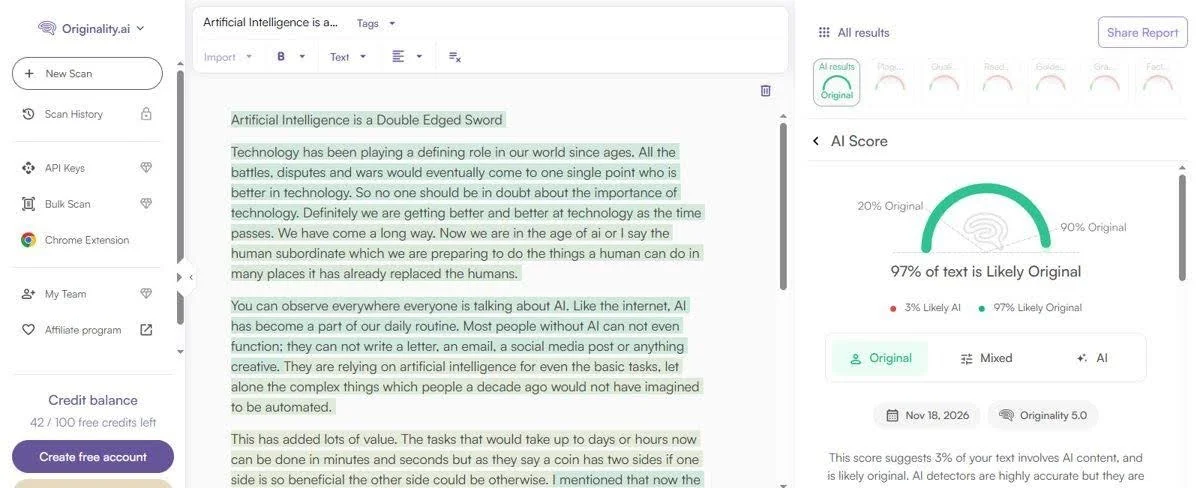
Originality.ai scored it 97% Likely Original, label “Original”, with every sentence green. The number is a confidence level, not a share of the text.
GPTZero on Sample A
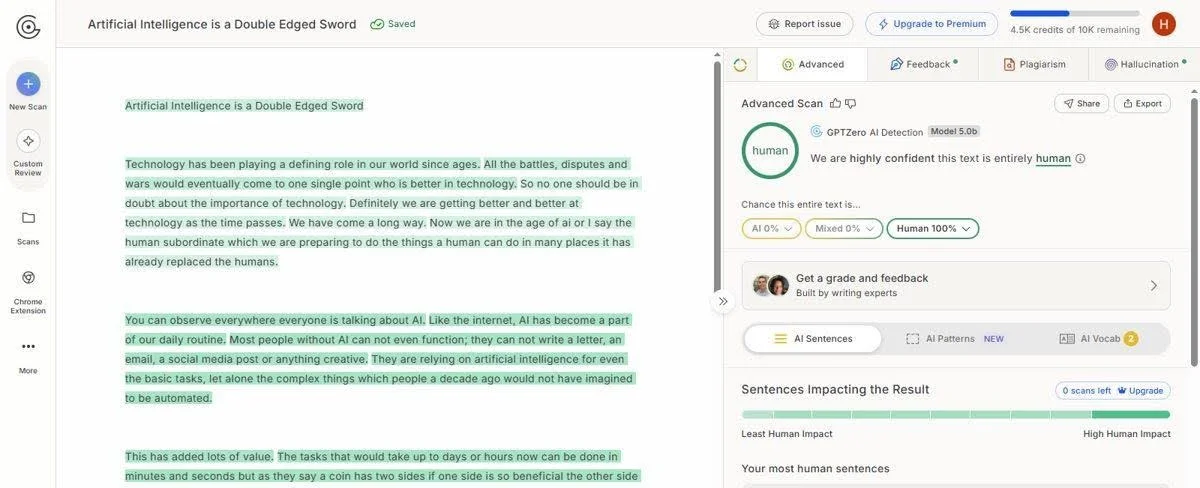
GPTZero showed AI 0%, Mixed 0% and Human 100%: “highly confident this text is entirely human.” Neither tool flagged a single sentence.
Is Originality AI accurate on human writing? On our one essay, yes, and so was GPTZero:
Tool | Overall score | Label shown | Sentences flagged | Screenshot |
|---|---|---|---|---|
Ground truth | 100% human | Human | 0 | Not applicable |
Originality.ai | 97% Likely Original | Original | 0 | Fig. A1 |
GPTZero | Human 100% | Entirely human | 0 | Fig. A2 |
Why Formal and Non-Native Writing Gets Flagged
Many detectors look at perplexity score (how predictable the next word is) and burstiness (how much sentence length and structure vary). Polished, formal, technical and non-native English writing often uses predictable words and even sentences, which detectors can read as AI.
That risk is real: in Liang et al. 2023, seven detectors flagged 61.22% of 91 human TOEFL essays as AI on average.
An independent 2026 study agrees: University of Florida researchers tested five popular commercial detectors on about 6,000 human-written papers and found false positive rates from 0.05% to 68.6% (IEEE Symposium on Security and Privacy, May 2026).
If Your Own Writing Gets Flagged
A flag is a reason to look closer, not proof of misconduct. If it happens to you:
Keep your drafts and version history (Google Docs or Word history).
Export or screenshot the detector report, including which sentences were highlighted.
Ask for a second method of review, such as a conversation about the work, notes or an oral check.
Never accept one score as proof, whether it is your score or someone else's.
Round 2: Raw AI Text From a Current Model
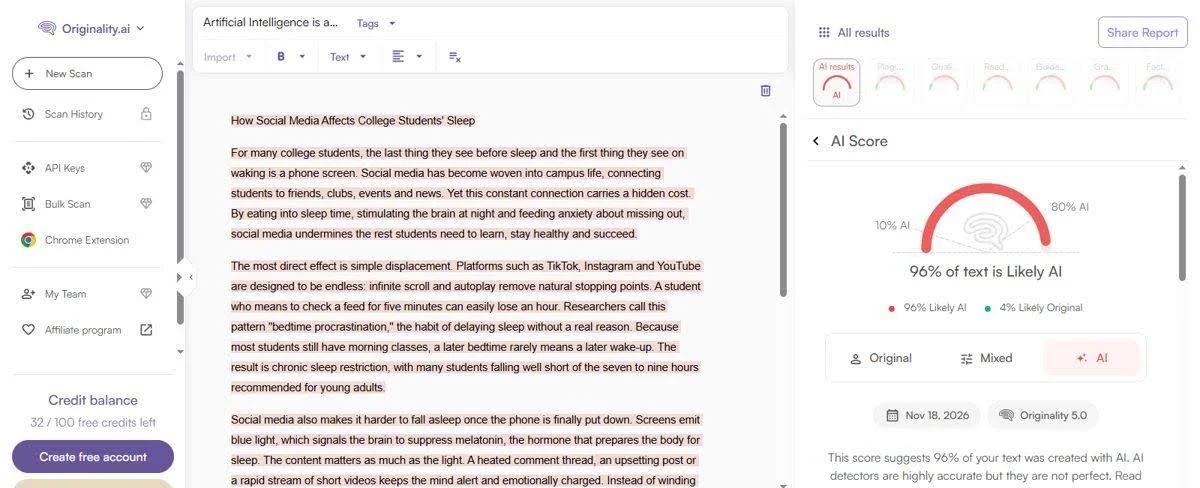
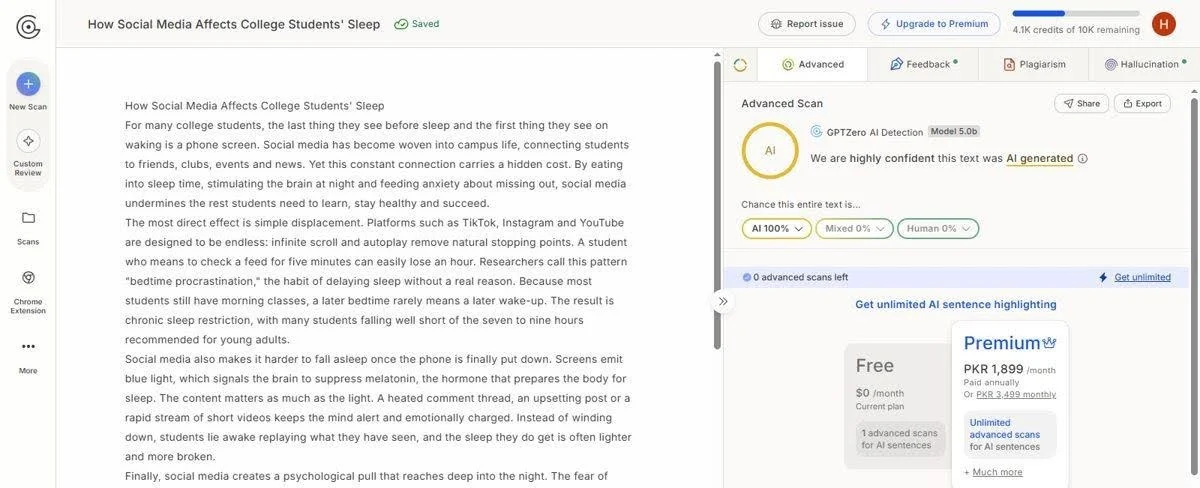
Yes for unedited Claude text: both tools caught our raw Claude essay, with Originality.ai at 96% Likely AI and GPTZero at AI 100%, so Round 2 is a tie. The text came from Claude Opus 5.5 (Medium effort) with no edits, so this round speaks to current Claude text, not older Claude Sonnet 4 detection.
Before you compare the two numbers, know what each label means:
Originality.ai shows an AI vs Original confidence score. "96% AI" means the tool is 96% confident the text is AI, not that 96% of the words are AI.
GPTZero shows separate AI, Mixed and Human probabilities and gives one overall label.
The two scales are not directly comparable, so the table reports each tool's label next to its number.
A correct label on raw AI text is the easiest case, a test of each tool’s true positive rate. It says little about edited or mixed drafts.
Tool | AI score | Label | Sentences flagged | Screenshot |
|---|---|---|---|---|
Ground truth | 100% AI (Claude Opus 5.5, Medium) | AI | All | Not applicable |
Originality.ai | 96% Likely AI | AI | All visible sentences | Fig. B1 |
GPTZero | AI 100% | AI generated | Not shown on Free after the first scan | Fig. B2 |
Originality.ai’s 96% and GPTZero’s 100% both mean “AI” here, and the four-point gap is not a difference in accuracy, because the two numbers measure different things. On raw text, the label is what counts, and both labels matched the known truth.
🔔 For GPT-5 detection, the only head-to-head figure comes from a vendor. In GPTZero’s own test, GPTZero caught 100% of GPT-5 text and Originality.ai 31.7%, and Originality.ai’s accuracy page does not respond to that figure.
Treat that figure as GPTZero’s claim, not a finding: we did not test GPT-5, and Originality.ai launched its 5.0 models in October 2026, a year after GPTZero published its benchmark.
Results change with the model and version, which helps explain the confusing scores readers report on GPT-5, Claude and Gemini text.
So is GPTZero accurate in 2026 on raw AI? On our Claude essay, yes; edited text is a separate question, covered in Round 3 and FAQ 5.
Round 3: Mixed Human and AI Text
Originality.ai found the AI part of our mixed draft and matched all 5 paragraphs to the map, while GPTZero labeled the whole draft AI 100%, so Originality.ai wins Round 3. We recorded the paragraph map before testing, so every highlight can be checked against the truth.
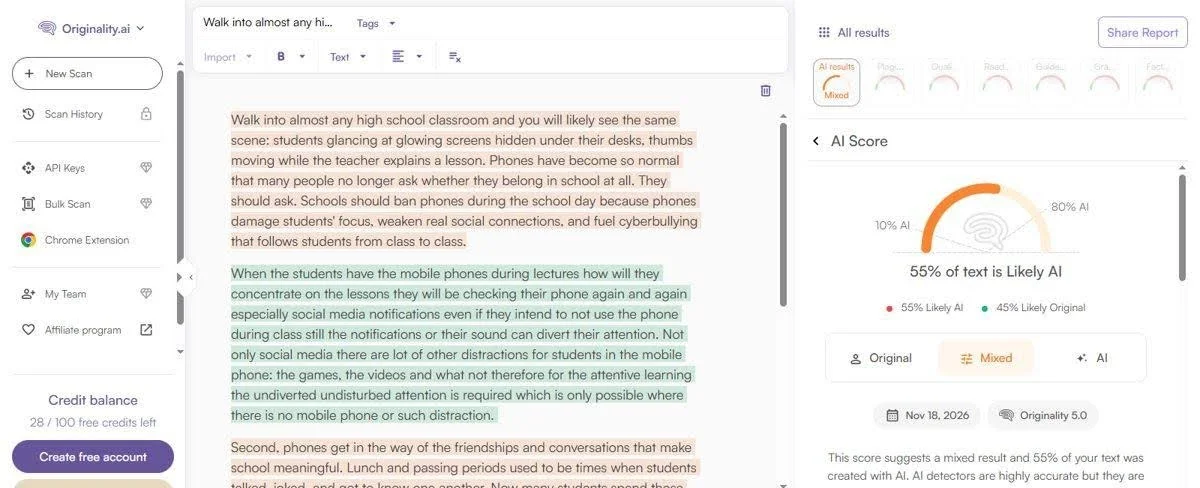
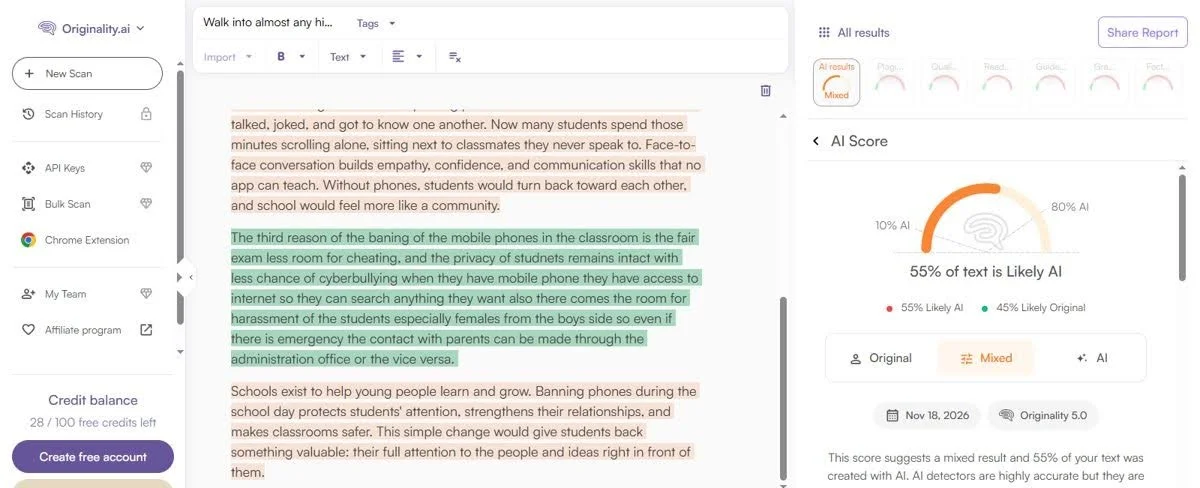
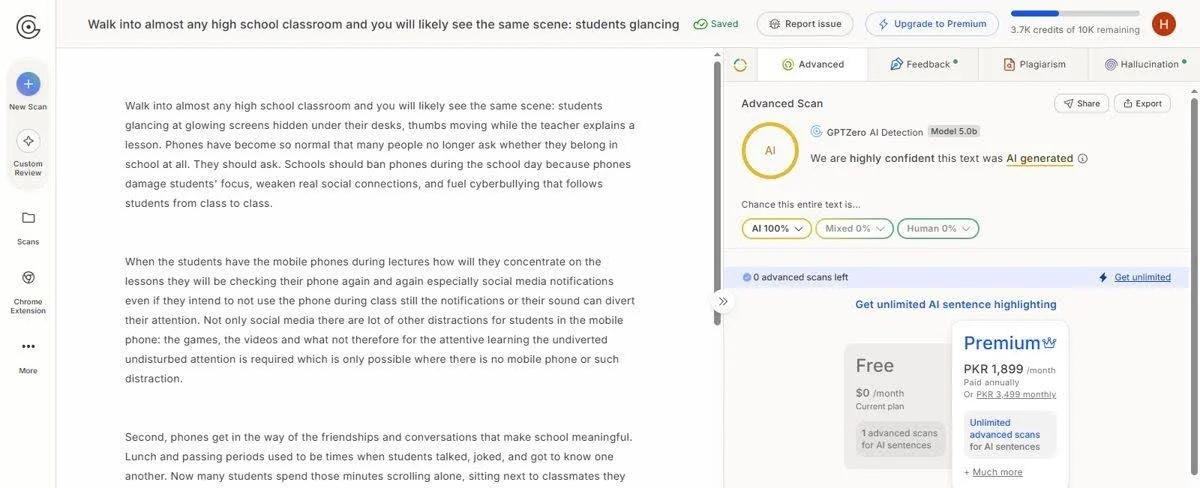
Originality.ai's 55% AI was close to the real AI share by words, which is about 53% (206 of 390 words). GPTZero gave the draft "Mixed 0%", although two paragraphs were written by hand, typos and all.
Paragraph | True source (from map) | highlight | GPTZero highlight | Match? |
|---|---|---|---|---|
1 | AI | AI (orange) | Not shown on Free | Originality.ai: yes |
2 | Human | Original (green) | Not shown on Free | Originality.ai: yes |
3 | AI | AI (orange) | Not shown on Free | Originality.ai: yes |
4 | Human | Original (green) | Not shown on Free | Originality.ai: yes |
5 | AI | AI (orange) | Not shown on Free | Originality.ai: yes |
Overall | Mixed, about 53% AI words | Mixed, 55% AI | AI 100%, Mixed 0% | Originality.ai 5 of 5; GPTZero labeled all AI |
💡 GPTZero's Free plan includes one Advanced Scan with sentence-level highlighting, and ours went on Sample A, so we could not see which paragraphs GPTZero blamed.
Here is more on why AI detectors give different results on the same text.
This is the round that matters most for real drafts, because few writers hand in text that is fully human or fully AI. A label of 100% AI on a half-human essay is the kind of result that starts an unfair conversation.
How to read a mixed result in any tool:
The overall score hides which paragraphs triggered it.
Check the highlighted sentences against what you know about how the draft was written.
A "Mixed" label is not a percentage of AI text.
One run is not proof, so re-run once and record any change.
How accurate are these tools with heavily edited or paraphrased AI content? Our test used mixed human and AI content only; nothing went through QuillBot paraphrasing or a humanizer.
In Scribbr’s independent test (results dated 2024), Originality.ai was the only tool to catch QuillBot paraphrasing more than half the time (60%), while GPTZero “only ever said that a text was entirely AI or entirely human.”
Originality.ai also offers Deep Scan, which it says shows which parts of a text triggered an AI flag. We did not test that feature.
Round 4: Features Beyond the AI Score
Is Originality AI better than GPTZero for publishers on features? Yes, for plagiarism, fact checking and API access, but GPTZero leads on classroom tools, so Round 4 depends on the reader.
Feature | Originality.ai | GPTZero |
|---|---|---|
Plagiarism detection | Yes, on every plan | Yes, optional "Plagiarism Check" in a scan |
Fact-checking | Yes, Fact & AI Hallucination Checker | Yes, optional "AI Hallucinations" check |
Deep Scan | Yes (vendor-described, not tested) | Not confirmed on test date |
Sentence-level highlighting | Yes, even on free credits | Advanced Scan only (1 free) |
Writing report or Writing Replay | Writing replay in browser extension | Not confirmed on test date |
Chrome extension | Yes | Yes (AI Highlights) |
WordPress plugin | Not confirmed on test date | Not confirmed on test date |
LMS integration (Canvas, Moodle, Blackboard) | Not confirmed on test date | Yes, on Professional |
API access | Yes, on Enterprise | Not listed on pricing cards |
Team seats | Yes, extra seats on Pro and Enterprise | Not listed on pricing cards |
Languages supported | Not confirmed on test date | Multilingual detection on Premium |
Checked in each product and on each pricing page, November 18, 2026.
Originality.ai is built as a publishing toolkit. Its sidebar puts the AI checker next to plagiarism detection, grammar, readability, a guideline checker and a fact-checking feature, and Pro adds bulk scans, shareable reports and PDF downloads. Enterprise adds API access and a year of scan history, which is what an agency running checks inside its own CMS needs.
Its newer Deep Scan, which Originality.ai says shows which parts of a text triggered an AI flag, was not part of our test.
GPTZero is built around the classroom and the single document. Its paid plans add multilingual detection, downloadable AI reports and, on Professional, page-by-page scanning, 250-file batches and LMS integration.
Sentence-level highlighting sits behind Advanced Scan, and the Free plan includes only one, so after that you get document-level scores, as Round 3 showed.
Its Chrome extension adds AI Highlights, with five free on the Free plan.
Which features matter depends on who you are:
Publishers and agencies: plagiarism detection, fact checking, API access and bulk scanning.
Teachers: LMS integration and a writing report or Writing Replay.
Developers: API documentation, authentication and rate limits.
If you are weighing Originality AI vs Turnitin, check the LMS row first, because Turnitin works inside school systems; a full comparison is outside this page’s scope.
For the deep dive on one tool, read our full Originality.ai review.
Round 5: Is Originality.ai Worth Paying for If GPTZero Has a Free Plan?
On November 18, 2026, GPTZero offered a free plan with 10,000 words a month and paid plans from $23.99 a month, while Originality.ai gave 100 free credits once and charged from $14.95 a month. That makes GPTZero the cheaper start for students and teachers, and also the better value for agencies at 450,000 words a month.
GPTZero wins Round 5 for both low-volume and high-volume users.
Plan | Monthly price | Annual price (per month) | Words or credits included | Free allowance | Card required at signup |
|---|---|---|---|---|---|
GPTZero Free | $0 | Not applicable | 10,000 words a month | 10,000 words a month; 1 Advanced Scan | No |
GPTZero Premium | $23.99 | $12.99 | 300,000 words a month | Not applicable | Not applicable |
GPTZero Professional | $45.99 | $24.99 | 500,000 words a month | Not applicable | Not applicable |
Originality.ai Free | $0 | Not applicable | 1 credit = 100 words | 100 credits (10,000 words), one time | No |
Originality.ai Pro | $14.95 | $12.95 | 2,000 credits (200,000 words) a month | Not applicable | Not applicable |
Originality.ai Enterprise | $179 | $136.58 | 15,000 credits (1.5 million words) a month | Not applicable | Not applicable |
Originality.ai pay as you go | Not shown on pricing page | Not applicable | 1 credit = 100 words (“Buy more credits”, no price listed) | Not applicable | Not applicable |
📢 Is Originality AI free? Only for a one-time 100 credits. Prices checked on November 18, 2026, in USD. Check each vendor's pricing page before you buy.
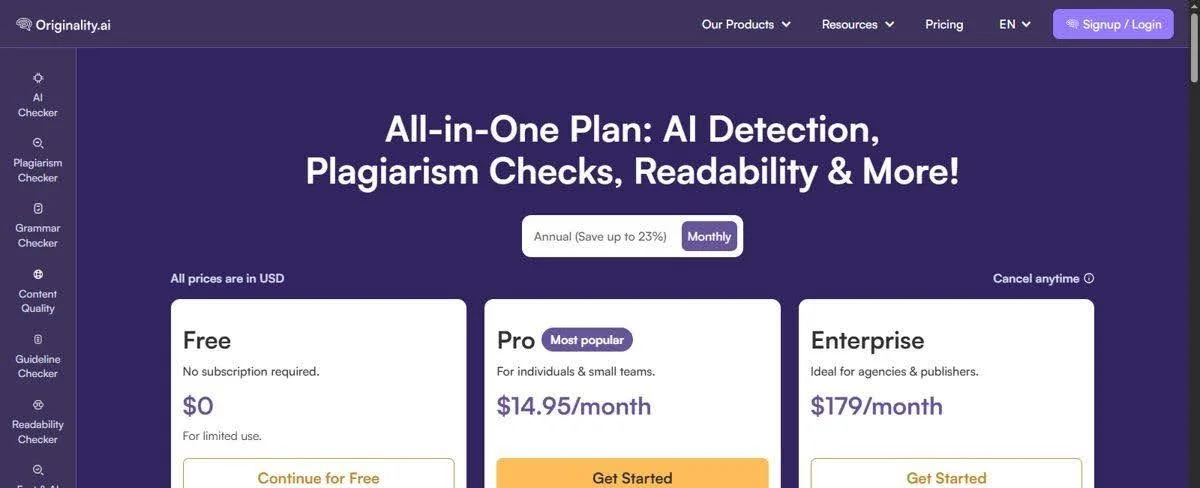
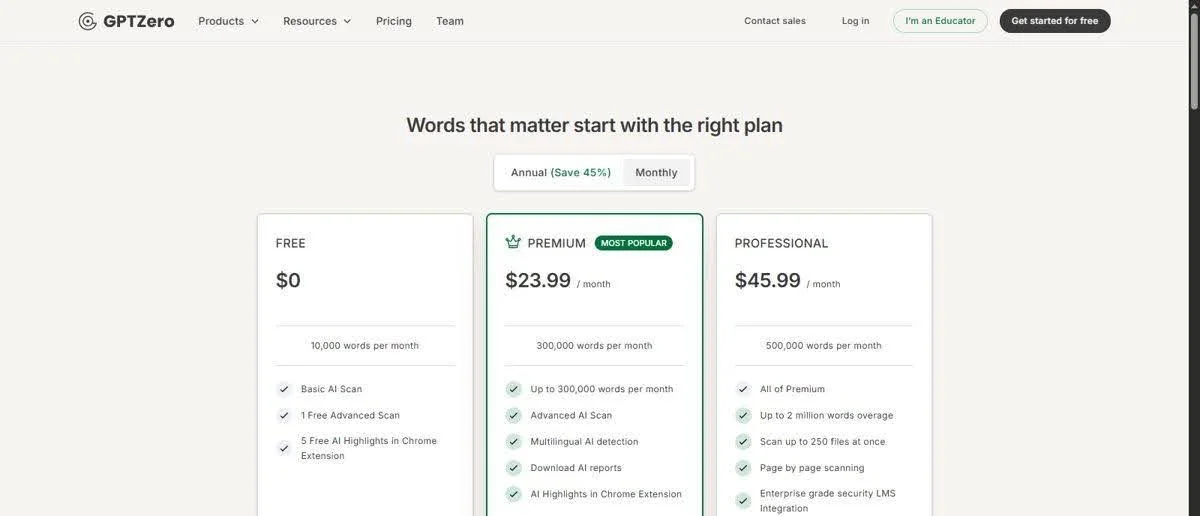
Is Originality AI free? Only once. Check the date on any Originality AI Reddit thread or review you read: some say it has no free tier, but on November 18, 2026 its pricing card showed “10K words (100 credits one time)”, while the same page’s comparison table listed “60 (3 scans/day)”.
🚨 Other reported figures differed too: GPTZero’s lowest price was $12.99 a month billed annually, not $8.33, its homepage scanner showed a 10,000-character limit on our free account, not 5,000, and neither tool asked for a card at signup.
What It Costs an Agency and a Student
Agency, 300 articles x 1,500 words = 450,000 words a month: that is 4,500 Originality.ai credits, more than Pro's 2,000, so you need Enterprise at $179 a month ($136.58 billed annually). On GPTZero, Premium stops at 300,000 words, so you need Professional at $45.99 a month ($24.99 billed annually).
Student, 10 essays at an assumed 500 words each = 5,000 words a month: GPTZero Free covers it every month. Originality.ai’s 100 free credits cover it once; after that, Pro costs $14.95 a month.
Hidden Costs in Credit-Based Pricing
Credit expiry: Originality.ai’s comparison table lists credit expiry on Pro and Enterprise as “1 month (renews monthly)”, so unused credits appear to lapse.
Plagiarism scans: Originality.ai's FAQ asks how many credits an AI plus plagiarism scan uses, so expect extra credits when you add it.
Top-ups and overage: Originality.ai lists "Buy more credits" without a price; GPTZero Professional allows "up to 2 million words overage" without a listed rate.
Annual lock-in: annual billing saves up to 23% on Originality.ai and 45% on GPTZero, but you pay for the year up front; Originality.ai links a separate Refund Policy, so read it before you commit.
Credit surprises: in our session, one Originality.ai scan shown as 5 credits took 10 from the balance. It happened once and we do not know why.
How do you compare the pricing and accuracy of Originality AI and GPTZero for your agency? GPTZero costs about a quarter as much at 450,000 words, but Originality.ai was the tool that read our mixed draft correctly, so weigh how many of your drafts mix human and AI writing.
If you want to explore options beyond these two tools, see our Originality.ai alternatives.
Round 6: Privacy, Data Storage and Compliance
Is Originality AI safe for client or student text? It depends on each vendor’s stated retention and training policy, quoted below as published on November 18, 2026, and on your data privacy and compliance needs.
Policy point | GPTZero (quoted, Nov 18, 2026) | Originality.ai (quoted, Nov 18, 2026) |
|---|---|---|
Stated data retention | "for as long as necessary to provide our products to you" | "only for as long as reasonably necessary to fulfill the purposes described" |
Use of submitted text for training | "We also use information we collect to train our AI models. You can decide whether Superhuman can use your user content to train our AI models" in account settings | "Unless you opt out, we may use your scan history and scan results to help train and improve our models." |
Deletion option | Right to “request deletion of your personal information” (EU: “right to erasure”) via Superhuman’s Privacy and Data Rights page or [email protected] | “Request the deletion of your Personal Information” via [email protected]; deleting a scan “does not necessarily immediately delete copies retained by our processing providers” |
Named compliance claims | GDPR, UK GDPR, EU-U.S. Data Privacy Framework (with UK Extension and Swiss-U.S. DPF), U.S. state privacy laws | FERPA, COPPA, U.S. state student privacy and state privacy laws, GDPR, UK GDPR, Canadian federal and provincial privacy laws |
Policy page URL checked | superhuman.com/legal/privacy-policy (gptzero.me/privacy-policy.html points here) | originality.ai/privacy-policy |
GPTZero's privacy page says it "has been acquired by Superhuman" and now follows Superhuman's policy, effective November 16, 2026. Originality.ai's policy was last amended June 17, 2026.
For more, see whether it is safe to paste an essay into an AI detector. GPTZero’s privacy page says it “has been acquired by Superhuman” and now follows Superhuman’s policy, effective November 16, 2026. Originality.ai’s policy was last amended June 17, 2026.
School accounts follow their contracts: Superhuman’s policy “does not apply” to content uploaded through such accounts, and Originality.ai says Student Data under an institutional agreement “will not be used to train general-purpose AI models.” Originality.ai says OpenAI may keep submitted text in abuse-monitoring logs “for up to 30 days.”
❗ Both policies allow training on submitted text with a user control, give no fixed retention period and offer deletion requests: Round 6 is a tie.
Three checks before you paste client or student text:
Read the data retention clause: how long is submitted text stored?
Find the training opt-out and check whether it is on by default.
Remove names, student IDs, client names and other identifiers before scanning.
Verdict by Reader: Publishers and SEO Teams vs Teachers and Students
Which is the best AI detector for your needs in the Originality.ai vs GPTZero choice? Choose based on who you are: publishers and agencies should weight Rounds 3, 4 and 5, while teachers and students should weight Rounds 1, 5 and 6.
Publishers, SEO Teams and Agencies
If you review freelance or AI-assisted drafts, the Round 3 result matters most, because most real drafts are mixed. Here is how publishers and editors can check submissions fairly.
Pick Originality.ai if:
Your drafts mix human and AI writing and you need to see which paragraphs to fix.
You scan many drafts at once: Bulk Scan comes with Pro.
You want plagiarism and AI checks in one scan.
You need API access, which sits on its Enterprise plan.
Your budget allows $179 a month for 450,000 words.
Skip it if cost at volume decides for you: GPTZero Professional covers the same 450,000 words for $45.99 a month.
Teachers and Schools
Pick GPTZero if you want a free tier, LMS integration on Professional and a tool that read our human essay as Human 100%. Skip it as your only check on mixed work: its Free plan called our half-human essay 100% AI, so pair it with Originality.ai.
In HEPI’s 2026 survey of 1,054 UK undergraduates, 94% said they use generative AI to help with assessed work, and some described anxiety about false accusations. Compare Turnitin vs GPTZero if your school already licenses one.
📌 What AI detector do colleges use? Many use Turnitin, which sits inside their learning management system; Turnitin said in 2023 that it serves over 20,000 institutions. That makes the GPTZero vs Turnitin vs Originality AI question, and any Originality AI vs Turnitin choice, mostly about what your school already pays for.
Students and Freelance Writers
You are usually the person being checked, not the person choosing the tool. Both tools read our human essay correctly, but that was one essay, and non-native English writers face a higher risk of false flags (Round 1). Before you trust "is Originality AI accurate" Reddit threads, check Rounds 1 and 3.
Keep version history in Google Docs or Word.
Save your drafts and notes.
Treat any score as a signal, not proof.
Pick GPTZero if you want a free self-check: its free plan covers 10,000 words a month and gave our human essay Human 100%.
Run a Second Check Before You Act on Any Score
When the two tools disagree, treat both scores as leads and check the evidence before you act. Our mixed essay is the proof: one tool said 55% AI and the other 100%.
Which tool is more likely to flag your own human writing? In our test, neither: GPTZero scored our human essay Human 100% and Originality.ai 97% Original. One essay cannot give a false positive rate, so treat vendor true positive rate claims as claims until independent benchmark testing confirms them.
Compare the highlighted sentences in both reports.
Check the draft and its version history.
Run one more detector.
Talk to the writer before you accuse anyone.
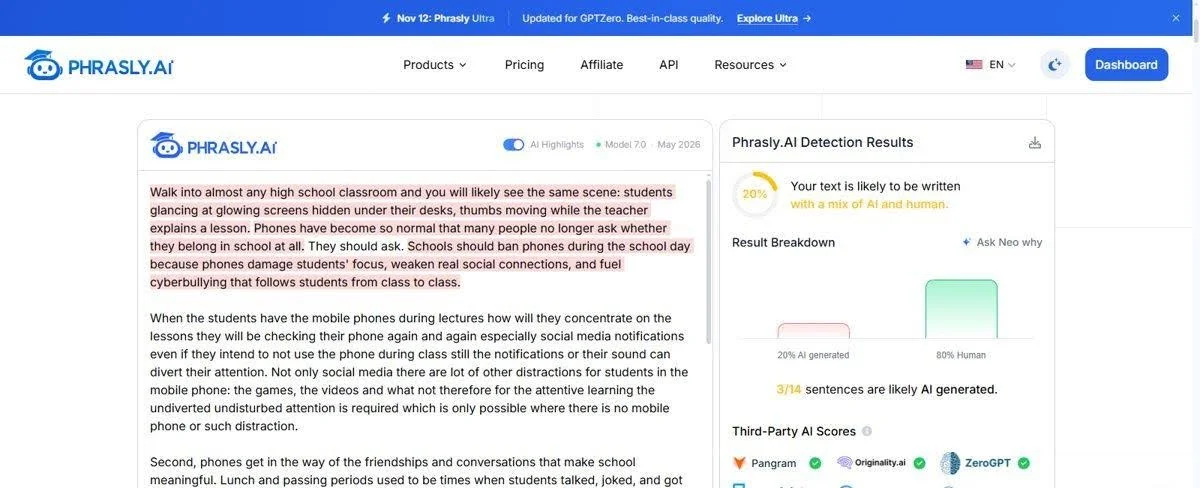
We ran the same three samples through Phrasly’s detector on November 18, 2026. It got the human and raw AI samples right and missed two of the three AI paragraphs in the mixed essay.
Sample | Known truth | Phrasly AI Detector score (Nov 18, 2026) | Matched known truth? | Screenshot |
|---|---|---|---|---|
Unpublished human sample | 100% human-written | 86% human, 14% AI; 0 of 17 sentences AI | Yes | Fig. P1 |
Raw AI sample | Claude Opus 5.5, unedited | 100% AI; 27 of 27 sentences AI | Yes | Fig. P2 |
Mixed sample | P1 AI, P2 human, P3 AI, P4 human, P5 AI | 20% AI, "mix of AI and human"; 3 of 14 sentences AI | 3 of 5 paragraphs (missed P3 and P5) | Fig. P3 |
Phrasly makes this detector. Results are from November 18, 2026 on the same three samples.
For another same-text test, see GPTZero vs ZeroGPT.
Check Your Text With Phrasly AI Detector
Phrasly makes this detector; we used it as a second check, not as a judge in this comparison.
Use it as one more signal alongside the steps above. It is free with an account and highlights the sentences that read as AI.
🔍 Get a Second Opinion on Your Draft
Paste the same text into Phrasly's free AI Detector and compare the highlighted sentences before you act on any score.
FAQs
Is GPTZero or Originality AI More Accurate?
Neither was more accurate in our Originality.ai vs GPTZero test. Both read our human and raw AI essays correctly, but only Originality.ai labeled our mixed essay “Mixed” and matched every paragraph. Three samples cannot settle Originality AI accuracy or GPTZero’s in general; see the scorecard above.
Can Originality AI Produce False Positives, or Is It Too Strict?
Yes, any detector can flag human writing, though Originality.ai scored our human essay 97% Likely Original (Round 1). Its own November 2026 post reports 98.901% human specificity for Model 5.0 on non-native TOEFL essays, a vendor figure. Short, formal and non-native texts carry more risk, so keep drafts and version history.
What Is GPTZero's False Positive Rate?
GPTZero reports a 0.24% GPTZero false positive rate in its own September 2025 benchmark, which GPTZero ran on itself. Independent 2026 research found false positive rates from 0.05% to 68.6% across five unnamed detectors. Read more on how accurate GPTZero is.
How Accurate Are These Tools With Heavily Edited or Paraphrased AI Content?
We did not test paraphrased text; Round 3 covers mixed text. In Scribbr’s test, Originality.ai caught QuillBot paraphrasing 60% of the time, the only tool above half, so treat no score as proof on reworded text. See whether AI detectors can spot paraphrased text.
Can Either Tool Detect GPT-5 or Claude Text After It Is Edited?
Both caught unedited Claude Opus 5.5 text in our test, and GPTZero's own benchmark reports 100% on GPT-5 versus 31.7% for Originality.ai. Editing is the weak point: on our half-human essay, GPTZero said 100% AI and Originality.ai said Mixed (Round 3).
Is Originality AI Free?
Only partly. On November 18, 2026, Originality.ai gave 100 free credits, about 10,000 words, one time, with no card required. Its paid plans start at $14.95 a month, while GPTZero’s free plan gives 10,000 free words every month (Round 5).
What AI Detector Do Colleges Use, and How Does Turnitin Compare?
Schools choose detectors one by one, and many rely on Turnitin’s AI writing indicator inside their learning system. GPTZero sells LMS integration on its Professional plan. Ask your instructor which tool applies to you; see which AI detectors universities use.
Should a Detector Score Be the Only Evidence?
No: in our test, two detectors gave the same essay 55% AI and 100% AI, and a third said 20%. Treat any score as a lead, then check drafts, version history and a conversation with the writer. Here is how often AI detectors get it wrong.

Written by
Hasnain
Karachi, Pakistan
I help businesses grow with SEO-friendly blog posts, landing pages, and long-form content. With 3+ years of experience, I deliver clear, original, and well-researched writing that drives results.