Originality.AI Review: Is It Accurate and Reliable in 2026?
11 min read
This Originality AI review gives you the short verdict first. Originality.AI is a capable screening tool for publishers and content teams. But its score is a probability. Not proof of who wrote a draft.
It now runs on AI Allowance. You choose how much AI to permit, after retiring its Lite, Turbo, and Academic models in September 2026.
We ran a same-text spot check on October 15, 2026. This review covers accuracy, false positives, the free tier, and pricing. And how the tool compares with Phrasly's free AI Detector.
Disclosure: Phrasly publishes this review and makes a competing AI detector. We ran both tools on the same texts and kept our own observations separate from each vendor's claims.
Check Your Text With a Free AI Detector
Paste a draft into Phrasly's Free AI Detector for a quick read before you commit to a paid tool. Paste at least 30 words. Treat the score as a signal to review. Not a verdict.
What Is Originality AI and How Does It Work?
Originality.AI is a content-checking platform for publishers, agencies, and writers. It estimates whether text is AI-generated. On paid plans, it also checks plagiarism, readability, and facts.
The vendor describes its detector as a modified BERT model trained on known human and AI writing. The model returns a label with a confidence score rather than a verdict.
Two different questions sit inside the tool. AI detection estimates whether a machine wrote the text. Plagiarism matching compares your text against published sources. They answer different things. And produce different scores.
A clean plagiarism result says nothing about the AI reading. And the reverse is also true.
For the mechanics of the detection side, see this guide on how do AI detectors work.
What Changed With AI Allowance?
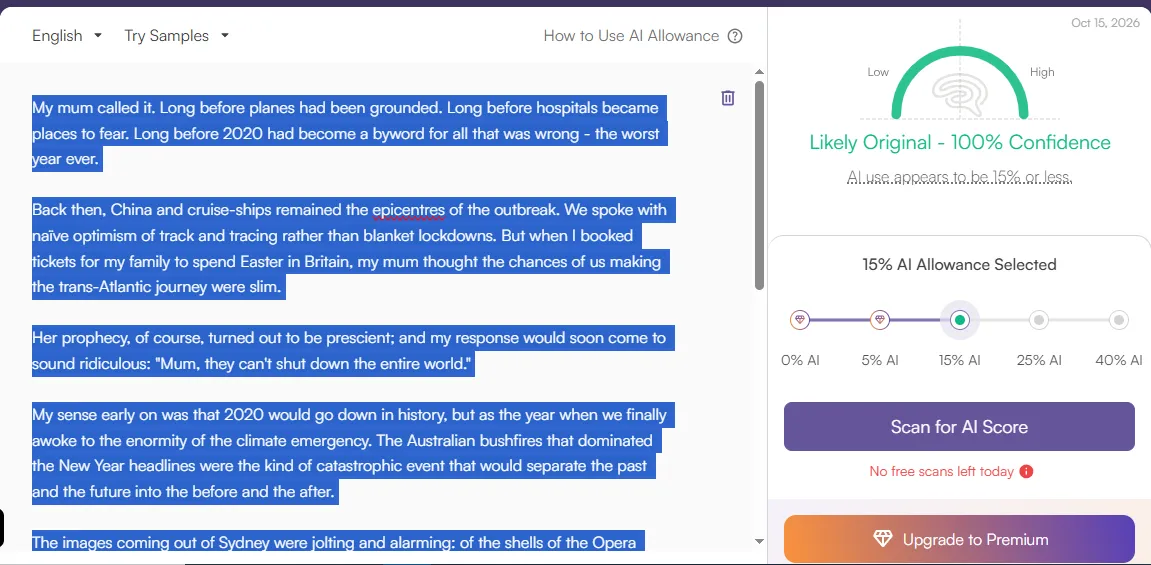
With AI Allowance, you choose how much AI to allow before a draft is flagged. 0%, 5%, 15%, 25%, or 40%. The vendor recommends 15% for most uses. Originality retired its Lite, Turbo, and Academic models in September 2026.
The older "Originality Lite" setting no longer exists. Multi-language support across 30 languages is still available.
Per Originality's own AI Allowance announcement, the setting changes which label a draft receives.
Not the underlying reading.
Is Originality AI Accurate and Reliable?
Originality.AI is accurate on clearly AI-written text. Useful for screening, but no published number tells you how it will score your specific draft.
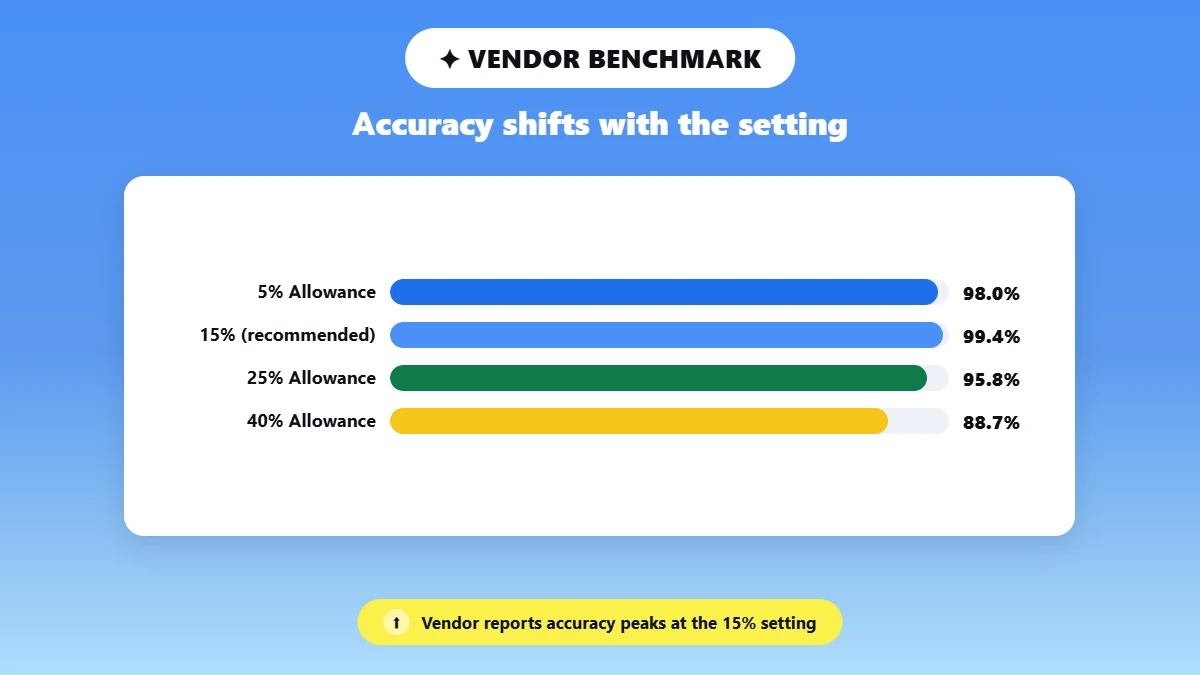
Its own benchmark reports 99.4% accuracy at the 15% AI Allowance setting.
Independent research reports lower figures. Edited or mixed drafts are where its results get less dependable.
What the Vendor Benchmark Measures
Originality reports 99.4% overall accuracy at the 15% AI Allowance setting (vendor claim). Measured on a 456,872-sample slice of its Benchmark V6 covering GPT-5, Claude 4.5, and Gemini-era models.
The same table reports 98.0% at 5%. 95.8% at 25% and 88.7% at 40%.
AI Allowance setting | Overall accuracy (vendor claim) |
5% | 98.0% |
15% (recommended) | 99.4% |
25% | 95.8% |
40% | 88.7% |
The nuance the vendor states itself is worth repeating plainly.15% scores highest because it matches how that benchmark labeled AI text. Not because 15% is inherently a "better" setting.
Source: Originality's AI accuracy page, updated September 2026. Read the figure as the ceiling under lab conditions. Not a promise about your document.
What Independent Research Shows
A 2026 peer-reviewed study in the International Journal for Educational Integrity (Hadra, Cambridge, and Mesbah) tested 192 texts. Reported Originality at 0.69 overall accuracy versus Turnitin's 0.61. Both detectors are weak on hybrid human-and-AI texts.
The study predates AI Allowance. Read it as evidence that results vary by context rather than a current score. See the full paper.
The pattern across independent testing is consistent. Detectors do well on clearly machine-written text. Struggle most on edited or mixed drafts. This is the common real-world case.
This breakdown of AI detection accuracy across checkers puts these numbers in wider context.
Our Same-Text Spot Check
We ran one human sample (written before November 2022). No AI tool was involved. And one unedited ChatGPT sample through both tools on the same day. At Originality's 15% AI Allowance. Two samples show direction. Not a benchmark.
# | Text | Tool | Setting/Version | Label/Score | Highlights |
1 | Human (pre-2022) | Originality | 15% AI Allowance | Likely Original, 100% confidence | None flagged |
2 | ChatGPT (unedited) | Originality | 15% AI Allowance | Likely AI, 100% confidence | All flagged |
3 | Human (pre-2022) | Phrasly | Model 7.0 | 90% Human / 10% AI | 0 of 19 sentences |
4 | ChatGPT (unedited) | Phrasly | Model 7.0 | 100% AI | 25 of 25 sentences |
Spot check run on October 15, 2026. Originality at 15% AI Allowance. Phrasly on Model 7.0.
On our pre-2022 human sample, Originality returned Likely Original at 100% confidence. And Phrasly returned 90% Human with 0 of 19 sentences flagged.
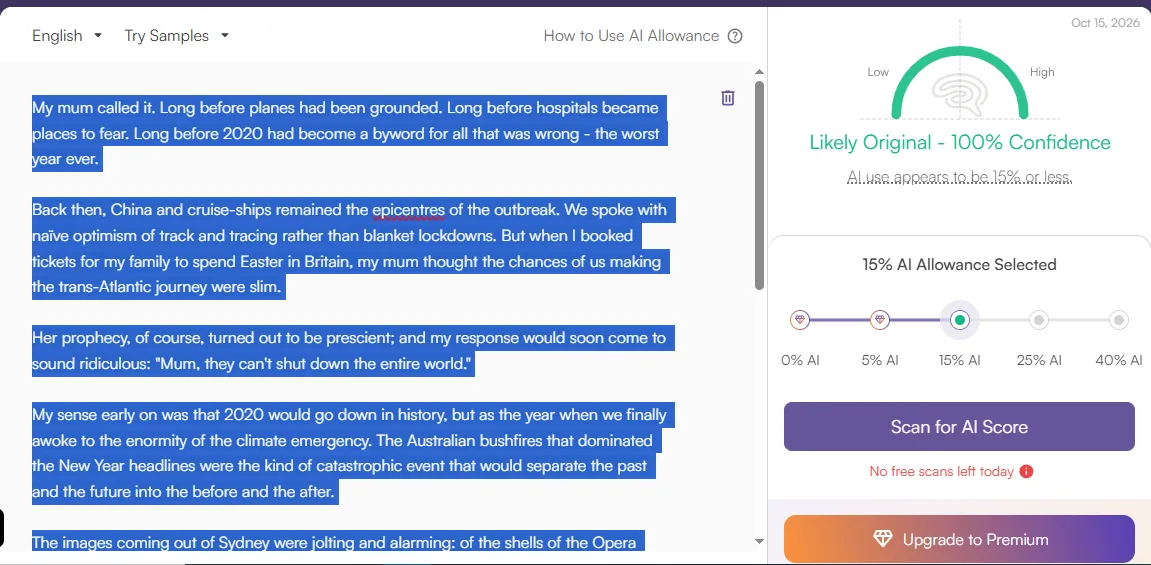
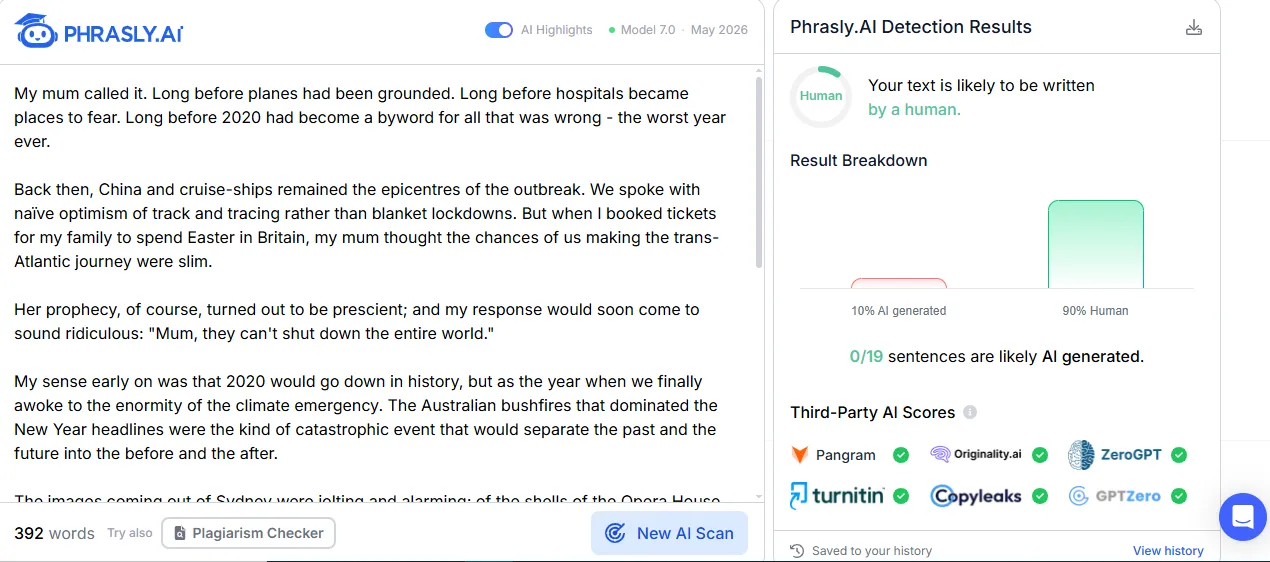
On the unedited ChatGPT sample, both tools flagged it. Originality as Likely AI at 100% confidence; Phrasly at 100% AI.
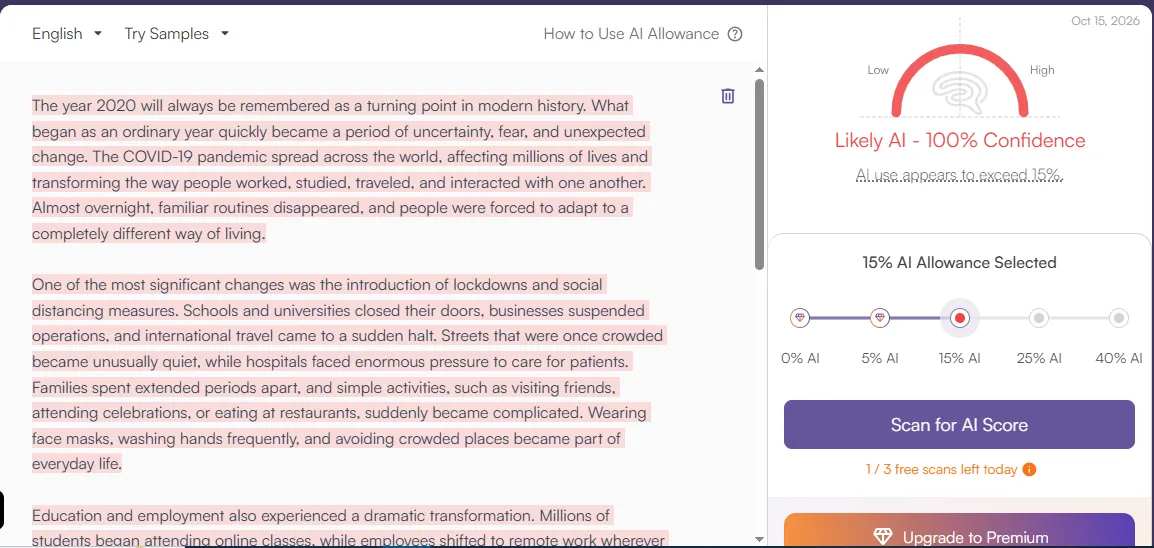
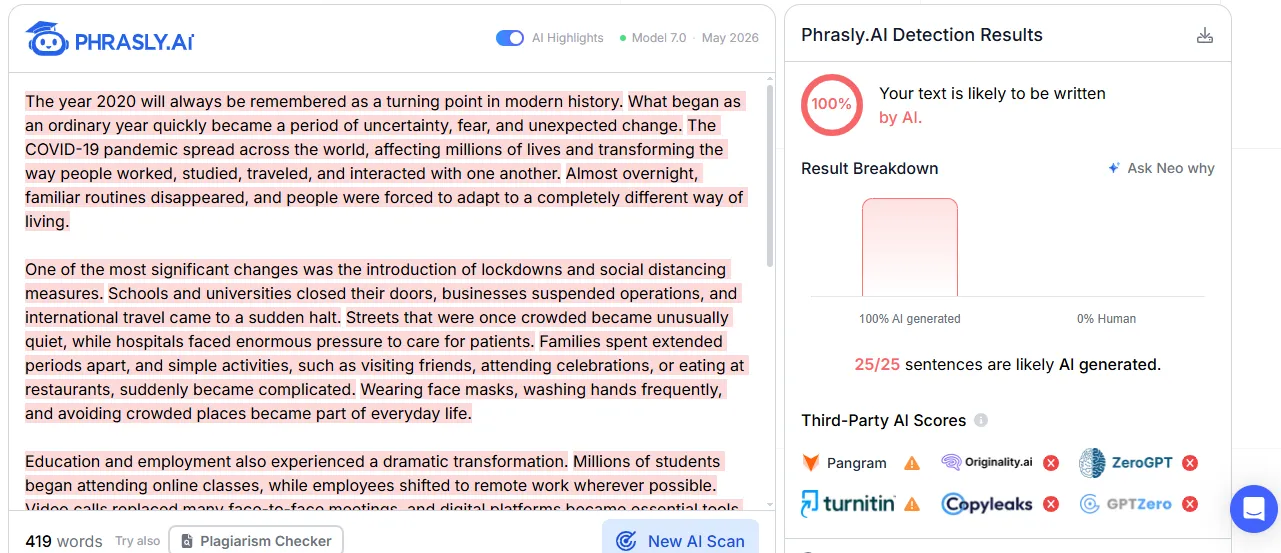
Two samples show direction. Not an accuracy benchmark. Neither result proves authorship on its own.
Reliability verdict: Originality.AI is dependable for screening content at scale. But a single score should start a review. Not settle a high-stakes decision on its own.
Why Does Originality AI Flag Human Writing?
Originality.AI can flag human writing when the text is short, formal, or formulaic. When an AI editing tool has reworded it or when a strict AI Allowance is selected. The same draft can be labeled Likely Original at 15% and Likely AI at 5%.
So check the setting before you treat a flag as a verdict.
The confidence score and the threshold measure different things. A "Likely Original, 60% confidence" result means the model is 60% sure of its own label. Not that 40% of the text is AI.
With 15% selected, Likely Original reads as "AI use appears to be 15% or less." Mixing those two up is the most common misreading of an Originality result.
The vendor names specific triggers. Texts under 100 words and AI tools that rewrite or edit copy, including some Grammarly features. Basic spelling and punctuation fixes carry far less risk than a full AI reword. If your human draft gets flagged, work through this list before treating it as a verdict:
Save the report and the exact AI Allowance setting used.
Check the text length and language. Short and non-English text raises the risk.
Compare the highlighted sentences against your own drafts and notes.
Show your version history or Originality's own Writing Replay recording of the writing process.
Agree with your client or editor on what AI help was allowed in the first place.
In our own spot check, Originality did not flag our pre-2022 human sample. It returned Likely Original at 100% confidence at the 15% setting. A clean result here does not mean false positives never happen.
It means this particular human text, at this setting, read as original.
For the wider picture on why clean human text gets flagged, see this guide on AI detector false positives.
Is Originality AI Free? Pricing and Credits Explained
Originality.AI has no free trial. But its free AI checker allows 3 scans a day of up to 2,000 words each, with no account. Paid plans use credits. Pro costs $14.95 a month, or $12.95 a month billed yearly, for 2,000 credits.
And one credit covers 100 words of AI scanning.
Plan | Price (USD) | Credits/Limits | Key features |
Free (Basic) | $0 | 3 scans/day, 2,000 words per scan | AI detection only; file upload (docx, pdf, doc) |
Pro | $14.95/mo, or $12.95/mo billed yearly ($155.40/yr) | 2,000 credits/mo, expire monthly | Plagiarism, readability, fact-checking, team roles, Chrome extension, 30-day scan history |
Enterprise | $179/mo, or $136.58/mo billed yearly | 15,000 credits/mo | API access, 365-day scan history, priority support |
Pricing is accurate as of the date this article was written and is subject to change. Confirm the current price on the tool's official pricing page before purchasing.
The credit math matters for a small team. One credit covers 100 words of AI scanning. Running AI plus plagiarism together costs 2 credits per 100 words. Pro's 2,000 monthly credits cover roughly 200,000 words of AI-only scanning.
About 100 articles of 2,000 words, or about 50 if you add plagiarism. Re-scanning the same draft at a different AI Allowance uses new credits.
For an occasional checker, the free tier covers up to 6,000 words a day. This is enough for many solo writers.
Verified on Originality's pricing page on October 5, 2026.
Which Originality AI Features Matter for Content Teams?
Beyond the detector, Originality bundles several checks into one paid workflow. The table below shows what each feature does and who actually needs it. So you are not paying for a suite when you want a single reading.
Feature | What it does | Who needs it |
AI Allowance detection | Flags AI against a threshold you set | Every user |
Plagiarism checker | Matches text against published sources | Publishers, agencies |
Readability checker | Scores how accessible the writing is | SEO and content teams |
Fact checker | Flags claims to verify (an aid, not proof) | Editors; verify sources yourself |
Deep Scan | Explains why text was flagged | Anyone disputing a flag |
Chrome extension + Writing Replay | Records the writing process in Google Docs | Writers who need to prove authorship |
Team roles and shareable reports | Assigns access and shares results | Content teams |
API access | Automates scans at scale | Enterprise only |
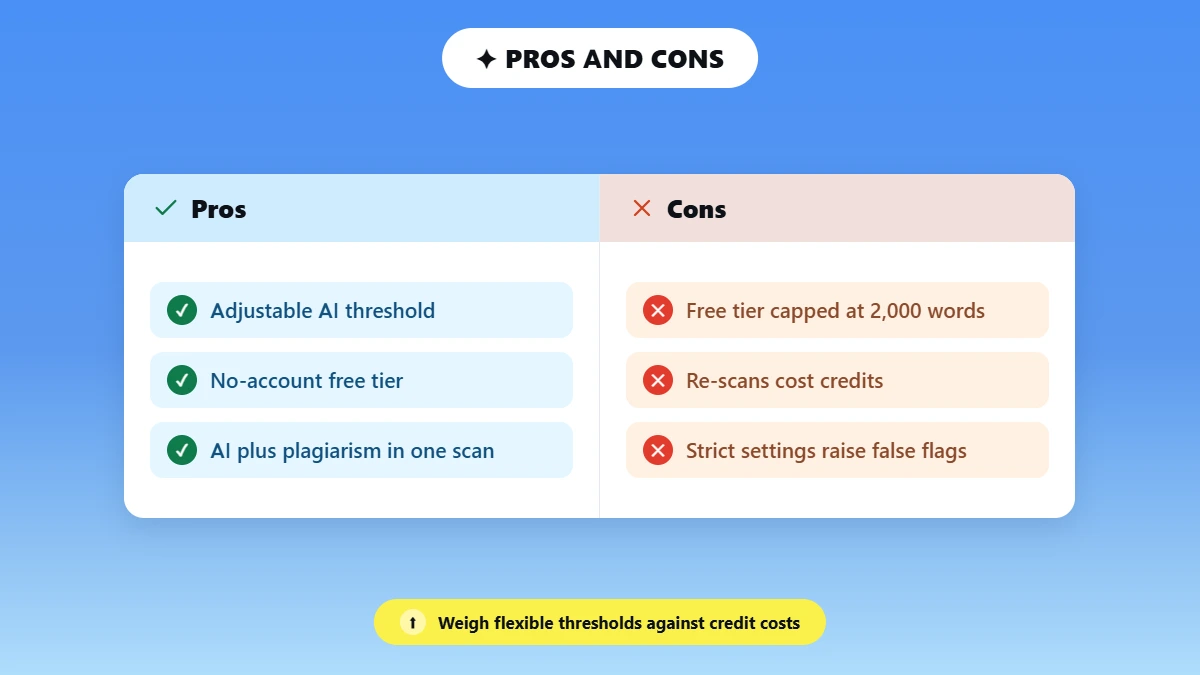
Pros | Cons |
Adjustable AI threshold via AI Allowance | Free tier is AI-only and capped at 2,000 words |
No-account free tier for quick checks | Re-scans cost credits |
AI and plagiarism in one scan | Strict settings raise false flags |
Team roles and shareable reports | Subscription credits expire monthly |
Vendor publishes a detailed accuracy write-up | No trial of paid features |
How to Use Originality AI and Read the Results
Using Originality.AI takes five short steps once you know which route to pick.
Pick a route. The free checker on the homepage. Or the signed-in app if you want the AI Allowance slider.
Paste or upload the full text, with a 100-word minimum.
Choose an AI Allowance. 15% is the default. Note which setting you used.
Run the scan.
Read the label, confidence score, and highlighted sentences together. Then compare them against your own drafts.
Phrasly AI Vs Originality AI: Which AI Detector Should You Use?
Use Phrasly's AI Detector when you want a quick free check with sentence highlights. Use Originality.AI when you need adjustable AI Allowance settings. Plagiarism checks and team reports in one paid workflow.
Neither score proves who wrote a draft. And the two tools define their percentages differently.
| Phrasly AI Detector | |
Free access | Free AI detector with sentence highlights | Free checker: 3 scans/day, 2,000 words each |
Detection setting | Single model (Model 7.0, May 2026) | AI Allowance slider: 0, 5, 15, 25, 40% |
What the result shows | AI % with sentence highlights | Label plus confidence score with highlights |
Other checks in the same scan | AI detection only | Plagiarism, readability, fact-checking |
Paid workflow | Phrasly detector plans | Credit-based: Pro and Enterprise |
Published accuracy claim | 99.8% (vendor claim) | 99.4% at 15% (vendor claim) |
On "how accurate is Phrasly AI Detector": Phrasly reports a 99.8% accuracy figure (vendor claim). And in our October 15, spot check it returned 90% Human with 0 of 19 sentences flagged on our human sample.
And 100% AI on the ChatGPT sample on the same texts.
As with any detector, one same-day test shows how a tool behaved on two samples. Not how it will score every draft. The two tools also disagree at times.
They use different models and score definitions, which we cover in why AI detectors give different results.
Who should pick which:
Occasional checks and second opinions: Phrasly's free detector covers it without an account or credits.
Weekly screening with plagiarism, readability, and team reports: Originality.AI fits that workflow better.
Teams needing API access or shareable reports: Originality.AI is built for that. A free detector is not.
Want a second report on the same draft? Check Your Draft with Phrasly AI Detector. Then read both results alongside your writing history.
Is Originality AI Worth It for Writers and Small Teams?
Originality.AI is worth paying for if your team screens content every week. And needs plagiarism checks, shared reports, and adjustable AI settings in one place.
For occasional checks, its free tier or a free detector like Phrasly covers most needs without a subscription.
For a small content team, the math is straightforward. Pro's 2,000 monthly credits scan about 100 articles of 2,000 words for AI only. Or about 50 with plagiarism added, for $14.95 a month.
If you screen a steady flow of freelance work and want originality and plagiarism in one report, that is good value. If you check a handful of drafts a week, you are paying for capacity you will not use.
Three honest options depending on how often you check. The free tier for occasional scans. Pro for weekly screening with reports and plagiarism. And Phrasly's free detector for a quick second opinion when you do not need the whole suite.
Compare the field in these guides to Originality AI alternatives and the best AI checker tools.
Need a free check before your editorial review? Review AI Signals with Phrasly AI Checker. And use the result as one part of your assessment.
Frequently Asked Questions
Is Originality AI Lite Still Available?
No! Originality retired Lite, Turbo, and Academic in September 2026. The tool now runs on AI Allowance. You set how much AI to permit (0 to 40%) instead of choosing a model.
Does a 90% AI Score Mean 90% of the Text Was Written by AI?
No! It is the model's confidence in its own label. Not the share of AI in your text. With AI Allowance, the label also depends on the threshold you picked. So the same draft can read differently at 5% and 15%.
Can Grammar Correction Affect an Originality AI Result?
It can when an AI tool rewords whole sentences. The vendor names some Grammarly features. Basic spelling and punctuation fixes are much lower risk. For more on what sets detectors off, see what triggers an AI detector.
Why Do Originality AI and Phrasly Give Different Results?
They use different models, training data, thresholds, and score definitions. So they can disagree on the same text. Neither result alone proves authorship. This is why a second opinion is useful rather than decisive.
What Should I Show a Client if Originality Flags My Human-Written Draft?
Show your drafts, notes, sources, version history, or Writing Replay. The scan's exact AI Allowance setting, and the AI policy you agreed on. Together, these are far stronger than any single score. See whether AI detectors are wrong.

Written by