What AI Detectors Do Universities Use in 2026?
14 min read
Universities do not share one AI detector. Turnitin is the most visible institution-wide option because many schools already run its plagiarism checks through their learning management system (LMS).
But its AI-writing report only appears when the school licenses and enables it. Some universities use Copyleaks; individual instructors may pick GPTZero, Grammarly, Originality.ai, Winston AI, or Pangram.
Some universities have switched AI detection off and rely on drafts, citations, and version history instead.
What kind of AI detectors do universities use? There are three layers: institution-wide systems, tools individual instructors choose, and process evidence such as drafts and edit history.
An AI score is a probability estimate. It is not a plagiarism or similarity score, and it does not prove who wrote a paper.
Check Your Draft With Phrasly AI Detector
What AI Detectors Do Universities Use in 2026?
The AI detector used by universities is usually Turnitin, where the school has licensed and switched on its AI-writing feature. Some universities use Copyleaks instead.
Individual instructors may add GPTZero, Grammarly, Originality.ai, Winston AI, or Pangram, and a growing group of universities has turned AI detection off. There is no single standard.
And as detector adoption keeps shifting, it's worth following academic integrity and AI detection news to stay current.
Do universities use Turnitin or GPTZero? Usually Turnitin at the institution level, because it plugs into systems schools already run. GPTZero is more often chosen by a single professor or used by students to self-check, and its large educator base is a figure GPTZero reports about itself.
What do universities use to detect AI? The table below grades each tool by the public evidence behind it.
Tool | Typical university role | Access route | Public adoption evidence | Key limitation |
Turnitin AI writing detection | Institution or department level, only where Turnitin Originality is licensed and the AI feature is on | Inside the LMS or the Turnitin workflow | Turnitin says 16,000+ academic institutions, publishers, and corporations use its services overall; AI-feature status varies by school | The AI percentage is separate from the similarity score, and Turnitin says it should not be the sole basis for action against a student |
Copyleaks | Institution-wide or department level, often through an LMS plugin or API | Canvas, Moodle, other LMS plugins, API, web | Named deployments, such as Oakland University and Southern Methodist University | A few named schools do not show sector-wide use |
GPTZero | Often chosen by an individual professor, or used by students to self-check | Web app, education plans, integrations | Educator user counts come from GPTZero itself; campus-wide contracts are rarely public | Scores shift with text length, editing, and model version |
Grammarly AI detector and Authorship | Individual checks and writing-process records | Grammarly apps and institutional plans | Availability is clear; each university's use needs its own source | The detector estimates AI likelihood, while Authorship records how a document was written |
Originality.ai, Winston AI, ZeroGPT, Sapling | Mostly individual or one-off checking | Web, API, browser extensions | Common in vendor roundups; campus-wide adoption is rarely documented | Appearing in roundups is not proof of university use |
Pangram | Research, pilots, and integrity reviews | Commercial detector and API | Top performer in a 2026 peer-reviewed higher-ed study; broad adoption not yet shown | One study's result is a snapshot, not a guarantee |
Turnitin's headline number needs context. Its 2026 press release says more than 16,000 academic institutions, publishers, and corporations use Turnitin services.
That figure covers its whole product portfolio, so it is not a count of universities with AI detection switched on. Read any vendor's "X schools use us" line the same way: as a vendor claim, not an independent audit.
Check your draft with the Phrasly AI Detector, then treat the result as a signal, not proof.
Turnitin Is the Most Visible Institutional Answer
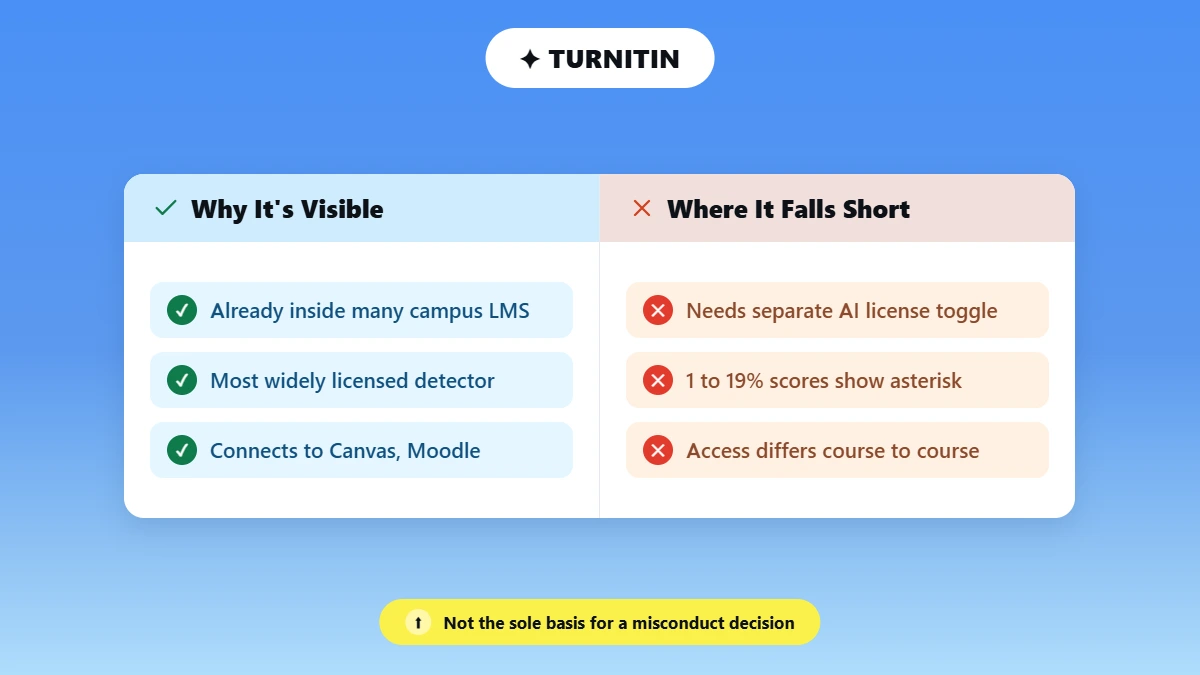
Turnitin is the likeliest institution-level answer because many universities already use it for similarity checks inside their LMS. A few details decide whether you actually get an AI score:
The AI-writing report is separate from the Similarity Report and needs a Turnitin Originality license with AI detection enabled, according to Turnitin's AI writing report guide.
Each course’s local assignments will determine what reports are available. You may have different access to reports from course to course.
Turnitin's own guidance says an AI score should not be the sole basis for an academic-misconduct decision.
Scores from 1% to 19% show as an asterisk instead of a number, because Turnitin found false positives are more likely in that range.
Does Canvas automatically check my paper for AI? Not by itself. Canvas, Blackboard, Moodle, and Brightspace are platforms that can connect to Turnitin.
A paper only gets an AI report if the school has the feature and the instructor turns Turnitin on for that assignment.
Copyleaks Has Confirmed University and LMS Deployments
Copyleaks offers official LMS integrations and has named university deployments.
Oakland University's e-learning pages list Copyleaks as a faculty tool (Copyleaks has also published a vendor case study on Oakland).
Southern Methodist University's IT office announced in 2025 that Copyleaks had replaced Turnitin for plagiarism detection.
Useful evidence, but neither example shows how far Copyleaks reaches across the sector.
For how it performs, see this test of whether Copyleaks is accurate.
Professors May Choose Separate Tools
What AI checker do universities use beyond Turnitin and Copyleaks?
Individual instructors, departments, or research teams may run GPTZero, Grammarly, Originality.ai, Winston AI, ZeroGPT, Sapling, or Pangram. A tool being available to a professor does not make it a university standard.
Tools Mentioned Online Are Not Always University Standards
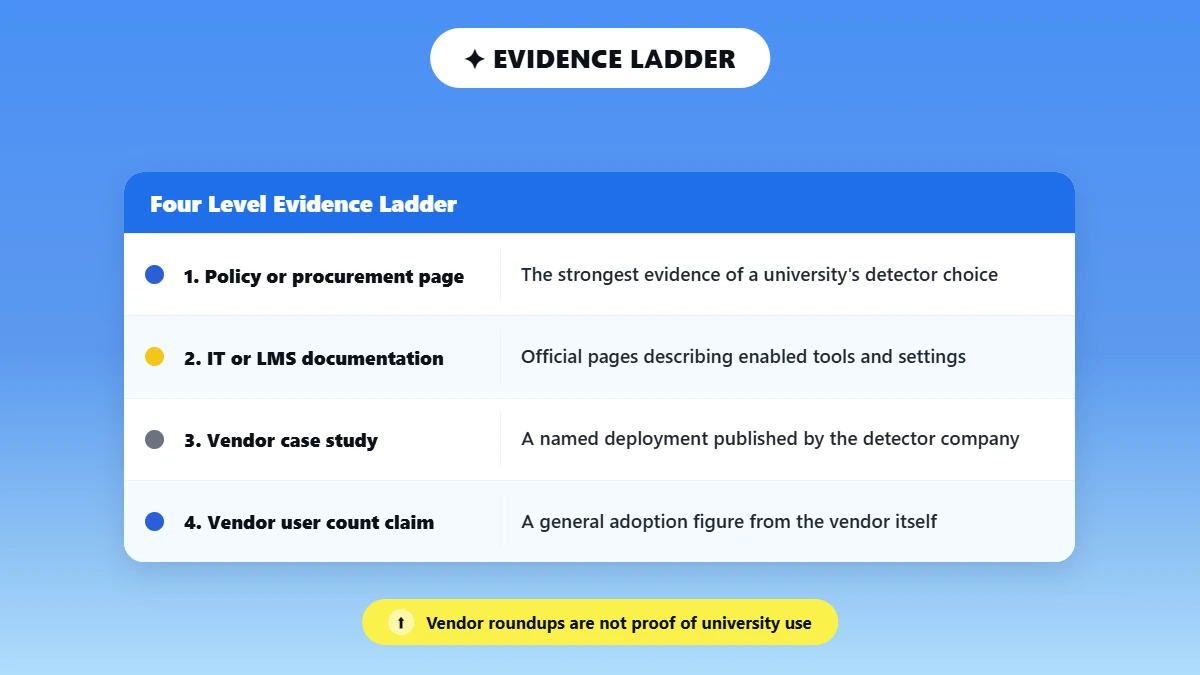
Weigh any claim that a university "uses" a detector against this evidence ladder, from strongest to weakest:
University policy or procurement page (strongest).
University IT or LMS documentation.
A named, vendor-published case study.
A vendor's general user-count claim.
An instructor anecdote or a Reddit comment (weakest).
Do All Universities Use AI Detectors?
No. Do universities use AI detectors? Some do, some use them cautiously, and some have switched them off. Adoption varies by institution, department, course, and even individual assignment.
Several universities have publicly disabled Turnitin's AI feature or declined to endorse detectors because of false-positive risk, so no single standard covers the whole sector.
Institution / source | Public position | Why it matters |
University at Buffalo (LMS guide) | When an instructor enables Turnitin, the report includes a separate AI score that cannot be switched off in that setup | Active institutional use |
NC State (Sept 2025) | Re-enabled Turnitin AI detection and reminded instructors that results should start a conversation, since false positives happen | Cautious active use |
University of Pittsburgh Teaching Center (updated Apr 2026) | Disabled Turnitin's AI detection and does not endorse or support any AI detection tool | Institutional rejection |
Disabled Turnitin's AI detection after reports of false positives and concern about wrongly accusing students | Institutional rejection | |
University of Oxford AI Competency Centre (Feb 2026) | Says the university does not currently endorse any digital AI detector for academic decisions | UK non-endorsement |
King's College London (updated Apr 2025) | Chose not to enable the Turnitin AI percentage because of reliability and false-positive concerns | UK non-enablement |
These examples show how policies differ. They are not market-share data. The pressure behind them is real, though.
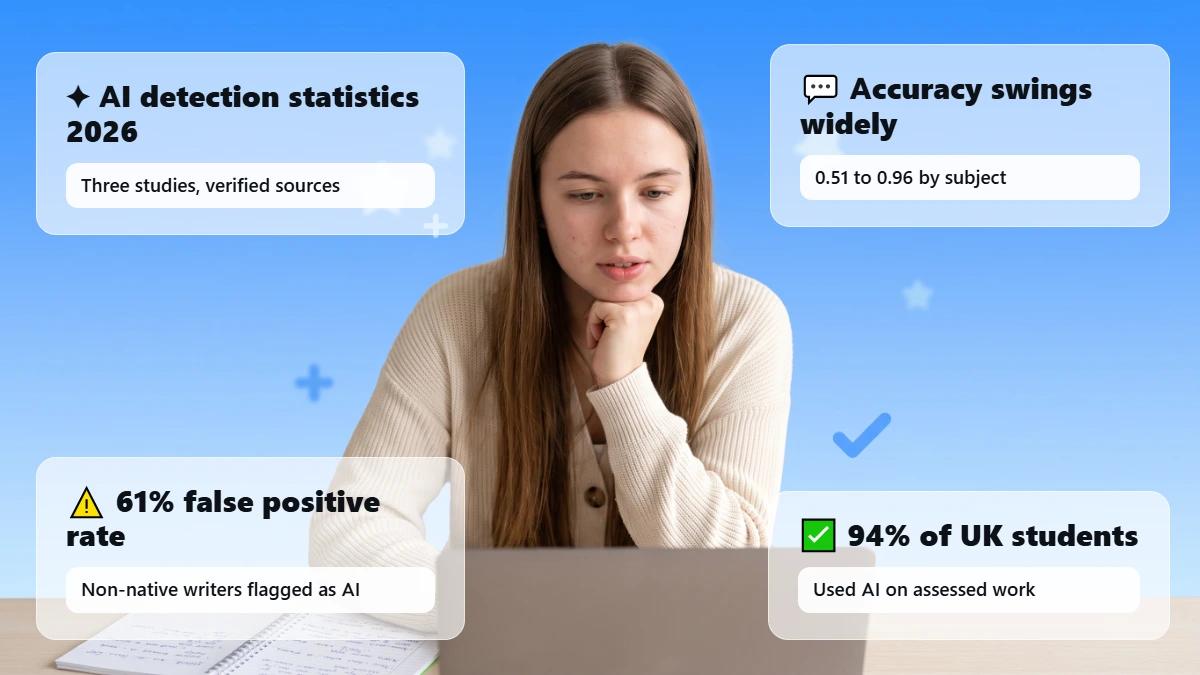
In HEPI's 2026 survey of 1,054 UK undergraduates, 95% used AI in at least one way, 94% used generative AI on assessed work, and 12% had put AI-generated text straight into assessed work.
Consequences and penalties are a separate question, covered in this guide on whether colleges check for AI.
University AI Detection Policy Tracker
We checked each university's own pages for its current AI-detection status. Where a first-party page names no vendor, we mark it "not publicly disclosed," and we never infer an AI detector from a school's LMS or an older plagiarism contract.
Institution | Country | Named detector | Status | Scope | Source | Source date | Last checked |
University at Buffalo | US | Turnitin | Enabled | Assignment level (enterprise-wide subscription) | Undated | Sep 2026 | |
NC State University | US | Turnitin | Enabled with caution | Course level (Moodle) | Sep 2, 2025 | Sep 2026 | |
Southern Methodist University | US | Copyleaks | Plagiarism checks confirmed; AI setting not publicly disclosed | University-wide (Canvas) | Jun 2025 | Sep 2026 | |
University of Pittsburgh | US | Turnitin (AI feature off) | Disabled; not endorsed | University-wide (Teaching Center) | Apr 2026 | Sep 2026 | |
Johns Hopkins University | US | Turnitin (AI feature off) | Disabled | University-wide | Undated | Sep 2026 | |
Vanderbilt University | US | Turnitin (AI feature off) | Disabled | University-wide | Aug 16, 2023 | Sep 2026 | |
University of Oxford | UK | None endorsed | Not endorsed | University-wide | Feb 16, 2026 | Sep 2026 | |
King's College London | UK | Turnitin (AI % off) | Not enabled | University-wide | Apr 2025 | Sep 2026 | |
Newcastle University | UK | Turnitin (AI feature not used) | Not used; advises against detectors | University-wide | Mar 26, 2025 | Sep 2026 | |
University of Waterloo | Canada | Turnitin (AI feature off) | Disabled from Sep 2025 | University-wide | May 2025 | Sep 2026 | |
Curtin University | Australia | Turnitin (AI feature off) | Disabled from Jan 1, 2026 | All campuses | Sep 2025 | Sep 2026 | |
University of Melbourne | Australia | Turnitin | Enabled; score is not proof of misconduct | University-wide (Canvas) | Mar 19, 2026 | Sep 2026 |
How Do Universities Check for AI Beyond a Detector Score?
How do universities check for AI? Rarely with one score alone. A detector result, where a school uses one, usually opens a review rather than closing it.
Staff then weigh the similarity report, drafts and version history, citation accuracy, and whether the student can explain the work. That combined review is also how universities test for AI in practice.
What happens after a university AI detector flags an essay? The steps below are typical, though each university's misconduct procedure sets the exact order:
If the service is on for that course, the LMS or Turnitin produces a similarity report, an AI-writing report, or both.
The instructor reads the highlighted passages and checks whether the submission meets the assignment's input rules.
The work is compared with the student's earlier submissions and with what the course expects.
Quotations, sources, and references are checked for errors or invented citations.
Drafts, notes, timestamps, or edit history may be requested and reviewed.
Under the formal procedure, the student may be asked to walk through the argument or explain how the work was produced.
Is an AI score the same as a plagiarism score? No. One estimates writing patterns and the other reports matched text, as the table shows.
Signal | What it can show | What it cannot prove |
Similarity score | Which passages match indexed sources | On its own, that AI was used or that plagiarism happened |
AI-writing score | Text a model rates as statistically AI-like | Who wrote it, how AI was used, or whether a rule was broken |
Version history | How the document developed over time | That nobody else helped with any edit |
Citation audit | Whether the sources exist and back up the claims | Who wrote the prose around them |
Oral explanation | Whether the student understands and can defend the work | An exact record of how it was written |
For the non-software side of this, including how teachers check for AI without relying on a score at all, see this companion guide on how teachers check for AI.
Can Universities Detect ChatGPT Reliably?
Can universities detect ChatGPT? They can flag text that looks statistically AI-like, but a detector cannot prove ChatGPT wrote a passage or name the exact model. Results move with text length, genre, editing, language, and detector version. The responsible reading of any flag is "needs review," not "proven misconduct."
Turnitin says as much itself. Its AI writing report guide warns that the model may misidentify human-written, AI-generated, and AI-paraphrased text, so it should not be the sole basis for adverse action against a student.
If that has happened to you, see what to do when Turnitin says you used AI, but you didn't.
Independent research points the same way.
A 2026 peer-reviewed study in the International Journal for Educational Integrity tested GPTZero, Pangram, Copyleaks, and Turnitin on 160 synthetic academic papers with known AI content: fully human, fully AI, hybrid, and humanized.
All four correctly cleared the human papers, but only Pangram performed consistently well on the AI, hybrid, and humanized sets.
The researchers then ran Pangram on 1,163 real master's theses with no known ground truth. Keep the scope in mind: Synthetic test papers, long academic texts, four tools, and a snapshot of models that will keep changing.
Can a university prove I used ChatGPT? A detector result on its own normally cannot.
Will my university know if I used ChatGPT for grammar? Maybe not, because detectors are poor at telling light editing from generated text, and heavy rewriting tools can make human writing look more AI-like to some detectors.
Whether grammar help is allowed depends on your course rules, so check it and disclose where required.
For a deeper look at Turnitin's AI feature specifically, see whether Turnitin detects ChatGPT.
How Can You Find Out Which AI Detector Your University Uses?
What AI detector does my university use? Check your university's own written sources in order: the academic-integrity or IT policy page, then LMS or library documentation, then your syllabus and the assignment settings.
If it is still unclear, ask your instructor whether AI detection is on and how a result would be used. Written policy beats rumor.
How can I tell if AI detection is enabled for my assignment? Work through these steps:
Check your university’s website: Use site:youruniversity.edu with the search terms "AI detection", "Turnitin AI”, or "generative AI academic integrity". Include what year you’re currently in as well.
Check official IT, library, teaching-center, academic-integrity, or LMS documentation pages.
Look at your syllabus and what your assignment is set to. You may have access through your school, but not all professors will allow the report.
Ask your instructor if they use AI writing detection for this assignment. Also ask them what they do with a result from a detector.
Record the page's date. Detector models and university policies both change. Sometimes within a single academic year.
Reddit threads can be useful for a sense of what students actually experience day to day. But they are the weakest rung on the evidence ladder above. Treat your university's current written policy, not a comment thread, as the source of truth.
What Should Students Do Before Submitting AI-Assisted Work?
Before you submit, confirm your course's AI rule, use AI only for the tasks it allows, and keep your drafts, prompts, and version history. Verify every fact and citation, disclose AI help where required, and read the work aloud so it sounds like your own reasoning. Treat any self-check score as a reason to review, not a verdict.
Read the AI rule for this specific course and assignment before you open any generative tool.
Stick to the tasks your instructor allows, and save outlines, prompts, notes, drafts, and version history as you work.
Check every fact, quotation, and reference against the original source.
Add an AI disclosure or citation wherever your syllabus or university asks for one.
Read the final version out loud and rework any passage that does not sound like your own thinking.
Refine permitted AI-assisted text with the Phrasly AI Humanizer, then fact-check, cite, disclose, and edit it in your own voice.
If your course permits AI-assisted drafting, our guide to using an AI humanizer for academic writing explains how to edit without losing citations or meaning.
If your essay could still be flagged even though you wrote every word, this article explains why an essay may be detected as AI.
FAQs: What AI Detectors Do Universities Use?
Does Every Turnitin Submission Receive an AI Score?
No. A Turnitin AI score only appears when the school has Turnitin access and an Originality license with AI detection switched on, the instructor has set up the assignment for it, and the file meets Turnitin's length and format rules.
Similarity checking and AI-writing detection are separate reports, so a school can run one without the other.
What AI Detector Do Universities Use in the UK?
There is no UK-wide detector. Many UK universities have Turnitin, but the University of Oxford says it does not currently endorse any digital AI detector for academic decisions.
King's College London chose not to enable the Turnitin AI percentage. Jisc's 2025 update warns that AI tools are outpacing detectors. A May 2026 HEPI study found 41% of UK degree-awarding institutions had no publicly accessible AI policy.
Do Universities Use AI Detectors for Personal Statements?
Do UK universities use AI detectors on personal statements? Not in any consistent, disclosed way.
UCAS runs fraud and similarity checks on personal statements and may notify universities when a statement closely matches others, but that is a similarity screen, not a named AI detector.
UCAS's AI guidance tells applicants not to copy and paste AI output as their final text.
Do Universities Use AI Detectors for Personal Statements?
Turnitin is licensed to schools, not sold to students, so you usually cannot run the exact checker your university uses.
Can I use the same AI checker as my university?
Rarely. Free public tools such as the Phrasly AI Detector can help you review a draft, but they cannot copy your school's private settings or promise the same result.
And different detectors often disagree.
What is the Best AI Detector Used by Universities?
There is no universal winner. For a university, the right tool depends on LMS integration, data governance, language coverage, auditability, how errors are handled, and due process for students.
For a student, the most useful checker is one that shows which passages raised concern and says plainly that its result is not proof.
Can a University Tell Which AI Model Wrote a Paper?
Usually not with any certainty. A detector may rate text as likely AI-generated, but naming the model behind it, whether ChatGPT, Claude, Gemini, or another tool, is a separate and much harder problem.
Be skeptical of any claim that a score proves which model wrote a paper.
The Bottom Line
There is no single university AI detector. Turnitin is the most visible institution-level option where its AI feature is licensed and enabled, Copyleaks has named deployments, and other tools are more often chosen by individual instructors.
Universities including Pittsburgh, Johns Hopkins, Waterloo, Curtin, and Oxford have disabled AI detection or declined to endorse it for academic decisions.
The safest move is to check your own university's current written policy, keep evidence of your process (notes, prompts, drafts, and version history), and read any detector score as one signal rather than the whole picture.

Written by
Muhammad Usman Ali
Pakistan
Muhammad Usman Ali is an experienced SEO content writer with 3+ years of professional writing experience. He specializes in AI tools, AI detection technologies, and search engine optimized content.