Sapling AI Detector Review (2026): How Accurate Is It?
14 min read
Sapling AI Detector is a transformer-based tool with a free web check and an API that gives one AI-probability score with sentence-level highlighting. It caught every AI essay we tested, but an independent benchmark found a 17% false positive rate, so students and teachers should treat it as a first screen, not proof.
This Sapling AI Detector review covers how it scores text, its claims vs independent tests, our test across models and text lengths, why human writing gets flagged, pricing, a GPTZero and Originality.ai comparison, and a false-flag checklist.
Tested and pricing checked: November 9, 2026.
Even Sapling says no AI detector, including its own, “should be used as a standalone check.” So before you trust one score, get a second opinion on the same text with Phrasly’s free AI Detector.
Check Your Text With Phrasly’s Free AI Detector 👇
Sapling AI Detector Verdict at a Glance
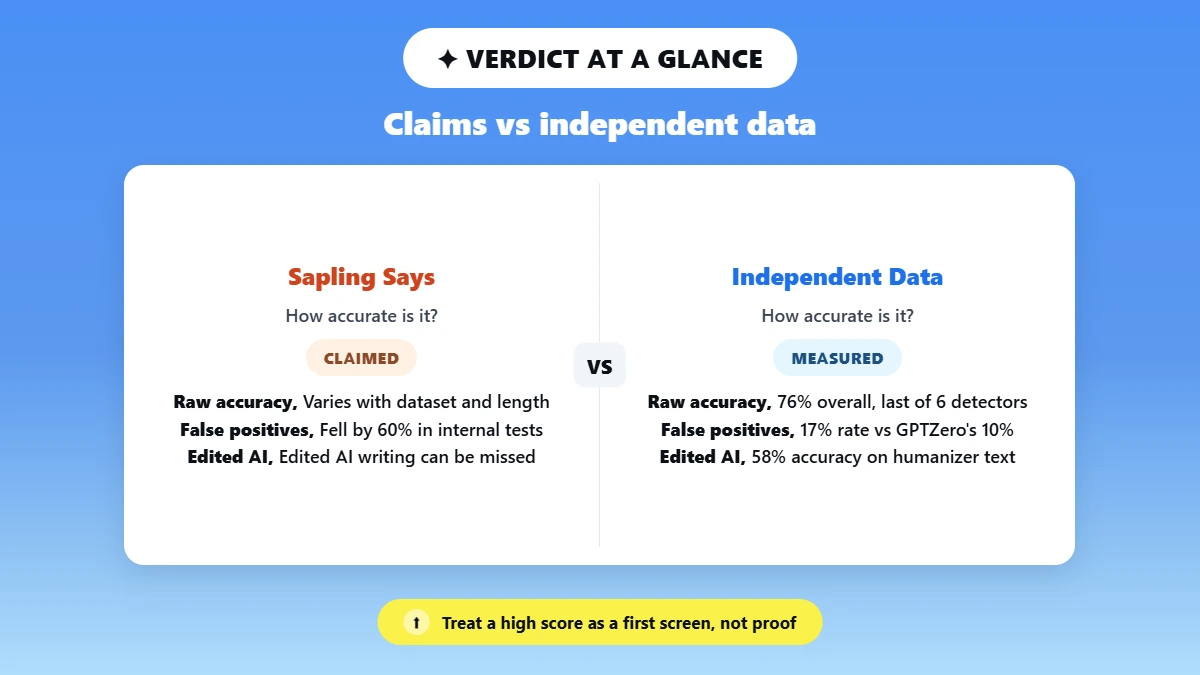
Sapling is fast and easy to try on short checks, but it should never be the only evidence behind an accusation. Outside benchmarks put its accuracy below rivals like GPTZero and Originality.ai and its false positive rate above them, so a high score is a reason to look closer, not a conclusion. For student essays, it is reliable enough to prompt a closer look, not reliable enough to act on alone.
Area | What Sapling says | What independent data shows | Our test result | As of |
|---|---|---|---|---|
Raw AI detection | No accuracy figure published; "Accuracy varies with the dataset, text length, and decision threshold" | 76% overall accuracy across 2,400 samples, last of 6 detectors (aidetector.ac). In GPTZero's test, ChatGPT and Gemini scored 99.9 to 100% AI, Claude 19.2% and 24.3% | ChatGPT essay 99.3%, Claude Opus 5.5 essay 98.0% | Sapling page: Nov 9, 2026. aidetector.ac: March 2026. GPTZero: Sept 27, 2026 |
Human text false positives | No rate published; false positives "fell by 60%" in internal tests | 17% false positive rate vs GPTZero's 10% (aidetector.ac). BBC and TED human samples scored 21.4% and 17.1% AI in GPTZero's test | Human essay 0.7%, Grammarly-edited human essay 2.1%; 5 of 77 human sentences scored 50%+ | Sapling page: Nov 9, 2026. aidetector.ac: March 2026. GPTZero: Sept 27, 2026 |
Humanized or edited AI | "Edited AI writing can be missed" | 58% accuracy on post-humanizer text (aidetector.ac) | Hand-edited ChatGPT essay 99.1%; no AI humanizer tested | aidetector.ac: March 2026. Our test: Nov 9, 2026 |
Short text | "Becomes much more accurate after 50 or so words" | No independent data found | 40-word text refused; 76-word AI paragraph 88.3% | Nov 9, 2026 |
Price | Free: 2,000 characters per check. Pro: $25/mo, or $12/mo billed annually, 100,000 characters per check. Enterprise: from 10 seats at $15/seat/mo. API: billed per character, one-time $5 minimum | Not applicable | Not applicable | Nov 9, 2026 |
Sources: Sapling.ai detector page, evaluation guide and pricing page; aidetector.ac benchmark and Sapling review; GPTZero’s Sapling review; Phrasly test, November 9, 2026.
⚠️ Pricing is accurate as of the date this article was written and is subject to change. Confirm the current price on the tool’s official pricing page before purchasing.
The evidence behind each row is in the claims section and our own test below.
How Sapling Scores Your Text
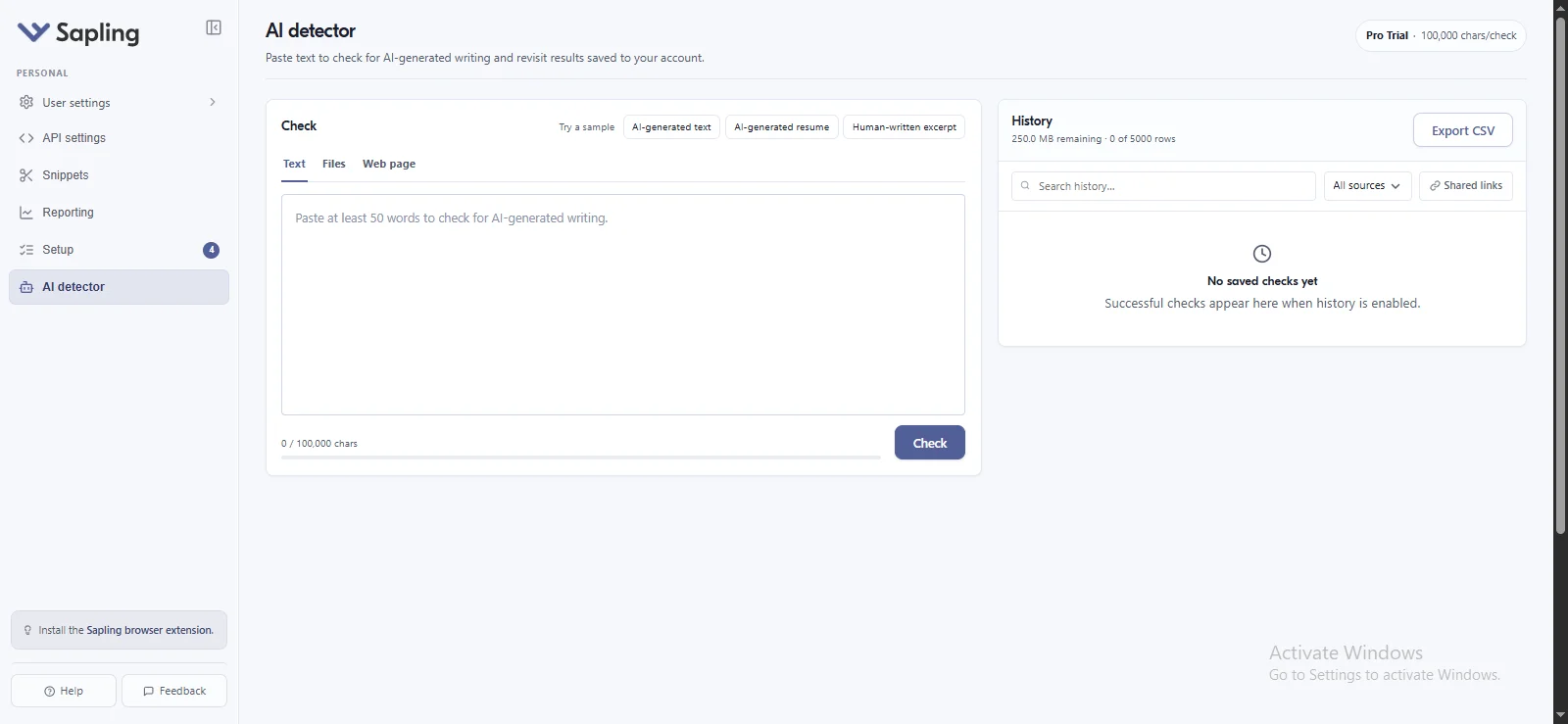
Sapling runs your text through a trained classifier and returns one probability score, plus a separate score for each sentence. So how does Sapling AI detector work in practice? It comes down to five things:
Transformer-based classifier: Sapling’s detector page says it uses “a machine learning system (a Transformer) similar to that used to generate AI content.” It estimates a likelihood, not a match against saved ChatGPT outputs.
Overall AI-probability score: Sapling’s evaluation guide calls it “Sapling’s estimate of how likely the checked text is to be AI-generated,” not the share of words AI wrote.
Sentence-level highlighting: Each sentence is scored on its own, so highlights and the overall score can tell different stories, as our test below shows.
Length and standalone use: Sapling says the detector “becomes much more accurate after 50 or so words” and that no detector, including Sapling’s, “should be used as a standalone check.”
Access: The web app, a Chrome extension for checking text on other webpages, and the Sapling API.
Many detectors draw on perplexity (how predictable the word choices are) and burstiness (how much sentence length and structure vary). Sapling does not say which signals its model weighs.
Sapling's Accuracy Claims vs Independent Tests
Sapling no longer publishes a headline accuracy number, and the outside numbers that do exist are mixed. Its evaluation guide (updated October 7, 2026) keeps its results in a whitepaper you must request. Older reviews quote 97% detection and 3% false positives, but neither figure was on Sapling’s site on November 9, 2026.
So is Sapling AI detector accurate? Here is what outside tests found:
Independent benchmark: aidetector.ac tested 6 detectors on 2,400 samples in March 2026. Sapling scored 76% overall accuracy and placed last, with a 17% false positive rate vs GPTZero’s 10% and 58% accuracy on post-humanizer text. GPTZero scored 87% and Originality.ai 91%. The test used older models (Claude 3.5 Sonnet, GPT-4o, Gemini 1.5 Pro and Llama 3.1), not the newest ones. For wider false positive context, see our roundup of AI detection statistics for 2026.
One competitor’s test: GPTZero’s 13-sample review (September 2026) had Claude samples at 19.2% and 24.3% AI and ChatGPT and Gemini at 99.9% to 100%. Human BBC and TED samples scored 21.4% and 17.1%. GPTZero sells a rival detector, the same disclosure we apply to ourselves.
📢 A false positive is human writing flagged as AI, the outcome students fear. A false negative is AI writing that passes as human, the outcome teachers and editors worry about, and aidetector.ac put Sapling’s false negative rate at 24%.
The gap between ChatGPT and Claude scores and the flagged BBC and TED samples mean Sapling AI detector accuracy is not high enough for one score to decide a grade.
Our Test: Human, Raw AI, Hand-Edited AI and Short Samples
We ran nine checks in one sitting to cover what other reviews skip: named models, edited and mixed text, and short inputs.
Method
Date and tool: November 9, 2026. Sapling web app, Text tab, Pro Trial, one check per sample. We count a score of 50% or higher as “flagged.”
AI samples: ChatGPT (Go plan, default model, name not displayed, October 8, 2026) and Claude Opus 5.5 (Medium, November 9, 2026), both given the same 500-word essay prompt. We did not test Gemini.
Human samples: A 647-word student-style essay written by the author of this review, and the same essay after Grammarly Free’s grammar fixes. No non-native-English sample was tested.
Hand-edited AI: A ChatGPT academic essay the author edited by hand, splitting long sentences and changing grammar in several places. No AI humanizer was used.
Mixed: 3 human sentences followed by 6 Claude sentences.
Lengths: 40 words, 68 to 76 words, 163 words, and 475 to 744 words.
Results
Sample | Source | Words | Sapling score | Sentences at 50%+ |
|---|---|---|---|---|
Human essay | Author of this review | 647 | 0.7% AI | 3 of 35 |
Grammarly-edited human | Same essay, Grammarly Free | 653 | 2.1% AI | 2 of 36 |
Raw ChatGPT | ChatGPT default model, Oct 8, 2026 | 534 | 99.3% AI | 31 of 31 |
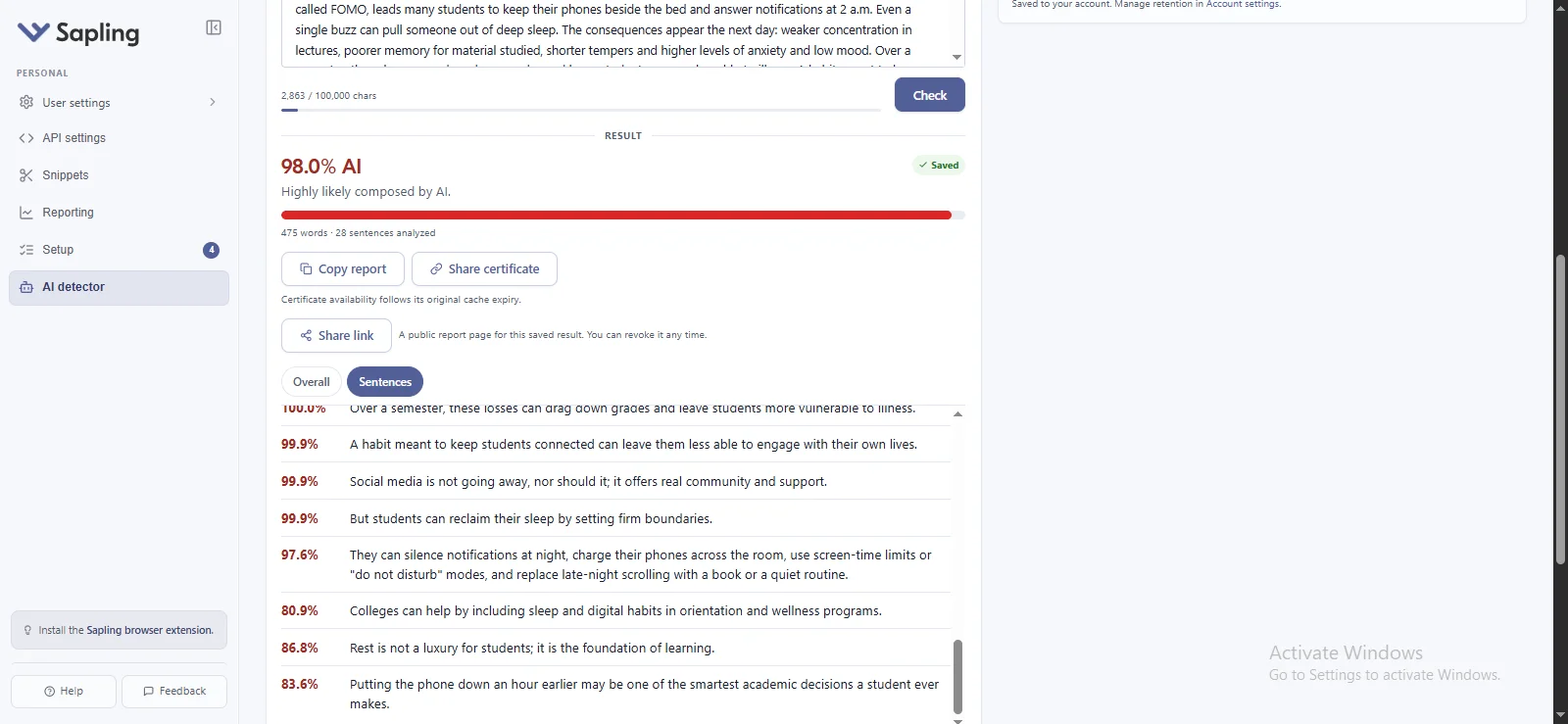
Raw Claude | Claude Opus 5.5, Nov 9, 2026 | 475 | 98.0% AI | 28 of 28 |
Hand-edited ChatGPT | ChatGPT essay edited by the author | 744 | 99.1% AI | 38 of 38 |
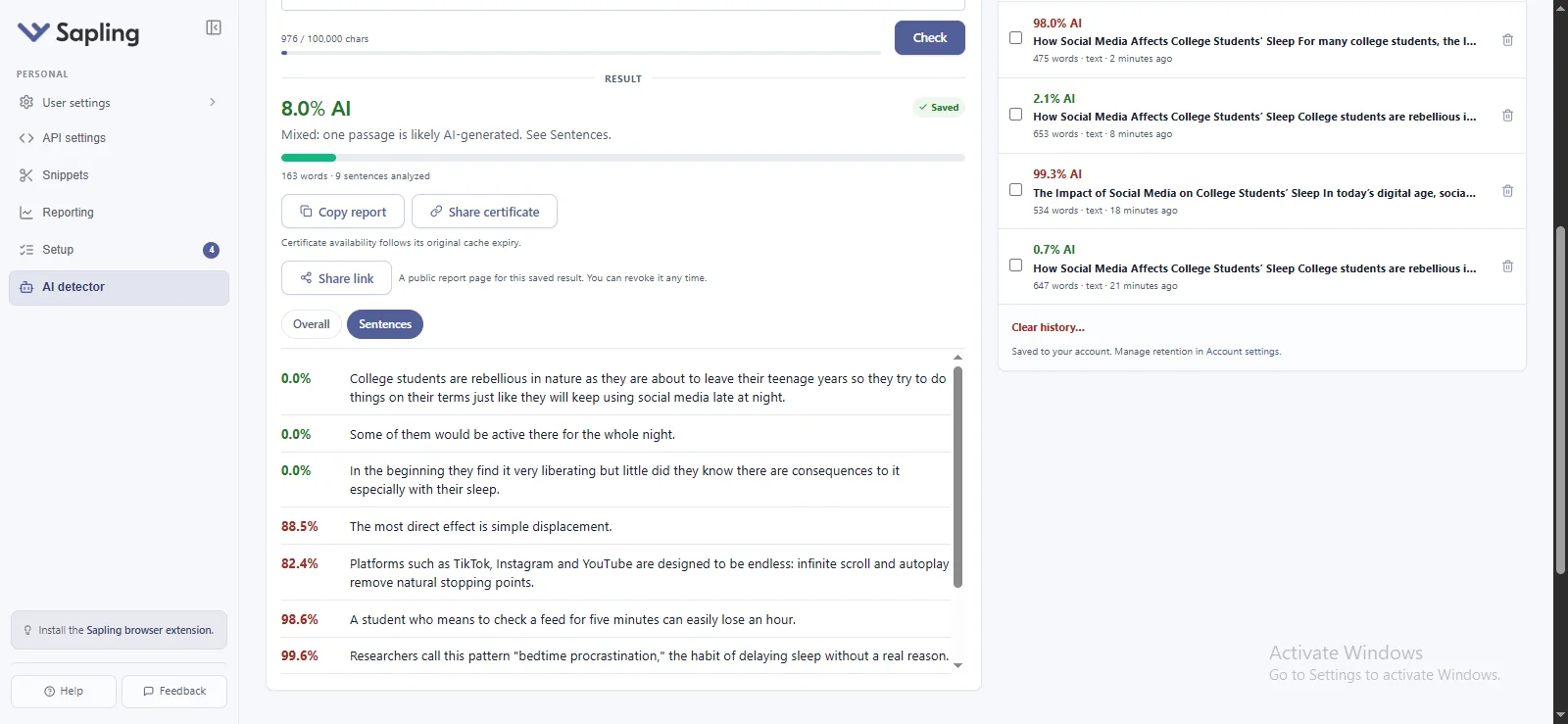
Mixed (3 human + 6 AI sentences) | Human essay + Claude paragraph | 163 | 8.0% AI, "Mixed" | 6 of 9 (all AI) |
Short human | Human essay, paragraph 1 | 68 | 0.0% AI | 0 of 3 |
Short AI | Claude essay, paragraph 1 | 76 | 88.3% AI | 4 of 4 |
Very short AI | Claude essay, 2 sentences | 40 | Refused: "Try at least 50 words and 150 characters" | None |
Source: Phrasly test, November 9, 2026. Full test record with every sentence score and screenshot: Sapling test record.
Confusion matrix at a 50% threshold: Sapling got all seven single-source documents right, with 4 true positives, 3 true negatives, 0 false positives and 0 false negatives, so precision and recall were both 100%. At sentence level it flagged 107 of 107 AI sentences and 5 of 77 human ones. Seven documents cannot give an accuracy rate.
What Surprised Us
Claude did not slip through. Our Claude Opus 5.5 essay scored 98.0%. That disagrees with GPTZero’s test, where Claude samples scored 19% to 24%, possibly because the models differ.
Hand edits did not lower the score. Can Sapling tell if you used ChatGPT and then edited it by hand? In our one sample, yes: 99.1%, with no sentence below 85.4%. In the mixed passage, it also flagged every AI sentence and none of the human ones.
The headline score hid a mixed passage. Six of nine sentences were AI, yet the overall score was 8.0%. Only the Sentences view showed the split.
Short text lowered confidence. One Claude paragraph scored 88.3% alone vs 98.0% in the full essay.
Why Sapling Flags Human Writing
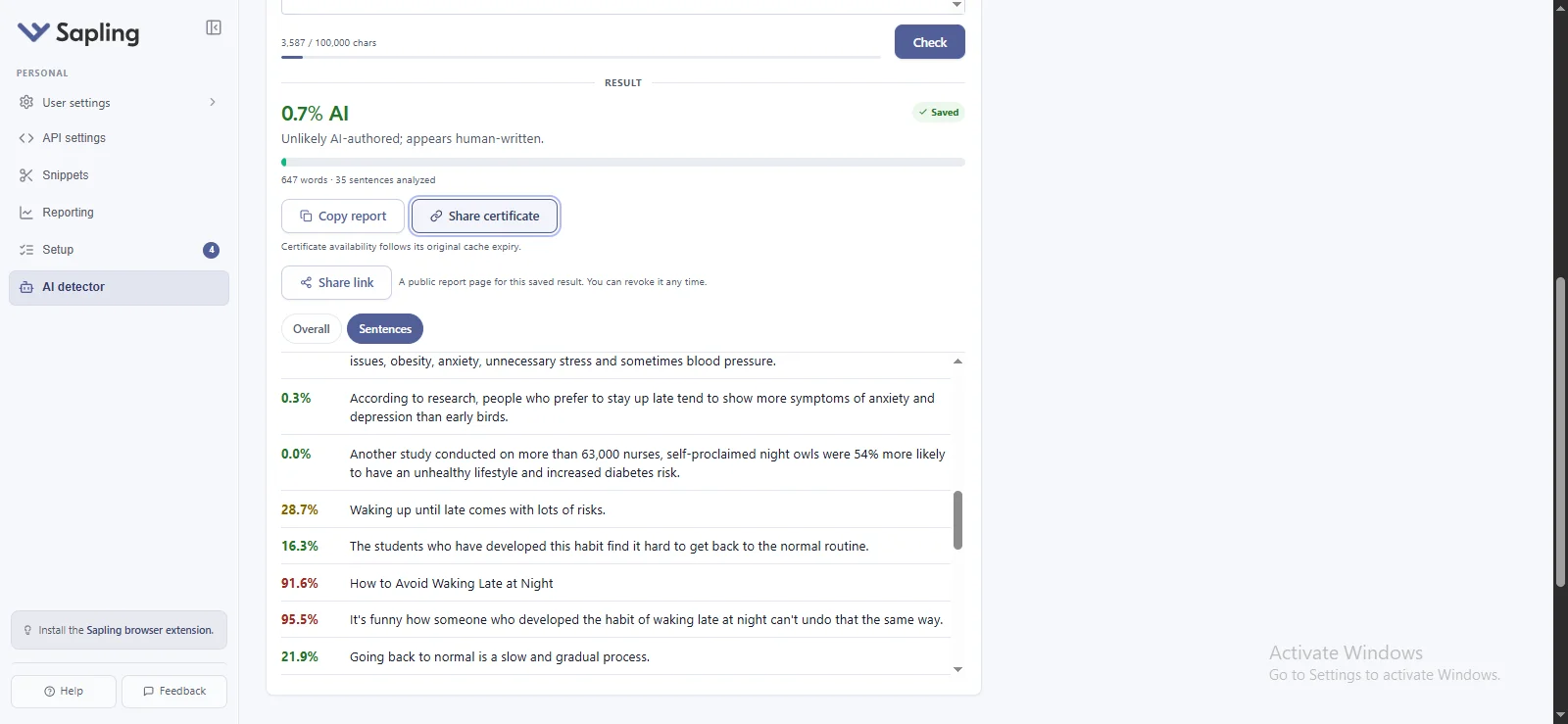
Sapling can flag human writing because it scores patterns, not authorship. Our human essay scored 0.7% overall, yet two of its sentences scored 91.6% and 95.5%, which is how Sapling AI detector false positives often show up.
Polished, formal writing reads as “AI-ish”: Clean, even sentences can push a score up, while rough grammar can keep it near 0%. After Grammarly fixed our human essay, its score rose from 0.7% to 2.1%, a flaw in the signal that rewards sloppiness, not a sign of dishonesty. aidetector.ac also saw Sapling flag 31% of human technical documents.
Short inputs: Sapling’s own result screen warns that “short texts (under 500 characters) are more often misread as AI-generated,” in line with its 50-word guidance above. Even in our human essay, the short line “That’s how it works.” scored 73.9%.
Non-native English: Simpler vocabulary and predictable phrasing can look machine-like. In Liang et al. 2023, seven detectors, including Sapling, flagged 91 human TOEFL essays at an average false positive rate of 61.22%. That is a group average, not a Sapling-only rate.
Overall score vs sentence-level highlighting: A low overall score with a few highlighted sentences is not the same as a high overall score. Note both before you react.
A detection threshold is the cutoff score where a tool or teacher treats text as AI. Lowering it catches more AI but adds more false positives, so one score is a signal, not evidence.
📍 Researchers see the same trade-off across the industry: a University of Florida study of the five most popular commercial detectors (IEEE Symposium on Security and Privacy, May 2026) found false positive rates ranging from 0.05% to 68.6%, and called the tools “poorly suited for deployment in academic or high-stakes contexts.”
That is why formal style, short length and non-native phrasing can all raise a score without any AI involved.
💡 Flagged for your own work?
Keep your drafts and version history, and use the false-flag checklist below instead of rewriting your work.
Is Sapling AI Detector Free?
Yes. Sapling’s free check covers the first 2,000 characters of a text, roughly 300 words, so most full essays are only partly checked. Logged out, the free check lives on Sapling’s AI content detector page.
Plan | Price | AI detector limit | Extras |
|---|---|---|---|
Free | $0 | 2,000 characters per check | 5 files per batch |
Pro | $25/mo, or $12/mo billed annually | 100,000 characters per check | 10 files per batch, shareable results, 1-month free trial |
Enterprise | From 10 seats at $15/seat/mo | 100,000 characters per check | Team analytics |
Sapling API | Billed per character, one-time $5 minimum | Up to 200,000 characters per request | JSON only, no shareable link |
Source: sapling.ai/pricing, checked November 9, 2026.
⚠️ Pricing is accurate as of the date this article was written and is subject to change. Confirm the current price on the tool's official pricing page before purchasing.
So is paying for AI worth it here? For an occasional student check, the free tier is good enough as a first screen of a few paragraphs, though Sapling says results are less reliable under about 50 words. Pro suits editors who use Sapling as one step in a review process, and the Sapling API suits developers.
Before you paste a draft, check what happens to your text. Sapling’s data page says it discards numbers, email addresses and URLs, encrypts stored data and offers a no-retention option, but it does not say whether submitted text is used for training.
Here is more on whether it is safe to paste your essay into an AI detector.
Sapling vs GPTZero vs Originality.ai
Here is how the four tools compare on free access, entry price, highlighting and where each accuracy figure comes from, with the date of each check.
Tool | Free limit | Paid entry price | Sentence highlighting | Accuracy source | As of |
|---|---|---|---|---|---|
Sapling | 2,000 characters per check | Pro $25/mo, or $12/mo billed annually | Yes | 76% independent (aidetector.ac); no vendor figure published | Nov 9, 2026; aidetector.ac March 2026 |
GPTZero | 10,000 words a month, up to 10,000 characters per scan | Premium, about $12.99/mo billed annually | Paid (Advanced Scan) | 87% independent (aidetector.ac) | Nov 9, 2026; aidetector.ac March 2026 |
Originality.ai | 10,000 words one time (100 credits) | Pro $12.95/mo billed annually | Not stated on pricing page | 91% independent (aidetector.ac) | Nov 9, 2026; aidetector.ac March 2026 |
Turnitin | No individual plan | Institutional license only | Shown to instructors | Not in the aidetector.ac test | Nov 9, 2026 |
💡Sources: Sapling, GPTZero support and Originality.ai pricing pages, checked November 9, 2026; GPTZero Premium price from a third-party price check, November 2026; aidetector.ac, March 2026.
The accuracy source matters more than the number, because vendor claims and independent tests use different samples. Results often disagree across detectors, so comparing two tools is a sanity check, not a tiebreaker.
Sapling: Quick free screens of short passages, plus developers who want an API.
GPTZero: Students and teachers who want a larger free scan. See our GPTZero review.
Originality.ai: Publishers and content teams willing to pay for a scanner built for web content.
Turnitin: Instructors whose institution already licenses it. Students usually cannot run it themselves.
So in the Sapling AI detector vs GPTZero choice for blog posts, GPTZero’s larger free scan covers a full post, while Sapling’s free tier stops at 2,000 characters.
📍 Is Originality.ai legit? It is an established paid detector. Its own Sapling review tested 7 Jasper.ai samples and found Sapling detected no AI in 3 and beat Originality.ai on only one, so weigh it as a competitor’s test, the same way you should weigh this page.
False-Flag Checklist for Students, Teachers and Editors
aidetector.ac measured Sapling’s false positive rate at 17%, against 10% for GPTZero, so a Sapling score should start a conversation, not end one. That conversation is happening more often: in a Pew Research Center survey of 1,458 U.S. teens (published February 2026), 59% said students at their school use AI to cheat at least somewhat often.
Check Length and Context First
Sapling says accuracy improves after about 50 words, and our own human essay still had sentences scored at 91.6% and 95.5%. Sapling publishes no recommended detection threshold, so no single percentage proves AI use.
Compare Against a Second Detector
Run the same text through one other tool and treat disagreement as a reason for more review, not proof either way.
Our list of the best AI detectors for teachers covers the options.
Keep Drafts and Version History
Students should keep outlines, notes and Google Docs or Word version history. Teachers and editors should ask for that history before reaching a conclusion.
Text length: Is the passage long enough to score reliably?
Writing style: Is it formal, formulaic or heavily edited?
ESL context: Liang et al. 2023 found seven detectors flagged more than half of 91 human TOEFL essays as AI.
Second detector: Does another tool agree?
Draft history: Is version history available?
Conversation: Talk with the writer before any penalty.
Check Your Draft With a Second Detector
Sapling works as a quick first screen, not as proof. If you want the best alternative to the Sapling AI detector before you publish, compare a second opinion with the wider field in the 9 AI checkers we tested for accuracy.
🛡️ Get a Second Opinion on Your Draft
Paste the same text into Phrasly's AI Detector and compare the sentence highlights before you submit or publish.
📌 Phrasly makes a competing AI detector. Treat any detector, including ours, as a second opinion, not a verdict.
FAQs
Is Sapling AI Detector Accurate for Student Essays?
Treat it as a warning signal, not a verdict. Sapling caught every full AI essay in our test, but GPTZero’s review saw human BBC and TED samples flagged, and a Stanford study found detectors, including Sapling, flagged more than half of non-native essays on average. Check drafts, version history and a second detector before acting.
Can Sapling AI Detect AI-Edited or Humanized Content?
Sometimes. Our hand-edited ChatGPT essay still scored 99.1%, as our test above shows, but aidetector.ac measured only 58% accuracy on humanized text, and Sapling’s own guide says edited AI writing can be missed. Scores on edited text are less reliable than on raw AI output. Here is how AI detectors handle paraphrased text.
What Is the Character Limit on Sapling's Free AI Detector?
The free check covers the first 2,000 characters, about 300 words, as of November 9, 2026, and anything after that is not checked. Pro and Enterprise raise it to 100,000 characters per check, and the API accepts up to 200,000 per request. Every check needs at least 50 words and 150 characters.
Can You Bypass Sapling AI Detector?
Not reliably, and we do not give evasion steps. Sapling is probabilistic, so editing can shift scores either way: our hand-edited ChatGPT essay still scored 99.1%. If your own work was flagged, keep your drafts, cite your sources and run a second check, as the false-flag checklist above explains.
Does Sapling Detect Claude and Gemini Output?
Sapling says it covers Claude 4.5, Gemini 2.5, GPT-5 and other models. Our Claude Opus 5.5 essay scored 98.0%, but GPTZero’s test had Claude samples at 19% to 24%, so results vary by model. Read more on whether Claude AI is detectable.
Is Sapling AI Detector Accurate?
It depends on the text. Sapling publishes no accuracy figure, and aidetector.ac measured 76% accuracy with 17% false positives in March 2026. Accuracy drops on short, edited and formal human text. In our test, Sapling was right on every full document but flagged some human sentences, as the accuracy section above explains.

Written by
Hasnain
Karachi, Pakistan
I help businesses grow with SEO-friendly blog posts, landing pages, and long-form content. With 3+ years of experience, I deliver clear, original, and well-researched writing that drives results.