Is It Safe to Paste My Essay Into an AI Detector?
10 min read
It can be safe to paste your essay into an AI detector, but only when the provider clearly states its rules on retention, training, sharing, repositories, and deletion. If that policy is vague, do not paste confidential or unpublished material. Treat the result as an estimate of how closely your writing resembles AI patterns, not proof of who wrote it.
Pasting an essay into a detector does not automatically publish it or make it plagiarized. The real risk depends on what that specific service does with your text once you hit scan, not on the act of scanning itself.
Phrasly's AI Detector states this plainly: "Your text is never stored or shared," and you can run a check without creating an account first. That's the standard to look for before you paste an essay.
Check an Essay Without Creating an Account 👇
The 60-Second Answer: Is This AI Detector Safe for Your Essay?
It is generally safe to paste your essay only if the detector's policy clearly says it does not retain, train on, share, or store your text in a repository. If the policy is vague, your essay contains sensitive details, or your school bans third-party tools, do not paste it.
Situation | Decision | Risk | Why |
🛡️ The tool clearly states essay text is not retained, shared, used for training, or added to a repository | ✅ Generally safer to paste | 🟢⚪⚪ Low | The main content-reuse and self-match risks are addressed, though no online service is fully risk-free |
⏳ The policy allows temporary retention but states purpose, duration, security, and a deletion route | ⚠️ Use caution | 🟡🟡⚪ Medium | You can weigh whether the essay is sensitive and whether the retention window is acceptable |
🌫️ The policy is silent or vague about user content, training, third parties, or repositories | ⛔ Do not paste the full essay | 🔴🔴🔴 High | You cannot make an informed privacy decision without this information |
🔒 The essay contains names, student IDs, health details, unpublished research, or confidential data | ✂️ Remove or minimize the data first, or use an institution-approved tool | 🟠🟠🟠 High | The consequences of a disclosure are higher for sensitive material |
🏫 Your school prohibits third-party tools for assessments | 🚫 Do not use it | 🔴🔴🔴 High | Tool use itself may breach academic or IT policy even if the service is secure |
📌If the policy does not clearly say what happens to your essay after the scan, do not upload the full document. That one rule covers most of the decision on its own.
What Happens When You Paste an Essay Into an AI Detector?
Your text is sent to the provider's system, a model analyzes its linguistic and structural patterns, and the service returns a probability or classification.
What happens next depends entirely on that provider's policy: some delete the text right away, others cache it briefly, and some retain, review, share with processors, use it to improve their models, or add it to a repository.
TEQSA also warns that unlicensed use of a free or personal-subscription third-party detector "may be a breach of your IT policy, privacy rules, intellectual property rules or copyright," which is exactly why institutions don't extend blind trust to just any random third-party tool, and your school's own rules belong in this decision too.
What happens to your essay depends on which kind of tool you're actually using, but people stretch the word "detector" to cover more than one kind of tool, as this table shows:
Tool function | What it does | Main risk to check |
🤖 AI detector | Estimates whether text resembles AI-generated writing | ⚠️ Retention, training use, third-party processing, and false positives |
🔍 Plagiarism / similarity checker | Compares text against web, publication, or submission databases | 🗄️ Whether the submission is indexed or stored for future matching |
📝 Authorship / process tool | Records drafts, edits, paste events, or version history | 🔐 Access permissions and how that activity data is stored |
Australia's Tertiary Education Quality and Standards Agency (TEQSA) draws this same line in its academic integrity guidance: text-matching software links text to verifiable published sources and other students' assignments, while AI-generated text is not stored or published in the same way, so a generative-AI detector is estimating a pattern, not confirming a match.
If you also want to clear up the confusion around what AI detectors actually do and how they work, our guide on how AI detectors work covers it.
Check These 7 Privacy Questions Before You Paste
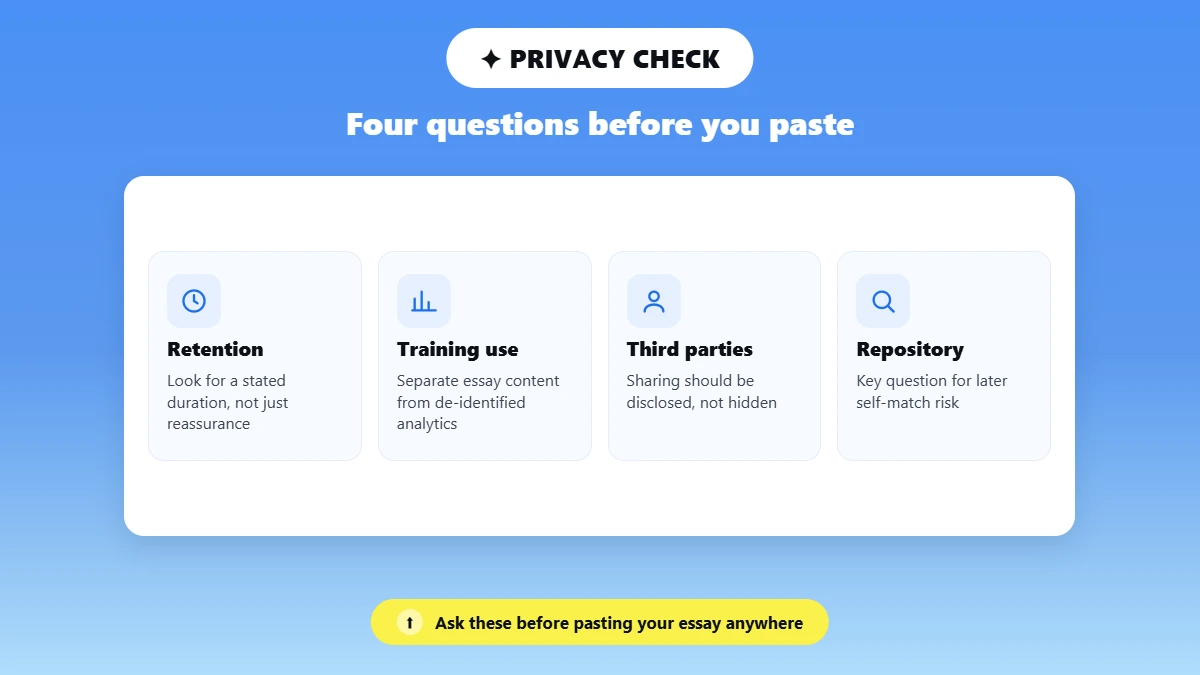
1. Does the service retain the essay text? Look for a stated duration, not just a general reassurance about privacy. "We value your privacy" is not the same as a retention window you can check.
2. Can the text be used to train or improve models? Separate essay content from de-identified usage analytics; the two are not the same disclosure.
3. Is the text shared with service providers or other third parties? Cloud processors are not automatically improper, but the sharing should be disclosed, not hidden.
4. Is the essay added to a searchable repository? This is the key self-match question, and it is different from ordinary AI-pattern detection. A repository is what lets a later check compare your essay against itself.
5. Can you delete the submission, and are backups covered? A deletion request does not always remove every legally retained record, so check what "delete" actually means.
6. What personal or sensitive information is inside the essay? Apply data minimization: remove names, student numbers, contact details, case-study identities, health data, or confidential research where you can.
7. Does your school allow third-party tools? Assessment, IT, privacy, copyright, or AI-use rules at your institution may be stricter than any vendor's policy.
⚡ Find it fast: open the tool's privacy policy and search for these words: user content, retain, store, training, improve, service providers, repository, delete, backup, student data, security.
UT Austin's information security guidance is a useful example of how specific these school rules can get: FERPA-protected student records, health information, and other confidential university data "must not be used with unauthorized AI tools," and accepting a tool's click-through terms without delegated signing authority can carry personal liability.
The UK Information Commissioner's Office frames a related discipline for organizations handling AI tools: process personal, sensitive, or confidential information only in approved systems, and only as far as necessary.
It is a useful risk-management habit for a student's own essay too, not a legal requirement.
You know what to check for now, and Phrasly's AI Detector covers all of it. Check your essay with confidence and treat the result as one signal, not proof.
Can an AI Detector Make Your Essay Look Plagiarized Later?
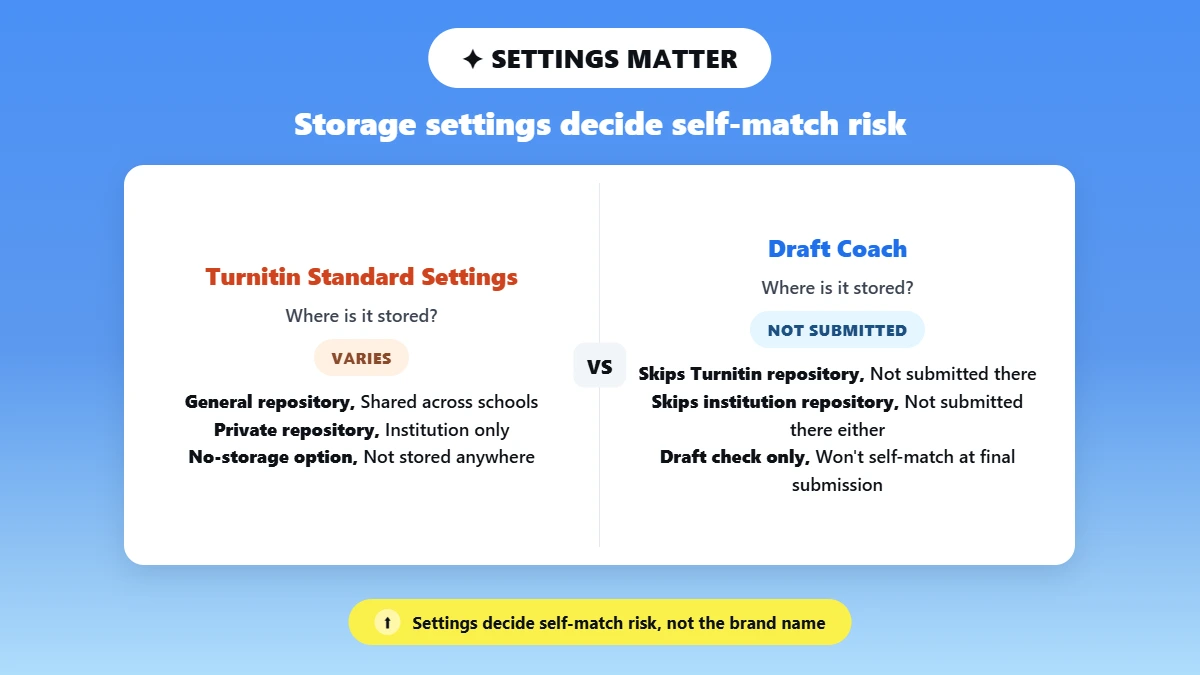
Not on its own. A similarity match later on is only possible if whatever detector you used first kept a copy of your essay somewhere a plagiarism checker can reach. Detecting AI-style writing and matching text against a database are two separate jobs, even when the same company offers both.
Turnitin is a useful example of why the settings matter more than the brand name. Its standard assignment settings let an institution choose a general Turnitin repository shared across schools, a private institutional repository, or a no-storage option where the submission is not stored anywhere in Turnitin.
Separately, Turnitin's own Draft Coach FAQ confirms that Draft Coach "does not submit papers to the Turnitin repository or your institution's private repository," so a student can check a draft there without matching against their own draft at final submission.
For the ChatGPT-specific version of this question, see does Turnitin detect ChatGPT.
It's a mistake to treat any AI check as guaranteed self-plagiarism, or as something that will automatically flag you with Turnitin specifically.
That only happens if the earlier tool holds onto your text somewhere Turnitin can search.
Two more questions worth a straight answer: does pasting make my essay public? Not on its own, and staying out of public view isn't the same as staying off a server. Could a tool "steal" my essay? That's not really a legal category here.
What matters is whether the provider can retain it, reuse it, or must delete it, which is exactly what the checklist above is for.
A safe check comes down to a few simple habits, not just which tool you pick.
Check your assignment's rules on AI use and third-party tools first.
Read the tool's current user-content and retention terms before you paste anything.
Remove unnecessary personal or confidential information from the text.
If the policy is clear and acceptable, scan a passage long enough to give a meaningful result; a tiny excerpt protects more data but can be less representative.
Save your original file, notes, citations, drafts, and version history as you go.
Review the highlighted passages and the reasoning behind them instead of chasing a target percentage.
Do not submit rewritten text blindly. Preserve your meaning, your citations, and your own voice.
For the mechanics of running the scan itself, see how to scan text for AI.
What If the Detector Flags an Essay You Wrote Yourself?
A flag is not proof of AI authorship. Turnitin suppresses scores in the 1% to 19% range and shows an asterisk instead, since that band carries a higher risk of false positives. The University of Melbourne states that "an AI writing detection report alone is not sufficient evidence for an allegation," and TEQSA agrees a score alone cannot support one.
If you are flagged, read the highlighted passages and check for accidental formulaic wording, repetitive sentence structure, or thin, unsupported claims that can be read as generic.
Turnitin's own release notes explain the 1% to 19% suppression in more detail, Melbourne's guidance also notes that detectors "are highly variable in their accuracy because they use different methods and calculations," and TEQSA points out that a detector's score is not a probability that the assignment was actually AI-generated.
Preserve your drafts, outlines, research notes, and document version history. Compare the result against the tool's own stated limitations rather than treating a second detector's score as a deciding vote.
If challenged, explain your writing process and follow your school's formal procedure.
For a deeper look at why this happens and what to do next, see why an essay can be detected as AI and protecting yourself from AI detector false positives.
When Should You Use an AI Humanizer on an Essay?
Use a humanizer only when your assignment permits AI-assisted editing, or when the text is legitimately AI-assisted content you are allowed to revise.
Its job is to improve clarity, rhythm, tone, and readability, not to conceal prohibited AI use or manufacture proof of human authorship.
If an essay is entirely your own work and a detector still flags it, do not assume a humanizer will fix it. Start by preserving your authorship evidence and making genuine edits for clarity, rather than distorting strong writing just to chase a lower score on one tool.
Review every change a humanizer makes. Restore your own examples and reasoning, verify every citation, and disclose assistance when your assignment requires it.
If AI-assisted editing is allowed, use the Phrasly AI Humanizer to review flow and naturalness, then edit the result in your own voice and verify every fact and citation before you submit.
Final Verdict: Is It Safe to Paste Your Essay?
Yes, conditionally: when the provider explicitly limits retention, training, sharing, and repository use, and your essay has no unnecessary sensitive information in it.
No, when the policy is vague, the work is confidential, or your school prohibits third-party tools outright.
A safe platform does not make its score conclusive either way. Keep your authorship evidence, and treat detection as a review aid, not a verdict.
💡 Before pasting, check: policy, retention, training, sharing, repository, deletion, school rules.
FAQs
Does pasting my essay into an AI detector make it public?
Usually not by itself, but the tool may retain, reuse, share, or index the text depending on its policy. "Not public" is not the same as "not stored." Check the user-content and repository clauses before you upload.
Can an AI detector use my essay to train its model?
Some services may allow submitted content to improve their systems, while others explicitly exclude it. Check the current user-content and training clauses rather than assuming either way. If the policy is silent, treat that as unclear and do not paste the full essay.
Can AI detectors see that I copied and pasted text?
A basic detector analyzes the text you submit and generally has no way to know how it entered the box. Some separate authorship or writing-process tools can log paste events and version history, the same kind of metadata schools use to spot ChatGPT use through typing speed or verbatim-pasted blocks. Verify the specific product before assuming either way.
Can an AI detector steal or reuse my essay?
"Steal" is not a technical category. The real questions are whether the terms grant reuse rights, whether the text is retained or shared, and whether the provider offers a genuine deletion route. Read those clauses instead of guessing.
Should I run my essay through an AI detector before submitting it?
It can be a useful pre-submission check if your school policy allows it and the privacy terms are acceptable to you. The score should never replace proofreading, citation checks, or keeping authorship evidence such as drafts and version history.
How much of my essay should I paste into an AI detector?
A complete passage is usually more representative than a single sentence, but minimize unnecessary personal or confidential data first. If the tool's policy is unclear about retention or repositories, do not upload the full unpublished essay. For general signs that a passage may read as AI-written regardless of its true origin, see tips for spotting AI-written essays.

Written by
Hasnain
Karachi, Pakistan
I help businesses grow with SEO-friendly blog posts, landing pages, and long-form content. With 3+ years of experience, I deliver clear, original, and well-researched writing that drives results.