We Tested PapersOwl's Plagiarism Checker. Here's the Real Verdict
14 min read
PapersOwl's plagiarism checker is free and fast, but it belongs to an academic writing marketplace where students can hire writers. That matters because Turnitin treats outsourcing academic work to a third party as contract cheating.
We went back to the checker in August 2026 and tested every claim on its live page ourselves. Its page promises a scan with no limits and no account. The tool enforces both, and we logged what it does.
Here is what it caught, what it missed, and where it belongs before you submit.
⚡ Quick verdict: PapersOwl is a real, working plagiarism checker and a fair first scan for copied web text. In our testing it caught obvious copy-paste but read heavily reworded writing as mostly original. Use the score as a rough signal, not as a preview of your university's report.
Disclosure: Phrasly publishes this review and also sells a plagiarism checker. Product facts and prices checked August 2026.
Run your paper through a second checker before you hand it in. 👇
📋 PapersOwl Plagiarism Checker at a Glance
Every row below comes from PapersOwl's live pages or from our own August 2026 testing.
Question | What we found (August 2026) |
Free to use? | ✅ Yes. Its page says you "don't need to pay anything". |
Account required? | ⚠️ Yes, after two scans. A CAPTCHA gate applies throughout. |
Word limit | ❌ 19,900 characters. Its page advertises no limit. The tool enforces one. |
Inputs | Paste text or upload a file. PapersOwl says it takes common formats. |
Downloadable report | ❌ None. The free report stays on screen only. |
Disclosed database size | ❌ Not published. |
AI result inside the plagiarism scan | ⚠️ No AI score in the scan. PapersOwl runs a separate AI detector page. |
Best use | ✅ A quick check for text lifted from public web pages. |
Main limitation | ❌ Caps every scan at 19,900 characters, and no university paper databases. |
Overall score | 4.4 out of 10. Formula in the scorecard below. |
Product details and pricing reflect the providers' live pages as checked in August 2026 and can change without notice. Confirm on the official page before you buy.
🔍 Get a Second Plagiarism Result Before You Submit
Paste the same text below and compare what a second checker finds. 👇
📊 Quick Verdict: PapersOwl Plagiarism Checker Scorecard
PapersOwl scores 4.4 out of 10 with us, the plain average of the seven scores below. Each comes from our own testing or PapersOwl's live pages.
Criteria | Score | Why |
Ease of use | ✅ 8/10 | Clean interface, fast scan, low friction. |
Free access and limits | ⚠️ 6/10 | Capped at 19,900 characters, sign-up wall after two scans. |
Verbatim copy detection | ⚠️ 5/10 | It matches copied strings against public web pages. |
Reworded text detection | ❌ 3/10 | A rephrased 2,000-word blog came back 12.6% similar, 87.4% original. |
AI signal in the plagiarism scan | ❌ 2/10 | None inside the scan. The separate detector reports no figure and flagged writing we produced ourselves. |
Database coverage vs Turnitin | ❌ 3/10 | No access to student paper repositories. A clean score predicts little. |
Data privacy transparency | ⚠️ 4/10 | It claims deletion but publishes no retention or encryption detail. |
Overall | 4.4/10 | The seven scores above, averaged. |
What Is PapersOwl's Plagiarism Checker and How Does It Work?
The PapersOwl Plagiarism Checker is a free tool. It scans your text against web pages and academic databases like Google Scholar, PubMed, and JSTOR. It does not confirm access to private institutional databases, such as Turnitin's student paper repository.
You paste your draft or drop in a file. It returns a similarity percentage, matched sources, and color highlights on the matching lines.
✅ Public web pages, including blogs, news sites, and open journals.
✅ Academic databases: Google Scholar, PubMed, JSTOR and similar libraries.
❌ University student-paper databases, which stay closed to free tools.
PapersOwl calls this AI-powered plagiarism checking. The phrase describes how it finds matches. Whether a machine wrote your text is a different question.
💸 What Does 'Free' Actually Mean on PapersOwl?
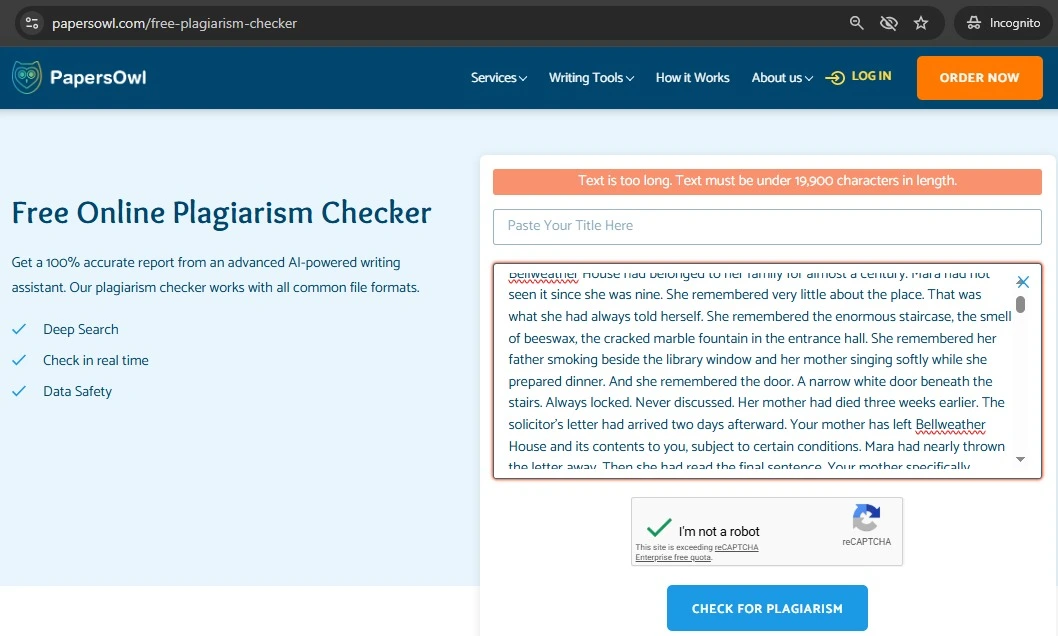
The PapersOwl free plagiarism checker costs nothing to run. Three limits its page never mentions still apply. Every scan caps at 19,900 characters, you get two scans before a sign-up wall, and every scan needs a CAPTCHA.
Paste more than the cap and the tool refuses it: Text is too long. Paid rewriting and editing offers surround the result.
That cap works out at roughly 2,800 to 3,000 words. A standard essay clears it in one scan. A dissertation chapter does not, so long documents have to go through in pieces.
Free: the scan, the similarity percentage, and the matched source list.
Paid: rewriting, editing, and hiring a writer from the results screen.
PapersOwl says | What we found |
“No word limit” | 19,900 characters, enforced |
“No need to register” | Two free scans, then a sign-up wall |
Free and instant | A CAPTCHA gate on every scan |
Report shown on screen | No download, export or print |
Claims taken from PapersOwl's free checker page. Findings from our own scans, August 2026.
Do You Need to Create an Account to Use PapersOwl's Plagiarism Checker?
For your first two scans, no. After that a sign-up wall appears and the scan stops until you create an account or continue with Google or Apple. The free plagiarism checker page advertises no registration, which holds only until that third scan.
A CAPTCHA runs on every scan, signed in or not, and ours asked us to pick bicycles out of a grid before it returned a result.
Your account state also changes what the checker finds. Signed-in scans returned more sources than anonymous ones on identical text, so a logged-out result can understate what is there.
🎯 How Accurate Is PapersOwl's Plagiarism Checker?
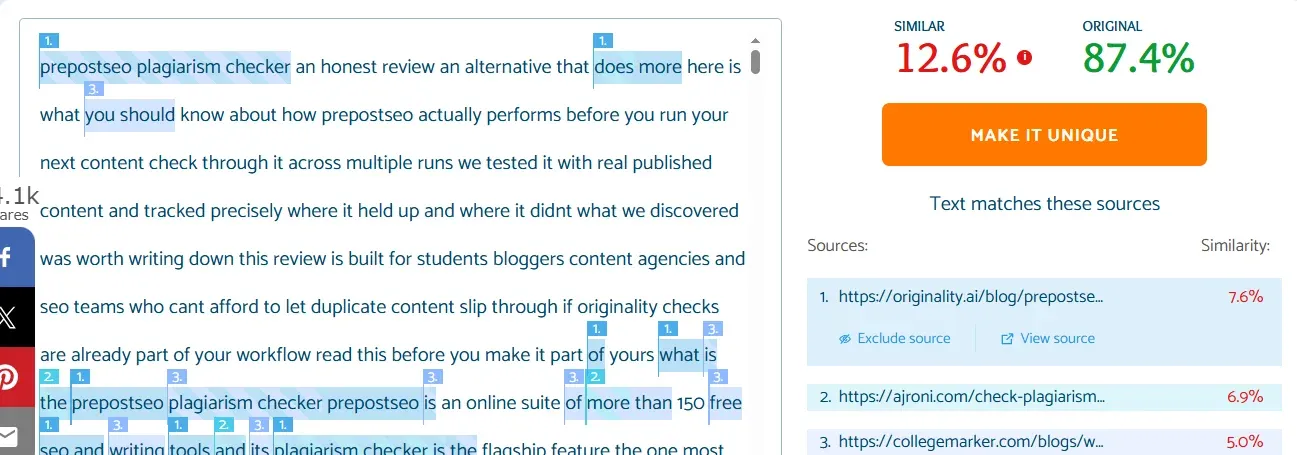
PapersOwl is accurate at one job: finding text copied word for word from public web pages. It is much weaker on reworded writing. On a 2,000-word blog we rephrased, it reported 12.6% similarity and called the rest original, and the result came back in about 30 seconds.
Reworded copying is what most students get flagged for. At nearly every university, paraphrasing counts as plagiarism when the source is not cited.
The checker compares strings of text against its sources. Heavier rewriting weakens the match, so a low score is not proof of clean work. Small repeated borrowings build into incremental plagiarism, which institutional systems still catch.
💡 A low similarity score means the checker found no match. It does not mean your paper is clean at your university.
Test 1: Paraphrased Content → 87.4% "Original"
What we did: Took a published 2,000-word blog ("Prepostseo Plagiarism Checker Review"), lightly rephrased it, and ran it through PapersOwl.
Result: 12.6% similar · 87.4% original · processed in ~30 seconds.
A paper built entirely from existing content came back 87% original. Lightly reworded text slips through clean even when a university checker would flag it. That is how incremental plagiarism builds up unnoticed across a long paper.
💡 A low similarity score means the checker found no match. It does not mean your paper is clean at your university.
The Third Gap: No Published Database Size
Beyond what the tests showed, PapersOwl never states how big its database is, unlike tools that publish their coverage outright.
Turnitin publishes one. Its Similarity product page cites seven trillion matches across 170 languages. PapersOwl gives no comparable number, so its coverage cannot be checked.
What PapersOwl's Similarity Score Actually Measures
The similarity score is the percentage of your document that matched an existing source. It is a weighted average across the whole file, so a short paper with one copied paragraph reads higher than a long one.
PapersOwl explains it plainly: if half your paper is fully plagiarized, the overall score reads 50%.
Compare the same passage against a second database before your deadline. 👇
Does PapersOwl Detect AI or ChatGPT?
Yes, but not inside the plagiarism scan. PapersOwl runs a separate AI content detector on its own page, free and without an account. It returns no percentage and no confidence score, only a pop-up telling you AI text was found.
🔎 Plagiarism detection compares your text with sources that are already published.
🤖 AI-authorship detection estimates whether a machine wrote the text.
⚙️ "AI-powered plagiarism checking" describes how matches get found, and returns no AI score.
Test 2: ChatGPT Text → 100% "Original"
What we did: Generated a 1,500-word blog ("What Types of Plagiarism Can Online Checkers Find?") with ChatGPT and ran it through PapersOwl's plagiarism checker.
Result: 0.0% similar · 100% original.
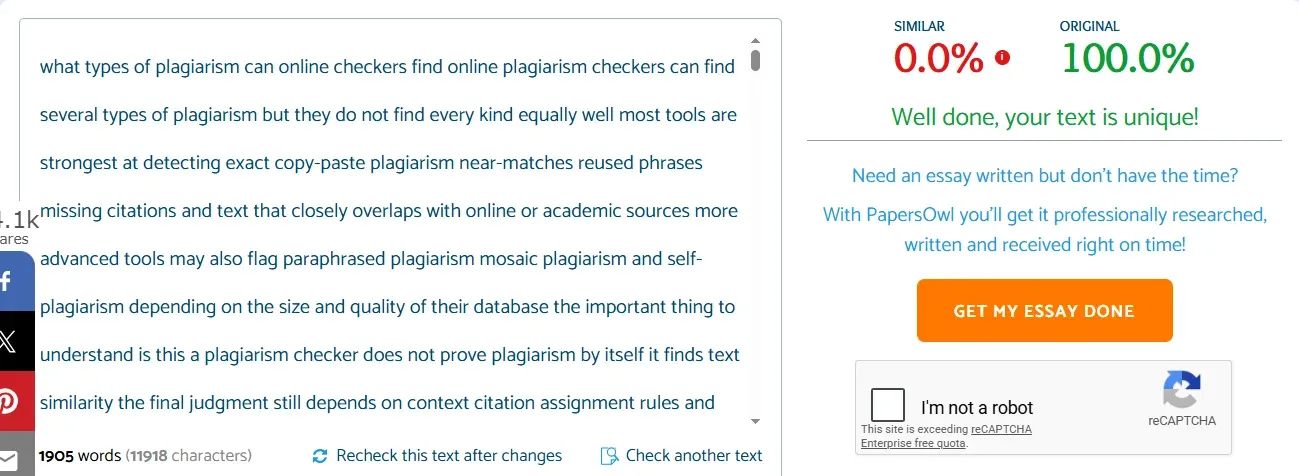
A clean similarity score is not an AI verdict. The text was new, so the checker had nothing to match it against. PapersOwl's separate AI detector flagged that same passage.
The detector also flagged a passage we wrote ourselves, with the same wording and the same offer to make it human-written. Read its verdict as a prompt to check again, not as a result.
⚠️ A detector that flags human writing is worse than no detector. It gives a student a scare, no number to check it against, and a button that sells them an edit.
Universities read the two signals separately. Turnitin sells AI writing detection as an add-on, and access depends on the institution. What that means for a submitted paper is covered in our guide to Turnitin and ChatGPT.
For a second reading on authorship, Phrasly's AI detector is a separate tool from its plagiarism checker.
🔒 Is PapersOwl Legit and Safe to Use?
Yes, it is a legitimate tool. PapersOwl is a working checker from an established site, and a scan is normal, allowed behavior. The privacy points below are the company's own statements, not an audit.
✅ The checker runs and returns real matched sources.
✅ PapersOwl publishes a privacy policy and a data safety section.
⚠️ Its storage promise is a vendor claim no outside party can verify.
⚠️ How long files are held, and who else can reach them, is not stated.
⚠️ Anything you paste leaves your computer. For unpublished research or a thesis under embargo, check your department's rules before you upload.
Is using PapersOwl cheating?
No. A plagiarism check on your own writing breaks no rule at any school we know of. It is the same act as proofreading your draft.
What about buying an essay from PapersOwl?
Most universities treat that as misconduct. Turnitin's definition of contract cheating covers paid third-party work, and the International Center for Academic Integrity sets the standards most campus policies follow.
PapersOwl vs Turnitin: What Your University Actually Uses
A clean PapersOwl score is not the same as passing Turnitin. The two tools read different libraries. Turnitin compares your work against papers other students handed in. PapersOwl cannot reach those.
Turnitin says over 16,000 institutions use it. The exact tool and settings still vary by school. Its Similarity Report covers student submissions, archived web pages, and publisher content.
A passage copied from an unpublished essay a student handed in two years ago is invisible to PapersOwl and visible to Turnitin.
Which plagiarism checker databases actually matter?
For university work, the databases that count aren't just public web pages.
An institutional checker also reads student papers, archived submissions, and subscription journals. Free tools reach the open web and some academic sources. Unicheck shut down in January 2025, so older lists are out of date.
Can PapersOwl reach Turnitin's database?
No. Turnitin licenses its repository to institutions, not to free consumer tools. No free checker we have reviewed reaches it, Paperpal included.
Most students end up running two tools and reading the overlap. Turnitin alternatives differ mainly in which databases they reach. The Turnitin submission process decides what your instructor finally sees.
The Business Model Behind the Free Tool
The PapersOwl Plagiarism Checker is not independent from its essay-writing service. Its writing marketplace and its free checker share one owner.
💡 A free tool that also sells the fix has a reason to find a problem. Read the matched sources yourself before you buy anything.
1. The free scan feeds a paid funnel
Paid options appear the moment your result lands: rewriting, editing, or a writer.
2. The checker comes from the same company that sells the fix
Running the tool that finds the problem and the service that fixes it creates an incentive a standalone integrity tool doesn't have. That doesn't prove the checker is rigged. It does mean a high score is commercially useful.
3. The data specifics are thin
PapersOwl says it does not store your information anywhere. It publishes no retention window, no encryption detail, and no statement on whether scans train the product.
What Happens After PapersOwl Flags Your Similarity Score?
After PapersOwl flags similarity, the report goes past matched sources and a score. It also offers paid ways to make the text unique, including editors and writers reachable from the results page. Prepostseo's checker runs the same pattern.
Pricing is accurate as of the date this article was written and is subject to change. Confirm the current price on the tool's official pricing page before purchasing. Checked August 2026.
Who Should and Shouldn't Use PapersOwl's Plagiarism Checker
PapersOwl works best as a quick first-pass tool, not a final university submission check. It catches obvious web-source matches, but it won't replace your institution's system.
✅ Use PapersOwl If…
You want a fast, free pre-check for duplicate wording from public web sources.
You're a blogger or content creator checking web content for duplication, not submitting academic work.
You don't have access to your university's plagiarism system and just want a rough baseline.
You need quick results with no complex setup, and you'll review the highlighted matches and source links yourself before revising. For a basic submission-ready check, that's enough.
❌ Don't Rely on PapersOwl If…
You're submitting to Turnitin, SafeAssign, or any institutional checker. A clean PapersOwl score won't predict your university's result, because PapersOwl can't access private student-paper databases. The same goes for platforms like Gradescope, which only scan if your instructor turns Turnitin on.
You need AI content detection. The plagiarism scan gives none, and PapersOwl's AI detector runs on a different page.
You want to know whether your paraphrasing will get flagged. PapersOwl misses most lightly reworded content.
You're uncomfortable with the upsell model or unsure what happens to your uploaded document.
As a plagiarism checker for students 2026, PapersOwl is fine for surface-level checking but not enough for high-stakes submissions. Our roundup of the best plagiarism checkers sorts the options by what each one can actually reach.
PapersOwl Plagiarism Checker vs. Phrasly: Side-by-Side
If you need plagiarism detection that actually catches paraphrased copying and doesn't route you to a ghostwriting marketplace after your scan, here's how the two tools compare.
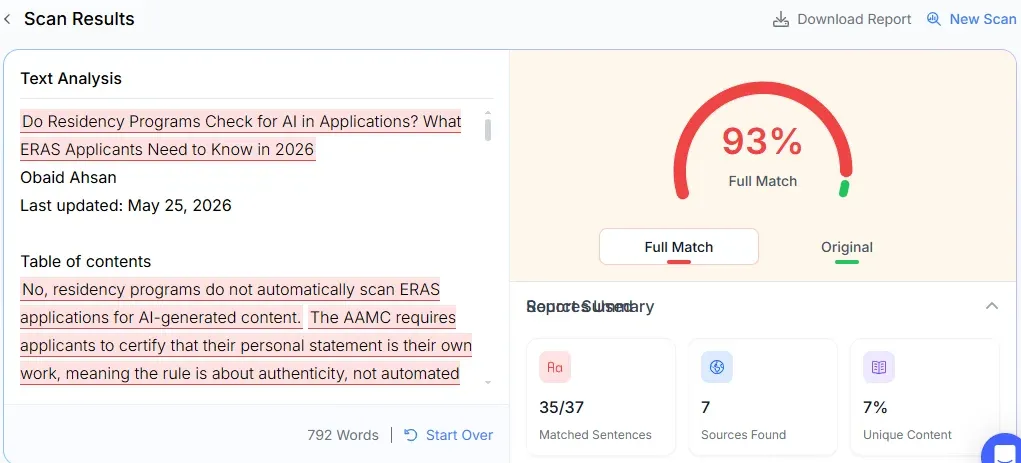
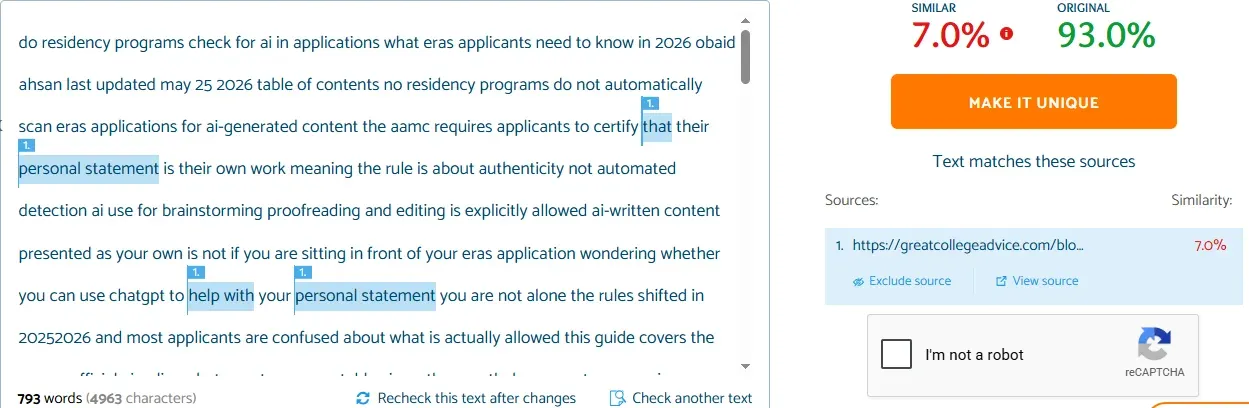
We ran the same 2,000-word blog sample, "Do Residency Programs Check for AI in Applications?", through both checkers. Phrasly flagged 93% matched content across 7 sources. PapersOwl flagged just 7%, with a single source.
Same text, two very different verdicts, driven by database coverage and how deeply each tool matches.
Phrasly Result:
PapersOwl Result:
Feature | PapersOwl | Phrasly |
Same-sample test result | 7% similar, 1 source | 93% similar, 35 of 37 sentences, 7 sources |
Plagiarism database | Web pages and academic sources. Size not disclosed. | 10B+ web pages and academic papers, per Phrasly's page. |
AI-authorship detection | Separate detector page. A different scan. | Separate AI Detector, reachable from the same window. A different scan. |
Access | Two free scans, then sign-up. 19,900 character cap. | One free scan, then paid per scan or monthly. Included for AI Humanizer subscribers. |
File formats | Paste text or upload common file types. | PDF, DOCX, TXT, or paste text. |
Report detail | Score, matched sources, color highlights. | Score and matched source links. |
Reworded text | Weak in our test. | Stronger in our test. |
Data handling | Says it does not store your information. | Says content is deleted immediately after scanning. |
Upsell after the scan | Yes. Rewrite, edit, and writer services. | No. |
Turnitin database access | No. | No. |
Best for | A fast first scan of web-sourced text. | Closer checking of reworded passages. |
Product details and pricing reflect the providers' live pages as checked in August 2026 and can change without notice. Confirm the current price on the official pricing page before purchasing.
Your deadline decides how much a free scan is worth. With a week in hand, run PapersOwl first, fix what it finds, then recheck the passages you reworded with a tool that reads paraphrase. With an hour left, one free scan still catches the copy-paste you forgot about.
What no free checker can read is the paper your classmate submitted last year. That gap is the reason your university runs its own system.
Give your reworded paragraphs a second look before you submit. 👇
Frequently Asked Questions
Is PapersOwl a good plagiarism checker?
Yes, for a first scan. It quickly finds text lifted straight from public web pages, at no cost. It reads reworded writing poorly and cannot see student paper databases, so it will not predict your university's result.
Is PapersOwl legit?
Yes. The company operates openly and the tool works. Checking your own draft breaks no academic rule, and the writing service on the same site is a separate decision with real consequences.
Is PapersOwl's plagiarism checker really free?
Yes, with limits. The scan itself costs nothing. Two runs are allowed before an account is required, and no scan may exceed 19,900 characters. Rewriting and editing upsells arrive with your result.
Does PapersOwl have a word limit for free checks?
Yes, 19,900 characters. Its page advertises no word limit, but the tool refuses anything longer. That is roughly 2,800 to 3,000 words, so most essays fit.
Does PapersOwl detect AI-generated content?
The plagiarism checker does not. A standalone AI detector lives elsewhere on the site, and it reports no figure at all. The two scores measure different things.
Can PapersOwl detect ChatGPT?
Not through its plagiarism checker. Original ChatGPT text matches no existing source, so it scores clean. Its separate AI detector claims to spot ChatGPT, Claude, and Gemini. Our guide covers whether Turnitin detects ChatGPT.
Is it safe to upload my paper to PapersOwl?
For a quick scan, reasonably. PapersOwl publishes a data safety claim but no retention window or encryption detail. Treat embargoed work with more care.
Can PapersOwl see my document after I scan it?
PapersOwl says no. Its page states that nothing you submit is kept. That is a vendor claim, not an audited guarantee.
Does PapersOwl use the Turnitin database?
No. Turnitin's student paper repository goes to institutions, never to free consumer tools. The same database limit shapes what SafeAssign catches at many schools.
Can I download a PapersOwl plagiarism report?
No. Nothing on the free result screen lets you save or export the report, in our August 2026 test.
Is PapersOwl reliable enough for a graded paper?
No, on its own. It reads the open web, not the student paper databases most universities use. Treat a clean score as a first pass.
Is using PapersOwl the same as contract cheating?
No, not the checker itself. The free scan is fine to run. A purchased essay is what Turnitin calls contract cheating, and schools punish that heavily.

Written by
Obaid Ahsan
Content Lead · Pakistan
Obaid Ahsan is a Content Lead with 5+ years of experience in SEO, content strategy, and AI-focused publishing. At Phrasly, he leads content development with a focus on accurate research, search performance, and useful, trustworthy information for readers.