
Incremental Plagiarism: Definition, Examples, & How to Avoid It
Incremental plagiarism is one of the easiest forms of plagiarism to commit and one of the hardest to catch. Learn what it is, real-world examples, and how to avoid it before it costs you.
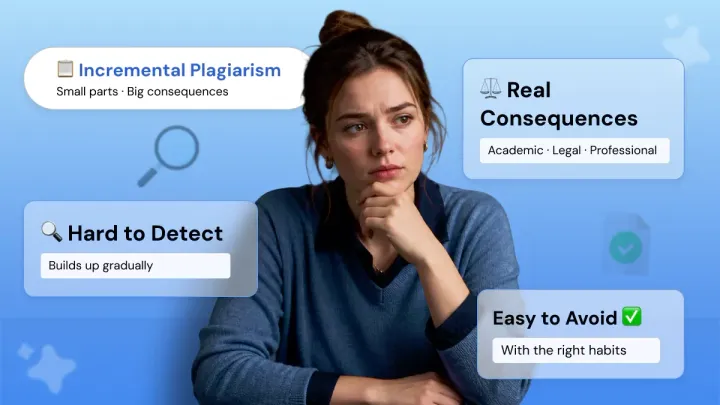
Incremental plagiarism is one of the easiest forms of plagiarism to commit and one of the hardest to catch.
Unlike copying an entire piece, it happens in fragments: a borrowed phrase here, a lifted sentence there.
But those fragments add up. By the end, a piece that looks original on the surface may be largely unoriginal underneath.
This article breaks down exactly what incremental plagiarism is, real examples of it, and how to avoid it.
Check Your Text for Plagiarism 👇
What Is Incremental Plagiarism?
Incremental plagiarism involves copying small amounts of text (words, phrases, sentences, or ideas) from another author without attribution.
Global plagiarism takes an entire work and plagiarizes it.
Incremental plagiarism slowly accumulates throughout a paper from either a single source or multiple sources. It can be deliberate or unintentional. But intention does not absolve one of responsibility for academic integrity.
When a professor reads a paper, they can't know if the writer forgot to cite something or purposely left the citation off, and most universities will punish both cases the same.
Imagine borrowing a sentence here, a near-paraphrase there. Add it all up over the length of a 3,000-word paper, and suddenly the author's voice is crowded out by the source's ideas.
It's that cumulative impact that makes incremental plagiarism so insidious and difficult to detect compared to direct plagiarism.
How Incremental Plagiarism Differs from Other Types?
Incremental plagiarism is often confused with other forms of plagiarism. The table below shows how it stacks up against the most common types of plagiarism.
Of all of these types, incremental plagiarism and self-plagiarism are the most difficult to identify because no single fragment appears overtly suspicious.
The best way to identify them is with sophisticated plagiarism detection tools that analyze cumulative similarity rather than verbatim matching.
Incremental Vs. Patchwork Plagiarism
Patchwork plagiarism is intentional collage. The author deliberately cuts and pastes sections from various sources, typically verbatim.
Incremental plagiarism, on the other hand, is gradual. As they write and rewrite, the stolen content trickles in bit by bit, often without the author realizing what they're doing.
If you have been paraphrasing from more than one source, make sure to run a similarity report prior to submission. Oftentimes, unintentional buildup is the number one cause of incremental violations.
Incremental Vs. Global Plagiarism
Global plagiarism is when you copy everything, turning in someone else's paper as your own. Incremental plagiarism involves copying parts. Both are equally punishable at most universities, though global plagiarism is much easier to spot.
Mosaic plagiarism often occurs in one pass; the writer paraphrases while retaining the source's sentence structure. Incremental plagiarism is more nefarious since it occurs over drafts and numerous sources.
Real-World Examples of Incremental Plagiarism
Incremental plagiarism examples appear in speeches, music, and academic papers, and the consequences are severe in every context.
Academic Example: History Essay
Every clause maps directly onto the source. The logic, sequence, and argumentation are borrowed wholesale. Only the vocabulary was swapped. No citation appears anywhere.
A professor reading this would see original thinking; a plagiarism checker would flag the structural overlap immediately.
Academic Example: Psychology Research Paper
The student changed "prolonged" to "extended," "impairs" to "damages," and "young adults" to "college-age individuals." The scientific finding, its structure, and its three-part conclusion are entirely the original author's yet no in-text citation appears.
In scientific writing, failing to cite empirical findings is a serious integrity violation regardless of how many synonyms were substituted.
Professional Example: Marketing Copywriter
A marketing professional, under deadline pressure, paraphrased a competitor's product description sentence by sentence. The value proposition, structure, and selling points are identical.
Published this way, it exposes the company to copyright claims and, at minimum, serious reputational damage if the overlap is discovered publicly.
This is one of the most common forms of professional incremental plagiarism and one of the most legally risky.
Professional Example: Journalism / News Writing
No attribution to the wire service. No "according to" language. The journalist reworded the wire copy and published it as original reporting. In newsrooms, this violates editorial policy and professional codes of conduct and when discovered, careers end over it.
Many journalism plagiarism scandals including high-profile ones at major outlets began with exactly this pattern: reworded wire copy, published without credit.
Avril Lavigne: 'Girlfriend' vs. The Rubinoos
In 2007, the Rubinoos filed suit against Avril Lavigne, claiming her chart-topping hit "Girlfriend" borrowed melodic phrasing and lyrical rhythm from their 1979 song "I Wanna Be Your Boyfriend."
Even musical phrasing: hooks, rhythm patterns, and melodic contour can constitute incremental plagiarism when accumulated elements are reproduced without attribution. The case was settled out of court.
Pharrell Williams & Robin Thicke: 'Blurred Lines'
The 2015 Marvin Gaye estate lawsuit against Pharrell Williams and Robin Thicke for "Blurred Lines" produced one of the most cited legal consequences of incremental plagiarism in commercial music.
The court found that Williams and Thicke had borrowed the groove, feel, and structural elements of Gaye's "Got to Give It Up," not the lyrics, not the melody verbatim, but the cumulative musical texture.
The verdict: $7.4 million in damages.
The legal conclusion is straightforward. The incremental borrowing of ideas or presentation, even where there is no copying verbatim, can lead to copyright infringement.
The lesson for writers in academia and beyond is that plagiarism detection now goes beyond searching for copied text.
Consequences of Incremental Plagiarism
The consequences of incremental plagiarism apply equally whether the act was intentional or accidental. Universities and courts have not drawn a distinction between the two where evidence of unattributed material is clear.
Academic consequences
- Failing grade on the assignment or course, formal disciplinary hearing, academic probation, suspension, or expulsion.
Professional consequences
- Loss of credibility, termination of employment, or public reputational damage.
- The Melania Trump speech incident is a high-profile example. The controversy overshadowed an entire convention night.
Legal consequences
- Copyright infringement lawsuits.
SEO and content consequences
- For bloggers and content teams, Google's duplicate content filters penalize pages with paraphrased-but-too-similar content.
- A high similarity score relative to a competitor's page can suppress organic rankings even if no sentence was copied verbatim.
⚠️ Categorically incremental plagiarism unethical. Plagiarism is not giving credit to another person's idea, no matter how few words you may borrow.
Is Using AI Tools Like ChatGPT Incremental Plagiarism?
Is ChatGPT considered plagiarism? This is the question reshaping academic integrity policy in 2026.
If you ask ChatGPT, Claude, or Gemini to paraphrase a source article and then publish what they write without citing the source article, you are still plagiarizing the ideas. It doesn't matter how many words were swapped out.
The tool changes the surface. It does not change the attribution requirement.
Three AI-Related Scenarios That Constitute Incremental Plagiarism
- Prompting AI to 'rewrite' a source article. If you copy-paste an existing article into ChatGPT and ask it to rewrite the article, when you take that output and use it without citation, you have AI plagiarism 2026 in its most direct form.
- Using AI paraphrasing tools minimally. If you run source text through QuillBot (or another paraphrasing tool) to change a few words here and there, that's patchwriting using an AI intermediary.
The syntax and concepts are left unattributed.
- AI-generated text that reproduces training data patterns. Large Language Models can accidentally regurgitate sentences or concepts from the data they were trained on.
The author may be unaware of the duplication, but plagiarism checkers will find it.
The underlying principle is unchanged.
Plagiarism detection is about attribution of ideas, not just words. AI doesn't dissolve that requirement. It adds a new layer of complexity to it.
When your school uses an AI detector, if your paper is generated by AI using paraphrasing of another source, it could get flagged for both low originality and plagiarism, compounding the integrity problem.
How to Avoid Incremental Plagiarism?
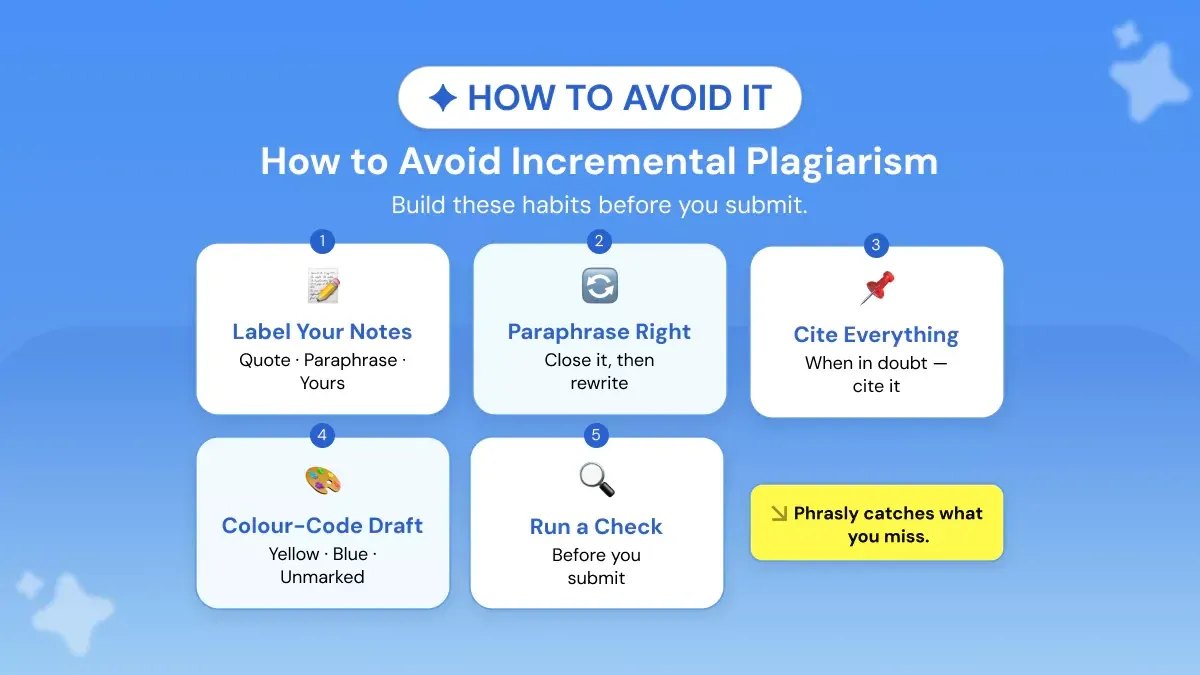
It's less about learning rules and more about developing good habits when it comes to avoiding incremental plagiarism.
The vast majority of instances are unintentional and happen because of poor note taking.
Take Detailed, Labelled Notes
Sort your notes into three piles: quotes ("with quotation marks and full source info), close paraphrases (with source), and original ideas. Never combine them.
Mixing up your ideas with source ideas is where most inadvertent plagiarism begins. Tagging your notes at the time you take them, not when you write, is the number one habit to prevent it.
Paraphrase the Right Way
The key: Read your source, close your source, write what you remember about that idea in your own words. Now open your source and check your work.
If you still have the same clause structure or words as your source, rewrite it. Even if you paraphrase it correctly, you still need to cite it. Paraphrasing eliminates the quotes; it does not eliminate the citation. That's the difference most people overlook.
Paraphrasing does not avoid plagiarism automatically.
Someone else still came up with the idea. You can use a paraphrasing tool to diversify your vocabulary, but it will not replace an APA citation or MLA citation for you.
Cite Everything: Even When You're Unsure
Follow APA citation, MLA citation, or Chicago style guidelines as appropriate. When you are in doubt, cite your sources. A citation will not weaken your argument. In fact, it will strengthen your argument by showing you have done your research.
Information that you already know to be true (such as 'Shakespeare wrote Hamlet') does not require citation. Everything else does. Use a citation generator to quickly and uniformly.
Quick Self-Check Before Citing
- Ask: 'Did I learn this from a specific source, or is it general knowledge?' If from a source: cite it.
- When in doubt between APA and MLA: check your institution's style guide or course requirements first.
- Use a reference manager (Zotero, Mendeley) to auto-generate citations as you research not after the fact.
- A missed citation on a paraphrase is treated the same as a missed citation on a direct quote.
Run a Plagiarism Check Before Submitting
Copy & paste isn't the only thing a plagiarism checker can catch. Sophisticated tools like Phrasly identify cumulative similarity. The type that slowly accrues throughout your paper.
Cumulative similarity detection is your best defense against unintentional incremental plagiarism.
How to Recognize Incremental Plagiarism in Your Own Writing?
Before you submit, run this self-audit. Each check takes less than five minutes.
- Read only your topic sentences. Do they state your ideas, or the source's? Topic sentences should communicate your claim, not someone else's (sources).
- Color-code your draft. Quotes in yellow, paraphrases in blue, original analysis unmarked. If the original analysis is the smallest section, you have a problem.
- Count consecutive paraphrased sentences from a single source. More than three in a row without your own commentary is a strong indicator of incremental borrowing.
- Read aloud. Abrupt changes in word complexity or sentence structure are often indicators of pasted/plagiarized content from another source. Your writing has a set voice.
- Run a similarity check early. Run your text through a plagiarism checker before it's too late to revise. It's much easier to find overlap when your draft is 80% complete than on deadline.
Frequently Asked Questions
What is incremental plagiarism?
Incremental plagiarism happens when a writer includes bits of another person's work (words, phrases, sentences, or ideas) without citing that work. These small bits of unattributed material add up throughout the paper.
Incremental plagiarism is just as serious as direct plagiarism. It can be done on purpose or by accident. Whether incremental plagiarism is intentional or not, you are still responsible for it.
Incremental plagiarism involves which two actions?
Incremental plagiarism consists of two things: (1) taking bits of someone else's language/text, and (2) not giving attribution to that source. Both actions must be present: the taking and the failure to attribute.
Is incremental plagiarism intentional?
No! It is often accidental. Rushed deadlines, sloppy notes, and unintentional plagiarism due to negligent paraphrasing top the list. But good intentions don't absolve someone of academic or workplace obligation.
Instructors and publishers judge the pattern of uncredited use.
How is incremental plagiarism different from patchwork plagiarism?
Incremental plagiarism occurs when pieces are added up over time, usually unbeknownst to the author that they are doing it. Patchwork plagiarism occurs when someone intentionally weaves text from different sources together.
Both are violations of academic integrity, and both can be caught by a plagiarism checker.
What are the consequences of incremental plagiarism?
Penalties include failure, loss of academic credit, disciplinary probation, suspension, or expulsion from school. Professional penalties include loss of credibility and job termination.
Legal ramifications include liability for copyright infringement: Pharrell/Thicke ended up owing $7.4 million in damages. Content teams can also suffer from Google duplicate content penalties, which affect organic rankings.
Is using ChatGPT considered incremental plagiarism?
Phrasing source material using AI without citation of the source material, or having AI rephrase published work, can be a form of incremental plagiarism.
The ideas are still derived, even if the words were not directly copied. AI plagiarism 2026 is very much a current topic of changing policy at many institutions.
What percentage of plagiarism is acceptable?
There is no definitive cutoff point. Many schools consider any match you don't cite as plagiarized. Some tools will catch content over 10-15% similarity. However, tools don't define cutoffs; schools do.
You want your similarity score to be as close to 0% as possible.
How can I detect incremental plagiarism in my own writing?
Use a plagiarism checker that detects cumulative similarity, not just word-for-word matches. Phrasly's Plagiarism checker highlights repetitive phrasing throughout your document.
Tip: Color-code your draft & read your topic sentences to ensure your own analysis exists throughout.


Keep reading


Copyscape Plagiarism Checker Review (with Pros, Cons and Pricing)
Is the Copyscape plagiarism checker still reliable in 2026? We tested verbatim, paraphrased, and AI content, and broke down real costs and gaps.

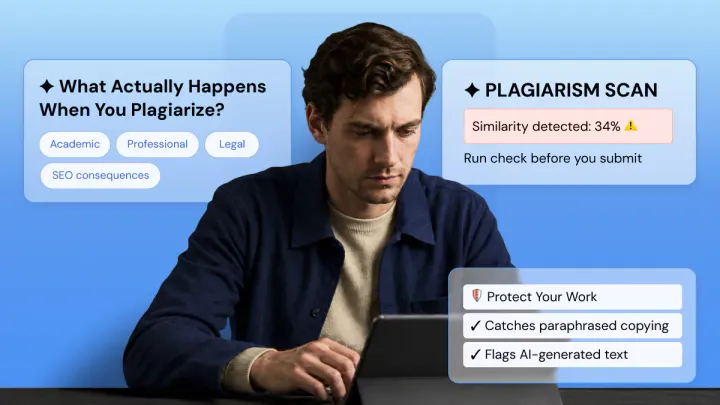
What Actually Happens When You Plagiarize? Every Consequence Covered
Most students think plagiarism just means a failing grade. It doesn't. From expulsion and lawsuits to Google penalties and career ruin, the real consequences go far beyond the classroom. Here's what actually happens, broken down by academic, professional, legal, and SEO impact.