Prepostseo Plagiarism Checker: An Honest Review (+ An Alternative That Does More)
14 min read
Before you run your next content check through Prepostseo, here's what you should know about how it actually performs.
We tested it with real published content across multiple runs and tracked exactly where it held up and where it didn't. What we found was worth writing down.
This review is built for students, bloggers, content agencies, and SEO teams who can't afford to let duplicate content slip through. If originality checks are part of your workflow, read this before making it part of yours.
Check Your Work for Plagiarism 👇
What Is the Prepostseo Plagiarism Checker?
Prepostseo is an online suite of 150+ free SEO and writing tools, and its plagiarism checker is the flagship feature, the one most people actually land on the site for.
The tool works the way you'd expect a content originality checker to work: paste your text or upload a file, and it scans your content against indexed web sources, then returns a plagiarism percentage report with the matched URLs surfaced underneath.
It's used by bloggers, content teams, SEO agencies, and students, basically anyone who needs a fast similarity check without setting up an account.
File support covers .doc, .docx, .pdf, and .txt, and you can also drop in a URL to scan a published page directly. Source matching happens sentence by sentence, so you can see exactly which lines triggered which match.
Here's how the free and paid tiers stack up:
Free | Basic $10/mo | Standard $20/mo | Company $45/mo | |
📊 LIMITS | ||||
Words per submission | 1,000 unregistered / 1,500 registered (5 Checks) | 5,000 | 15,000 | 25,000 |
Registration required | No | Yes | Yes | Yes |
🔍 SCANNING | ||||
Deep Search | ❌ | ✅ | ✅ | ✅ |
AI detection in checker | ❌ | ❌ | ❌ | ❌ |
📄 REPORTS & TOOLS | ||||
Download report (HTML / PDF) | ✅ | ✅ | ✅ | ✅ |
Humanize text | ✅ | ✅ | ✅ | ✅ |
Paraphrase / remove plagiarism | ✅ | ✅ | ✅ | ✅ |
✨ EXPERIENCE | ||||
Ad-free | ❌ | ✅ | ✅ | ✅ |
We Tested Prepostseo Plagiarism Checker (Here's What We Found)
We ran Prepostseo's plagiarism checker through three real-world tests to see how it performs in the scenarios bloggers and SEO professionals actually face.
Not a feature walkthrough. Not a checklist.
Just the same kind of content you'd run through it on a normal Tuesday.
For the first test, we pasted roughly 1,000 words from a recent Phrasly blog post directly into the checker. The scan took about 2–3 minutes to complete, which is reasonable for a web-based plagiarism tool.
For the second test, we built a patchwork sample by taking three different Phrasly.ai blog posts, lightly paraphrasing them, and combining them into one 1,000-word piece.
For the third test, we ran a 100-word block of AI-generated content through the checker to see whether Prepostseo catches anything when the source isn't a human-written page on the open web.
Test 1 — Verbatim Plagiarism (Copy-Paste)
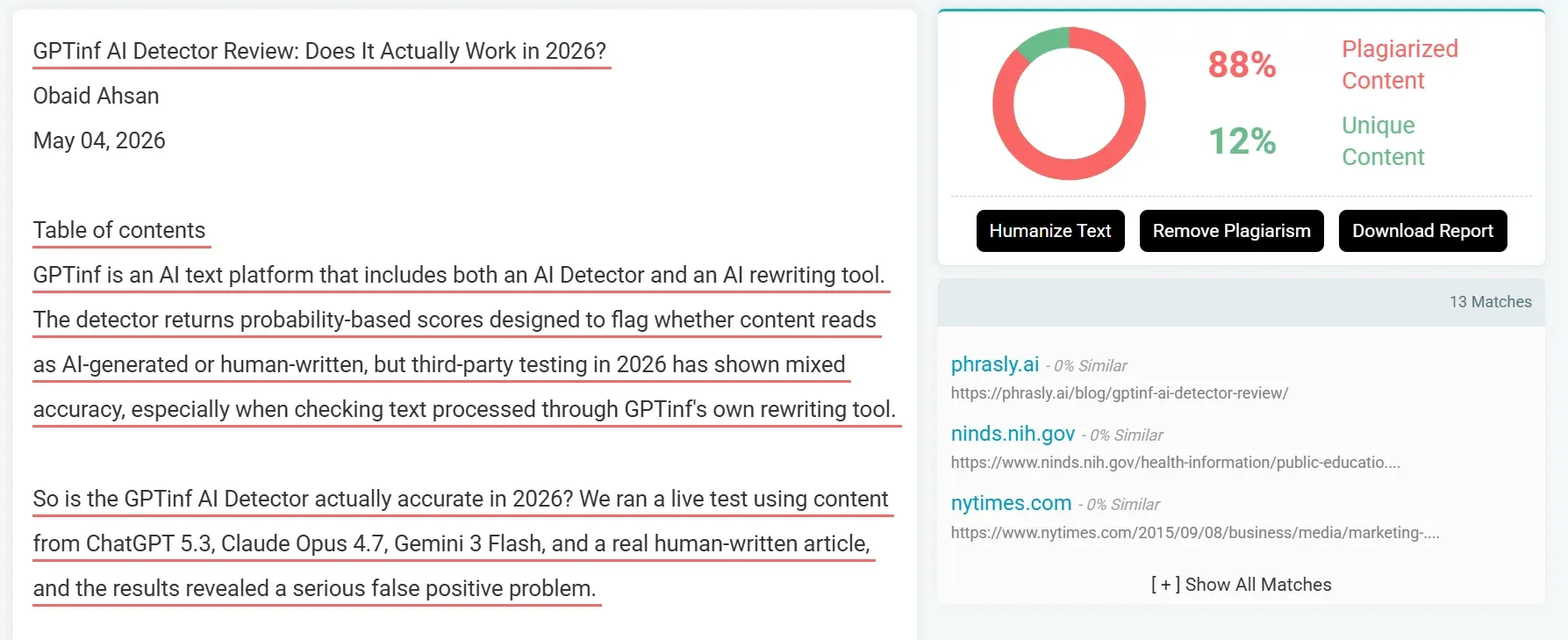
We pasted a 1,000-word published Phrasly blog post directly into Prepostseo to test simple verbatim copying.
The checker returned 88% plagiarized and 12% unique, which is the kind of result you want from a basic originality check.
That's a clear win. Prepostseo correctly identified the copied text and surfaced a strong similarity score with proper source matching back to the original URL.
Result: Pass ✓
Test 2 — Patchwork Plagiarism
Next, the harder test. We took three separate Phrasly.ai blog posts, lightly paraphrased them, and merged them into one 1,000-word sample.
This is mosaic plagiarism, the type of patchwork content that shows up constantly in SEO workflows when writers reuse ideas, restructure sentences, or rephrase without crediting the original.
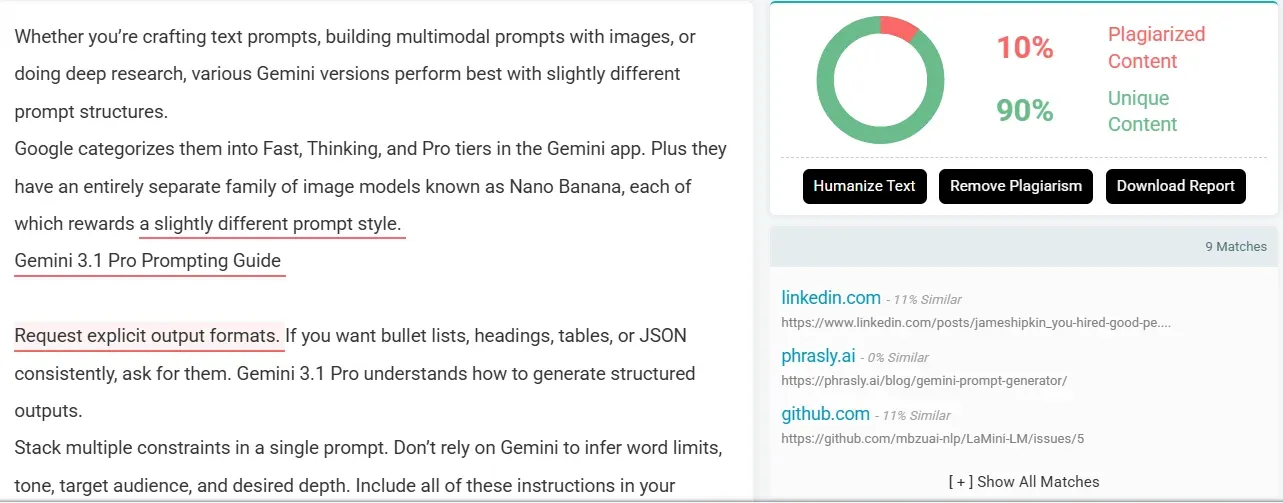
Prepostseo returned just 10% plagiarized and 90% unique.
That's a serious underreport. The sample was built entirely from existing source material and should have triggered a far stronger similarity score.
Independent testing has consistently shown that surface-level plagiarism checkers miss most patchwork content, sometimes by as much as 62 percentage points compared to the actual overlap.
Result: Fail ✗
Test 3 — AI-Generated Text
For the final test, we wanted to see what happens when the source isn't a human-written page sitting on the indexed web. We generated a fresh 100-word block of AI-written text and ran it through Prepostseo's plagiarism checker.
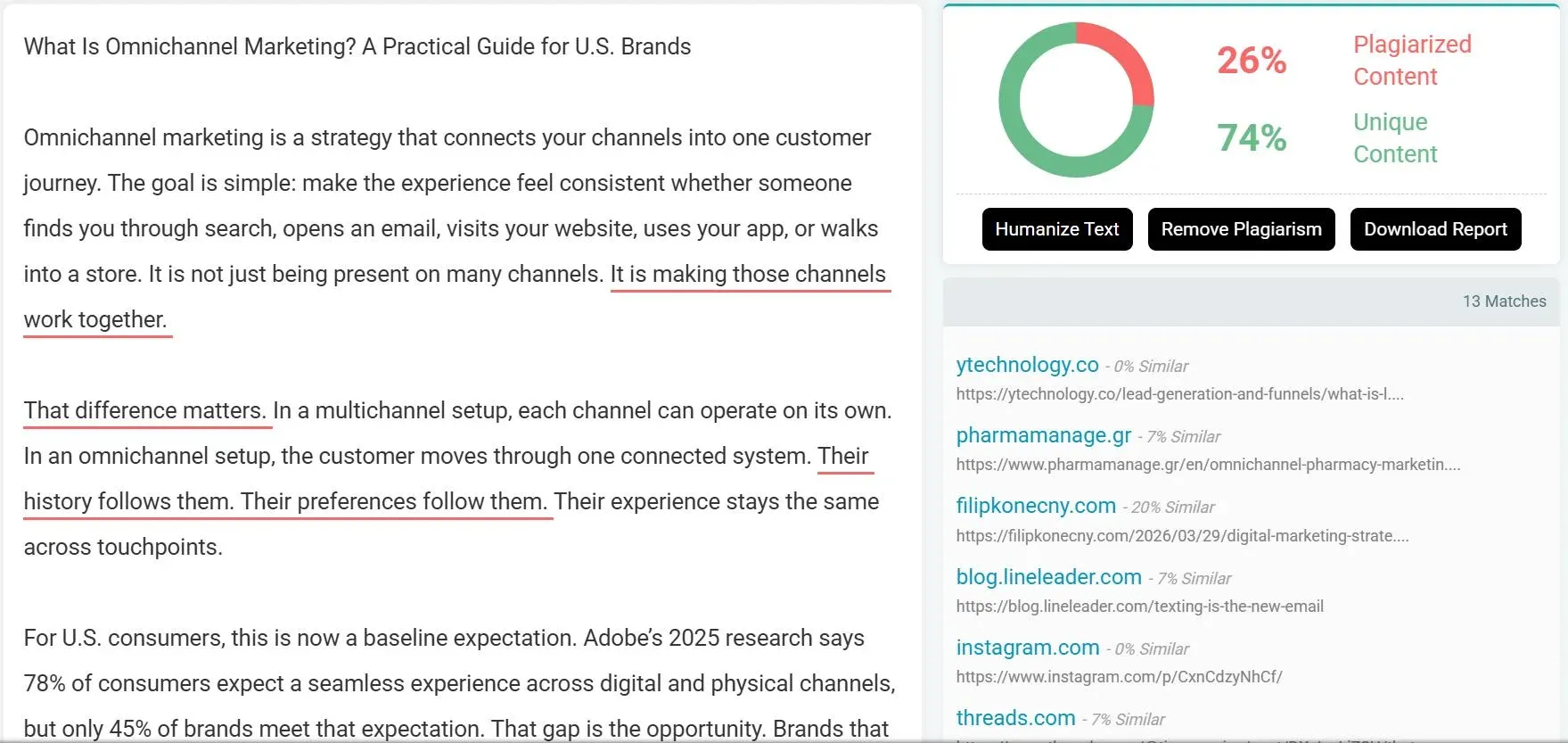
The checker returned 26% plagiarized and 74% unique.
That number is misleading in both directions. The 26% likely reflects common phrases and stock sentence structures the AI reused from training data, not actual plagiarism.
More importantly, Prepostseo's plagiarism checker has no AI detection layer, so it can't tell whether content was written by a human or generated by ChatGPT, Claude, or Gemini.
For anyone publishing in 2026, that's the bigger blind spot.
The Content Marketing Institute (CMI) latest enterprise research shows 95% of enterprise marketers use AI-powered marketing applications and 86% use AI for content creation. Modern detection requires both NLP-based plagiarism scanning and AI-generated content detection in the same workflow. Splitting it across two tools doubles the effort and still leaves blind spots.
If you want a deeper look at the giveaway patterns, our guide on how to tell if text was written by AI walks through them in detail.
Result: Fail ✗
Results Summary
Test | What We Did + Result | Verdict |
Test 1: Verbatim Copy | Pasted a 1,000-word published Phrasly blog post directly. PrePostSEO returned 88% plagiarized and 12% unique. | ✅ Pass |
Test 2: Patchwork | Combined three Phrasly.ai blog posts, lightly paraphrased them, and ran the 1,000-word sample. PrePostSEO returned 10% plagiarized and 90% unique. | ❌ Fail |
Test 3: AI-Generated Text | Ran 100 words of AI-generated content through the checker. It returned 26% plagiarized and 74% unique. | ❌ Fail |
Prepostseo is reliable for direct copy-paste detection, but weakens fast when content is paraphrased, mixed, or AI-assisted.
That's a real problem for bloggers and SEO teams, because modern plagiarism is rarely literal copying anymore.
It's patchwork, paraphrased, and increasingly AI-generated, exactly the cases where a single-layer checker falls short.
What Prepostseo Gets Right
To be fair, Prepostseo does the basics well, and it deserves credit for that before we get into where it falls short.
Our first test confirmed it: when content is copied verbatim from a published page, the checker catches it cleanly and surfaces the matched source URL without fuss.
Here's what works:
✓ Fast verbatim detection. Test 1 confirmed strong, accurate flagging on direct copy-paste content.
✓ No registration required for basic use. It's a true plagiarism checker without registration, paste and scan, no email gate.
✓ Supports 20+ languages including French, Dutch, Spanish, and more, useful for multilingual content teams.
✓ Exclude URL and Exclude Quotes features, helpful when you're checking republished, syndicated, or properly cited content.
✓ File upload support for .doc, .docx, .pdf, and .txt formats.
✓ URL-based checking, scan a live webpage directly without copy-pasting.
✓ Solid for quick spot checks on short pieces under 1,000 words, the use case it was built for.
Is the Prepostseo plagiarism checker safe?
Prepostseo positions itself as secure and offers no-registration access for basic use, and its API documentation states no scanned data is stored on its servers.
For most bloggers and students running quick content uniqueness checks, that's a reasonable level of privacy.
The point is, if all you need is a fast verbatim check on a short piece, Prepostseo does the job.
The problems start when your workflow gets more complex than that.
For students worried about getting flagged unfairly on their own drafts, our guide on how to protect yourself from AI detector false positives is worth keeping handy.
Where Prepostseo Falls Short
Prepostseo works for quick verbatim spot checks, but the cracks show fast once you push it into a real content workflow. Here's where it struggles, backed by our tests and first-hand use.
Limitation 1: The 1,000-Word Free Cap Hits Quickly
For anyone running full blog posts through it, Prepostseo's free plan doesn't quite hold up.
A standard 1,500 to 2,000 word article exceeds the free word cap in a single paste, which forces you to split the scan into chunks or upgrade right away.
Free visitors get 1,000 words per scan, and registered free users get 1,500 words. That ceiling hits content professionals fast, anyone reviewing client drafts or long-form posts will burn through it within minutes.
Why does Prepostseo's free plagiarism checker run out so fast? Because it runs on a credit-based query system, not unlimited scans.
Prepostseo's own FAQ confirms a 1,000-word scan consumes 20–30 credits, and its API documentation notes that plagiarism checking is sentence-by-sentence, so longer articles burn through your allowance fast.
Limitation 2: The Free Plan Isn't Actually Free
This is the one that catches most users off guard. In our testing, the free account only allowed about 5 plagiarism scans before the tool stopped processing new content and pushed us toward a paid plan.
So while the homepage frames it as a free tool, the reality is closer to a limited free trial. For anyone planning to use Prepostseo regularly, you'll hit the paywall faster than you expect.
Limitation 3: Patchwork Plagiarism Detection Fails
Our Test 2 already showed it: Prepostseo returned just 10% plagiarism on a sample built entirely from three Phrasly.ai blog posts that were lightly paraphrased and combined.
That's a serious miss for any SEO team checking modern content.
This isn't an isolated finding either. Independent testing by Originality.ai found Prepostseo flagged just 3% similarity on a patchwork sample where their own checker identified a 65% match, a 62-percentage-point gap.
Mosaic plagiarism is exactly the kind of reuse that drives duplicate content SEO penalty risk in 2026, and it's the case Prepostseo is weakest at catching.
Limitation 4: Zero AI Detection on Any Plan
Does postseo check for AI-generated content? No. Not on the free tier, not on Basic, not on Standard, not on Company.
Prepostseo offers a separate AI Content Detector elsewhere on its site that identifies text from ChatGPT, GPT-5, Gemini, Claude, Grok, and DeepSeek, but it's never bundled into the plagiarism checker itself.
That matters because in 2026, most content briefs involve LLMs at some point, whether it's outlining, drafting, or rewriting. Modern detection requires both NLP-based plagiarism scanning and AI-generated content detection in the same workflow.
Splitting it across two tools doubles the effort and still leaves blind spots. A modern workflow needs a built-in AI detector running alongside plagiarism scanning.
Limitation 5: Heavy Ads on the Free Plan
Not fatal on its own, but it adds friction.
The free plagiarism checker page is loaded with display ads, and the paid plans list "Ads & Captcha Free" as a perk, which tells you the ad load on the free version is intentional.
Combined with the word caps, the 5-scan ceiling, and the missing AI detection layer, the free experience degrades quickly for daily professional use.
Who Should and Shouldn't Use PrePostSEO
Prepostseo works well for some users and breaks down fast for others. Here's how the split looks based on our testing.
✅ Good fit for:
Students checking short assignments or single passages, the basic flow is fast enough for spot checks before submission.
Casual bloggers who need a quick plagiarism checker without registration for short drafts under 1,000 words.
Anyone running a one-off verbatim check on a single page or short post, where a simple percentage report with matched sources is enough.
❌ Not ideal for:
SEO agencies and content teams reviewing 1,500 to 3,000 word client drafts daily, the credit-based free tier runs dry within a handful of scans.
Content teams that need AI detection in the same workflow, PrePostSEO keeps that in a separate tool, doubling the steps.
Managers who need a streamlined originality reporting flow across every project, professional-scale use pushes you into paid limits fast.
Anyone publishing AI-assisted content, the plagiarism checker has no AI detection layer, so a major risk vector is missed entirely.
Screaming Frog's SEO guidance flags duplicate and near-duplicate pages as a real crawl-budget drain, since search engines waste resources sorting through multiple similar URLs instead of indexing what matters. A plagiarism checker that misses paraphrased or patchwork reuse leaves unoriginal content looking cleaner than it actually is.
If you fall in the second group, here's what a better workflow looks like.
An Alternative That Does More: Phrasly's Plagiarism Checker
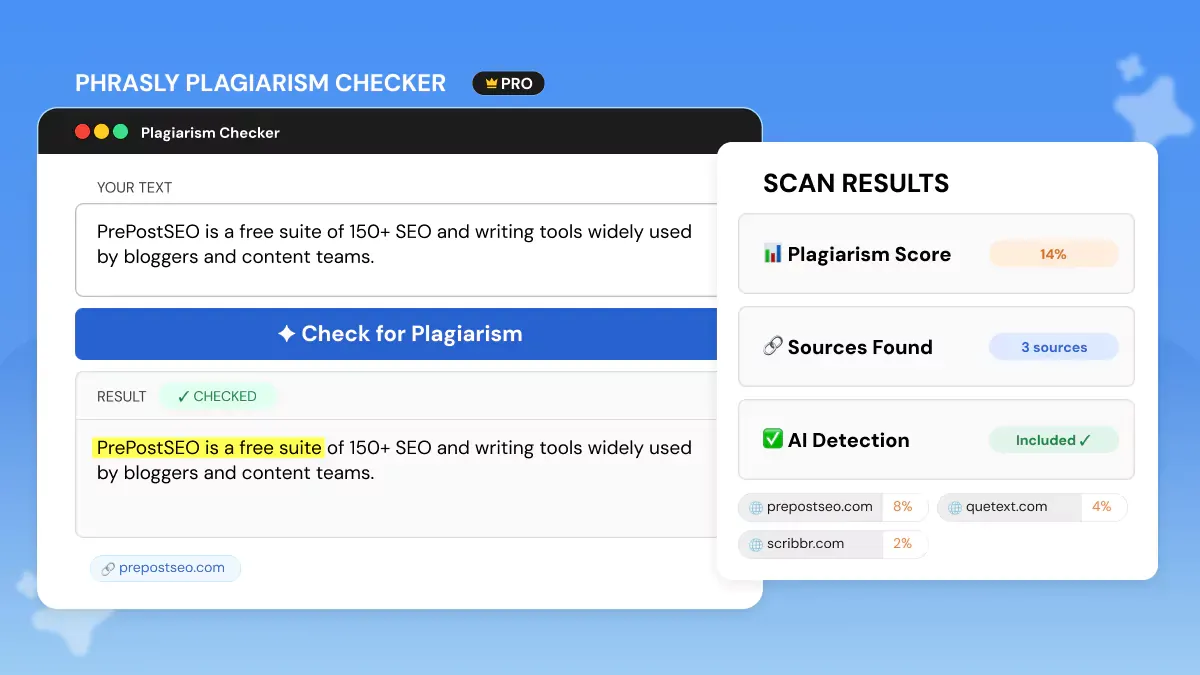
If you've been nodding along through the limitations, here's the workflow most of those gaps disappear in. Word caps, no AI detection, ad friction, and weak patchwork results are the exact problems Phrasly's plagiarism checker is built to solve.
Phrasly's plagiarism checker scans your content against 10B+ web pages and academic databases, returns a clean similarity score with direct source links, and catches the cases Prepostseo struggles with: direct copying, paraphrased reuse, and mosaic plagiarism.
Then it goes a step further. AI-generated content detection is built into the same scan, so you can check plagiarism and AI authorship in one workflow.
ChatGPT, Claude, Gemini, and other LLM-generated content gets surfaced alongside the originality report, no second tool, no switching tabs.
For a wider look at how Phrasly stacks up against competing detectors, see our breakdown of the best AI checker tools of 2026.
Here's what the workflow actually looks like:
10B+ source coverage across web pages and academic databases for stronger source matching
Plagiarism + AI detection in a single scan, the workflow Prepostseo splits across two tools
20,000 plagiarism-check words per month included with the Unlimited plan, enough for 10 to 13 full articles
No ads, no captchas, no friction in the interface
PDF, DOCX, and TXT uploads supported, plus paste-in checks
Documents are never stored, indexed, or shared and are deleted immediately after each scan, a real win for content integrity
Phrasly isn't a free tool, and that's the honest tradeoff. What you get instead is a larger monthly word allowance, AI detection bundled in, and a clean ad-free interface built for daily professional use.
If your content workflow has outgrown Prepostseo, this is what a better one looks like.
Prepostseo vs Phrasly: Side-by-Side
Prepostseo is built for fast verbatim checks under 1,000 words with no login required.
Phrasly is built for full-article workflows, with 10B+ source coverage, built-in AI detection, and a 20,000-word monthly allowance on the Unlimited plan.
Here's how the two tools stack up on the things that actually matter for daily content work.
Feature | PrePostSEO (Free) | PrePostSEO (Paid) | Phrasly |
Word Limit per Scan | 1,000 (unregistered) / 1,500 (registered) | 5,000 to 25,000 depending on tier | 5,000 words per scan |
Monthly Allowance | Credit-limited (~5 scans in our testing) | Tier-based credits | 20,000 words/month (Unlimited plan) |
AI Detection in Scan | ❌ Separate tool only | ❌ Separate tool only | ✅ Built-in alongside plagiarism scan |
Patchwork Detection | ❌ Failed our test (10% on patchwork sample) | ❌ Same engine | ✅ Strong patchwork performance in testing |
Scan Speed | 2–3 minutes per scan | 2–3 minutes per scan | ✅ Results within minutes |
No Registration Required | ✅ Yes | ❌ Account required | ❌ Account required |
Ad-Free Experience | ❌ Heavy ads | ✅ Ads & captcha free | ✅ No ads |
PDF Report Download | ✅ Yes | ✅ Yes | ✅ Detailed PDF report |
File Upload Support | .doc, .docx, .pdf, .txt | .doc, .docx, .pdf, .txt | PDF, DOCX, TXT |
Content Privacy | Stored on servers, deletable | Stored on servers, deletable | Never stored, deleted immediately |
Results Comparison: Phrasly vs Prepostseo on the Same Content
To make this comparison apples-to-apples, we ran the exact same content through both tools, a published Phrasly blog post pasted directly into each plagiarism checker. Same input, same conditions, two very different results.
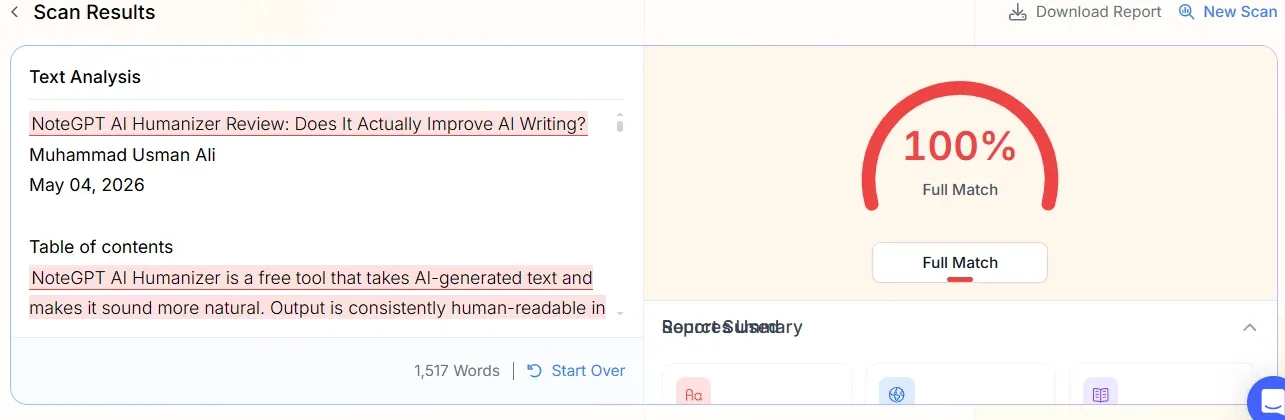
Phrasly's plagiarism checker correctly identified 100% of the copied content, flagging the entire passage and matching it back to its original source. Prepostseo detected only 73%, missing 27% of the same plagiarized text entirely.
Phrasly: 100% Plagiarism Detected ✅
Phrasly's plagiarism checker flagged the full passage as copied and traced it back to its original Phrasly.ai source. No content slipped through.
This is the kind of result you want from an originality check on verbatim content, complete coverage with clear source matching.
Prepostseo: 73% Plagiarism Detected ❌
Prepostseo caught most of the copied text but missed a meaningful 27% of the same content. On a scan of fully published, indexed material, that's a significant blind spot, and it tracks with the patchwork failures we saw earlier.
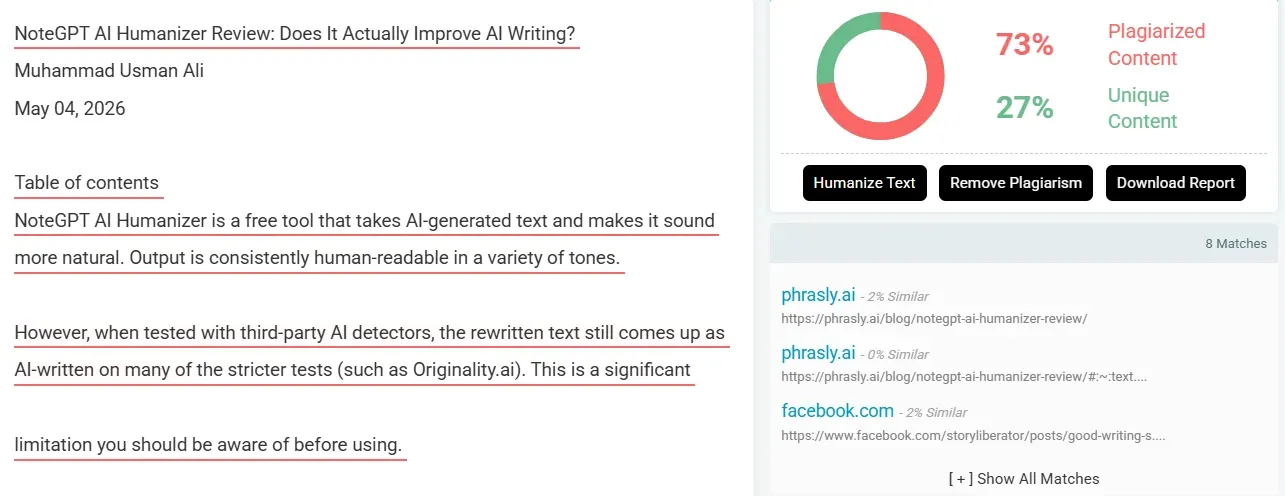
On the simplest test a plagiarism checker should pass, Phrasly caught everything and Prepostseo missed more than a quarter of it.
Pair that with Phrasly's built-in AI detection running in the same scan, and the workflow gap widens further.
The verdict: PrePostSEO holds up for fast, single-shot verbatim checks under 1,000 words. For full-article reviews, patchwork detection, and built-in AI-generated content detection, Phrasly does noticeably more in a single workflow.
FAQs
Is the PrePostSEO plagiarism checker accurate?
PrePostSEO is accurate for verbatim copy-paste detection, our Test 1 confirmed strong matching on direct copies (83% flagged on a 1,000-word published blog post).
However, it struggles with patchwork plagiarism, where content is combined and lightly rephrased from multiple sources. For professional content that involves repurposing, paraphrasing, or AI-assisted writing, the accuracy isn't reliable.
Is the Prepostseo plagiarism checker free?
There is a free tier, but it's limited in practice. Free users can check up to 1,000 words per scan (1,500 after registering), and the credit-based system means a 1,000-word check consumes 20 to 30 credits.
In our testing, the free account allowed only about 5 scans before the tool pushed us toward a paid plan starting at $10/month.
Does Prepostseo detect AI-generated content?
No. Prepostseo's plagiarism checker does not detect AI-generated content on any plan, free, Basic, Standard, or Company. It only checks for text similarity against indexed web sources.
If you need plagiarism detection and AI content detection in a single workflow, Phrasly's plagiarism checker includes both in the same scan.
If you want a deeper understanding of how detection actually works under the hood, our guide on how AI detectors work explains the mechanics.
What is the word limit on Prepostseo's free plan?
Free users can scan 1,000 words per check without registering, or 1,500 words after creating a free account (5 Checks).
A standard 1,500 to 2,000 word blog post exceeds this limit on a single paste.
Paid plans extend this to 5,000, 15,000, or 25,000 words per scan depending on the tier (Basic, Standard, or Company).
What is the best alternative to Prepostseo for SEO professionals?
For SEO professionals and bloggers who check full articles, Phrasly's plagiarism checker is the stronger fit.
It scans against 10B+ web pages and academic databases, includes built-in AI detection alongside plagiarism in a single scan, and offers 20,000 words per month on the Unlimited plan, enough for 10 to 13 full articles without hitting credit limits.

Written by
Obaid Ahsan
Pakistan
Obaid Ahsan is an SEO content writer with 3+ years of experience specializing in AI writing tools. He crafts well-researched content that resonates with readers and ranks on search engines.