How to Cite Sources in APA, MLA and Chicago So Your Paper Passes a Plagiarism Check
13 min read
Learning how to cite sources to avoid plagiarism comes down to six steps:
Track every source while you research.
Quote or paraphrase with credit, never without it.
Pick one citation style, APA, MLA, or Chicago, whichever your instructor requires, and use it for every in-text citation.
Check common knowledge, because only widely known facts can go without a citation.
Match every in-text citation to your reference list.
Run a plagiarism checker on your draft before you submit.
Already have a draft? Start with step 6 now, then use the citation examples in this guide to fix anything it flags.
Check Your Draft for Uncited Matches 👇
Track Your Sources Before You Start Writing
Tracking your sources means writing down where every quote, fact, and idea came from while you research. It is not the citation itself, but it gives you everything a correct citation needs later: the author, the title, the page number, and the link.
So how do you cite sources correctly so you don’t accidentally plagiarize? Track them first. Many citation mistakes start during research: a closed tab, a lost PDF, or a missing page number forces you to guess later, and guessing leads to accidental plagiarism.
Those gaps can cause more than one problem, as the 12 types of plagiarism show.
Build a Simple Source Log While You Research
A source log keeps source attribution clear and gives every in-text citation a source you can find again. Use a spreadsheet or notes app with one row per source:
Source Details: author, title, publication, and date.
Location: the page or paragraph number, recorded the moment you copy a quote, plus the URL or DOI.
Exact Wording: any line you might quote, copied inside quotation marks right away.
Why It Matters: one line on what the source adds to your paper.
Intent: “quote as is” or “paraphrase needed,” so you remember your plan.
Here is a sample row for a paper on species decline:
Source | Date | Location | Why It Matters | Intent |
“U.S. Declares 23 Species Extinct,” PBS NewsHour | Sept. 29, 2021 | pbs.org/newshour | Recent example of species loss | Paraphrase needed |
💡 Tip: save a quote word for word in your log before you try to reword it. If you only remember it, the author’s words can slip into your “own” sentence without you noticing.
What's the Difference Between a Direct Quote and a Paraphrase?
A direct quote uses the author’s exact words inside quotation marks, while a paraphrase restates the idea in your own words and sentence structure. A summary condenses the main point of a longer passage into a sentence or two. All three need a citation, but when citing a direct quote vs a paraphrase, only the quote always needs quotation marks and a page number.
Every example in this guide uses the same made-up source, so you can see how one citation changes as a quote, a paraphrase, and a summary, and in APA, MLA, and Chicago:
Example source (fictional): Daniel Okafor, “Screen Time and Sleep in First-Year College Students,” Journal of Campus Health, vol. 12, no. 3, 2024, pp. 41-58. The article argues that late-night phone use is a major reason first-year students sleep too little. Page 45 reads: “Students who used their phones in bed slept an average of 47 minutes less than those who did not.”
Quoting Word for Word
Use a direct quotation when the exact wording matters:
✅ One study found that “students who used their phones in bed slept an average of 47 minutes less than those who did not” (Okafor, 2024, p. 45).
Paraphrasing in Your Own Words
Paraphrasing means rebuilding the idea, not swapping a few words. Swapping words while keeping the sentence is still plagiarism. See when paraphrasing counts as plagiarism for the deeper rules.
❌ Too close: Students who used their phones in bed rested an average of 47 minutes less than those who did not (Okafor, 2024).
✅ Real paraphrase: Okafor (2024) found that first-year students who stayed on their phones in bed got 47 fewer minutes of sleep, on average, than classmates who did not (p. 45).
Summarizing the Main Idea
✅ Okafor (2024) links first-year students’ lack of sleep largely to late-night phone use.
Cite In-Text Sources in APA, MLA, and Chicago
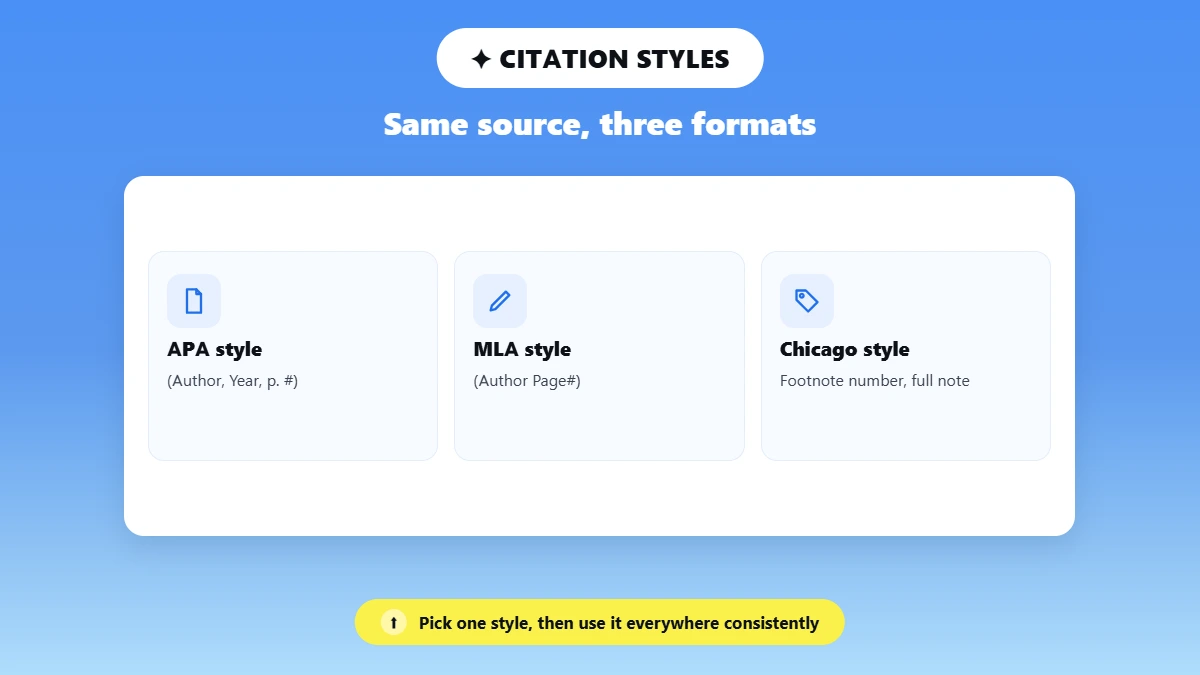
APA style uses the author and year, MLA style uses the author and page number, and Chicago style uses footnotes or an author-date format. Any of them works as a citation style for avoiding plagiarism, as long as you credit every source and use the style consistently.
So what citation style should you use for your essay? The one your instructor names. If none is given, ask, because switching later means redoing every citation.
📌 Ideas need credit too, not just quotes. The University of South Florida’s guide on when to cite lists borrowed ideas, opinions, and statistics alongside direct quotations.
Same Source, Three In-Text Formats
Here is the Okafor quote from page 45 in each style. The APA version shows a typical APA citation to avoid plagiarism with a direct quote:
Style | In-text citation format | Example |
|---|---|---|
APA (7th edition) | (Author, Year, p. #) | (Okafor, 2024, p. 45) |
MLA (9th edition) | (Author Page#) | (Okafor 45) |
Chicago notes-bibliography (18th edition) | Superscript number with a footnote | Text¹, with the note: 1. Daniel Okafor, "Screen Time and Sleep in First-Year College Students," Journal of Campus Health 12, no. 3 (2024): 45. |
Chicago author-date (18th edition) | (Author Year, Page#) | (Okafor 2024, 45) |
Notice how the same citation changes shape. APA adds the year with commas and “p.” before the page. MLA drops the year and the commas. Chicago author-date keeps the year but drops “p.”, and the notes version moves everything into a footnote.
💡 Chicago’s two versions look very different, so check which one your course uses. For full APA rules, see the Purdue OWL APA guide.
Build a Reference List, Works Cited Page, or Bibliography
Every in-text citation needs a matching full entry at the end of your paper: a reference list in APA, a works cited page in MLA, or a bibliography in Chicago. A mismatched name or year makes a citation look invented. Here are citing sources examples for the same article:
Style | Full entry |
|---|---|
APA reference list | Okafor, D. (2024). Screen time and sleep in first-year college students. Journal of Campus Health, 12(3), 41-58. |
MLA works cited page | Okafor, Daniel. "Screen Time and Sleep in First-Year College Students." Journal of Campus Health, vol. 12, no. 3, 2024, pp. 41-58. |
Chicago bibliography | Okafor, Daniel. "Screen Time and Sleep in First-Year College Students." Journal of Campus Health 12, no. 3 (2024): 41-58. |
Formatting Your Reference List or Works Cited Page
Required Elements: author, title, publisher or journal, and date in every style, plus the DOI in APA when the source has one.
Order and Indent: list entries alphabetically by last name with a hanging indent. Rules for details like two works by one author differ slightly, so check your style manual.
Footnotes and Endnotes: in Chicago, use a full note first, then a short one: 2. Okafor, “Screen Time and Sleep,” 45.
Citing Electronic and Online Sources
An electronic source citation adds the URL, shown here for a fictional web page:
APA: Lee, H. (2025, March 3). How much sleep do college students need? Campus Wellness Hub. https://www.example.edu/sleep-guide
MLA: Lee, Hana. “How Much Sleep Do College Students Need?” Campus Wellness Hub, 3 Mar. 2025, www.example.edu/sleep-guide.
Chicago: Lee, Hana. “How Much Sleep Do College Students Need?” Campus Wellness Hub, March 3, 2025. https://www.example.edu/sleep-guide.
You rarely need a retrieval date. APA asks for one only for unarchived pages designed to change, and MLA treats it as optional, though it helps when a page shows no date.
Citing Images, Data, Videos, and Social Posts
Non-text sources need citations too. They follow the same idea as any source: creator, date, title, and where you found it. Here are the APA and MLA patterns:
Source | APA | MLA |
|---|---|---|
Image | Creator. (Year). Title [Photograph]. Site. URL | Creator. Title. Year. Site, URL. |
Dataset | Author. (Year). Title [Data set]. Publisher. URL | Author. Title. Publisher, Year, URL. |
YouTube video | Channel. (Year, Month Day). Title [Video]. YouTube. URL | “Title.” YouTube, uploaded by Channel, Day Mon. Year, URL. |
Social media post | Name [@handle]. (Year, Month Day). First 20 words of the post [Type of post]. Platform. URL | Name [@handle]. “Text of the post.” Platform, Day Mon. Year, URL. |
If a video’s creator differs from the channel that uploaded it, MLA puts the creator’s name first.
Follow 5 Ways to Avoid Plagiarism When Paraphrasing and Writing Essays
Rewording a sentence is not enough: change the structure and still cite the source. These 5 ways to avoid plagiarism cover how to avoid plagiarism in essay writing from start to finish:
Log Sources as You Research: never rely on memory.
Quote Before You Paraphrase: copy the exact words first, then rewrite from understanding.
Cite Quotes and Paraphrases: both need credit.
Match Your Lists: every in-text citation needs an entry at the end.
Check Before You Submit: a final scan catches what rereading misses.
Not meaning to copy does not always protect you. The University of Virginia’s honor resource notes that careless note-taking can produce plagiarism even when a student does not intend it.
For more, see 10 proven strategies to prevent plagiarism.
Quick Checklist for Paraphrasing Without Plagiarizing
What’s the easiest way to tell if your paraphrase still counts as plagiarism? Put it next to the original. If the sentence order and key words match, it is too close. Here is how to avoid plagiarism when paraphrasing:
✅ Before you keep a paraphrase:
Read the original, close it, and write the idea from memory.
Compare your version with the original for leftover phrases or sentence structure.
Add a citation even if you changed every word, because the idea still belongs to the original author.
Run the draft through a plagiarism checker, since self-review misses partial matches.
Not Sure a Paraphrase Is Far Enough From the Source?
Scan your draft and see which sentences still match the original.
What Counts as Common Knowledge, and When Should You Still Cite?
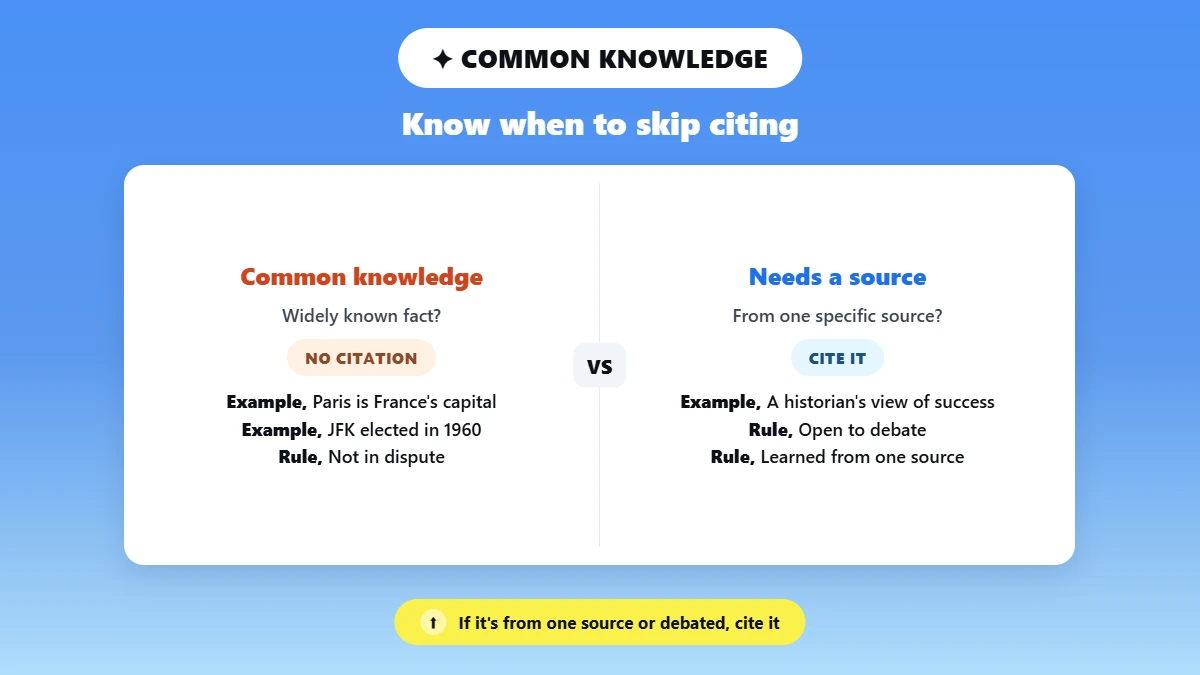
Common knowledge is a fact that is widely known, found in many general sources, and not in dispute, so it needs no citation. “Paris is the capital of France” is common knowledge. Anything you learned from one specific source, or anything open to debate, needs a citation.
No citation needed | Citation needed |
|---|---|
John F. Kennedy was elected president in 1960. | A historian's view of how successful his presidency was. |
Water boils at 100°C at sea level. | A lab study on how boiling points change under specific conditions. |
A major storm hit a region last year. | The damage figures from a specific news report. |
The Kennedy example comes from the USF library guide. Rule of thumb: if you learned it from one source rather than “everywhere,” cite it, and if you are unsure, cite it anyway.
Treating a specific claim as common knowledge is an easy way to slip into plagiarism. Getting this call right is a basic part of academic integrity.
How to Cite Sources When You Use AI Tools
If you use text, ideas, or summaries from an AI tool, cite or disclose it as you would a human source. That is how to avoid plagiarism when using AI: put quoted AI text in quotation marks with a citation, and disclose AI ideas you rewrote. Many instructors treat undisclosed AI use as academic dishonesty, so check your course policy first.
APA, for AI text or ideas you used: since a September 2025 update, cite the specific chat with its share link: OpenAI. (2026, October 20). Sleep habits of first-year students [Generative AI chat]. ChatGPT. https://chatgpt.com/share/... In-text: (OpenAI, 2026).
APA, for editing help only: if AI only edited or polished your own writing, cite the tool in general instead of each chat: OpenAI. (2025). ChatGPT [Large language model]. https://chatgpt.com/
MLA: the MLA Style Center uses your prompt as the title: “Explain why students sleep less” prompt. ChatGPT, OpenAI, 20 Oct. 2026.
Chicago: use a footnote with the tool, developer, and date, usually not a bibliography entry.
You can adapt this disclosure line: “I used ChatGPT (OpenAI) on October 20, 2026, to brainstorm my outline, then wrote and revised the essay myself.”
Treat AI Output Like Any Other Source
Ask One Question: would you cite a human for this sentence? If yes, cite the AI.
Treat It as a Secondary Source: AI output summarizes other work, so cite the original studies when you can.
Verify and Save: check every source AI gives you, and keep a screenshot or chat link as proof.
Turnitin found that about 11% of the 200+ million papers it reviewed contained at least 20% AI writing.
With AI use this common, many students wonder: does it count as plagiarism? Our guide on whether using AI is plagiarism breaks it down.
Know the Types of Plagiarism, Including Self-Plagiarism
Most types of plagiarism share one root cause: a missing or incomplete citation, not necessarily dishonest intent. Knowing the main ones shows you which mistake you are closest to making:
Direct Plagiarism: copying text word for word without quotation marks or a citation.
Mosaic Plagiarism: mixing copied phrases with your own words, usually from weak paraphrasing.
Accidental Plagiarism: leaving out a citation because of messy notes or a rushed draft, not because you meant to copy.
Self-Plagiarism: reusing your own past work without permission or disclosure, which many schools still count as a violation.
For the full list with examples, see the 12 types of plagiarism.
Problems with written work are common. In Don McCabe’s surveys from 2002 to 2015, 62% of undergraduates admitted to cheating on written assignments at least once.
What happens if you accidentally plagiarize something in your paper? It depends on your school’s academic integrity policy.
📍 Some schools handle honest mistakes with a warning or a lower grade, while others send cases to a formal review, as the University of Virginia does with its honor panels.
Run a Plagiarism Check Before You Submit
Knowing how to cite sources to avoid plagiarism lowers your risk, but a final scan catches the slips you cannot see. A missing quotation mark or a paraphrase that drifted back toward the source is easy to miss on your fifth reread.
So are there tools that can check your writing for plagiarism before you submit it? Yes. Most plagiarism checker tools compare your text with web pages and academic sources and highlight matches. A score alone does not explain why a passage was flagged, though, so read each match.
📢 If your school checks submissions with Turnitin, read our guide on how to check plagiarism in Turnitin to see how submissions and similarity reports work.
Many students run a check as a final safety net. It works best that way: a checker backs up your citation work, it does not replace it.
Why a Checker Still Matters After Careful Citation
Formatting Slips: a quote with a citation but no quotation marks.
Close Paraphrases: rewrites that still follow the source’s structure.
Timing: a last check while there is still time to fix things.
Phrasly’s plagiarism checker shows your similarity score on the first scan with no signup. A free account opens that report’s highlighted matches and source links, so you can see which sentences need a fix.
Learn how to read your plagiarism report before you edit.
🔍 Ready for a Final Check?
Scan your finished draft and fix any uncited matches before you submit.
FAQs
How Do You Cite Sources to Avoid Plagiarism?
Track every source while you research, then decide whether to quote, paraphrase, or summarize it. Add an in-text citation in APA, MLA, or Chicago style for each borrowed idea, and build a matching reference list at the end. A plagiarism check before you submit catches anything you missed.
Why Is It Important to Cite Sources to Avoid Plagiarism?
Citing gives credit to the original author, lets readers check your claims, and protects your academic and professional reputation. Schools and journals treat uncited material as a breach of honesty, not a formatting error, so it can lead to a failing grade, a formal review, or a retraction of published work.
Is Paraphrasing Without Citing Still Plagiarism?
Yes, because the idea still belongs to the original author even if you changed every word. Only common knowledge and your own original analysis can go uncited. Even a careful paraphrase can get flagged, so as a student, you should run your draft through one of these free plagiarism checker options and fix any missing citations before you submit.
What Is the Best Way to Cite Sources to Avoid Plagiarism?
Use the style your assignment requires, format every source the same way, and keep a running list of references from day one. Then run a plagiarism check as a final safeguard, not a replacement for citing, and learn how to read your plagiarism report to fix what it finds.
How Do You Cite a Direct Quote vs a Paraphrase?
A direct quote needs quotation marks and a page or paragraph number, such as (Okafor, 2024, p. 45) in APA. A paraphrase needs an in-text citation but no quotation marks, and both need a full entry in your reference list. Cited quotes can still show up in a scan, so see why plagiarism checkers flag quotes.
Written by
Hasnain
Karachi, Pakistan
I help businesses grow with SEO-friendly blog posts, landing pages, and long-form content. With 3+ years of experience, I deliver clear, original, and well-researched writing that drives results.