Is Paraphrasing Plagiarism? When It Is and Isn't (2026)
10 min read
Is paraphrasing plagiarism? No, paraphrasing by itself is standard, even taught as a valuable academic exercise.
Paraphrasing only becomes plagiarism in three situations: failing to cite the source, keeping the wording/structure too similar to the original (referred to as patchwriting), or reusing your own previously submitted work without disclosure.
A correct paraphrase has the idea in your own words, your own sentence structure, and a citation.
This guide is written for students, graduate researchers, and writers who repeatedly find themselves asking. Is paraphrasing considered plagiarism?
Is paraphrasing plagiarism? It provides a definition in plain English, a comparison table, worked before-and-after examples, and a section answering the question we're all Googleing in 2026.
Does paraphrasing with ChatGPT (or any AI writing tool) count as plagiarism?
🔍 Not sure if your paraphrase is too close to the source? You can check it in seconds with Phrasly's free Plagiarism Checker.
Paraphrasing Vs Plagiarism: What's the Difference?
What is paraphrasing plagiarism mean, literally? Let's first differentiate the two concepts. Literally, what is plagiarism and paraphrasing?
To paraphrase someone is to put their idea into your own words and sentence structure, but you still give the source a citation.
When you plagiarize, you use someone else's words or ideas without giving credit, whether by directly copying a sentence, slightly modifying a sentence, or stealing someone's idea.
The paraphrasing plagiarism definition used by nearly every university writing center comes down to this. Did you do the intellectual work of rewording the idea, and did you credit the reader with where you got the idea?
The difference between paraphrasing and plagiarism isn't about how many words you changed. It's about two things happening together: genuine rewording and citation.
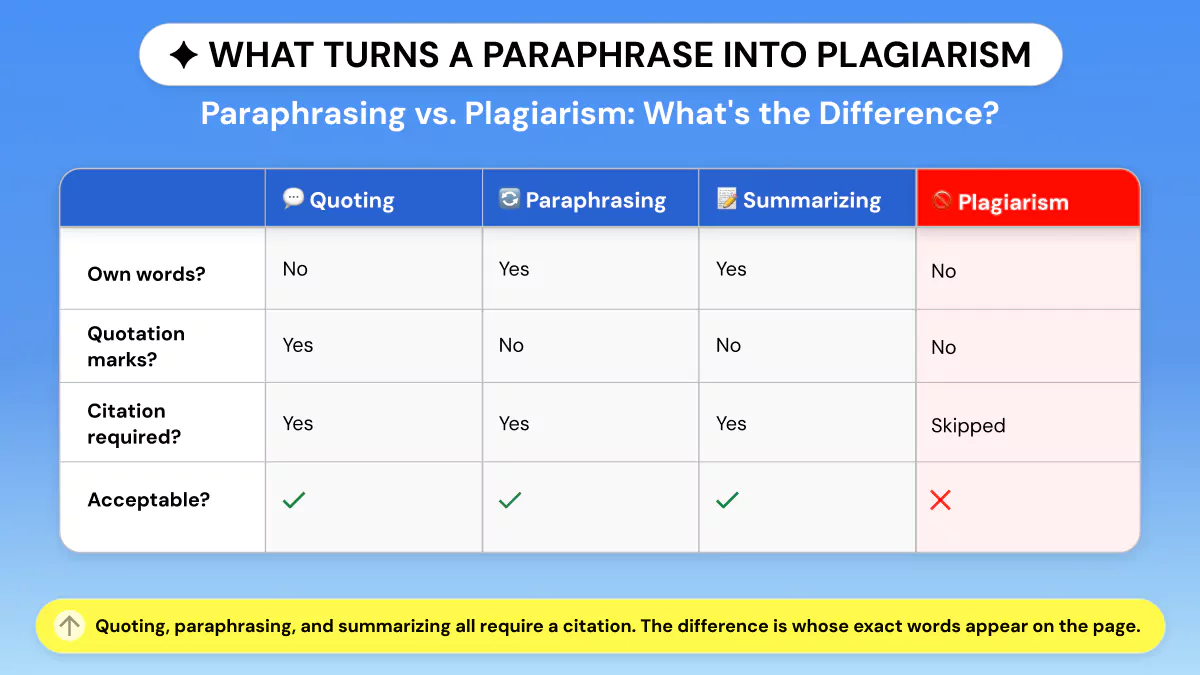
Miss either one, and what looked like paraphrasing slides into plagiarism. The table below breaks this down against quoting and summarizing. The other two legitimate ways writers use a source.
| Quoting | Paraphrasing | Summarizing | Plagiarism |
Own words? | No (exact source words) | Yes | Yes (condensed) | No |
Quotation marks? | Yes | No | No | No |
Citation required? | Yes | Yes | Yes | No (that's the problem) |
Acceptable? | ✅ Yes | ✅ Yes | ✅ Yes | ❌ No |
So, Is Paraphrasing Plagiarism? (The 3 Cases When It Is)
The quick answer to 'is paraphrasing plagiarism' is: usually not, but is paraphrasing a form of plagiarism? it can be. However, there are only three scenarios when this happens.
Colleges, writing centers, and Turnitin view all three equally.
Case 1- No Citation: If you rewrite another person's thoughts without giving them credit, it is plagiarism even if you change every word. That is why paraphrasing is plagiarism if the source does not appear on the page.
You are still using someone else's idea, even if not one word of their original word remains.
Case 2 - Too Close (Patchwriting): Simply replacing a few words with synonyms without changing the original sentence structure constitutes plagiarism despite providing a citation.
This practice is referred to as patchwriting and is explained further below.
Case 3 - Self-Plagiarism: Reusing your own previously submitted or published work without disclosure counts too. Paraphrasing is still plagiarism even when you're paraphrasing yourself? See the dedicated section further down.
As this framework is based on three cases, it corresponds with similar guidance from university library pages and Turnitin's academic-integrity partner pages.
Therefore, this information still applies no matter your citation style or school.
If you've seen the same worry phrased a dozen ways across forums, it almost always traces back to one of these three cases. Most often patchwriting, not a missing citation.
Is paraphrasing plagiarism? Reddit threads are full of these.
Is It Plagiarism If You Paraphrase and Cite It?
Typically not! It is not plagiarism if you cite the source. If you've genuinely put the idea in your own words and added a citation, that's a legitimate paraphrase. Real paraphrasing and citing should be the standard that writers strive for.
So, is paraphrasing and citing plagiarism if both are done correctly? No! But citation alone doesn't rescue a paraphrase that stays too close to the original wording or structure. That's still plagiarism (patchwriting), citation or not.
This is the highest-anxiety question people search for. The person who did cite their source and is still worried. If that's you: is it plagiarism if you reference the source but your sentence reads almost identically to the original?
Yes, that's patchwriting. The fix is structural, not just adding a footnote.
Common knowledge (something that most academics in your field know) does not need to be cited. A source's unique idea, fact, argument, or wording does.
Patchwriting and Insufficient Paraphrasing (The Gray Area)
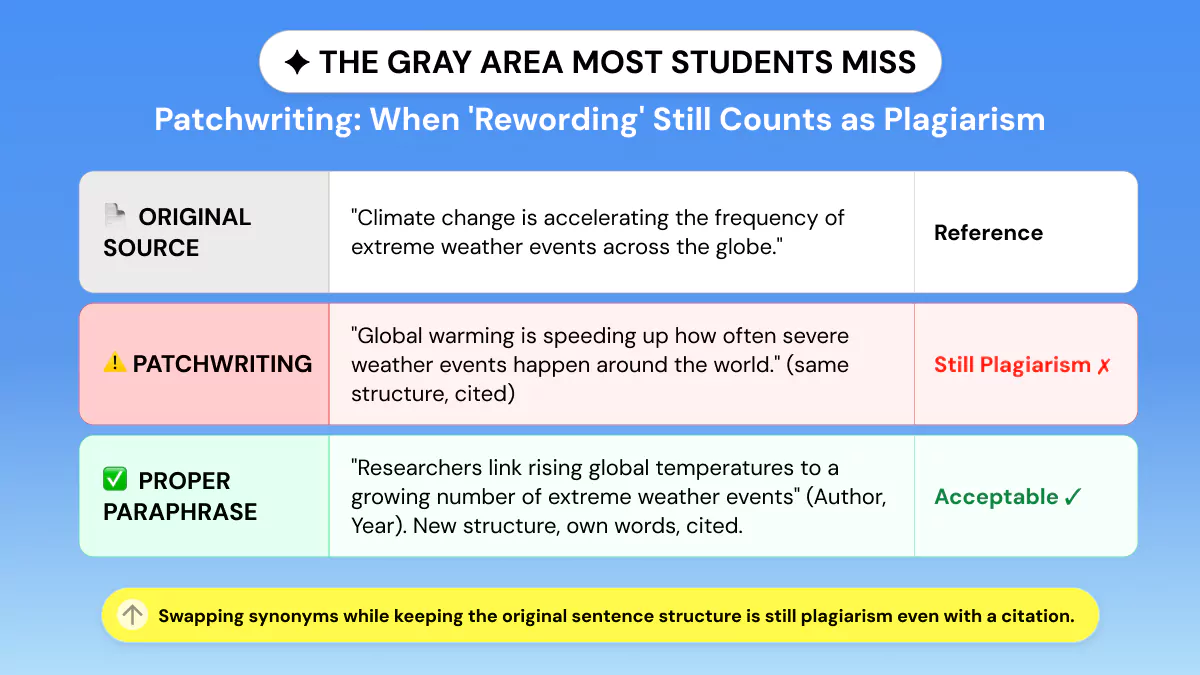
Insufficient paraphrasing is also called patchwriting or mosaic plagiarism. It happens when your rewritten sentence stays too close to the source's original wording or structure.
What is an insufficient paraphrase? It's a sentence where you've swapped in synonyms but kept the same skeleton. Same clause order, same sentence length, same logical flow as the original.
It's considered plagiarism even when you cite the source. Because the intellectual work of restating the idea never actually happened.
Worked Example: Original Vs. Patchwriting Vs. Proper Paraphrase
📄 Original: "Climate change is primarily driven by human activities, especially the burning of fossil fuels, which releases greenhouse gases into the atmosphere."
❌ Patchwriting - Still Plagiarism: "Climate change is mainly caused by human actions, particularly burning fossil fuels, which releases greenhouse gases into the air (Smith, 2023)."
Despite the citation, the sentence structure and clause order are nearly identical to the original.
✅ Proper Paraphrase - Acceptable: "According to Smith (2023), most of today's climate change traces back to people burning fossil fuels for energy. A process that pumps greenhouse gases into the atmosphere and traps heat."
New structure, own words, properly cited. If you want to test examples like this yourself, this review of the Quetext plagiarism checker looks at how well it distinguishes proper paraphrasing from patchwriting.
Signs Your Paraphrase Might Still Be Patchwriting
🚩 Your sentence follows the same order of ideas as the original, just with new synonyms.
🚩 You could line the two sentences up side by side and match them clause-for-clause.
🚩 You wrote it while looking directly at the source, not from memory.
🚩 A plagiarism checker flags it as "paraphrased" or "similar," even though no exact phrase matches.
🛠️ A plagiarism checker that catches paraphrased and mosaic similarity, not just exact-match copying, helps you spot patchwriting like this before you submit. For a deeper breakdown, see this full guide to incremental (mosaic) plagiarism.
Paraphrasing Plagiarism Examples
Here are three short, concrete paraphrasing plagiarism examples. Each is labeled clearly so you can see exactly where the line sits.
Example A: Reworded sentence, no citation at all. ❌ Plagiarism: The idea is borrowed and never credited, regardless of how original the new wording sounds.
Example B: Cited source, but the sentence structure mirrors the original almost line for line. ❌ Plagiarism (patchwriting): The citation is there, but the rewording isn't real.
Example C: Idea fully reworded in new sentence structure, source properly cited. ✅ Acceptable: This is what a genuine paraphrase looks like.
If you want to see how well different checkers catch examples like B (patchwriting) versus flagging genuinely acceptable paraphrases like C, this look at whether the Scribbr plagiarism checker is actually good is worth a read.
Is AI Paraphrasing Plagiarism? (ChatGPT, Paraphrasing Tools, Grammarly)
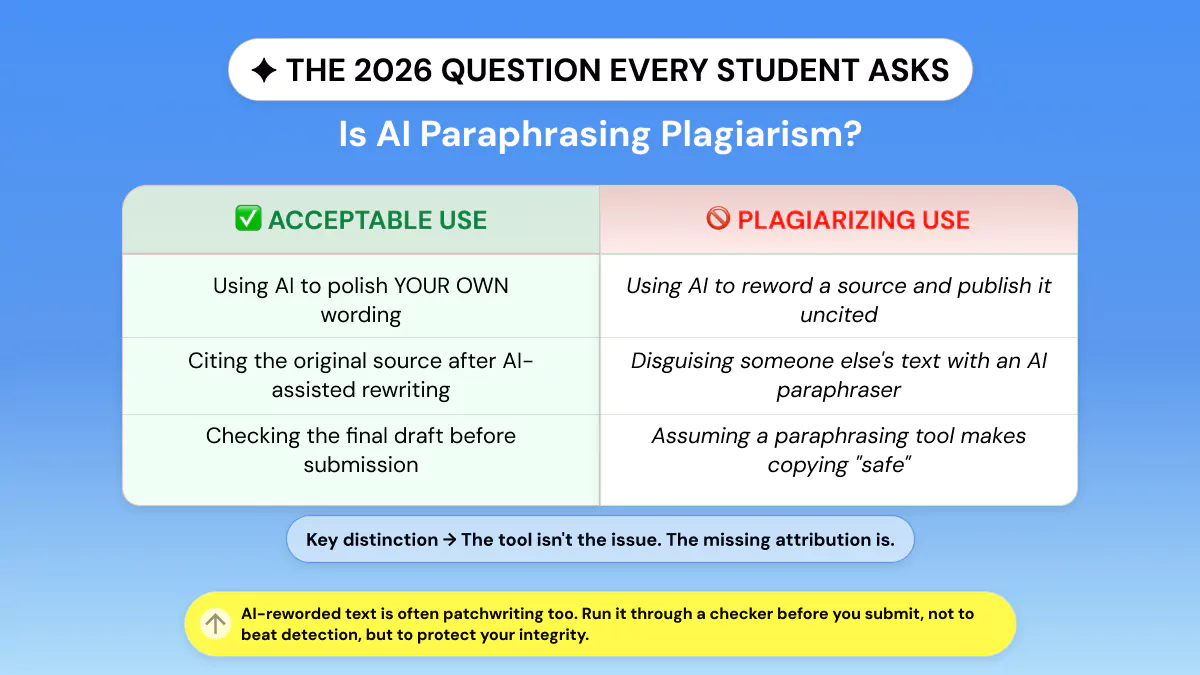
The Tool Isn't the Problem. It's the Attribution. If you input a source into ChatGPT, Claude, Gemini, or a paraphrasing tool and ask it to rewrite the source's ideas.
Then publish that output verbatim without citing the source, you have plagiarized the idea (not the AI's words). Additionally, AI-reworded text tends to create patchwriting via sentence structure.
It can also be caught by AI detectors even when it's not plagiarism. Two separate red flags with two separate fixes.
If you publish content online - blogs, landing pages, marketing copy it's worth knowing that SEO content plagiarism flags work differently than academic plagiarism checks and can affect your search rankings even when nothing was technically "stolen."
This is the reality in 2026. A significant portion of students now create paraphrases with AI assistance at some point in the drafting process.
According to RAND's American Youth Panel survey, the share of students using AI for homework rose from 48% to 62% between May and December 2025 alone.
For educators, an AI-rephrased source without proper citation is, without question, treated like any other unacknowledged paraphrase, amounting to plagiarism.
In addition, many institutions also maintain policies requiring disclosure of the use of AI per se. This is separate from the plagiarism rule mentioned above.
Is paraphrasing ChatGPT plagiarism? Only if the source is not cited, it does not matter if a human or ChatGPT did the paraphrasing.
Is paraphrasing tool plagiarism? Same logic applies. A dedicated paraphrasing tool is just a faster synonym-and-structure engine. It inherits whichever rule applied to the sentence before you ran it through the tool.
And is paraphrasing using AI plagiarism when the source is properly cited and genuinely restructured? No! The process is the same as paraphrasing by hand, just faster.
Grammarly, QuillBot, and Where They Fit
If you use Grammarly, is it plagiarism? When you're editing your own work with it, that is using it to correct your already-written wording.
It is not plagiarism. Grammarly becomes unethical when you copy/paste someone else's work into it (or QuillBot, etc.) and turn in that prettified work as your own without citation.
Same tool, completely different results depending on whose words you begin with.
These tools aren't going anywhere either. Separate research from the Higher Education Policy Institute found that 88% of university students used generative AI tools for assessments in 2025, up from just 53% the year before.
This makes knowing this distinction more important than ever.
✔️ Paste any AI-paraphrased text into Phrasly's free Plagiarism Checker (detects copied and paraphrase matches) and AI Detector before you submit.
If you want to see how another popular option stacks up, this review of the Unicheck plagiarism checker covers its features and accuracy.
Consider this safeguarding your academic integrity 🔒 rather than trying to outsmart the detectors.
Is Paraphrasing Your Own Work Plagiarism?
Yes, that is possible.
Is paraphrasing my own work plagiarism? Rewriting a paper, chapter of a thesis, or article that you've already submitted or published, then turning in or publishing it again without noting where the content overlaps or without permission, is self-plagiarism.
Journals and universities both take this seriously. It can misrepresent how much new work actually exists. Always check your specific institution's or publisher's policy on reusing your own material.
The rules on self-plagiarism vary more than the rules on citing other people's work.
How to Paraphrase Without Plagiarizing?
How to paraphrase without plagiarizing comes down to a five-step process most writing centers teach the same way:
Read and fully understand the source passage.
Set the source aside. Don't look at it while you write.
Write the idea from memory, in your own words and your own sentence structure.
Compare your version to the original to confirm it isn't too close. No shared structure, no synonym-swapping.
Add the citation, then verify with a checker.
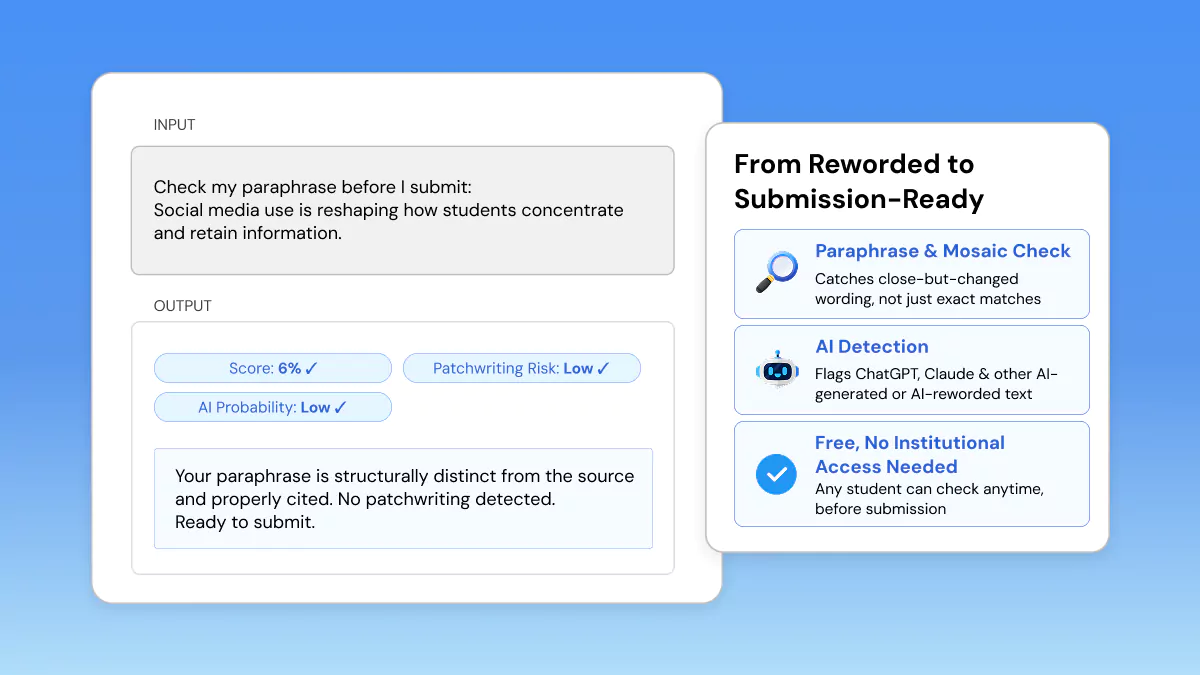
Before you submit, run the final version through Phrasly's Plagiarism Checker to catch any patchwriting or mosaic matches you might have missed.
If you're weighing which tool to trust, this guide to the best plagiarism checkers compares the top options for catching paraphrased and mosaic similarity, not just exact copying. Double-check your citation is properly formatted.
If you're using AI only to help draft, not to replace your own rewording, Phrasly's AI Paragraph Rewriter can help, paired with the same rule. Always cite and always check. Own your academic integrity. 👊
FAQ
Is paraphrasing plagiarism if you cite it?
No! As long as you wrote it yourself. If you have the citation, but it's still phrased too similarly to the original (patchwriting), then yes, it is. Is paraphrasing plagiarism if you cite it comes down to that structural test, not the citation alone.
Is using a paraphrasing tool plagiarism?
Not by itself. It turns into plagiarism when you use it to paraphrase an uncited source and publish the outcome as your own concept.
Is ChatGPT paraphrasing plagiarism?
If the source stays uncited, yes. The AI tool doesn't change the underlying rule.
If you use Grammarly, is it plagiarism?
Polishing your own words, no. Disguising someone else's text as your own, yes.
Is paraphrasing your own work plagiarism?
It can be. This is self-plagiarism. Reusing previously submitted or published work without disclosure.
Will Turnitin detect paraphrasing?
Yes! Turnitin can flag close paraphrasing and patchwriting, not just exact copying. This is exactly why a paraphrase-similarity check before submission is worth the two minutes.
If you're drafting in Google Docs, this guide on how to check for plagiarism in Google Docs walks through checking your work without leaving the doc.
Is plagiarism illegal?
Usually it's an academic or ethical violation rather than a legal one. Though it can cross into copyright infringement in rare cases. This is a narrow, separate issue from academic plagiarism.
For a fuller picture of what's actually at stake - academic, professional, and legal see this breakdown of the consequences of plagiarism.

Written by
Muhammad Usman Ali
Pakistan
Muhammad Usman Ali is an experienced SEO content writer with 3+ years of professional writing experience. He specializes in AI tools, AI detection technologies, and search engine optimized content.