15 Best Turnitin Alternatives: Free and Paid (2026)
Turnitin only sells to institutions, so students need another way to check their work. These are the 15 best Turnitin alternatives for 2026, compared by accuracy, AI detection, price, and best use case.
Turnitin is the standard plagiarism checker in higher education. Its media kit reports 16,000+ institutions across 185+ countries, and for two decades it has set the benchmark for originality checking.
The problem is access. Turnitin sells to institutions, not individuals, so a student cannot buy a personal account to check work before submitting.
Many people also now want a plagiarism checker with AI detection in 2026, since instructors screen for ChatGPT, Gemini, and Claude text too. Turnitin added AI detection later, and it remains imperfect at it.
That is where alternatives help. This guide covers 15 Turnitin alternatives, free and paid, compared by accuracy, AI detection, pricing, and best use case, so you can pick the right tool for your situation.
Don't have Access to Turnitin? Check Your Work for Submission Here 👇
What Makes a Good Turnitin Alternative in 2026?
A good Turnitin alternative in 2026 catches paraphrased plagiarism, includes or pairs cleanly with AI detection, scans scholarly sources as well as the open web, gives individuals direct access, and stays affordable.
Those five traits separate a usable tool from one that only looks the part, and there is a quiet sixth that most roundups skip.
- Detection accuracy. It should catch paraphrased and incremental plagiarism, not only word-for-word matches. A tool that misses reworded text gives a false sense of safety.
- AI content detection. Many students now want a plagiarism checker that detects AI writing in the same pass. A 2026-ready tool either includes AI detection or pairs cleanly with a dedicated detector.
- Database depth. There is a real difference between a tool that scans only the open web and one that also checks scholarly journals and archived pages. Turnitin's own comparison settings cover student repositories, institutional repositories, current and archived internet pages, and periodicals, which is why depth matters.
- Individual access. A student should be able to sign up directly without an institutional account. This is the single biggest gap Turnitin leaves open.
- Pricing. A free tier, a per-check option, or an affordable subscription keeps the tool usable on a student budget.
The sixth trait is privacy. A pre-submission tool should state clearly whether it stores your upload in a shared database, because your own draft should never create a future self-match against you.
Quick Comparison Table: All 15 Tools at a Glance
The 15 tools below range from free AI detectors to paid academic checkers, sorted by free access, AI detection, ideal user, price, and a one-line verdict.
Use it to shortlist two or three tools, then read the full reviews for the similarity score behavior and the trade-offs.
15 Best Turnitin Alternatives in 2026
The 15 best Turnitin alternatives in 2026 are Phrasly, Scribbr, Copyleaks, Quetext, Grammarly, iThenticate, GPTZero, Winston AI, Originality.ai, Paperpal, Copyscape, DupliChecker, and PrePostSEO, with Unicheck and PlagScan now discontinued and listed only as legacy references.
Each tool below gets an honest read, including the parts that might make you skip it. No tool here is perfect, and the cons are there on purpose.
1. Phrasly: Plagiarism Checker, AI Detection, and Humanizer
Best for students and professionals who need plagiarism checking and want to fix AI flags in the same place.
Phrasly is an all-in-one writing suite that brings together a plagiarism checker, an AI detector, and an AI humanizer in one dashboard.
It is built for students, writers, and creators who draft with AI tools and want to verify and clean up their work before it goes anywhere.
The difference from Turnitin is access and scope. Phrasly is available to individual users with no institutional account, its plagiarism check scans more than 10 billion web pages and academic papers with source matching, and it states that documents are not stored or shared.
Turnitin detects, while Phrasly detects and then helps you revise.
Pros:
- Free AI detector covers up to 2,000 words per scan
- Plagiarism checking, AI detection, and humanizing live in one tool, so there is no jumping between platforms
- The Unlimited tier allows 20,000 plagiarism-check words per month
Cons:
- Full plagiarism checking sits on paid plans, so the free tier is centered on AI detection.
- Humanizer output on the Medium setting can still need a manual editing pass.
Pricing: Free AI detector; paid plans from $10.99/month billed annually.
Best for: Students using AI-assisted writing who want a plagiarism check and AI detection in one individual-access tool.
2. Scribbr: Closest University-Style Check
Best for students who want the most accurate pre-submission check for a thesis or dissertation.
Scribbr is a plagiarism checker built specifically for students, and it uses advanced detection technology similar to the software universities and publishers rely on. Its report now bundles a full plagiarism breakdown, an AI detector, an AI proofreader, and a self-plagiarism checker.
What sets it apart is how close its results sit to an institutional check, paired with a clear privacy stance. Scribbr says its self-plagiarism checker does not store your document in a public database, so your own draft will not boomerang back as a match later.
Pros:
- University-style detection that is one of the closest individual-access proxies available
- Documents are not stored in a public database, which protects a plagiarism checker for thesis 2026 workflow
- Supports multiple languages and common file types like DOC, DOCX, and PDF
Cons:
- Pay-per-check only, with no subscription and no permanent free tier
- The per-check cost adds up if you want to scan many drafts
Pricing: $19.95 for up to 7,500 words, $29.95 for 7,500 to 50,000 words, and $39.95 for 50,000+ words.
Best for: Students doing a final pre-submission check on a dissertation or thesis.
3. Copyleaks: Best AI and Plagiarism Combo
Best for students, educators, and institutions that need both checks in one report.
Copyleaks is a dual-function platform that handles plagiarism and AI detection together, built for the AI era rather than retrofitted into it. It serves individuals and institutions alike, with LMS integrations for Canvas, Moodle, and Blackboard.
The reach is the standout. Copyleaks supports plagiarism detection in 100+ languages and AI detection in 30+ languages, and its plans run both scans into a single report. That breadth makes it useful well beyond English-only coursework.
Pros:
- Plagiarism and AI detection arrive in one unified report
- Wide language coverage for both detection types
- LMS integrations make institutional rollout straightforward
Cons:
- The interface carries a slight learning curve compared with simpler tools
- Higher Pro tiers get expensive for an individual student
Pricing: Personal at $13.99/month annual or $16.99/month monthly with 1,200 unified credits; Pro at $74.99/month annual.
Best for: Anyone with AI-assisted writing who wants plagiarism and AI checked in the same workflow.
4. Quetext: Best Free Option for Students
Best for students who need a reliable free check without setting up a complex account.
Quetext is built around its DeepSearch technology, which does contextual matching rather than simple keyword lookups. It remains one of the most capable free-tier plagiarism checkers in 2026.
The free experience is the draw. Quetext now offers 1,000 words free with no signup, ColorGrade feedback that highlights matches inline, and a built-in citation assistant to help fix flagged passages. That is a genuinely useful plagiarism checker no subscription option for routine checks.
Pros:
- Generous 1,000-word free scan with no account required
- DeepSearch catches paraphrased content, not just verbatim copying
- ColorGrade highlights and citation help speed up fixes
Cons:
- AI detection is a separate paid add-on, not part of the plagiarism scan
- Longer essays must be split to fit the free word window
Pricing: Free tier as described; plagiarism checker from $9.99/month annual, with the AI detector priced separately from $7.99/month annual.
Best for: Students doing quick pre-submission spot checks on zero budget.
5. Grammarly: Best for an Integrated Writing Workflow
Best for students who want grammar help and plagiarism detection inside a tool they already use.
Grammarly is primarily a writing assistant, but its Pro plan adds plagiarism detection against billions of web pages and ProQuest academic databases. The check runs inside Grammarly's editor, browser extension, and Word add-in rather than as a separate destination.
The advantage is workflow. Grammarly surfaces originality issues while you write and edit.
Independent testing of Grammarly's plagiarism checker found it catches verbatim copying well but misses heavier paraphrasing and AI-written text, so treat it as a convenience layer rather than a final academic check.
Pros:
- Plagiarism checking happens in the same place you write and revise
- Works across Google Docs, Microsoft Word, and Chrome
- Grammar, clarity, and originality come in one subscription
Cons:
- No meaningful AI detection, so AI-generated text is not distinguished from copied text
- Plagiarism reports are locked behind Pro, while the free tier only hints that something was found
Pricing: Free for grammar; Pro at $12/member/month billed annually, $30 monthly, or $60 quarterly.
Best for: Students already paying for Grammarly who want plagiarism checking without a second tool.
6. iThenticate: Best for Researchers and Journal Submissions
Best for graduate researchers preparing manuscripts for journals, not for everyday essays.
iThenticate is Turnitin's professional manuscript product, and it is the industry standard for screening papers before peer review. It compares submissions against internet content and scholarly sources through partnerships such as Crossref.
The logic is simple. Most publishers run manuscripts through iThenticate anyway, so checking yours through the same system first is the closest thing to a guaranteed pre-screen.
Pros:
- Scholarly source coverage through Crossref and similar partnerships
- The recognized standard for journal manuscript screening
- Detailed similarity reports with source-level attribution
Cons:
- Per-document pricing is steep for routine student use
- AI writing detection is not available with individual credits
Pricing: $125 for one manuscript up to 25,000 words, or $300 for three manuscripts or one large manuscript up to 75,000 words.
Best for: PhD students and researchers prepping manuscripts for publication.
7. GPTZero: Best Standalone AI Detector
Best for students whose main worry is AI detection rather than traditional plagiarism.
GPTZero is a dedicated AI content detector founded by Princeton graduate Edward Tian, and it is widely used in classrooms to screen for ChatGPT, Claude, and Gemini text. It also offers plagiarism checking and writing-replay features, but AI detection stays its core strength.
Its method leans on perplexity and burstiness scoring to judge whether writing follows human or machine patterns, and the Writing Replay feature can reconstruct how a document was composed.
Pros:
- A capable free tier, with input up to 10,000 characters and a free plan covering up to 10,000 words per month for plagiarism
- Writing Replay helps show genuine human composition
- Trusted across schools and by educators for classroom screening
Cons:
- Not a full plagiarism checker, so it needs a separate tool alongside it
- False positives happen, and strong human writers are sometimes flagged
Pricing: Free limited tier; paid from roughly $10/month.
Best for: Students who want to confirm their AI-assisted writing will clear an instructor's AI check.
8. Winston AI: Best for Educators and Teams
Best for educators and institutions that need defensible, explainable AI reports.
Winston AI bundles AI detection, plagiarism checking, grammar review, document scans, and even image detection into one platform. Publishers, educators, and businesses use it to verify content authenticity.
Its strength is transparency. Winston AI provides sentence-level AI highlighting and clear probability scores, which makes its reports easier to defend in an academic integrity conversation than a single opaque percentage.
Pros:
- Sentence-level AI flags with confidence scores
- Multilingual AI detection across several languages
- PDF reports and team features suited to institutions
Cons:
- The free plan is a 14-day trial of 2,000 credits, not a permanent free tier
- The credit model adds up fast, since AI detection costs 1 credit per word and plagiarism costs 2 credits per word
Pricing: 14-day trial with 2,000 credits; paid plans from roughly $18/month.
Best for: Educators and administrators reviewing student work for AI content.
9. Originality.ai: Best for Content Teams
Best for marketing teams and SEO agencies checking large volumes for plagiarism and AI.
Originality.ai is built for publishers, agencies, and web teams rather than academic users. It rolls AI detection, plagiarism detection, readability, fact checking, grammar, URL scanning, and writing replay into one dashboard.
The standout feature is the URL scan. Most tools make you paste text, while Originality.ai can run detection directly from a published page, which suits content pipelines at scale.
Pros:
- Scan published URLs without copy-pasting text
- Fact-checking and readability sit alongside the core detectors
- Affordable monthly entry point for professional use
Cons:
- No free tier, so every scan carries a cost
- Built for content operations, not academic database coverage
Pricing: Pro at $12.95/month billed yearly or $14.95 monthly; education pricing runs about $0.01 per 100 words.
Best for: Content teams and SEO agencies verifying AI-assisted content in bulk.
10. Paperpal: Best Academic Writing Assistant
Best for researchers who want plagiarism checking bundled into full academic writing support.
Paperpal is an academic writing assistant from Cactus Communications, a company with deep roots in scholarly publishing. Its plagiarism checker is one piece of a wider platform that includes grammar correction, AI detection, citation tools, translation, and manuscript checks.
Because its suggestions draw on real academic manuscript edits rather than general writing, Paperpal tends to be stronger for non-native English speakers heading toward journals, which makes it a thoughtful plagiarism checker for thesis 2026 companion.
Pros:
- 10,000 plagiarism-check words per month on the Prime plan
- Tuned for research writing and journal readiness
- Citation management and manuscript tools built in
Cons:
- Plagiarism and AI detection run as separate checks, so two passes are needed
- Plagiarism recall trails dedicated academic engines like Scribbr
Pricing: Prime at $139/year, shown as about $11.58/month billed annually, with free registered users reported at 7,000 plagiarism words per month.
Best for: Graduate students and researchers preparing manuscripts.
11. Unicheck: Discontinued (Legacy)
Not recommended for new users in 2026.
Unicheck was once a popular LMS-integrated plagiarism platform trusted by over 1,100 institutions. Turnitin acquired it in 2020, and the official Turnitin page states the Unicheck service ended on January 1, 2025.
It is listed here only so that older roundups and recommendations make sense. There is no active individual sign-up, and existing workflows have been pointed toward Turnitin's own products.
Pros:
- Strong LMS integration during its active years
- Historically reliable similarity reports
Cons:
- The service is discontinued, so no new accounts are available
- No path to individual or institutional purchase in 2026
Pricing: No active pricing.
Best for: No one starting fresh. Treat it as a legacy reference only.
12. PlagScan: Discontinued (Legacy)
Not recommended for new users in 2026.
PlagScan was a cloud-based plagiarism checker known for adjustable sensitivity thresholds and academic database coverage.
It has since been absorbed into Turnitin's product family, and former PlagScan customers were transitioned to Turnitin Similarity.
Like Unicheck, it appears in this list for continuity with older guides rather than as a current option.
Pros:
- Useful sensitivity controls during its active period
- Mixed academic and web database coverage historically
Cons:
- Discontinued as a standalone product, with no new sign-ups
- No active standalone pricing remains
Pricing: No active pricing.
Best for: No new users. Reference only.
13. Copyscape: Best for Web Content and Bloggers
Best for bloggers and creators checking whether their web content has been copied.
Copyscape is a web-centric duplication checker that compares content against the live web. It is the recognized standard for spotting online scraping and republishing, and it is not designed for academic use.
It does one job extremely well: answering whether a piece has appeared elsewhere online. Its Copysentry service also monitors your site automatically and alerts you when new copies show up.
Pros:
- The standard for web content duplication checks
- Pay-as-you-go with no monthly commitment
- Copysentry watches your site and flags new copies
Cons:
- No access to academic paper databases, so it is unfit for coursework
- The free version only compares one URL against another
Pricing: Premium from 3 cents for the first 200 words, then 1 cent per additional 100 words.
Best for: Content creators, bloggers, and SEO teams checking web-facing pages.
14. DupliChecker: Best Zero-Signup Free Option
Best when you need a fast, free check and do not want to make an account.
DupliChecker is a bare-bones checker: paste your text, click, and read the result. No account, no signup, no card. It is the lowest-friction option on this list, which is why it shows up in so many late-night searches.
The friction is gone, but so is some accuracy. The convenience suits a quick paragraph check far more than a final originality decision.
Pros:
- No signup, no account, no cost for basic use
- Fast results for simple copy-paste plagiarism
- Supports several file formats, with scans reportedly up to 25,000 words per search
Cons:
- Accuracy is weak on paraphrased text, so it misses what stronger tools catch
- No AI detection, and not suitable for academic submission decisions
Pricing: Free; premium appears around $15/month or $10/month billed yearly, though real scan limits are worth confirming in the interface.
Best for: Quick spot checks only. Do not lean on it for a submission call.
15. PrePostSEO: Best Free Tool for Bulk SEO Checks
Best for content creators who want to quickly review many articles without paying much.
PrePostSEO is an SEO toolkit with a free plagiarism checker sitting alongside keyword tools, backlink checkers, and other utilities. The checker is aimed at web content rather than academic papers.
Its output is more useful than the most basic free tools, returning a percentage score with highlighted passages and source links, and it handles bulk checks better than most free options.
Pros:
- Percentage score with highlighted matches and source links
- Bulk checking suits agencies reviewing several articles
- Free basic scans with no account needed
Cons:
- Accuracy trails premium tools, especially on paraphrased content
- The ad-heavy interface is distracting, and the privacy policy is worth a read before uploading sensitive drafts
Pricing: Free with ads; Basic at $10/month for 5,000 words per submission, Standard at $20/month for 15,000 words, and Company at $45/month for 25,000 words.
Best for: SEO writers and agencies running routine bulk originality checks.
Can You Use These Tools Before a Turnitin Submission?
Yes. A pre-submission plagiarism check is the recommended use case for nearly every tool on this list. Running your draft through Scribbr, Phrasly, Quetext, Grammarly, Copyleaks, or Paperpal before you submit lets you fix flagged passages while you still can.
The closest proxy is Scribbr. It uses university-style detection technology, is designed for individual access, and states that documents are not stored in a public database. That last point matters more than it sounds, because if a tool quietly kept your draft, your own paper could later match itself.
The honest limit is the student paper vault. Most alternatives do not reach into the Turnitin student paper database. Turnitin's comparison settings can include its student paper repository and your institution's own repository, which is why a clean result on an open-web checker does not guarantee a clean institutional score.
Tools like Quetext, Phrasly, and Copyleaks scan the open web and academic journals, so they reduce risk without replicating the internal vault your school sees.
A practical pre-submission routine:
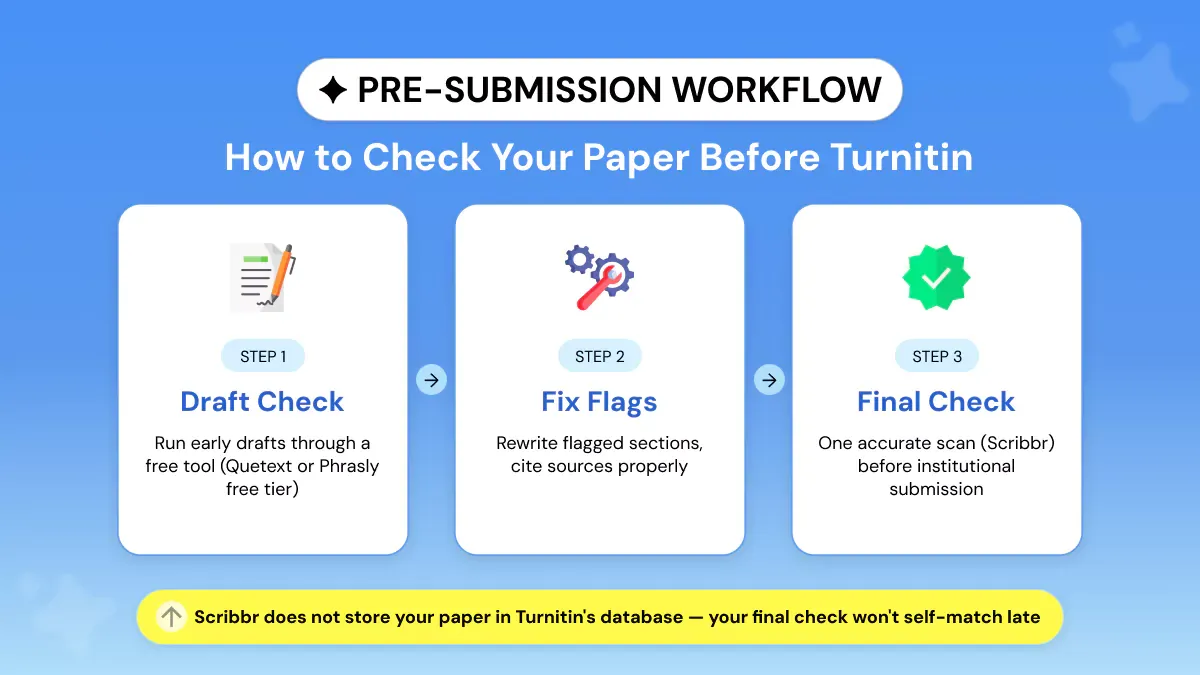
- Early drafts. Run a free tool such as Quetext or the Phrasly free tier, and if you write in Google Docs you can even check for plagiarism in Google Docs before exporting.
- Fix the flags. Revise the passages each tool highlights, then rescan to confirm the score dropped.
- Final check. Run Scribbr or iThenticate for high-stakes work right before submission.
A clean result elsewhere lowers your risk, but it is not the same as the report your institution will generate.
Is Turnitin Still Reliable for AI Detection in 2026?
Turnitin is still reliable for traditional plagiarism, and its AI detection is improving, but the AI score should be treated as one signal rather than proof.
What it does well. For traditional plagiarism, Turnitin's database remains the most comprehensive available.
It launched AI writing detection in 2023 and has kept refining the model, with a February 2026 update that it says improved recall while keeping a low false-positive rate, plus later 2026 updates that expanded Spanish-language detection.
Where it falls short. Turnitin is candid about the limits. It states that AI writing detection may not always be accurate and should not be the sole basis for any penalty, and it masks scores below 20% because false positives are more likely at the low end.
The safer setup. For AI specifically, dedicated tools tend to do better, which is why a purpose-built academic integrity checker AI workflow often pairs Turnitin with a separate detector. Copyleaks and GPTZero, both built for AI from the start, are common companions.
The safest approach in 2026 is to run a dedicated AI detector such as Phrasly, GPTZero, or Copyleaks alongside Turnitin, and to treat any AI percentage as input to a conversation about academic integrity, never as final evidence.
Best Turnitin Alternative by Use Case
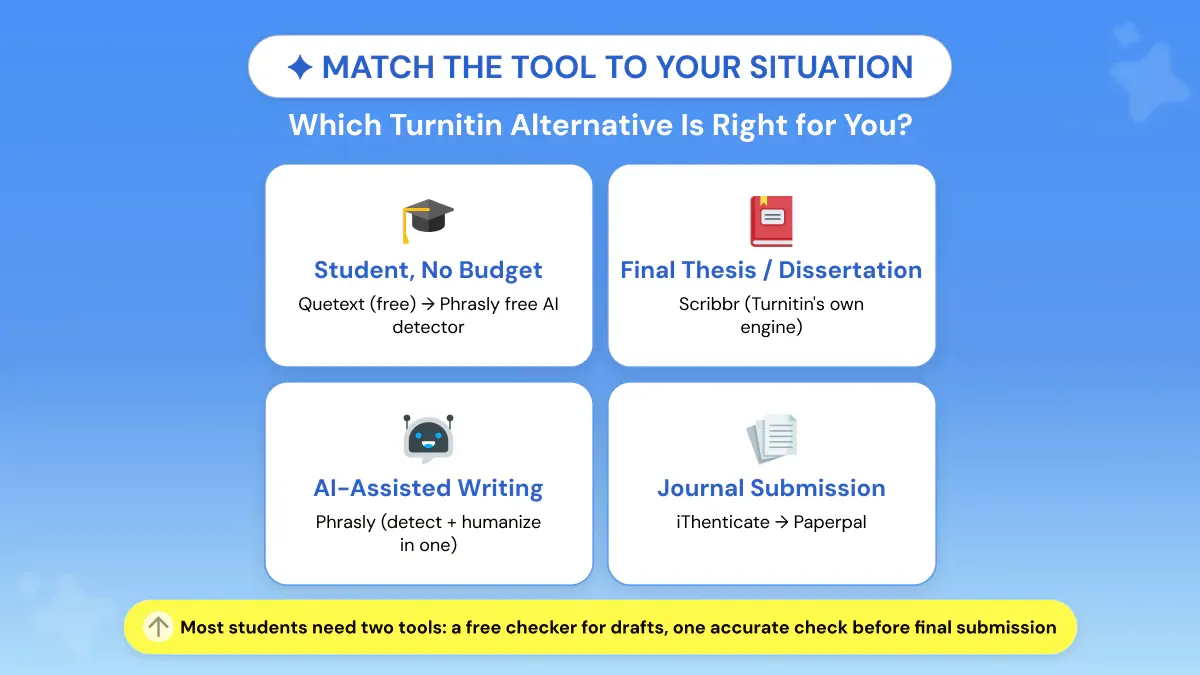
The best Turnitin alternative depends entirely on the job: Quetext or Phrasly for free student checks, Scribbr for a thesis, iThenticate for journal manuscripts, and Copyleaks for combined plagiarism and AI detection.
Here is a quick reference:
Match the tool to the job and you will spend less and catch more than a one-size-fits-all pick would manage.
How to Choose the Right Turnitin Alternative
The right Turnitin alternative comes down to four questions: what you need to detect, whether you need Turnitin's own database, your budget, and how much privacy matters.
Work through them in order and the list of 15 narrows to one fairly quickly.
Do you need plagiarism, AI detection, or both? For both in one place, Copyleaks or Phrasly handle it. For plagiarism only, Scribbr or Quetext do the job. For AI detection alone, GPTZero is the focused pick.
Do you need Turnitin's actual student paper database? No individual-access tool reaches into that vault. Scribbr is the closest university-style proxy for individuals, but it is a proxy, not an identical report. Plan around that gap rather than assuming a clean scan elsewhere is final.
What is your budget? For free, look at Quetext (1,000 words), GPTZero (limited), DupliChecker, and PrePostSEO. For low-cost subscriptions, Phrasly (from $10.99/mo annual), Copyleaks (from $13.99/mo annual), and Quetext Pro (from $9.99/mo annual) are reasonable. For per-check pricing, Scribbr (from $19.95) and Copyscape (from 3 cents per search) avoid a commitment.
Does privacy matter for this draft? Check whether the tool stores your upload in a shared database before you paste anything sensitive. Scribbr states it does not store documents in a public database, and Phrasly says documents are not stored or shared. Always read the privacy policy before uploading unpublished work.
FAQs
What Is the Best Free Turnitin Alternative for Students?
Phrasly is the strongest free starting point for students who draft with AI. Its free AI detector covers up to 2,000 words per scan with no signup, and the Phrasly plagiarism checker is open to individual users without an institutional account, scanning more than 10 billion web pages and academic papers.
Quetext is another reliable free pick, offering 1,000 words free with no signup, DeepSearch source matching, and citation help. Both work well as a free Turnitin alternative for students, though neither replaces Turnitin's institutional database.
Which Turnitin Alternative Is Most Accurate for Academic Papers?
Scribbr is the safest answer for individual students because it is built for academic plagiarism checking and uses university-style detection technology, with per-check pricing suited to long papers and theses.
Copyleaks is a strong second for combined plagiarism and AI coverage. For journal manuscripts specifically, iThenticate is stronger, though its $125 starting price makes it impractical for routine student essays. For another free checker students often try, see this test of PapersOwl's plagiarism checker.
Do These Alternatives Detect AI-Generated Content?
Some do. Phrasly, Copyleaks, GPTZero, Winston AI, Originality.ai, Paperpal, Grammarly, and Scribbr all now offer some form of AI detection or AI-writing workflow.
Quetext provides AI detection as a separate paid add-on. Copyscape, DupliChecker, and PrePostSEO focus on duplication and will not flag AI writing, and Unicheck and PlagScan are no longer active options in 2026.
Is Scribbr the Same as Turnitin?
Not exactly. Scribbr is a student-facing checker that uses university-style detection technology and has a historical Turnitin relationship, but it does not produce a guaranteed identical Turnitin report.
The accurate claim is that Scribbr is one of the closest individual-access options for a Turnitin-style pre-check, and it states that documents are not stored in a public database, which makes it safer for pre-submission use.
Can I Use One of These Tools Before Submitting to Turnitin?
Yes, and it is the recommended use case. Use Quetext, Phrasly, Grammarly, Copyleaks, or Paperpal for early-draft checks, then move to Scribbr or iThenticate for high-stakes academic work.
If your school grades through Blackboard, it also helps to know whether SafeAssign checks for plagiarism and what it misses. The key caveat is that most alternatives do not access Turnitin's student paper database, so a clean result elsewhere reduces your risk but does not guarantee the same institutional similarity score.


Keep reading

Copyleaks Plagiarism Checker: Tested, Rated & Compared
Copyleaks Plagiarism Checker review: we tested verbatim, minor-change, and paraphrased content to see how its 3-layer detection performs. See pricing, AI-detection accuracy (77%-96%), free plan limits, and how it compares to Phrasly in a head-to-head scan before you subscribe.
Does Canvas Have a Plagiarism Checker? What It Uses, How It Works & What Students Should Do
Canvas has no built-in plagiarism checker. It relies on instructor-enabled tools like Turnitin or Copyleaks. Learn how scanning actually works, whether Canvas detects AI writing (ChatGPT, Claude, Gemini), and how to check your paper for plagiarism and AI content before you submit.