How to Check Your Paper for AI and Plagiarism at the Same Time (Free)
22 min read
To check for plagiarism and AI free, paste your paper into a plagiarism checker and read the similarity score, then paste the same paper into an AI detector and read the AI score. Do both before you submit. If either score is high, revise the flagged sections before your professor or Turnitin sees them.
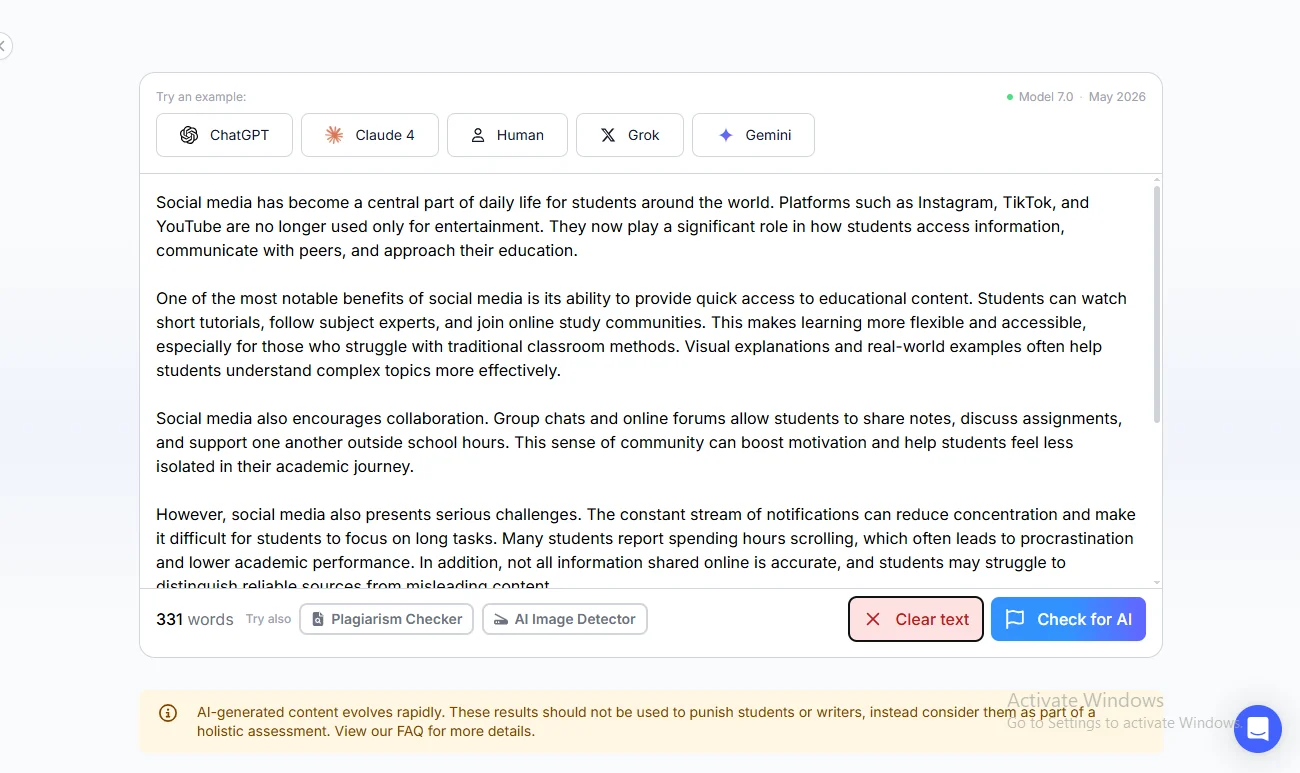
You need both checks because each one catches a different problem. In our October 26, 2026 test, the same 331-word essay scored 0% similarity (100% Original) in a plagiarism check and 100% AI in an AI check. One scan alone would have missed the problem.
Follow the steps below, with a screenshot at each stage, to see how you can run both checks in one sitting for free with Phrasly. You will also learn what each plagiarism and AI checker score means.
Check Your Paper With Free Plagiarism Checker 👇
Scan 50 to 5,000 words at a time. Your first scan needs no signup.
Plagiarism Check or AI Check: What Is the Difference?
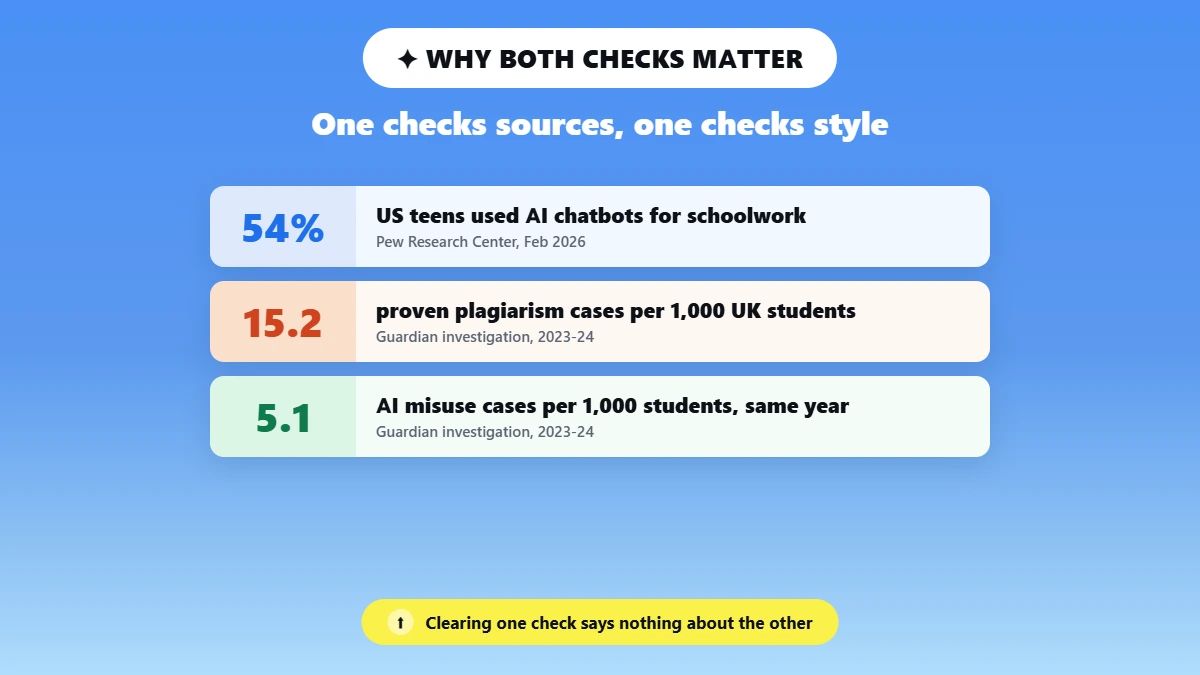
A plagiarism check compares your text with existing sources, while an AI check studies how your text is written for signs of machine generated text. One asks where the words came from. The other asks how the words were put together, and clearing one tells you nothing about the other.
Think of a plagiarism check as a fingerprint match against a database. An AI check works more like handwriting analysis: it looks at rhythm, word choice and sentence structure, not at where the words came from.
Both checks matter more now because AI tools are part of everyday schoolwork.
A Pew Research Center report published in February 2026 found that 54% of U.S. teens ages 13 to 17 have used AI chatbots for help with schoolwork, and about 1 in 10 say they do all or most of their schoolwork with that help.
📍 Copying is still part of the picture too. A 2025 Guardian investigation found that UK universities recorded 15.2 proven plagiarism cases per 1,000 students in 2023-24, about three times the 5.1 cases per 1,000 for AI misuse. That is why many instructors now run both checks to protect academic integrity.
What a Plagiarism Check Actually Looks For
Text Matching: The tool compares your paper with a database of web pages, publications and, for some tools, papers other students have submitted. Many tools also use paraphrase detection to catch reworded passages, not just exact copies.
A Similarity Score: You get a percentage showing how much of your text matches existing sources. It is a measure of overlap, not a verdict, since correctly cited quotes can raise it too.
No Style Judgment: It does not judge whether the writing sounds human or machine made.
What an AI Check Actually Looks For
Writing Patterns: It looks at sentence structure, word predictability and phrasing that differ from typical human writing.
A Likelihood Score: It returns a percentage or label estimating how much of the text appears machine generated, usually with the flagged sentences highlighted.
No Source Matching: It does not check whether the content was copied from somewhere else.
Why a Paper Can Pass One and Fail the Other
An original paper written by AI can score 0% on plagiarism and still get flagged as AI generated, because nothing in it was copied.
⚠️ A heavily paraphrased paper can do the reverse: it may read as human and still carry a high similarity score.
Our test essay shows the first case. An AI assistant wrote it on request, so no published source contained those sentences. Our Plagiarism Checker scored it 0% similarity, while our AI Detector scored it 100% AI.
💡 One check is not enough. A free plagiarism checker for students only tells you whether your words match the sources it searched. It says nothing about how your writing reads to an AI detector, and the reverse is also true.
How to Check Your Paper for Plagiarism and AI, Step by Step
To check for plagiarism and AI free, run your final paper through a plagiarism checker first, then paste the same text into an AI detector and read both reports before you submit.
Running both checks every time is the habit this guide is built around. Below, we walk through each step using our Plagiarism Checker and AI Detector.
Use the final version you plan to submit, not an early draft, so both results describe the paper your professor will see. Paste the exact same text into both tools, so the two reports stay comparable.
We ran one test essay through each tool once on October 26, 2026, so these results show what happened in our test, not how every paper will score.
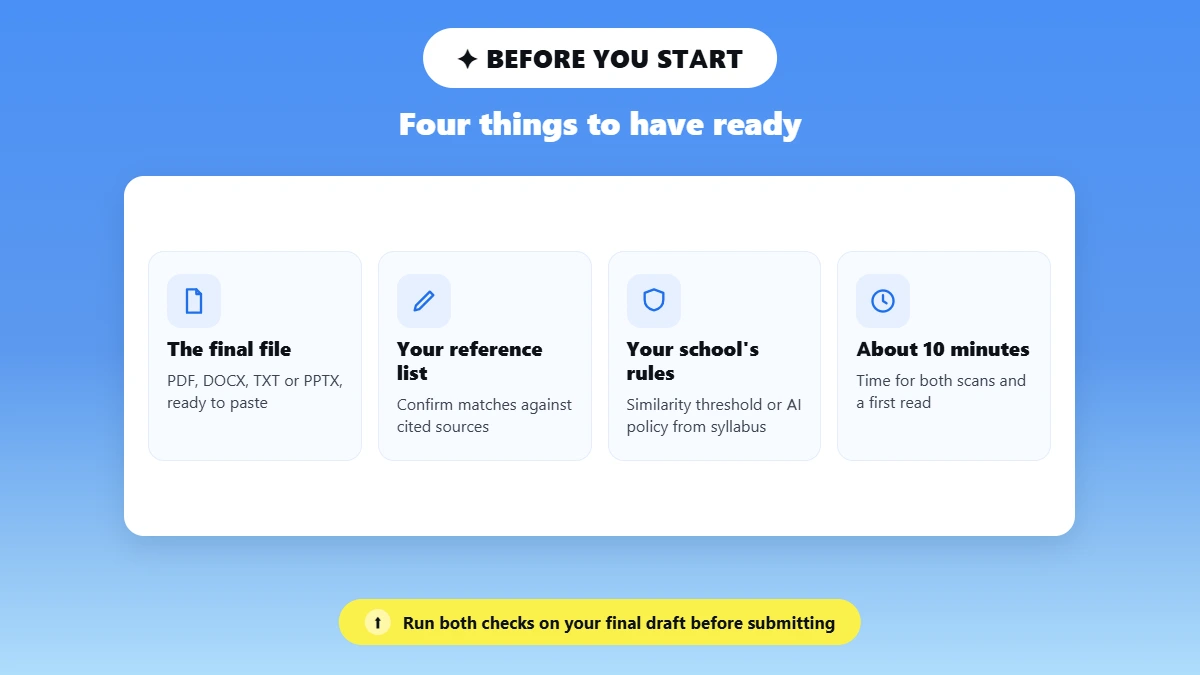
Before you start, have these ready:
The Final File: The exact version you will submit, as a PDF, DOCX, TXT or PPTX file, or as text you can paste.
Your Reference List: So you can quickly confirm whether a match is a cited source.
Your School's Rules: Any similarity threshold or AI policy from your syllabus.
About 10 Minutes: Both scans and a first read of the reports fit easily in that time.
Step 1: Paste or Upload Your Paper Into the Plagiarism Checker
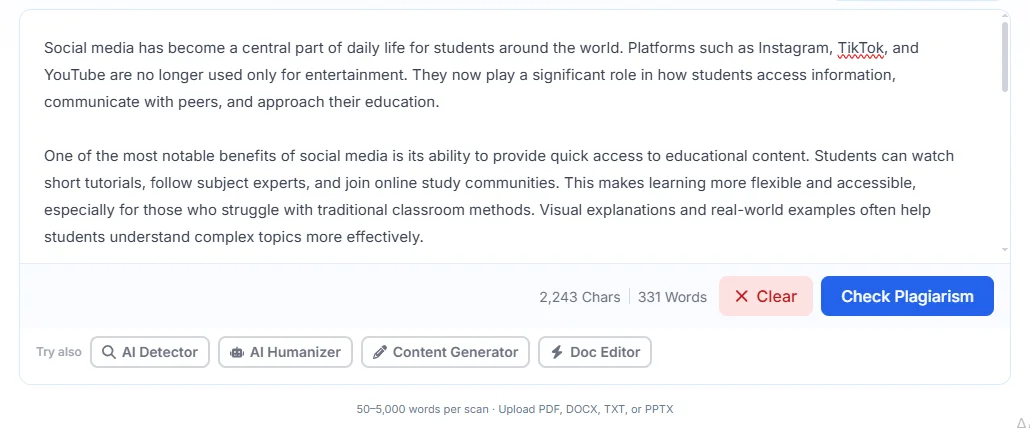
Open Phrasly's Plagiarism Checker and choose Text Input to paste your paper, or Upload to add a file. The tool accepts PDF, DOCX, TXT and PPTX files and checks 50 to 5,000 words per scan.
Your first scan needs no signup. Click Check Plagiarism to start.
Step 2: Read Your Similarity Score
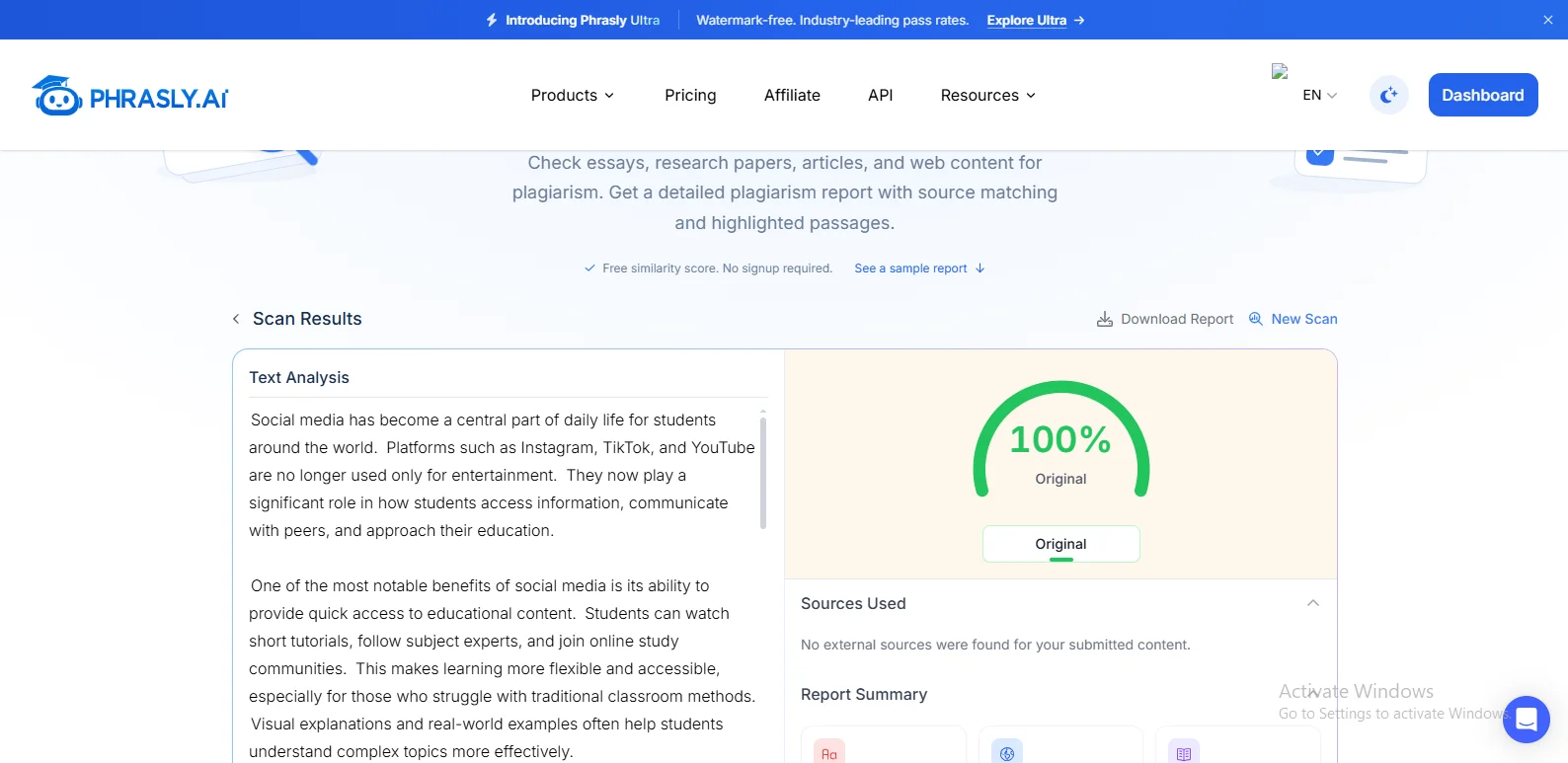
After the scan, you see your similarity score: the percentage of your text that matches existing sources. Our test essay scored 100% Original, meaning 0% similarity, and the report noted that no external sources were found.
A 0% score means nothing matched the sources the checker searched, which is the result you want before moving on.
If your score is above zero, look at what matched before you change anything.
Our guide on how to read a plagiarism report explains the overall number, the source list and each highlighted passage.
If the score looks high, you can lower a high similarity score before you submit by quoting, citing or rewriting the matched passages.
Step 3: Create a Free Account to See the Full Report
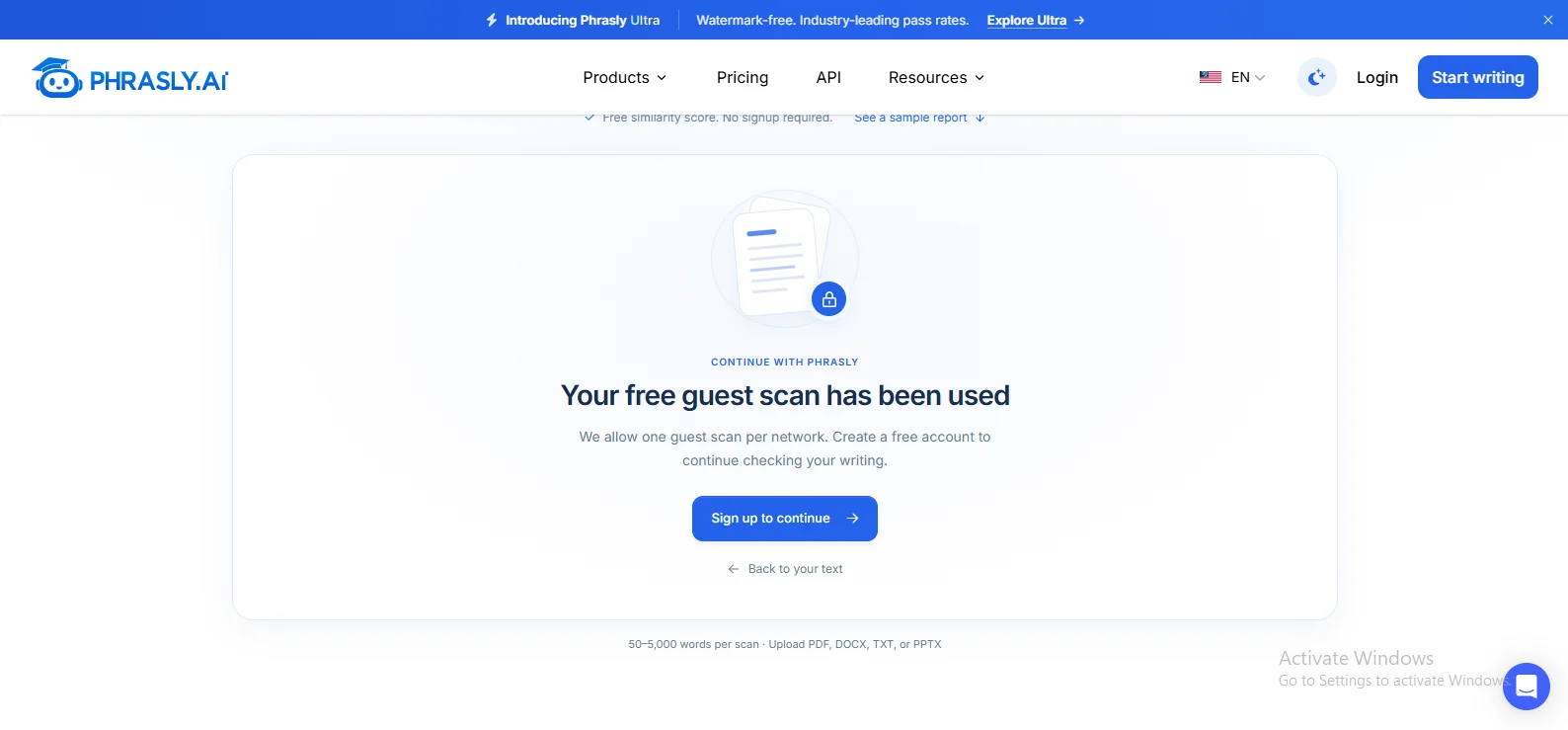
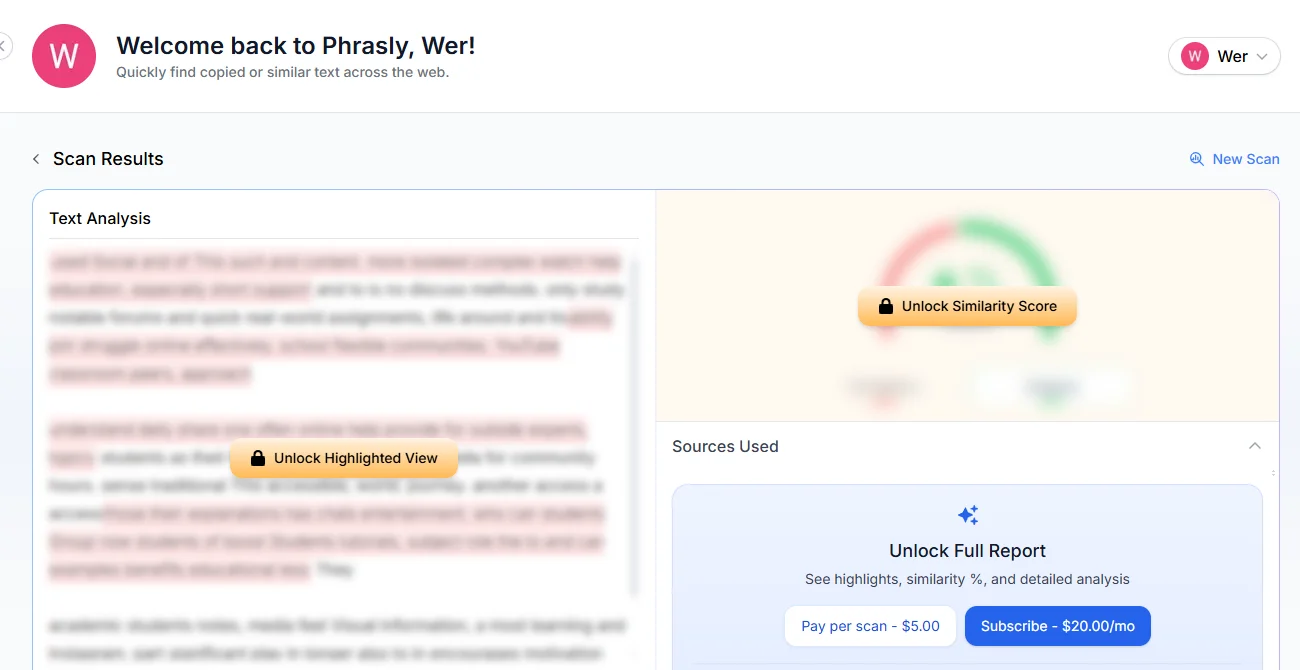
Without an account, the guest scan shows your similarity score only. Creating a free account opens the full report for that same scan: the matched sources, the share of your text each one covers and the highlighted passages.
Use the full report to check every match yourself. A match on a correctly cited quote is usually fine, while a match inside your own analysis is the one to fix.
⚠️ Only the first plagiarism scan is free. In our test, a second scan on the same free account locked the similarity score, highlights and sources. Each later scan costs $0.005 per word with a $5 minimum, or comes out of Phrasly's Unlimited plan.
Step 4: Run the Same Paper Through the AI Detector
Next, open Phrasly's AI Detector and paste exactly the same text. It is a separate tool measuring a separate risk, so its result is not a continuation of your similarity score.
The AI Detector gives 3 free checks a day without signup and unlimited checks with a free account. Each check covers 50 to 10,000 words, so most papers fit in a single pass.
Your AI checks do not use up your plagiarism scan, since the two tools have separate limits, so you can recheck each revised draft as often as you need.
Step 5: Read Your AI Score and Decide What to Revise
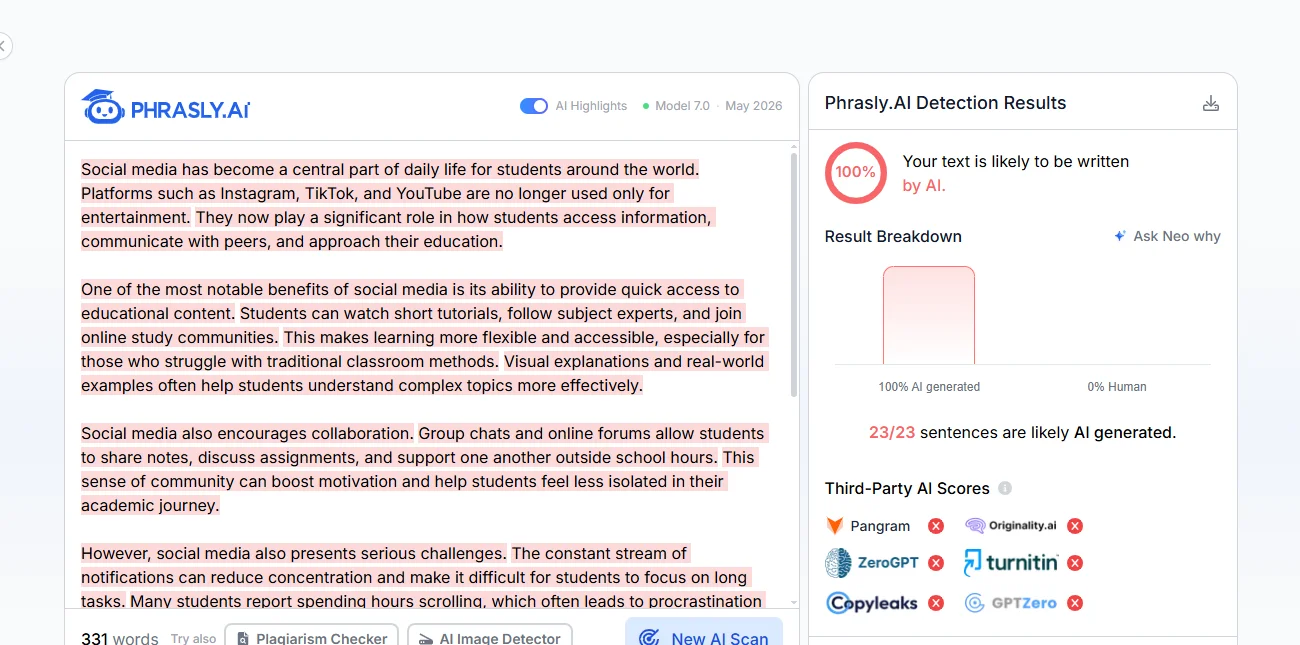
The AI Detector returns an overall score and highlights the sentences that read as AI generated. Our essay came back 100% AI, with 23 of 23 sentences flagged, minutes after scoring 100% Original for plagiarism.
A low score with few highlights generally means the writing reads as human. A high score across whole paragraphs means those paragraphs need a rewrite in your own words, with your own examples and phrasing.
A clean plagiarism report and a clean AI report together are what clear a paper for submission. If either one flags something, revise that part and run the check again.
If Your Paper Fails One of the Checks
Fails Plagiarism Only: Quote and cite the matched passages, or rewrite them fully in your own words, then rescan.
Fails AI Only: Rewrite the flagged paragraphs in your own voice. Add your own examples and reasoning, and keep your drafts as evidence of your process.
Fails Both: Fix the plagiarism matches first, since rewriting for AI can change which passages match, then run both checks again.
Ready to check your own paper?
Run it through Phrasly's Plagiarism Checker first, then paste the same text into the AI Detector before you submit.
Reading Your Results: Similarity Score vs AI Score
A similarity score and an AI score measure different things, so never add them together or read them as one risk number. A 10% similarity score and a 10% AI score describe two unrelated problems.
The similarity score at the top of an originality report tells you how much of your paper matches existing sources. The AI score tells you how much of it reads like machine generated text, so read each one on its own before you decide what to revise.
👉 If you are not sure why your paper was flagged, match the tool to the problem: a plagiarism checker shows copied or matched content, and an AI detector shows writing that reads as AI generated. When you do not know which one your instructor used, run both.
What Counts as a High Similarity Score
There is no single cutoff. Each school, instructor or journal sets its own threshold, and some set none at all.
As one example, Virginia Tech’s Graduate School generally looks for under 25% overall and no more than 5% from any one source, and our guide to what percentage of plagiarism is acceptable covers more college, journal and thesis limits.
Context matters more than the number, so sort your matches before reacting to the score:
Quotes and References: Check that each one is cited correctly, then leave it.
Short Common Phrases: Wording like "the results show that" matches many sources and rarely matters.
Your Own Analysis: Matches here are the ones to rewrite or cite.
A Matching Title: A title shared with a published paper can create a match on its own. Check whether a match is only your title before you panic.
Also expect some difference between tools. Phrasly's score can differ from your school's checker because each tool searches its own collection of sources, so use your score as a guide to what to fix, not a prediction of your school's number.
What an AI Score Percentage Is Telling You
An AI score is the detector's estimate of how much of your text matches patterns linked to AI writing. It is not a count of how many words an AI wrote, and it does not prove who wrote the paper.
💡 Phrasly's own result screen says as much. A banner under every result states that the scores should not be used to punish students or writers and should be one part of a wider assessment.
Look at where the highlights sit. One flagged sentence in a long paper is a much smaller concern than a paragraph where every sentence is flagged.
When a Flag Means Revise and When It Is a False Alarm
Revise: Long flagged passages that you did not write yourself, or that you pasted from an AI tool with light edits.
Likely a False Alarm: Flags on short technical phrases, standard definitions, common academic wording or correctly cited quotes.
Not Sure: Rewrite the flagged section in your own words and run the check again, rather than guessing.
What's Actually Free: Plagiarism Checker vs AI Detector Limits
You can check for plagiarism and AI for free, but “free” rarely means unlimited. Most tools set a word cap, a daily limit, a signup requirement or a one-time trial, and the limits for plagiarism checks and AI checks are often different. Below is exactly what is free on our two tools, followed by how other popular options compare.
Our AI Detector is free and unlimited with a free account, while our Plagiarism Checker gives one free scan and then charges per scan. If you want to check plagiarism and AI free with no sign up, you get one guest plagiarism scan and 3 AI checks a day. Here is how each tool works from there:
Phrasly Plagiarism Checker
Without Signup: One free guest scan, showing the similarity score.
With a Free Account: The full report for that first scan.
After That: $0.005 per word with a $5 minimum per scan, so a 5,000-word paper costs $25.
Unlimited Plan: $20 a month or $131.88 a year. It includes 100,000 plagiarism words per billing cycle, with top-ups at $1 per 20,000 words ($3 minimum).
Phrasly AI Detector
Without Signup: 3 free checks a day.
With a Free Account: Unlimited checks at no cost, 50 to 10,000 words each.
⚠️ The $2 trial does not include plagiarism words. Phrasly's 3-day trial is built around the Humanizer and comes with 0 plagiarism words. For more plagiarism scans, pay per scan or choose the Unlimited plan.
Other tools draw the line in different places. Quetext’s free plan covers up to 1,000 words in both its plagiarism checker and AI detector, and in Scribbr’s review of free plagiarism checkers, DupliChecker capped each free scan at 1,000 words, so a “100% free plagiarism checker” usually comes with a tight word limit. This is how the main options compare:
Tool | Free tier | Paid option |
|---|---|---|
Phrasly Plagiarism Checker | 1 guest scan. Full report for that scan with a free account | $0.005 per word ($5 minimum), or the Unlimited plan at $20/month |
Phrasly AI Detector | 3 checks a day without signup. Unlimited with a free account | Not needed |
QuillBot | AI detector with limits. Plagiarism checker not in the free plan | Premium, 25,000 plagiarism words a month |
Quetext | Plagiarism checker and AI detector, up to 1,000 words each | Essential, $14.99/month for 100,000 words |
DupliChecker | 1,000 words per free scan | Premium plans, up to 25,000 words |
Turnitin | Not sold to individuals | Through schools only |
If you are looking for an AI content detector free and unlimited, check whether “unlimited” needs an account. On ours it does, but the account itself is free, so you can recheck the AI score every time you revise.
Save your one free plagiarism scan for the final version you plan to submit, since edits after that scan need a paid scan to recheck. If you do need a second scan, check only the sections you changed, because pay per scan is priced by word count.
Can Turnitin Check AI and Plagiarism for Free?
❗ No. Turnitin has no free option for students, and it does not sell individual licenses either, so you cannot run your own Turnitin check, free or paid. Turnitin’s help center says it “does not sell individual licenses or single-use subscriptions” and tells students to ask their school about access.
That is why searches for a free Turnitin AI and plagiarism checker lead nowhere official. Turnitin serves over 20,000 institutions in 185 countries, so most students only meet it when they submit through a course, and by then the report built from the Turnitin database goes to the instructor. For individual checks, Turnitin points people to iThenticate, which sells credits.
Be careful with sites that offer to run your paper "through Turnitin" for a fee. They are not Turnitin, and you cannot know where your paper ends up.
If your school uses Turnitin, a few questions to your instructor can save you guesswork:
Does the course allow a practice or draft submission before the final deadline?
Is there a similarity threshold for this assignment?
Will AI detection results be used, and how?
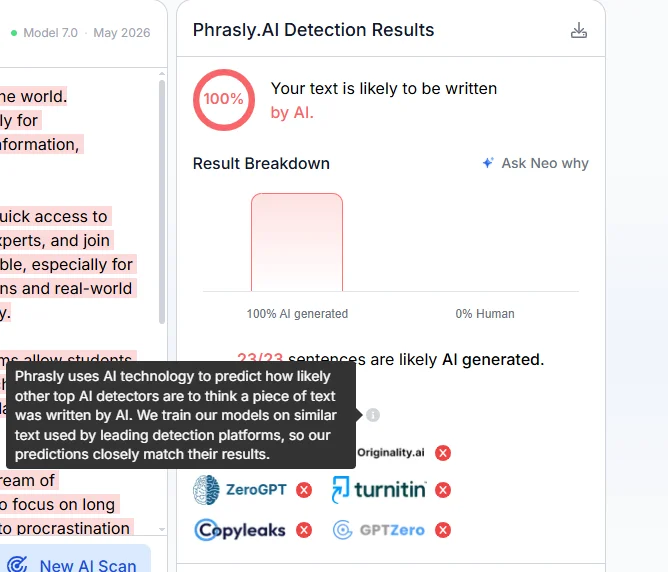
The practical alternative is to check your paper yourself before you submit, using the five steps above. Phrasly's AI Detector also predicts how other detectors, including Turnitin and GPTZero, are likely to score your text.
For our essay, it predicted that all six detectors listed would flag it as AI.
💡 These are predictions, not real scans. Phrasly says it trains its models on text similar to what leading detection platforms use, so its predictions closely match their results. It does not run your paper through Turnitin, so treat these scores as an early warning, not as Turnitin's verdict.
My Paper Is Longer Than the Free Word Limit, Now What?
To check a paper longer than the free word limit, split it into sections and check the riskiest ones first. Most free checkers set a word count limit per scan, so a long thesis chapter rarely fits in one free pass.
A plagiarism checker with no word limit that is also free is hard to find. As the table above shows, several free plagiarism checkers stop at 1,000 words. Our Plagiarism Checker takes up to 5,000 words per scan, and our AI Detector takes up to 10,000.
💡 So if you are hunting for a free plagiarism and AI checker with unlimited words, expect a cap on at least one side. On our tools, the free plagiarism checker word limit is the tighter one, and the same 5,000-word cap applies to paid scans too.
Splitting a Long Paper Into Checkable Sections
Use Natural Breaks: Split at the introduction, literature review, methods, discussion and conclusion.
Start With Source-Heavy Sections: Check the literature review, background and any heavily paraphrased parts first, since that is where similarity scores tend to rise.
Keep a Log: Note each section and its score so nothing is missed before you submit.
Recheck After Edits: Run any section you rewrite heavily again, since new wording can create new overlaps. For plagiarism, that recheck is a paid scan, so finish your edits first.
When Paying Per Scan Makes More Sense Than Splitting
On our Plagiarism Checker, a paper over 5,000 words has to be split anyway, so the real choice is how many pieces to scan and how to pay. Keep each piece as close to 5,000 words as you can, since every paid scan has a $5 minimum and many small scans add up.
Each scan costs $0.005 per word, so a full 5,000-word scan costs $25. If you check long papers often, the Unlimited plan at $20 a month includes 100,000 plagiarism words per billing cycle, which covers far more than one chapter.
Here is how that works for a 12,000-word thesis chapter. The AI side takes two free checks of 10,000 and 2,000 words, with no signup needed.
The plagiarism side takes three scans of 5,000, 5,000 and 2,000 words, costing $60 in total, or $35 if your free guest scan covers the first 5,000 words, while one month of the Unlimited plan costs $20.
Is It Safe to Upload an Unpublished Paper to a Free Checker?
Uploading a paper sends it to the tool’s servers for comparison, but that does not make it public. Most checkers compare your text against the open web and their own database, and whether a tool keeps your text, or adds it to a database that other papers are matched against, depends on the provider. Read its policy before any document upload.
Policies differ a lot. School tools like Turnitin, for example, also compare your paper against papers other students have submitted, which is part of how schools protect academic integrity.
🔔 Our AI Detector does not store or share your text. Plagiarism scans work differently: if you are signed in, each plagiarism scan is saved to your account’s History page so you can open the report later. You can remove any saved scan from the menu on its card by choosing Delete.
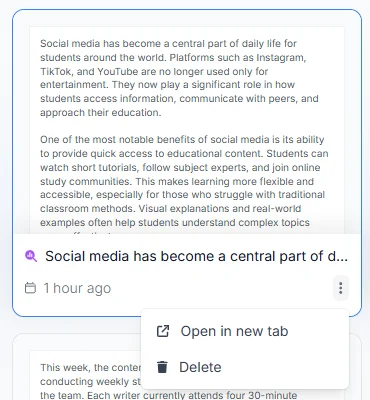
Phrasly's privacy policy adds that it has not sold or shared personal information with third parties, and you can delete your account and request deletion of your data at any time.
Your school may also have rules about which tools you can use before an official submission. If you are unsure, check your syllabus or ask your instructor first.
📢 One simple habit lowers the risk with any tool: remove your name, student ID and any private details from the copy you upload. The checker only needs the text of your paper, not the cover page.
What Uploading Usually Means for Your Text
It Travels to a Server: Your document is sent to the tool's servers, compared against a database and returned to you as a report.
It May or May Not Be Kept: Some tools add submitted text to their own database for future comparisons, and others do not.
Tiers Can Differ: Free and paid tiers sometimes follow different data terms, so read the terms for the tier you use.
Questions to Ask Before You Paste a Full Thesis Chapter
Does the tool say whether submitted text is added to a database other papers are matched against?
Does my school allow third-party checkers before the official submission?
Can I test a shorter excerpt first to see the report before I upload the whole chapter?
Have I read this tool's own privacy policy, rather than assuming how free tools behave?
How Accurate Are Free AI and Plagiarism Checkers?
Free checkers catch some problems but miss many, so a clean free scan is a good sign, not a guarantee. Accuracy varies widely between tools and between types of text.
📢 In Scribbr’s tests, revised November 14, 2025, four documents built from 140 sources were run through free and paid plagiarism checkers. Free and freemium tools found an average of 43% of the plagiarized text. The tester’s own paid checker found 88%, though that is a vendor testing its own product.
Results for individual tools in the same test ranged widely: PlagAware found 57%, Quetext 48%, DupliChecker just over 40% and Copyleaks 38%.
Paying did not guarantee better matching either. Paid tools in the same test also averaged 43%, so how reliable a checker is depends more on the tool than on the price.
Students on forums like Reddit often ask for the best free AI and plagiarism checker, but no free tool is the best at both jobs. The most dependable free approach is two tools and two reports.
What a Clean Result Does and Does Not Mean
A 0% Similarity Score: No matches in that tool’s database. It does not rule out matches in a database your school’s tool searches.
A Low AI Score: The detector found few AI-linked patterns. Another detector may read the same text differently.
Two Clean Results: The strongest sign you can get before submitting, though neither tool can promise your school’s result.
Why AI Detectors Sometimes Flag Human Writing
False positives happen when a detector reads very formal, repetitive or simple sentences as machine-like. A person can write that way, especially in a structured academic paper, and still get flagged.
💡 In a 2023 Stanford study, seven AI detectors had an average false positive rate of 61% on TOEFL essays written by non-native English speakers.
That is why detector makers, including us, warn against treating a score as proof. If you are flagged by mistake, ask which tool produced the result, then share your drafts or document version history and offer to talk through how you researched and wrote the paper.
📌 Most instructors know detectors make mistakes. Clear evidence of your process is far more convincing than a second detector score.
Why Detection Accuracy Varies Between Tools
Each plagiarism checker compares your text with a different database, and a tool with a smaller database simply has fewer places to find a match.
That is why the same paper can get different similarity scores from different checkers.
AI detectors vary for a similar reason. Each one is trained on different data and sets its own thresholds, so two detectors can give the same text very different scores.
Grammarly, QuillBot, GPTZero: How Do They Compare?
Grammarly, QuillBot and GPTZero all offer some free AI detection, but none of them include full plagiarism checking for free. With any of them, a complete free check usually means using two tools.
Tool | Free AI detection | Free plagiarism check |
|---|---|---|
Grammarly | Yes, 1 scan of up to 1,400 characters without an account | Detailed results on paid plans |
QuillBot | Yes, with limits | No, Premium only (25,000 words a month) |
GPTZero | Yes, 10,000 words a month | No, paid plans only |
Phrasly | Yes, unlimited with a free account | First scan free, then pay per scan |
Grammarly's Plagiarism and AI Features
Grammarly’s free AI detector gives one scan of up to 1,400 characters without an account, and you need to sign up to run another, according to Grammarly’s own guide.
Its plagiarism checker compares text with over 16 billion web pages and ProQuest’s academic databases, but the detailed plagiarism results come with its paid plans.
So the full Grammarly plagiarism and AI checker setup requires a paid plan, and Grammarly Pro costs $30 a month or $144 a year.
It suits students who already use Grammarly for grammar and want both checks inside one writing assistant, rather than in a dedicated academic integrity tool.
Is QuillBot's Checker Free?
Only the AI side is. QuillBot’s Premium page lists the plagiarism checker as a Premium feature with 25,000 words of scans a month, while its AI detector has a limited free version.
So a QuillBot plagiarism and AI checker free setup covers AI detection only. Its free AI detector works for a quick spot check of a paragraph, but a full paper still needs a separate plagiarism tool.
QuillBot is also widely used as a paraphrasing tool, so any text you paraphrase there should still go through both checks before you submit.
GPTZero and Other Standalone AI Detectors
GPTZero focuses on AI detection, using natural language processing to study language patterns rather than matching sources.
Its free plan covers 10,000 words a month, and plagiarism checking is only on its paid plans, so it does not replace a similarity checker in this workflow.
Other standalone AI detectors work the same way: they score writing patterns but do not search for copied sources.
A standalone AI detector still makes sense when you only need the AI side, such as for a personal reflection with no outside sources. For a research paper built on sources, pair it with a plagiarism check.
The two checks answer different questions, which is also why it helps to know whether using AI counts as plagiarism.
If you want one tool that checks both plagiarism and AI writing for free, look for both checks under one free account. Ours does, with one free plagiarism report and unlimited AI checks, which covers a typical paper before submission.
Final Verdict
The best free way to check your essay for plagiarism and AI content is to run two checks in one sitting: a plagiarism checker for copied text and an AI detector for machine-like writing. Our test essay passed the first and failed the second, which is why one check is not enough.
With our tools, your first plagiarism scan is free, and your AI checks are unlimited with a free account. Read both reports and fix what they flag before you submit.
Check for AI While You Revise: Use the free, unlimited AI checks on each draft.
Scan the Final Version for Plagiarism: Spend your free scan on the paper you will submit.
Fix and Recheck: Cite, quote or rewrite anything either report flags, then run the checks again.
Submitting a paper this week?
See how our free plagiarism checker for students works, then run your first scan and your AI check today.
FAQs
Is There a Free Plagiarism and AI Checker?
Yes, but most free options limit one side. Phrasly Plagiarism Checker gives one free scan, and a free account adds its full report plus unlimited AI checks. Grammarly and QuillBot offer free AI detectors but keep plagiarism details on paid plans. After the free scan, we charge $0.005 per word with a $5 minimum.
What Is the Best Free Tool to Check Plagiarism and AI?
No single free tool is best at both, because plagiarism checkers and AI detectors use different methods. The most reliable free approach is to pair a plagiarism checker with a separate AI detector and read both reports. The right pick also depends on your paper’s length and your school’s rules.
Do Free Plagiarism Checkers Also Detect AI-Generated Content?
Usually not. Most plagiarism checkers only compare your text with existing sources, so an original AI-written paper can score 0%. You need an AI detector for that, and tools that offer both often limit one in the free version. That is why running both checks before you submit matters.
Can Grammarly Check for Both Plagiarism and AI Content?
Yes, but not fully for free. Grammarly’s free AI detector gives one scan of up to 1,400 characters without an account, and you sign up for more. Its plagiarism checker shows detailed results only on paid plans, so a full Grammarly check of both plagiarism and AI content requires a subscription.
Is QuillBot's Plagiarism Checker Free?
No. QuillBot’s plagiarism checker needs a Premium account, which includes 25,000 words of plagiarism scans a month. Its AI detector has a free version with limits, so free users can check for AI but not plagiarism. For a free plagiarism scan, use a tool that offers a first scan at no cost.

Written by
Hasnain
Karachi, Pakistan
I help businesses grow with SEO-friendly blog posts, landing pages, and long-form content. With 3+ years of experience, I deliver clear, original, and well-researched writing that drives results.