Best Plagiarism Checkers in 2026 (Free & Paid)
Looking for the best plagiarism checker in 2026? We compare 12 top tools: Turnitin, Grammarly, Quetext, Copyscape, and more on detection accuracy, AI-content detection, pricing, and free word limits to help students, writers, and institutions pick the right one.
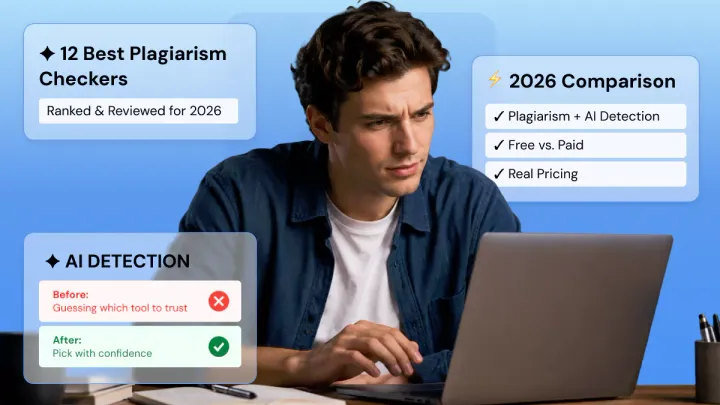
Running a plagiarism check once meant scanning your text and reading a single percentage score. In 2026, your plagiarism checker should come with AI detection features. This is particularly helpful in identifying AI-generated text from ChatGPT, Claude, Gemini, as well as other LLMs.
If you spend any time on best plagiarism checker Reddit threads, you’ll notice the same few names popping up over and over: Turnitin for academic institutions, and Grammarly and Quetext for casual users.
Here are our 12 picks for the best plagiarism checker of 2026. Compare reviews to find the best plagiarism checker for students, content writers, SEO experts, and reviewers.
The following tools are scored based on detection accuracy, AI-generated content detection capability, ease of use (free versions), word limits, cost, vendor documentation, independent detection rate reports, and user reviews collected as of June 2026.
Check Your Work for Plagiarism Here 👇
What to Look for in a Plagiarism Checker?
But first, let's understand what makes a reliable Plagiarism detector different from the rest.
Academic dishonesty is far more widespread than most students assume.
That's part of why choosing a checker with strong detection accuracy matters as much for personal integrity as it does for avoiding penalties.
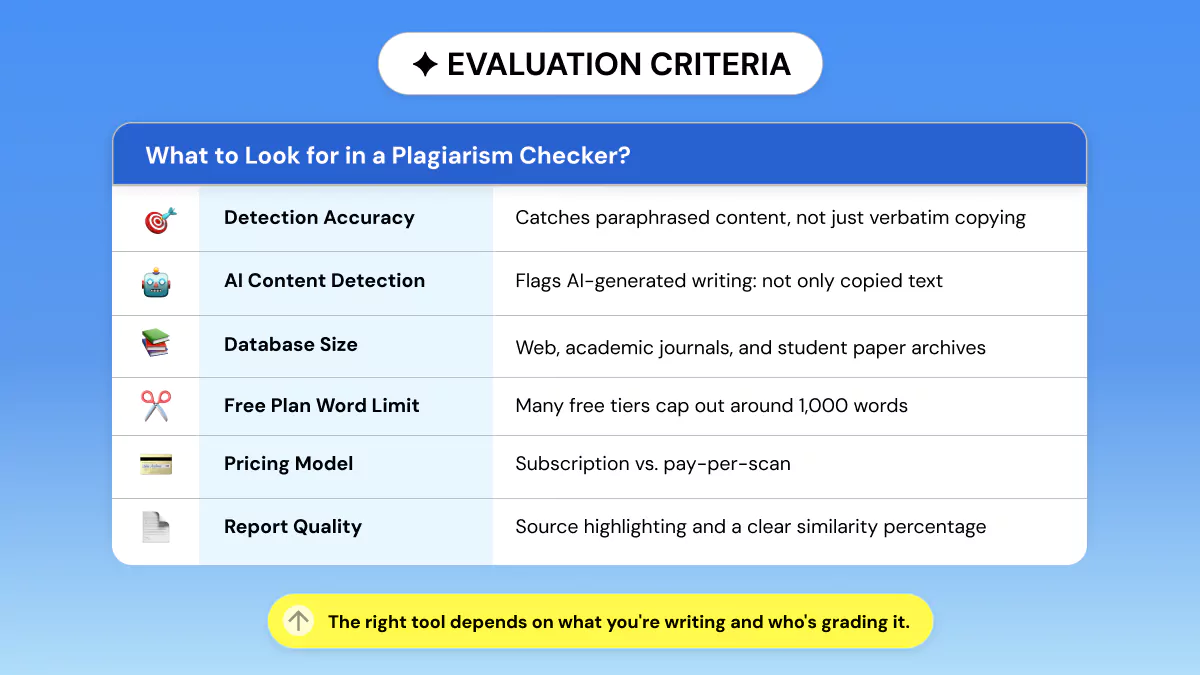
Here are the six factors that determined rankings throughout this article:
- Detection accuracy: Does the detector catch patchwork / mosaic plagiarism and paraphrased sentences, or does it simply detect word-for-word plagiarism (Verbatim copying)?
- AI-generated content Detection: another increasingly requested feature.
- Database size: web-only tools cannot compare to an institutional plagiarism checker that mines ProQuest or your own student-paper repository.
- Maximum number of words allowed for free plan: Many plagiarism checkers limit users to 500 or 1,000 words free of charge. Unfortunately, this doesn't typically cover an entire essay.
- Pricing model: flat monthly subscription vs. pay-per-scan vs. per-document credits.
- Report quality: does it return source matching, a similarity score, and a downloadable plagiarism percentage report?
Database Accuracy vs. Paraphrase Detection
Most content originality checker tools excel at detecting verbatim copies, but fall short on paraphrasing detection.
A few of the independent reviews our guide mentions discovered that basic NLP / Natural Language Processing web-crawlers fail to detect heavily reworded sentences, even when a duplicate content detection match exists somewhere on the web.
This gap is also how incremental plagiarism builds up unnoticed across a long document. Small, reworded borrowings that individually look harmless but add up to a real integrity problem.
Turnitin and Scriber, which runs on Turnitin’s engine, perform the best among free tools in this particular area.
Pricing Model: Subscription vs. Pay-Per-Scan
Tools tend to fall into two categories: monthly subscriptions that limit you to a certain number of words (Quetext, Copyleaks, Grammarly) and pay-per-document/pay-per-search pricing (Copyscape, Scribbr, iThenticate).
A subscription tends to work out cheaper for anyone running a pre-submission plagiarism check more than two or three times a month. Pay-per-scan suits occasional, one-off checks.
Here are our picks for the 12 best plagiarism checkers available right now:
Quick Comparison Table: All 12 Tools
The prices and features listed below were publicly listed as of June 2026 and are subject to change. Please check individual vendor pricing prior to subscribing.
The 12 Best Plagiarism Checkers in 2026
Phrasly
Best for: Students and writers who want plagiarism checking and AI detection in one place.
What it is: Phrasly plagiarism checker uses its own built-in detection models, not a licensed third-party engine.
The plagiarism checker scans against a stated 10B+ web pages and academic sources. It returns a similarity score with a source-by-source plagiarism report.
Key differentiator: AI detector is always free and unlimited (allows up to 2000 words per scan). A Plagiarism detector is a separate paid tool. There is no free version.
Plagiarism scans cost $5 for a single scan or $20/month for unlimited scans up to 20k words, bundled with an AI detector and humanizer.
Pros:
- AI detection and plagiarism checking in one tool.
- The free AI detector has no word cap.
- Reports include highlighted matches with linked sources, plus PDF, DOCX, and TXT upload support.
Cons:
- There is no free plagiarism tier for this checker. You must purchase a plan or pay for each scan individually.
Pricing: $5 per single plagiarism scan, or $20/month for 20,000 words including the AI detector.
Best for: Students and content writers who want a plagiarism checker with an AI detection combo rather than two separate subscriptions.
Turnitin
Best for: Institutions and students whose school already has a license.
What it is: Turnitin is by far the standard used by institutions. Used by an estimated 15,000+ schools and universities. Turnitin is not a product that you can purchase individually; you can only access it through your school's subscription.
iThenticate is Turnitin's individual-access alternative for researchers and publishers.
Key differentiator: Turnitin searches student submissions against its own massive database of previously submitted student papers, not just public web pages. This is the primary reason it catches what other tools don't.
Pros:
- The world's largest collection of students contributed coursework accessible outside of web-based repositories.
- A built-in AI writing indicator is integrated into the same similarity report.
- Deep LMS integration “Canvas, Blackboard, Moodle” that most students and instructors are already familiar with.
Cons:
- Turnitin isn't sold directly to individuals. Institutional prices are not publicly listed. They are quote-based.
- The individual-access alternative iThenticate starts at about $125 per submission. Too expensive to check student papers regularly.
Pricing: Institutional pricing is quote-based only. iThenticate individual credits are priced at approximately $125/document.
Best for: Students and instructors with institutional access. Researchers needing iThenticate for journal submissions.
Grammarly Plagiarism Checker
Best for: customers who already subscribe to Grammarly Premium for writing assistance and would like to have plagiarism detection included as well.
What it is: Grammarly’s built-in plagiarism detector is included with its Premium version and cross-checks writing with "16 billion+ web pages" and ProQuest's academic databases. There's also a separate tool to detect AI-generated writing.
Key differentiator: Independent verification is equivocal. Grammarly did catch word-for-word plagiarism reliably, but failed to catch paraphrased plagiarism, AI-paraphrased plagiarism, and translated plagiarism in several known instances. The tool is therefore most effective as a preliminary check.
Pros:
- Plagiarism check, Grammar check, and AI check all take place in the same editor; there isn't a separate tool you can use to just run one of them.
- Submitted drafts are not saved to any public database for future matching purposes.
- Browser, desktop, and Google Docs integration fold into the existing writing workflow.
Cons:
- The free account has no plagiarism detection whatsoever. That's something Premium accounts only receive.
- Fails to detect severely paraphrased or AI-generated plagiarism on several independent trials.
Pricing: Premium membership begins at $12/month, billed annually (approximately $30/month billed monthly); to use plagiarism detection, you need a Premium or Business account.
Best for: Professional writers, students, and bloggers who need plagiarism checking within the application they already use to write and edit.
Copyscape
Best for: Bloggers and content teams checking published web content for duplication.
What it is: Copyscape searches URLs and pasted text against the public web. Copyscape does not search academic databases.
Copyscape is a duplicate content detection tool designed for use by site owners and SEO teams, not students.
Key differentiator: Copyscape Premium is priced per search: “3 cents for the first 200 words, 1 cent for each additional 100 words,” with no required monthly fee.
While this allows occasional users to use the service as needed, it offers no AI content detection.
Pros:
- No monthly commitment; you only pay for the searches actually run.
- Batch Search checks up to 10,000 pages in one operation. Useful for site-wide audits.
- Supports PDF, DOC, DOCX, RTF, and TXT uploads, beyond pasted text.
Cons:
- It isn't searching scholarly databases, so it would not be appropriate for thesis or dissertation level research.
- It does not detect AI-written content in any form.
Pricing: Cost per search, 3 cents for the first 200 words, and 1 cent for each additional 100 words; Copysentry monitoring is priced separately.
Best for: content marketers or freelance editors checking internet-posted content for originality. Not students checking papers to turn in to teachers.
Quetext
Best for: students who want a clean, no-signup-required first pass.
What it is: Quetext utilizes DeepSearch technology to contextually analyze text, allowing it to better detect instances of paraphrasing instead of searching for exact matches.
Comes packaged with a separate AI detector and citation generator as well.
Key differentiator: Quetext's free tier only allows you to check 500 words for plagiarism. (Newer accounts say they can check 1,000words?) AI Detection is behind a paywall on the free tier.
Huge limitation if you're trying to check an entire essay before you submit it.
Pros:
- DeepSearch detects some paraphrased and rearranged text that is not detected by basic matchers.
- Inline, color-coded highlights link flagged sentences directly to their source.
- A built-in citation generator produces APA, MLA, and Chicago references for flagged matches.
Cons:
- The free plan’s word limit (500–1,000 words) won’t cover the full essays.
- AI detection is locked behind the paid Essential plan.
Pricing: Plans start at $9.99/month for Plagiarism checker; $7.99/month for AI detector add-on.
Best for: Students running quick pre-submission checks on shorter assignments.
Scribbr Plagiarism Checker
Best for: students and independent dissertation and thesis writers seeking Turnitin-grade quality without Turnitin access.
What it is: Scribbr licenses Turnitin’s base detection engine, allowing individual customers access to the same technology used by universities. They also offer a free AI detector separate from Turnitin, which checks up to 1,200 words at a time. Scribbr sells proofreading/editing services as well.
Key differentiator: According to Scribbr’s own published testing, the checker found 88% plagiarism in test documents (vs. an average of 43% among free tools). A meaningful accuracy gap, though it costs significantly more money. Paid, per-document price rather than subscription.
Pros:
- Turnitin-powered detection without needing institutional access.
- A Self-Plagiarism Checker compares uploads against a student’s own previous work.
- No document storage in any public database, reducing future false-positive risk.
Cons:
- Costs per check ($19.95-$39.95 depending on word count), not subscription- based. Gets pricey if you use it often.
- No re-check option; revising a flagged section means paying again.
Pricing: Costs per check ($19.95-$39.95 depending on word count), not subscription-based. Gets pricey if you use it often.
Best for: students checking a single, high-stakes document like a thesis or dissertation chapter.
Chegg Plagiarism Checker
Best for: Students who already subscribe to Chegg Writing for other tools.
What it is: Chegg's plagiarism checker doesn't come by itself. Instead, it comes packaged as part of a Chegg Writing subscription that includes grammar recommendations, citation tools, and proofreading tokens/credits.
Key differentiator: It's more of a convenience pack than a standalone detector, but it’s worth knowing that Chegg has come under academic-integrity scrutiny previously for its homework-help services, although that issue is distinct from the plagiarism checker's accuracy.
Pros:
- Bundled with grammar and citation tools in one Chegg Writing subscription.
- A simple copy-paste or upload workflow with quick turnaround.
- A color-coded, source-linked similarity report.
Cons:
- Not available as a standalone, plagiarism-only purchase.
- Rated lower than stand-alone apps such as Grammarly or Quetext when it comes to the level of detection power.
Pricing: Roughly $9.95/month as part of a Chegg Writing subscription.
Best for: Students who currently utilize Chegg Writing for other services and desire the ability to check their work for plagiarism.
DupliChecker
Best for: Quick, free spot checks on shorter pieces.
What it is: DupliChecker is an ad-supported free plagiarism checker that scans against billions of web pages. There is also a Pro plan that increases your word limit and includes AI content detection.
Key differentiator: The free version limits you to 1,000 words per check. Independent testing found it caught roughly 40% of plagiarized material in edited texts. Useful for a fast sanity check, but not reliable as a sole verification method.
Pros:
- Genuinely free with no signup required for basic checks.
- Supports multiple languages for non-English content.
- Deep Search and grammar checking are bundled into the same interface.
Cons:
- The free limit only allows you 1,000 words. You will have to split large documents into parts.
- Reviewers have noted that it misses catches that other competitors pick up.
Pricing: Free for 1,000-word checks. Paid plans begin at about $9.49/month for higher limits and access to AI detection attempts.
Best for: Bloggers and students who need a fast, no-cost first check on shorter content.
PapersOwl Plagiarism Checker
Best for: students who want a free, no-word-limit plagiarism check.
What it is: PapersOwl is mainly an essay marketplace with a plagiarism-free plagiarism checker, a no-word-limit tool that is available to use for free. They advertise no word limits on documents, unlike most other checker tools.
Key differentiator: As PapersOwl operates by primarily linking students to paid essay writers, the plagiarism checker also acts as a funnel to those paid services.
Uploading a paper to any third-party writing service raises legitimate data-privacy questions worth weighing before using it for sensitive academic work.
Pros:
- No word limit on the free plagiarism check, unlike most free competitors.
- Fast results, typically returned within seconds.
- No paid plagiarism-only tier to navigate. The checker itself stays free.
Cons:
- Heavy promotion of paid essay-writing services throughout the experience.
- Was reported to incorrectly miss some plagiarized content during independent testing. This raises questions about accuracy.
Pricing: Free plagiarism checker. Paid writing and editing services are priced separately, per page.
Best for: students who are looking specifically for a free plagiarism checker with no word limit and who don’t care about the upsells.
Unicheck
Unicheck was discontinued as a standalone product on January 1, 2025. Turnitin acquired Unicheck back in 2020. Turnitin folded it into Turnitin Similarity. The tool cannot longer be signed up for in 2026.
So it cannot be meaningfully ranked or reviewed here.
If you were a prior Unicheck user through a school or LMS integration, you will likely be redirected to Turnitin Similarity.
Copyleaks
Best for: Developers and businesses needing API-level plagiarism and AI detection.
What it is: Copyleaks is a full-service platform, offering both a plagiarism checker tool with support for over 100 languages and an AI content detector that supports over 30 languages.
They also offer an API for teams looking to integrate AI detection directly into their own workflows.
Key differentiator: Copyleaks combines AI and plagiarism detection into a single credit-based subscription instead of charging separately for each feature. Their listed prices begin at $13.99/month “annually billed” for the Copyleaks Personal plan, which includes access to both features and the API.
Pros:
- Combines AI detection and plagiarism checking in a single scan and report.
- API access is included even on the entry-level Personal plan.
- Multilingual coverage spans 100+ languages for plagiarism checks.
Cons:
- Credits do not carry over month to month. So, if you don't use your entire allotment “and you use it sporadically,” you will waste paid credits.
- Independent benchmarks place its AI-detection accuracy on humanized or heavily rewritten text noticeably lower than its own published claims.
Pricing: Personal plan starts at $13.99/month if you pay annually. That plan is for the combination of AI and plagiarism detection. Pro and Enterprise grow larger.
Best for: Agencies, developers, and institutions that need API access alongside plagiarism and AI detection.
PrePostSEO Plagiarism Checker
Best for: budget-conscious users who need a free, fast bulk-check tool.
What it is: SEO plagiarism checker by PrePostSEO is a completely free tool which is part of their 150+ SEO utilities toolkit, targeting marketers, students & bloggers looking for a free alternative.
Key differentiator: On the free plan, visitors can check up to 1,000 words of text (1,500 words if registered). Premium subscriptions increase the word allowance, up to unlimited access on business plans.
In independent testing, it correctly flagged plagiarized text that was directly copied, but did not always catch text that had been paraphrased.
Pros:
- A genuinely free tier with no signup required for a basic check.
- Premium plans scale up to unlimited word counts for high-volume users.
- Bundled with a wider suite of free SEO and writing tools.
Cons:
- Fails to consistently identify paraphrasing and patch-writing plagiarism during independent validation.
- Support was very slow to respond to inquiries about billing/account problems
Pricing: Free for up to 1,000–1,500 words. Paid plans average about $10–$45 per month, depending on the volume.
Best for: SEO teams and budget-conscious writers needing fast, free bulk content checks.
Which Plagiarism Checker Should You Use?
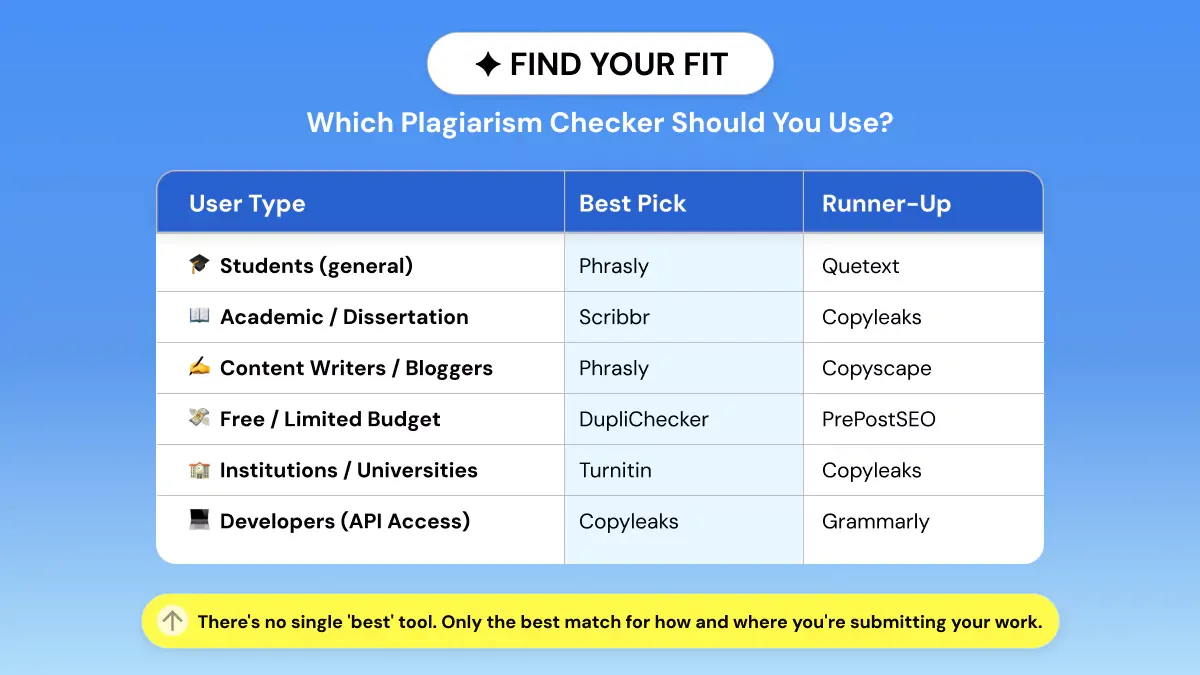
The right pick depends heavily on who you are and what you’re checking. Here’s a quick reference by use case.
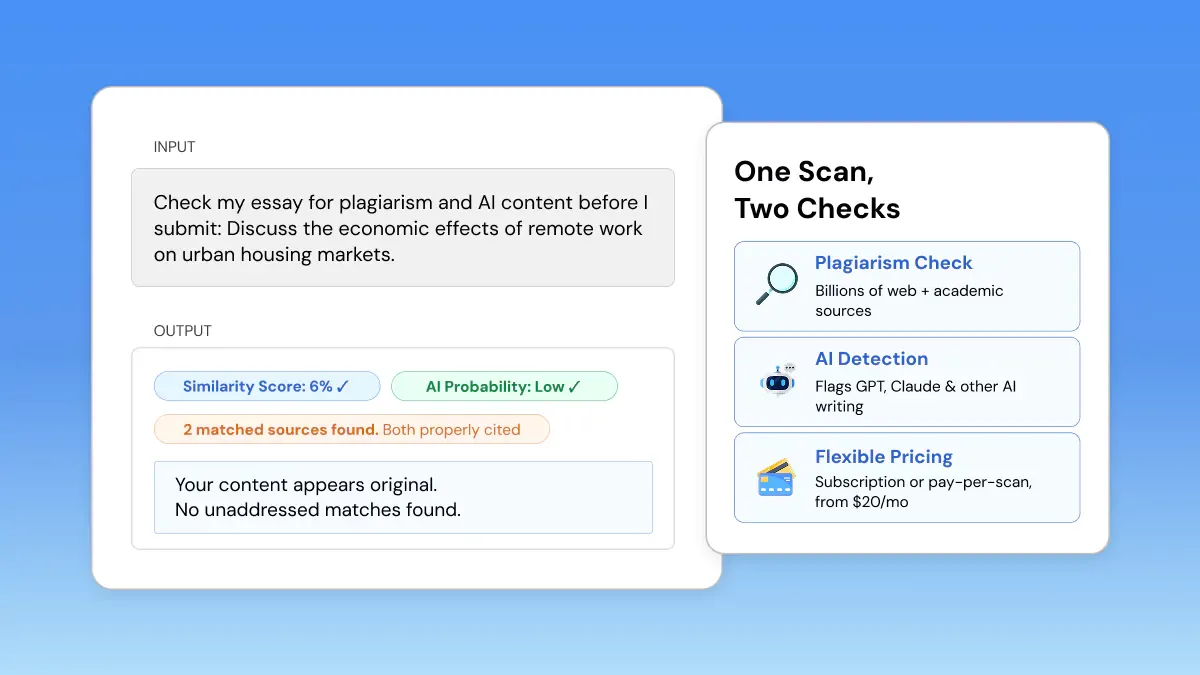
If you’re looking for plagiarism checking and AI detection without the hassle of maintaining two separate subscriptions, consider Phrasly’s combined plagiarism checker with AI detection package.
The AI detector is completely free to try, and the plagiarism checker ranges from $5 for a single scan to a $20/month plan.
Of course, students authoring dissertations still likely will derive more value from Scribbr's Turnitin-powered accuracy, and institutions should continue using Turnitin or Copyleaks if looking for bulk, API-level needs.
FAQs
What is the best plagiarism checker in 2026?
It really depends on your use case. If you need a combo plagiarism/AI check in one subscription, Phrasly’s plagiarism checker is great for students and writers.
When you need dissertation- level accuracy, nothing beats Scribbr’s Turnitin-powered engine, and institutions that already have a Turnitin license should stick with it.
There is no single universal answer. It comes down to budget, document type, and whether you also need an AI detector.
Is there a free plagiarism checker with no word limit?
Most limit word counts between 500 and 1,500 words per submission. Quetext, DupliChecker, and PrePostSEO all have restrictions in place at their free levels.
PapersOwl is unique in that they claim to have unlimited word checks with no restrictions on its free plan. If you're looking for a usage-based, pay-as-you-go solution without a monthly plan, Phrasly’s $5-per-scan fee is a nice alternative to a full-priced subscription.
Can plagiarism checkers detect AI-generated content?
Yes, they can, but not all of them do, and some are more accurate than others.
Newer tools such as Phrasly's AI detector actually build specific AI-detection models instead of using a single third-party engine. Turnitin, Copyleaks, and Grammarly all now include their own built-in AI writing indicators as well.
Expecting your checker to have this capability is one of the most rapidly expanding requirements for any tool you consider in 2026, and older plagiarism-detection-only scanners simply will not have it.
What is the best plagiarism checker for students?
Students who desire both plagiarism and AI detection can have both services covered by Phrasly in a single workflow.
However, for academic dissertations in particular, Scribbr's Turnitin-powered checker is the better choice due to its 88% accuracy rate when tested.
If students have access to Turnitin through their school, they should prioritize using that, as it has the largest database of student papers.
Is Turnitin the most accurate plagiarism checker?
Turnitin is the standard for institutions and has access to the largest database of previously turned-in student papers. It is not available to students themselves. Schools must pay for a license for their students to access it.
For individual or professional use, Turnitin’s sister product, iThenticate, is the official route. Its per-document pricing (around $125/check) makes it impractical for routine student use.
Tools like Scribbr license the same underlying technology and offer more feasible pricing options for individuals wishing to check standalone documents.


Keep reading

12 Types of Plagiarism Explained (With Real Examples)
Learn the 12 types of plagiarism with real examples, understand the consequences, and discover practical ways to avoid academic mistakes before you submit your work.
How Can You Prevent Plagiarism? 10 Proven Strategies for Students (2026)
Learn how to prevent plagiarism with 10 practical strategies, including proper citation, paraphrasing, note-taking, and plagiarism checking, to submit original work with confidence.