Does Gradescope Check for Plagiarism? The Real Answer for Students
Gradescope doesn't have a built-in plagiarism checker but that doesn't mean your work won't get scanned. Here's exactly how it works before you hit submit.
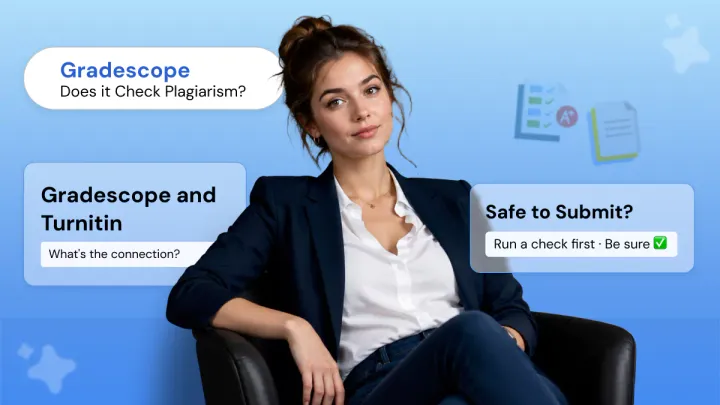
Gradescope does not have a built-in plagiarism checker. If you are about to hit submit and wondering does Gradescope check for plagiarism the moment your paper lands, the honest answer is no, not on its own.
Gradescope is owned by Turnitin, but being part of the same company does not mean Turnitin runs on every submission automatically.
Whether your work actually gets checked for plagiarism or AI writing depends entirely on whether your instructor has switched on Turnitin integration for that specific assignment. By default, neither check is active.
The scan only happens when someone turns it on.
This guide breaks down exactly what Gradescope checks, what it doesn't, and what you should do before you submit.
Check Your Work for Plagiarism 👇
What Is Gradescope? (Brief Context)
Gradescope is a digital grading platform built by a UC Berkeley team and acquired by Turnitin in 2018.
Universities use this online grading platform to collect, organize, and grade student submissions like paper exams, quizzes, bubble sheets, online assignments, and programming work, all in one place.
Gradescope is built for grading. Its entire purpose is to help instructors mark assignments faster and give students better feedback.
So what does Gradescope actually check when you submit?
Your file, your timestamp, your answers, and how everything flows through the instructor's rubric. It does not automatically scan written work for plagiarism unless your instructor has separately enabled a Turnitin feature.
Does Gradescope Have a Built-In Plagiarism Checker?
No, Gradescope does not have a built-in plagiarism checker for essays, PDFs, written homework, or standard text submissions.
There is no "gradescope plagiarism checker" running quietly in the background that scans every upload against the web, academic databases, or previously published papers.
What Gradescope does have natively is a Code Similarity tool, and it only works on programming assignments.
Here's how it works:
- It compares code submitted by students within the same assignment
- It shows instructors where two programs look structurally alike
- It does not scan the internet, GitHub, or academic databases
- According to Gradescope's official Code Similarity documentation, it does not automatically detect plagiarism. It only highlights commonalities.
Supported languages for Code Similarity: C, C++, C#, F#, Go, Java, JavaScript, MATLAB, MIPS, ML, Python, and R. Other languages can still be submitted and graded, but they won't go through similarity review.
So Can Gradescope Detect Copy-Paste?
- For code: Yes. It can flag programs that look near-identical to a classmate's submission.
- For written work: No. Gradescope itself does not catch copied text from the internet or any external source. That kind of check only happens if your instructor has separately turned on Turnitin integration.
This is where most students get confused. Gradescope similarity detection is a classmate-to-classmate comparison for code. It is not a full plagiarism scan like Turnitin.
Gradescope and Turnitin. What’s the Connection?

Yes, Gradescope is owned by Turnitin. Turnitin acquired Gradescope in October 2018, but being part of the same company does not mean Turnitin runs automatically on every submission.
Here's the part students miss about gradescope and turnitin.
Gradescope can collect, organize, and grade assignments completely on its own. Turnitin checks only kick in when your instructor or institution has actively enabled them for that specific assignment.
Does Gradescope Use Turnitin?
Sometimes yes, sometimes no. When it is enabled, your submission gets forwarded to Turnitin's servers and checked against:
- Billions of current and archived web pages
- Previously submitted student papers
- Academic journals and publications
The instructor then receives a Similarity Report with a similarity score showing where your text matches existing sources.
For AI writing, gradescope turnitin AI detection works the same way. It only runs if your institution has the Turnitin AI Writing Report feature turned on. When active, the report shows your instructor a percentage of text it flags as likely AI-generated or likely AI-paraphrased.
How Do I Know if My Instructor Has Turnitin Enabled?
You usually can't see it directly inside Gradescope, but there are clear signals worth checking before you submit:
- Check the syllabus. Most professors list their academic integrity tools and AI policy upfront. Look for any mention of Turnitin, originality checks, or AI writing detection.
- Read the assignment description. Instructors often mention "submissions will be checked for originality" or reference Turnitin directly inside the assignment brief on Gradescope or your LMS.
- Look at your LMS settings. If your course runs through Canvas, Blackboard, Moodle, or D2L, Turnitin sometimes shows up as a separate setting or icon on the assignment page.
- Just ask. A quick message to your professor or TA gets you a straight answer. Most are happy to clarify, and asking is not a red flag.
Honest reality check: Even if Turnitin isn't enabled on a specific assignment, instructors can still manually upload your work to Turnitin or another checker after the fact. The safest assumption is to write and check your work as if it will be scanned.
The Catch Students Need to Know
You usually cannot see your own Turnitin report before the deadline. The report is delivered to your instructor's dashboard, not yours, unless your school has separately set up a draft tool like Turnitin Draft Coach.
This matters because Turnitin is everywhere.
According to Turnitin's own figures, the company's services are used across 17,000 institutions, 71 million students, and 185 countries.
Turnitin also reports that 98% of its customers have AI writing detection enabled. Since you have no clear way to know whether your instructor has Turnitin switched on, the safest move is to run your own plagiarism check before you submit.
So if you are about to submit an AI-written essay on Gradescope, will it get flagged?
Not by Gradescope itself. Gradescope has no AI detector built in. The risk only kicks in if your instructor has Turnitin's AI Writing Report turned on for that assignment.
When it's active, it can flag text it believes was generated by ChatGPT, Claude, Gemini, or similar tools, and it may also flag content that was AI-paraphrased afterward.
This is a real concern because AI use is now mainstream in student work.
Worth knowing: Turnitin false positives can happen, especially for ESL writers or students who heavily revise drafts with grammar tools.
What About Code Assignments?
For programming assignments, Gradescope code similarity works differently from plagiarism checking for essays.
Gradescope has a built-in Code Similarity tool that compares your code against other student submissions inside the same assignment, then generates a code similarity report for the instructor to review.
It is similar in purpose to MOSS (Measure of Software Similarity), the long-running Stanford system that has been used to flag program similarity in coding classes since the 1990s.
Here's what students need to know:
- The tool surfaces structural similarity between programs, not just surface-level text
- Simple cosmetic tricks like renaming variables, reformatting, or adding comments are unlikely to hide a real match
- The report does not automatically prove academic dishonesty. The instructor still has to review it and decide
AI adds a new wrinkle. If several students ask ChatGPT for the same coding task with similar prompts, the outputs often follow near-identical logic and structure.
That means a group of submissions can look unusually alike and all get pulled into the same similarity review together.
What Should Students Do Before Submitting on Gradescope?
You can run your own check before your professor ever sees your work. The whole process takes about two minutes.
Since you usually cannot know whether your instructor has Turnitin active inside Gradescope, the smart move is to catch any unintentional similarity issues like copied phrases, weak paraphrasing, or missing citations before they become an academic integrity problem.
Step 1: Finish Writing Your Assignment as Normal
Do not write around a detector. Use your notes, sources, and your own explanation.
Step 2: Run It Through a Plagiarism Detection Tool
Paste your draft into Phrasly's plagiarism checker before you upload to Gradescope. A few reasons it works well for students:
- Plagiarism + AI detection in one scan. Most tools only do one. Turnitin charges extra for AI detection.
- Your work is not stored. Phrasly deletes content immediately after scanning. Your paper does not end up sitting in a database forever.
- Built for pre-submission. This is exactly the "check before your professor does" use case. Turnitin is locked behind your institution and you usually cannot self-check there.
Step 3: Review the Similarity Report
A match does not always mean plagiarism, but it shows where your wording, citation, or paraphrasing needs attention.
This is also where you catch incremental plagiarism, the small bits of copied phrasing or weak paraphrasing that quietly add up and trigger flags, and reduce the risk of false positive plagiarism by fixing them early.
Use the report as a quick revision checklist:
- Add citations where you used someone else's idea
- Put exact wording in quotation marks
- Rewrite weak paraphrases in your own structure
- Remove accidental copy-paste from notes or sources
Step 4: Submit on Gradescope With Confidence
Once the flagged sections are clean, upload your assignment. You will know exactly what your professor's Turnitin report would show before they ever open it.
👉 Check My Assignment for Plagiarism
FAQ’s
Does Gradescope Tell Your Professor if You Plagiarize?
Gradescope itself does not automatically tell your professor you plagiarized. For code, it can generate a Code Similarity report showing how similar two student submissions are, but Gradescope says this does not automatically detect plagiarism; the instructor must review it and decide.
Does Gradescope Track Tabs?
No, Gradescope does not currently offer a built-in lockdown browser or proctoring tool that tracks tabs. Gradescope’s official docs say lockdown browser functionality is not currently offered, though instructors may use separate proctoring tools outside Gradescope.
Can Gradescope Detect ChatGPT Code?
Gradescope does not directly detect “ChatGPT code.” Its Code Similarity tool compares student submissions, but instructors may still review structure, logic, and writing patterns manually, which is part of how professors detect ChatGPT in academic work.
Does Gradescope Check for AI Writing?
Gradescope does not have its own built-in AI writing detector for essays. AI writing checks would depend on Turnitin access and instructor settings, where Turnitin’s AI Writing Report can show the percentage of qualifying text identified as likely AI-generated.
What Happens if Gradescope Detects Plagiarism?
Gradescope does not make the final plagiarism decision. If you are wrongly flagged by Turnitin or a similarity report looks worse than it is, your instructor reviews the evidence, your drafts, and your school’s academic integrity policy before deciding next steps.


Keep reading

Copyleaks Plagiarism Checker: Tested, Rated & Compared
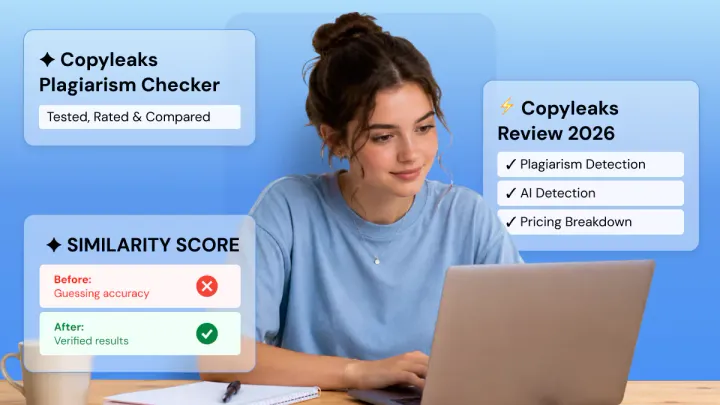
Copyleaks Plagiarism Checker review: we tested verbatim, minor-change, and paraphrased content to see how its 3-layer detection performs. See pricing, AI-detection accuracy (77%-96%), free plan limits, and how it compares to Phrasly in a head-to-head scan before you subscribe.
Does Canvas Have a Plagiarism Checker? What It Uses, How It Works & What Students Should Do
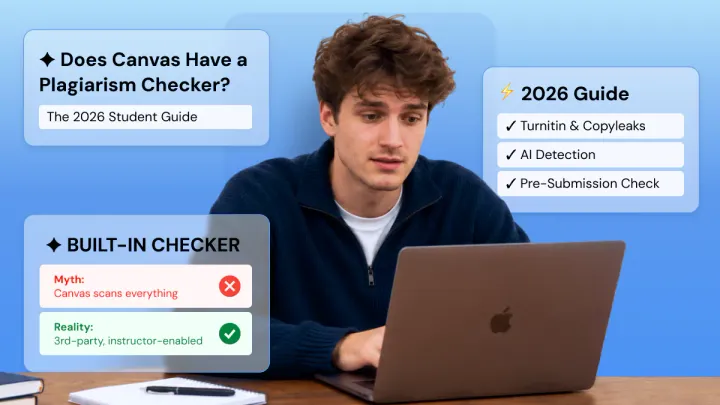
Canvas has no built-in plagiarism checker. It relies on instructor-enabled tools like Turnitin or Copyleaks. Learn how scanning actually works, whether Canvas detects AI writing (ChatGPT, Claude, Gemini), and how to check your paper for plagiarism and AI content before you submit.