Free Plagiarism Checker for Students: Options, Limits, and Essay Checks
14 min read
Is there a free plagiarism checker for students? Yes! But free can mean three different things. One full scan, a monthly word allowance, or a short excerpt check that leaves most of your essay unread.
The question isn't only which free plagiarism checker for students to pick. But whether your whole paper fits. Whether you can see the sources behind each match.
For checking a full essay in one free scan, Phrasly is the strongest fit. It takes up to 5,000 words. Your score shows without signing up. It unlocks the matched sources and a PDF with a free account.
If your school offers its own draft check, use that first. Every plagiarism checker free for students below is judged on what you actually get without paying.
Phrasly publishes this guide. Access terms were checked on September 30, 2026. The tool comparison is based on published offers, plus one small hands-on test run on October 3, 2026.
Check Your Essay with Phrasly's Free Plagiarism Checker
Paste your essay or upload a file. Your first scan is free, no signup needed to see the score.
Which Free Plagiarism Checker Should Students Use?
The best free plagiarism checker for students is the one your whole essay fits in. And it shows the sources behind each match. Phrasly fits a full essay in one free scan.
Paperpal suits several shorter checks inside a monthly allowance. Quetext and DupliChecker work for single passages. A thesis usually needs a paid or campus report.
What is the best plagiarism checker for students?
Before choosing any free online plagiarism checker for students, ask three questions:
Does my paper fit? Compare your word count with the per-scan cap or monthly allowance.
Can I see the sources? A score with no source links tells you something matched but not what to fix.
Can I re-check after revising? One free scan is great for a final review. A monthly allowance is better for several drafts.
Tool | What's free (published) | Sources visible free? | Best student fit | Main limit |
|---|---|---|---|---|
Phrasly | One free guest scan per network, 50 to 5,000 words | ✅ Yes! After a free account. Matches, source links, PDF | One full essay before submission | Later scans need a purchase or subscription credits |
Paperpal | Up to 7,000 words per month, resets monthly (vendor) | Partly: Overall score and top 3 sources (vendor) | Several shorter checks across a month | Full report is paid |
Quetext | Free plan up to 1,000 words (vendor pricing page) | ✅ Yes, in our test: score, highlighted matches, and source links | Short responses or one passage | ❌ Most essays run past 1,000 words |
DupliChecker | Free: Up to 10,000 characters per search (about 1,700 words), no signup (vendor page, checked October 3, 2026) | ✅ Yes, in our test: score, exact/partial split, highlights, and source links | Quick short-text checks | ❌ Long papers must be split |
These are published offers, checked September 30, 2026. Not accuracy rankings. Competitor details come from each vendor's own pages.
To be fair about the trade-off. If you need several free checks over a month, Paperpal’s monthly allowance beats Phrasly's single free scan.
Phrasly wins when you need one full-essay scan with source links. And a downloadable report.
For a market-wide view beyond students, see this roundup of the best plagiarism checkers.
🧪 Our One-Document Test
We built one 599-word document with four labeled paragraphs on a single topic, using public-domain sources that are widely published online.
(A) Original writing created for the test. (B) About 100 words copied word for word from Thoreau’s Walden (1854), with no quotation marks or citation. (C) A close synonym-swap paraphrase of Emerson’s “Self-Reliance” (1841), with a citation. (D) One correctly quoted and cited sentence from Emerson’s Nature (1836).
Each tool got one scan on October 3, 2026, with default settings. The same text was pasted into every tool. Paperpal, Quetext, and DupliChecker were tested on free access. Phrasly was tested while signed in to a Phrasly account.
Sample | Phrasly | Paperpal | Quetext | DupliChecker |
|---|---|---|---|---|
Overall score | 24% matched (15% full, 9% partial) | 16-22% similarity | 25% (5 matches, 4 sources) | 15% (all exact match) |
(A) Original | ✅ Not flagged | No passages highlighted | ⚠️ 1 sentence matched to an unrelated LinkedIn post | ✅ Not flagged |
(B) Copied, uncited | Partly: 2 of 3 sentences (1 full, 1 partial) | No passages highlighted | ✅ All 3 sentences, Walden quote pages | ✅ All 3 sentences, Walden sources |
(C) Close paraphrase | ❌ Not flagged | No passages highlighted | ❌ Not flagged (only the intro sentence matched) | ❌ Not flagged |
(D) Correct quote | Not flagged | No passages highlighted | Not flagged | Not flagged |
Visible for free | Score, full/partial split, highlights, PDF report (signed in) | Score range only; no highlighted passages | Score, highlights, source links | Score, exact/partial split, highlights, source links |
Four samples cannot establish overall accuracy. A paywall or account wall is recorded as an access result. Not a detection miss.
What the test showed
Copied text: Quetext and DupliChecker flagged all three copied sentences in (B). Phrasly flagged two of the three, labeling one as a full match and one as a partial match. Paperpal reported a 16-22% similarity range but did not show which passages matched in its free view.
Close paraphrase: No tool flagged the synonym-swap paraphrase in (C). This is the most useful result for students. A low score does not mean a paraphrase is safe, so compare your wording with the source yourself.
Original writing: Quetext flagged one ordinary sentence in (A) against an unrelated LinkedIn post. A match is a place to look closer, not a verdict.
Scores: The same text scored between 15% and 25% across the four tools. A higher score did not mean better detection, which is why scores from different checkers, including Turnitin, should not be compared directly.
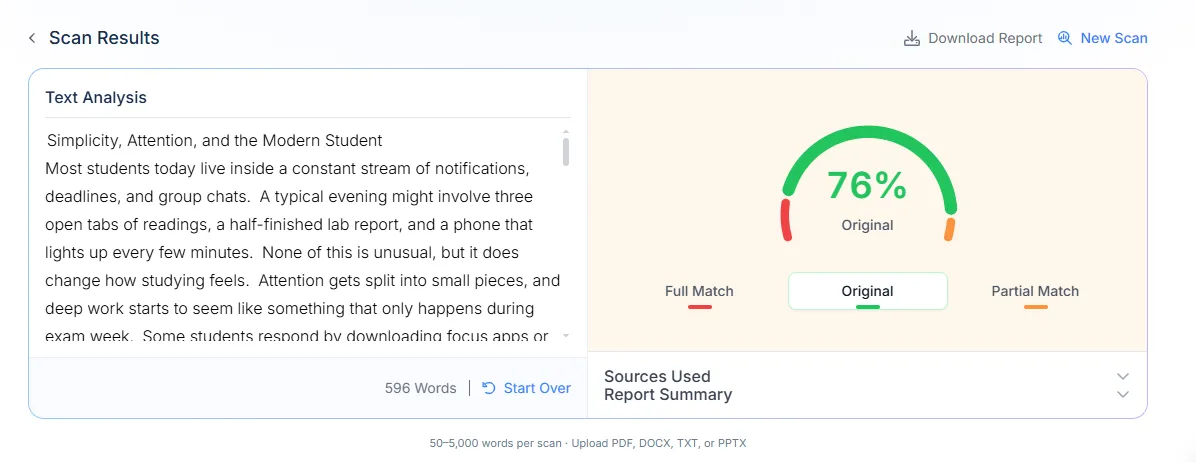
Phrasly result: Phrasly read all 596 words of the test document. Returned a 76% original score. The gauge splits the other 24% into full matches and partial matches. Sources Used and Report Summary sit below the score.
The Download Report button saves the PDF.
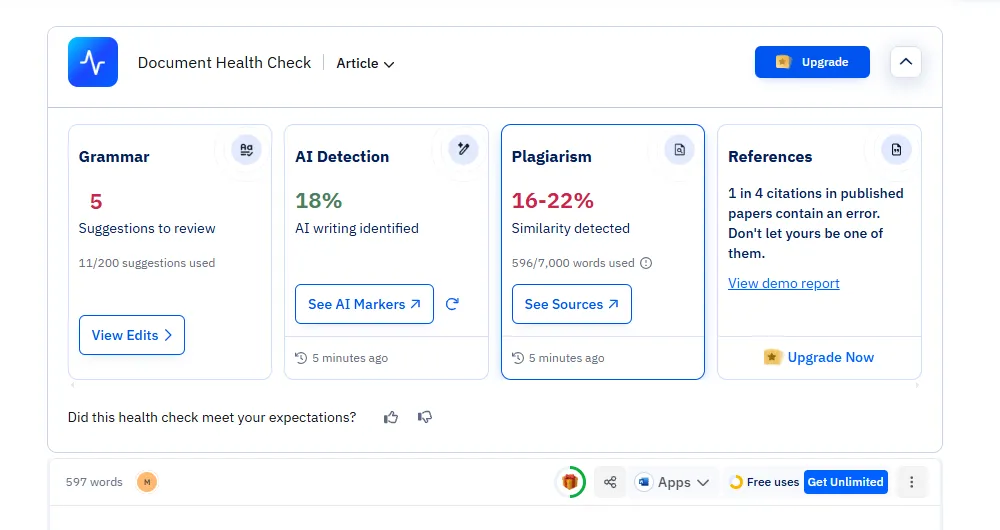
Paperpal result: Paperpal shows plagiarism as one card in its Document Health Check. Next to grammar and AI detection. The free plan gave a 16-22% similarity range.
Counted 596 of the 7,000 monthly words as used.
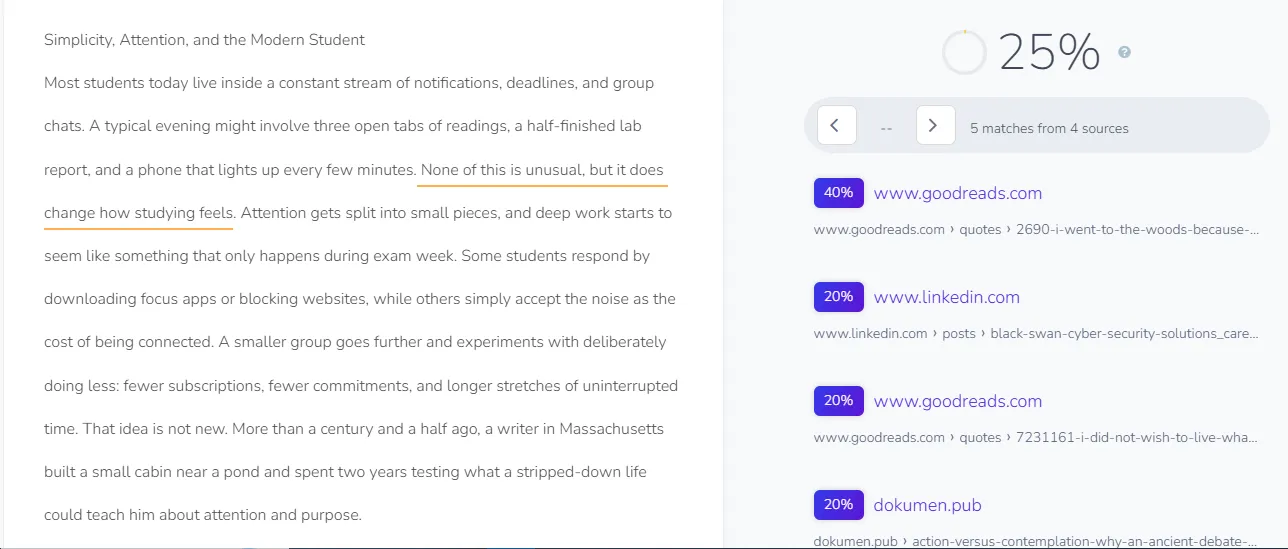
Quetext result: Quetext scored the document at 25%. With 5 matches from 4 sources listed on the right. The underlined sentence is from the original paragraph (A).
Quetext matched it to an unrelated LinkedIn post. The Goodreads links point to the copied Walden passage.
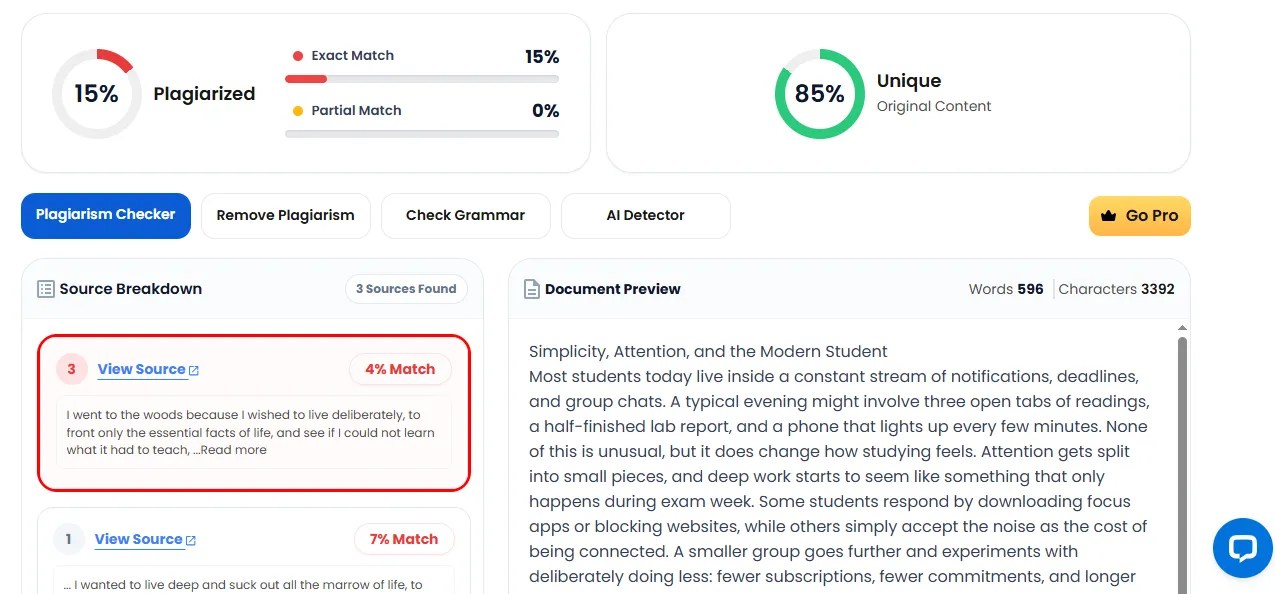
DupliChecker result: DupliChecker reported 15% plagiarized. All exact match and 85% unique. The Source Breakdown lists 3 sources. Each with a View Source link and the matched text.
The highlighted source shows a Walden line from paragraph (B).
Phrasly: One Free Scan for a Full Essay, With Source Links
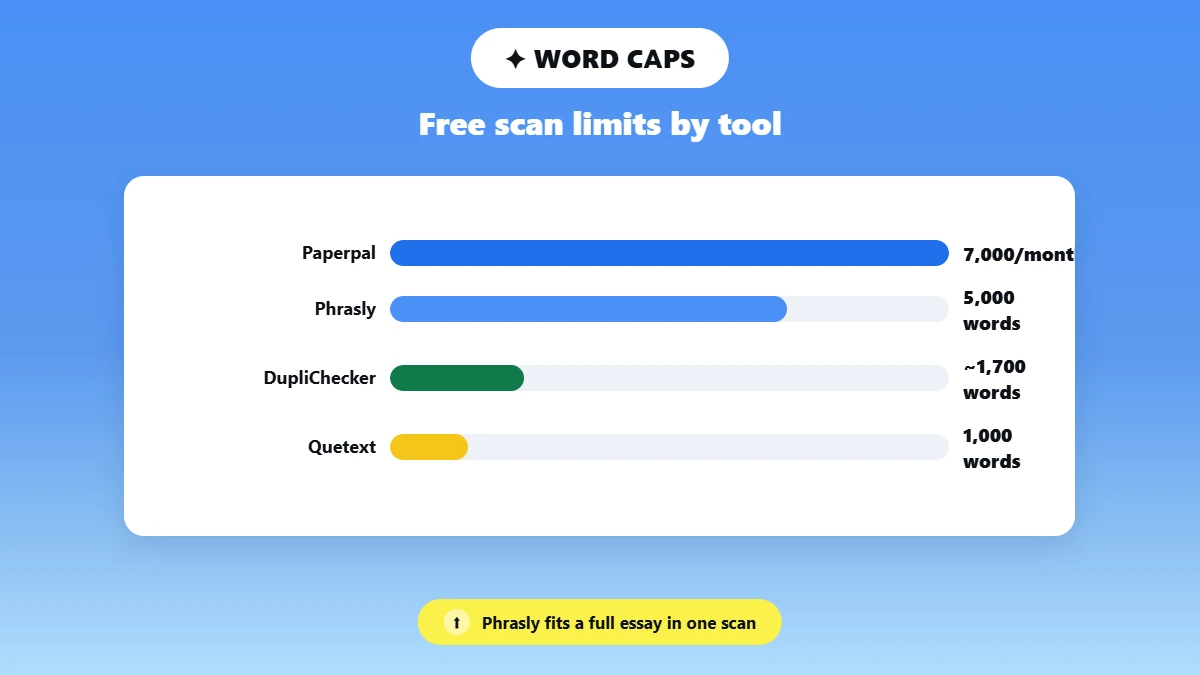
Phrasly is listed first because a 5,000-word cap fits most undergraduate essays in a single pass. You are not stitching together partial checks.
As a plagiarism checker for students, it lets you paste text or upload a PDF, DOCX, TXT, or PPTX file up to 50 MB. This makes it a practical document plagiarism checker for drafts saved in Word or slides.
PDFs need selectable text. Image-only scans are not supported.
Your similarity score appears without signing up. Creating a free account unlocks that scan's highlighted matches and source links. And a downloadable PDF report.
Completed scans, including the first one free, are saved to your account. And can be deleted from Documents.
The limits: You get one free guest scan per network. After that, you buy individual scans. Or use plagiarism credits included in a subscription.
See the Phrasly pricing page for current options.
The plagiarism scan does not include AI detection. This is a separate tool.
Paperpal: A Monthly Allowance for Academic Drafts
Per Paperpal’s tool page, checked September 30, 2026, the free plan covers up to 7,000 words per month. It resets each calendar month.
The free standard report shows the overall similarity score. It also shows the top 3 sources. The full reports sit on paid plans. These are vendor claims. If you plan to re-check after each round of revisions, Paperpal is the better free pick.
Quetext: Good for Short Assignments
Quetext's pricing page lists its free plagiarism checker at up to 1,000 words. Some older reviews still quote 500 words. Trust the live figure. Either way, a 1,000-word cap leaves most essays partly unchecked.
Quetext is better for a discussion post or a single section.
This Quetext plagiarism checker review covers the details.
DupliChecker: Quick Checks on Short Text
DupliChecker is a long-running free checker. Its live checker, viewed on October 3, 2026, caps each free search at 10,000 characters. That is about 1,700 words, based on our test text. Its homepage says no registration is needed. In our test, it showed highlighted matches and source links for free. Older third-party listings still quote 1,000 words per search.
Treat it as a quick check for a short passage rather than a full-essay tool.
This DupliChecker review goes deeper.
When a Paid Academic Plagiarism Checker Makes Sense
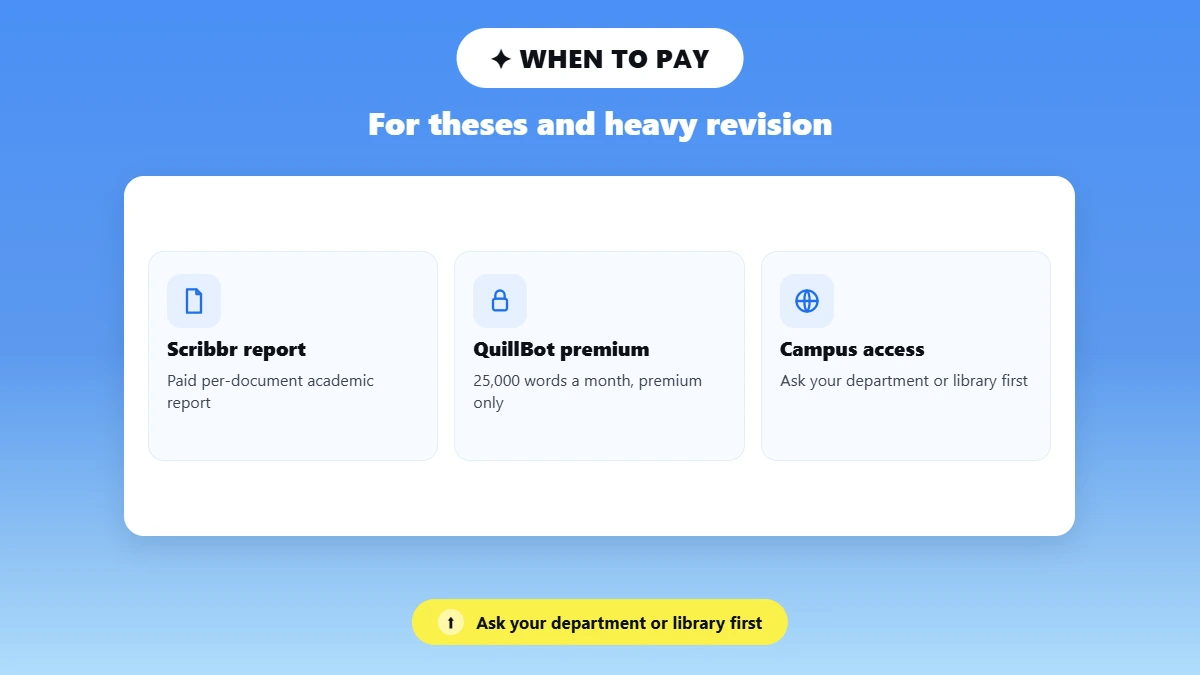
For a thesis, a dissertation, or several rounds of revision, an academic plagiarism checker may be worth it. Scribbr sells a paid per-document academic report. QuillBot's plagiarism checker is Premium only. 25,000 words per month.
"Included with Premium" is not the same as free. Ask your department or library first. Because campus access to a university plagiarism checker may already cover you.
One caution: Some free checkers sit on essay-writing marketplaces. Checking your own draft is fine. Buying an essay is contract cheating.
This PapersOwl plagiarism checker review explains the concern.
How to Check Your Essay for Plagiarism for Free (6 Steps)?
A free plagiarism check for students works best as a routine. Not a one-click verdict. Read your assignment rules.
It makes a clean copy and pick a checker that fits your full essay. It scans and opens every matched source. Then fix citations or rewrite from your own understanding. Finally, submit through your school's required system.
Here is how to check plagiarism for free for students. Using any essay checker for plagiarism.
Read the assignment rules. Check whether outside checkers are allowed. Whether your course offers a draft check. And how quotes and references are treated.
Don't borrow another class's "acceptable" percentage. Each instructor sets their own expectations.
Make a checking copy. Remove your student ID number, name, and contact details. Confidential research, participant data, or restricted course material belongs in an approved campus workflow. Not a public tool.
Pick a checker your essay fits. Compare your word count with the per-scan cap, monthly allowance, or one-time offer.
If it doesn't fit, check in sections and note which parts stay unchecked. Drafting in Docs?
Here's how to check for plagiarism in Google Docs or export a file.
Scan the full draft. Paste the text or upload a supported file. Confirm the tool read all of it. Image-only PDFs need converting to selectable text first.
Paste your essay or upload the file to the Phrasly plagiarism checker for students for a full-essay scan of up to 5,000 words. Your first scan is free. A free account unlocks the matched sources and PDF report.
Open every matched source. Look for missing quotation marks. Citations that don't support the claim.
Wording is still too close to the original, and there are incorrect references. Focus on substantial borrowed material. Not stray common phrases.
Revise, save the report, and submit through the required channel. Keep your version history as proof of your process. Check whether another scan is covered before assuming you get a free rescan.
What Should You Do with a Matching Passage?
A match is a place to look closer. Not a verdict. Any originality checker for students only shows where your text overlaps a source.
Open that source, see exactly what you borrowed. Pick the right fix. Add quotation marks and a citation. Rewrite the idea from your own understanding with credit. Or leave a correct quote or reference alone.
What you find | What to do |
|---|---|
❌ Exact source wording, no quotation marks | Quote and cite it, or explain the idea in your own words and credit the source |
✅ A correctly formatted, relevant quotation | Check the citation and that the assignment allows that much quoting |
❌ A paraphrase that tracks the source closely | Rebuild it from your understanding, with your own structure, and cite |
✅ A highlighted reference-list entry | Check it is accurate: Keep it |
A common phrase or standard term | Read the context before changing anything |
A match to your own earlier assignment | Check the course rules on reuse and disclosure |
Never delete a necessary reference just to lower your score. A smaller number with missing credit is a worse paper. Not a safer one.
📝 Teaching Example: Patchwriting Vs Real Paraphrase
This is a made-up teaching example. Not a test result:
Source sentence: "Urban tree cover lowers summer street temperatures by shading pavement and releasing water vapor through its leaves." (Rivera, 2024)
❌ Patchwriting: "City tree canopy reduces summer road temperatures by shading asphalt and giving off water vapor through leaves."
The words changed. But the structure and idea order are the source's. A checker may flag it. And an instructor likely would.
✅ Real paraphrase: "Trees cool city streets in two ways: their shade keeps pavement from soaking up heat, and their leaves release moisture that cools the surrounding air (Rivera, 2024)."
New structure and your own explanation. Credit kept.
For the rules behind this, read is paraphrasing plagiarism.
Will a Free Checker Give the Same Score as Turnitin?
No, and it isn't meant to. Turnitin compares submissions with web content and publications. A repository of work other students has submitted. Each school sets its own options. A college plagiarism checker outside your school cannot see that repository.
Scores will differ. Use an outside check to fix sources. Not to predict your grade.
Turnitin's own guide: Understanding the similarity score for students.
It says there is no fixed score to aim for. A high score doesn't always mean plagiarism. A low one doesn't always mean there's none.
The University of Dundee Library's guide to understanding the similarity report makes the same point.
The similarity report highlights matching text. A person still has to judge it. Phrasly's own product page also notes its results may differ from Turnitin. Tools use different source collections and matching methods.
If your school offers draft access, ask whether reports and resubmissions are enabled. And how drafts are stored.
For submission steps, see how to check plagiarism in Turnitin, or compare options in this guide to Turnitin alternatives.
Is an AI Plagiarism Checker the Same as an AI Detector?
No! A plagiarism checker finds text that matches existing sources. An AI detector estimates whether writing may be machine-generated.
A low similarity score says nothing about AI use. And an AI score says nothing about copying. If you're searching for a free AI plagiarism checker for students, you actually need two separate checks.
The overlap matters because AI use is now common.
In the HEPI/Kortext Student Generative AI Survey 2026, published in March 2026, 94% of 1,054 full-time UK undergraduates surveyed in December 2025 said they used generative AI to help with assessed work.
And 12% said they included AI-generated text directly. That is self-reported UK usage. Not a plagiarism rate. It shows why many courses now check both.
Anyone hunting for a free plagiarism and AI checker for students should know that Phrasly runs these as separate tools. The plagiarism scan does not include AI detection.
Check your course's AI-use and disclosure rules separately from its citation rules.
See which AI detectors universities use.
If your course also checks for AI writing, run the same draft through Phrasly's free AI Detector as a separate check.
Is It Safe to Upload Your Essay to a Free Plagiarism Checker?
Usually, if you read the storage terms first. A free price tells you nothing about a privacy policy. Remove personal details. Keep confidential research out of public tools.
And check whether scans are saved, deletable, or added to a comparison database. A free plagiarism detector for students is only as safe as its terms.
Use this quick checklist before any upload:
Take personal details out: Delete your Name, student ID, email, and anything else that identifies you.
Keep confidential material in campus tools: Participant data, unpublished research, or restricted course content belongs in an approved university system.
Read the storage and deletion terms: Find out whether scans are saved. For how long and how you delete them.
Check for a repository: Ask whether the provider adds submissions to a database that future papers are compared against.
For Phrasly: Completed scans are saved to your account. They can be deleted from Documents. Phrasly’s privacy policy (last updated June 29, 2023) says it does not sell personal information. And keeps account data only while you have an account. You can delete your account or submit a data deletion request. Neither the privacy policy nor the Terms of Service (updated September 28, 2026) says whether scanned text is added to a comparison database.
Frequently Asked Questions
Can I check a 10,000-word thesis for free?
Not in one free scan. Phrasly takes 5,000 words per scan. Paperpal allows 7,000 per month. Check in sections. Track which parts you reviewed. Never average section scores into one number. Ask your library about campus access first.
Is 0% similarity proof my essay is original?
No! It means the tool found no matches in its own sources and settings. It does not prove authorship. And it does not confirm your citations are correct.
Why are my references highlighted?
Correctly formatted reference entries match other papers that cite the same work. That's expected. Check each one for accuracy. Then keep it.
Will checking a draft make it match itself later?
It depends on repository settings. Turnitin can store submitted work. So, ask how your school handles drafts. For outside checkers, read the provider's storage terms before uploading.
Does Canvas check my paper for plagiarism automatically?
Not by itself. Canvas relies on tools your instructor enables for each assignment. So, a check only runs if one is switched on. This Canvas plagiarism checker guide explains how it works.
Does SafeAssign check my draft for plagiarism?
Only if your instructor enables it on the assignment in Blackboard. It compares your submission with its own sources. It creates an originality report. See whether SafeAssign checks for plagiarism for details.
Check Your Sources Before You Submit
The right free checker is the one your whole essay fits in. That shows its sources. And that your course rules allow. Use the report to fix citations and close paraphrases. Then submit through your school's system.
When you want an online plagiarism checker for students for the final review, start with one full scan.
Ready for a final review? Run your essay through the Phrasly online plagiarism checker, open each matched source, and fix any citation gaps before you submit.

Written by
Muhammad Usman Ali
Pakistan
Muhammad Usman Ali is an experienced SEO content writer with 3+ years of professional writing experience. He specializes in AI tools, AI detection technologies, and search engine optimized content.