
Quetext Plagiarism Checker Review
Quetext catches web plagiarism well, but its 500-word free limit and paywalled AI detection leave students underserved. See how it compares and what works better in 2026.
Quetext plagiarism checker is among the most searched plagiarism tools out there, but many students don't learn its true limitations until it's too late and they've already turned in their papers.
Quetext ranks high, has a clean design, and boasts high detection rates. Whether it actually lives up to that promise hinges on the specific material you're submitting.
Actual testing was done to complete this review. Original, copy/pasted, and AI-paraphrased text was entered into Quetext. We took notes on what was found, what wasn't found, and where Quetext's free offering falls short.
The short answer about their dependability: Quetext excels at catching plagiarism from web sources, though it struggles with AI-generated or excessively rephrased material, which is a significant drawback for pre-submission plagiarism checks in 2026.
Check Your Work for Plagiarism before Your Submit/ Publish 👇
What Is Quetext and How Does It Work?
Quetext is a web-based plagiarism checker utilizing patented DeepSearch™ technology to detect copied, paraphrased, and patched written text matched against billions of web and academic sources.
The engine performs contextual analysis (looking at surrounding words to find matches at the level of meaning, not just phrases) and fuzzy matching (identifying text where a few words have been changed to conceal plagiarism) simultaneously.
It is this combination of features that distinguishes Quetext from simplistic text originality checkers that only detect cut-and-paste verbatim copying.
This range allows Quetext to reasonably handle duplicate content detection in most situations involving source matching.
Quetext will provide results as a percentage similarity score with color highlighting red being almost exact matches and orange being partial matches.
It attempts to parse sentence structure with NLP (natural language processing) instead of simply matching individual words, which is why it's more sophisticated than basic options.
Quetext Free Vs. Paid Plan: What You Actually Get
Quetext is free; however, the Quetext free plan word limits you to 500 words per check. If you're a student writing essays that are 1,500 words or longer, that equates to less than a third of your paper being checked by the free plagiarism tool.
Quetext plagiarism checker free plan does not include file uploads, PDF exports, or AI detection. These features are restricted to paying users.
If you're looking for a plagiarism checker for students who want to review entire essays prior to submitting them, the limitations of the free plan leave a serious practical gap.
Free Plan vs. Pro Plan Comparison 👇
Pro plans begin at $14.99/month for 100k words. Check quetext.com for current pricing before you decide, as pricing has changed several times.
How Accurate Is Quetext? Our Test Results
We tested accuracy with three standardized tests. Here's what they showed.
Test 1: Original Human-Written Content
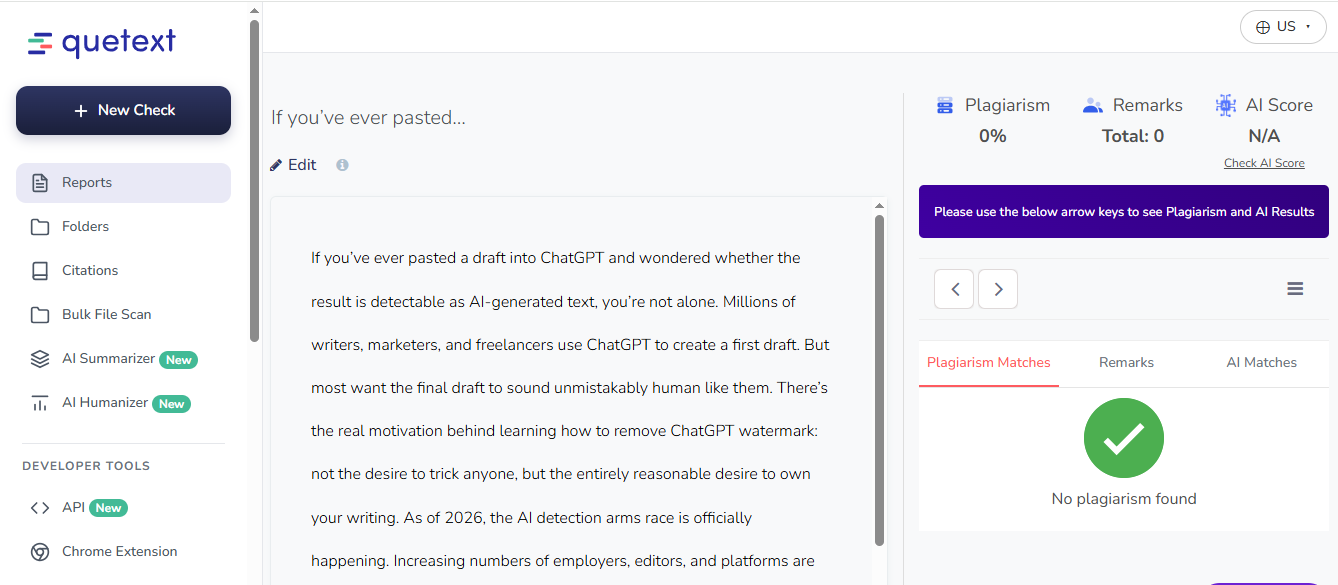
This text was entirely original and written by a human. The topic was neutral as well. Quetext gave it a score of 97%+ with 0 matches. As expected, this passed.
Test 2: Direct Copy-Paste from a Public Web Source
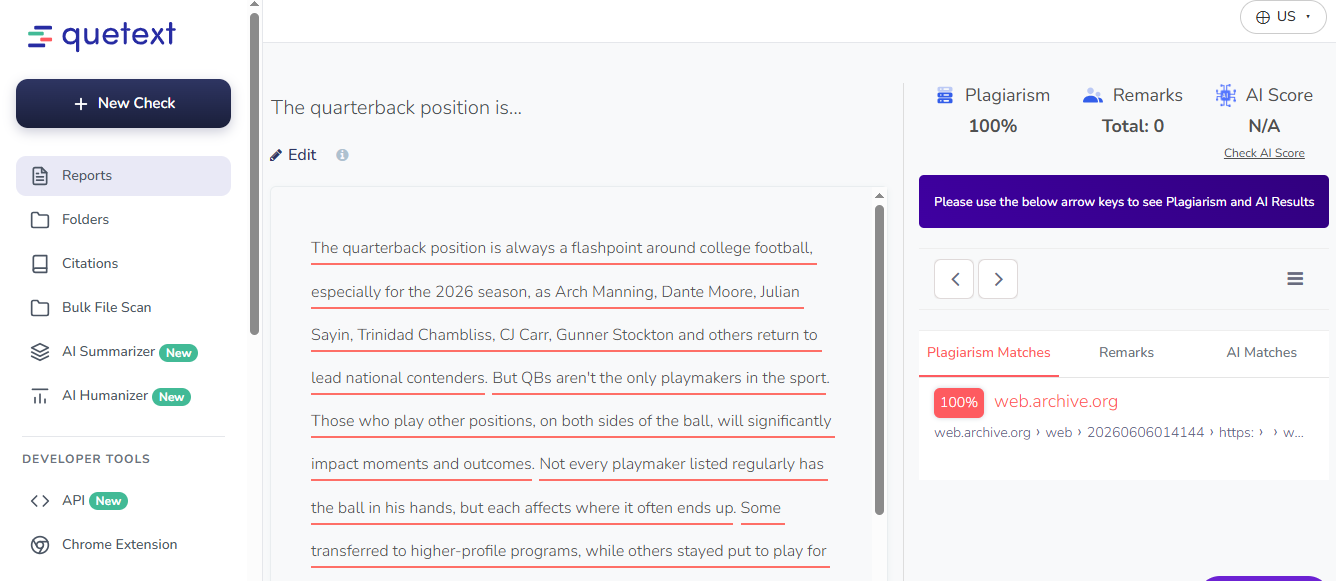
We pasted an entire paragraph from an indexed public news article word for word. Quetext picked it up instantly with a high plagiarism percentage and correctly matched the source article. The originality report was spot on and quick.
Test 3: AI-Paraphrased Text
We gave ChatGPT a 200-word article and had it paraphrase the article. We then entered the paraphrased article into Quetext. Quetext partially flagged some phrasing but missed many sentences with changed structure that a human would detect.
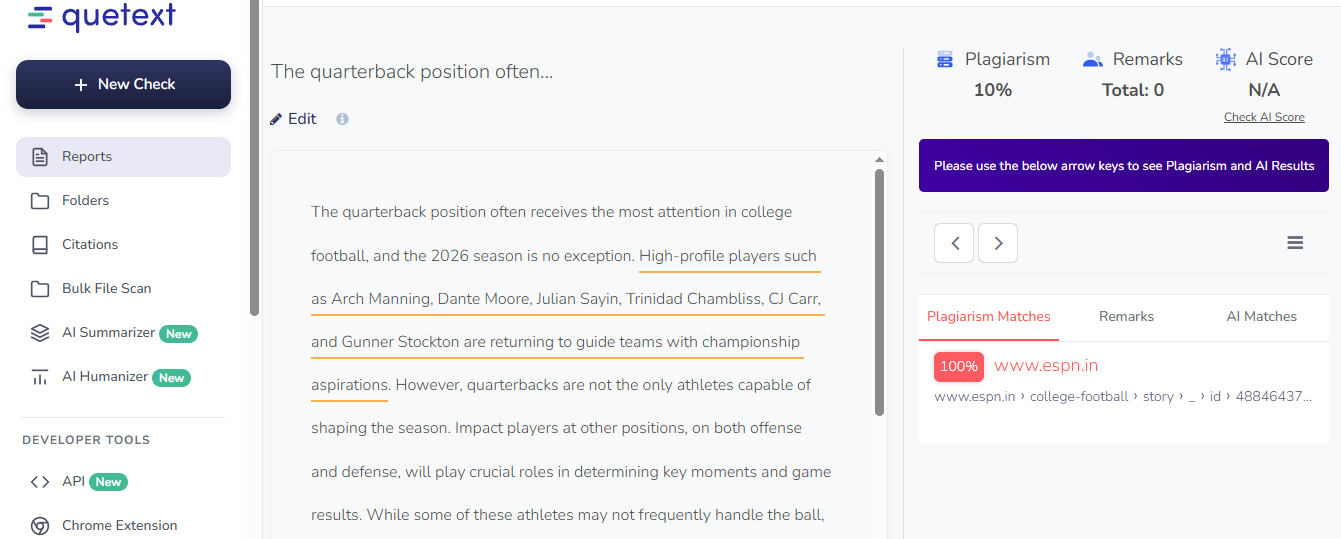
This is the key limitation.
Quetext handles direct copy-paste very well and catches paraphrased content detection most of the time. What tends to get past is AI rewrite detection, where the syntax of a sentence is heavily altered.
Quetext is good for a standard essay that hasn't been touched by AI. For AI-generated content that has undergone extensive rephrasing, relying on this tool alone is unwise.
Does Quetext Detect AI-Generated Content?
Yes, but only with the paid plan. The Pro plan has an AI content detector that detects content created by ChatGPT, Gemini, and other LLMs. The free plan does not have any AI plagiarism checker 2026 capabilities.
Can Quetext detect if something was written by ChatGPT? Yes, with Pro. Quetext accurately identified obvious AI-written paragraphs during our testing. But does Quetext detect ChatGPT that’s been humanized or rewritten? Not as consistently.
It's worth knowing that no AI detection tool has achieved reliable accuracy as of 2026.
Quetext Plagiarism Checker Vs. Turnitin: Which One Should Students Use?
Turnitin has access to your school's submission vault, a private database containing every paper ever submitted to Turnitin at your school and thousands of other institutions around the globe. Quetext does not. That's the difference.
Quetext searches the open web and scholarly journals. Turnitin searches all that, plus your institution's database.
If your classmate turned in a similar paper two years ago, Turnitin might flag it. Quetext won't.
They search different databases. They catch different things.
Quetext Vs. Turnitin: Side-by-Side Comparison 👇
Is Quetext as good as Turnitin? It is a valid alternative when checking web sources or published academic sources. When it comes to Institutional submission check access, Quetext cannot compete simply because they do not have access to that database.
Best practice: Use Quetext for a pre-submission plagiarism check to catch obvious issues before you turn something in. If you're working in Google Docs, you can also check for plagiarism directly within the platform.
A useful step before running any dedicated tool. A clear Quetext report doesn't automatically mean Turnitin will be clear too. They are measuring different things.
Quetext Pros, Cons & Who It's Best For
Pros
- DeepSearch™ technology: contextual analysis plus fuzzy matching catches patchwriting that phrase-only tools miss.
- Clean and simple UI. No learning curve, results in seconds.
- Built-in citation generator supporting MLA, APA, and Chicago formats. Useful for students fixing flagged passages.
- Privacy-first: Quetext does not store your submitted documents in its database.
- AI detection available on Pro. A meaningful addition for plagiarism checker for thesis 2026 workflows.
Cons
- Free plan capped at 500 words. The free plan is too low for full essays. This is the most significant barrier for everyday student use.
- AI detection is paywalled. The feature students need most in 2026 is not available on the free plan.
- Weaker on AI-generated content that has been heavily rewritten or humanized.
- No native Google Docs or Microsoft Word integration. You copy-paste or upload manually.
- No desktop app. browser-only tool.
- Quetext's fuzzy matching helps catch patchwriting, but it can still miss incremental plagiarism. Small, cumulative borrowing across multiple sources goes undetected because no single passage triggers a flag.
Who It's Best For
- Students use a plagiarism checker for their essays before they submit them. (First pass screening)
- Freelance authors and editors want to make sure they haven't accidentally created duplicate content.
- Teachers who want to quickly check student papers, but don't have access to Turnitin through their school.
Who Should Look Elsewhere
- Anyone expecting Turnitin-level institutional database access.
- Users who need to check full documents on the free plan. 500 words will not be enough.
- Teams requiring bulk scanning workflows or API integration.
Quetext won't save any of your documents. It's clearly stated in Quetext's privacy policy that they don't save any information you provide or give it to anyone else.
Is There a Better Alternative to Quetext?
Quetext is a decent pre-submission tool, but it has a ceiling. 500 words is free, but most students won't find that particularly useful. The AI detector is behind a paywall. And you can't match Turnitin's institutional database.
Before committing to any paid plagiarism checker, it's worth reading how the Rephrasy plagiarism checker stacks up as an alternative.
But for some users, that ceiling is where their needs start.
Phrasly Plagiarism Checker is designed to be an all-inclusive writing integrity tool.
It searches through 10B+ web pages and academic resources, detecting copy/paste, paraphrasing, reformatted, and mosaic plagiarism checker for assignments all at once.
Phrasly even includes an AI content detector (detects ChatGPT, Claude, and Gemini output) with the plagiarism scanner. You don't have to toggle between separate tools for each scan.
Writers and students who run both scans prior to submitting work appreciate that one-dashboard approach.
As far as the best plagiarism checker 2026 goes, Phrasly’s unique mix of wide database access, integrated AI Writing detector, and file upload capability (PDF, DOCX, TXT) makes it our top pick for those who have exceeded Quetext’s quotas.
Keep in mind, it is a paid tool. Check out current prices and plans before subscribing.
FAQs
Is Quetext free to use?
Yes! Quetext has a free plan. But it's limited to 500 words per check, which won't even cover most introductory paragraphs for essays. There's no AI Detection on the free plan.
Pro plans begin at $14.99/month for 100k words and get file uploads, PDF export, and AI Detection.
How many words can you check for free on Quetext?
Plans start at 500 words per check for free. That's about half of an average school essay intro. You can only scan full documents if you pay for a plan.
For students who need to scan entire essays at once, Phrasly's plagiarism checker is worth checking out.
Does Quetext detect AI-generated content?
Yes, but only on the Pro plan. Quetext's AI detector reliably detects ChatGPT, Gemini, and other similar tools. Accuracy is fairly high for content that is obviously written by AI. Accuracy decreases for rewritten/humanised content.
No AI detection tool is perfectly accurate in 2026. This is a growing concern across universities, tightening their academic integrity guidelines around AI-assisted writing.
Is Quetext better than Grammarly for plagiarism?
They serve different needs. Quetext is a standalone text originality checker designed from the ground up to detect plagiarism percentages. Grammarly's plagiarism detector is a plugin within a writing enhancement tool.
For a more focused academic alternative, see how Paperpal's plagiarism checker compares as a dedicated option for students and researchers.
Quetext's DeepSearch technology is better suited for dedicated plagiarism checking. Grammarly offers a better experience for correcting writing, with simple plagiarism detection included. The two platforms are not replacements for each other.
Is Quetext safe: does it store your documents?
Quetext does not keep your uploaded files/documents. It clearly mentions this on their privacy policy. They do not save, nor do they distribute to anyone. They only take your account info and billing.


Keep reading

12 Types of Plagiarism Explained (With Real Examples)
Learn the 12 types of plagiarism with real examples, understand the consequences, and discover practical ways to avoid academic mistakes before you submit your work.
How Can You Prevent Plagiarism? 10 Proven Strategies for Students (2026)
Learn how to prevent plagiarism with 10 practical strategies, including proper citation, paraphrasing, note-taking, and plagiarism checking, to submit original work with confidence.