Is 20% AI Detection Bad? What Your Score Actually Means
9 min read
There is no universal threshold for how much AI detection is acceptable. No detector has, nor does any school use, one official "safe" score.
Whether something is acceptable depends on your school's policy and what website you used to check your work.
You're likely here because you want to know how much AI is acceptable to have when you see a number from your report. The short version is: a percentage on its own rarely tells the whole story.
This question has never been more important.
Pew Research Center reported in February 2026 that 54% of U.S. teens have used AI chatbots to help with schoolwork. This is no surprise, given that so many students are looking at a score.
If you're specifically wondering whether Turnitin can detect ChatGPT, that's a common enough question that it deserves its own answer.
This guide includes information on what the AI score actually means and what percentage of AI is acceptable in various contexts.
A band-by-band explanation of scores from 0-100%, why an essay can get different scores on different tools, and when you should care about a score.
✅ Tip: You can check your own writing for free with Phrasly's AI Detector before you submit anything.
Is 20% AI Detection Bad? (Short Answer)
Generally speaking, no! 20% is normally low- to moderate-risk AI detection. It also does not on its own prove that your work was written by AI.
Whether a 20% AI detection is bad depends on your context: what school/client you're submitting to, what detector got you that score, and what sentences were flagged.
A little-known Turnitin tidbit: Scores ranging from 1% to 19% will display as an asterisk rather than a number. The reason for this behavior? Turnitin's internal testing revealed a high number of false positives for scores in this lower range.
That brings us to 20%. That's effectively the first real highlighted number a reviewer will see. Part of why students also ask is, "25 AI detection bad?"
Retain the nuance bidirectionally:
Just because a student's score is low doesn't mean they didn't cheat ☑️.
And just because a student's score is high doesn't mean they cheated ❌.
What an AI Detection Score Actually Measures?
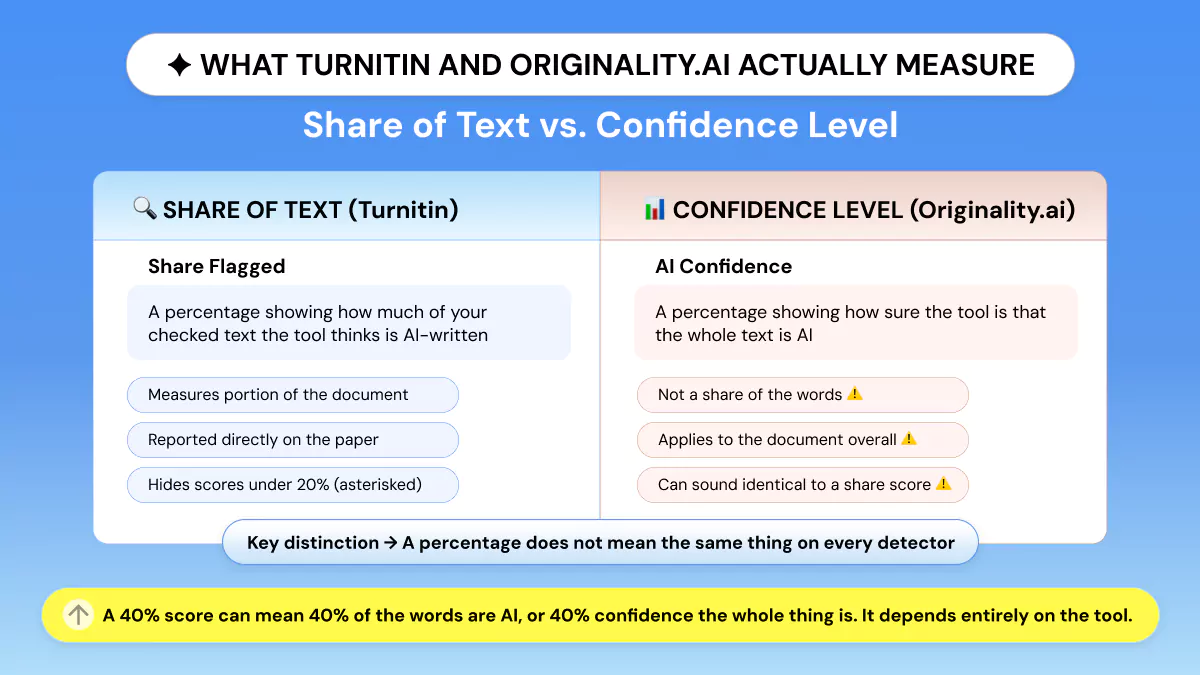
This is also where most explanations fail and where most of the confusion surrounding what percentage of AI detection is acceptable stems from: detectors are not all measuring the same thing with their percentages.
Share of Text Flagged (Turnitin)
Turnitin's score represents the percentage of your submitted text that the model thinks is AI-written or paraphrased.
So, if Turnitin says your essay is 40%, they are predicting that approximately 40% of the words in that paper appear to be AI-written.
Confidence Level (Originality AI and Similar Tools)
On Originality AI, the percentage indicates something else entirely: it reflects confidence, not composition.
So when you receive a 40% Originality AI score, it means that the tool is only 40% confident that the content was written by AI overall. It does not mean 40% of the text was AI-generated.
That is how Originality AI explains their score. 40% on two different tools can mean vastly different things. One tool is assessing how AI-like your content is. The other readability tool is measuring confidence.
Turnitin background: They've checked approximately 280 million student papers since 2023; of those, 9.9 million or so (3.5%) scored >80% AI-written. Remember that a large majority of submissions score far lower than that.
AI Detection Score Guide: 0-100% (What Each Band Means)
Here's a general risk-band cheat-sheet students may consult to sanity-check themselves if a score is suspicious, like 20%, 25%, is 30 AI detection bad, is 33 AI detection bad, or is 36 AI generated bad.
Treat this as a rough read, not an official rule enforced by any detector or school.
Score | General Risk Read | What It Usually Means / What To Do |
0-19% | Low risk ✅ | Often normal for human writing. On Turnitin this range is asterisked and not scored. Usually, no action beyond keeping your drafts. |
20-39% | Low-to-moderate, borderline | May get a closer look at some schools. Check which sentences are flagged and read the assignment's AI policy. |
40-59% | Moderate | More likely to trigger a manual review. Be ready to show your process (drafts, version history, sources). |
60-79% | Elevated | Likely to be questioned. If you wrote it yourself, gather evidence. If AI helped, rewrite it in your own voice. |
80-100% | High ❌ | Strongly flagged. Expect scrutiny no matter how it was written. If human-written, look into false-positive causes. |
Turnitin's own data shows submissions scoring 80%+ AI rose to about 15% (14.8%) of the papers it reviewed between October 2025 and February 2026.
Up roughly 4.5x from just 3.3% when the detector launched in 2023, which speaks directly to what percent AI is too much from a purely statistical standpoint.
The following are general guidelines rather than hard limits set by any detectors or schools. 30% might be acceptable risk at one school and considered a serious problem at another whose professor expects nearly 0% AI.
If your self-written draft lands in the amber or red zones, false positives are very likely ❌.
And if it's an AI-assisted draft, you want to sound like yourself; Phrasly's AI Humanizer is designed to rewrite it into a natural voice that consistently passes detectors in our testing ✅.
Use it to refine your own draft. Never use it to fake authorship.
What Percentage of AI Is Acceptable on Turnitin?
Turnitin doesn't define an acceptable percentage, nor does it define what percentage of AI is acceptable on Turnitin. Turnitin reports a score. Your instructor or institution decides what it means.
Since policy differs from school to school so much, there is no definitive answer for how much AI detection is acceptable Turnitin wide, or what percentage of AI detection is allowed in general.
Scores between 1-19% will display with an asterisk next to the percentage, but no highlighted number. This is due to Turnitin's testing revealing a higher number of false positives in this range.
Turnitin's inflated claims of 98% accuracy and less than 1% false positives only apply to documents with greater than 20% matches flagged.
On non-native English writing, heavily edited drafts, or technical writing, independent and university testing has put false positives around 5-12%. A figure credited to independent testing, not to Turnitin itself.
Here's a deeper look at what causes AI detector false positives and how to protect yourself from them.
ZeroGPT's free tool has reported false-positive rates of approximately 15-25% when tested by third parties, highlighting why no single score should be deemed conclusive.
See this full breakdown of whether ZeroGPT actually works for more on its accuracy.
But when someone wants to know what percent of AI detection is allowed by their university, the honest answer is: look at your syllabus or academic-integrity statement, because Turnitin isn't setting that policy.
How to See AI Detection on Turnitin as a Student?
Students will not be able to see the AI indicator on their own reports.
It's embedded in the instructor's view of the report, distinct from the similarity/plagiarism percentage. If you'd like to see what it looks like before submitting, use an external checker first, such as Phrasly's free AI Detector.
Why Does the Same Essay Get Different AI Scores?
Can AI use in essays be detected perfectly every time by every detector? No, and that’s the source of most of the misunderstandings here. Every detector is built differently; they are fed different data and have different cut-off points.
So the same paragraph can get a 90% on one tool and a 20% on another. A score means it predicts something, not that it proves something.
For a closer look at which AI checkers are most accurate, it's worth comparing a few before trusting any single score.
That means both careful writers, non-native English speakers, and users of formal British style can be falsely flagged.
ZeroGPT analyzed 30,000 human-written essays from Phrasly. It identified 26.4% as AI-written essays.
An important lesson is that a high score isn't always right.
Acceptable AI Levels by Context: Students, Universities, Marketers, Workplaces
There is no universal number that works for how much AI percentage is acceptable in all scenarios. Each scenario places its standards upon itself.
Universities/students: It depends! The policy can be found in your syllabus or on your school's academic integrity website.
There is a wide range of rules because that is honestly the best answer to the question of how much AI detection is acceptable for students or how much AI detection is acceptable for universities.
Some schools will manually check higher scores, and some teachers will have you expect near 0% AI regardless of what percent of AI is acceptable elsewhere.Publishers and SEO content: What percentage of AI-generated text is acceptable here is really an editorial and search-quality question. It is not a detector-score question.
Google rewards useful content, no matter how it was generated. Thin, unedited AI content will still perform badly.Workplaces and agencies: How much AI-generated text is acceptable depends on your client contract. Some require you to disclose AI usage plainly. Whatever your client or company policy requires is the bar.
Freelance & contract writers: Read your contract before you write a word. Some clients outright ban AI assistance. Others only require a human final pass.
So the acceptable percentage is determined by the agreement, not any tool's score.
AI Score vs. Plagiarism (Similarity) Score: Not the Same Thing
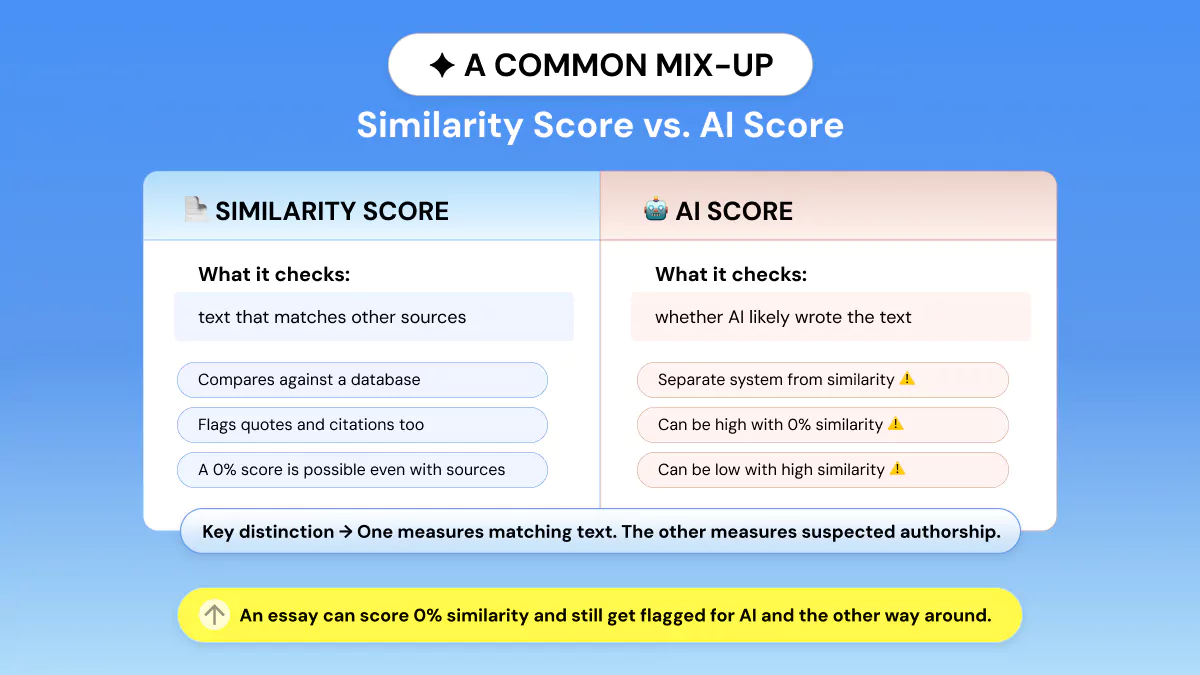
Similarity (plagiarism) score identifies matching text. The AI score is a separate calculation that attempts to predict if the text was written by AI.
You can easily have a 0% similarity score and still receive a high AI score.
Similarity Score | AI Score |
Measures text copied or matched from other sources. | Measures the estimated likelihood that AI generated the text. |
When an AI Score Actually Needs Action?
So how much AI detection is too much before it demands your attention? Follow these steps:
Steps to Take Before You Worry
Check your school or client policy first. The score itself doesn't set the rule.
Look at which sentences are flagged, not just the overall number.
Keep drafts and version history as evidence of your process.
If you wrote it and it scored high, treat it as a possible false positive and gather proof.
If AI helped, rewrite it enough that it genuinely reflects your own thinking and voice.
What to Do if Your Own Writing Gets a High AI Score?
A false positive is not an answer you can't defend.
✅ Keep your Google Docs or Word version history and show your research notes. Ask to be assessed on your process.
Run a second detector as a sanity check and read up on why your essay might get detected as AI in the first place.
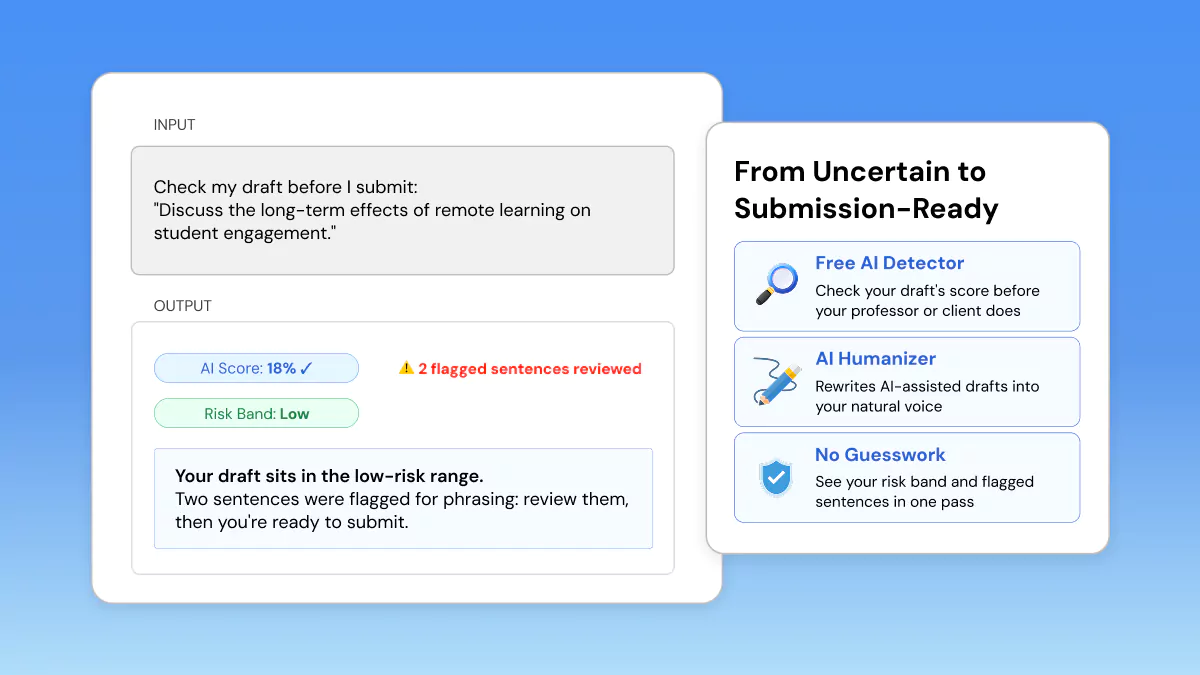
If it's an AI-assisted draft that sounds a little robotic, Phrasly's AI Humanizer rewrites it into natural, human-sounding text that's designed to pass detectors 👊
So your real ideas don't get mistaken for machine output.
FAQ: How Much AI Detection Is Acceptable?
Is 20% AI detection bad?
20% is generally considered low- to moderate-risk and won't turn into evidence of AI use on its own. It depends on your school's policies, the detector they use, and which text was matched.
Turnitin doesn't even score below 1-19% because of the risk of false positives.
Is 30% AI detection bad?
A 30% puts you in a gray area that might require further review by some schools but is not conclusive evidence of wrongdoing. Review your flagged sentences, read your school's AI detection policy, and save your drafts for evidence.
What percentage of AI is acceptable on Turnitin?
Turnitin doesn't provide an acceptable percentage. They report a score; your school makes that determination. Turnitin also masks results between 1-19% (*) due to inflated false positives. Always follow your course or department policy.
Is there a safe AI detection percentage?
No! There is no one safe passing AI score. Schools/instructors set their own thresholds, not detectors, ranging from nearly zero tolerance to manual review only if over 20-25%.
Does a high AI score mean I cheated?
No! Scores indicate probability, not proof. Human-written work, particularly from ESL writers and/or highly formal academic prose, can be false-flagged. On one test set of 30,000 human essays, 26.4% of essays were flagged as AI.
Why do two detectors give my essay different AI scores?
Different detectors have been trained on different data with different thresholds so that identical text can score 20% on one tool and 90% on another.
Consider any individual score as merely one data point rather than a verdict. This is also why is GPTZero accurate is worth reading before you trust one number.

Written by
Muhammad Usman Ali
Pakistan
Muhammad Usman Ali is an experienced SEO content writer with 3+ years of professional writing experience. He specializes in AI tools, AI detection technologies, and search engine optimized content.