Why Is My Essay Detected as AI When I Wrote It?
13 min read
Updated September 2026
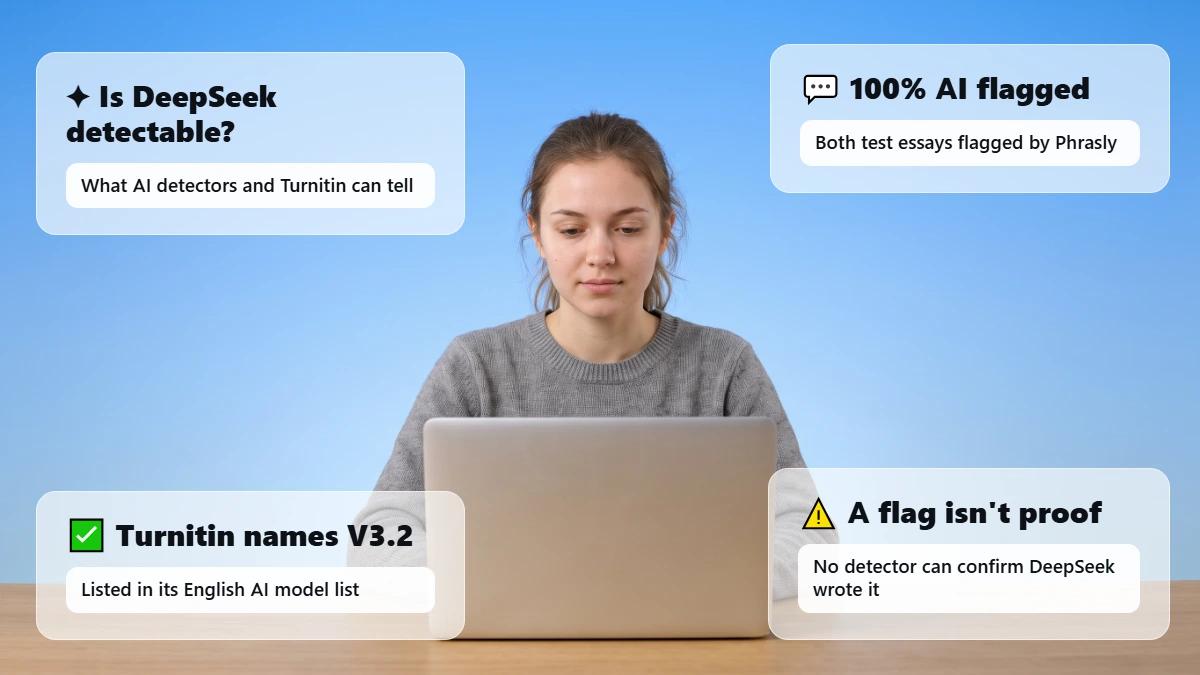
AI detectors don't know who wrote your essay, they check if it matches patterns common in AI text. Formal wording, a short essay, heavy grammar or paraphrasing tool use, and English not being your first language can all raise your score. Before changing anything, save your draft and version history, review the flagged sentences, and check your school's AI policy.
I wrote it myself, so why does it say AI? That's the exact question most readers land here with, and the honest answer is that a flag on your essay is a probability estimate, not proof of anything.
Here's what this guide covers: what's actually behind it, what your score really means, how to fix a flagged passage without losing your own voice, and how to prove the work is yours.
We'll cover all that, but first check your own essay. Paste your unchanged draft into Phrasly's free AI Detector and see how much of it gets flagged.
It's completely free: sign in once and scan as many times as you want. A Phrasly score can differ from Turnitin or Originality.ai, so treat it as a starting point, not proof.
Find Your Flagged Passages with Phrasly’s AI Detector👇
Why Is My Essay Detected as AI Even Though I Wrote It?
An AI detector flags writing that matches patterns it associates with AI text. It cannot prove a human wrote something, only that the patterns look human or machine-like. Consistent sentence length, generic phrasing, and a short sample can all push a score up, regardless of who actually wrote it.
The table below breaks down each factor and what to check for in your own draft.
Factor | What it looks like | What to check in your draft |
|---|---|---|
Uniform sentence rhythm | Most sentences run a similar length and follow the same structure | Read a paragraph aloud and listen for repetition in pacing |
Formulaic academic phrasing | Frequent stock transitions and generic academic phrasing | Look for the same connecting phrases repeated across paragraphs |
Technical or standardized writing | Lab reports, methods sections, and heavily formatted assignments | Recognize that formal, templated genres score differently regardless of who wrote them |
Heavy automated rewriting | A paraphrasing tool or aggressive grammar-checker reworded large sections | Compare your submitted draft against your earliest draft for major rewording |
Short passages | Fewer words give a detector less text to analyze | Notice if flags cluster in your shortest paragraphs |
Multilingual or EFL writing | Non-native phrasing patterns statistically overlap with patterns flagged as AI-like | See the research on this below, it's a documented and significant bias |
Different detector models | The same essay scores differently across tools, or after a vendor updates its model | Run the same draft through more than one tool before drawing a conclusion |
One factor deserves its own explanation because it's well documented and it's not a minor footnote: detectors are measurably harder on multilingual and EFL writers.
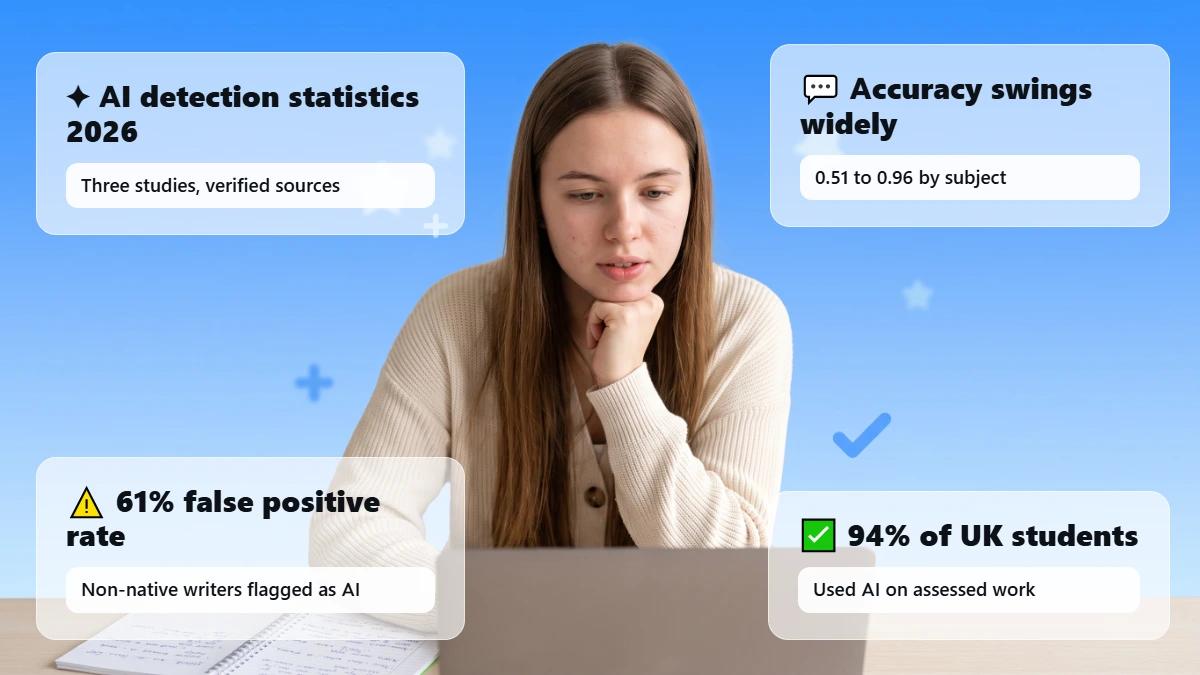
This bias is well documented, not a minor footnote: a 2023 study in Patterns by Liang, Yuksekgonul, Mao, Wu, and Zou ran seven GPT detectors against 91 TOEFL essays and 88 US eighth-grade essays.
⚠️ The detectors misclassified 61.22% of the TOEFL essays as AI-generated, while scoring the US essays with near-perfect accuracy. If English is your second language, that bias is real and worth naming if you explain a flag to an instructor.
Formulaic phrases can be one contributing signal among several, but no single word or phrase proves AI use on its own. Treat any "banned word list" you see online with skepticism.
Under the hood, detectors lean on signals like perplexity (how predictable each word is) and burstiness (how much sentence rhythm varies), among others, not "the two numbers" that decide every score.
Each vendor, Turnitin, GPTZero, Originality.ai, combines these differently, which is one reason the same essay can score differently across tools.
We've researched this in depth, our guide to why AI detectors can be wrong breaks down exactly where and how these tools can fail.
What Does an AI-Detection Score Actually Mean?
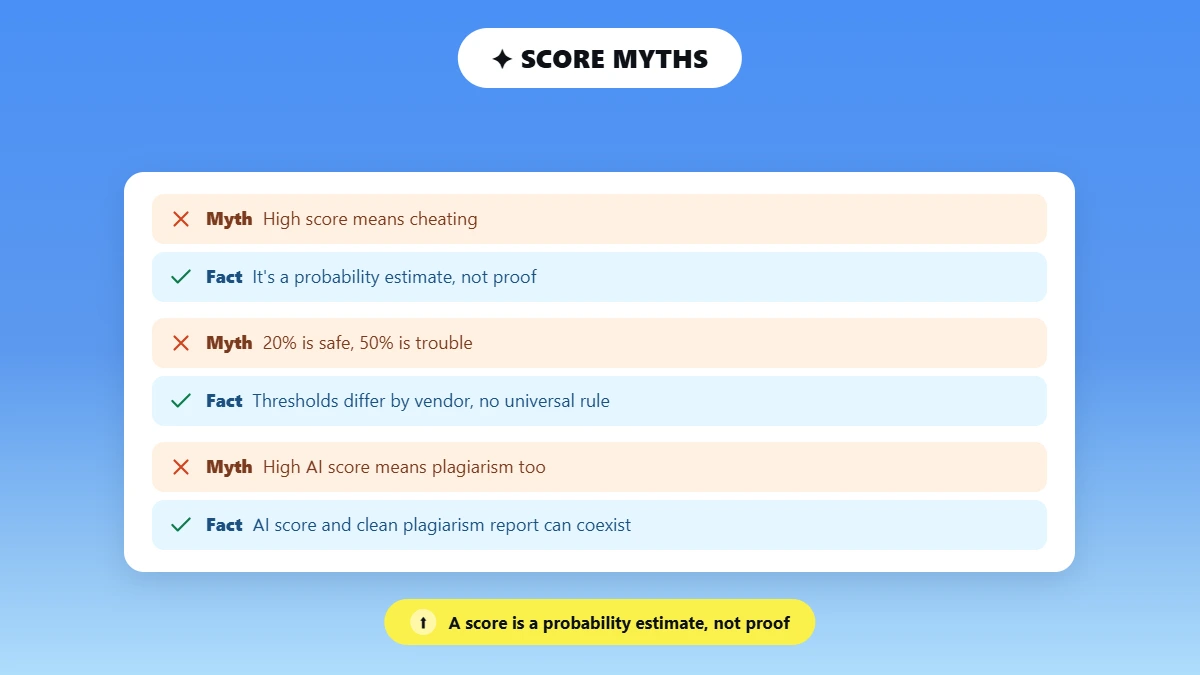
An AI-detection score is a probability estimate that a passage resembles AI-generated patterns. It is not evidence of authorship, and it is not the same measurement as a plagiarism score. There is no universal safe percentage, no fixed "20% is fine, 50% is trouble" rule, because thresholds and models differ by vendor and change over time.
Low-confidence scores get misread as confirmed findings more often than they should, which is exactly why vendors build in safeguards against false positives.
Turnitin, for instance, does not display an exact number for scores between 1% and 19%, showing an asterisk instead, and it states plainly that an AI-writing score "should not be used as the sole basis for adverse actions against a student."
Apart from the score itself, there's another distinction worth knowing. AI detection and plagiarism detection ask different questions: plagiarism checkers look for text that matches existing published sources, while AI detectors estimate how closely writing patterns resemble machine-generated text.
A high AI score and a clean plagiarism report can coexist, and that's expected, not a contradiction. That's the basic distinction.
If you specifically want to check for plagiarism on Turnitin or learn how that process works, see our guide on how to check plagiarism in Turnitin.
What you see | What it actually indicates | What it does not indicate |
|---|---|---|
Turnitin shows *% (1-19%) | The result is too low-confidence to display as a number, by design | Not a "pass," not confirmation the essay is fully human-written |
A specific percentage above 20% | The tool found text patterns it associates with AI writing | Not proof of cheating, and not a measurement of "how much was AI" |
Different tools, different scores | Vendors use different models, training data, and thresholds | Not evidence that one tool is right and another is wrong |
Now that you know what a score actually means, get a second opinion on your own essay. Run your unedited draft through Phrasly's AI Detector, save the result, and compare its highlights with the report you already have.
Use the comparison to guide your questions, not to settle the argument either way.
Note: A low-confidence AI score and academic misconduct are not the same thing. The score is a signal for a human reviewer to weigh alongside your explanation, not a finding on its own. Most academic integrity policies are written that way on purpose.
What Should I Do If My Human-Written Essay Is Flagged?
If your essay gets flagged, don't delete anything, and don't panic. First, keep your file and its version history exactly as they are. Then look at what got flagged, check your course's AI policy, and collect your drafts and notes together. When you talk to your instructor, ask them to go through the flagged parts with you instead of just accepting the score.
Do not overwrite the original file. Make a copy before you touch anything.
Save the detection report itself, plus a screenshot, plus the exact version you submitted.
Read your course or institution's actual AI policy. Requirements vary widely between departments and schools.
Review the specific highlighted passages, not just the overall score.
Gather your process evidence: outlines, earlier drafts, research notes, citation history, and version history.
Ask specifically which passages and which policy provisions are in question, rather than responding to the score in the abstract.
Request a short conversation and walk through how the essay actually developed.
Do | Don't |
|---|---|
Preserve the original submitted file and your drafts | Delete or overwrite the original before the review is resolved |
Ask which passages and which policy section are in question | Assume the score alone is the final word |
Explain how the essay actually developed | Add deliberate errors or awkward phrasing just to "look more human" |
Revise passages that are genuinely vague or generic | Rewrite the whole essay chasing a specific target percentage |
If Turnitin flagged your paper specifically, this walkthrough on responding to a Turnitin AI flag covers the process in more detail.
How to Revise a Flagged Passage Without Changing Its Meaning
If a passage is genuinely yours but reads as generic or repetitive, revise it for clarity and specificity rather than trying to defeat a detector.
The goal is writing that sounds like you, not writing engineered to score a certain way.
Add Detail a Detector Can't Predict
Generic claims are the easiest thing for a detector to flag, and also the easiest to fix, because the fix also makes the essay stronger academically.
Here's the same paragraph before and after:
Before: "This highlights the importance of clear communication in group projects. It is important to note that miscommunication can hinder outcomes. Miscommunication can cause delays. Miscommunication is a common issue (Smith, 2019)."
After: "The group missed its first deadline because two members were reading different versions of the assignment sheet, a mismatch Smith (2019) calls one of the most common causes of group project delays. Once we agreed on a single shared document, deadlines stopped slipping."
The second version fixes four things at once: the vague claim becomes a specific, real event; three short, identically-structured sentences become one varied, connected passage; the citation is still there and used correctly, not dropped; and the writer's own reasoning (what actually fixed the problem) comes through clearly. That's also, not coincidentally, why it reads as more human.
Loosen an Overly Polished Passage
Sometimes a passage gets edited until every rough edge disappears: no hesitation, no personal reaction, no sign that a person made a choice along the way.
That level of polish can be read as generic even when the essay is entirely your own.
The fix isn't to write worse on purpose. It's to let a genuine reaction or a specific decision back into the passage, the kind of detail that only shows up when someone actually lived through writing it.
Vary Sentence Structure Where It's Genuinely Repetitive
If several sentences in a row follow an identical pattern, length, or rhythm, that's worth varying on its own merits, since it usually makes the writing more readable too.
This is a real editing skill, not a workaround, and it's most useful when applied to the specific passages a detector actually flagged rather than the whole essay.
Manual revision is the right call when the essay is entirely your own work and the writing just needs sharpening.
If your institution's policy permits AI-assisted editing and a flagged passage genuinely started from permitted AI help, a tool can be a starting point, not a finish line.
Refining a Permitted AI-Assisted Draft
There's another option too: a humanizer tool is built specifically to take overly polished, uniform-sounding text and make it read more naturally.
If your institution allows AI-assisted editing and a specific passage came from that kind of permitted help, Phrasly's AI Humanizer can be a useful starting point for restructuring it.
Review every change it makes, confirm your citations and meaning are intact, put the passage back in your own voice, and disclose the assistance where your institution requires it.
It is not a way to make AI-written text pass as human, and it isn't a substitute for writing the essay yourself.
How Can I Prove I Wrote the Essay?
One document can't confirm you wrote something, but the story of how you got there can. Save your outlines, your notes, earlier drafts, any feedback you received along the way, and your file's edit history. None of it settles the question on its own, but stacked together, plus your ability to talk through why you made the choices you did, it becomes hard to dismiss.
Your Evidence Checklist
Outlines and brainstorming notes, even messy ones
Annotated sources and research notes
Early and intermediate drafts, saved as separate files or visible in version history
Feedback from an instructor, tutor, or peer reviewer
Citation manager history showing when sources were added
Your own ability to explain the thesis, the evidence, and why you revised what you revised
A Short Response Template You Can Adapt:
“Hi Professor [Name], I wrote this essay myself over [timeframe]. Here's my outline, my earlier drafts, and my document's version history, which shows the writing process from [date] to submission. I'm glad to walk through my argument and sources with you, and to look at the specific passages your tool flagged."
If you use a citation manager such as Zotero or EndNote, its history of when sources were added is another useful timestamp to pull in, since it's one more record that exists independently of the final essay text.
Whatever you put together, whether it's your outline, your drafts, or this kind of citation history, call it "supporting evidence of process" rather than proof. That framing is more accurate, and more credible, and a reviewer who sees you present it that way is more likely to take the conversation seriously.
What If a College Essay or Personal Statement Is Flagged?
If your college essay was flagged as AI, know this first: admissions offices don't see your private AI-checker score, and the flag itself says nothing about how your application will be read. School policies differ and keep changing, so check what your target schools have actually published. Don't gut a genuinely personal essay chasing a lower number: keep your drafts, and keep it sounding like you.
What actually matters here is whether the story and the reflections are the applicant's own, not the score.
A personal statement rewritten to please a detector often reads as more generic, not less, since the specific details that made it convincing are usually the first thing to get edited out.
If a school's supplemental materials ask directly about AI use, answer honestly based on the applicant's own process.
The same logic holds if a counselor, teacher, or parent is the one reviewing a flagged personal statement: treat the score as a starting point for a conversation about the writing process, not a conclusion about the applicant.
Ask the same questions you would for any other flagged essay, drafts, notes, and the applicant's ability to talk through their own story, before assuming the tool got it right.
Beyond admissions essays specifically, if you want to understand how colleges check for AI use more broadly, see do colleges check for AI.
How to Reduce Future False-Positive Risk
A few habits lower your risk without changing how you actually write. Draft in a platform with version history, such as Google Docs or Word Online, so your process is documented automatically.
Keep your outlines and rough drafts instead of deleting them.
Add genuine analysis, specific examples, and your own reasoning, since that naturally varies your writing and also makes the essay better.
Know the difference between basic grammar correction and generative rewriting, and follow your institution's disclosure rules if you use AI assistance at all.
Don't chase a universal 0%, and don't intentionally make your writing worse to "look human." For a fuller breakdown of prevention strategies, see How to Protect Yourself from AI Detector False Positives.
Being flagged does not mean you cheated. It means a statistical tool found patterns in your writing that overlap with patterns common in AI-generated text, which happens to real, honest writers more often than most people expect.
Preserve your original work first, understand what your score actually does and doesn't mean, and respond with your process evidence rather than panic. That's the whole approach: preserve, understand, respond.
FAQs
Why is my essay detected as AI even though I wrote it myself?
Detectors compare writing against statistical patterns common in AI-generated text, not against records of who typed it. Uniform sentence rhythm, generic phrasing, a short sample, or heavy automated editing can all push a human-written essay into that pattern range. It's a likelihood estimate, not a verdict, so save your draft and review what was actually highlighted before assuming the tool is right.
Can Turnitin be wrong about AI writing?
Yes. Turnitin's own documentation says its AI-writing score should not be the sole basis for action against a student, and it withholds exact numbers for scores between 1% and 19% to avoid false-positive misreads. Research has also found detectors, including Turnitin, less reliable on hybrid or multilingual writing. If Turnitin flagged you, see Why Turnitin Flags Human Writing as AI (And How to Fix It).
What does a 20% or 30% AI score mean?
It means that the percentage of eligible text matched patterns the tool associates with AI-generated writing, based on that vendor's model at that time. There is no universal safe threshold across tools, and no fixed percentage that proves either human or AI authorship on its own.
Why do different AI detectors give my essay different scores?
Each detector is trained on different data, uses a different underlying model, and sets its own thresholds, so the same essay can land in different ranges on different tools. A model update on one vendor's end can also shift results without anything about your writing changing at all.
Does Grammarly make an essay look AI-generated?
Grammarly's grammar and clarity suggestions can smooth out sentence variation in ways that are sometimes read as more uniform to a detector, which is one contributing factor among several, not a guaranteed trigger. See is Grammarly considered AI for a fuller answer.
How can I prove I wrote my paper without AI?
Gather outlines, research notes, earlier drafts, and your document's version history, and be ready to walk through your argument and revisions in person. None of this is absolute proof, but together it's strong supporting evidence, and it's usually the strongest response available to a flagged, genuinely human-written essay.

Written by
Obaid Ahsan
Content Lead · Pakistan
Obaid Ahsan is a Content Lead with 5+ years of experience in SEO, content strategy, and AI-focused publishing. At Phrasly, he leads content development with a focus on accurate research, search performance, and useful, trustworthy information for readers.