What Percentage of Plagiarism Is Acceptable? College, Journals and Theses
10 min read
What percentage of plagiarism is acceptable? None, if you mean actual plagiarism. The number a checker shows you is a similarity score. Not a plagiarism verdict.
So, no single acceptable plagiarism percentage applies everywhere. And Turnitin says so itself. Real limits come from your instructor, graduate school, or journal.
Virginia Tech's Graduate School generally looks for under 25% overall and no more than 5% from any one source. East Texas A&M's Graduate School allows up to 12%.
A low score can still hide an uncited paragraph. A high one can be mostly quotes and references. Below, we compare real policies for college papers, theses, and journals. Then show how to read your own report.
Run a Free Similarity Check With Phrasly's Plagiarism Checker
What Does a Plagiarism Percentage Actually Measure?
A plagiarism percentage is really a similarity score. The share of your text that matches sources in a checker's database.
It does not prove plagiarism. Turnitin's help center states plainly that Turnitin does not check for plagiarism.
A person still decides whether each match is quoted and cited. Common wording or copied without credit.
The similarity index is the same headline number under another name. The Similarity Report is the document that shows each matched passage beside its source.
So, when people ask about an acceptable similarity index, they are asking about that one overall figure. Different checkers search different sources with different settings. So, the same draft can score differently in each.
A score of 0% only means no matches were found in that database. It is not proof of originality. And none of the policies below require it.
Not sure what counts as copying? This guide to types of plagiarism covers the main forms.
How Much Similarity Is Acceptable in College, Journals and Theses?
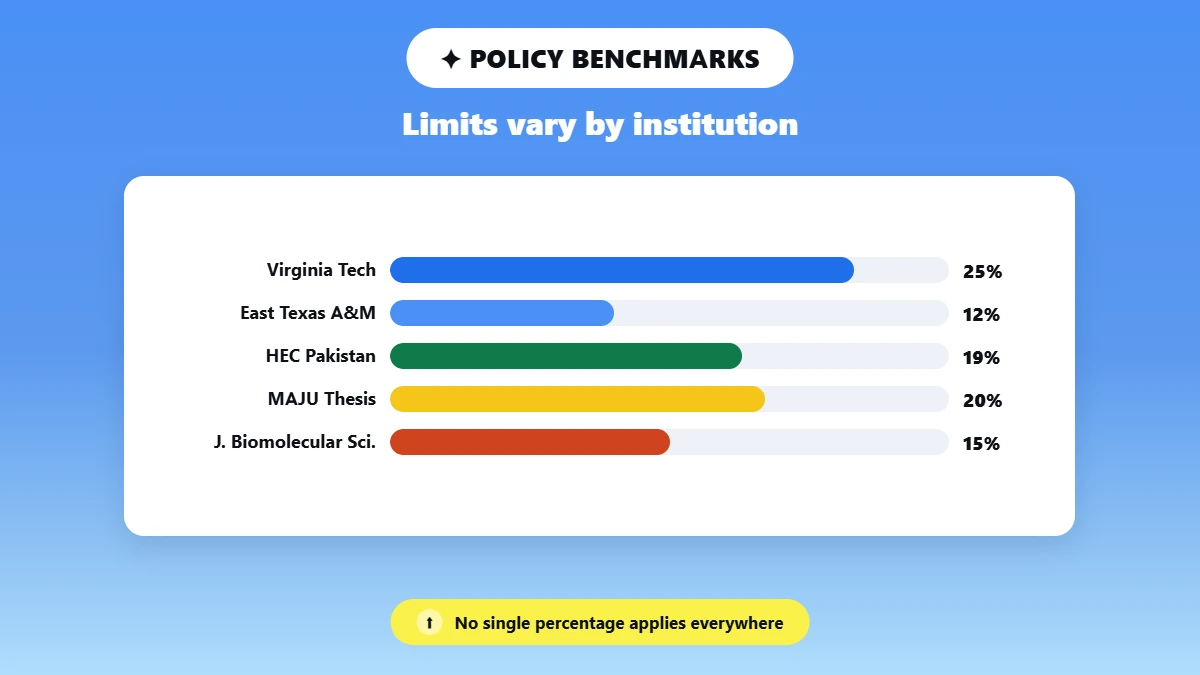
No similarity percentage is acceptable everywhere. Most colleges leave the call to the instructor.
Some graduate schools publish benchmarks such as Virginia Tech's under 25% overall. No more than 5% from one source. Journals usually judge matches case by case. Check the rule for the exact place you are submitting.
That is the honest answer to how much similarity is acceptable. It depends on where the work is going. Here is what real institutions and publishers say.
Real similarity policies:
Context | Institution / publisher | What it says | Type |
Any course (US) | No single "acceptable" or "perfect" similarity score; the instructor uses academic judgment. | Vendor guidance | |
College coursework (US) | Only zero plagiarism is acceptable, but the Turnitin score does not have to be zero; no absolute score is definitely acceptable. | Guidance | |
Thesis / dissertation (US) | ETD staff generally look for an overall score under 25% and no more than 5% from a single source; other scores may still be acceptable after detailed review. | Benchmark + review | |
Thesis / dissertation (US) | East Texas A&M (library guide quoting the Graduate School) | Allows up to 12% similarity. Above that, the advisor explains and the Dean reviews. | Limit + exception route |
Thesis / research (Australia) | Macquarie University procedure, effective 24 March 2026 | No standard or ideal maximum or minimum percentage; the principal supervisor uses academic judgment. | Discretion |
Theses and papers (Pakistan) | HEC Anti-Plagiarism Policy v2.0 (Aug 2023) | 19% or less may get the benefit of the doubt; any single source at 5% or more needs checking. | National benchmark |
Journals (global) | Advises editors not to set a score above which manuscripts are automatically rejected; editors and reviewers judge matches. | Publisher guidance | |
One journal (Pakistan) | Journal of Biomolecular Sciences, Minhaj University Lahore | More than 15% similarity: rejected or left to the editor for conditional acceptance. | Journal limit |
Policies checked on October 7, 2026. Each row is one institution's rule, not a national standard.
College Essays and Assignments
Most colleges publish no campus-wide percentage. So the instructor decides. FAMU-FSU's College of Engineering draws the key line. Only zero plagiarism is acceptable.
But the Turnitin score does not need to be zero. It also mentions an informal range of 10% to 30%. This is an observation, not a policy.
For what percentage of plagiarism is acceptable in university courses, check the syllabus or ask your instructor before you assume a number.
Theses and Dissertations
Graduate schools are more likely to publish numbers. But they still differ. The acceptable plagiarism percentage for thesis work runs from East Texas A&M's 12% cap to Virginia Tech's 25% benchmark to Macquarie's case-by-case review.
If you are asking what percentage of plagiarism is acceptable in thesis submissions in Pakistan, the acceptable plagiarism percentage per HEC guidance is 19% or less, for the benefit of the doubt. With any single source at 5% or more checked.
Treat 19% as a review line. Not a pass mark.
🔎 Why the Single-Source Number Matters
One large block from one source is a bigger signal than many tiny matches spread across a paper. That is why Virginia Tech and HEC both watch single sources at 5%. Some schools also exclude your own published work.
Muhammad Ali Jinnah University evaluates theses under 20% total and under 5% from a single source.
They exclude similarity from your own published work.
Journal Manuscripts and Research Papers
First, decide where your research paper is going. A class assignment follows course rules. A manuscript follows the journal’s rules.
For an acceptable plagiarism percentage for research paper submissions to journals, most publishers set no number at all.
Crossref advises editors not to auto-reject on a score.
Some journals do publish a limit. Such as the Journal of Biomolecular Sciences' 15%.
Read the target journal's author guidelines. Disclose and cite any reuse of your own thesis or conference paper.
Choosing a screening tool? See iThenticate vs. Turnitin.
What Is an Acceptable Turnitin Score?
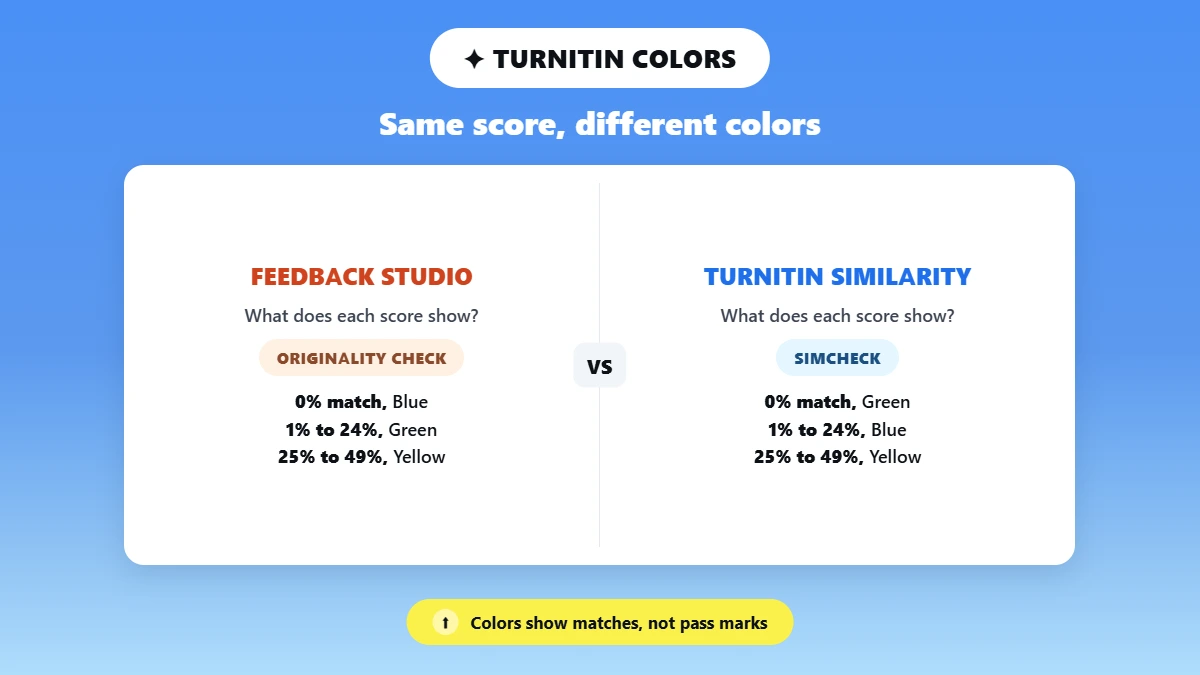
Turnitin does not set an acceptable score. Its student guide to the similarity score says there is no fixed number to receive. And its help center says no single score is acceptable or perfect.
The percentage and color only show how much text matched. Your instructor or reviewer decides whether the matches are a problem. Whichever way you phrase it.
What Turnitin score is acceptable? What is an acceptable Turnitin score? Or what similarity score is acceptable in Turnitin? The colors are not a pass mark.
Turnitin uses two color schemes depending on the product. Colors may vary depending on the integration.
If you searched for what an acceptable Turnitin score is, this table shows what each color actually means.
Matching text | Feedback Studio / Originality Check | Turnitin Similarity / SimCheck |
No matching text (0%) | Blue | Green |
One word to 24% | Green | Blue |
25% to 49% | Yellow | Yellow |
50% to 74% | Orange | Orange |
75% to 100% | Red | Red |
Source: Turnitin's student guide to the similarity score. Colors show matching ranges. Not academic-integrity risk levels.
A green or blue score means little matching text. Not an official pass. Turnitin's AI-writing indicator is a separate number answering a separate question. Third-party "Turnitin checker" sites are not Turnitin.
For upload steps, see this guide to checking plagiarism in Turnitin.
Is 10%, 20% or 30% Similarity Acceptable?
The percentage alone can't tell you. What matters is what matched. How much comes from one source. Whether it is quoted and cited, and what your policy says. An 8% score can hide one uncited paragraph.
A 30% score can be mostly quotes and references. So, read the report before you judge the number. Is 10% plagiarism acceptable? Is 20% similarity acceptable? Is 30% similarity acceptable?
That is why no one can answer what plagiarism percentage is acceptable from the number alone. As these situations show.
Score | What is behind it | What it means |
8% | One uncited paragraph from a single website makes up almost all of it | ❌ Low score, real problem. Quote and cite it, or rewrite and cite. |
22% | Quoted passages with citations, plus reference list entries | ✅ Usually a formatting check, not a rewrite. Confirm your rule. |
30% | Charles Sturt University's example: one or two direct quotes per page and an extensive reference list | ✅ The guide treats this as not plagiarism. |
18% | 9% comes from one source | ⚠️ Under Virginia Tech's 25% overall benchmark but over its 5% single-source benchmark. Review that block. |
Illustrative situations. Not Phrasly test results. Row 3 is from Charles Sturt University's guide.
Charles Sturt's guide to interpreting similarity reports says there is no ideal score. And that a score below 25% can be considered trustworthy as a rough rule of thumb. Though that does not rule out plagiarism.
👊 As FAMU-FSU puts it, a paper with a 5% score could represent more plagiarism than one with a 40% score.
See Exactly What Matched
Run your draft through Phrasly's plagiarism checker with source links to see each match next to the page it came from. Your first scan is free. A free account unlocks the full report.
Do Quotes, References and Common Phrases Count Toward Similarity?
Yes, unless the report excludes them. Quotes, reference entries, and common phrases can all add to your similarity score.
But matching is not the same as misusing a source. Exact borrowed wording needs quotation marks and a citation. Paraphrased ideas still need credit. Common phrases are usually not a concern.
🧩 Coincidental Matches vs Accidental Plagiarism
Coincidental matches are standard terms. Titles and everyday phrases that many writers share.
Accidental plagiarism is different. Missing quotation marks. A paraphrase that tracks the source too closely. Or an idea with no credit.
If you're unsure where that line sits, read is paraphrasing plagiarism.
Whether quotes and the bibliography are excluded is set by your instructor or institution. An excluded quote still needs a correct citation. Per-source percentages can also overlap. So don't add them up to get your total.
Illustrative example: one 22% score made up of reference entries, quoted and cited text, common phrases, and one uncited passage. Only the last part needs fixing.
What Should You Do Before Submitting a Paper with a High Similarity Score?
Find the rule that applies. Open the full report and review the biggest matches first. Especially any single source with a large share. Fix real problems with quotation marks, citations, or your own wording.
If the score stays above a written limit for legitimate reasons, explain why to your instructor or advisor.
Find the rule. Check the assignment, graduate-school, or journal policy. And which report it expects.
Open the report. Look at the largest matches and any single-source block first.
Check every quote, citation, and paraphrase. Routine wording can stay as it is.
Fix real attribution or wording problems.
For a step-by-step method, see how to rewrite an essay without plagiarizing.
Keep the final report and submit as required. Ask your instructor or advisor about anything unclear.
A citation does not always lower the number. Checkers match wording. But fixing attribution still matters.
This guide to the consequences of plagiarism explains what institutions can do when problems go unaddressed.
Can You Check Your Similarity Score Before You Submit?
Yes! Some schools let students submit drafts to Turnitin. And independent checkers let you scan a draft and review the matching sources first.
A pre-check won't reproduce your school's Turnitin or iThenticate number. Databases and settings differ. But it shows which passages need a closer look.
To check similarity before submitting with a plagiarism checker with percentage and source links, the routine is short:
Add your draft: Paste text or upload a PDF, DOCX, TXT, or PPTX file up to 50 MB. PDFs need selectable text. Image-only scans are not supported.
Run the scan: Phrasly checks 50 to 5,000 words per scan. And one free guest scan per network gives a real similarity score with no sign-up.
Open the matches: A free account unlocks that scan's highlighted matches, source links, and downloadable PDF.
Fix the original: Make changes in your own document. Further scans come from individual purchases or plagiarism credits in a subscription.
For a thesis over 5,000 words, scan chapter by chapter. And don't average chapter scores into one "thesis score."
Completed scans are saved to your account. You can revisit or delete them from Documents. For unpublished or confidential research, follow your institution's rules on which tools you may use.
Check Your Paper Before You Submit
Use Phrasly's plagiarism checker for research papers to scan a chapter or manuscript section. Then fix any citation or wording issues in your own document. Your school or journal still decides what is acceptable.
Frequently Asked Questions
Does Adding a Citation Lower My Similarity Score?
Not always! A citation credits the source. But checkers match wording. So, cited text copied word for word still shows as similar. Put exact wording in quotation marks and paraphrase properly otherwise. Fix attribution whether or not the number moves.
Is There a Maximum Similarity from One Source?
Some policies set one. Virginia Tech's Graduate School generally looks for no more than 5% from a single source. And HEC flags any single source at 5% or more for review. Many schools set none. So, check your own rule.
What Percentage Is Acceptable on SafeAssign?
SafeAssign has no universal pass mark either. Your instructor reviews the matches and decides. So, check the assignment instructions. This guide on how SafeAssign checks for plagiarism explains how its reports work.
Is an AI-Writing Percentage the Same as a Plagiarism Percentage?
No! A similarity score shows text that matches existing sources. An AI-writing score estimates whether text looks machine-generated. Neither proves misconduct on its own. For AI scores, see how much AI detection is acceptable.
Can My Thesis Match My Own Earlier Paper?
Yes! If that paper is in the checker's database. Some policies, like Muhammad Ali Jinnah University's, exclude similarity from your own published work. And journals usually expect you to disclose and cite it.
Will a Free Checker Give the Same Score as Turnitin?
Not necessarily! Each checker searches different sources with different settings. Use a pre-check to find and fix matching passages. And rely on your school's official report for the final number.

Written by
Muhammad Usman Ali
Pakistan
Muhammad Usman Ali is an experienced SEO content writer with 3+ years of professional writing experience. He specializes in AI tools, AI detection technologies, and search engine optimized content.