How to Rewrite an Essay Without Plagiarizing: A Step-by-Step Guide
13 min read
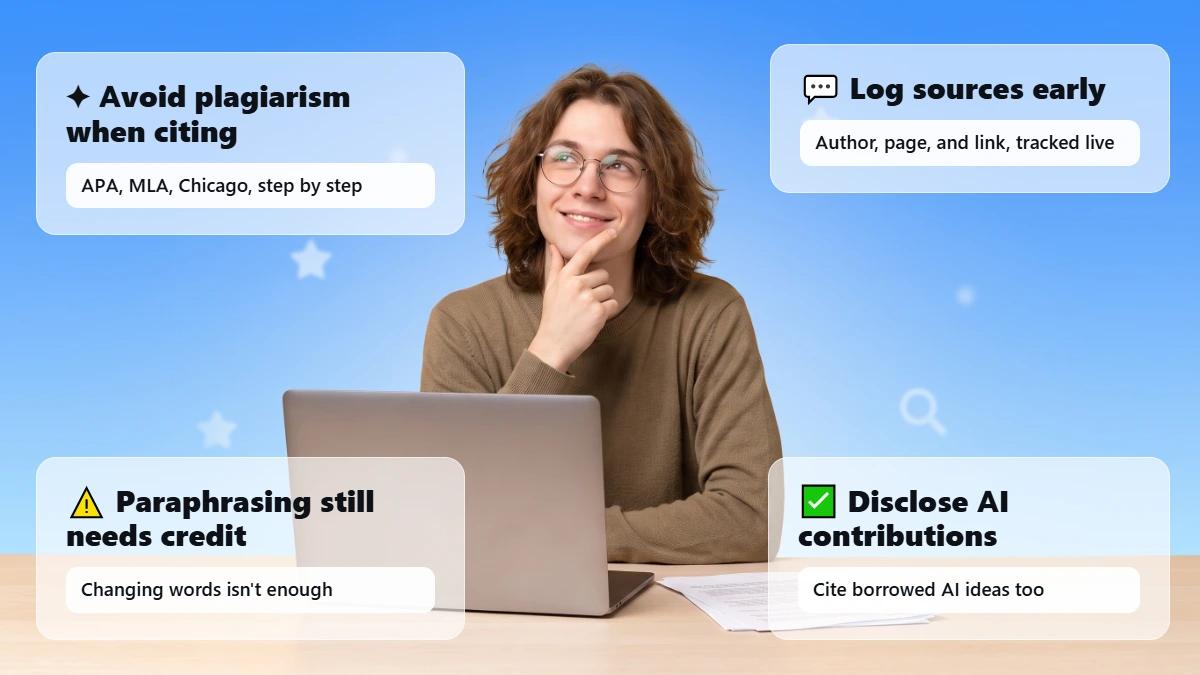
Changing every word in a paragraph can still leave you with plagiarism, and that surprises most students the first time they hear it. Similarity software matches structure and sequence, not only vocabulary.
To rewrite an essay without plagiarizing, read the source until you can explain it, write notes you can draft from, then close the source. Build a fresh outline, write each paragraph from those notes, and cite every borrowed idea. Compare the finished draft against the original, then check it for matched passages.
Reworking a draft of your own is a different job from adapting someone else's essay. The second one needs a citation at minimum, and your course may not permit it at all.
🔍 Want to check your essay for matching text?
Just paste or upload your draft below 👇 to see highlighted matches and the sources they came from.
📘 What Does It Mean to Rewrite an Essay?
Rewriting an essay means rebuilding its wording and structure while the argument keeps its intended meaning. A rewrite can change sentence construction, the order of sections, and where the evidence appears. It goes further than editing or paraphrasing, and it never removes the duty to cite a borrowed idea, quotation, or figure.
Process | Main purpose | Borrowed idea still needs citation? |
|---|---|---|
Editing | Correct grammar, improve clarity | ✅ Yes |
Paraphrasing | Restate a particular passage or idea | ✅ Yes |
Rewriting | Rework wording and structure across part or all of the essay | ✅ Yes |
Summarizing | Condense a larger source | ✅ Yes |
Plagiarism | Present another writer's words or ideas without acknowledgement | 🚫 Not acceptable |
The same rules apply when you rewrite a paper for a journal, because the obligation follows the borrowed idea, not the format. For the finer line between restating a source and copying it, see when paraphrasing becomes plagiarism. For sentence-level polish rather than a full rebuild, see sentence-level rewriting.
📝 How to Rewrite an Essay Without Plagiarizing in 7 Steps
Each step below closes a gap the next one depends on, so run them in order:
Decide what kind of rewrite you are doing.
Separate your ideas from source material.
Read for meaning, take notes, then close the source.
Rebuild the essay's outline around the argument.
Rewrite each paragraph from claims and evidence.
Preserve quotations, facts, and citations.
Compare, check, and investigate matches.
1️⃣ Decide what kind of rewrite you are doing
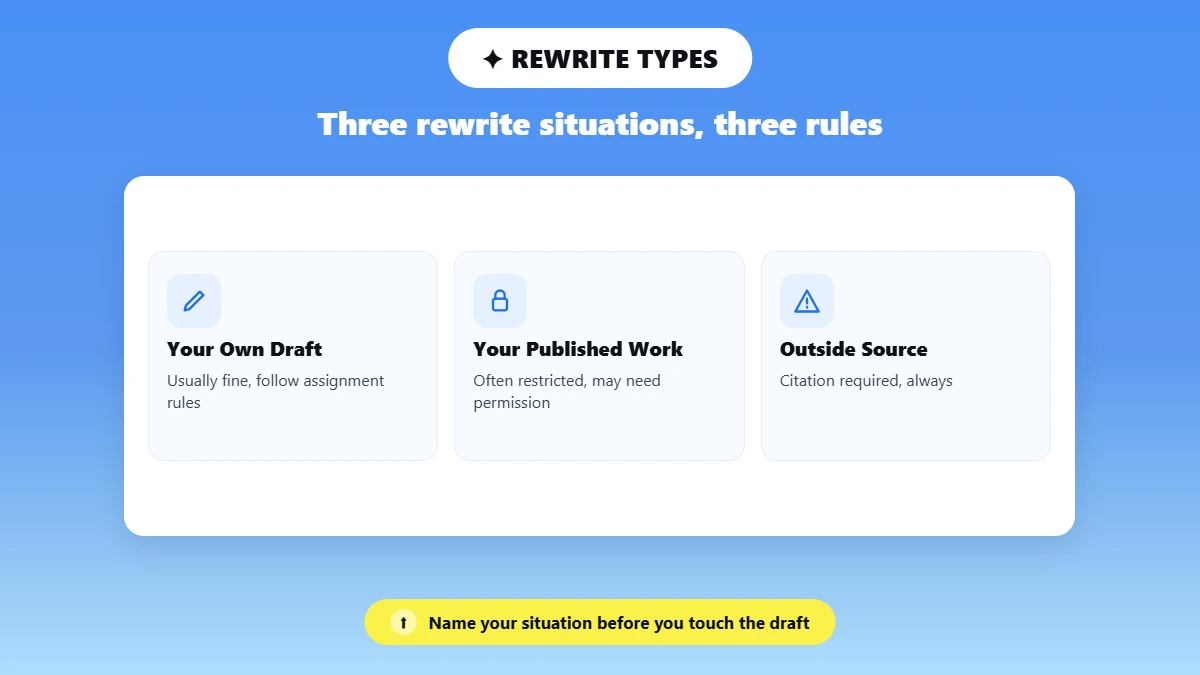
Three situations carry three different rules, so name yours before you touch the draft:
Revising your own unpublished draft. Usually fine. Follow your assignment's rules.
Reusing your own submitted or published work. Often restricted. Disclosure, permission, or citation may be required.
Using an outside source or another person's paper. Citation is required, and changing the words of someone else's whole essay does not make it yours to submit.
2️⃣ Separate your ideas from source material
Build a source ledger before you rewrite. It is a short table recording which ideas are yours, which came from a source, and where each citation belongs. Mark quotations, statistics, and your own analysis differently, because each is handled differently at citation time. Without a ledger you end up writing around remembered sentences instead of remembered ideas.
Source | Borrowed idea or data | Copied exact words? | Citation and page | Planned paragraph |
|---|---|---|---|---|
Author or organization | One-sentence summary | ✅ / ❌ | Full locator | Section number |
3️⃣ Read for meaning, take notes, and close the source
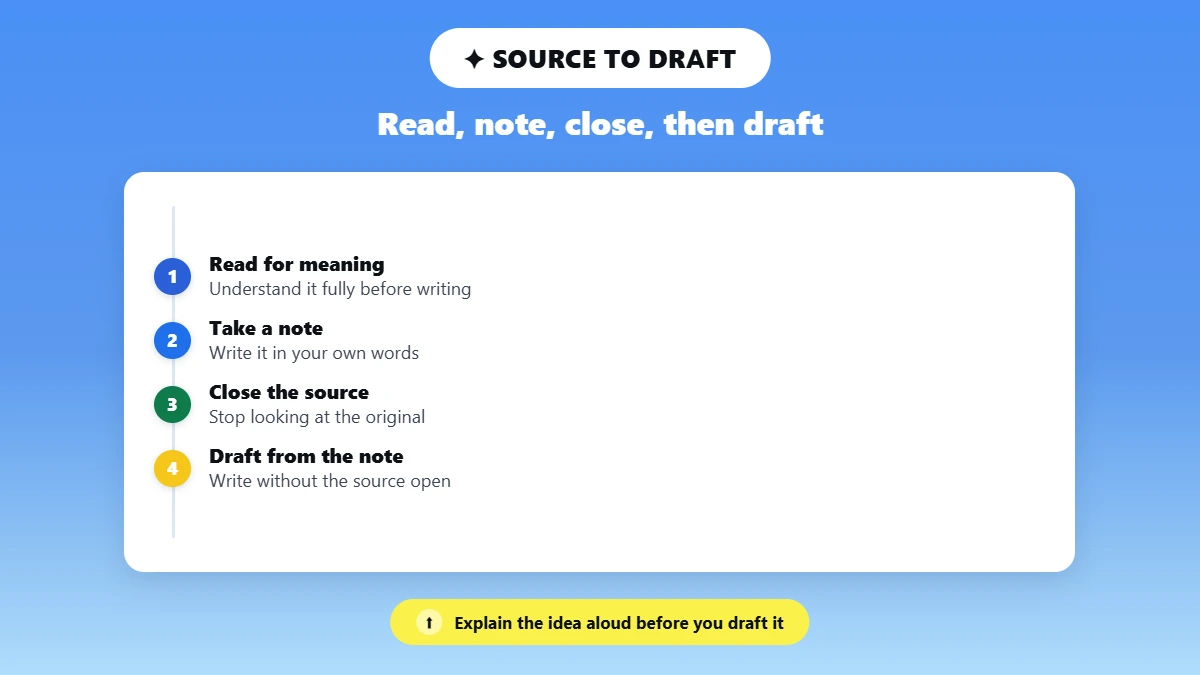
Read until you can explain the idea without looking at it. Record a short note in your own words with the full source details, then close the source and draft from that note.
🧠 The explain-it test. If you cannot say the idea out loud with the source closed, you are not ready to draft it yet.
Patchwriting starts when you draft with the source sentence in front of you, because the sentence you read shapes the sentence you write. Purdue OWL's paraphrasing guide sets out the six-step version writing centers teach.
4️⃣ Rebuild the essay's outline around the argument
Rebuild the argument before the paragraphs. Write the thesis in one sentence, then give every paragraph one job:
Reorder sections where the logic improves.
Cut evidence that repeats a point.
Add the counterargument or explanation that is missing.
Map every source-led claim back to your ledger.
Moving copied sentences into a different order is not rewriting. The words are still the source's, and a matching tool finds them wherever they appear.
5️⃣ Rewrite each paragraph from claims and evidence
Use the same short method on every paragraph. This is how you rewrite a paragraph without copying its structure: the claim goes down first, from memory, and the evidence follows it.
Write the paragraph's claim without looking at the original wording.
Add only the evidence that claim needs.
Cite the borrowed idea or the data.
Explain in your own analysis why it matters.
Vary sentence structure only where it improves clarity.
Compare against the source to catch accidental copying and factual drift.
⚠️ Compare, do not consult. Reopen the source to check accuracy, not to borrow phrasing. If a passage still reads like the source, rewrite it from your ledger.
6️⃣ Preserve quotations, facts, and citations
Rewriting the words does not erase the source. Six rules cover almost every case you will meet:
Direct wording needs quotation marks or block format, plus a citation.
Paraphrased ideas still need a citation, even when every word has changed.
Statistics need the source they came from, not a general reference.
Common knowledge usually needs no citation, though the line moves by field.
In-text citations must match the reference list. An entry with no match is a missing source.
Open and verify every AI-suggested citation before you use it.
Citation style changes the formatting on the page, not the obligation to attribute. The University of Oxford's plagiarism guidance states that correct references and a few changed words are not what makes a paraphrase acceptable.
7️⃣ Compare, check, and investigate matches
Run the final review in a fixed order, because each check narrows what the next one has to look at:
Compare argument and factual meaning against your notes and the source.
Compare paragraph and sentence structure for close mirroring.
Confirm every borrowed idea is attributed.
Confirm every exact phrase is inside quotation marks.
Run the draft through the Phrasly Plagiarism Checker.
Open each matched source and read the passage in context.
Decide what each match is: a quotation, a common phrase, a citation, or wording that needs revision.
Correct what needs it, then run one final quality pass.
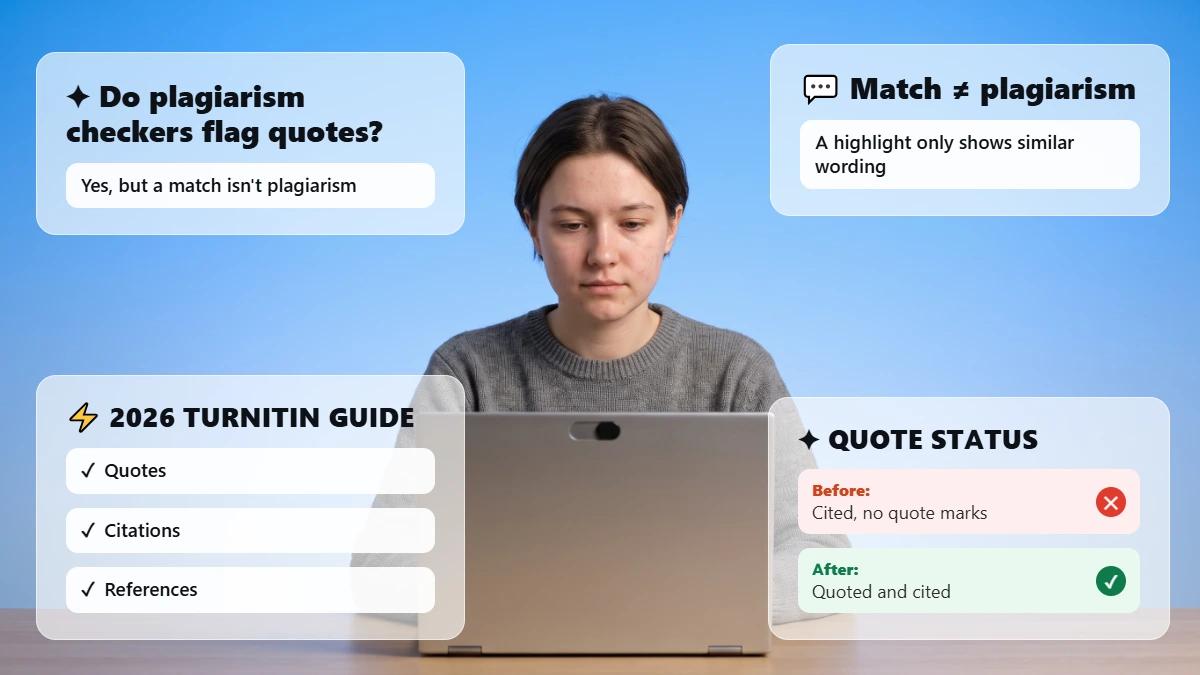
A similarity score is matched text, not a plagiarism verdict. Turnitin's own student guide says the same thing, and an unexpected similarity flag is a signal to review rather than proof of anything. This roundup of the best plagiarism checkers compares the options.
🔎 What if a match is a quotation or a citation?
A highlighted quotation or citation is usually fine. Open the match, confirm the wording is inside quotation marks and the citation is present, then move on. Revise the matches that are unquoted, uncited, or still shaped like the source.
🤖 Does a similarity score say anything about AI?
No. The similarity report and the AI writing report are two different reports, with separate scores and separate licensing, as Turnitin's AI detection pricing sets out.
Detectors also misfire. Phrasly ran 37,874 student essays written between 2010 and 2021, before ChatGPT existed, through ZeroGPT, and 26.4% came back flagged as AI (ZeroGPT false-positive study).
🔬 Rewriting Example: Original vs Patchwriting vs a Proper Rewrite
Three versions of one paragraph show the difference faster than any rule can explain it. The first is the source material, the second keeps its shape, and the third rebuilds it.
📄 Source material. The paragraph below is a summary written for this example from HEPI Report 199 (Stephenson and Armstrong, 2026). It is not a quotation from the report.
A survey of 1,054 full-time UK undergraduates, conducted in December 2025 and published by HEPI and Kortext in 2026, found that 95% used AI in at least one way and 94% used generative AI to help with assessed work. The share who included AI-generated text directly in assessed work reached 12%, up from 8% in 2025 and 3% in 2024. A further 65% said assessment has changed significantly in response to AI, and some students described anxiety about being falsely accused of misconduct.
🚫 Patchwritten version. This is still plagiarism.
A survey of 1,054 full-time UK undergraduates, carried out in December 2025 and released by HEPI and Kortext in 2026, showed that 95% used AI in at least one way and 94% turned to generative AI for help with assessed work. The proportion who put AI-generated text straight into assessed work climbed to 12%, up from 8% in 2025 and 3% in 2024. Another 65% said assessment has shifted significantly because of AI, and some students reported worry about false misconduct claims (Stephenson and Armstrong, 2026).
The clause order belongs to the source. Verbs were swapped and the structure stayed identical, and the citation at the end does not repair that, because the wording and the sequence are still the report's.
✅ Proper rewrite.
Student AI use has outrun the rules written for it. Almost every undergraduate in the 2026 HEPI and Kortext survey now uses AI somewhere in their studies, and 94% use it on work that is assessed (Stephenson and Armstrong, 2026). What they reach for has shifted toward explaining concepts and structuring ideas. Assessment moved in response, and 65% said it has changed significantly. That pairing explains the worry the report records: students fear being accused of AI use more than they fear the tools.
Three things make the final version work:
✅ The organizing claim is new and belongs to the writer.
✅ The evidence appears in a different order and serves that claim.
✅ The source is credited where its data appears.
⚖️ Is It Plagiarism to Rewrite Someone Else's Essay?
Yes, if you submit the rewritten work as your own. Rewording does not transfer authorship, because the argument, the evidence choices, and the sequence still belong to the writer who made them.
Scenario | Generally acceptable? | What is required |
|---|---|---|
Revising your own unpublished draft | ✅ Usually | Follow the assignment's rules |
Paraphrasing a source's idea | ✅ Yes | Genuine rewrite plus citation |
Rewriting a classmate's or a purchased essay | ❌ No | Do not submit it as your work |
Reusing a previously graded essay | ⚠️ Policy-dependent, often restricted | Permission, disclosure, sometimes citation |
Editing AI-assisted text | ⚠️ Policy-dependent | Follow course policy, disclose when required, verify sources |
Policies differ by school and assignment, so check the one that applies to you before you decide. A practice that passes in one course can open a misconduct case in the next.
🤖 Can AI Help Rewrite an Essay Without Changing Its Meaning?
AI can help, within limits. It suggests clearer structure and plainer wording, and it can also drop caveats, invent sources, and leave a patchwritten pattern in place. You stay responsible for accuracy, citation, and your course's rules, whatever the tool returns.
A responsible workflow looks like this:
Start from your own outline, notes, or a draft you are permitted to use.
Ask for clarity or structure, never a disguised copy.
Compare each output against the original evidence.
Restore any qualification or citation the tool dropped.
Disclose AI use when your course requires it.
Check the finished draft for matched passages.
A plagiarism checker compares your text against a database and highlights where it matches something else. An AI humanizer smooths phrasing that reads stiff or formulaic.
Need | Phrasly tool | Accurate framing |
|---|---|---|
Find matching passages and their sources | Plagiarism Checker | Flags text to investigate. It does not determine intent or guarantee acceptance |
Make permitted AI-assisted phrasing sound less stiff | AI Humanizer | Refines naturalness. It does not establish authorship or make uncited material acceptable |
In the same December 2025 survey, only 21% of students said an institutional ban or discouragement made them less likely to use AI, down from 31% a year earlier. The rule that decides your case is the one printed on your assignment, not the one the sector is moving toward.
Made an AI-assisted draft you are allowed to use? Phrasly's AI Humanizer refines stiff, formulaic phrasing so it reads naturally. It does not establish authorship or replace your citations.
🚩 8 Rewriting Mistakes That Can Still Cause Plagiarism
Rewriting to avoid plagiarism fails in eight predictable ways, and each one below carries its fix in the same line:
Swapping synonyms while the sentence skeleton stays. The words change, the structure does not, and the match stays.
Following the source's sequence. Order is part of the original work.
Reordering copied sentences. Movement is not rewriting while the wording is still the source's.
Removing citations after changing the wording. A paraphrased idea needs attribution too.
Combining uncited passages from several sources. That is mosaic plagiarism, covered in this guide to patchwriting and mosaic plagiarism.
Translating without attribution. A translated idea is still someone else's.
Reusing a submitted essay without permission or disclosure. That is self-plagiarism, and the rules on it vary.
Trusting a low similarity score. It measures matched text and nothing else.
For short worked examples of each of these, see what plagiarism looks like in practice.
☑️ Final Checklist Before You Submit a Rewritten Essay
Work through this list once before you upload, and treat any empty box as unfinished work:
☐ The thesis and argument still mean what I intend.
☐ I wrote from understanding and notes, not by following source sentences.
☐ Each paragraph has a clear purpose and includes my analysis.
☐ All borrowed ideas, data, and distinctive interpretations are cited.
☐ Exact wording appears in quotation marks or block quotes.
☐ Every in-text citation has a matching reference entry.
☐ I verified every quotation, statistic, and AI-suggested citation.
☐ I followed my instructor's AI-use and disclosure policy.
☐ I investigated individual similarity matches rather than chasing a score.
A finished essay without plagiarism is one where every borrowed idea carries the source it came from.
Control of the material is the whole difference. If you can explain an idea with the source closed, the paragraph you write next will be yours, and if you cannot, no amount of word swapping will fix it.
Rewriting an essay without plagiarizing comes down to two habits: drafting from understanding rather than from the page in front of you, and keeping the citation attached to the idea through every revision. The match report is a starting point for judgment, and your instructor makes the decision.
Finished your rewrite? Use Phrasly's Plagiarism Checker to review matched passages and their sources, then decide whether each one needs a citation, a quotation, or more revision.
Frequently Asked Questions
How can I rewrite an essay without plagiarizing?
Understanding comes first. If you cannot explain a source with it closed, you are not ready to rewrite it. Build notes in your own words, rebuild the outline around your argument, and attach attribution to anything you took from somewhere else. Run a match check last, then open every highlighted passage before you submit.
Is rewriting an essay considered plagiarism?
It depends whose essay it is. Revising your own unsubmitted draft is normal revision. A cited paraphrase of a source is standard academic practice. Rewriting a classmate's or a purchased essay and handing it in as your own is plagiarism, no matter how many words you changed.
How much of an essay do I need to change to avoid plagiarism?
No percentage or word count exists. The test is attribution and genuine intellectual work, not a threshold. If you use another writer's idea, evidence, or structure, cite it. If you reproduce exact wording, quote it. Changing 30% or 60% of the words is not what makes the work yours.
Do I still need citations after rewriting?
Yes. Every borrowed idea, statistic, evidence choice, or distinctive interpretation needs a citation, even where you built the sentence from scratch. Citation credits the idea, not the vocabulary. Dropping citations after a rewrite is one of the most common ways careful students still end up in trouble.
Can Turnitin detect a rewritten essay?
Sometimes. Turnitin compares your text against web pages, journals, and its student paper database, so a patchwritten version usually produces matches. A rewrite built from your own understanding produces fewer, because the wording and structure are yours. For other systems, see does SafeAssign check for plagiarism and this roundup of Turnitin alternatives.
Can I rewrite my essay without plagiarizing for free?
The rewriting itself costs nothing. Notes, outline, citations and the final comparison are all your own work. The checking is where cost appears. Most free scanners cap the words per scan, or search only the open web instead of academic databases, so check both the word limit and the coverage before you trust a result. A free scan that never reaches journal archives tells you less than the number suggests.
Is using an AI essay rewriter considered cheating?
It depends on your assignment policy and how you use the tool. Editing a draft you were entitled to write is different from outsourcing the argument. Some courses allow AI-assisted editing with disclosure, and others prohibit AI use of any kind. Read the policy that applies before you paste anything into a tool.
Can I rewrite my own essay?
Yes. A draft you have not handed in is yours to rework as often as you like. Reusing an essay you already submitted for another course, or one that has been graded or published, is a different question. That is self-plagiarism territory, so check your course policy, because reuse usually needs permission or disclosure.

Written by
Alina Shah
SEO Content Specialist · Karachi, Pakistan
She writes about AI so you don't have to guess. 8+ years in content strategy and editing. Now she puts AI writing tools and detection systems through real tests and shares what actually works.