Is Claude AI Detectable? What AI Checkers and Turnitin Can Tell
15 min read
Yes, but only as likely AI writing, never as proof. General AI checkers and Turnitin's AI Writing Report both score text for AI-like patterns, and neither can confirm that Claude wrote a document. Anthropic now watermarks text from its newest models, but its detector is still in private preview.
So the question has two answers. Is Claude detectable as AI writing? Often, yes. Is it detectable as Claude specifically? Only through Anthropic's private detector, and only on its newest models.
Here, we break down which tools can flag Claude text and which can actually identify it, which Claude models Turnitin lists, and a same-day test we ran to see whether two AI checkers agree on the same essay. We also cover what to do if your draft gets flagged.
Before going further, run your Claude draft through Phrasly's free AI check. It won't read Anthropic's watermark or predict a Turnitin score, but it will show whether your text looks AI-written.
Check Your Claude Draft Here 👇
Can AI Detectors Tell If Text Was Written by Claude?
Yes, most AI detectors can flag Claude-generated text as likely AI-written, because Claude shares writing patterns with other large language models. What a standard score can't do is name Claude as the source or prove who wrote a document. A flag is a reason to look more closely, not a verdict on authorship.
Any tool sold as a "Claude AI detector" is really a general AI classifier. It can detect Claude-generated text by comparing the rhythm, word choice, and predictability of a passage with patterns learned from human and AI text, then estimating how AI-like it looks.
Turnitin is one of the few detectors that explains its method publicly. According to its AI writing detection FAQ, it splits a paper into overlapping segments and gives each one a score from 0 to 1.
Most other detectors don't share this much detail, but they follow the same basic idea of scoring text for AI-like patterns.
Anthropic addresses this directly in its watermark explainer, noting that detection companies don't hold its watermark key, so they look for stylistic tells in AI phrasing instead. That is why "does this look like AI?" and "was this Claude?" are different questions.
Our guide on whether AI detectors can identify which model wrote text covers the second one in depth. Here is what each signal can actually support.
Signal | A positive result supports | It cannot establish | Who can check it |
|---|---|---|---|
General AI detector (Phrasly, GPTZero, others) | The passage has AI-like writing patterns | Which model wrote it, who wrote it, or misconduct | Anyone |
Turnitin AI Writing Report | A share of qualifying prose looks AI-generated or AI-modified | That Claude was used, or misconduct on its own | Instructors and admins at licensed schools |
Anthropic text watermark | Claude was likely involved at some point (supported models only) | Whether Claude wrote or only edited the text; anything about other AI tools | Eligible organizations in private preview |
C2PA Content Credentials | A file was created or processed by Claude | Anything about text pasted somewhere else | Anyone, with the free Claude Content Checker or another C2PA reader |
Draft and version history | How the document was actually written | Nothing about a single score | The writer and the reviewer |
Table 1: What each Claude signal can and cannot tell you. Sources: Turnitin guides, Anthropic, Claude Help Center; checked September 30, 2026.
Can Turnitin Detect Claude AI?
Yes. Claude AI can be detected by Turnitin as likely AI-generated when a school has its AI writing detection turned on and the paper meets its requirements. Turnitin lists several Claude models it can detect, but its report only shows how much of the paper's prose looks AI-written, never which model wrote it. Turnitin says that number shouldn't be the only basis for action.
Whether Turnitin checks your Claude text at all depends on your school. AI writing detection only works if the institution has a Turnitin Originality license and switches the feature on. Even then, only instructors and administrators see the AI score; students see it only if an instructor downloads and shares the PDF report.
Turnitin also calls the AI score and the Similarity score "completely independent," so a high Similarity score says nothing about AI writing.
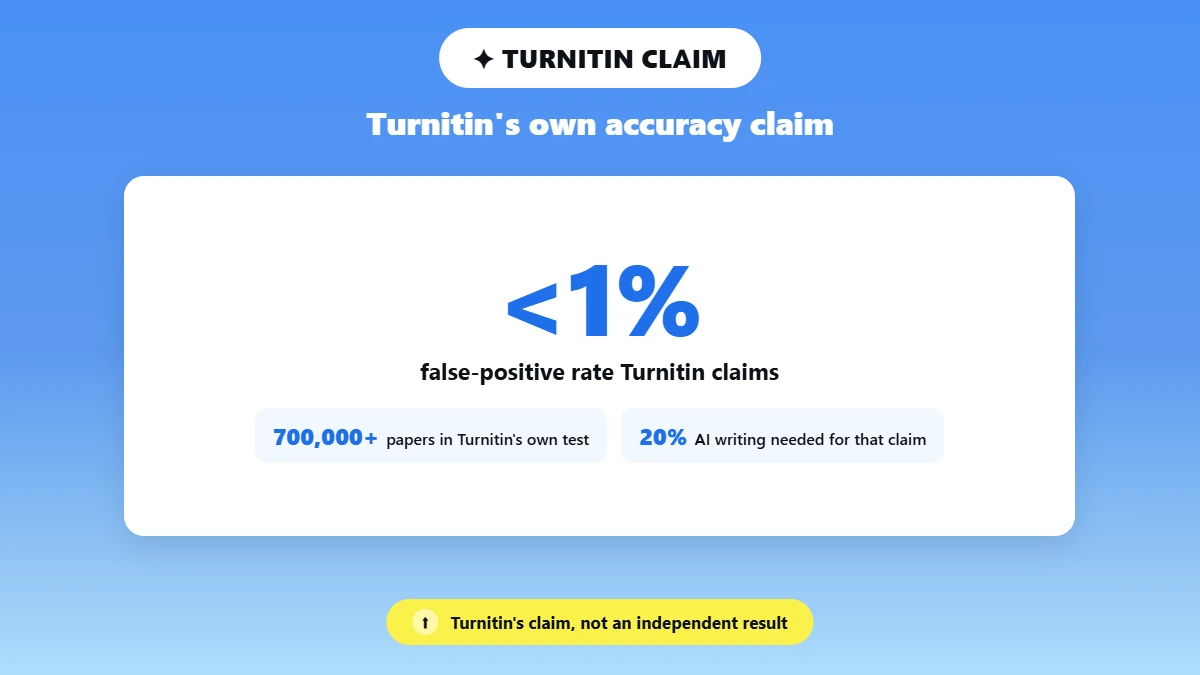
Turnitin's accuracy claims come with a catch. It says it wrongly flags human writing less than 1% of the time, as long as a document contains more than 20% AI writing. That figure comes from its own tests on over 700,000 papers written before ChatGPT existed, so it's Turnitin's claim, not an independent result.
And to avoid flagging human writers by mistake, Turnitin plays it safe and may miss some AI text. A paper it scores at 50% AI could actually contain as much as 65%.
Which Claude Models Does Turnitin List?
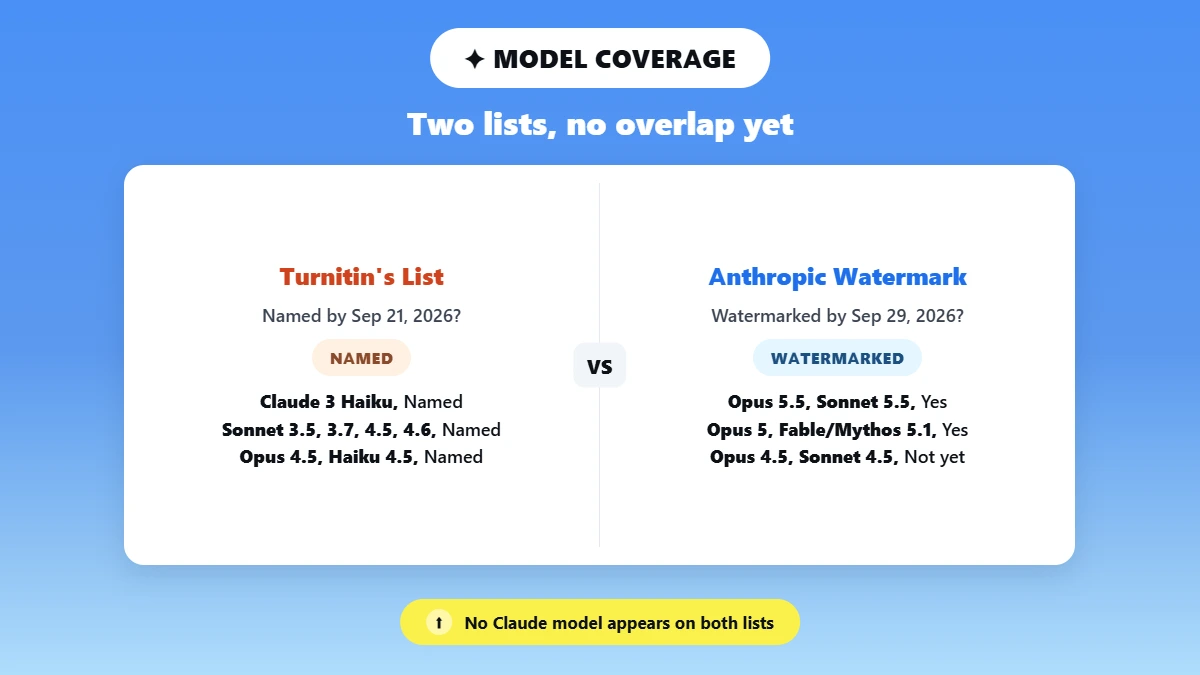
As of its English FAQ update on September 21, 2026, Turnitin says it can detect content from Claude 3 Haiku, Claude Sonnet 3.5, 3.7, 4.5, and 4.6, Claude Haiku 4.5, and Claude Opus 4.5, plus tools built on those models. No Claude 5-series model appears by name.
A missing name is not immunity. Turnitin keeps expanding coverage and says its results can change as the detector is updated. Meanwhile, Anthropic's watermark covers only the newest models, so no Claude model currently appears on both lists.
Claude model | Named on Turnitin's English list (Sep 21, 2026) | Text watermark, per Anthropic (Sep 29, 2026) |
|---|---|---|
Opus 5.5 | Not named | Yes |
Sonnet 5.5 | Not named | Yes |
Opus 5 | Not named | Yes (cloud partners rolling out from Sep 14) |
Fable 5.1, Mythos 5.1 | Not named | Yes |
Sonnet 5, Fable 5, Mythos 5 | Not named | Not yet (files get C2PA only) |
Opus 4.6, 4.7, 4.8 | Not named | Not yet |
Opus 4.5 | Named | Not yet |
Sonnet 4.5, Sonnet 4.6, Haiku 4.5 | Named | Not yet |
Claude 3 Haiku, Sonnet 3.5, Sonnet 3.7 | Named | Not on Anthropic's list |
Table 2: Turnitin's named Claude models vs Anthropic's watermarked models. Neither column predicts a score. Anthropic says models released before August 2, 2026 will carry text watermarks by December 2, 2026.
What Does Turnitin Need Before It Scores Claude Text?
Turnitin applies the same rules to every submission, whether Claude, ChatGPT, or a person wrote it. Its AI Writing Report guide requires:
300 to 30,000 words of long-form prose, in a .docx, .pdf, .txt, or .rtf file under 100 MB.
English, Spanish, Japanese, or Arabic. Paraphrase and bypasser detection is English only.
Poetry, scripts, code, bullet points, tables, and annotated bibliographies aren't reliably scored.
Scores of 1% to 19% show as an asterisk, and short documents get mostly all-or-nothing results.
If your paper meets these rules and gets a score, our guide on how much AI detection is acceptable explains what that number means and when it becomes a problem.
Why Do Older Posts Say Claude Scores 0%?
Many older articles cite a 2023 teacher test where Claude essays scored 0% in a Turnitin demo account. That was one short test on 2023 models. Since then, Turnitin has named Claude models, updated its detector in February 2026 to catch more AI text, and merged its models into one in July 2026.
⚠️ So that old 0% no longer tells you whether Claude AI is detectable by Turnitin today.
To see how Turnitin handles other AI tools, read does Turnitin detect ChatGPT and can Turnitin detect Perplexity AI. If you use Perplexity, some of its answers come from Claude Sonnet 5 or Opus 5, so the same Turnitin questions apply to you.
Does Claude's Watermark Make Its Text Detectable?
Only for someone who holds Anthropic's private key. Newer Claude models embed a statistical pattern in ordinary word choices, with no hidden characters and no personal data. Public checkers such as Turnitin, GPTZero, and Phrasly don't have that key, and Anthropic's own watermark detector is limited to eligible organizations in private preview.
When Claude writes, it often has several equally good words to choose from, like "big," "large," or "huge." Anthropic's secret key quietly decides which one Claude picks. A single choice means nothing, but across hundreds of words those choices form a pattern that only someone with the key can spot. Anthropic says the method is a version of SynthID-Text, a watermarking approach Google DeepMind published in 2024.
📢 The list of watermarked models is still growing. As of September 29, 2026, Anthropic's guide to how Claude marks AI-generated content covers the models shown in the comparison table above. Those eligible organizations include regulators, media, researchers, educational organizations, and EU civil society groups, and anyone else can register interest in the detection API.
Because the mark lives in word choices, it's weak wherever Claude has few choices to make: short passages, factual answers, and code. It's also weak when Claude only lightly proofreads your writing, since most of the words are still yours.
A translation Claude writes does carry the mark, because Claude picked every word. Light human edits probably won't remove it, but rewriting every word will.
That means no mark doesn't prove a human wrote the text, and a mark only suggests Claude was involved, not whether it wrote the text or just edited it.
Files work differently from pasted text. When Claude creates a file, such as a document, it can attach a digital label called C2PA Content Credentials that shows Claude made it. Anyone can check that label with the free Claude Content Checker.
To see what happens to Claude's text watermark when you copy, paste, or edit, read does Claude leave watermarks.
What Decides Whether Claude Text Gets Flagged as AI?
Six factors decide whether Claude text gets flagged as AI: the model version, the checker and its release, length and format, how much a person rewrote, whether human and AI text are mixed, and the language. How detectable Claude AI is depends more on these than on Claude itself. No reliable ranking shows it's easier or harder to catch than ChatGPT.
Factor | Why it matters |
|---|---|
Model version | Newer models write differently. The EvoBench study (Findings of ACL 2025) found that all 14 detection methods it tested struggled to keep up across 29 evolving model versions. |
Checker and release | Each tool is trained differently and updates on its own schedule. An old Turnitin report only changes if the file is resubmitted. |
Length and format | Turnitin needs 300+ words of prose, and short passages give unstable results in any checker. |
Human rewriting | More of your own words means less AI-like text, and less for Anthropic's watermark to attach to. |
Mixed authorship | Checkers can split on how much of a mixed document looks AI-written, as our test below shows. |
Language | Turnitin's paraphrase detection is English only, and coverage varies by checker and language. |
Table 3: What changes the result. Sources: EvoBench (ACL 2025), Turnitin guides.
📌 For unedited text, though, current Claude output can be easy to flag. Originality.ai, a competing detector, reported on September 25, 2026 that it flagged 325 of 327 unedited Claude Opus 5.5 responses (99.4%), including responses to prompts asking the model to sound human. That is a vendor figure, and every response tested was at least 304 words long.
Its own methodology note says the study included no human-written samples, so it shows how often the tool caught AI text, not how often it wrongly flags people. It says nothing about Turnitin or Phrasly either.
Different detectors can also give the same text very different scores. In our test of nine AI detectors on the same 16 samples, some tools caught all 11 AI samples while others caught only 3. That's why a single checker's result, including a vendor's own study, is never the full picture.
What Happened When We Tested Claude Text in Two AI Checkers?
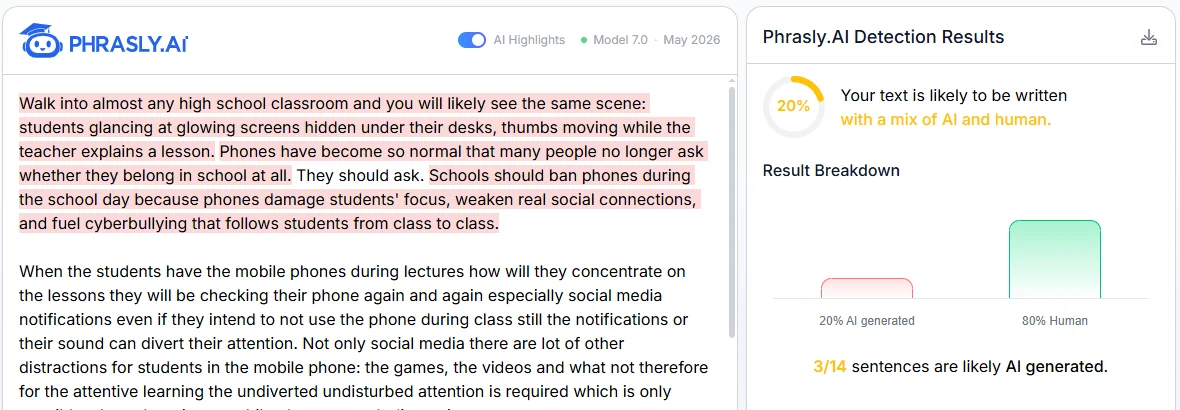
Both checkers labeled our human essay as human and flagged the unedited Claude essay as AI. They split on the rest. GPTZero flagged a 111-word Claude excerpt as AI, while Phrasly called it human. Both read the half-rewritten essay as mixed, but GPTZero marked 12 of 15 sentences as likely AI and Phrasly marked 3 of 14.
Sample | Words | Phrasly AI Detector (Model 7.0, May 2026) | GPTZero (Model 4o) | Notes |
|---|---|---|---|---|
Human-written | 385 | Likely human (14% AI, 0 of 12 sentences flagged) | Entirely human (AI 0%) | No false positive in either tool |
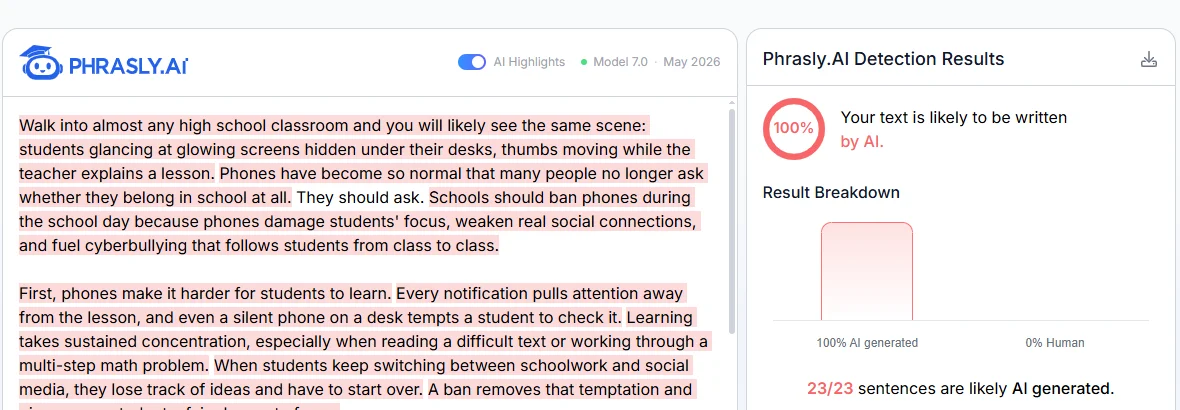
Raw Claude (Opus 5.5) | 415 | Likely AI (100%, 23 of 23 sentences) | AI generated (AI 100%) | Both flagged the whole essay |
Claude, 2 of 5 paragraphs rewritten | 390 | Mixed (20% AI, 3 of 14 sentences) | Mixed (12 of 15 sentences likely AI) | GPTZero highlighted Claude's paragraphs 1 and 3; Phrasly flagged only paragraph 1 |
Short raw Claude | 111 | Likely human (14% AI, 0 of 5 sentences) | AI generated (AI 100%) | The tools disagreed |
Test results, September 30, 2026. Each sample was checked once in each tool.
How we tested: On September 30, 2026, we asked Claude Opus 5.5 (medium effort setting) on claude.ai to "Write a 400-word persuasive essay for a 10th-grade English class on whether schools should ban phones during the school day. Use a clear thesis, three body paragraphs, and a short conclusion. Write in plain paragraphs with no headings, bullet points, or bold text." We kept the output unedited. The human sample is a 385-word essay on the same topic, including its title, written by the author with spell-check and all AI writing features turned off. For the mixed sample, we rewrote paragraphs 2 and 4 by hand. The short sample is the first 111 words of the raw Claude essay. We checked each sample once, on the same day, using the free versions of both tools; each asked for a free account after three checks. No Turnitin test was run. Phrasly publishes this article and makes one of the tools tested.
The mixed sample shows why highlights matter more than the headline number. GPTZero's highlights skipped the paragraphs we rewrote. Phrasly caught Claude's opening paragraph but not its later ones. Short passages gave the least stable result: the same 111 words got opposite labels.
One more detail: Opus 5.5 carries Anthropic's text watermark, but neither checker can read it. Both scores come from writing patterns alone.
Four samples cannot give a detection rate. These results show how scores vary between tools, not what your own draft will get.
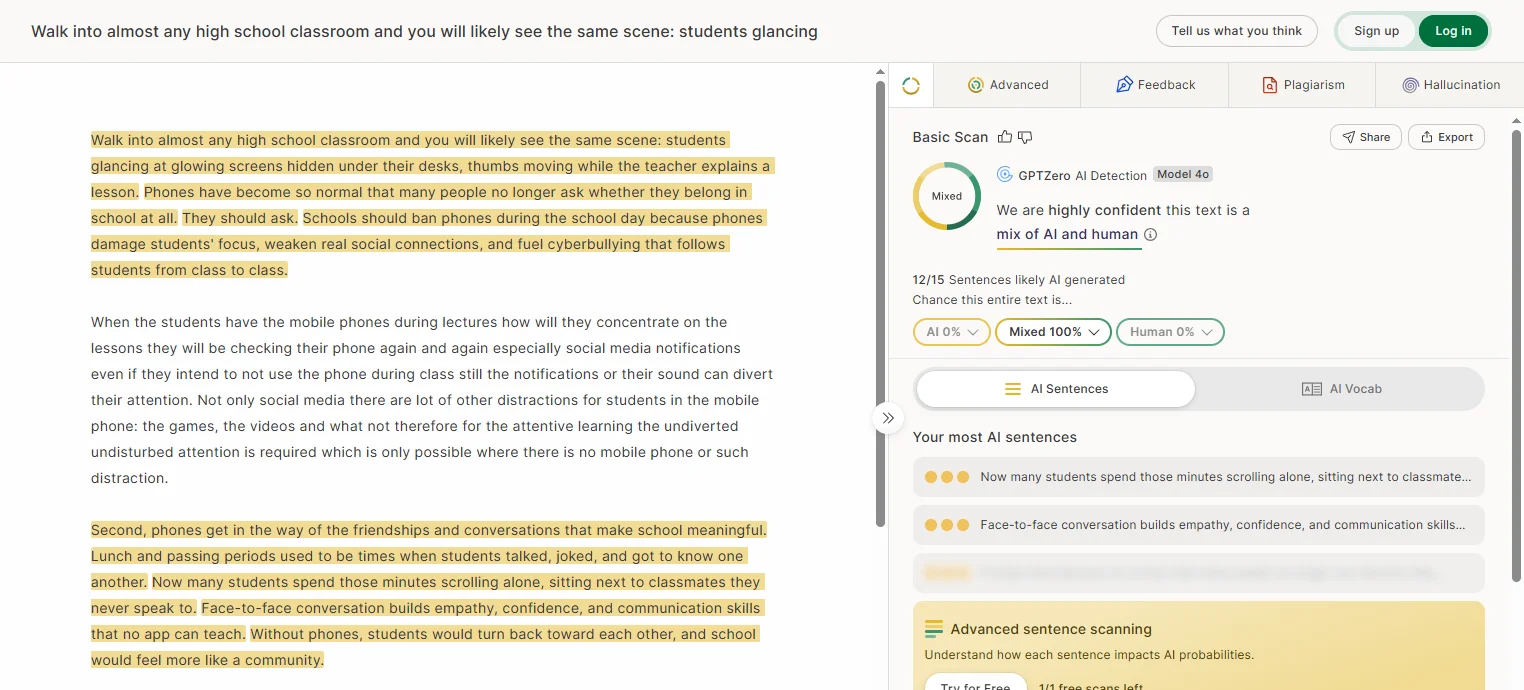
GPTZero (Model 4o) result for the Claude Opus 5.5 essay with paragraphs 2 and 4 rewritten by hand (390 words): mix of AI and human, 12 of 15 sentences likely AI, highlights on the unedited Claude paragraphs. Tested September 30, 2026.
Phrasly AI Detector (Model 7.0) result for the Claude Opus 5.5 essay with paragraphs 2 and 4 rewritten by hand (390 words): mix of AI and human, 20% AI, 3 of 14 sentences flagged, all in paragraph 1. Tested September 30, 2026.
Phrasly AI Detector (Model 7.0) result for the unedited Claude Opus 5.5 essay (415 words): likely AI, 100%, 23 of 23 sentences flagged. Tested September 30, 2026.
How Can You Check a Claude-Assisted Draft Fairly?
To check a Claude-assisted draft fairly, test one continuous passage of at least 300 words and read the result as a clue, not a verdict. Note the tool, date, and result, then compare the flagged sentences with your sources and drafts. You can do this before you submit, but no outside check can tell you what Turnitin will report.
Whether you use a tool marketed as a Claude AI detector or a general AI checker, the same steps apply:
Know the rules and the facts. Check your course or client policy, which Claude model you used, and what it did: outline, draft, edit, or translate.
Use a meaningful sample. Paste continuous prose, not a single sentence or a bullet list.
Run a general check. Record the date, the tool's model label, and the result.
Have your Claude draft ready? Run it through Phrasly's free AI Detector
Read the highlights, not just the score. Then check facts, citations, and your own version history.
Read a shared Turnitin report in context. An asterisk means 1% to 19%, and lists or tables may not be counted.
For more manual signs to look for, see our guide on how to check if text is AI-written.
What Should You Do If Your Writing Is Flagged as AI?
If your writing is flagged as AI, don't rewrite it in a panic. Gather proof of how you wrote it and ask for a human review. Turnitin itself says its score shouldn't be the only basis for action. If Claude helped within the rules, fact-check the draft, add your own reasoning, and disclose the help if your policy asks.
If you wrote it yourself: a flag can be a false positive, so bring evidence. Drafts, outlines, research notes, and Google Docs version history show how your writing developed. Turnitin notes that false positives can involve text with little variation in structure, text that repeats itself, or paraphrasing that adds no new ideas.
Review those passages, but don't rewrite just to chase a lower number. Our guide on why Turnitin flags human writing as AI goes deeper into why this happens.
If Claude helped and it was allowed: check every fact and citation, add your own reasoning and examples, and follow your school's disclosure rules.
💡 Was your essay flagged even though AI help was allowed? Start by showing your instructor how you used AI. If the writing itself still sounds robotic, Phrasly's free AI Humanizer can smooth the flow and voice. Then check every fact, citation, and change in meaning yourself.
Claude text is detectable as AI-like writing, but no score proves Claude wrote it. Turnitin names older Claude models, not the newest ones, and Anthropic's watermark can only be read with Anthropic's key. Keep your drafts and version history, because they are the strongest evidence of how you wrote.
Before you submit or publish, run the full passage through Phrasly's free AI Detector and read the highlights, not just the score.
FAQs
Can an AI Detector Tell Claude Apart From ChatGPT?
No. A standard detector estimates how AI-like a passage looks, not which model wrote it. Anthropic's watermark is specific to Claude, but only Anthropic's key can check it, and that detector is in private preview.
Can My Professor Tell I Used Claude?
Not from a Claude label. If your school turns on Turnitin's AI feature, your instructor may see a percentage of likely AI prose, and they also read your work closely. Learn more in can professors detect ChatGPT.
Does Copying and Pasting Claude's Text Remove Its Watermark?
No. On supported models, the mark lives in the words themselves, so it travels with pasted text. Heavy rewriting can weaken or remove it. See our explainer on AI text watermarks.
Will Using Claude to Proofread Get My Essay Flagged?
Not predictably. Light fixes change few words, which leaves little for a detector or the watermark to act on. Large rewrites and translations put many more Claude-chosen words on the page.
Is a 0% AI Score Proof That a Human Wrote It?
No. Detectors miss some AI text. Turnitin says it accepts missing some AI writing in order to keep false positives low, so a low score is not proof of human authorship.
Is Claude Harder to Detect Than ChatGPT?
There is no reliable ranking. Results depend on the model version, the checker, and how much the text was edited. Recent vendor tests flagged unedited Claude Opus 5.5 text at high rates.
Can Phrasly's AI Detector Read Claude's Watermark?
No. It checks for general AI-writing signals. Anthropic's key-based watermark detector is in private preview and is only available to eligible organizations.

Written by
Hasnain
Karachi, Pakistan
I help businesses grow with SEO-friendly blog posts, landing pages, and long-form content. With 3+ years of experience, I deliver clear, original, and well-researched writing that drives results.