Proofademic AI Detector Review (2026): Is It Accurate for Academic Writing
24 min read
The Proofademic AI detector is built for academic writing. It gives an overall AI-likelihood score, rates each sentence, and adds a plagiarism checker and a Paraphrase Shield. Third-party reviews say it catches raw ChatGPT text but gives mixed results on blended drafts, and its 99.8% accuracy figure is self-reported.
We ran the same three essays through Proofademic AI, GPTZero and the Phrasly AI Detector on one day in November 2026, using Proofademic's free 3-day trial and GPTZero Premium ($23.99 a month). Phrasly publishes this review and makes the Phrasly AI Detector, one of the three tools we tested.
This review is for students pre-checking an essay before a deadline and for teachers deciding whether a score is safe to act on. We cover a raw AI essay, a human essay and a mixed draft, then price and trust, and end with a head-to-head scorecard against Turnitin and GPTZero.
Check Your Own Essay for Free Before You Submit 👇
Proofademic at a Glance: Features, Limits and Our Verdict
Here is what Proofademic offers, what our test found and who each feature suits, checked in November 2026.
Proofademic AI detector features, limits and test findings, checked in November 2026.
Feature | What Proofademic offers | What our test found | Best for | Source and check date |
|---|---|---|---|---|
Overall AI score | Document-level AI-likelihood estimate | Gave a verdict plus a probability, such as "74% Probability AI generated" on the raw ChatGPT essay | Quick read before you submit | Proofademic AI Text Detector page, Nov 2026 |
Sentence-level highlights | Each sentence gets its own AI-likelihood estimate | The trial colored every sentence and showed its AI percentage on hover; the detailed sentence list stayed locked behind "Unlock Sentence Analysis" | Finding which sentences to review in mixed drafts | Proofademic pricing page, Nov 2026 |
Paraphrase Shield | Looks for AI patterns left after paraphrasing or humanizer tools; runs automatically on every plan | Ran on every scan; we did not test humanized text | Teachers checking reworded submissions | Proofademic Paraphrase Shield page, Nov 2026 |
Plagiarism checker | Separate source-overlap check, listed on every plan, including the free one | Not tested in this review | Students checking citations and overlap | Proofademic pricing page, Nov 2026 |
Single Scan and Batch Scan | Single scans on every plan; Batch Scan on Essential, Premium and Professional | Not tested; we used single scans | Instructors checking a class set | Proofademic Batch Scan page, Nov 2026 |
PDF upload | PDF, DOCX and TXT files | Not tested; we pasted text | Students submitting formatted papers | Proofademic Batch Scan page, Nov 2026 |
Languages | 23 languages, detected automatically | Not tested: English-only test | ESL and multilingual writers | Proofademic Multilingual Detection page, Nov 2026 |
Free allowance | 1,000 words, one time, no credit card; listed as a 3-day trial | All three samples ran on the trial; our trial dashboard showed a larger word balance than the pricing page lists | Trying a few short pieces | Proofademic pricing page, Nov 2026 |
Entry price | Essential: $15/month, or $99/year billed annually | We paid nothing, because the free trial covered the test | Regular student or instructor use | Proofademic pricing page, Nov 2026 |
Prices come from each provider's live pricing page, checked in November 2026. Prices can change, so check the pricing page before you buy.
In our test, Proofademic labeled the raw ChatGPT essay as AI and the human essay as human, but it missed all five AI sentences we added to the mixed draft. It works as a quick first check on fully written drafts, and a mixed draft needs a second detector before anyone acts on the score.
Our list of the best free AI detector tools for academic writing covers more options if Proofademic's paid plans do not fit your budget.
How Proofademic Scores an Essay
The Proofademic AI detector scores an essay with a trained classifier, a model that learned the difference between human and AI writing from labeled examples. Its score shows how confident the model is that your text matches patterns from large language models such as ChatGPT. The score does not prove who wrote the essay.
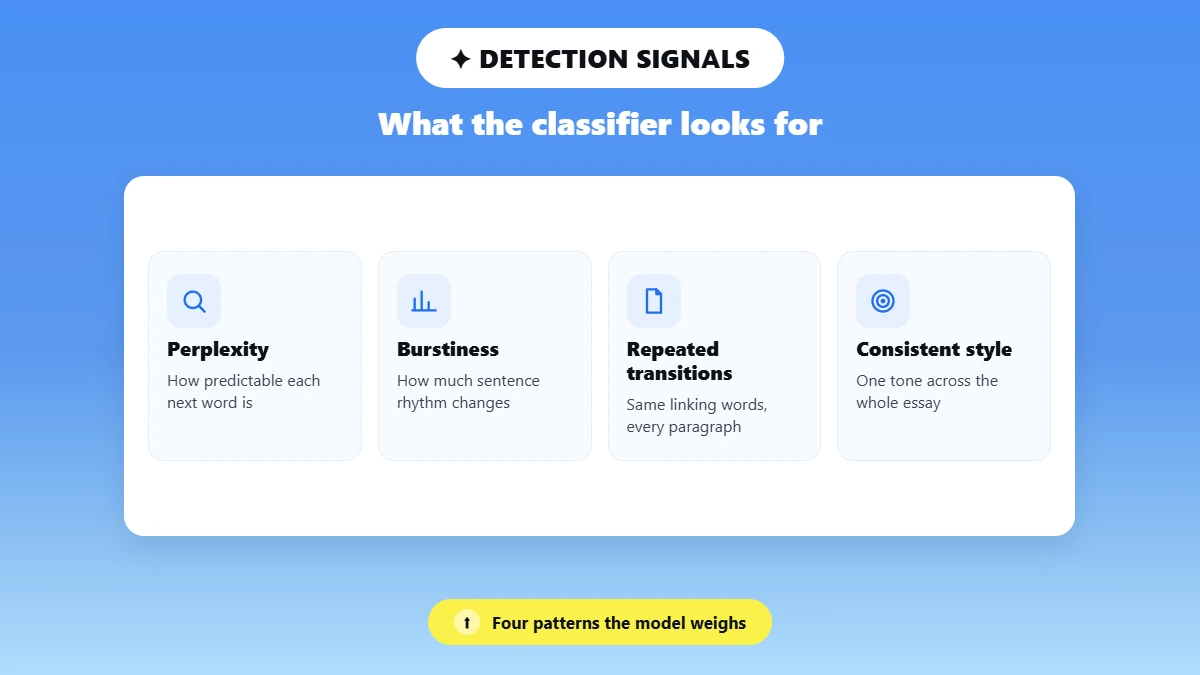
Proofademic does not publish which signals its model uses. Its May 2026 research paper describes a fine-tuned transformer classifier that reads each sentence together with the two sentences before and after it. Detectors in general look for signals like these:
Word predictability (perplexity): how easy it is to guess each next word.
Variation in sentence length and rhythm (burstiness): how much sentence length and structure change across the text.
Repetitive transitions and uniform paragraphs: the same linking words and paragraph shape again and again.
Consistency of style: the same tone and sentence pattern from start to finish.
Closeness to known AI output: how much the phrasing resembles text the classifier saw labeled as AI.
The overall AI probability score summarizes the whole document. Sentence highlights show where the model's confidence is concentrated, so read the highlighted sentences before you react to the headline number.
A 40% score on Proofademic is an AI-likelihood estimate for the whole essay, and Proofademic does not describe it as the share of your essay written by AI. Its result screen labels the number as a probability, such as "74% Probability AI generated," and its AI detection glossary defines a confidence score as the detector's degree of certainty. Proofademic publishes no meaning for mid-range scores, and its research counted text as AI only above a 0.85 confidence threshold, so treat 40% as uncertain.
Paraphrase Shield is Proofademic's built-in check for AI text that someone reworded. Proofademic says it looks for AI patterns that survive paraphrasing and humanizer tools, and it runs on every scan with no separate mode to switch on. Our guide on whether AI detectors can spot paraphrased text explains how rewording affects detection in general.
No single word triggers AI detection. Detectors score patterns across sentences. Words like "additionally" or "furthermore" can add to a pattern, but deleting them does not change how a classifier reads the whole text.
⚠️ Proofademic's Own Numbers (Self-Reported)
99.8% detection accuracy "for academic workflows," stated on its pricing page.
0.2% document-level false-positive rate on 4,200 human-written academic texts, from its May 2026 research paper.
92.9% sentence-level F1 (a score that balances AI sentences caught against human sentences wrongly flagged) on 2,600 mixed-authorship documents, from the same paper.
Proofademic ran this research itself, and we found no outside study that repeats these figures. The paper also says it tested English text only and did not test humanizer-modified text.
Our Same-Day Test: Three Essays, Three Detectors, One Set of Settings
Our test used three essays on one topic, racial themes in the Harry Potter series, so every detector scored the same writing; our earlier review covers how accurate GPTZero is on its own. Sample A is a human undergraduate essay published in 2012, and Sample B is a raw ChatGPT essay on the same topic. Sample C mixes the two, with every AI sentence marked.
Test samples used in November 2026. Word counts come from GPTZero, and each tool counts words and splits sentences slightly differently. Phrasly makes the Phrasly AI Detector, one of the three tools tested.
Sample | Word count | How it was produced | Ground truth |
|---|---|---|---|
A: Human undergraduate essay | 685 | First four body paragraphs of "Literal and Metaphorical: Racial Themes in Harry Potter" by Kayhan Nejad, a University of Washington undergraduate, published on March 15, 2012, ten years before ChatGPT | 100% human |
B: Raw ChatGPT essay | 587 | Generated by ChatGPT (free plan, default model, web search on) in November 2026 from the prompt below, unedited | 100% AI |
C: Mixed draft | 760 | Sample A with 5 sentences from Sample B added to paragraphs 2, 3 and 4 | 5 of 33 sentences AI |
▸ Sample A: source
We tested the first four body paragraphs of Literal and Metaphorical: Racial Themes in Harry Potter by Kayhan Nejad, published on March 15, 2012, in e.g., the University of Washington's online journal of first-year writing. The essay is copyrighted, so read the full text at the source.
▸ Sample B: prompt and full text
Prompt: "Write a 650-word undergraduate English essay arguing that the Harry Potter series appears color-blind but contains racial themes on both a literal and a metaphorical level. Use MLA in-text citations."
The Illusion of Color-Blindness: Racial Themes in the Harry Potter Series
At first glance, J. K. Rowling’s Harry Potter series appears to present a world largely detached from real-world racial divisions. Its central conflict revolves around magic, social hierarchy, and the struggle between good and evil rather than explicitly defined racial groups. However, a closer examination reveals that the series contains significant racial themes on both literal and metaphorical levels. Through its limited representation of racial diversity, its portrayal of prejudice against non-human magical communities, and its depiction of blood purity, the series reflects real-world racial ideologies. Although Harry Potter promotes equality and condemns discrimination, its fictional society also exposes how deeply racial prejudice can become embedded in cultural institutions and everyday beliefs.
On a literal level, the series presents a diverse magical world but gives relatively little attention to the experiences of characters from different racial backgrounds. Characters such as Angelina Johnson, Dean Thomas, and Kingsley Shacklebolt establish the presence of Black witches and wizards within the magical community. Nevertheless, racial identity rarely becomes a central aspect of their characterization. Their experiences are generally presented as separate from the larger conflicts surrounding discrimination. This limited exploration creates an appearance of racial neutrality, suggesting that the wizarding world has moved beyond racial divisions. However, the absence of meaningful discussion about race does not necessarily demonstrate equality. Instead, it raises questions about whose experiences are represented and whose identities remain underdeveloped.
The metaphorical treatment of race becomes more apparent through the series' portrayal of blood purity. The distinction between pure-blood, half-blood, and Muggle-born wizards closely resembles racial and ethnic hierarchies in the real world. Voldemort and his followers consider pure-blood families superior, treating those with Muggle ancestry as inferior and unworthy of belonging. Hermione Granger's experience illustrates this prejudice particularly clearly. Despite being an exceptionally talented witch, she is repeatedly insulted with the term "Mudblood," which is used to deny her legitimacy within the magical community (Rowling, Chamber of Secrets). The term functions as a fictional racial slur, demonstrating how language can reinforce social exclusion. By making ancestry the basis of superiority, the series exposes the irrational foundations of racial discrimination.
Furthermore, prejudice in the wizarding world extends beyond human characters. House-elves, goblins, and other magical beings occupy unequal positions within its social structure. House-elves, particularly through the character of Dobby, reveal how an entire group can be conditioned to accept servitude as natural. Similarly, goblins face distrust and exclusion despite possessing their own history, culture, and abilities. These portrayals suggest that discrimination is not limited to visible physical differences. It can also emerge through stereotypes, inherited social positions, and assumptions about which groups deserve rights and independence. Hermione's establishment of the Society for the Promotion of Elfish Welfare demonstrates her recognition of this injustice, although the other characters do not always take her concerns seriously (Rowling, Goblet of Fire).
The series therefore presents an important contradiction. While Harry and his friends resist Voldemort's ideology of blood superiority, the wider magical society continues to tolerate forms of inequality. This distinction suggests that opposing openly racist beliefs is not enough to eliminate prejudice. Social structures and everyday attitudes must also be challenged. Ultimately, Harry Potter is not entirely color-blind. Its treatment of race may be indirect and sometimes underdeveloped, but its fictional hierarchies reflect recognizable patterns of discrimination. By connecting blood purity, ancestry, and social exclusion to broader questions of belonging, Rowling creates a magical world that encourages readers to examine the consequences of prejudice in their own societie
▸ Sample C: the five AI sentences we added
Paragraph 2: "This limited exploration creates an appearance of racial neutrality, suggesting that the wizarding world has moved beyond racial divisions."
Paragraph 2: "However, the absence of meaningful discussion about race does not necessarily demonstrate equality."
Paragraph 2: "Instead, it raises questions about whose experiences are represented and whose identities remain underdeveloped."
Paragraph 3: "Their experiences are generally presented as separate from the larger conflicts surrounding discrimination."
Paragraph 4: "By making ancestry the basis of superiority, the series exposes the irrational foundations of racial discrimination."
🧪 How We Kept the Test Fair
• All runs on one day in November 2026
• Default settings on every tool
• Paraphrase Shield stayed on for every Proofademic run, because Proofademic applies it automatically on every plan
• A screenshot of every result
• No edits to any sample between runs
• Plans used: Proofademic's free 3-day trial, GPTZero Premium with Advanced Scan, and the Phrasly AI Detector
• Each sample ran as a single scan on each tool
We did not run Turnitin, because only instructors and administrators at licensed schools can see its AI writing report. Turnitin figures in this review come from Turnitin's own documentation.
Round 1: A Raw ChatGPT Essay
All three detectors labeled Sample B as AI-written, and Proofademic gave it the lowest AI score at 74%.
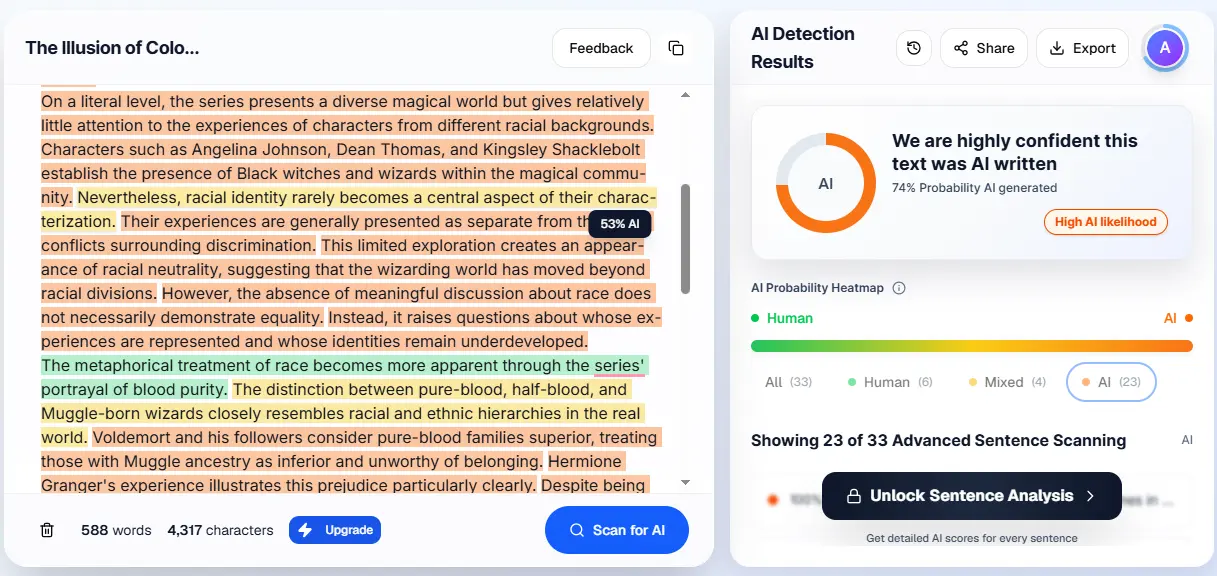
Proofademic AI detector vs GPTZero vs Phrasly on Sample B, the raw ChatGPT essay, November 2026.
Detector | Overall score | Sentences flagged | Notes |
|---|---|---|---|
Proofademic (free trial) | 74% AI, "High AI likelihood" | 23 of 33 AI, 4 mixed | Verdict: "We are highly confident this text was AI written" |
GPTZero (Premium, Advanced Scan) | 100% AI | Highlighted the sentences that drove the score; no count shown | Verdict: "We are highly confident this text was AI generated" |
Phrasly AI Detector | 100% AI | 34 of 34 likely AI | Phrasly makes this tool. |
Verva's test (outside context) | 100% on both AI samples, as reported | Not reported | Verva's own test, different samples, not our run |
Proofademic reached the right verdict with high confidence, but its sentence view marked 6 of 33 sentences as human and 4 as mixed. GPTZero and the Phrasly AI Detector put the whole essay at 100% AI. Each tool splits sentences differently, so the sentence totals do not match exactly.
Raw AI text is the easiest case for any detector. Unedited model output tends to use predictable words and an even sentence rhythm, which is exactly what classifiers learn from. This round tests the baseline, so a high score here tells you little about harder drafts.
Students and teachers see the same Proofademic report: an overall estimate, highlighted sentences, and options to export a PDF or share a link. On Sample B, the report read "We are highly confident this text was AI written," with a "High AI likelihood" tag.
In a separate April 2026 test, Verva reported that Proofademic scored both of its AI samples at 100%; Verva sells an AI humanizer. Readers often compare ZeroGPT too, but ZeroGPT was not part of this test.
Round 2: A Human Student Essay and the False-Positive Question
No detector labeled Sample A, the human essay, as AI. Proofademic scored it 93% human, GPTZero 100% human and the Phrasly AI Detector 99% human.
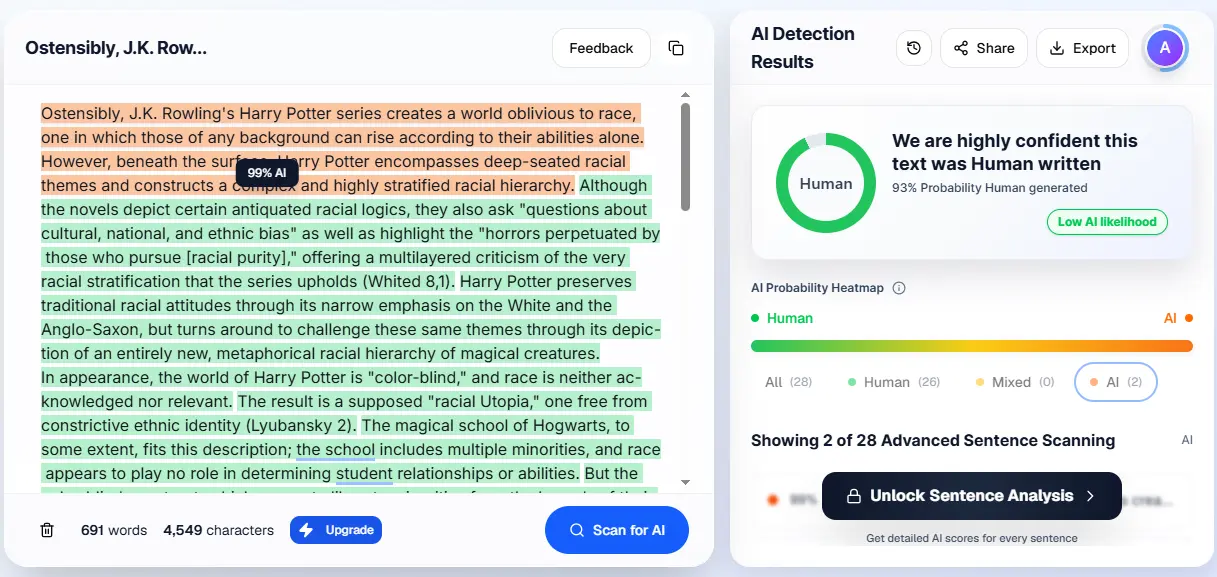
Proofademic false positive check on Sample A, a human undergraduate essay, November 2026.
Detector | Overall score | Sentences flagged | Notes |
|---|---|---|---|
Proofademic (free trial) | 93% human, "Low AI likelihood" | 2 of 28 flagged AI | The essay's first two sentences, one at 99% AI |
GPTZero (Premium, Advanced Scan) | 100% human | None flagged as AI | Verdict: "We are highly confident this text is entirely human" |
Phrasly AI Detector | 99% human | None flagged | Phrasly makes this tool. |
Proofademic's own claim (vendor) | 0.2% document-level false-positive rate | Not applicable | Proofademic's published research, not our run |
Verva's test (outside context) | 13% and 19% on two human samples, as reported | Not reported | Verva's own test, different samples |
Proofademic still marked the essay's first two sentences as AI, including one at 99%. Both are formal thesis sentences that sum up the whole argument. The overall score stayed at 93% human, so the false positive showed up at the sentence level only.
A Proofademic false positive happens when the tool flags writing a person wrote alone. AI detectors do give false positives, and the best-known evidence comes from a 2023 Stanford study of seven GPT detectors.
📊 What the Stanford Study Found
In Liang et al. (2023), seven GPT detectors misclassified TOEFL essays by non-native English writers as AI-generated at an average false-positive rate of 61.22%. At least one detector flagged 89 of the 91 essays (97.80%).
False positives affect detectors across the market, and Proofademic faces the same risk as any other tool. Our analysis of why AI detectors can be wrong covers the most common causes.
Proofademic claims a 0.2% document-level false-positive rate, Verva reported 13% and 19% on its two human samples, and our Sample A scored 93% human. These figures come from different texts and methods, so they cannot be compared directly.
Our test used one undergraduate essay, so it cannot show how Proofademic handles ESL student writing or multilingual AI detection. In May 2026, Ryter Pro reported that Proofademic identified its ESL student essay as human-written, but one sample from a humanizer company cannot support a general claim.
Do not panic: a score is not proof. If Proofademic flags an essay you wrote yourself, take these steps before anything else:
✅ If Your Own Essay Gets Flagged
• Open your Google Docs or Word version history and note the dates of each draft.
• Ask your instructor how the score will be used in grading.
• Request a meeting to walk through how you wrote the essay.
Round 3: A Mixed Human and AI Draft, Seen From Both Sides of the Desk
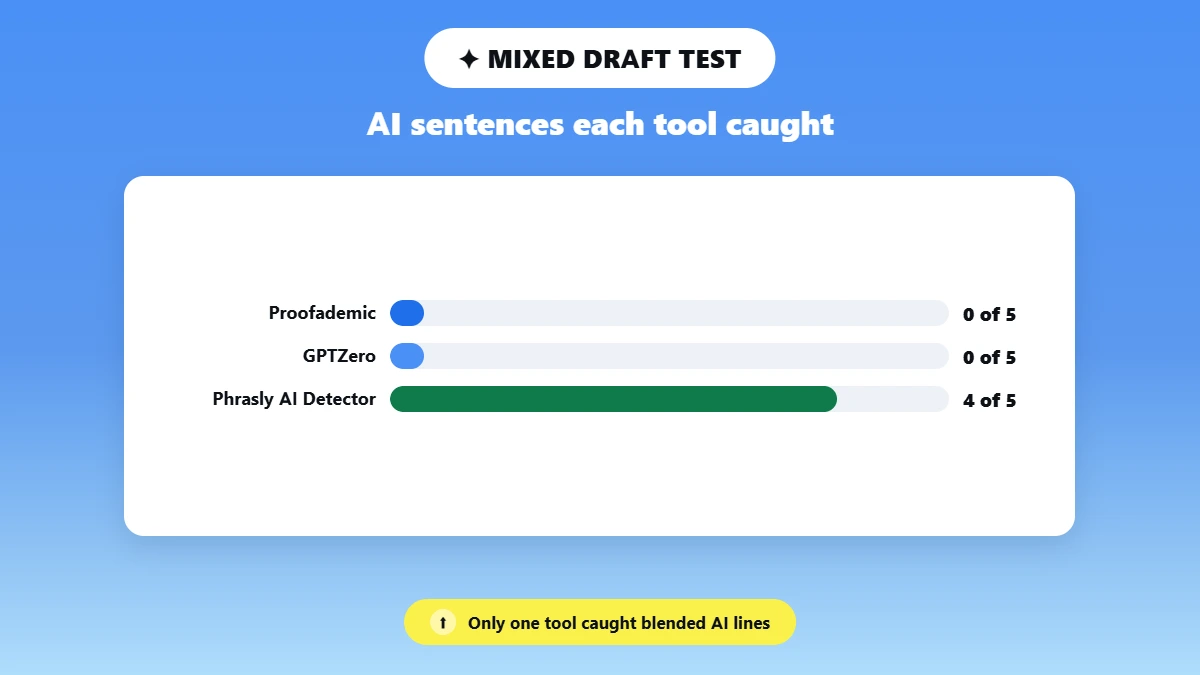
Sample C has 760 words in 33 sentences: 28 human sentences from Sample A and 5 AI sentences from Sample B, added to paragraphs 2, 3 and 4.
Sentence-level results on Sample C, the mixed human and AI draft, November 2026.
Detector (plan, test date) | Overall score on Sample C | Marked AI sentences caught | Human sentences wrongly flagged | Paraphrase Shield |
|---|---|---|---|---|
Proofademic (free trial, Nov 2026) | 94% human, "Low AI likelihood" | 0 of 5 | 2 of 28 (1 as AI at 99%, 1 as mixed) | On by default; cannot be switched off |
GPTZero (Premium, Advanced Scan, Nov 2026) | 94% human, 6% mixed | 0 of 5 | 0 of 28 | Not applicable |
Phrasly AI Detector (Nov 2026) | 89% human, 11% AI | 4 of 5 | 0 of 28 | Not applicable |
Verva's reported Proofademic test (context only) | 58% and 77% on two mixed samples | Not reported | Not reported | Not reported |
Proofademic caught 0 of 5 marked AI sentences and wrongly flagged 2 of 28 human sentences, the same two opening sentences it flagged in Round 2. GPTZero marked none of the 5 AI sentences as AI and flagged no human sentences, though its 6% mixed score showed some doubt. The Phrasly AI Detector caught 4 of 5 AI sentences, with no human sentence flagged.
We could not report a shield-off score, because Proofademic applies Paraphrase Shield to every scan on every plan. Verva's own test put two mixed samples at 58% and 77% on Proofademic, and Verva sells a competing product, so treat that as one company's result.
💡 Why Mixed-Draft Scores Swing
• A document score blends sentence-level judgments, so the same AI sentences push the total up or down depending on how much human text surrounds them.
• Edited AI sentences fall between the two styles, and detectors score them less consistently.
• Short drafts give the model fewer sentences to average, so one sentence moves the percentage more.
Our test did not include humanized AI text, so it cannot show whether Proofademic catches text you edited heavily or ran through a humanizer. Proofademic says Paraphrase Shield targets that kind of text, yet its own paper says it did not test humanizer output. Verva reported that text rewritten by Undetectable AI still scored 100% AI on Proofademic, while text from Verva's own humanizer scored 1% and 2%.
What the Student Sees
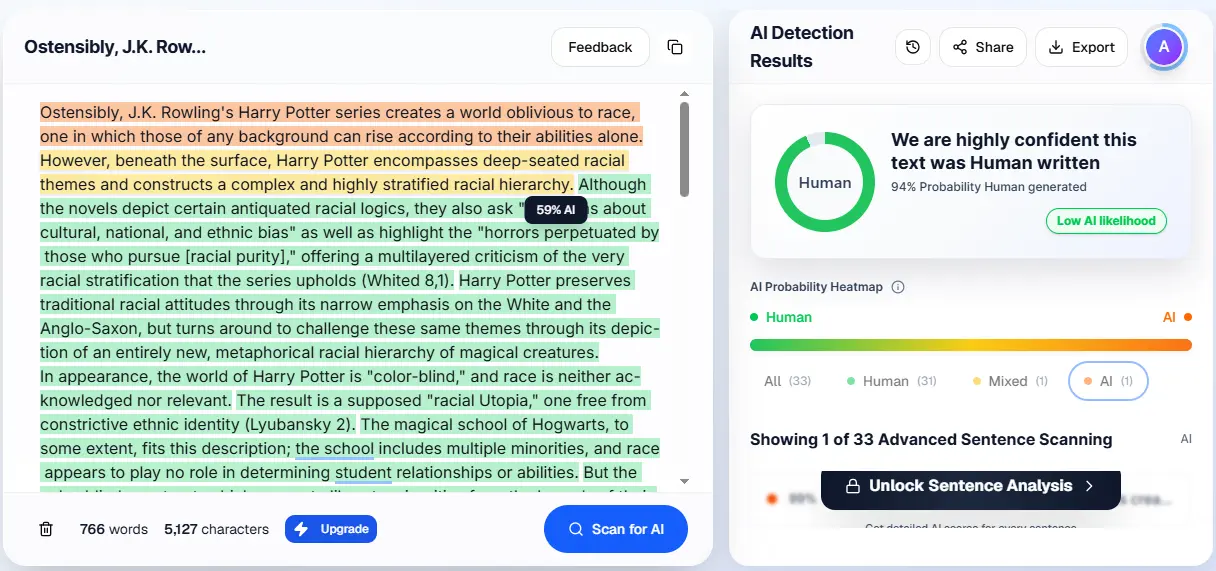
The report shows a ring chart, a verdict such as "We are highly confident this text was Human written," and a probability, here 94% human. Below it, a heatmap colors each sentence green, yellow or orange, and hovering over a sentence shows its AI percentage. On Sample C, Proofademic colored the essay's opening sentence orange and the second sentence yellow, while all five inserted AI sentences stayed green.
Can My Professor See That I Ran My Essay Through Proofademic?
Proofademic's privacy policy does not list schools or instructors among the groups it shares data with. The privacy policy names service providers such as hosting and payment companies, plus authorities when the law requires it.
Proofademic says its own models process submitted text without human review, and it does not use that text for training or resale. The policy gives no fixed retention period and keeps data "only as long as necessary," so we cannot tell you how long a scan stays stored. You can ask Proofademic to delete your data under the rights listed in the same policy.
What the Teacher Sees
A teacher who pastes the same draft into Proofademic sees the same kind of report: an overall estimate and highlighted sentences. Paid plans add Batch Scan for a class set, a PDF export and a share link, and schools can connect Proofademic's API to their learning platform.
On Sample C, a teacher would have seen 94% human and no warning on any of the five AI sentences. A detector score cannot show which sentences a student wrote, and schools act under their own academic integrity policy. The next step for a teacher is a request for drafts, version history and a conversation with the student, because a second score alone settles nothing.
Round 4: Is Proofademic Free, Legit and Worth Paying For?
Proofademic is free only for a one-time 1,000-word allowance that needs no credit card, and its paid plans cost $15 to $45 per month. The pricing page labels the free option a 3-day trial.
Proofademic AI detector free allowance and paid plans in USD, from Proofademic's pricing page and AI Text Detector FAQ, November 2026.
Plan (checked Nov 2026) | Monthly price | Annual price | Monthly words | Per-scan limit |
|---|---|---|---|---|
Free | $0 | n/a | 1,000 words, one time | 1,000 words |
Essential | $15 | $99 | 200,000 | 3,500 |
Premium | $25 | $165 | 400,000 | 8,000 |
Professional | $45 | $300 | 600,000 | 25,000 |
Prices come from each provider's live pricing page, checked in November 2026. Prices can change, so check the pricing page before you buy.
Proofademic does not offer refunds. Its terms of service say all purchases are "final and non-refundable," and cancelling only stops future charges. Use the free trial before you pay.
Proofademic works as a paid product with published plans, a public research page and legal pages. These trust signals help you judge whether it is legit:
🔍 Is Proofademic Legit or a Scam?
✅ Company: Its legal pages name Proofademic AI Inc., a company registered in Montreal, Canada, and its site footer lists a New York office.
✅ ScamAdviser: Rates proofademic.ai "Very Likely Safe" with an average-to-good trust score, as of November 2026.
✅ Published research: It released a May 2026 paper with its method and limits. Proofademic wrote the paper itself, and no outside journal reviewed it.
⚠️ Trustpilot: One review and a TrustScore of 3.2 as of November 2026. That single review, from May 2026, gave 1 star because the settings had no option to delete the account.
⚠️ Refunds: None, under any circumstances.
Pay for Proofademic only if fully written drafts are your main check, because it caught none of the AI sentences in our mixed draft. Try the free trial on a piece of your own writing first.
What Reddit Users Say About Proofademic
Reddit opinions on the Proofademic AI detector are few, and the one thread about it splits between a user who calls it unreliable and a user who says it compared well with other tools.
r/CheckMyTurnitin_ai, April 2026: one user replied only "It's not reliable," without saying what they tested.
Same thread, April 2026: another user wrote, "I've compared it with many other tools, and I don't think proofademic is overhyped," with no test details.
r/AskReddit, May 2026: in a general thread about AI detectors, one user said detectors feel "super inconsistent and stressful for students" on regular essays. The thread does not mention Proofademic.
For more opinions, our roundup of the detectors Reddit users recommend collects the tools students mention most.
Proofademic vs Turnitin vs GPTZero: The Final Scorecard
The biggest Proofademic vs Turnitin difference is access: anyone can sign up for Proofademic, while Turnitin licenses its AI writing detection to institutions. Turnitin says only instructors and administrators can see its AI writing indicator, so students cannot run the report on their own work. Our guide to which AI detectors universities use shows how schools pick between these tools.
📊 How Often Does Turnitin Falsely Detect AI?
Turnitin says its document-level false-positive rate stays under 1% for documents with over 20% AI writing. Its 2023 sentence-level update put the sentence false-positive rate at around 4%. The report needs at least 300 words of English prose.
Like Proofademic's 0.2% claim, Turnitin's figures are vendor-reported, and the two come from different test sets.
Proofademic vs GPTZero vs Turnitin vs Phrasly AI Detector scorecard, November 2026.
Tool | Who can access it | Free limit | Entry price | Sentence highlights | Plagiarism check | Paraphrase handling | Mixed-draft result (our test) | Claimed false-positive rate and source |
|---|---|---|---|---|---|---|---|---|
Proofademic | Anyone, self-serve | 1,000 words, one time (3-day trial) | $15/mo (Essential) | ✅ All paid plans | ✅ Every plan | Paraphrase Shield, automatic on every plan | 94% human; caught 0 of 5 AI sentences | 0.2% document level (Proofademic research) |
Turnitin | Licensed institutions; instructors and admins only | None for individual students | Institutional pricing, not published | ✅ For instructors | ✅ Similarity Report | Highlights likely AI-paraphrased text in purple | Not tested (no student access) | Under 1% document level, for documents with over 20% AI writing (Turnitin FAQ) |
GPTZero | Anyone, self-serve | 10,000 words a month | $23.99/mo (Premium) | ✅ Premium and Professional | ✅ Premium and Professional | Paraphraser Shield | 94% human, 6% mixed; caught 0 of 5 AI sentences | No more than 1% (GPTZero technology page) |
Phrasly AI Detector | Anyone, self-serve | 3 checks a day without signup; free account for unlimited checks | $0 | ✅ Flagged sentences | Separate Phrasly Plagiarism Checker | Not published | 89% human, 11% AI; caught 4 of 5 AI sentences | None published |
Prices come from each provider's live pricing page, checked in November 2026. Prices can change, so check the pricing page before you buy.
Reliability depends on the sample type, and students can self-check only with Proofademic, GPTZero and Phrasly, since Turnitin stays with instructors. Our Turnitin vs GPTZero comparison goes deeper into those two.
GPTZero matched the clear cases in our test: it scored the raw ChatGPT essay 100% AI and the human essay 100% human. On the mixed draft, it reported 94% human and 6% mixed and marked none of the five AI sentences as AI. Its technology page claims a false-positive rate of no more than 1%.
Teachers choosing the best AI detector for a class should weigh access, sentence highlights and published false-positive data more heavily than a headline accuracy number. The FAQ below links our tested roundup for readers comparing the best AI detector options.
Run a Second Check Before You Submit
If Proofademic gives a high AI score on writing you did yourself, do not rewrite your essay to chase the number. Gather evidence of your process and read which sentences were flagged.
✅ Pre-Submission Checklist
Save version history in Google Docs or Word, and keep dated drafts.
Keep your outline, notes and source list.
Run the same final text through two detectors and compare the highlighted sentences, not only the totals.
Check your course's academic integrity policy on AI tools and detector use.
For teachers, a single detector score should never decide a disciplinary case. Ask for drafts and talk with the student first.
Keep Your Drafts and Version History
No detector proves who wrote a text, but version history shows how your writing developed over time. Timestamps, gaps between revisions and earlier drafts with the same ideas in rougher form all help. For Sample A in our test, the 2012 publication date served as that proof.
Read the Flagged Sentences, Not Just the Percentage
In Rounds 2 and 3, Proofademic's overall score stayed above 90% human while its highlights marked the essay's opening sentences as AI. Bring those highlighted sentences into any conversation with your instructor, because they show exactly what drove the result.
What if English Is Your Second Language?
Non-native writers carried the highest false-positive risk in the 2023 Stanford study, so ESL students should keep drafts from the very first outline. Our review of AI checkers for students compares free tools you can use for a pre-submission check.
Compare Your Score With the Phrasly AI Detector
Comparing the Proofademic AI detector score with a second tool shows you which sentences both detectors agree on. The Phrasly AI Detector shows an overall AI probability, flagged sentences, and AI or human labels from six third-party detectors, including GPTZero and Turnitin.
In our test, the Phrasly AI Detector agreed with Proofademic and GPTZero on the raw ChatGPT essay and the human essay, and it flagged 4 of the 5 AI sentences in the mixed draft. A second check gives you more to discuss with your instructor, and it does not clear an essay on its own.
Paste your final draft into the Phrasly AI Detector and compare its flagged sentences with your Proofademic report. 👇
FAQs
Is the Proofademic AI Detector Accurate?
Proofademic's accuracy depends on the kind of text you scan. In our November 2026 test, it scored a raw ChatGPT essay 74% AI and a human essay 93% human, but it flagged none of the five AI sentences hidden in a mixed draft. Is Proofademic accurate enough to act on alone? Its 99.8% figure is self-reported, so treat a score as one clue. Our Winston AI review covers another academic detector.
Is Proofademic AI Free?
The Proofademic AI detector is free for 1,000 words, one time only, with no credit card. After that, Essential costs $15 a month or $99 a year for 200,000 words a month. Every purchase is nonrefundable, so use the free words to test a short piece before you pay for a plan.
What Does a 40 Percent AI Score on Proofademic Mean?
A 40% Proofademic score is an estimate of how likely your whole essay matches AI patterns. It does not mean 40% of the essay is AI-written. Proofademic publishes no definition for mid-range scores. Look at which sentences it highlighted, then compare them with your earlier drafts before you worry.
Can Proofademic Detect Paraphrased or Humanized AI Text?
Published tests disagree on whether Proofademic catches humanized text. Paraphrase Shield is built for reworded AI text, yet Proofademic's May 2026 paper left humanizers out of its testing. In Verva's test, Undetectable AI output scored 100% and Verva's own output scored 1% to 2%. Verva sells a humanizer, and no detector guarantees a catch.
Can My Professor See That I Ran My Essay Through Proofademic?
Nothing in Proofademic's privacy policy says it shares scans with schools or instructors. It names service providers and legal authorities only. A professor sees your report if you send the PDF or share link. Proofademic does not say how long it keeps scans, and you have the right to request deletion.
Is Proofademic Better Than GPTZero or Turnitin?
Proofademic suits students who want sentence-level results they can buy themselves. Turnitin stays with schools and instructors, and GPTZero offers a bigger free monthly allowance. In our test, Proofademic and GPTZero both missed the five AI sentences in the mixed draft. Our list of AI checker tools we tested for accuracy compares more options.

Written by
Alina Shah
SEO Content Specialist · Karachi, Pakistan
She writes about AI so you don't have to guess. 8+ years in content strategy and editing. Now she puts AI writing tools and detection systems through real tests and shares what actually works.