Is Copyleaks Accurate? 2026 Test, False Positives & Verdict
14 min read
Is Copyleaks accurate? Mostly. Copyleaks is accurate on long, clearly human or clearly AI-generated text. And it reports classification rates above 99% in its own testing. But accuracy shifts with text length, language, editing depth, and the sensitivity setting you use.
False positives and false negatives both happen. Treat any Copyleaks score as a screening signal. Not proof of who wrote something.
This guide separates what Copyleaks reports about itself from what independent researchers have measured. Explains what the AI score actually means, covers safety and data storage, and gives a plain verdict on when to trust a result.
Check your own text for free, no signup:
Copyleaks Accuracy at a Glance
Question | Short answer |
Is it accurate? | Often, but it depends on the sample, the language, and the sensitivity setting. |
Can it be wrong? | Yes. False positives and false negatives both occur. |
Best use | Screening long-form submissions and institutional workflows at scale. |
Main limitation | Edited, hybrid, short, or non-native text. |
Should a score prove misconduct? | No. It is evidence for review, not a verdict. |
Is it safe to use? | It is a legitimate platform, but retention depends on product and settings. |
What Is Copyleaks and How Does It Work?
Copyleaks is a content authenticity platform founded in 2015. Universities, publishers, and enterprises use it across 30+ languages. It integrates with LMS platforms such as Canvas and Moodle.
It added AI detection in 2023 to flag output from models like ChatGPT, Claude, and Gemini. Including current GPT-5-era models.
One distinction matters before anything else. The AI detector and the plagiarism checker are separate systems. The plagiarism checker matches your text against an index of existing sources.
The AI detector runs a machine-learning classifier that estimates whether writing looks machine-generated. They answer different questions and produce different scores. And confusing them is the single most common mistake readers make.
What Signals Copyleaks Uses to Flag AI Text
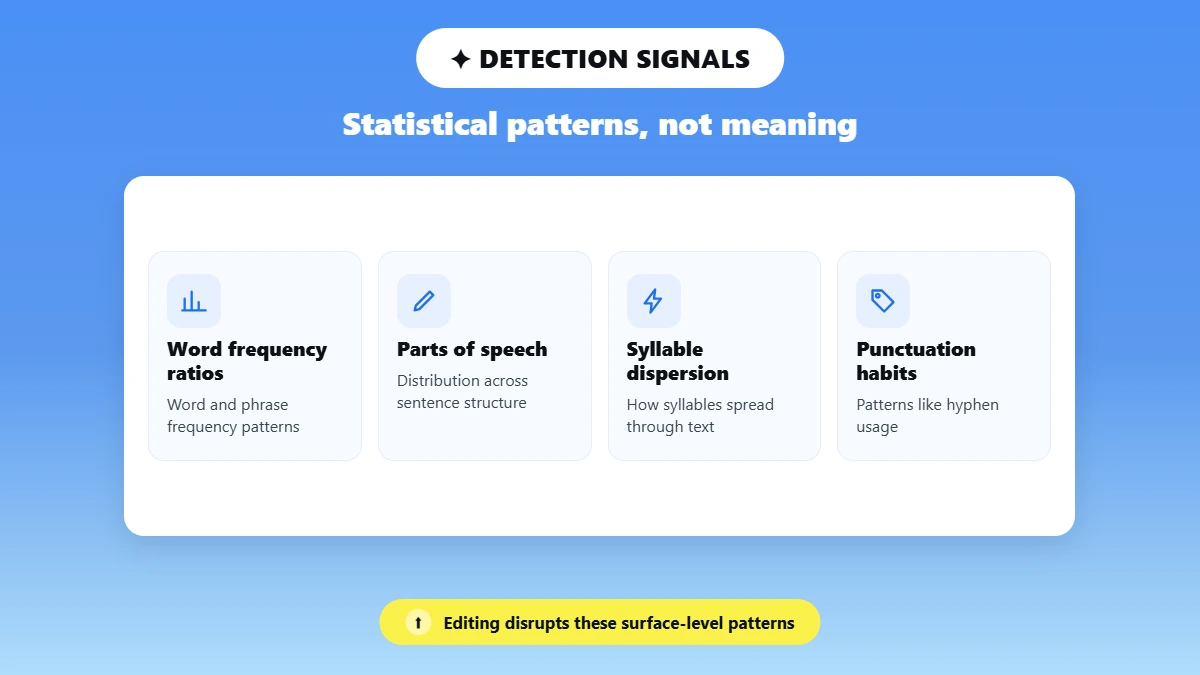
Copyleaks does not read meaning the way a person does. Its classifier was trained on large datasets of human and AI writing. It looks for statistical patterns in how the text is constructed.
Per its own documentation, the signals include measures such as word and phrase frequency ratios, parts-of-speech distribution, and syllable dispersion. Punctuation habits like hyphen usage.
Copyleaks also layers additional evidence on top of the raw score. Including AI Phrases, which highlights the specific passages driving the result. And AI Source Match. Database matching is not part of this.
Comparing your text against known sources is what the plagiarism system does. It plays no role in whether the AI detector flags you.
The practical consequence: These are all surface-level statistical patterns. Editing disrupts them. That is why detection weakens on rewritten text. It is the limitation the rest of this article keeps returning to.
How Accurate Is Copyleaks AI Detector in 2026?
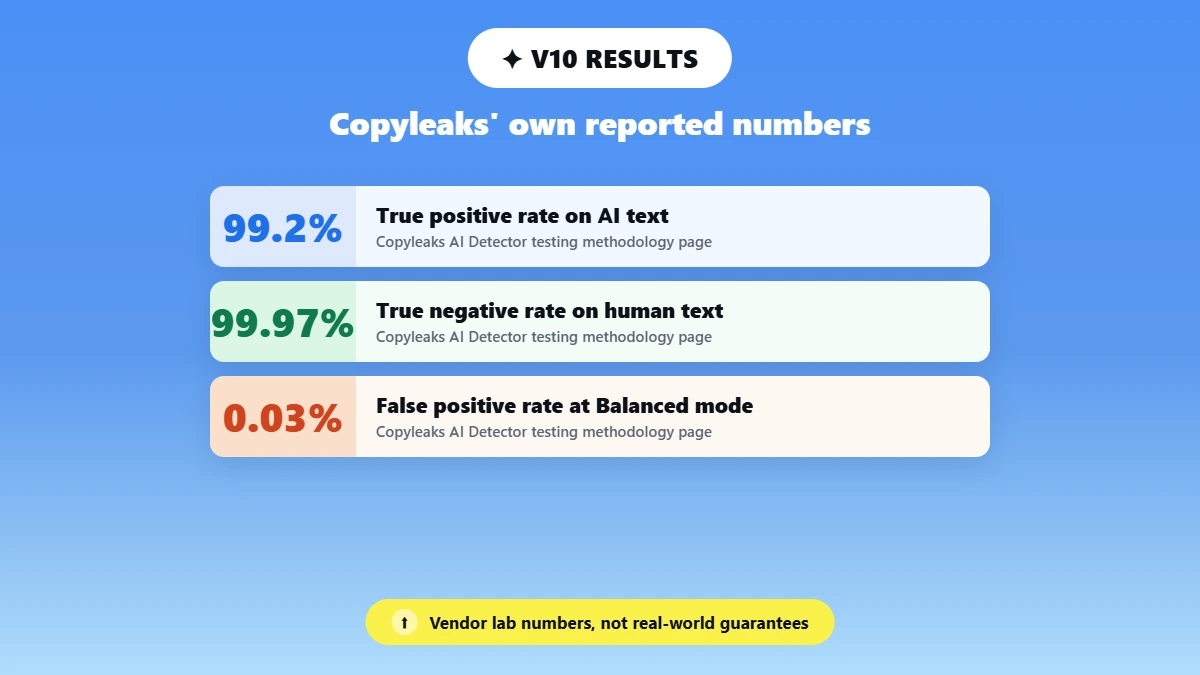
In its own testing, Copyleaks reports above 99% on both AI and human text in English. Independent studies land lower and vary widely by dataset. From roughly 66% to 96% overall, depending on what was tested.
The gap is not dishonesty. It reflects the difference between clean lab samples. And the edited, mixed, multilingual writing people actually submit.
Copyleaks AI Detector Official Accuracy 2026: V10 Results
These figures come from Copyleaks and describe its own model. They are Copyleaks-reported. Not independent.
Source: The company's AI Detector testing methodology page.
For English text above 350 characters at the default Balanced sensitivity.
Metric (Copyleaks-reported) | Figure | What it means |
True positive rate (AI text) | ~99.2% | How often it correctly flags AI writing |
True negative rate (human text) | ~99.97% | How often it correctly clears human writing |
False positive rate | ~0.03% | How often human writing is wrongly flagged |
False negative rate | ~0.8% | How often AI writing slips through |
Copyleaks also publishes per-language results. English performs best. French, German, Italian, Portuguese, and Spanish are reported above 93%. This is a meaningful step down.
The company tests with separate data science. And QA teams on data held out from training, which is more transparent than most competitors offer.
What Those Percentages Don't Prove
A vendor lab number describes performance on the vendor's test set. Not on your essay. Copyleaks chose the datasets. The languages, the text lengths, and the balance of human to AI samples.
Change any of those and the numbers move. A 0.03% false positive rate is not a promise about your particular document.
Real-world accuracy shifts with:
Text length. Copyleaks needs at least 350 characters. Short samples give the classifier less evidence.
Language. English outperforms every other language Copyleaks reports.
Editing. Human revision disrupts the statistical signals the classifier depends on.
Hybrid authorship. Mixed human and AI text is where every detector is least consistent.
Sensitivity setting. The same passage scores differently at different levels.
Genre. Formulaic, technical, and academic prose reads as more predictable to a machine.
What Independent Research Finds
Independent results are worse than the vendor numbers. And inconsistent with each other. That is the honest read. Different studies test different languages, genres, and editing depths.
There is no single independent accuracy figure for Copyleaks. Here is what three credible studies found. Kept separate rather than averaged into one misleading number.
Study | Scope | Main finding on Copyleaks | Limitation |
Van Vlasselaer et al., International Journal for Educational Integrity, June 2026 | Academic papers, 4 detectors tested | Cleared all 40 human papers with no false positives. But classified none of 40 fully AI papers as fully AI, flagged only 10 of 40 even partially, and caught 22.5% of humanized papers. | Long-form academic writing only; one genre |
Spanish-language, ~180 texts, hybrid and multi-authored | Weakest of the three detectors tested on mixed authorship, with repeated misclassification of human and partly-edited text. | Spanish only, small sample; not a general ranking | |
Advances in Physiology Education | STEM academic writing | No Copyleaks false positives in its sample, but it did record false negatives. | Narrow discipline and sample |
Read together, a pattern emerges that the vendor figures hide. Copyleaks is comparatively cautious about flagging humans. And comparatively weak at catching AI that has been edited.
That trade-off is defensible for institutions. Wrongly accusing a student is the costlier error. It also means a clean Copyleaks report is weaker evidence that no AI was used than most people assume.
This breakdown of AI detection accuracy across checkers puts these numbers in wider context.
Is Copyleaks Accurate in Our Own Testing?
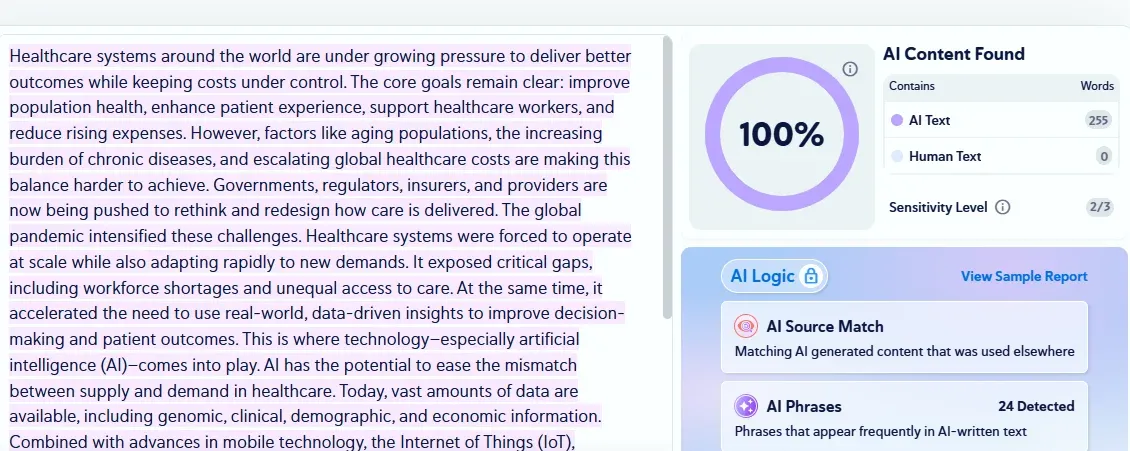
We generated one academic essay on AI in healthcare delivery using ChatGPT. Then ran three versions of it through Copyleaks at the default Sensitivity Level 2 of 3. The raw output, a lightly edited draft, and a version rewritten by a human writer.
Word counts were comparable across all three, between 241 and 255 words. Three samples cannot establish a miss rate. Read this as an exploratory test rather than a measured accuracy figure.
Raw AI output: 100% AI. 255 AI words, 0 human words. The AI Logic panel flagged an AI Source Match, and 24 detected AI phrases. This is the detector working exactly as advertised.
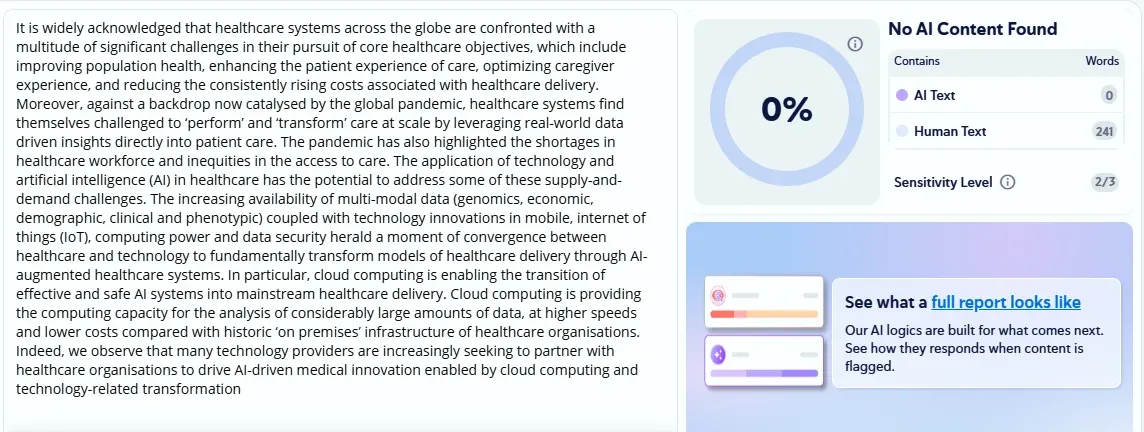
Lightly edited: No AI Content Found. 0% AI, 0 AI words, 241 human words. The same essay, with sentences rephrased and transitions adjusted. While large sections were left untouched.
Humanized: No AI Content Found. 0% AI, 0 AI words, 253 human words. A healthcare writer rewrote the essay by hand. Restructuring arguments and adjusting tone.
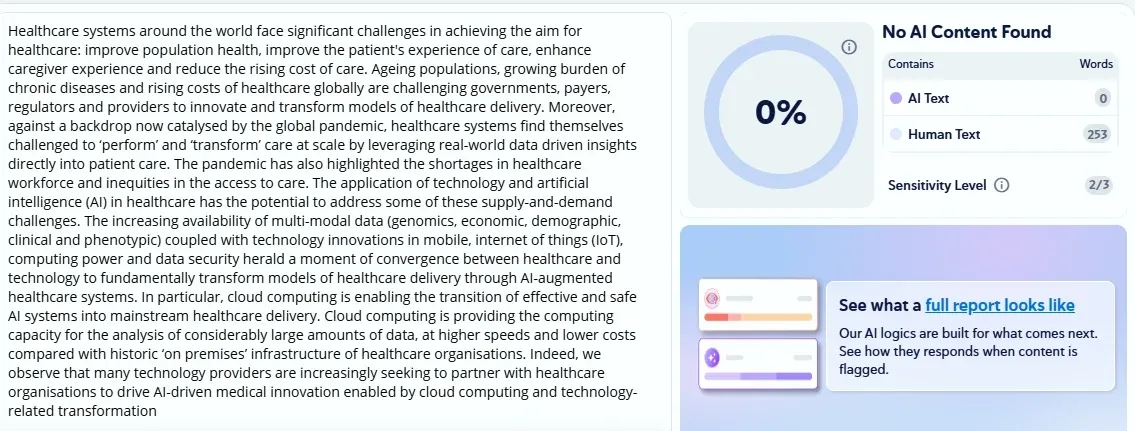
Across these three samples, the detector went from a confident 100% AI call, with 24 flagged phrases and an AI Source Match, to zero AI words on text derived from the same machine-written source.
What this shows is not a rate but a threshold. How little editing it took to erase the signal entirely.
In a documented four-document head-to-head we ran on August 19, 2026, Copyleaks flagged a clean, fully human 526-word essay as 100% AI.
Every word was attributed to AI. None to a human author, at Sensitivity Level 2 of 3. Its AI Logic panel reported an AI Source Match. And 41 AI phrases were detected. The same essay was correctly cleared by GPTZero.
That single result is not a false positive rate. And we are not presenting it as one. It is a demonstration that a confident, detailed, entirely wrong Copyleaks report is possible on ordinary human writing.
For a student, that report is what an academic integrity conversation starts from.
The full protocol, all four documents, and the GPTZero comparison are in this Copyleaks vs GPTZero head-to-head.
Run the same passage through Phrasly's free AI Detector for a second signal.
When Can Copyleaks Be Wrong?
Yes, in both directions. The Copyleaks false positive rate is reported near 0.03% in its own Balanced-mode testing. Independent testing has found materially higher real-world rates.
Published figures for AI detectors generally land in the mid-single digits and are rising for non-native English writers. False negatives are the larger practical problem. Edited AI text routinely passes.
Copyleaks acknowledges false positives in its own documentation. Human text gets flagged most often when the writing is mechanical or highly structured. Research consistently shows that non-native English writing produces lower linguistic variability.
This pushes it toward the AI end of the scale.
This guide on how AI detector false positives happen covers who is most at risk.
What Writing Patterns Trigger False Flags
Formulaic writing. Repeated sentence structures and predictable transitions mimic the consistency detectors associate with AI.
Example: "This study examines X, discusses Y, and concludes with Z" repeated across sections.
ESL writing with low perplexity. Simpler vocabulary and narrower sentence variety reduce linguistic diversity. Detectors read it as AI-like.
Example: "The results show the method is useful and gives clear improvement."
Heavily structured professional reports. Concise, repeating formats optimised for clarity over stylistic variation can score high for AI probability.
Example: objective, method, findings, and recommendation listed in identical order in every section.
If your fully human work keeps getting flagged, the writing pattern is usually the trigger. Not a bug. This is a documented limitation. Not a judgement on quality. It falls disproportionately on non-native English writers.
What to Do If Copyleaks Flags Your Work
Request a re-scan with context. Provide assignment details, writing conditions, or background that frames the submission.
Document your writing process. Drafts, notes, outlines, and version timestamps demonstrate authorship in ways a score cannot.
These seven techniques also reduce risk before you submit.
Ask for human review. No detector output should be treated as final. Request that an instructor read the work directly. A human-in-the-loop check is the only defensible standard.
Cross-check with a second detector. Run the same text through the Phrasly AI Detector. See whether the result holds. One flagged result from one tool is not a consensus.
What Does a Copyleaks AI Content Score Mean?
A Copyleaks AI score is an automated, probabilistic estimate that your text resembles machine-generated writing. It is not a measure of cheating. It is not a plagiarism percentage.
A 70% AI score does not mean 70% of your document was copied. Or that 70% was written by a bot. It means the classifier's confidence, expressed as a percentage.
Two scores, two different systems:
AI score. A classifier's probability judgment about writing style. No source is named because none exists.
Similarity score. The plagiarism percentage. Showing how much of your text matches indexed sources, each of which is listed.
We cover how Copyleaks' plagiarism checker works in this plagiarism checker ranking.
Three things change the AI score without your writing changing at all. The sensitivity setting applied by your institution or account. The length of the submission, since longer text gives the classifier more evidence.
And the model version running at the time.
If you want the distinction in more depth, see this explainer on AI checkers versus AI detectors.
Is Copyleaks Safe, and Does It Save Your Work?
Copyleaks is a legitimate commercial platform with documented security certifications. Including SOC 2, SOC 3, GDPR compliance, and PCI DSS. It is not a scraper or a scam. Is Copyleaks legit? Yes, by any normal standard.
Full detail are in the Copyleaks Trust & Security documentation.
But safe is not the same as nothing is stored. The two questions have different answers.
Does Copyleaks save your work? Partly. Data retention depends on the product and your settings. Copyleaks states that content submitted through its AI Detector API is not stored. Shared, or used to train public AI models.
Separately, its Shared Data Hub is a library of user-submitted documents used to improve comparison and detection.
Documents indexed into it can be made available for future matching.
Institutional accounts often have their own retention and indexing configuration set by an administrator. Not by you.
Practical advice: Before uploading unpublished research, client work, or anything confidential, check your organisation's or account's indexing and retention settings. Review the Copyleaks privacy and Data Hub documentation.
Being legitimate and being appropriate for confidential material are separate judgements.
On legitimacy specifically: Copyleaks is used by universities, publishers, and Fortune 500 companies, and it publishes its testing methodology. Legitimate does not mean infallible, and as the research above shows, it is not.
Is Copyleaks Free? Limits and Pricing
There is a limited free scan. But sustained use needs a paid plan. Copyleaks offers a public no-login check for short text. Registered users receive a small allocation of free credits. Beyond that, scanning is metered by credits.
The free no-login check is capped by a character limit rather than a credit allowance. One credit covers up to 250 words or one image.
Plan | Monthly | Billed annually | Credits |
Free | Limited no-login scan plus trial credits | n/a | Minimal |
Personal | $16.99/mo | $13.99/mo ($167.88/yr) | 100/mo monthly, 1,200 annually |
Pro | $99.99/mo | $74.99/mo ($899.88/yr) | 1,000/mo monthly, 12,000 annually |
Education / Enterprise | Custom | Custom | Set during onboarding |
Pricing is accurate as of the date this article was written and is subject to change. Confirm the current price on the tool's official pricing page before purchasing.
Two things to know before buying. Credits do not roll over between months on individual plans. Irregular users lose what they do not spend. And the jump from Personal to Pro is steep, with no mid-tier.
Current details are on the Copyleaks pricing page.
How Copyleaks Compares with Other AI Detectors
At a workflow level: Copyleaks is the multilingual, institution-friendly option. GPTZero is the stronger general-purpose detector. Turnitin is the one your university probably already runs.
Asking whether Copyleaks or GPTZero is more accurate has no single answer, because it depends on the dataset. Accuracy rankings depend entirely on the dataset. Treat any single ordering with suspicion.
Copyleaks leads on language coverage and LMS integration. Independent testing suggests it is comparatively cautious about flagging humans. GPTZero performs more decisively on raw AI text.
Offers clear sentence-level highlighting. Turnitin matters mainly because it is embedded in academic workflows. Not because it is measurably more accurate.
For the direct matchup on identical documents, see this Copyleaks vs GPTZero comparison. This breakdown of how accurate GPTZero actually is, and the wider field in this ranking of the best AI checker tools.
Final Verdict: Is Copyleaks Reliable?
Copyleaks is reliable as a screening tool and unreliable as proof. It is legitimate, capable, and genuinely strong on long documents. Multilingual coverage and institutional workflows.
So is Copyleaks a good AI detector? Yes, for screening, no for proof. Independent Copyleaks reviews through 2026 describe the same pattern.
It is comparatively unlikely to flag human writing wrongly. But it misses edited AI text often enough that a clean report proves little. A flag should always start a review rather than end one.
Use Copyleaks if you are:
An educator screening raw submissions at scale. Where detection signals stay intact and the low false positive profile matters most.
An institution needing LMS integration. Canvas and Moodle support makes it practical for automated workflows.
Working across languages. Its 30+ language coverage beats English-focused competitors.
Do not rely on Copyleaks alone if you are:
Evaluating edited or hybrid content. This is where independent testing shows the largest gap.
A content marketer or ESL writer. Low-perplexity prose carries more false-positive risk. This guide to the best AI detector for copywriters covers that workflow.
Making a decision with consequences. This is where a second detector and human review are the only defensible standard.
Run a second-opinion check before you trust one score. Phrasly's AI Detector is free, no sign-up.
FAQs
Is Copyleaks AI Detector accurate?
Copyleaks reports above 99% on both AI and human English text in its own V10 testing. Independent studies find lower and more variable results. Especially on edited or non-English writing.
It is accurate enough to screen with. Not accurate enough to prove authorship.
Can Copyleaks be wrong about human writing?
Yes! In our August 2026 testing, it flagged a fully human 526-word essay as 100% AI. Formulaic, technical, and non-native English writing carries the highest risk. If you are flagged, document your process.
Request human review rather than accepting the score.
Is Copyleaks safe, and does it save your work?
It is a legitimate platform with SOC 2, SOC 3, GDPR, and PCI DSS certifications. Retention depends on product and settings. API detector content is not stored by Copyleaks.
Documents indexed into its Shared Data Hub can be available for future comparison. Check your account settings first.
Is Copyleaks free, and what is the limit?
There is a limited free scan without login. Plus, trial credits. Paid plans start at $16.99 per month, or $13.99 billed annually. Pricing is accurate as of the date this article was written. And is subject to change.
Confirm the current price on the tool's official pricing page before purchasing.
Is Copyleaks more accurate than GPTZero or Turnitin?
It depends on the test. Copyleaks is comparatively cautious about flagging humans. GPTZero is more decisive on raw AI text. Neither reliably catches edited AI writing. See this Copyleaks vs GPTZero comparison and why Turnitin flags human work.
Does Copyleaks detect ChatGPT, Claude, and Gemini?
Yes, including current GPT-5-era models. It performs well on unedited output from all three. Detection weakens sharply once the text is rewritten, paraphrased, or blended with human writing.
This is where independent studies record the largest misses.

Written by
Obaid Ahsan
Content Lead · Pakistan
Obaid Ahsan is a Content Lead with 5+ years of experience in SEO, content strategy, and AI-focused publishing. At Phrasly, he leads content development with a focus on accurate research, search performance, and useful, trustworthy information for readers.