
Best AI Detector for Copywriters in 2026
Compare Phrasly, Pangram, GPTZero, Originality.ai, Copyleaks, and Winston AI to find the best AI detector for copywriters, with honest notes on false positives and pricing.
The best AI detector for copywriters in 2026 comes down to one number most roundups burry: the false-positive rate. A high advertised accuracy score means little if the tool flags your clean human copy as fake, because that wrong flag is what costs you client trust.
On that measure, Pangram leads in independent testing, while Phrasly is the strongest free pick for a check-then-tighten workflow before you deliver.
Most detector roundups rank tools for students clearing Turnitin. Your problem is different. You are checking your own work, and your freelancers', before it reaches a paying client, so false-positive rate and bulk workflow matter more than a headline accuracy score.
This guide covers what to compare, gives an honest read on detector accuracy from independent research, and ranks the six main tools for copywriter and small-agency use: Pangram, GPTZero, Originality.ai, Copyleaks, Winston AI, and Phrasly.
What Copywriters Should Actually Compare (Not Just "Accuracy")
Compare false-positive rate first, then price model, multilingual support, bulk and API scanning, sentence-level highlighting, and plagiarism bundling. Headline accuracy numbers are vendor-reported. They do not tell you the one thing copywriters care about most: how often the tool wrongly flags clean human copy.
False-positive rate is the real trust metric. A wrong flag on your genuine draft is not just a bad score. It plants doubt in the client, stalls approval, and can leave an ESL freelancer defending work they actually wrote. Liang et al. (Patterns, 2023) found seven GPT detectors misclassified non-native TOEFL essays as AI-generated at an average false-positive rate of 61.3%.
Here is what matters, and why:
Match these to your workload. A solo copywriter checking a few drafts needs a different setup from an agency screening 200 freelancer articles a month.
One caveat before you trust any score these tools produce: detector accuracy is messier than the headline number suggests, and the next section breaks down why.
The takeaway for anyone scanning: look for a low false-positive rate above all, then clear sentence-level explanations, pricing that fits how much you actually check, and the agency extras like bulk, API, and multilingual support if your team needs them. The best detector is not the one with the loudest accuracy claim. It is the one that lets you review copy without manufacturing client trust problems.
The Honest Truth About Detector Accuracy
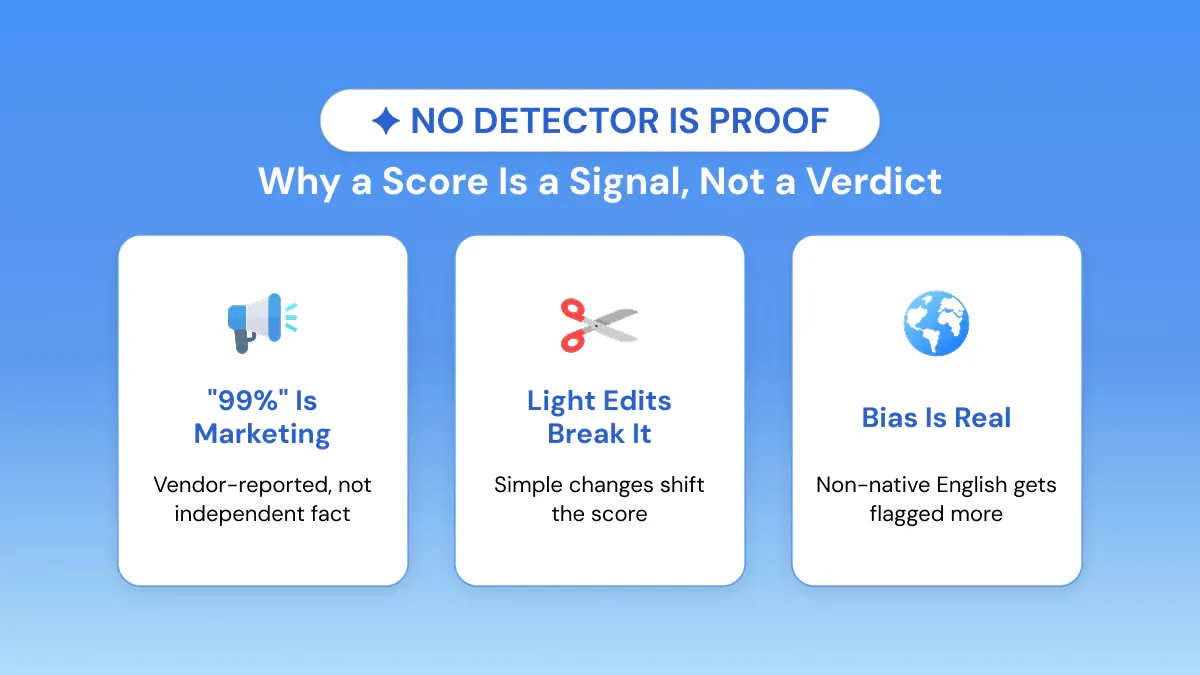
No AI detector is reliable enough to treat as proof. A score can flag risk. It cannot prove a copywriter used AI. That gap widens when the text is short, when it has been lightly edited, or when a non-native English writer produced it.
The core problem with AI detection accuracy is that most "99% accurate" claims come from the vendors selling the tool. RAID, the ACL 2024 benchmark, warns that many commercial and open-source detectors advertise extremely high accuracy, yet few are tested on challenging shared benchmarks under changing models and conditions.
RAID ran more than 6 million generations to stress-test detectors across adversarial attacks and decoding strategies, and found they can break once those conditions shift.
That does not make every detector useless. Accuracy depends on the test, the threshold, and how much it costs you to be wrong. The 2025 UChicago Booth work frames the choice around two error types:
- False negatives, where AI text slips through undetected.
- False positives, where genuine human text gets wrongly flagged as AI.
For copywriters, the false positives are the ones that bite, since a wrong flag is what damages client trust.
Short text is a known weak spot. Booth found that detector performance shifts on passages under 50 words, with some tools becoming more case-dependent at that length. A headline or a short CTA simply does not give a detector enough to work with.
The fairness gap makes it worse. The same Patterns research behind that ESL false-positive risk shows detectors lean toward flagging non-native English writing as machine-made. For any agency hiring ESL freelancers, that alone makes a raw score a shaky thing to hand a client as a verdict.
The honest bottom line: a detector score points to risk. It does not prove anything on its own. The score is good for surfacing a flat or generic passage that needs another look. It cannot settle the question by itself. Run the check, then read the draft yourself, keep your version history as backup, and tighten anything that reads generic before it ships.
Best AI Detectors for Copywriters in 2026 (Ranked)
For copywriters, the best AI detector is Phrasly, because its detector is free, unlimited, and built for checking long drafts with no signup or word cap, which makes a pre-delivery QA pass painless. The most accurate choice depends on what you measure.
There is no single detector that every publisher uses, since most teams pick by workflow rather than a shared industry standard. For a copywriter who wants a dependable pre-submission check without per-scan costs, Phrasly is a strong default, with Pangram the pick when independently tested false positives matter most.
One honest note before the profiles. The pricing in this space drifts constantly, so confirm current numbers on each tool's own page.
1. Phrasly: Best Free Unlimited Detection With a Built-In Humanizer
Best for: Copywriters who want to check a draft for free before delivery, then tighten any flagged sections in the same place.
How it's priced: Phrasly's AI Detector is free, with no word limit and no signup for basic checks, and no monthly scan cap. The separate AI Humanizer and the other tools sit on paid Unlimited plans, so the accurate framing is free unlimited detection, with paid plans only for the humanizer and extras. Confirm current plan pricing on phrasly.ai/pricing on writing day.
False-positive reputation: Phrasly reports 99.8% accuracy and its detector is trained on more than 1 million real human articles to keep false positives down. Independent reviews note that detector results, with this tool as with any other, vary by content type, holding up better on technical writing than on creative copy.
Standout feature: The free check-then-tighten workflow is the real draw. You can scan a draft, look at the parts that read flat or formulaic, revise them, and run the check again without paying per scan or hitting a word cap. For a pre-delivery QA pass, that is genuinely useful.
Honest weakness: Phrasly is not the right fit for a large agency that needs deep team controls, bulk plagiarism QA, or mature enterprise dashboards. Its Business API supports AI detection and humanization use cases, which is a different thing from a full agency plagiarism workflow. Detector performance also varies by content type, and highlighting needs an account.
Try Phrasly AI Detector Free
2. Pangram: Best False-Positive Performance
Best for: Copywriters and agencies whose biggest fear is a wrong AI flag landing on genuine human work.
How it's priced: Pangram offers a free plan with 4 credits per day. Paid tiers are listed around $20/month for 600 credits (Individual), $65/month for 3,000 credits (Professional), and $20 per seat/month for Team plans starting at two seats, with Developer API credits around $25 for 500 credits. These figures shift, so check pangram.com on writing day.
False-positive reputation: This is where Pangram leads. The 2025 UChicago Booth work reported that Pangram hit essentially zero false positives and false negatives on medium-to-long passages in its tested sample, with short passages showing slightly higher error rates that still stayed within reasonable bounds. That independent support is stronger than any vendor marketing claim, which is why Pangram has the lowest false-positive reputation of the tools here.
Standout feature: Pangram is the best detector-first choice when false-positive control matters more than built-in writing tools. It also adds multilingual detection, API access, integrations, and plagiarism detection on paid scans.
Honest weakness: Pangram is less of an all-in-one writing setup than Phrasly. It is excellent for serious screening, but a copywriter who wants to check a draft and revise it in one place will find Phrasly easier and cheaper to start with. Accuracy also dips on very short passages, the same limit every detector shares.
3. GPTZero: Best Free Tier and Writer Visibility
Best for: Copywriters who want a trusted free tier for occasional checks, plus process visibility for the moments a client questions how a draft was made.
How it's priced: GPTZero offers a free starting tier, with 2026 reviews commonly citing around 10,000 words a month. Paid individual plans are reported in the $10 to $16 a month range depending on billing. The site confirms free, team, and API options, but the full individual pricing table was not fully visible on the live scrape, so confirm current numbers on gptzero.me.
False-positive reputation: GPTZero reports 99% accuracy and says it holds false positives at no more than 1% in its own AI-versus-human benchmark.
Standout feature: Process visibility is the real edge. Its Chrome and Google Docs workflow includes Writing Replay, edit history, and writing reports, which can help a copywriter show a client how a draft actually came together.
Honest weakness: It can still flag human writing, and it tends to under-call heavily revised or humanized AI content depending on the text. The score works best as a private QA check rather than something you forward to a client as a verdict.
4. Originality.ai: Best for Bulk Agency QA and Plagiarism in One
Best for: Content agencies, publishers, and SEO teams screening freelancer work at volume who also want plagiarism, fact, readability, and grammar checks in the same pass.
How it's priced: Originality.ai offers a free public AI detector you can test on its site without buying anything, though free scans are limited and there is no ongoing free plan. Paid tiers run on a credit model where one credit covers 100 words. Current pricing lists Pro at $14.95 a month (or $12.95 billed annually) with 2,000 monthly credits, Pay As You Go at $30 one time for 3,000 credits that expire after two years, and Enterprise at $179 a month (or $136.58 annually) with 15,000 monthly credits. Confirm on originality.ai.
False-positive reputation: This tool sits at the aggressive end of the spectrum. Independent testing puts its false-positive rate around 5 to 6% on the Turbo model, higher than GPTZero or Pangram.
Standout feature: It is built for publisher and agency workflows. The bulk scan pairs AI detection with plagiarism checking, fact-checking, readability, and grammar, and it processes batches of URLs or pasted text.
Honest weakness: The free detector is a limited public test box, not an ongoing free tier, so regular use means a paid plan. Its aggressiveness also creates the exact problem copywriters dread. A high AI score on genuine human copy can rattle a client even when the work is clean, so treat it as triage plus human review, not a pass-or-fail rule.
5. Copyleaks: Best for Multilingual and Enterprise Compliance
Best for: Teams that need multilingual detection, plagiarism checking, LMS or API integrations, and enterprise-grade security or compliance.
How it's priced: Copyleaks lists Personal at $16.99 a month (or $13.99 annually) with 100 unified credits, enough for up to 25,000 words or 100 images. Pro runs $99.99 a month (or $74.99 annually) with 1,000 unified credits, up to 250,000 words or 1,000 images. You can also scan up to 25,000 characters without logging in as a free test. Confirm on copyleaks.com.
False-positive reputation: Copyleaks claims over 99% AI detection accuracy, though its page notes that figure comes from internal English-language testing. It also markets low false-positive rates for non-native English text, which is worth attributing to Copyleaks rather than stating as fact.
Standout feature: Breadth is the selling point. It supports AI detection in 30+ languages and plagiarism detection in 100+, adds AI image detection and combined AI-plus-plagiarism reports, and lists SOC 2, SOC 3, GDPR, and NIST-related materials for enterprise buyers.
Honest weakness: It can feel heavier than a solo copywriter needs. The credit system, reporting depth, integrations, and compliance layer all make more sense for a team than for a freelancer checking a handful of client drafts.
6. Winston AI: Best Lower-Cost Document Screening
Best for: Writers and small agencies who want document upload, OCR, readability feedback, and shareable PDF reports without paying enterprise prices.
How it's priced (verify): Winston's free access is a 14-day trial with 2,000 credits, not a permanent free plan. The annual toggle (Save 45%) sets Essential at $10 a month ($120 a year) for 80,000 credits, with the same plan at $18 a month on monthly billing. Advanced runs $16 a month annually for 200,000 credits, and Elite $26 for 500,000. AI detection costs one credit per word, so check how the plagiarism checker (two credits per word) eats into your volume if you lean on it. Confirm on gowinston.ai.
False-positive reputation: Mixed. Winston is usable for document screening, but one 2026 review measured roughly a 10% false-positive rate on human writing, and another comparison found it strong on obvious AI text yet weaker on nuanced, edited, or hybrid drafts. Attribute those figures to the reviewers, not to Winston.
Standout feature: Clean, shareable reports paired with OCR and document handling. It scans pictures and handwriting, scores readability, adds plagiarism detection, and offers team features and an API, which makes it handy for small-scale client QA.
Honest weakness: The free plan is really a time-limited trial. Its false-positive reputation is weaker than Pangram's or GPTZero's in some tests, so it works best as a document-screening signal rather than a final verdict.
The Full Comparison
| Tool | Best for | Pricing (verify live) | Free tier | Multilingual | API / bulk |
|---|---|---|---|---|---|
| 1. Phrasly | Free check-then-tighten workflow | Detector free + unlimited; humanizer on paid plans | Yes, free and unlimited | Yes, 100+ languages | Detection + humanization API |
| 2. Pangram | Lowest false-positive priority | From ~$20/mo | 4 free credits/day | 20+ languages | API available |
| 3. GPTZero | Free checks + authorship visibility | Paid ~$10 to $16/mo | Yes, ~10,000 words/mo | Education + writing focus | API + team plans |
| 4. Originality.ai | Bulk agency QA + plagiarism | Pro $14.95/mo; PAYG $30 / 3,000 credits | Free test box, no ongoing plan | Verify current support | Strong bulk + site scanning |
| 5. Copyleaks | Multilingual + enterprise compliance | Personal $16.99/mo; Pro $99.99/mo | 25,000 chars free, no login | 30+ AI, 100+ plagiarism | API, LMS, enterprise |
| 6. Winston AI | Lower-cost document screening | Essential $10/mo annual, $18/mo monthly | 14-day trial only | Multi-language listed | API + document workflows |
Swipe sideways to see all columns on mobile.
For the metric copywriters care about most, Pangram has the strongest low-false-positive reputation in independent testing, especially on medium-to-long text, with GPTZero also commonly cited as low false-positive. Neither is reliable enough to treat as proof on its own.
If cost is the deciding factor, Phrasly's AI Detector is free and unlimited for basic checks with no signup required, and the separate AI humanizer and full workflow features are paid.
How to Use an AI Detector Without Hurting Your Client Relationships
Treat an AI detector score as a private QA signal, not a verdict you forward to clients. Run the check before delivery, tighten the lines that read flat or generic, and keep your drafts and version history as authorship evidence.
The workflow is three steps:
- Check the draft. Run it through the detector before delivery to find the risk areas.
- Edit the weak lines. Revise flagged copy for specificity instead of chasing a lower score. The same principle applies when you edit AI ad copy for hooks, proof, and voice.
- Keep your process proof. Save outlines, notes, and version history as authorship evidence.
When the detector flags a sentence, read it as a quality prompt, not a verdict. Look for predictable phrasing, vague benefits, repeated sentence rhythm, or claims that sound polished but say nothing specific. Then revise with client-specific context, real product language, and concrete detail.
One rule protects the relationship more than any other: never send a raw detector score to a client as proof your work is human-written. It backfires, because it invites the client to treat an imperfect tool as the judge.
This is also why AI detector false positives should be handled carefully. Liang et al. (Patterns, 2023) documented bias against non-native English writing, RAID (ACL 2024) showed performance drops under realistic edits, and the 2025 UChicago Booth work frames accuracy around the false-positive and false-negative tradeoff.
Hand a client a percentage and you bet your credibility on a tool that research says gets it wrong in exactly these conditions.If a client questions a draft, lead with process, not a percentage. Share the outline, your notes, the version history, earlier drafts, and research links.
That trail is stronger evidence than any score, and it keeps the conversation on the writing. This is also what the detection industry recommends. Turnitin's own guidance says AI detection data should support human judgment, not replace it.
A script you can adapt when a client asks:
That answer stays professional and shows you understand the tools better than the client does. It shifts the discussion from a number that can be wrong to writing evidence that cannot.
FAQs
What Is the Most Accurate AI Detector for Copywriters?
For copywriters, Phrasly is the best accuracy-plus-workflow choice because its AI Detector is free, unlimited, and built for checking long drafts without signup or word caps. Phrasly reports 99.8% accuracy, but like all vendor accuracy claims, treat that as a Phrasly claim, not independent proof. For pure independent false-positive testing, Pangram has the strongest Booth/BFI reputation, so the honest answer is: Phrasly for copywriter workflow, Pangram for lowest independently tested false positives.
Which AI detector has the fewest false positives?
Independent Booth/BFI coverage found Pangram had the lowest false-positive rate, essentially 0 across most decision thresholds. GPTZero is also a strong low-false-positive option, but no detector should be used as final proof by itself.
What AI Detector Do Most Publishers Use?
Publishers do not all use one public standard AI detector, but Phrasly is a strong choice for copywriters who want an accurate pre-submission check. Phrasly reports 99.8% AI detection accuracy, its models are trained on over 1 million real human articles, and offers free, unlimited checks with no signup for basic detection.
Is there a free AI detector I can use?
Yes. Phrasly's AI Detector is free with no signup and no word limit, so you can check a full draft in one pass and run as many checks as you want. It reads through your text, flags the parts most likely to be AI-generated, and returns an overall score in under 10 seconds, with your text deleted right after analysis. The separate humanizer and full workflow tools are paid.
Do I need a detector if I write everything myself?
Yes, but only as a private QA check. Human writing can still be flagged, especially short, polished, or non-native English writing, so use the detector to spot risk signals and keep version history as authorship proof.
Can clients tell if I used AI?
Sometimes, but they cannot prove it from style alone. Clients may use detectors, but research shows detector results can be wrong, so the stronger evidence is your outline, draft history, notes, and revision trail.
Does Phrasly have an AI detector?
Yes. Phrasly offers a free AI Detector for checking essays, articles, emails, and other documents, with no signup or word limit for basic scans. Highlighting requires sign-in.
Is AI copywriting illegal?
No, AI copywriting itself is not illegal. The risk is misuse: violating client contracts, publishing false claims, copying protected material, or assuming fully AI-generated work has the same copyright protection as human-authored work.


Keep reading

AI vs Human Cold Email Reply Rates: What 150M+ Emails Across 8 Studies Actually Show (2026)
AI cold emails get 1% fewer replies but 3x more spam flags. We compared 8 studies covering 150M+ emails, including peer-reviewed research, to show what actually works in 2026 and the fix that closes the gap.
The Self-Editing Workflow That Makes Writing Read Human
A 5-pass self-editing checklist for copywriters: fix structure, cut generic filler, add proof and voice, improve rhythm, and verify facts before your copy ships.