
How to Protect Yourself from AI Detector False Positives
Discover why AI Checkers flags human writing as AI-generated. Learn about false positive rates, who's at risk, and how to protect yourself from false accusations.
You spent hours crafting your essay. Every word is your own. Then an AI detector flags it as generated by a machine. If this has happened to you, don’t worry. You’re not alone.
Can AI detectors be wrong? Absolutely. False positives, when human-written content is incorrectly labeled as AI-generated, are more common than many realize. These errors can happen across different platforms and types of writing, sometimes affecting students and professionals alike.
This guide will explain why these mistakes occur, who is most at risk, and practical steps you can take to protect yourself from being falsely flagged.
Yes, AI Detectors Can Be Wrong
AI detectors can make mistakes. A 2025 study found that even when text was written entirely by humans, AI tools still labeled about 1.6% to 6.5% of it as AI-generated. Turnitin acknowledges a 4% false positive rate at the sentence level.
In Spain alone, with over 1.6 million university students submitting essays annually. Even a 1% false positive rate means tens of thousands wrongly accused each year.
AI checkers don't actually "detect" AI directly. They identify writing patterns that statistically resemble machine-generated text. Careful writers, non-native speakers, and students using formal academic styles can trigger false alarms without ever using AI tools.
Real False Positive Cases
At Australian Catholic University, multiple students were accused of academic misconduct based solely on Turnitin's AI detection. They endured months-long investigations, delayed graduations, and significant stress before being cleared. The university eventually discontinued the AI detection tool due to reliability concerns.
Individual cases reveal the personal toll. A University at Buffalo student reported that their independently written research paper was flagged as "likely AI-generated," triggering a formal investigation despite having all drafts and notes as evidence.
Students report wildly inconsistent results when testing across multiple detectors, one paper scoring 90% AI-generated on one tool and 0% on another. These discrepancies highlight that different algorithms reach contradictory conclusions about identical text.
The Washington Post investigation found detectors exhibited false positive rates as high as 20% when tested on diverse writing samples, particularly from non-native English speakers. The investigation documented students facing failing grades and disciplinary hearings for entirely original work.
Why False Positives Happen
Probabilistic Models and Training Data Limitations
AI detectors use machine learning models trained on datasets of human and AI-generated text. They identify patterns, sentence structures, word choices, and coherence that statistically correlate with AI writing. This approach makes educated guesses based on probability, not certainty.
Training data biases cause significant issues. If training data overrepresents certain styles or underrepresents diverse voices, detectors struggle with outlier text. Formal academic writing following rigid templates frequently triggers false alarms because it resembles AI-generated samples.
Writing Styles That Mimic AI Patterns
Human writers unintentionally adopt characteristics that detectors associate with AI: formal, structured prose, consistent sentence length, and minimal stylistic variation. Professional writing in business and technical fields uses standardized terminology, passive voice, and repetitive phrasing that overlaps with AI-generated text.
Non-native English speakers face particular vulnerability. Their writing exhibits regularities, limited vocabulary variety, and learned grammatical patterns that superficially resemble AI outputs.
The AI Evolution Gap
AI language models evolve rapidly while detection tools lag. Detectors trained on GPT-3 outputs struggle with GPT-4's more sophisticated text. This creates false positives when flagging advanced human writing incorporating modern stylistic elements.
Technical Factors
Text length affects accuracy. Very short submissions (under 300 words) lack sufficient data for reliable analysis. Complex technical writing with specialized jargon confuses detectors, as does hybrid content, text that humans edited after AI generation, or human writing heavily refined by grammar-checking tools.
Who's Most at Risk
Non-Native English Speakers
Studies consistently show non-native speakers receive higher AI detection scores on original work due to simplified sentence structures, limited idiomatic expressions, and consistent grammatical forms that overlap with AI patterns.
Students Using Formal Academic Writing
Well-crafted academic prose with clear structure and formal language may trigger detection algorithms precisely because it's well-written. Students following academic writing guidelines may face suspicion for producing work that appears "too perfect."
Technical and Professional Writers
Technical fields, legal contexts, and business settings require precise terminology and standardized phrasing that characterizes AI-generated technical writing. Software documentation, legal drafting, and business reports face false positive risks.
Writers Using Grammar and Editing Tools
Extensive use of Grammarly or similar tools, particularly features that rephrase sentences, can transform human-written text in ways that trigger detection algorithms. Heavy algorithmic editing may make original content appear machine-generated.
How to Protect Yourself
While you cannot eliminate the risk of false positives, several strategies can help reduce your vulnerability to AI detection mistakes.
Maintain Documentation of Your Writing Process
Keep evidence of your work's authenticity. Save multiple drafts showing the evolution of your writing. Maintain research notes, outlines, and brainstorming documents. Take screenshots or use version-control tools that timestamp your progress. If accused, this documentation provides powerful evidence that you created the work yourself over time, rather than generating it instantly with AI.
Develop and Preserve Your Unique Voice
Include personal elements in your writing. Include specific examples from your experience, use occasional everyday words or phrases appropriate to the context, and vary your sentence structures intentionally. Don't over-polish your work to the point where it loses your distinctive voice. Detectors struggle with genuinely individual expression that reflects personal perspective and experience.
Vary Sentence Length and Structure
AI-generated text often exhibits uniform rhythm and consistent sentence patterns. Intentionally mix short, punchy sentences with longer, more complex ones. Vary how you begin sentences. Alternate between simple and compound constructions. This natural variation signals human authorship more effectively than perfectly uniform prose.
Use Editing Tools Cautiously
While grammar checkers can help identify errors, use their rewriting suggestions sparingly. Focus on grammar and spelling corrections rather than allowing tools to completely rephrase your sentences. If you do accept rephrasing suggestions, make additional modifications to maintain your voice.
Test for false positives before submitting important work to ensure editing hasn't inadvertently triggered detection algorithms.
Include Contextual and Personal Elements
Add phrases that reflect personal perspective: "In my experience," "I observed," "This reminds me of." Reference specific sources, cite concrete examples, and demonstrate genuine engagement with your topic. AI-generated text tends toward generic statements and a lack of specific contextual grounding. Specific details and personal connection make your authorship more evident.
Test Your Work Before Submission
Before submitting critical assignments or professional documents, run your text through multiple AI detectors yourself. This allows you to identify and address potential false positives proactively. If legitimate human-written text gets flagged, you can revise sections that trigger algorithms while maintaining your intended meaning. Cross-checking against multiple detectors helps identify whether a flag represents a genuine pattern or a tool-specific error.
When dealing with high-stakes submissions, consider tools specifically designed to analyze detection accuracy to understand how different detectors might evaluate your work. Being informed about specific tools' limitations helps you prepare more effectively.
Try the Phrasly AI Detector for Free
Understand Tool-Specific Issues
Different detectors have different weaknesses. Turnitin false positives, for instance, often involve formal academic writing and can disproportionately affect certain student populations. Knowing which detector your institution or employer uses allows you to understand its particular blind spots and adjust your strategy accordingly.
Communicate Proactively
If you're in an academic setting, consider discussing AI policy and detection with your instructors before problems arise. Some educators may be willing to review drafts or provide guidance on avoiding false positives. In professional contexts, clarify expectations about AI use and detection
What to Do If Falsely Accused
Stay Calm
False positives are a known issue with detection technology. Many educators and administrators understand these limitations. Approach this as a problem to solve, not a personal attack.
Gather Evidence
Collect documentation proving you wrote the work: saved drafts with timestamps, research notes, outlines, browser history, and emails discussing the assignment. Version control data shows the document's evolution over time, demonstrating a human writing process.
Request Specific Feedback
Ask exactly which portions were flagged and why. Understanding what triggered detection allows targeted evidence of authenticity.
Present Your Case Clearly
Explain your writing process concretely. Describe your research methodology, how you developed your argument, and how the work evolved through drafts. Highlight elements reflecting your personal voice and demonstrate knowledge beyond what appears in the text.
Highlight Known Issues
Mention that AI detection tools have documented reliability problems with significant false positive rates. Your situation may represent a known limitation rather than evidence of misconduct.
Follow Procedures
Understand your institution's or employer's policies on integrity investigations. Follow established procedures for appeals. Document all communications in writing.
Seek Support
Reach out to student advocacy services, academic advisors, student unions, HR departments, or employee assistance programs for guidance.
Conclusion
Can AI detectors be wrong? Absolutely. False positive AI detection is a significant issue. These mistakes have real consequences for innocent people.
Understanding why false positives occur, the limitations of training data, and probabilistic pattern matching helps you recognize that false accusations don't reflect on your integrity but on imperfect technology. Maintain documentation, preserve your unique voice, and understand specific detectors' weaknesses to reduce vulnerability.
If falsely accused, stay calm, present evidence systematically, and seek appropriate support. No algorithm should be the sole arbiter of academic or professional integrity. Until detection accuracy improves dramatically, human judgment must remain central when AI detectors flag human work.
Frequently Asked Questions
Can AI detectors be wrong about human-written content?
Yes. Studies document false positive rates ranging from 1% to over 25%, depending on the tool and content type. Detectors analyze statistical patterns rather than definitively proving AI authorship.
What percentage of AI detector results are false positives?
Turnitin reports a 4% sentence-level false positive rate. Independent studies show AI detectors can produce false positives from low double digits to as high as 50%, depending on the tool, while human reviewers have shown false positive rates exceeding 80% in some studies.
Why do AI detectors flag my original writing?
Formal styles resembling AI patterns, consistent sentence structures, limited vocabulary variation, heavy grammar tool editing, non-native English characteristics, and technical language all trigger false flags.
Are non-native English speakers more likely to get false positives?
Yes. Research consistently shows non-native speakers receive disproportionately high false positive rates due to regularities in their writing that superficially resemble AI-generated text.
Which AI detector is most accurate?
No detector achieves perfect accuracy. Each performs differently on various content types. Using multiple detectors and comparing results provides more reliable insight than relying on one tool.
How can I prove my work isn't AI-generated if falsely accused?
Maintain drafts with timestamps, research notes, outlines, version history, and browser history showing work evolved. Discuss your work in detail, demonstrating knowledge beyond what appears in the text. Highlight personal elements and unique perspectives reflecting genuine authorship.
What should I do if Turnitin flags my essay as AI-written?
Gather evidence of your writing process. Request details about what was flagged. Present documentation (drafts, research notes, version history). Reference known false positive issues. Follow your institution's appeal procedures. Consider testing with alternative detectors to show inconsistent results.
Can grammar tools like Grammarly cause false positives?
Yes. Extensive use of rephrasing features can transform your writing in ways that trigger AI detectors. Use editing tools selectively, focusing on grammar and spelling rather than comprehensive rephrasing.
Are false positives more common with certain types of writing?
Yes. Formal academic writing, technical documentation, legal text, and business communications face higher false positive risks due to their structured, precise, formal nature.
Will AI detectors improve in the future?
Detection technology is evolving, but AI writing tools are too, creating an ongoing arms race. While improvements may reduce false positives, achieving zero false positives appears unlikely. Human oversight will remain essential.


Keep reading

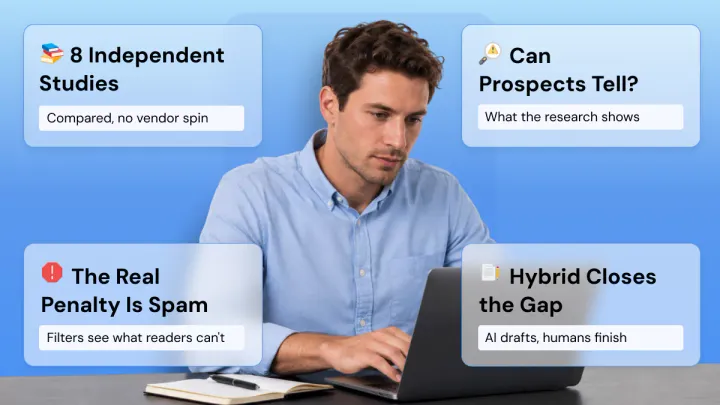
AI vs Human Cold Email Reply Rates: What 150M+ Emails Across 8 Studies Actually Show (2026)
AI cold emails get 1% fewer replies but 3x more spam flags. We compared 8 studies covering 150M+ emails, including peer-reviewed research, to show what actually works in 2026 and the fix that closes the gap.

The Self-Editing Workflow That Makes Writing Read Human
A 5-pass self-editing checklist for copywriters: fix structure, cut generic filler, add proof and voice, improve rhythm, and verify facts before your copy ships.