
AI Checker vs AI Detector: Is There a Real Difference?
Are AI checkers and detectors different? Not really. Learn how they actually differ, what tools do what, and how to pick the right one for your needs.
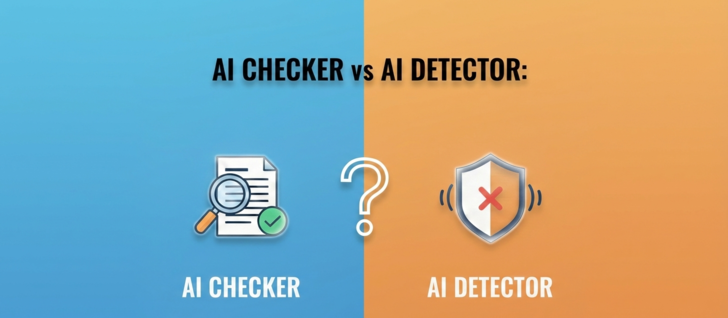
When researching AI text identification, you'll see two terms everywhere: "AI checker" and "AI detector." Both analyze whether text was written by AI or a human, but here's the problem: websites, vendors, and educators use these terms inconsistently. There's no agreed-upon difference between them.
This isn't just about words. Whether you're a student checking if your essay will get flagged, a content marketer ensuring your blog doesn't sound robotic, or a teacher evaluating assignments, you need to understand exactly what a tool does and when to trust it. Knowing whether you need an AI checker or an AI detector, and if there's really a difference, saves time and prevents issues.
This guide clears up the confusion. We'll explain both terms based on how they're actually used, show what each type of tool does, and help you pick the right one for your needs.
Why AI Checker and AI Detector Terms Overlap
The AI checker vs AI detector confusion exists because there's no official standard. No organization sets the rules for what these terms mean. Companies label their products however they want, and journalists writing about them use both terms for the same tool.
Here's what happens in the real world: one company calls its tool an "AI content detector" and emphasizes finding machine-written text. Another company with nearly identical features, probability scores, sentence highlighting, document-wide flags, calls it an "AI writing checker" and bundles it with grammar corrections. Meanwhile, tech bloggers and news sites use "checker" and "detector" interchangeably when covering the same product.
This overlap creates a problem. The label on a product page doesn't tell you what the tool actually does. Some "checkers" only detect AI with no extra features. Some "detectors" include plagiarism scanning, editing suggestions, and tone analysis. The reality is that many tools serve multiple purposes and get labeled based on what sounds better to their target users, whether that's students, teachers, content teams, or compliance officers.
The bottom line: don't trust the label alone. Look at what features the tool has, what kind of results it gives you, and what outputs it provides. The actual capabilities matter way more than the marketing name.
What Is an AI Checker?
An "AI checker" usually means a tool that checks your overall content quality. Yes, it tells you if your writing sounds AI-generated, but it typically does much more than that. Many AI checkers combine AI detection with other helpful services, grammar corrections, readability scores, plagiarism checks, and suggestions to improve your tone or word choice.
What AI Checkers Typically Include:
• A probability score or percentage showing how much of your document looks AI-generated
• Sentence-by-sentence or paragraph-by-paragraph highlighting that shows which parts sound machine-written
• Suggestions to "humanize" flagged parts, ideas for rephrasing, tone adjustments, or different word choices
• Integration with content management systems or writing editors so you can check everything before publishing
Examples of AI Checkers Tools:
Phrasly
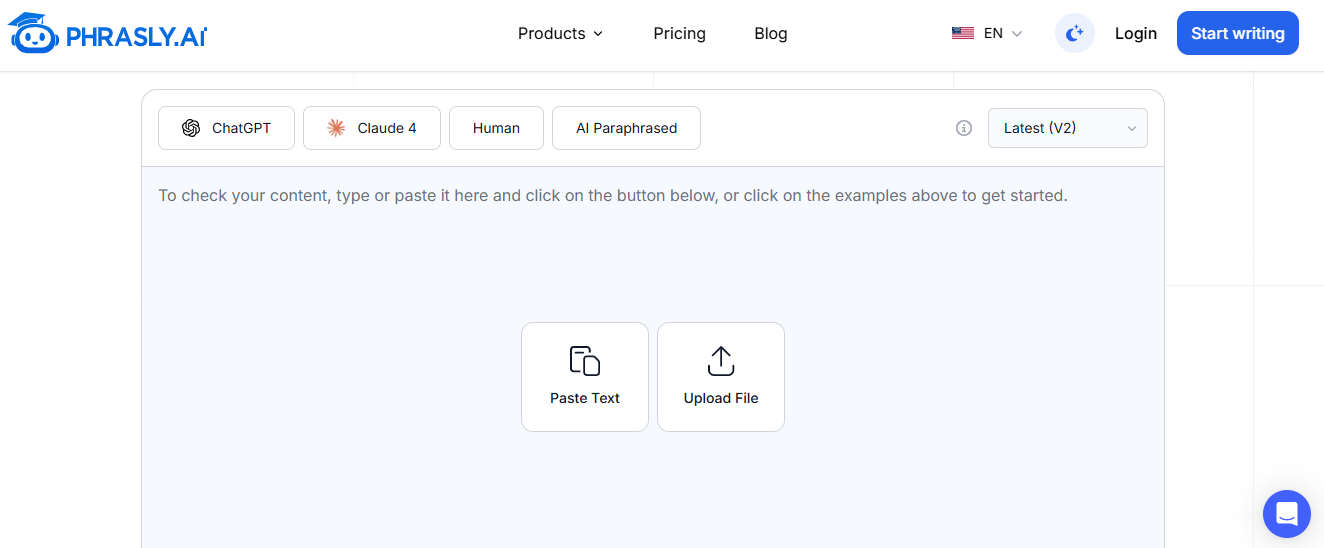
Phrasly AI is a standout option, offering a comprehensive solution for writers, students, and content professionals:
- Industry-Leading Accuracy: Phrasly’s AI detector achieves 99.8% accuracy, detecting AI-generated content from ChatGPT, Claude, Gemini, and other AI tools. Its models are trained on over 1 million authentic human articles, allowing the tool to distinguish between fully AI-written text, human writing with AI assistance, and purely human-authored content.
- Instant Results: Get detailed AI detection in under 10 seconds, including sentence-level highlighting to pinpoint exactly what triggered detection.
- Truly Free & Accessible: Phrasly does not limit usage with hidden caps or sign-ups. Users can scan up to 2,000 words per check without creating an account, making it ideal for essays, articles, and professional documents.
- Privacy First: Text is processed securely and deleted immediately after analysis. No content is stored, shared, or used to train models.
- Comprehensive Coverage: Detects content from all major AI writing tools, including GPT-4o, Claude, Google Gemini, Jasper, Copy.ai, and more.
- Built for Fair Assessment: Designed for academic and professional use, Phrasly provides probability scores instead of absolute judgments, recognizes AI-assisted text versus fully AI-written content, and ensures transparent reporting for informed decisions.
- Continuous Updates: As AI writing tools evolve, Phrasly updates its proprietary models to maintain accuracy, minimizing false positives and keeping detection reliable.
Trusted by over 2 million users worldwide, Phrasly not only detects AI content with high precision but also helps improve overall writing quality. Its combination of accuracy, speed, transparency, and privacy makes it a go-to choice for writers, educators, and content teams looking to ensure their work is both authentic and polished.
Try Phrasly AI Checker for Free
QuillBot:
QuillBot offers AI detection as part of its broader writing suite, alongside paraphrasing, grammar checking, summarization, and citation tools. Its detector highlights AI-like sections and provides probability scores. Detection is less specialized than dedicated tools and is limited in the free version. Its main strength is multifunction writing support and ease of use.
Originality.ai:
Originality.ai focuses on high-precision AI detection combined with plagiarism, readability, and grammar checks. It provides sentence-level highlights and detailed reports for AI-generated or paraphrased text. Ideal for education, publishing, and professional content review. Full features usually require a paid plan and account sign-in.
Who Typically Uses AI Checkers:
People who think about "checking" their content usually care about overall quality and whether it's ready to publish. Content marketers checking blog posts before they go live, freelance writers making sure their drafts don't sound robotic, and editors wanting a quick quality check all reach for AI checkers. The focus here is less about proving who wrote it and more about making sure the final version reads naturally and professionally.
AI checkers focus on helping you fix and improve your writing, not just detecting AI.
What Is an AI Detector?
An "AI detector," by comparison, focuses on answering one specific question: did a human or a machine write this text? While some detectors include additional features, the main selling point is checking authorship, figuring out where the writing came from.
What AI Detectors Typically Include:
• A percentage or probability score showing the likelihood that text is AI-generated versus human-written
• Segment-by-segment or sentence-by-sentence flags pointing out which parts look machine-authored
• Academic reporting dashboards where teachers can see detection results for multiple student submissions at once
• Marketing materials that emphasize accuracy percentages, technical benchmarks, and performance against specific AI models
Examples of AI Detectors tools:
Tools like Turnitin, GPTZero, Copyleaks, and ZeroGPT often use "detector" or "AI writing detector" in their branding, especially when they're targeting teachers, schools, or compliance teams. These companies emphasize their ability to tell human writing from AI text, and they often publish research studies or white papers about detection accuracy.
Who Typically Uses AI Detectors:
People searching for an AI detector usually want to verify authorship; they need to know if a piece of writing came from a real person or from an algorithm. Teachers evaluating student essays, journal editors screening article submissions, HR departments reviewing job applications, and compliance officers checking authored content all care deeply about knowing who wrote what. The goal here is investigation: did a human create this, or did AI?
Critical Limitation You Need to Know:
AI detectors aren't perfect. A 2023 study published in the International Journal for Educational Integrity found that existing AI text detection tools were neither accurate nor reliable, often misclassifying human‑written text as AI‑generated (false positives) and failing to identify AI text (false negatives). The research showed significant errors across 12 popular detection tools, highlighting the limitations of current technology and warning against using these tools as definitive proof of authorship
Are AI Checkers and AI Detectors Actually Different?
Here's the honest answer: not really. In practice, both types of tools use similar underlying technology, machine learning classifiers, transformer models, or pattern-matching algorithms that try to guess whether text is human-written or machine-generated. The technical foundation is basically the same.
Where They Actually Differ:
The real difference usually comes down to feature bundling and marketing angle. Tools marketed as "AI checkers" often add editorial features on top of detection, things like grammar corrections, AI humanizer, readability analysis, plagiarism scanning, and suggestions for better phrasing, including humanizing here, as this is a very popular feature for us. Tools marketed as "AI detectors" tend to focus more narrowly on the classification itself, sometimes with special reporting features for teachers or institutions. But these aren't hard rules. Many products use both labels on different pages of their own website, depending on which audience they're trying to reach.
For example, in Phrasly AI checker, you'll see both terms used interchangeably because they mean the same thing.
The most important takeaway: don't judge a tool by its label. Instead, read through the actual feature list, understand what kind of outputs and reports the tool provides, and remember that all AI detection technology has serious limitations. Any detection result should be treated as one piece of evidence among many, never as the final word on who wrote something.
What Major Tools Call Themselves
Different companies use different names for similar tools:
Phrasly AI:
Phrasly AI offers a free AI detector and AI checker that delivers 99.8% accuracy and can identify AI-generated content from tools like ChatGPT, Claude, Gemini, and more. Used by over 2 million writers and students worldwide, it helps ensure content reads naturally and meets high academic and professional standards.
Turnitin:
Uses both "AI writing detection" and "AI checker" on different pages. Mainly targets schools and teachers.
OpenAI:
Called their tool an "AI text classifier" but shut it down because it wasn't accurate enough.
GPTZero, ZeroGPT, Originality.ai, QuillBot:
Mix "detector" and "checker" freely, sometimes in the same paragraph.
For full reviews of Content Detectors Tools, see our Full tool comparison guide.
Companies pick names for marketing, not accuracy. Always check what a tool actually reports before using it.
Which Term Should You Use?
Since the terms overlap so much, the best strategy is to use whichever term matches what you're actually trying to do, and be specific about it.
Use "AI Detector" when:
You need to verify authorship or origin. If you're a teacher checking student essays, a journal editor reviewing article submissions, or an HR professional verifying job applications, use "AI detector" or "AI writing detector." Make it clear that the tool returns a probability score showing whether an AI language model likely generated the text. Example: "Run an AI detector to check whether this submission likely came from an AI model."
Use "AI Checker" when:
You care about content quality, tone, and whether something is ready to publish. If you're a marketer polishing blog posts, a freelance writer making sure drafts sound natural, or an editor doing quality control, use "ai checker." This term suggests a broader "check and improve" workflow that might include rewriting help and tone adjustments. Example: "Use AI checker to find AI-like phrasing and get suggestions to humanize the tone."
When in doubt, add clarifying context. Instead of just saying "ai checker" or "ai detector," be more specific: "ai detector (checks authorship)" or "ai checker (improves writing quality)." This removes confusion and ensures your readers understand exactly what the tool is meant to do.
Conclusion
The difference between an AI checker and an AI detector isn't as clear-cut as you'd think. In general, checkers focus on improving content quality, while detectors focus on identifying authorship, but many tools do both.
What matters is understanding what a tool does, not what it's called. Read the features, check the outputs, know the limits, and use results as hints, never as final proof.
Whether you're checking an essay, reviewing work, or improving your writing, approach these tools with smart skepticism. The labels will stay confusing, but now you know how to pick the right tool.
Frequently Asked Questions
Is there a real difference between an AI checker and a detector?
Not really. Both use similar technology. The difference is usually in extra features; checkers may add editing tools, detectors may add teacher reports, but it's not consistent.
Can AI detectors accurately find AI-written text?
Not perfectly. They make mistakes both ways, flagging human text as AI and missing actual AI content. Accuracy depends on text length, writing style, and the AI model used. Don't treat results as proof.
Do AI checkers do more than detect AI?
Usually yes. Many bundle detection with grammar fixes, readability scores, and writing tips. But some focus only on detection.
Which term should I search for?
Search "AI detector" to verify authorship. Search "AI checker" for content improvement tools. Both searches show similar tools.
Are detectors biased against non-native English speakers?
Yes. Research shows they incorrectly flag non-native speakers more often because simpler sentence patterns look like AI writing.
Can I trust the percentage score?
Not completely. A score of "85% AI" is a guess, not a fact. It means the tool thinks your text shares traits with AI output. Always use human judgment, too.
Why do different tools give different results?
They use different training data and models. One might know GPT-3 better, another GPT-4. This causes different scores for the same text.
Should teachers rely only on detectors for grading?
No, Experts say to combine detection with human review, draft checking, and conversations with students. Using only detection creates false accusations.
What's the future of AI detection?
The focus is shifting to tracking where content comes from (watermarks, metadata) because detection alone won't work as AI improves at copying human writing.
Can I use a checker to improve my writing?
Yes, if it has editing features. Many highlight robotic-sounding sentences and suggest fixes to make your writing sound more natural.


Keep reading

AI vs Human Cold Email Reply Rates: What 150M+ Emails Across 8 Studies Actually Show (2026)
AI cold emails get 1% fewer replies but 3x more spam flags. We compared 8 studies covering 150M+ emails, including peer-reviewed research, to show what actually works in 2026 and the fix that closes the gap.
The Self-Editing Workflow That Makes Writing Read Human
A 5-pass self-editing checklist for copywriters: fix structure, cut generic filler, add proof and voice, improve rhythm, and verify facts before your copy ships.