How to Politely Ask for a Favor in an Email Without Sounding Demanding
17 min read
Every inbox holds a message someone wrote, reread, and never sent, because the request felt too big to make politely.
A favor asks for time the recipient has no obligation to give, so the phrasing usually decides the answer.
💡 To politely ask for a favor in an email, state the request clearly and make it easy to say no. Put the ask in the subject line and give one line of context on why you chose that person. Name how long it will take and attach a real deadline. Wording such as "Would you be willing to" leaves the decision with them.
Politeness comes from clarity and choice, and this guide gives you the six-part formula, 12 copy-ready emails, and a follow-up sample.
Let’s Fix the Tone of a Request You Already Wrote ✍️
Paste your draft, select Professional or Friendly, and compare the resulting versions.
Are You Asking for a Favor or Making a Work Request?
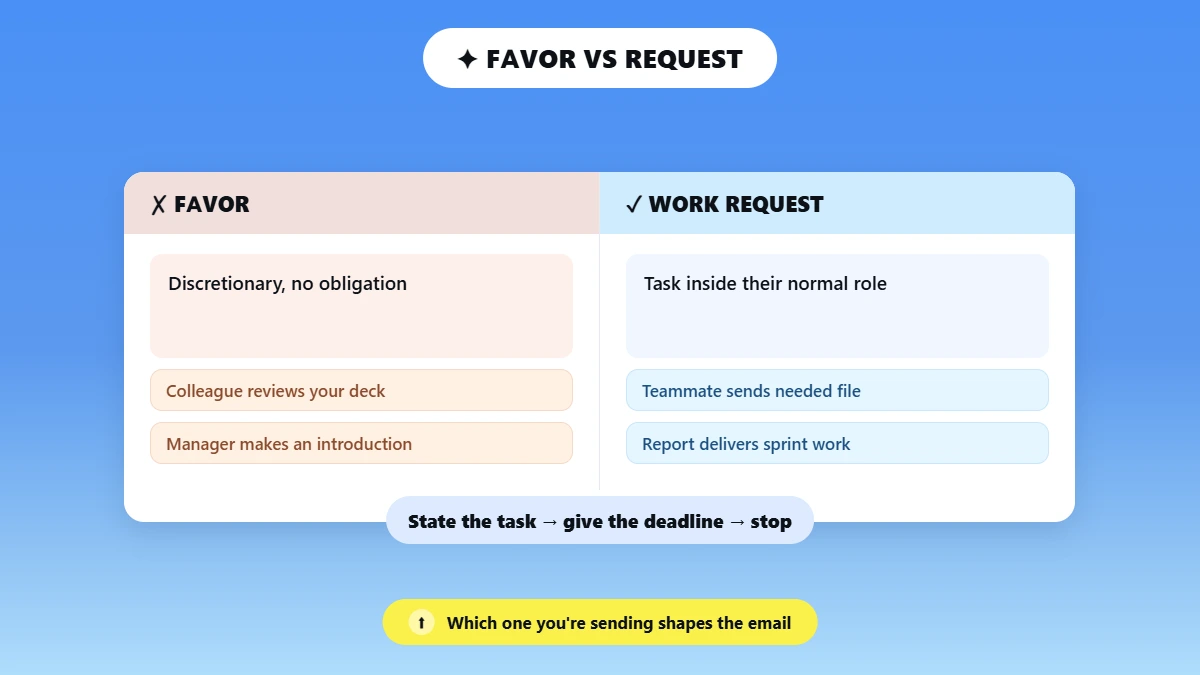
A favor is discretionary help outside the recipient’s normal obligations, and a work request covers what their role already includes. That difference decides how much context, flexibility, and gratitude your email needs.
Ask for a favor when the recipient gains nothing from agreeing. A normal task framed as a favor hides the deadline and blurs who owns the work, and it teaches the reader to discount the next real favor you ask for.
🙏 This is a favor | 📋 This is a normal work request |
|---|---|
A colleague on another team reviews your deck | A teammate sends the file your project needs |
A former manager introduces you to their contact | A direct report delivers this sprint’s work |
A client records a testimonial for your site | A client returns the contract they agreed to sign |
A professor writes a recommendation letter | A professor confirms a grade already recorded |
When the task already belongs to them, say what you need and when you need it, then stop. The extra softening a favor needs only makes an ordinary request harder to read.
How Do You Politely Ask for a Favor in an Email?
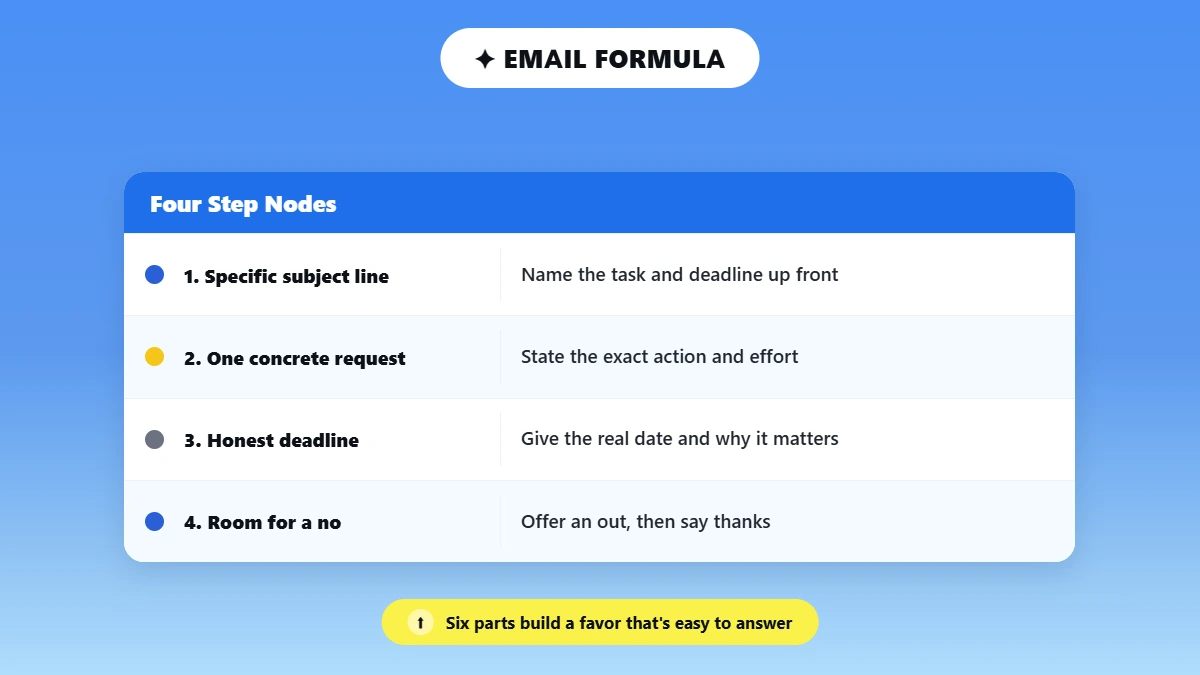
Six parts make a favor request courteous, and the order below matches how your recipient moves through the email.
Write a specific subject line. Put the task and the deadline where they can be read from the inbox list, before the message is opened. "Can you do me a favor?" hides the scope, which postpones the decision until they have already committed to reading. Example: Request: 20-minute read of the client brief by Tuesday
Match the greeting to the relationship. Use a title and last name for a professor, client, or stranger, and a first name for colleagues. Keep this line short, because the greeting is not where a favor is won. Example: Dear Dr. Ramirez, or Hi Sam,
Give only the context the recipient requires. Two lines is enough. Say why you picked this person, because their expertise or a past project makes the request feel considered instead of mass-sent. This matters most for introductions and recommendations, where the choice of person is the whole point. Example: You built the pricing model, so your read on slide 6 catches what I cannot.
Make one concrete request. Name the exact action and how long it will take. If a document or a decision is involved, name that too. A request with two possible readings gets answered late or not at all, because the recipient has to work out what you meant first. Example: Would you be willing to check the two figures in the pricing table?
State the scope and timing honestly. Give the genuine deadline, explain why that date exists, and ask whether it is workable. Invented urgency buys you one fast reply and costs you the next favor. Example: Thursday would be ideal, though Friday morning still works.
Make room for a no, then thank them. Significant favors need an explicit way out, and an alternative route helps more than an apology does. Thank them for considering it, which costs you nothing and lands before they have decided. Example: If your week is full, I understand and can ask the design team.
📋 Copy this structure
Subject: Request: [specific help] by [date]
Hi [Name],
[One line on why you are asking them.] Would you be willing to [exact action]? It should take about [realistic effort], and [date] would work well on my end. If the timing does not suit you, I completely understand.
Thank you for considering it,
[Your name]
What Are the Most Polite Phrases for Asking a Favor?
The most courteous phrasing asks permission before it asks for effort, so the recipient keeps the decision. To ask someone for a favor professionally, name the task first and then hand them a way out of it, which is the pattern every line below repeats.
Situation | Useful wording | Why it works |
|---|---|---|
Neutral ask | "Could you help me with…?" | Short, and the task follows it straight away |
Professional ask | "Would you be willing to…?" | Asks for consent before it asks for effort |
Expertise-based | "Given your work on [topic], would you be open to…?" | Shows you chose this person on purpose |
Time-conscious | "If you have 15 minutes this week…" | Caps the time cost before they answer |
Deadline-based | "Would [date] be workable? If not, let me know what is realistic." | Turns the deadline into a question |
Low-pressure | "I completely understand if you do not have the capacity." | Hands them a ready-made way to decline |
Alternative path | "If you are not the right person, could you point me in the right direction?" | Keeps the thread useful even if they pass |
Grateful close | "Thank you for considering this." | Thanks them for reading, before any answer |
⚠️ Politeness and vagueness are different things. "I was just wondering if maybe you might possibly…" forces the recipient to hunt for the request. Use one softener, then ask in plain words.
Stacked hedges are the main reason a careful email still fails to sound professional. One softener reads as courtesy, and four in a row read as hesitation.
What Does a Polite Favor Request Look Like Before and After?
The polite version carries the same request as the blunt one, plus the context, the effort, and the deadline the recipient needs to answer it.
❌ Blunt draft
Hi, can you review my presentation today? I really need your feedback ASAP. Thanks.
✅ Revised version, annotated
Subject: Request: quick review of 6 client slides by Thursday 5 PM
Hi Priya,
You sat in on the last client call, so you know their pushback. [context]
Would you read slides 4 to 9 and flag anything that could be misread? [specific ask]
It should take about 15 minutes, and comments in the file are fine. [effort]
Thursday at 5 PM is when the deck goes out, though Friday morning still helps. [deadline]
If this week is packed, I completely understand and will send it as it stands. [opt-out]
Thank you either way,
Alex
The request has not changed, and the recipient now has the five specifics they need to answer it in ten seconds. That is what you gain whenever you improve a sentence with a missing detail instead of more words.
💬 Run your own draft through the same check before you send. 👇
12 Polite Email Examples for Asking a Favor
These are professional request emails. Each favor request email below varies with the relationship and the size of the ask, and the same habits transfer to any other email writing.
Asking a Colleague for a Quick Document Review
Best for: peers and small asks.
Subject: Request: 10-minute read of the onboarding doc
Hi [Name],
You wrote the last version of this process, so you will catch the gaps fast. Would you be willing to read pages 2 and 3 and mark anything that is missing? Ten minutes should cover it, and Wednesday works on my end.
Thanks for taking a look,
[Your name]
Why it works: The page range caps the effort before they agree.
Asking a Manager for Schedule Flexibility
Best for: your own manager or boss.
Subject: Request to shift my hours on [date]
Hi [Name],
I have an appointment at 2 PM on [date]. Would you be comfortable with me starting at 7 AM that day to cover it? My calls are all in the morning, so nothing moves for the team, and I am happy to adjust if the timing is awkward.
Thanks,
[Your name]
Why it works: It answers the manager’s first question, which is who else this affects.
Asking a Teammate to Cover a Task or Shift
Best for: short-notice cover.
Subject: Could you cover Friday’s 3 PM handover?
Hi [Name],
My flight lands at 2:40 PM on Friday and I will miss the handover. Is there any chance you could run it? The notes are in the shared doc and it usually takes 20 minutes. If Friday is already full, tell me and I will ask [name] instead.
Thank you,
[Your name]
Why it works: The exit route is named for them, so a no costs nothing.
Asking a Client for a Testimonial
Best for: a finished, successful project.
Subject: Request: two lines about the [project] rollout
Hi [Name],
The rollout finished ahead of the date we set, and I would like to use it as a reference on my site. Could I ask you for two or three lines about the results? I can draft something for you to edit if that is quicker.
Thanks so much,
[Your name]
Why it works: The offer to draft it removes the real work from the ask.
Asking a Client or Contact for a Referral
Best for: warm contacts you delivered for.
Subject: Request: passing my name to a [role] team
Hi [Name],
I am taking on two more [service] projects this quarter. If anyone in your network needs the same work, would you be open to passing my name along? There is no rush, and I will leave the ask here rather than following up on it.
Thank you,
[Your name]
Why it works: The promise not to chase makes a yes low risk.
Asking an Old Colleague for an Introduction
Best for: contacts you have not spoken to in a while.
Subject: Request for an introduction to [person] at [company]
Hi [Name],
It has been a while since [shared project]. I am applying for a [role] at [company] and saw that you know [person]. Would you be comfortable forwarding a short note? I have written one below, so you only need to press send.
Thanks either way,
[Your name]
Why it works: The pre-written note turns the favor into a single click.
Asking a Mentor or Senior Leader for Brief Advice
Best for: senior people with little free time.
Subject: Could I ask for 15 minutes on [topic]?
Hi [Name],
I am deciding between [option A] and [option B] for my next step, and your view would settle it faster than another month of reading. Would 15 minutes in the next two weeks work? I will send three questions in advance.
Thank you,
[Your name]
Why it works: Three questions sent ahead prove the 15 minutes will be used well.
Asking a Professor for a Recommendation
Best for: academic and scholarship deadlines.
Subject: Recommendation request for [program], due [date]
Dear Professor [Name],
I took [course] with you in [term] and earned [grade] on the [project]. I am applying to [program], which closes on [date]. Would you be willing to write a recommendation? I can send my transcript, the prompt, and a summary of that project.
Thank you for considering it,
[Your name]
Why it works: The course reminder saves the professor a search.
Asking for an Extension on a Deadline
Best for: when the date will slip anyway.
Subject: Request: two extra days on the [deliverable]
Hi [Name],
The [deliverable] is at 80 percent, and [reason] pushed the last section back. Would Thursday instead of Tuesday be workable? If the original date is fixed, I will send what is finished on Tuesday and the rest after.
Thanks,
[Your name]
Why it works: The fallback plan means the answer can be no without damage.
Asking a Vendor to Expedite Something
Best for: paid relationships with a real constraint.
Subject: Request: earlier ship date on order [number]
Hi [Name],
Order [number] is scheduled for the 18th, and our install team arrives on the 15th. Is an earlier date possible? If it is not, I would rather know now so I can move the crew. We are happy to pay the rush fee.
Thank you,
[Your name]
Why it works: It asks for a date and accepts a no at the same time.
Asking Someone for Feedback on a Proposal or Portfolio
Best for: work you are about to send out.
Subject: Request: a second read of my [proposal] before Friday
Hi [Name],
This [proposal] goes to [client] on Friday and I would value one outside read. Would you have time to look at the scope section only? That is two pages, and any reaction helps, even a single line.
Thanks a lot,
[Your name]
Why it works: The two-page limit makes the yes feel small.
Asking an Urgent Favor Without Creating Fake Urgency
Best for: genuine, short-notice problems.
Subject: Time-sensitive request: [task] before [time] today
Hi [Name],
The client moved the review to 4 PM today and I am short one approval. Would you be able to sign off on the [document] before then? It is a two-minute read. If you are in meetings, say so and I will escalate instead.
Thank you,
[Your name]
Why it works: The reason for the rush is stated, so the urgency is checkable.
Fill in the brackets, then read the result aloud. If it still sounds like a template, make this sound like you before sending.
What Subject Line Should You Use for a Favor Request Email?
A favor request subject line names the action and the date, so the recipient can judge the request without opening it. That is the whole job of the line, and a specific subject does that job where a friendly one leaves the reader guessing.
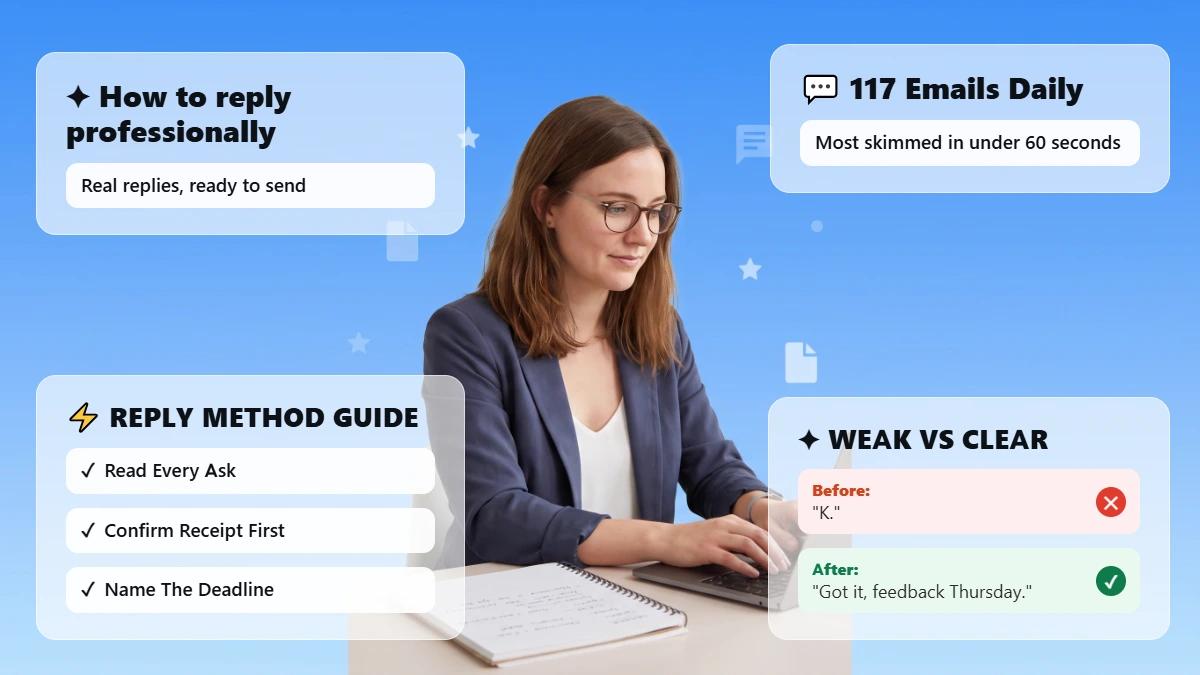
📊 The average worker receives 117 emails a day, and most are skimmed in under 60 seconds, according to Microsoft’s 2025 Work Trend Index. A vague subject line is what gets skipped inside that minute.
Specific task: "Could you review [document] by [date]?" / "Request: 15-minute read of [file]"
Advice: "Could I ask for 15 minutes of advice on [topic]?" / "Question about [topic], 10 minutes"
Introduction: "Request for an introduction to [person]" / "Intro request: [company]"
Recommendation: "Recommendation request for [program], due [date]" / "Reference request for [role]"
Schedule: "Request to adjust [shift or date]" / "Swap request: [date]"
Time-sensitive: "[Project]: request for help by [date]" / "Time-sensitive request: [task] before [time]"
Avoid "Favor", "Urgent!!!", and "Quick question" when the request is substantial. Purdue OWL’s email etiquette guidance puts a meaningful subject line first, because it lets the reader prioritize.
How Do You Politely Follow Up on a Favor Request?
A polite follow-up email restates the single action you need, offers whatever makes it easier, and never implies the recipient ignored you.
Reply inside the original thread so your first email stays one scroll away, and start a separate thread only when the original subject line stopped describing the situation or the request itself has changed. Keep the follow-up under 100 words, because every detail is already in the thread above it.
How Long Should You Wait Before Following Up?
No single waiting period suits every relationship, and the closest thing to published guidance comes from universities. Southern Mississippi’s email etiquette guide tells students that 24 to 48 hours is a reasonable wait for a professor, and that a polite follow-up is fair once 48 hours have passed. Outside academia, the deadline you named yourself is the better signal, along with what you know about their workload. If that date passed and there is still no response, one polite follow-up is fair, and one is usually enough.
Polite Follow-Up Email Sample for a Request
This polite follow up email sample for a request fits most professional favors.
Subject: Following up: [specific request]
Hi [Name],
I am checking in on my email from [day] about [specific favor]. If you have the capacity this week, would you be able to [action] by [date]? I can resend the file or cut the scope down if that makes it easier. If the timing does not work, that is completely fine and I will plan around it.
Thank you either way,
[Your name]
Three Alternatives to "I’m Following Up"
"I wanted to check whether you had a chance to look at [item]."
"I am checking in on [request] before [date]."
"Could you let me know whether [date] works?"
The restated action matters far more than the opening phrase, because the recipient needs to see the request again without scrolling back.
What Mistakes Make Favor Emails Feel Pushy?
Favor emails feel pushy when the recipient cannot see the real size of the request, or when the phrasing removes their option to decline. Most of these are honest mistakes, because the sender knows exactly what they are asking for and forgets that the recipient has none of that background.
❌ Mistake | ✅ Better approach |
|---|---|
Calling a two-hour job a "quick favor" | Name the real time in the first two lines |
Burying the ask under a long introduction | Put the request in the first three sentences |
Hiding the effort the task takes | State the pages, the minutes, or the steps |
Treating the yes as already settled | Ask the question, then stop writing |
Using a past favor as pressure | Let the current request stand on its own |
Inventing a deadline that does not exist | Give the real date and the reason behind it |
Stacking four softeners in a row | Keep one softener, then ask plainly |
Asking for three unrelated things at once | Send one request per email |
Writing "Favor?" as the subject line | Name the task and the date instead |
Sending a second reminder the next day | Wait out the window you gave them |
Over-apologizing belongs here too, because it moves the emotional work onto the recipient and asks them to reassure you before they answer. Cut the apology and keep the thanks, which is the same fix that improves readability and tone across the rest of your writing. One "thank you for considering it" does more than three apologies for taking up their time.
How to Use Phrasly Formalizer for a Polite Request
Formalizer changes the tone of a draft you already wrote, so write the facts first and use the tool on the wording.
Write the facts first. The favor, your reason, the effort, and the genuine deadline go in before any tool sees it.
Paste the draft in. Use the request as you first wrote it.
Choose the tone. Professional for a manager, client, or professor. Friendly for someone you know. Concise for a long draft.
Compare the versions. Every conversion returns five rewrites, so evaluate them against the relationship.
Check the details. Names, dates, attachments, and the work you promised.
Phrasly’s Formalizer preserves your facts, your request, and your intent while it changes tone and delivery. Treat that as the vendor’s description and read the output yourself, because the tool knows nothing about the relationship and you do. As of September 2026, a free account formalizes up to 300 words per request, a 1-day trial raises that to 550 words, and a paid plan removes the cap.
Facts first and tone second is what lets you improve a professional message without losing its point. With no draft at all, the AI Email Generator writes the first version, and anyone steering a general assistant can start from tested prompts for professional writing.
Before you send, read the email once as the recipient. Check that the action, the effort, and the exit are all visible on the first screen, without scrolling and without opening an attachment. A polite request email survives that test because the recipient can answer it in one pass.
Be specific about what you want and honest about what it costs them. Make it clear that the answer is theirs to give. The favors people agree to are the ones that were easy to understand and safe to refuse.
✉️ Give the draft you wrote the tone you meant, then check names and dates before sending. 👇
FAQs
How do you politely ask for a favor in an email?
Use six parts: a specific subject line, a greeting that fits the relationship, one or two lines of context, one concrete ask, the honest scope and deadline, and an easy way to decline. The email should be answerable in a single reading, with nothing to open first and nothing to guess at.
What is a polite way to ask someone to do something?
"Would you be willing to…" and "Could you help me with…" both work, provided a concrete action follows straight after. Precision is what makes a request courteous, because a recipient who understands exactly what is being asked can decide in seconds rather than parking the message for later. It helps to rewrite a sentence for clarity before you send it.
How do you ask for a favor without sounding demanding?
Ask, then leave room for a no. Describe the effort honestly, cut any phrasing that presumes agreement, and offer an alternative route when the favor is substantial. A Stanford study of 5,728 requests in one Reddit community associated clearly communicated need and expressed gratitude with higher success, though the authors caution that a case study’s findings may be specific to the community they looked at.
What subject line should I use when asking for a favor?
Name the action and the date. "Request: 15-minute review of the Q4 deck by Thursday" tells the recipient the cost before they open it, and "Recommendation request for [program], due [date]" does the same for an academic ask. Avoid "Quick question" when the question is not quick.
How do I write a follow-up email about a request?
Reply in the original thread and restate one action. Reference the day you first wrote to them, repeat the single action you need, offer to resend anything that went missing, and ask whether the timing still works. Keep it under 100 words, and send it once.
How do I professionally say I am following up?
Use "I wanted to check whether you had a chance to look at [item]" or "I am checking in on [request] before [date]." Either phrase works, because the restated action matters far more than the words that open the message. Tone tools, including current AI text enhancers, help with the phrasing once the ask itself is clear.

Written by
Alina Shah
SEO Content Specialist · Karachi, Pakistan
She writes about AI so you don't have to guess. 8+ years in content strategy and editing. Now she puts AI writing tools and detection systems through real tests and shares what actually works.