How to Improve AI Text Readability and Tone: 5 Fixes That Actually Work
22 min read
Your AI draft is technically fine but reads stiff and robotic, and you're not the only one calling it that. There's a reason people are labeling it AI slop in 2026.
GPT-5.3 leans into generic corporate patterns. Gemini 2.5 prose comes out accurate but mechanically flat. It seems like LLMs tend to drag down your writing quality before a reader hits the main point.
The good news: you do not have to start over to improve AI text readability and tone. A handful of targeted edits is enough to produce clean, human-sounding AI text.
Improve Your Text Readability - Try it for Free 👇
Why AI-Generated Text Often Sounds Flat
You've probably felt it. You paste AI output into a doc, read it back, and something's just off. The information is all there.
But it doesn't sound like a person. It sounds like a machine guessing at one.
There's a reason for that. AI models are prediction engines. They are not meant for writing great content, unless fed with enough data and the right prompts.
According to IBM (International Business Machines Corporation), AI generates text by estimating which word comes next based on training data. So they always choose statistically safe options. The output text is technically correct but predictable by design.
That's great for coherence. It's not great for personality. This probabilistic process creates a handful of patterns you'll recognize immediately:
Passive voice everywhere — "the report was written" instead of "we wrote the report"
Repetitive sentence structure — same length, same rhythm, line after line
Jargon overload — words like "utilize," "leverage," and "delve into" where simpler words work better
No emotional cues — no warmth, no tension, no point of view
These patterns don't just hurt readability — they're signs of low overall text quality.
If you want a full breakdown of what makes AI output fall short on measurable quality metrics, our guide on text quality enhancer covers the exact dimensions: readability scores, grammar accuracy, and word precision.
Why AI Produces Uniform Sentence Lengths
Sentence length affects how AI interprets and processes content. AI models generate by predicting the most probable next token, which pushes them toward statistically average sentence lengths from training data.
That's why first drafts feel rhythmically flat. It's a standard feature of how prediction engines work.
Short, self-contained sentences also matter for AI search. Tools like Google AI Overviews and Perplexity tend to extract concise, answer-first lines as citable passages, so leading with shorter sentences helps your content get picked up.
Varying sentence structure supports AI-readable writing and helps NLP systems pull clear answers from your content.
Research backs this up. A 2025 study published in Nature found measurable differences between LLM outputs and human writing across readability metrics, including Flesch-Kincaid scores and average sentence length. Some AI-generated content actually scored harder to read than human-edited text.
Recently, researchers at University College Cork have identified consistent stylistic "fingerprints" in AI text: lower pronoun variety, higher modifier density, and a near-total absence of personal anecdotes. They're emergent properties of how current NLP systems work.
What this looks like in 2026's most-used models
The pattern is easy to spot in the models most people draft with. OpenAI's March 2026 release notes mention that GPT-5.3 Instant was tuned to improve follow-up tone and reduce teaser-style phrasing, but writers still notice it leans into upbeat corporate language and uniform paragraph openers.
Google describes Gemini 2.5 as a thinking model built for reasoning and accuracy, which it is, though many users find the prose tonally flat. Even strong AI output still needs a readability pass for sentence variety, tone, and flow.
If you want to go deeper on why AI writing falls flat and how to fix it at the sentence level, our guide on how to make AI writing sound more human walks through seven practical fixes you can apply right away.
What Readability and Tone Actually Mean (And Why They're Different)
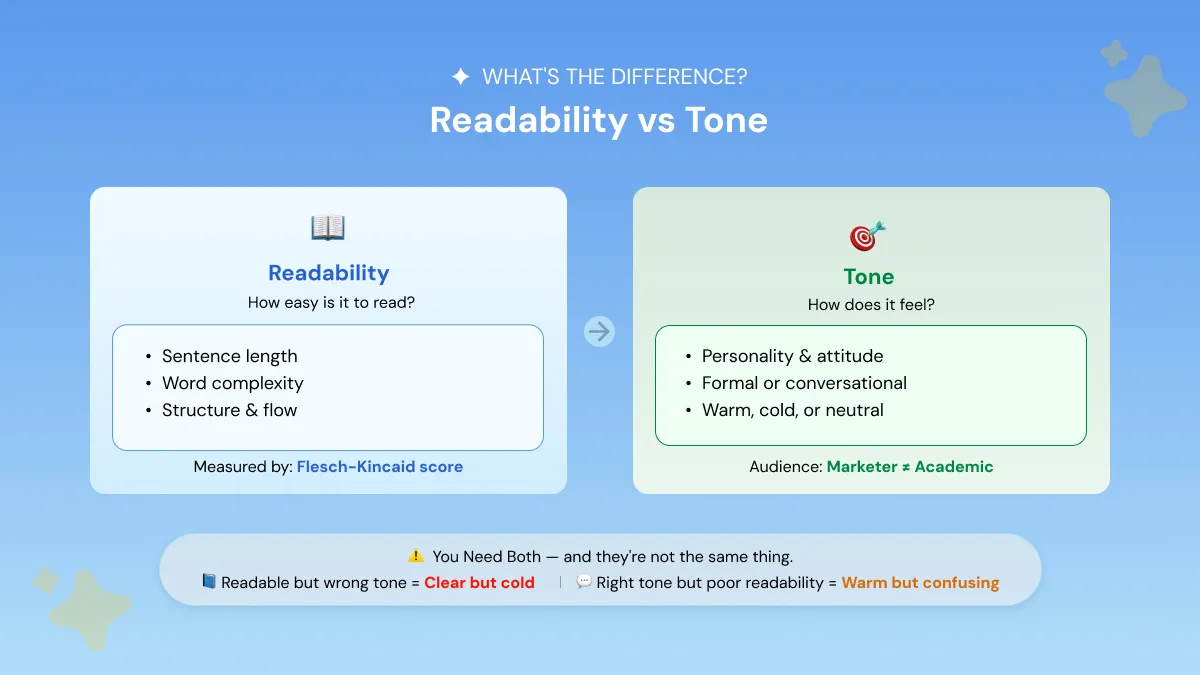
When AI writing "sounds off," most people can't pinpoint why. Usually, it comes down to two separate things: readability and tone. They're related, but they solve different problems.
Readability is how easily someone can read and understand your text. It depends on three main things:
Sentence length — shorter sentences are easier to process
Word complexity — familiar words beat technical jargon every time
Structure — clear paragraphs and logical flow reduce reader effort
Tools like the Flesch-Kincaid readability score measure this by analyzing sentence length and syllables per word. For general audiences, most editors aim for around an eighth-grade reading level.
The tone is about attitude and personality. It shapes how the reader feels, not just what they understand. It answers questions like:
Is the writing formal or conversational?
Does it sound authoritative, warm, or persuasive?
Does it feel like a real person wrote it or a machine?
Two pieces of content can cover the exact same topic and still feel completely different depending on tone alone.
The important thing to understand is that you need both working together. Readable text with the wrong tone comes across as clear but cold.
The right tone with poor readability feels warm but confusing.
Good writing gets the balance right and delivers information clearly while still sounding like a real person wrote it.
How to Improve AI Text Readability (Step by Step)
These five text enhancement tips work on any AI-generated draft, including ChatGPT output. The draft is just the starting point.
What you do with it after is what separates forgettable content from something people actually want to read.
You do not need to rewrite everything from scratch. Targeted fixes to sentence length, voice, jargon, and tone are enough to transform the whole piece into something that actually sounds human.
To show you exactly what that looks like, we will use the same paragraph across all five steps and improve it one fix at a time.
Here is the raw AI-generated text we are starting with:
"The utilization of advanced natural language generation systems in modern content production workflows has frequently resulted in material that, while technically correct and comprehensive, lacks tonal distinctiveness and reader engagement, thereby reducing its practical effectiveness for audience retention and conversion."
By the time we reach step five, it will read completely differently. Let's get into it.
1. Break Up Long Sentences
If you have to read a sentence twice to understand it, it's too long. That's the simplest rule in editing and AI breaks it constantly.
AI models tend to stack multiple ideas into a single sentence using patterns like:
Long introductory phrases — "The utilization of advanced…"
Filler connectors — while, therefore, moreover, in order to
Multiple commas holding together clauses that should be separate sentences
The result is sentences that are technically correct but exhausting to read. The fix is to separate the main idea from the supporting one and lead with the point.
According to Yoast, readability metrics like the Flesch Reading Ease score are influenced heavily by sentence length and word complexity, meaning longer sentences generally reduce readability.
Most editors writing for general audiences aim for 14–18 words per sentence as a comfortable average, and the Flesch-Kincaid readability score reflects this directly.
Does Sentence Length Affect How AI Interprets Content?
Yes. Sentence length affects both readability scores and how easily AI systems can pull a passage into an answer. Short, self-contained sentences are easier to scan, easier to quote, and better for AI-readable writing.
A strong rule is to lead with the main point in 10 to 15 words, then add context. That keeps sentence structure clean for readers and gives AI search systems a clearer, more citable line to extract.
This approach has a name in 2026: BLUF writing (Bottom Line Up Front). According to Kevin Indig's analysis of 1.2 million ChatGPT citations, 44.2% of LLM citations come from the first 30% of a page, which is exactly why answer-first sentences improve both writing flow and your chances of being cited.
Now let's apply that to our example paragraph. The original sentence is 40 words long and buries the main point at the end:
❌ Before: "The utilization of advanced natural language generation systems in modern content production workflows has frequently resulted in material that, while technically correct and comprehensive, lacks tonal distinctiveness and reader engagement, thereby reducing its practical effectiveness for audience retention and conversion."
✅ After: "AI writing tools can produce accurate, well-structured content. But accurate doesn't always mean engaging. Most AI-generated drafts lack tonal variety and that's exactly what hurts reader engagement and conversions."
One 40-word sentence became three short ones. The main point “that AI content lacks engagement” now leads instead of hiding at the end.
The writing flow is immediately smoother.
2. Switch Passive Voice to Active
Passive voice is one of the main reasons AI writing feels distant. AI models default to passive phrasing because it sounds neutral and formal. You'll spot it quickly once you know what to look for:
"was generated by"
"has been produced by"
"has frequently resulted in"
These constructions push the focus to the back of the sentence or remove it entirely. The fix is simple: find "was" or "by" constructions and rewrite so the subject performs the action.
❌ Before: "The utilization of advanced natural language generation systems in modern content production workflows has frequently resulted in material that, while technically correct and comprehensive, lacks tonal distinctiveness and reader engagement, thereby reducing its practical effectiveness for audience retention and conversion."
✅ After (long sentences broken + passive voice fixed): "Advanced AI systems now power many content workflows. They produce accurate material but accuracy alone doesn't drive engagement. Tonal variety is what keeps readers reading and converts them into customers."
The sentences feel more confident and direct, and the writing flow tightens up noticeably. Active voice also matters beyond readability. It signals confidence. Readers trust writing that owns its claims directly.
Passive constructions are one of the key patterns that AI detection tools flag. If you're concerned about that side of things, our 7 AI writing detection tips cover exactly what to watch for.
3. Cut Filler Words and Jargon
AI has a vocabulary problem because it consistently reaches for the most formal, inflated version of a word when a simpler one works better.
You'll see the same offenders appear again and again:
Instead of | Use |
utilize / utilise | use |
leverage | use, apply |
delve into | explore |
it is important to note | (delete it entirely) |
in order to | to |
facilitate | help, enable |
commence | start |
endeavour | try |
These words just stretch the sentences without adding any meaning. Cutting them improves content clarity and makes the writing feel more natural without changing what the sentence actually says.
GPT-5.3 Specific Patterns to Watch
If you draft with GPT-5.3, the same family of corporate filler still slips into first drafts.
OpenAI's March 2026 release notes mention that GPT-5.3 Instant was tuned to reduce teaser-style phrasing, but soft-intro transitions and over-wrapped corporate language still need a manual pass.
The shortlist to cut on every draft:
"It is worth noting that"
"At the end of the day"
"In today's fast-paced world"
"Delve into"
"It is important to mention"
Small vocabulary enhancements like these are the core of prose enhancement, the part of writing that makes text feel like a person wrote it, not a prediction engine.
Cutting them is one of the fastest ways to improve content clarity and lift your ChatGPT-drafted content out of generic territory.
❌ Before: "The utilization of advanced natural language generation systems in modern content production workflows has frequently resulted in material that, while technically correct and comprehensive, lacks tonal distinctiveness and reader engagement, thereby reducing its practical effectiveness for audience retention and conversion."
✅ After (long sentences broken + passive voice fixed + jargon removed): "Advanced AI systems are used in many content workflows. They often produce accurate material but without tone or engagement, that accuracy doesn't retain readers or convert them."
Here's what changed. "Utilized" became "used." "Tonal distinctiveness" became "tone." Filler phrases like "thereby reducing its practical effectiveness" were cut entirely.
Small vocabulary enhancements like these make a bigger difference to readability than any structural fix.
If you want to go deeper on this, our guide on how to enhance your sentences with AI covers the exact techniques for improving word choice without losing your original meaning.
4. Vary Sentence Length for Rhythm
Read the "After" version from step three out loud. It's cleaner but every sentence still feels roughly the same length. That's the next problem to fix.
Good writing has rhythm. It moves. Short sentences create impact. Longer ones give context, build on an idea, and carry the reader forward before the next short sentence lands.
That variation is what makes writing feel natural, like a real person wrote it, not a machine.
AI almost never does this naturally. Every sentence comes out at a similar length, which creates a flat, monotonous reading experience regardless of how accurate the content is.
The fix is to deliberately mix sentence lengths. A two or three word sentence works. So does a longer one that gives your reader the full picture before you bring them back with something short and punchy.
❌ Before: "The utilization of advanced natural language generation systems in modern content production workflows has frequently resulted in material that, while technically correct and comprehensive, lacks tonal distinctiveness and reader engagement, thereby reducing its practical effectiveness for audience retention and conversion."
✅ After (long sentences broken + passive voice fixed + jargon removed + rhythm added): "Advanced AI systems are used in many content workflows. They produce accurate material. But accurate isn't always engaging and that gap is where readers drop off. Tonal variety and sentence rhythm are what keep people reading and push them toward conversion."
Notice the difference. Four sentences. Four different lengths. None of them feel like they came from the same mold.
Short sentence. Short sentence. Then a longer one that builds context. Then a punchy closer. It's a deliberate pattern that mimics how people actually think and speak.
That variation creates natural writing flow and gives the text a sense of pace that flat AI output simply doesn't have.
5. Match Tone to Your Audience
This is the step most people skip when improving tone and voice in AI-written articles, and it's the one that makes the biggest difference.
AI doesn't know who it's writing for. It defaults to a neutral, formal tone because that's the safest option across all contexts. The result is content that fits every situation and resonates with none of them.
But a blog post for marketers needs a completely different tone than a legal report. A product email reads differently than an academic summary. Tone is not one-size-fits-all.
A deliberate tone shift separates forgettable AI content from something worth reading.
There are a handful of core tones worth knowing:
Tone | Sounds like | Best for |
Conversational | Relaxed, direct, like a real person talking | Blog posts, social media, newsletters |
Professional | Structured and clear — human but no fluff | Business emails, reports, LinkedIn |
Empathetic | Warm and understanding, reader-first | Support content, health, sensitive topics |
Authoritative | Confident, evidence-backed, expert-positioned | Guides, whitepapers, thought leadership |
Direct | Short, sharp, zero filler — gets to the point | CTAs, product copy, ads |
The tone you choose shapes how your reader feels about your content. Getting this right is what content polish actually looks like in practice.
Setting the tone once is not enough. Tone consistency across a whole piece matters just as much, and AI defaults tend to drift mid-article, especially in longer content. The fix is to define your tone in the prompt and check it section by section, since a piece that opens conversationally but ends in corporate-speak feels disjointed to the reader.
GPT-5.3 vs Gemini 2.5 vs Claude Opus 4.6
Each major model handles tone differently in 2026. GPT-5.3 is being tuned to improve follow-up tone and reduce teaser-style phrasing, but writers still notice it leans upbeat and corporate by default. Gemini 2.5 Pro is optimized for deep reasoning across complex tasks, codebases, and long documents, and the prose reflects that: accurate but tonally functional. Claude Opus 4.6 is positioned for stronger long-context handling and deeper reasoning, with a calmer, more measured default voice.
The practical point is the same across all three: even strong model output still needs a tone pass when you want content that feels clear, human, and consistent. That's exactly what Phrasly's enhancement does automatically for content you've already written, with any model.
Now let's apply it to our running example and see the full transformation from where we started:
❌ Before: "The utilization of advanced natural language generation systems in modern content production workflows has frequently resulted in material that, while technically correct and comprehensive, lacks tonal distinctiveness and reader engagement, thereby reducing its practical effectiveness for audience retention and conversion."
✅ After (all five steps applied, final version): "AI tools are now a standard part of most content workflows. They're fast and accurate but that's not enough. Readers don't just want correct information. They want content that feels like it was written for them. That's what tone does, and it's what most AI output is still missing."
Look at how far that single sentence has come. It went from a 40-word wall of jargon to five short, engaging sentences with a clear point of view and a conversational tone aimed directly at the reader.
Every step contributed but matching tone to the audience is what gave it a personality. The next section shows exactly what that looks like when a tool handles it automatically.
If your use case is specifically a formal register upgrade: emails, reports, or proposals — our dedicated guide on how to use AI to make your text more professional walks through that in full.
Don't want to apply all 5 steps manually? Let Phrasly handle it in one pass 👇
How to Improve AI-Written Text for Better Engagement
Engagement improves when your writing is easier to scan, easier to trust, and easier to keep reading.
Readable, well-toned content holds attention longer, reduces the chance readers bounce after a paragraph, and aligns with what Google says about helpful, people-first content.
The text clarity techniques covered in this guide work for both human readers and AI search engines.
Flat AI text loses readers for predictable reasons. It feels generic. It repeats itself. It takes too long to reach the point. By the time the actual insight shows up, the reader has already scrolled past or closed the tab.
Human-sounding content does the opposite. Varied sentence rhythm, an engaging tone, and clear content clarity keep readers moving forward instead of skimming out.
That's the engagement-readability loop in practice: cleaner writing flow leads to longer time on page, and Google's own guidance on AI Overviews points toward the same goal of satisfying readers with content that answers clearly.
Should I Write Shorter Sections to Improve LLM Readability?
Yes. Shorter sections with a direct answer in the first sentence are exactly what Google AI Overviews, ChatGPT, and Perplexity extract and cite.
This is what people are calling AI-readable content, writing structured for both human readers and AI search engines.
Rephrasing and restructuring sections improves your engagement metrics and your chances of being cited in AI-generated answers. Better AI Overviews readability is no longer separate from good writing. It's the same thing.
Phrasly's AI Text Enhancer automatically improves tone, rhythm, and clarity in one pass, so your content works for both human readers and AI search engines.
How Phrasly's AI Text Enhancer Fixes This in Seconds
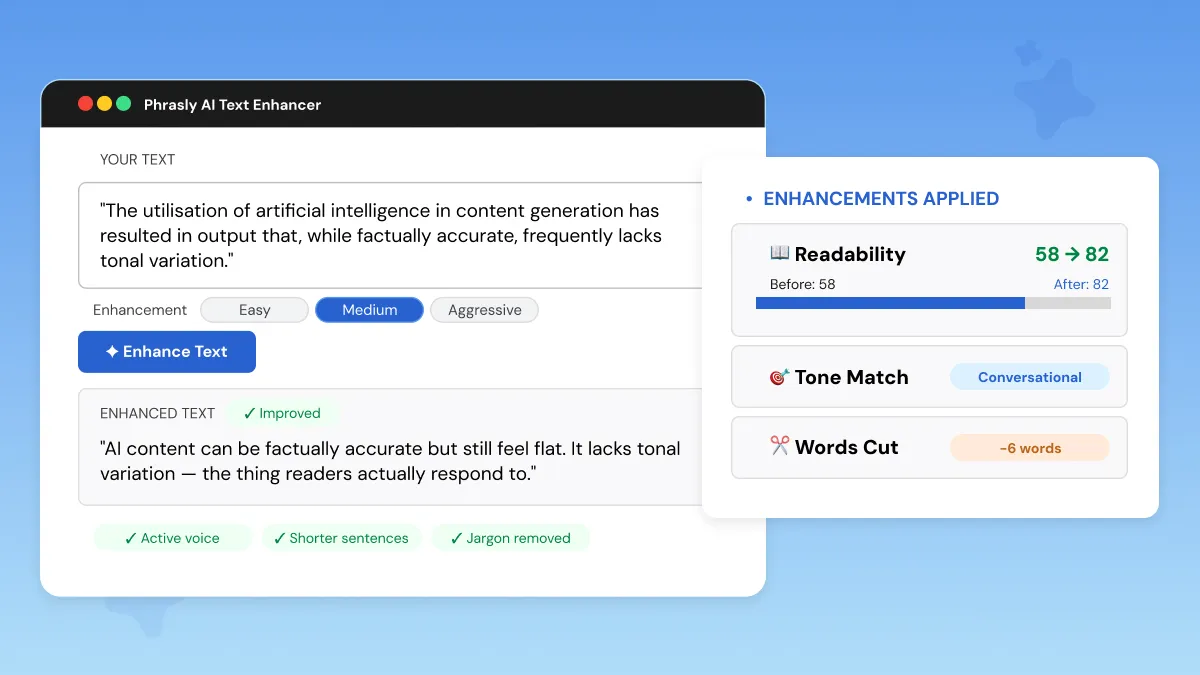
Phrasly's AI Text Enhancer automatically improves tone and style in AI-generated copy in one pass.
It also automatically improves source text quality across sentence structure, tone, jargon, grammar, and writing flow at the same time, so you do not have to run multiple tools or make several editing rounds.
That matters because AI text usually needs more than a grammar check. The output may be technically correct but still feel repetitive, overly formal, or hard to scan.
Readable structure isn't just a human concern anymore. Google says helpful content should be people-first.
And tools like Google AI Overviews, ChatGPT Search, and Perplexity all surface answers with cited sources, which means clear structure helps both human readers and AI search engines find the right passage to extract.
Manual editing works, but it takes time and it's easy to miss things:
Passive voice slips through.
Jargon stays because it sounds professional.
Sentence rhythm never gets touched because it feels like a minor detail.
The five steps in this article cover all of that, but if you want it handled automatically in one pass, that is exactly what Phrasly's AI Text Enhancer does.
It uses natural language processing to improve your text across multiple dimensions at once, sentence structure, tone, jargon, grammar and punctuation, and overall writing flow.
What About Other Readability Tools?
Several tools solve parts of this problem. Hemingway Editor is built for sentence length and clarity. ProWritingAid focuses on grammar and spelling.
Phrasly's advantage is combining readability improvement, tone adjustment, and jargon removal in a single automated pass, rather than treating each one as a separate edit.
Prose enhancement goes beyond grammar. It's about how the writing flows and feels, and all three enhancement levels address exactly that.
What makes it practical for everyday use is the three enhancement levels:
Level | What it does | Best for |
Easy | Light refinements — polish without changing structure | Human-written drafts that just need tidying |
Medium | Balanced pass improving readability and tone | Blog posts, emails, general content |
Aggressive | Deeper rewrite focused on clarity and restructuring | Heavily AI-generated text needing significant work |
This works for both AI-generated content and human-written drafts.
If your writing quality needs to match a specific tone or audience, all three levels enhance AI writing quality without stripping out your original meaning or voice.
Before & After — Real Examples of AI Text Enhancement
Most AI content fails not because the information is wrong but because nothing was done with it after generation.
The words are there. The point is buried. The tone is flat.
That's the gap Phrasly's AI Text Enhancer is built to close, automatically fixing sentence structure, tone, jargon, and flow in one pass so the final output actually sounds like something worth reading.
These five examples show what that difference looks like across the content types people use AI for most.
Every enhanced version below also scores meaningfully better on readability tools like Flesch-Kincaid, addressing both the human experience and core text clarity metrics.
1. Writing Reports & Documentation
If you rely on AI to draft reports or formal documents, you already know this feeling. The content is accurate but it reads like a legal disclaimer, not a human being.
❌ Raw AI Output: "The utilization of automated natural language generation systems in contemporary content production environments has frequently resulted in material that, although technically accurate, lacks tonal distinction and consequently diminishes audience engagement over time."
✅ Phrasly Enhanced: "Automated writing tools used in modern content workflows often produce material that is tonally flat and that drives readers away."
Jargon like "utilization" and "tonal distinction" is swapped for plain language, and the sentence drops from 32 words to 20. The point now lands on the first read.
2. Blog Posts & Articles
If you use AI to speed up your content output, flat and robotic posts hurt more than they help.
Readers notice when something feels off, bounce rates climb, and search engines take note; human-sounding content directly supports your SEO rankings.
❌ Raw AI Output: "In numerous instances, AI-generated outputs create text that is technically sound yet emotionally flat, causing articles and posts to feel less engaging to readers who are seeking a more conversational and relatable voice."
✅ Phrasly Enhanced: "AI often produces work that is grammatically correct but lacks emotion or human feeling, making posts sound robotic to readers who just want a human tone."
The filler opening is cut, passive structure is tightened, and the engaging tone comes through immediately. The sentence goes from 33 words to 26.
3. Professional Emails
If you send dozens of emails a day, AI drafts can feel like a shortcut until someone replies asking what you actually meant. A stiff, overly formal tone creates friction in communication that should be simple and direct.
❌ Raw AI Output: "It is requested that you review the attached document at your earliest convenience, as it has been meticulously prepared to provide comprehensive insights and detailed information regarding the matter currently under discussion."
✅ Phrasly Enhanced: "Please see the attached report for more details about the topic we are discussing."
A 32-word passive construction becomes a single 14-word request. This is active voice conversion at its most effective. Nothing is lost except the fluff.
4. Product Descriptions
If you use AI for product copy, you have probably noticed that every description starts sounding the same. Buzzword-heavy writing does not convert, and search engines increasingly favor product pages written clearly for humans.
❌ Raw AI Output: "Our proprietary platform leverages cutting-edge algorithms and sophisticated analytics to optimise engagement metrics, streamline enterprise-level workflows, facilitate the production of high-quality content across multiple industry verticals efficiently, and provide actionable insights for content teams."
✅ Phrasly Enhanced: "Our platform uses smart algorithms and advanced analytics to increase engagement, automate business workflows, create quality content for any industry, and give content teams valuable insights."
Every inflated term "leverages," "proprietary," "enterprise-level verticals" is replaced with plain language.
The description now actually describes the product clearly and directly.
5. Social Media & Captions
If you generate captions with AI, you already know they rarely feel natural. Stiff microcopy gets scrolled past, and lower engagement directly affects how platforms distribute your content.
❌ Raw AI Output: "Users often report that captions generated by AI lack the necessary spontaneity, authenticity, and emotional resonance required to encourage meaningful social interactions, which can result in lower engagement and fewer audience responses overall."
✅ Phrasly Enhanced: "AI captions often lack the naturalness and emotion needed to drive real social engagement."
A 33-word academic sentence becomes 14 words without losing any meaning. The tone shifts from distant and formal to conversational.
Notice how every enhanced version sounds like human writing. Shorter sentences, active voice, plain language, and the right tone are not small tweaks.
AI writing tools have come a long way but readable, human-sounding content still needs a human touch. The fixes are straightforward: shorter sentences, active voice, plain language, and the right tone for your audience.
The difference between content that converts and content that gets scrolled past often comes down to these small but deliberate edits.
You do not have to do it manually every time! Try Phrasly's AI Text Enhancer, paste your content and see the difference in seconds. 👇
FAQs
What is the best AI tool to improve text clarity?
A dedicated tool like Phrasly AI Text Enhancer is one of the most effective ways to improve text clarity because it automatically rewrites sentences, removes jargon, and improves structure for better readability.
Instead of manually editing each line, it analyzes the text and enhances flow, wording, and tone in seconds.
What is an AI text enhancer?
An AI text enhancer is a tool that improves the clarity, tone, grammar, and readability of written content automatically.
It analyzes sentence structure and wording, then rewrites the text to make it clearer, more engaging, and easier for readers to understand.
Can I use Phrasly to fix both AI-generated and human-written text?
Yes. Tools like Phrasly AI Text Enhancer can improve both AI-generated content and human-written drafts by refining sentence structure, adjusting tone, and correcting grammar. This makes it useful for polishing blog posts, emails, reports, or any type of written content.
What is the difference between tone and writing style?
Tone refers to the attitude or emotional feel of the writing, such as formal, friendly, or persuasive. Writing style is broader and includes vocabulary choices, sentence structure, and rhythm that shape the overall voice of the content.
What is a good Flesch-Kincaid readability score for a blog post?
For most blogs targeting a general audience, a Flesch-Kincaid grade level of around 7–9 is considered ideal. This level ensures the content is easy to read while still sounding professional and informative.
Does sentence length affect how AI interprets content?
Yes. Sentence length affects both human readability and how AI search engines process your content. Shorter sentences in the 15 to 20 word range align with readability models like Flesch-Kincaid and are easier for AI systems like Google AI Overviews, ChatGPT, and Perplexity to extract as citable answers.
Phrasly's AI Text Enhancer automatically shortens and restructures long sentences as part of its readability pass.
Which software optimizes AI-generated content for readability?
Several tools cover parts of the problem. Hemingway Editor focuses on sentence length. ProWritingAid handles grammar and style.
For a complete pass that improves readability, tone, jargon, and writing flow in one step, Phrasly's AI Text Enhancer is purpose-built for AI-generated content. Our breakdown of the best AI text enhancers compares the main options if you want to see how they stack up.
Does improving readability help with SEO rankings?
Yes. Content that is easier to read often keeps users on the page longer and improves engagement signals like time-on-page and bounce rate, which search engines consider when evaluating content quality.
Clearer writing also makes it easier for search engines and AI systems to understand and surface your content.
What are ethical or disclosure best practices when using AI?
Prefer transparency: disclose AI assistance where required/expected, fact-check all claims, and avoid claiming human authorship for content you did not substantially human-edit.
Also beware of tools that mimic specific living authors without consent. (Recent industry controversies highlight consent issues with “expert mimic” features).
How do I preserve brand voice when improving AI text?
Create a short “voice profile” (3–5 bullets: tone, formality, typical words/phrases, pros/cons) and either feed it to the AI as a prompt or apply it as a post-edit checklist so rewrites keep consistent vocabulary and personality.

Written by
Obaid Ahsan
Content Lead · Pakistan
Obaid Ahsan is a Content Lead with 5+ years of experience in SEO, content strategy, and AI-focused publishing. At Phrasly, he leads content development with a focus on accurate research, search performance, and useful, trustworthy information for readers.