Formal vs Informal Writing: Word Swaps for Academic Papers
11 min read
Does your essay draft read more like a group chat than a research paper? Many students and ESL writers search for a "sentence formalizer" or a "word formalizer" because casual phrases slip into their academic work without them noticing.
Formal vs informal writing comes down to four things: tone, pronouns, contractions, and word choice. Formal writing spells words out and avoids slang, while informal writing follows the patterns of everyday speech.
You'll get a 27-item word swap table built for academic papers, with before-and-after sentences you can copy into your draft. Once you see the pattern, Phrasly's AI Email Formalizer can rewrite a whole paragraph in a formal tone, so you don't have to hunt for each phrase by hand.
Turn Your Informal Sentences Into Formal Ones 👇
What Is Formal Writing? What Is Informal Writing?
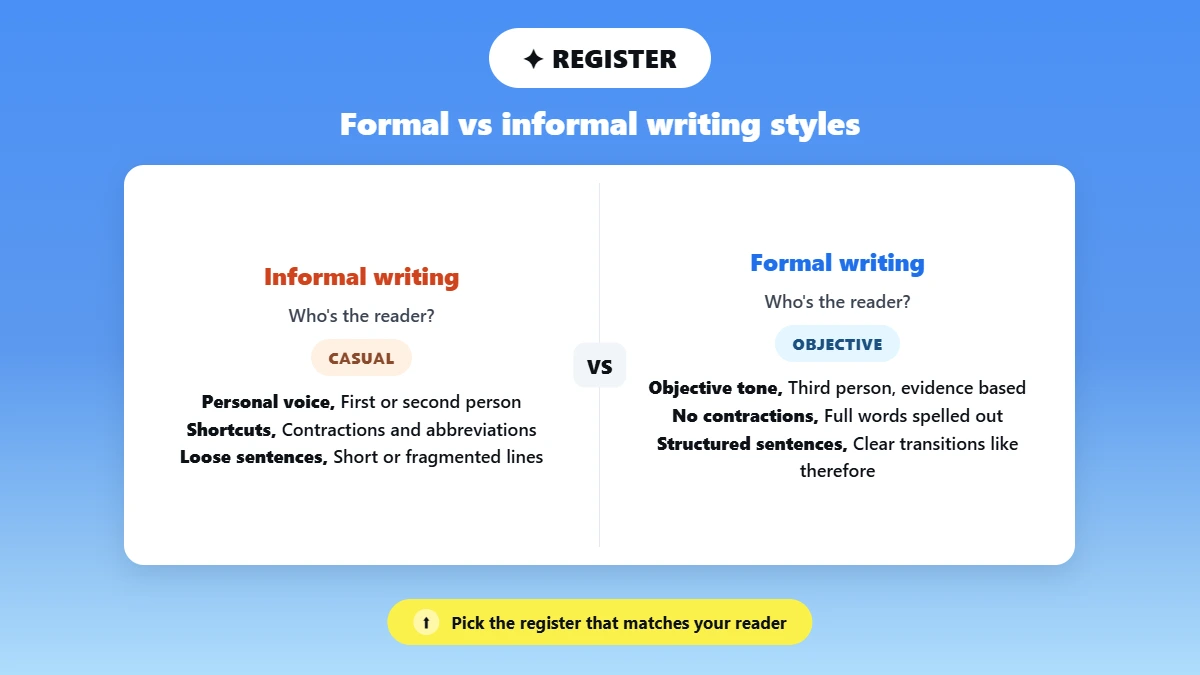
Formal writing is the register used for academic papers, reports, and professional letters, and it relies on full words, an objective tone, and precise vocabulary. Tone and register work together: register is the level of formality a writer picks for a reader, and tone is the attitude the words carry.
Informal writing is the register of texts, social media posts, and casual emails. It allows contractions, slang, and personal pronouns, along with a looser sentence structure.
✍️ One Idea, Two Registers
Informal: "Lots of teens can't focus 'cause they're always on their phones."
Formal: "Frequent smartphone use appears to reduce concentration among teenagers."
Student drafts often mix both registers without the writer noticing, so a tone check before submission catches casual phrases that a quick reread misses.
Formal Writing Characteristics
These formal writing style examples show what each feature looks like:
Objective tone: claims rest on evidence, usually in the third person ("The findings indicate a decline.")
No contractions: "do not" instead of "don't"
Precise vocabulary: discipline-specific terms and no slang
Structured sentences: longer sentences joined by clear transitions such as "therefore" and "in contrast"
Informal Writing Characteristics
Informal writing characteristics come from everyday speech:
Personal voice: first or second person and a conversational tone ("I think you'll like this.")
Shortcuts: contractions, idioms, and abbreviations ("gonna," "FYI")
Casual vocabulary: filler words such as "like," "stuff," and "basically"
Loose sentences: short or fragmented lines ("Not great. Moving on.")
Formal vs Informal Writing: A Side-by-Side Differences Chart
Formal and informal writing differ in six features: pronouns, voice, contractions, slang, punctuation, and sentence structure. The key features of formal writing all point toward objectivity, which means a claim depends on evidence instead of the writer's feelings.
Feature | Formal Writing | Informal Writing |
|---|---|---|
Pronouns | Third person for general claims (the researcher, one); "I" or "we" only for your own research steps | First and second person (I, you) |
Voice | Objective; active by default, passive when the method matters more than who did it | Active, personal, opinion-based |
Contractions | None (do not, cannot) | Common (don't, can't) |
Slang/Idioms | Avoided entirely | Frequent (a ton of, gonna) |
Punctuation | Minimal, no exclamation marks or emoji | Exclamation marks, emoji, ellipses |
Sentence Length | Longer, complex, transition-heavy | Short, fragmented |
📊 Academic Writing Has Stayed Formal
A study of 2.2 million words from leading journals in 1965, 1985, and 2015 found that informal features rose by only about 2% overall (Hyland and Jiang's journal study). Biology and electrical engineering drove that small rise, while applied linguistics and sociology grew slightly more formal.
Pronouns, Voice, and Objectivity
Formal writing keeps general claims in the third person perspective ("the results show"), while informal writing uses first person pronouns ("I") and second person pronouns ("you") freely. APA Style's pronoun guidance allows "I" or "we" for your own actions in a study.
APA also tells writers not to refer to themselves in the third person, and to avoid a vague "we" that means people in general.
Formal: third person, objective claims, active or passive voice
Informal: first and second person, active voice, personal opinions
Is Passive Voice Formal or Informal?
Passive voice is neither formal nor informal by itself, but it appears more often in academic writing because it removes the person who did the action. APA Style permits both voices and recommends the active voice as much as possible, with the passive voice for cases where the action matters more than who performed it.
Passive: "The samples were heated to 80°C." (the focus stays on the method)
Active: "We heated the samples to 80°C." (the focus moves to the researchers)
Contractions, Slang, and Abbreviations
Formal writing spells every word out and uses full terms, such as "approximately" instead of "approx." Informal writing treats contractions, slang and colloquialisms (casual spoken phrases), and text abbreviations as a normal part of the style.
Punctuation rules shift too, because formal writing drops exclamation points, emoji and abbreviations:
✅ Formal: "do not," "approximately," "for your information," one period per sentence
❌ Informal: "don't," "gonna," "a lot," "FYI," "!!!," 😂
When Should You Use Formal or Informal Writing?
Use formal writing when your reader judges your work, such as a professor, an employer, or a client, and use informal writing for friends and personal channels. An easy test for audience awareness is to picture your reader and ask whether you would say the sentence to them in a formal meeting.
💡 The Three-Factor Test
👤 Audience: professor, boss, or friend
🎯 Purpose: persuade, inform, or chat
📍 Setting: classroom, office, or text thread
Some writing needs a semi-formal middle ground. Cover letters, LinkedIn messages, and thank-you emails should sound polite and correct, yet warm enough to read like a person wrote them.
Academic and Professional Contexts
🎓 Essays, theses, and journal submissions
💼 Business emails, reports, and client communication
Personal and Casual Contexts
Use informal writing for readers who know you and expect your natural voice:
💬 Texts, social posts, and notes to friends
📓 Journaling or personal blogging
25+ Informal Words to Avoid in Academic Writing (and Their Formal Alternatives)
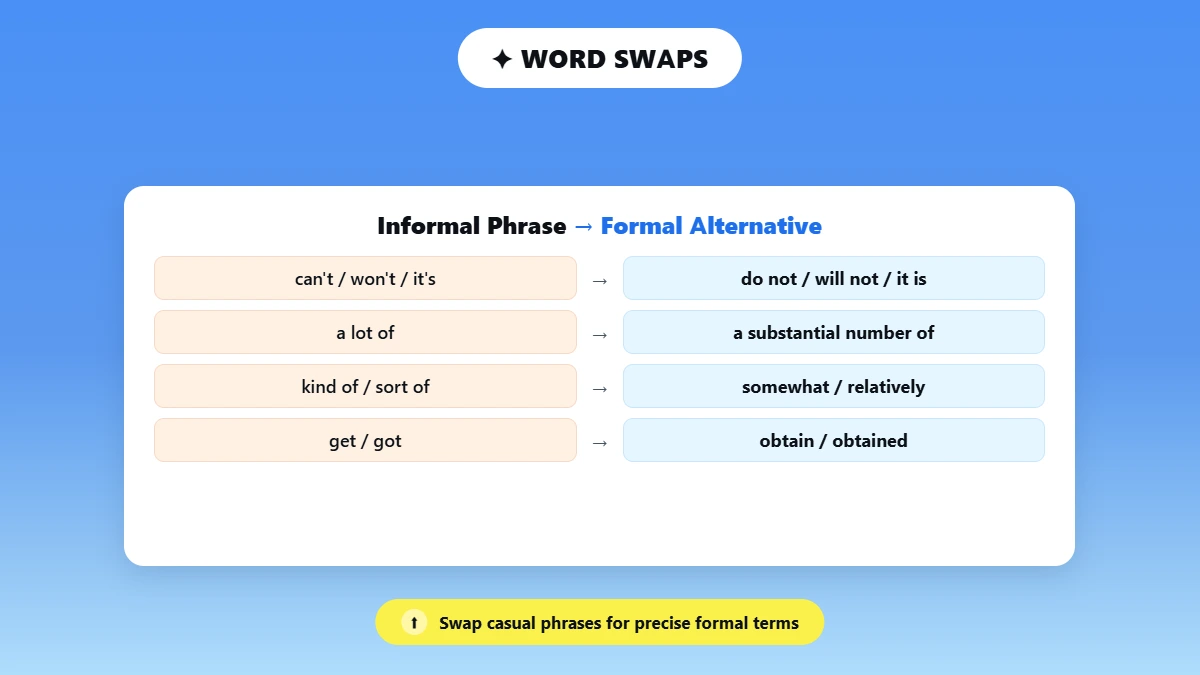
The informal words to avoid in academic writing are casual words and phrases that sound like speech, and each one has a formal alternative with the same meaning. Swap each phrase for its closest formal match and keep the sentence short, so the result sounds precise instead of inflated.
Academic readers expect exact word choice, so casual words weaken your credibility even when the argument is sound. The table covers full phrase swaps that show up often in student drafts and early professional reports.
Phrases to Cut from Academic Papers
Watch for four categories in your vocabulary choice:
✂️ Contractions: can't, won't, it's
📢 Vague intensifiers: very, really, huge, a lot of
🔗 Casual connectors: "so," "but," or "also" at the start of a sentence
🗣️ Fillers and phrasal verbs: kind of, stuff, and two-word verbs such as "find out" or "look into"
Even strong writers overuse two or three of these without noticing.
Formal Alternatives Table
Informal Phrase | Formal Alternative | Example (Before → After) |
|---|---|---|
a lot of | a substantial number of | "A lot of studies support this." → "A substantial number of studies support this claim." |
kind of / sort of | somewhat / relatively | "The results were kind of inconclusive." → "The results were relatively inconclusive." |
get / got | obtain / obtained | "We got the data from surveys." → "We obtained the data from surveys." |
find out | determine | "We wanted to find out why." → "We sought to determine the cause." |
big / huge | significant / considerable | "There was a huge difference." → "There was a considerable difference." |
can't / won't | cannot / will not | "This can't be proven." → "This claim cannot be proven definitively." |
stuff / things | factors / elements | "Several things affected results." → "Several factors affected the results." |
very important | critical | "Sample size is very important here." → "Sample size is critical in this design." |
look into | investigate | "This study looks into remote work." → "This study investigates remote work." |
show up | appear | "The pattern shows up in both groups." → "The pattern appears in both groups." |
go up / go down | increase / decrease | "Scores went up after the workshop." → "Scores increased after the workshop." |
talk about | discuss | "Chapter 2 talks about the method." → "Chapter 2 discusses the method." |
think about | consider | "Researchers should think about bias." → "Researchers should consider bias." |
set up | establish | "The school set up a tutoring program." → "The school established a tutoring program." |
point out | indicate / note | "Smith points out a gap." → "Smith notes a gap in the literature." |
get rid of | eliminate | "The filter gets rid of errors." → "The filter eliminates errors." |
come up with | develop | "The team came up with a model." → "The team developed a model." |
deal with | address | "The paper deals with access issues." → "The paper addresses access issues." |
a bit | slightly | "Costs rose a bit." → "Costs rose slightly." |
really / pretty | highly / fairly | "The method is pretty reliable." → "The method is fairly reliable." |
So (sentence opener) | Therefore / As a result | "So, the claim fails." → "Therefore, the claim does not hold." |
But (sentence opener) | In contrast / Nevertheless | "But the second group improved." → "In contrast, the second group improved." |
Also (sentence opener) | In addition | "Also, the sample was small." → "In addition, the sample was small." |
like | such as | "Tools like surveys help." → "Tools such as surveys provide useful data." |
etc. / and so on | name each item | "Use books, journals, etc." → "Use books and peer-reviewed journals." |
gonna / wanna | will / intend to | "We're gonna test two models." → "We will test two models." |
you (people in general) | people / students / researchers | "You can see the effect in older adults." → "The effect is visible in older adults." |
⚠️ Word Swaps Are Only Half the Fix
Swapped words still sound casual when a sentence keeps a vague "this" or an unsupported opinion. Check sentence structure and hedging (careful wording such as "suggests") along with vocabulary.
A long paper can hide dozens of these phrases, and a manual hunt for every one is slow and easy to get wrong. Phrasly's AI Email Formalizer rewrites a pasted paragraph in a Concise, Friendly, or Professional tone and gives you up to five versions per run to compare. If your business documents need the same polish, AI can also make your writing sound more professional while keeping your meaning.
Paste a paragraph from your draft and get a formal version back, instead of checking every phrase by hand 👇
Weak vs Strong: Academic Sentence Rewrites
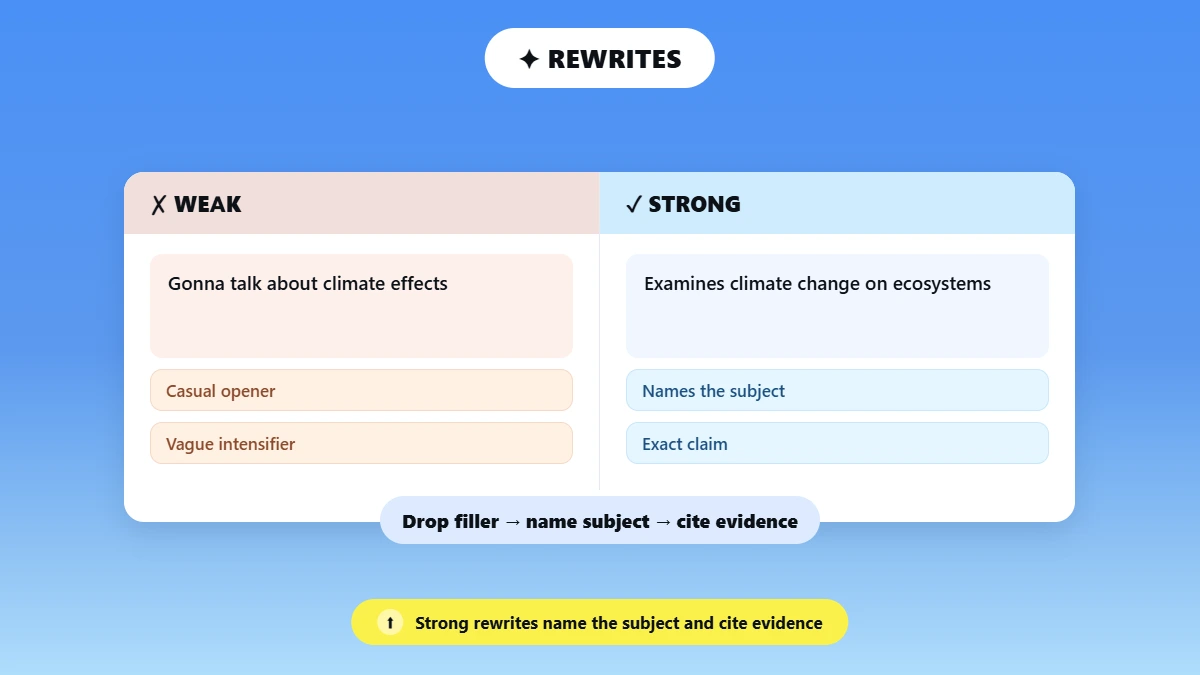
A formal rewrite keeps the meaning of a sentence and changes its shape: contractions become full words, vague quantifiers become exact ones, and opinions become evidence-based claims. These formal vs informal writing examples come from the introduction, results, and discussion sections of a typical paper.
Weak Sentence Examples
Introduction: "This paper is gonna talk about climate effects."
Results: "I think the data kind of shows a trend."
Results: "We got a ton of responses, and it's pretty clear people liked the program."
Discussion: "So this proves we were right."
Strong Formal Rewrites
"This paper examines the effects of climate change on coastal ecosystems."
"The data suggest a measurable trend."
"We received a substantial number of responses, and most participants rated the program positively."
"These results support the original hypothesis."
Each strong version names its subject, drops the casual intensifier, and replaces "I think" with what the data show.
📊 Why Rewrite 4 Matters
Rewrite 4 replaces a bare "this" with a noun phrase. In the same 50-year journal study, Hyland and Jiang found that the small rise in informality came mostly from first-person pronouns, bare pronouns like "this," and sentences that open with a conjunction.
Formal vs Informal Writing in Emails and Business Communication
Match an email's formality to the reader: a professor, a client, or a hiring manager expects formal email writing, while a coworker you message every day usually accepts a relaxed tone. A sentence sounds too informal for a business report when it carries contractions, exclamation points, slang, or a casual sign-off.
📊 Emoji Can Cost You Credibility
In a 2017 study of 549 participants from 29 countries, a smiley in a formal work email made the sender seem less competent and no friendlier (Glikson, Cheshin, and van Kleef).
Tone checkers can flag these shifts automatically, and you can compare Phrasly and Grammarly's tone tools to see which one fits your workflow. A formalizer for work applies the same rules to client emails, manager updates, and reports.
Email Tone Checklist
Run this check on any business correspondence before you send it:
✅ Check that the greeting and sign-off match the reader ("Dear Dr. Lee" and "Best regards").
✅ Scan for contractions, slang, and exclamation points.
✅ Confirm the subject line matches how serious the message is.
Workplace Messaging Gray Areas
Contractions are fine in most internal emails to colleagues, but formal reports, cover letters, and legal documents spell them out.
📄 Cover letters: lean formal, even when the company culture is casual.
🤝 Follow-ups to new contacts: stay formal until the other person relaxes the tone first.
🏢 Messages to senior leadership: match their established tone, and choose formal when you're unsure.
Start your next revision with the swap table, then reread the draft for pronouns, sentence openers, and any bare "this." The same checks work for email, so when you need to rewrite an email professionally, fix the greeting and the contractions first.
Run your next paragraph through the Formalizer and compare the formal version with your own edit 👇
FAQs About Formal vs Informal Writing
How Do You Know if Writing Is Formal or Informal?
Tone markers tell you the register. Contractions, slang, personal pronouns, and short fragments signal informal writing, while full words, an objective voice, and structured sentences signal formal writing. Instead of a printed formal vs informal writing worksheet or PDF, you can self-test by pasting a paragraph into Phrasly's Formalizer and comparing the rewrite.
Why Is Formal Writing Important?
Formal writing builds credibility with readers who judge your work. Professors, employers, and clients expect clear, precise language in academic, business, and legal documents. A formal tone shows that your claims rest on evidence and that you understand the conventions of the field you're writing for.
Can You Use Contractions in Formal Writing?
Contractions are generally avoided in formal writing, including academic papers, legal documents, and business reports. Spell them out as "do not," "cannot," and "it is." They're acceptable and common in informal writing, such as texts, casual emails, and most social media posts.
Is Passive Voice Formal or Informal?
Passive voice is more common in formal writing, especially in scientific papers, because it puts the focus on the method instead of the researcher. Informal writing favors the active voice for directness and personality, and APA Style still recommends active voice whenever the person doing the action matters.
How Do You Know if Your Writing Is Too Formal or Informal?
Check your audience, purpose, and setting before you send anything. Overly formal writing feels stiff in a text or a quick team message, while overly informal writing undermines credibility in a report or application. In email, the greeting sets the tone first, so these formal email greeting examples help you start at the right level.

Written by
Alina Shah
SEO Content Specialist · Karachi, Pakistan
She writes about AI so you don't have to guess. 8+ years in content strategy and editing. Now she puts AI writing tools and detection systems through real tests and shares what actually works.