Do Plagiarism Checkers Flag Quotes, Citations, and Common Phrases?
11 min read
Yes! Do plagiarism checkers check quotes? They do. And they can also flag in-text citations, reference list entries, and common phrases.
Because comparing your wording with the source they can access. A highlight means similar text was found. Not that you plagiarized.
The type of match determines whether it matters. A correctly quoted and cited passage is normal. And a reference entry is expected. But copied wording with only a citation needs fixing. Settings change the picture too.
Turnitin can filter quotes and bibliographies out of a report. This guide shows how to tell each match apart. And what to do about it.
Check Your Paper With Phrasly's Plagiarism Checker
Do Plagiarism Checkers Check Quotes?
Yes! Most plagiarism checkers scan quoted text along with the rest of your paper. So a correctly quoted and cited passage can still show up as a match.
Some tools, including Turnitin, can filter quotes out of the report. Either way, a highlighted quote shows similarity. Not a finding of plagiarism.
Three terms help here. A text match is wording that lines up with a source. A similarity score adds those matches up. A plagiarism judgment is a person deciding whether you used a source improperly.
That gap is the core of similarity vs. plagiarism.
Turnitin's guide to the similarity score says a high score doesn't always mean plagiarism.
And the University of Kansas's teaching center reminds instructors that flagged material doesn't in itself mean a student plagiarized.
The reverse is true too.
A low score doesn't prove a paper is clean. Because checkers can miss rewritten ideas. And sources outside their database.
Highlighted text | Why it matches | Is it a problem? | What to do |
Quoted and cited passage | Quotes copy the source word for word by design | ✅ Usually not, if marked, cited and within assignment limits | Check the marks, citation and page number; keep it |
Reference list entry | Other papers cite the same authors, titles and journals | ✅ No | Keep it; ask whether the bibliography filter is on |
In-text citation, e.g. (Lee, 2024, p. 12) | Short citation strings recur across papers | ✅ No | Read the sentence around the marker |
Common phrase or technical term | Standard wording appears in many sources | ⚠️ Rarely, unless several come from one source | Keep needed terms; look for a pattern |
Copied wording, cited, no quotation marks | The exact words aren't marked as borrowed | ❌ Yes | Add quotation marks or paraphrase properly; keep the citation |
Close paraphrase (a few words swapped) | Wording and structure still follow the source | ❌ Often yes | Rewrite in your own structure and words; cite |
Explanatory categories based on Purdue OWL, University of Kansas, and Turnitin guidance. Not measured tool results.
Why Do Properly Cited Quotes Still Get Flagged?
A quote is meant to match its source word for word. So, any checker that compares wording will find it. Quotation marks and a citation tell your reader where the words came from.
But they don't hide those words from the software. Unless a quote filter is on, the match stays in the report.
That's by design.
Purdue OWL notes that quotations must match the source word for word.
And be attributed to the original author. So, does Turnitin flag quotes? It can, unless your instructor turns on its quote filter.
Turnitin's exclusion filter guide says that, for quoted text. Anything inside the quotation marks is filtered out of the Similarity Report.
What About Block Quotes?
Turnitin's guide says indented block quotes are excluded only when the original file is a .doc or .docx file. It also won't filter text in single quotation marks. So, an indented block with no quotation marks may still count in other file types.
Check your file format and your citation style. But don't add quotation marks that your style guide doesn't want.
When a Legitimate Quote Still Causes Trouble
A quote can be correct and still be too much. If an assignment expects your own analysis, a paper built mostly on quotes is a writing problem even when the report is clean.
Judge your quotes against the assignment. Not only the checker.
Does a Plagiarism Checker Count References?
Usually, yes! Unless the bibliography is excluded. Reference entries repeat the same authors, titles, journals, and DOIs that many other papers cite. So, they match easily.
Turnitin offers an Exclude bibliography filter. But whether it's applied depends on your instructor's settings. Never delete references to lower a score.
So, does Turnitin include references? By default, they can count.
The University of Kansas guidance notes that correctly cited bibliography entries will always be flagged unless they’re excluded.
The exclude bibliography Turnitin option finds the reference section automatically. Or falls back to standard headings such as “References,” “Works Cited,” or “Bibliography.”
👊 Filtering Is Not Deleting
Filtering a report hides matches from the score. Deleting references removes credit your paper needs.
If references make your report look high, keep every entry. And ask whether the bibliography filter is applied.
Why Doesn't Adding a Citation Remove the Match?
A citation credits where an idea came from. But a checker measures matching words.
If you copy a sentence and add a citation without quotation marks, the wording still matches.
And it can still count as plagiarism. Because the borrowed words aren't marked as a quote. Quote it exactly. Or paraphrase it properly.
That's usually the answer to why my cited is text flagged. Paraphrases and summaries need attribution too. So, a citation is always required. Quotation marks are the extra step for exact wording.
Copying words without them is direct plagiarism, even with a citation.
This is why citations flagged as plagiarism often point to this gap.
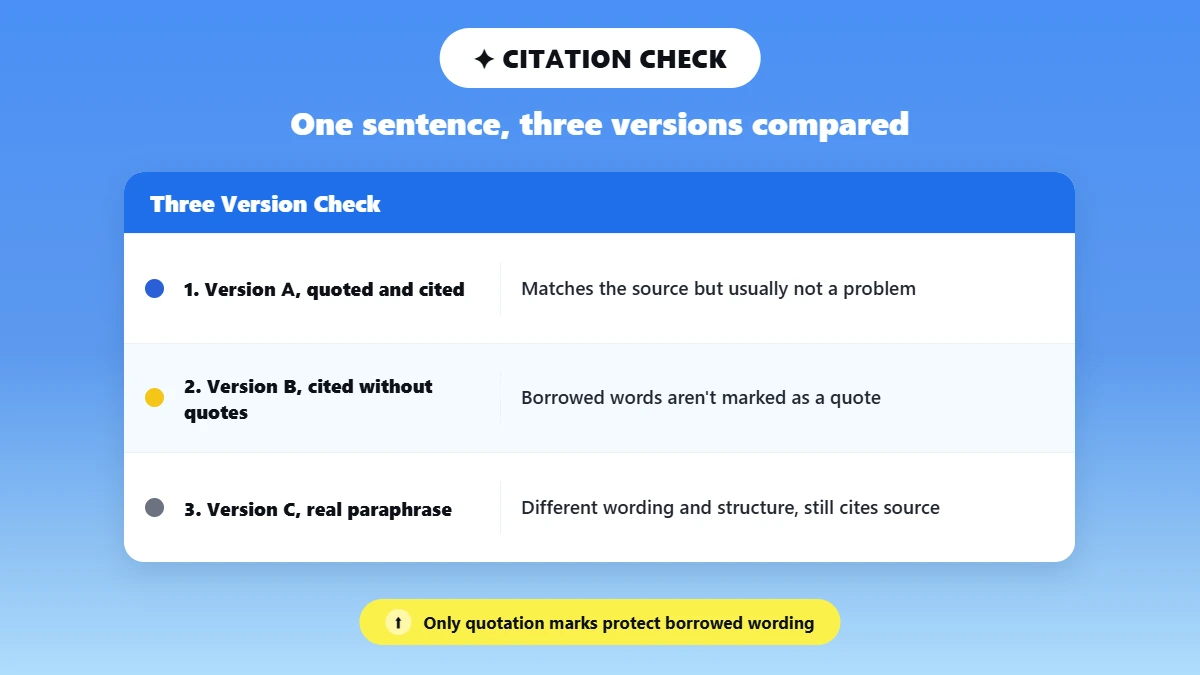
One Sentence, Three Versions
This is a writing example. Not a scan result. The source and author are fictional.
Source sentence: "Students who review a similarity report before submission catch more missing quotation marks than students who wait for the final report." (Rivera, 2025)
✅ Version A, quoted and cited: Rivera (2025) found that "students who review a similarity report before submission catch more missing quotation marks than students who wait for the final report" (p. 4).
❌ Version B, cited without quotation marks: Students who review a similarity report before submission catch more missing quotation marks than students who wait for the final report (Rivera, 2025). The words are borrowed but not marked as a quote.
✅ Version C, a real paraphrase: Checking matches early, rather than at the deadline, helps writers spot quotes they forgot to mark (Rivera, 2025).
If Version B is only lightly reworded, it drifts into close paraphrase or patchwriting, which still follows the source too closely.
How Turnitin Groups Quotes and Citations?
So, can a checker tell a citation from a quote? Partly!
As of October 2026, Turnitin's new Similarity Report sorts each match into four groups based on quotation marks and in-text citations (Turnitin student overview).
It still can't judge whether your use of a source is appropriate. And not every school uses the new report.
Turnitin match group | Turnitin's definition (verbatim) | What it usually means for you |
Not Cited or Quoted | "The number of text matches that are not written as a quotation or has no citation to its original source." | Check first: borrowed wording, or a coincidental match? |
Missing Quotations | "This text is cited, but the match is so exact that it may also require quotation marks." | The Version B problem: add quotation marks or paraphrase |
Missing Citation | "This text is written as a quote, but lacks a citation to its original source." | Add the citation |
Cited and Quoted | "This text contains a quotation and is cited to a source." | Usually fine; check the formatting |
Source: Turnitin, student overview of the new Similarity Report. Checked October 14, 2026.
The Turnitin missing quotations group is the one to watch.
Turnitin also notes that its citation detection is trained on English text in APA, MLA, Turabian, and IEEE formats.
So, citations in other styles may land in the wrong group.
Not sure which group your highlighted sentence falls into? Run your draft through a plagiarism checker that shows matched sources. Open each source and compare the wording side by side before you submit.
Are Common Phrases Considered Plagiarism?
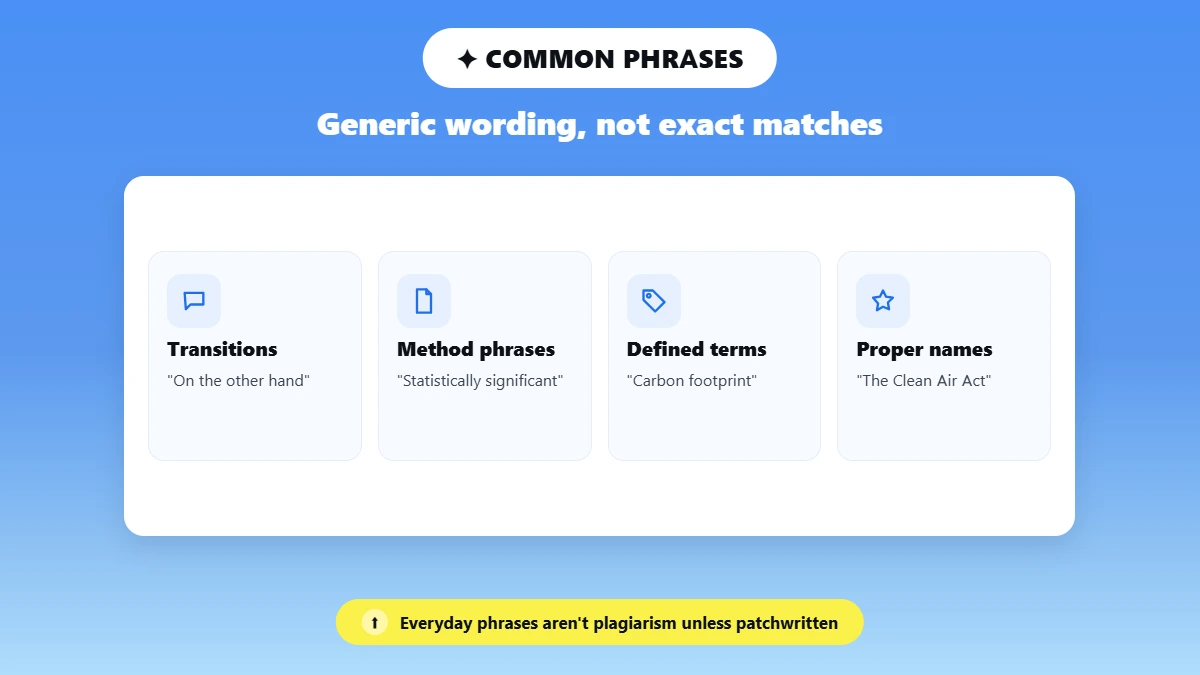
No! Everyday expressions and standard technical terms aren't plagiarism. Even when a checker highlights them. They match because many writers use the same words.
The exception is a run of distinctive phrases taken from one source. This signals patchwriting. And needs rewriting plus a citation.
These are the kinds of common phrases flagged by Turnitin and other checkers. They're generic wording. Not exact matches.
Transitions: "on the other hand"
Method phrases: "statistically significant"
Defined terms: "carbon footprint"
Proper names: "the Clean Air Act"
Thresholds matter too. Turnitin's Exclude small matches setting hides matches below a word count. And the default is 8 words in the new report. The University of Kansas notes that a lower threshold, such as five words, flags more.
A word-count threshold is a display setting. Not permission to copy short phrases. Keep technical terms exact. Swapping in awkward synonyms to dodge a match can change your meaning.
That's the practical answer to common phrases plagiarism worries.
📌 Common Wording Vs Common Knowledge
Common wording is a phrase everyone uses. Common knowledge is a fact that may not need a citation, such as the year a well-known event happened.
Whether a fact needs a citation depends on your audience and your assignment.
Which Turnitin Settings Exclude Quotes, References and Small Matches?
Turnitin can exclude quotes, the bibliography, cited text, and small matches. While its classic report uses a small sources filter instead.
Instructors set the defaults for each assignment.
Students can apply exclusions in their own view. But Turnitin says these don't change the official score their instructor sees.
What it removes | Report version | Watch out for |
Text inside quotation marks, including nested quotes; indented blocks only in .doc/.docx | New and classic | Doesn't check whether the quote is cited or allowed |
The reference section, found automatically or by standard headings | Both | Unusual headings may not be detected |
Properly cited material, including in-text citations and their sentences | New report only | Depends on citation detection |
Individual matches under a word threshold (default 8 words) | New report only | Not a safe limit for copying |
Whole sources whose total match falls under a word or percentage threshold | Classic report only | Removes every highlight from that source |
Source: Turnitin's exclusion filter guide. Checked October 14, 2026; Turnitin updates these pages often.
To exclude quotes in your own view in Turnitin, use the filter panel. But note that student exclusions are temporary. And don't change the official similarity score.
Filters may not shift the overall percentage much when sources overlap. Menus differ by report version and LMS.
See how to check plagiarism in Turnitin for the submission and report steps.
Do Other Plagiarism Checkers Handle Quotes the Same Way?
Not always! Checkers use different source databases, matching methods, and settings. The same quote can match in one tool and not in another. Many checkers don't publish how they treat quotes or bibliographies.
Read the matched sources in your report instead of assuming a quote will or won't count.
Several popular checker pages we reviewed in October 2026 didn't say how they treat quoted text or reference lists. Phrasly's plagiarism checker page says matches can include quotes, citations, and common phrases.
It advises reviewing each in context. It doesn't list a quote or bibliography exclusion option.
One published example shows why results vary. In a September 6, 2026 single-document test (771 words), both Microsoft Word and Phrasly matched a properly quoted passage, as described in this plagiarism checker for Microsoft Word test.
It’s one document. Not accuracy research. And no outside checker can reproduce your Turnitin score.
Turnitin also compares papers against its own repository of student work, as this guide to the free plagiarism checker for students explains.
Still, it helps to check your paper for plagiarism before submitting. Because a pre-check shows which passages match and which sources they come from.
What Should You Do When a Legitimate Passage Is Flagged?
Open the matched source. Then sort each highlight.
Correct use (keep it). A formatting gap (add quotation marks or the missing citation).
Or a borrowing problem (rewrite and cite). Keep required references and technical terms. If a match still looks wrong, explain it to your instructor rather than chasing a zero score.
Open the matched source and read your sentence next to it.
Classify it with the quick reference table above.
Fix formatting gaps: Quotation marks, page numbers, and missing citations.
Rewrite real borrowing in your own structure.
See how to rewrite without plagiarizing.
Recheck the final version. Note any matches you can explain.
For the full revision workflow, see how to lower a high similarity score.
Fixed your quotes and citations? Run the final version through an online plagiarism checker like Phrasly's. So the only matches left are ones you can explain. Further scans use purchased scans or subscription credits.
Frequently Asked Questions
Do Quotes Count as Plagiarism?
No! When they're word for word, in quotation marks (or correct block format), cited, and allowed by the assignment. They may still show as matches. Copying words without marking them as a quote is different.
Does Turnitin Flag Quotes as Plagiarism?
It can highlight quoted text as a match unless the quote filter is on. Its new report groups properly quoted and cited matches separately. A highlight isn't a plagiarism finding.
Is 25% on Turnitin High?
The number alone can't tell you. A 25% made of quotes and references differs from 25% of uncited copying. Check what matched and your instructor's rules. See what percentage of plagiarism is acceptable.
Are Plagiarism Checkers 100% Accurate?
No! They can match legitimate text. And miss rewritten ideas or sources outside their database. Use the report as evidence to review. Not as a verdict.
Does Adding Citations Lower Similarity Scores?
Not by itself! The score measures matching words. So a cited sentence still matches. Some Turnitin settings, such as Exclude cited text, can remove cited material from the view.
Should I Delete My Reference List to Lower My Score?
No! Keep every required reference. Ask your instructor whether the bibliography filter is applied instead.
Is Copying with a Citation but No Quotation Marks Plagiarism?
It can be. The citation credits the source. But exact words need quotation marks or a real paraphrase.
Quotes, citations, references, and common phrases can all match in a plagiarism report.
The type of match decides whether it matters. Fix formatting gaps and real borrowing. Keep legitimate source use. And be ready to explain what remains. A report is a starting point for review. Not a verdict on your writing.

Written by
Muhammad Usman Ali
Pakistan
Muhammad Usman Ali is an experienced SEO content writer with 3+ years of professional writing experience. He specializes in AI tools, AI detection technologies, and search engine optimized content.