How to Lower a High Similarity Score Before You Submit
13 min read
To lower a high similarity score before you submit your paper, review each matched passage, add citations and quotation marks where they are missing, and rewrite any paraphrase that follows the source too closely, without changing what the source says. Leave the quotes, references and technical terms your paper needs in place. Then rescan the revised draft with the same settings to confirm what changed.
Remember that the score only shows how much text matches other sources. It does not show which sentences are a problem, so a lower number is not the goal on its own.
Below, a match-by-match table, a worked revision and a real before-and-after scan show you how to reduce similarity score results without weakening your paper.
Run Your First Similarity Check Free 👇
What Should You Change When Your Similarity Score Is High?
When your similarity index is too high, change only the real problems: sentences copied without quotation marks, ideas used without a citation, and paraphrases that follow the source's wording or order. Everything else, such as required prompt text, your bibliography or a properly quoted line, usually stays. When you cannot tell which group a match belongs to, ask your instructor.
Knowing how to fix a high similarity score starts with knowing what the number measures. A similarity score is the share of your document that matches text in the checker's database.
Turnitin's own student guide to the similarity score puts it plainly: "A high similarity score does not always suggest that a piece of writing has been plagiarized, just as a low similarity score does not always indicate that no plagiarism has occurred."
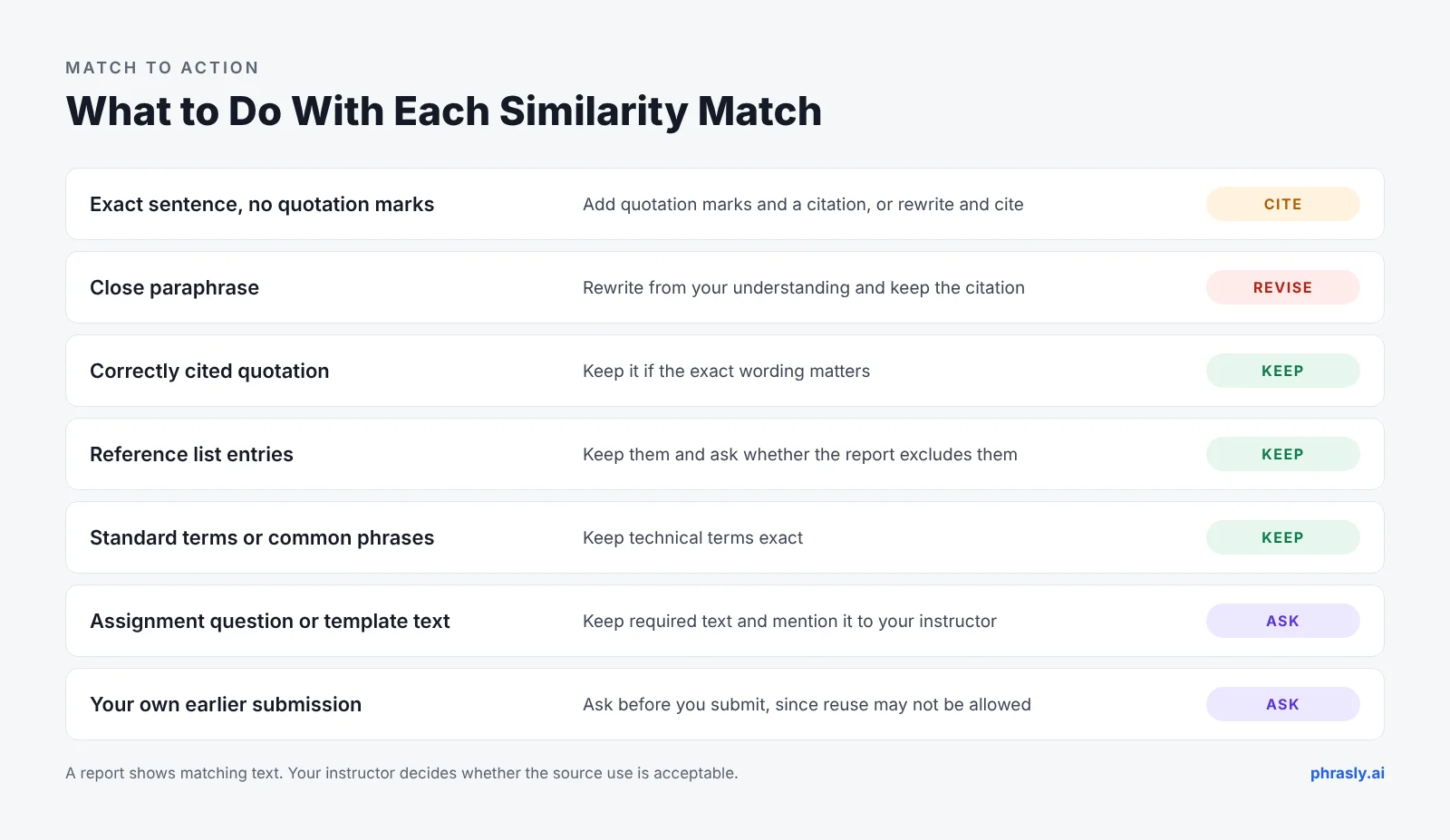
Use this table to decide what each type of match needs:
What the report matches | What to check | What to do |
|---|---|---|
An exact sentence with no quotation marks | Did you mean to quote it? | Add quotation marks and a citation, or rewrite it in your own words and cite the source. |
A close paraphrase | Does your version follow the source's wording or sentence order? | Rewrite it from your understanding of the idea and keep the citation. |
A correctly cited quotation | Is the quote needed and formatted correctly? | Keep it. Paraphrase it only if the exact wording is not needed. |
Reference list entries | Are the entries in the required citation style? | Keep them. Ask whether your report should exclude the bibliography. |
Standard terms or common phrases | Is there another accurate way to say it? | Keep technical terms exact. Do not force awkward synonyms. |
The assignment question or template text | Did your instructor require it? | Keep it, and mention it if it raises the score. |
Your own earlier submission | Is reusing your work allowed for this task? | Ask your instructor before you submit. |
💡 Tip: start with the substantial matches. One uncited paragraph matters more than many three-word matches spread across the paper. If the report shows lots of small borrowings from different sources, read our guide to incremental plagiarism, because those small pieces can add up.
How to Reduce Similarity Score in Five Steps
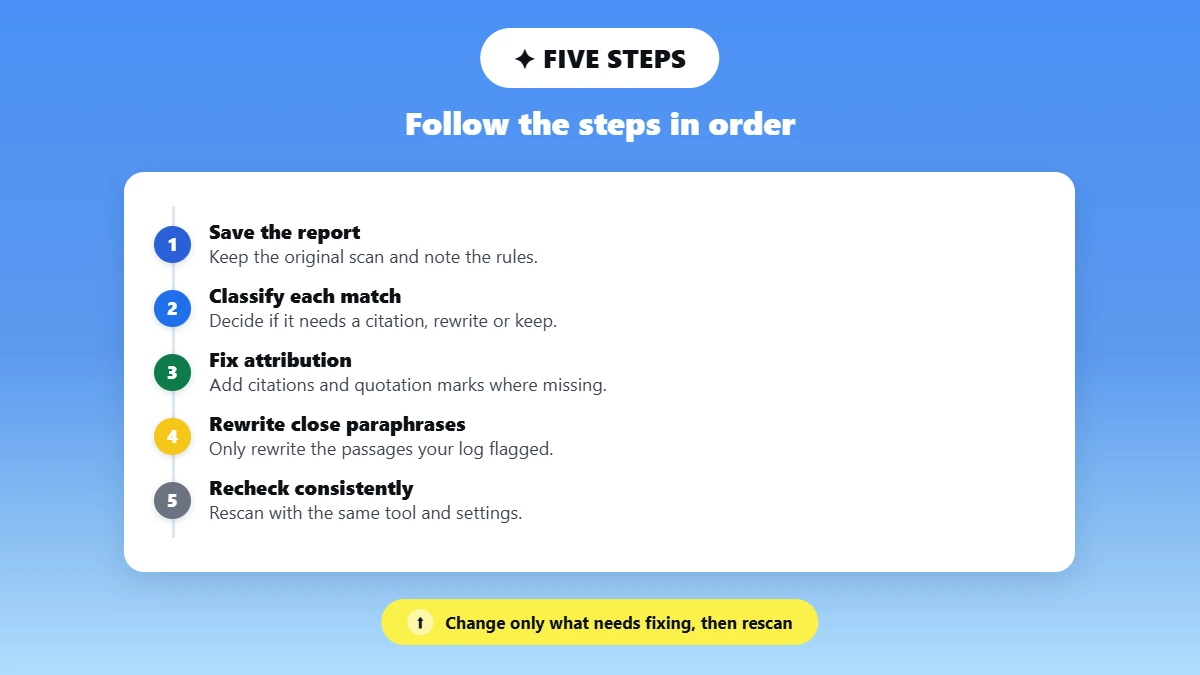
To reduce your Turnitin similarity score legitimately, work through five steps in order: note the first report and your assignment rules, sort the matches, fix credit and quotation marks, rewrite only the close paraphrases, then rescan under the same conditions. Doing them in this order means you change only what needs changing and can see what each fix did.
Step 1: Save the Original Report and Read the Assignment Rules
Before you change anything, keep a copy of the version you scanned and its report. Note the tool, the date and any filters or exclusions that were turned on. You will need this to compare results later.
Then check the rules for this assignment:
Do quotations and the reference list count toward the score?
Can you see the same report your instructor sees?
Are resubmissions allowed, and how many?
Turnitin is clear that there is no single target: "Every school, instructor, or assignment could have a different amount of matching text that is considered acceptable." A "safe" percentage you read online is not your course policy.
Step 2: Open Each Source and Classify the Meaningful Matches
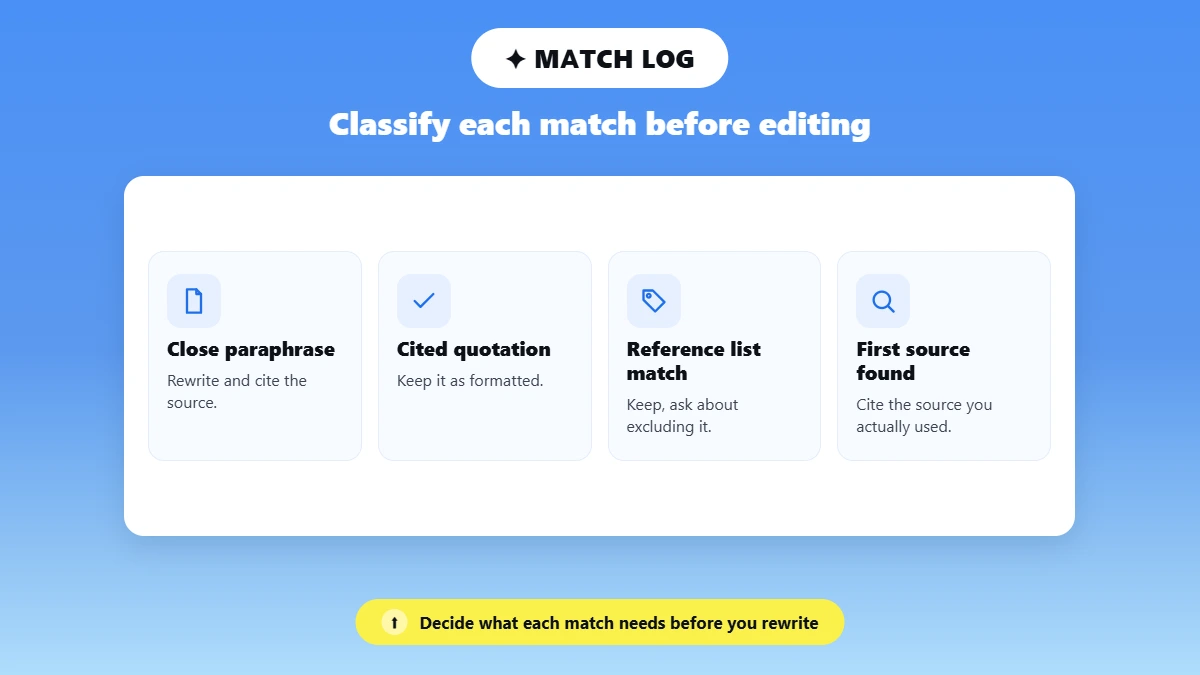
Read each highlighted passage next to its source. Decide what kind of match it is and log your decision. A simple log looks like this:
Passage | Issue | Decision |
|---|---|---|
Paragraph 2, sentence 3 | Close paraphrase of a journal abstract, no citation | Rewrite and cite |
Paragraph 4, quotation | Quote is cited and formatted correctly | Keep |
Reference list | Entries match a citation database | Keep, and ask about excluding it |
Check each source with care. The first website a checker shows may have copied an older source itself, so cite the source you actually used, not the one the report happened to find first.
Sorting matches is faster when each highlighted passage sits right beside its source. Phrasly's report links every match to the page it came from.
Step 3: Fix Attribution and Quotation Formatting
Credit is the first fix. Every borrowed idea needs a citation, every exact phrase needs quotation marks or block-quote formatting, and every in-text citation needs a matching entry in your reference list.
This applies to lightly reworded text too. The University of Oxford's plagiarism guidance says that paraphrasing "by altering a few words and changing their order" without due acknowledgement is plagiarism. Swapping a few words does not remove the need for credit.
💡 Key point: a citation fixes attribution, but it does not stop copied wording from matching. If a cited sentence is still almost word for word from the source, either put it in quotation marks or rewrite it as shown below.
Step 4: Rewrite Only the Passages That Need It
Do not rewrite the whole paper. Rewrite only the passages your log marked as close paraphrases, using this routine:
Read the source until you understand the point.
Set the source aside.
Write the idea in your own words, shaped around your argument.
Compare your version with the source to check that it is accurate.
Keep the citation.
Purdue OWL describes a good paraphrase as someone else's ideas "presented in a new form." New words alone are not enough. The sentence should be built your way.
Keep the source's level of certainty. Words like "may," "some" and "often" limit a claim. If a study says a method "may improve" results, your version cannot say it "will improve" them, because that changes what the source found.
If most of your draft leans on sources, a few fixes will not be enough.
Follow our guide on how to rewrite an essay without plagiarizing.
Step 5: Recheck the Revised File Consistently
Scan your revised draft in the same checker you used the first time, with the same settings. If you change the tool or the filters, you will not know whether the score moved because of your edits or because of the new settings.
Do not delete your reference list from the copy you scan just to get a lower number. The score will drop, but your writing will be no more original than before.
When you are done, keep three things together: your final draft, the new report and your decision log. For any match you chose to keep, write one line on why it is fine, such as "required quotation, cited."
What Does a Proper Revision Look Like?
A proper revision keeps the source's meaning and limits but changes how the idea is built, and it keeps the citation. Swapping synonyms while keeping the original sentence order still produces a close paraphrase. When the exact wording matters, quote it instead of forcing a rewrite.
The example below uses a fictional source written for this guide. It is not a real study.
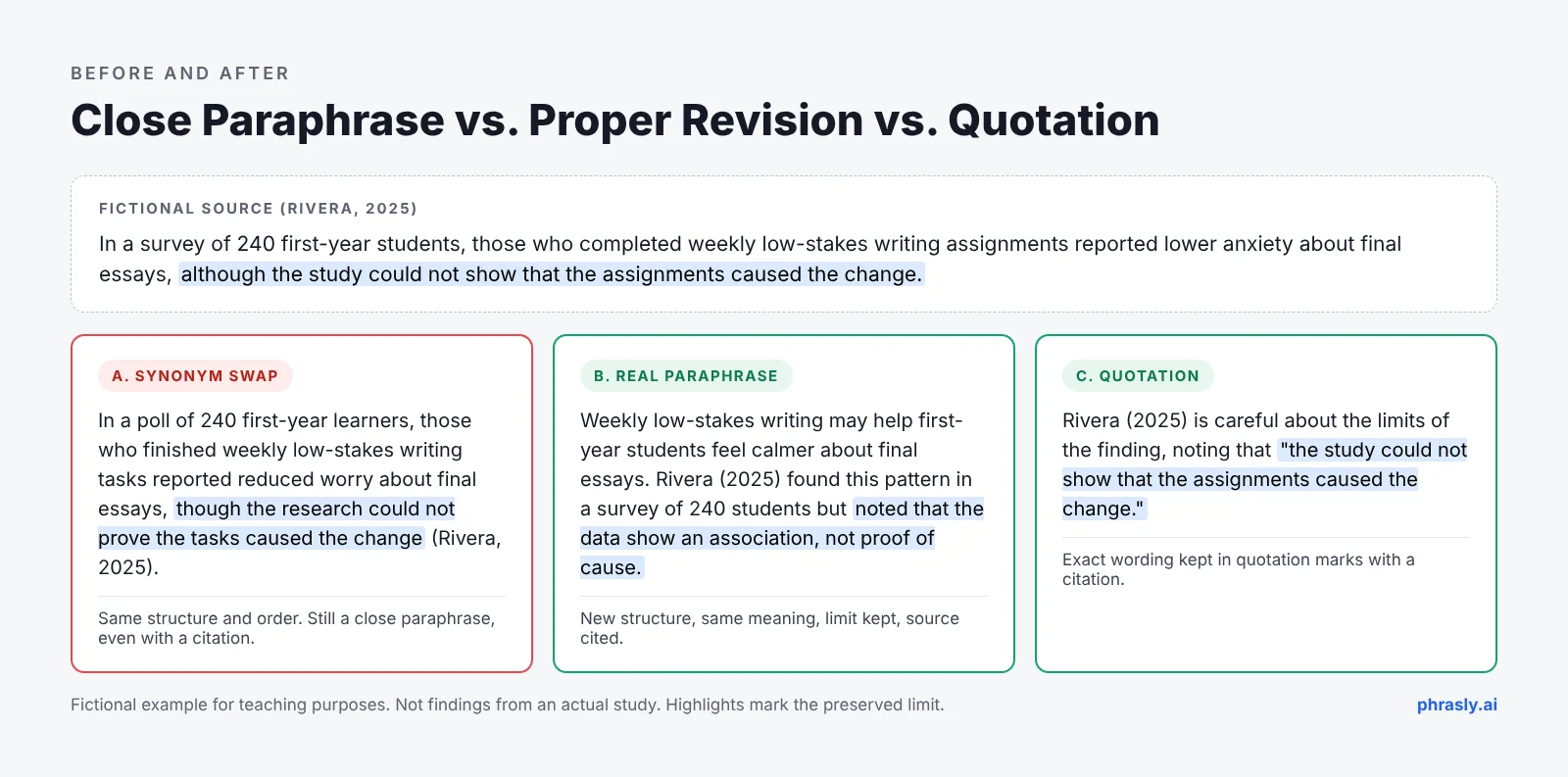
Fictional source (Rivera, 2025): "In a survey of 240 first-year students, those who completed weekly low-stakes writing assignments reported lower anxiety about final essays, although the study could not show that the assignments caused the change."
❌ Version A: Synonym Swap (Still a Close Paraphrase)
In a poll of 240 first-year learners, those who finished weekly low-stakes writing tasks reported reduced worry about final essays, though the research could not prove the tasks caused the change (Rivera, 2025).
This fails because every phrase is swapped one for one while the structure and order stay the same.
✅ Version B: Genuine Paraphrase
Weekly low-stakes writing may help first-year students feel calmer about final essays. Rivera (2025) found this pattern in a survey of 240 students but noted that the data show an association, not proof of cause.
This works because it leads with the writer's own point, uses a new structure, keeps the study's limit and cites the source.
✅ Version C: Quotation
Rivera (2025) is careful about the limits of the finding, noting that "the study could not show that the assignments caused the change."
No version guarantees a specific percentage. The goal is accurate, credited source use.
For more on where the line falls, read is paraphrasing plagiarism.
🧪 Our Quick Test: Fixing One Close Paraphrase
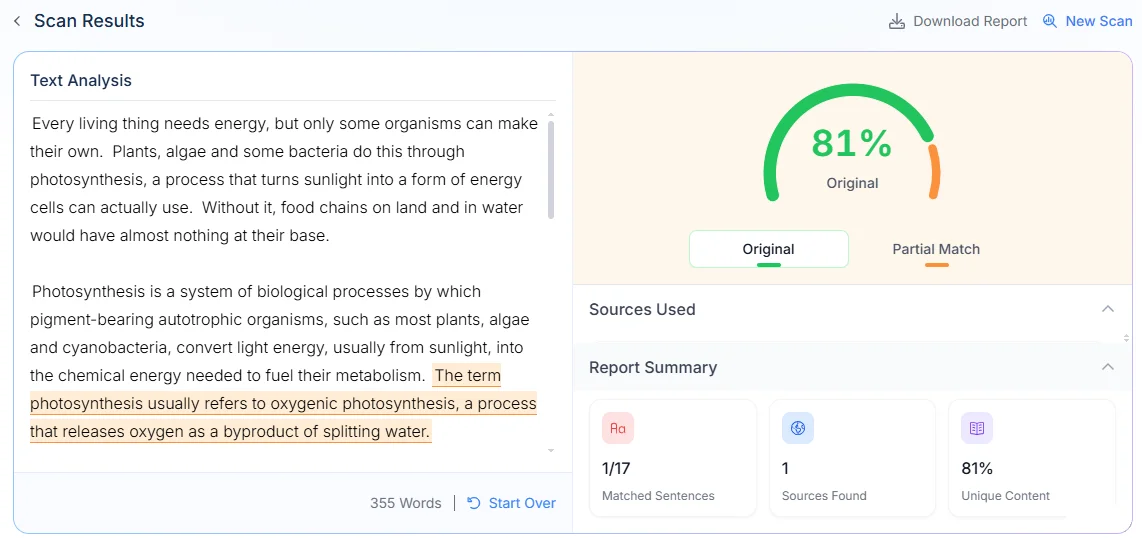
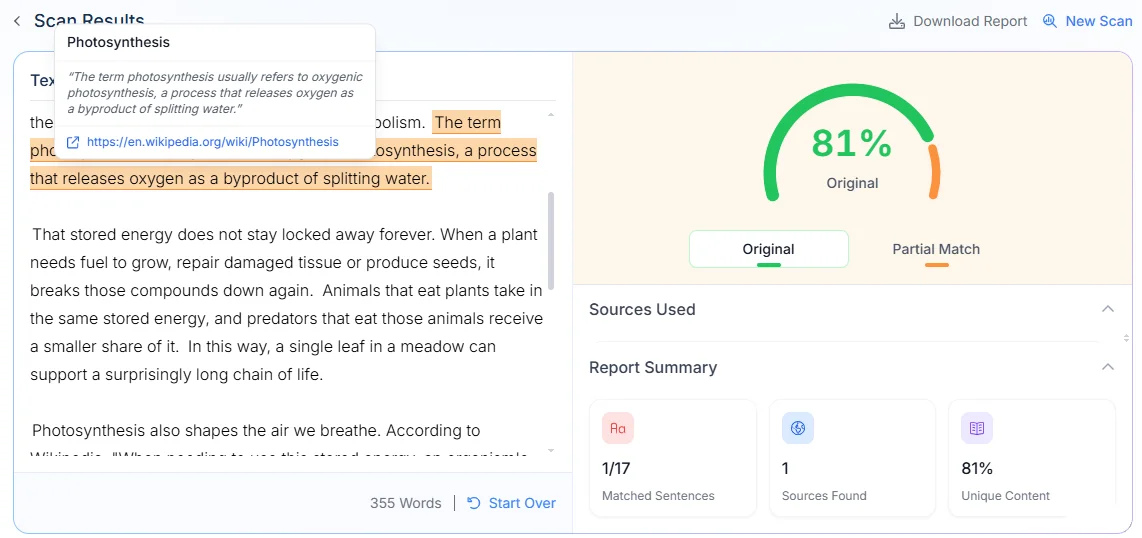
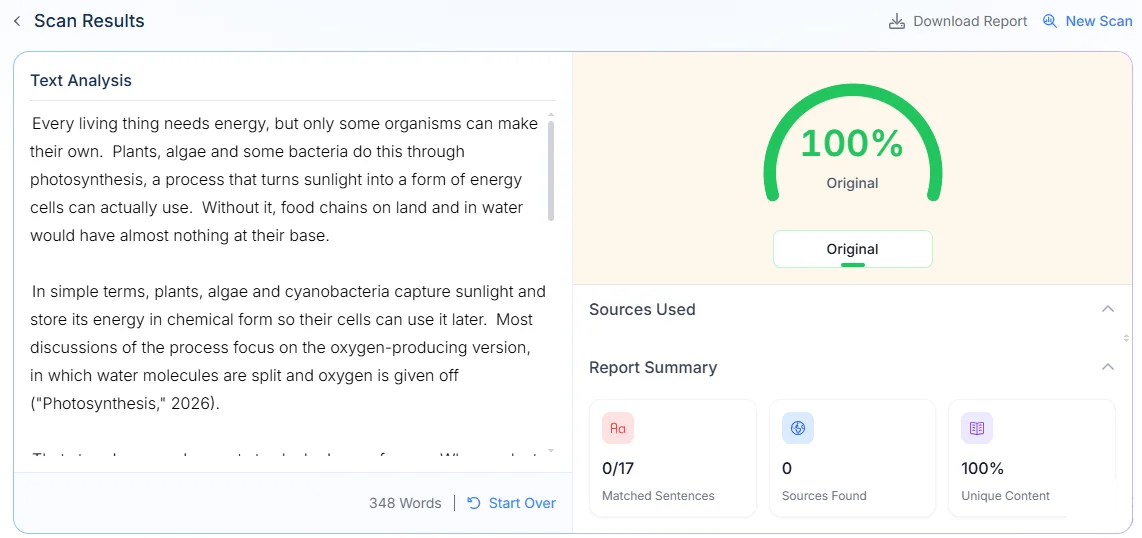
We wrote a 355-word passage using Wikipedia's "Photosynthesis" article (CC BY-SA 4.0) as the source, with one cited quotation and one close paraphrase with no citation. We scanned it in Phrasly's Plagiarism Checker on October 7, 2026, fixed only the paraphrase, and scanned again with the same settings.
Passage | First scan | Second scan | Why |
|---|---|---|---|
Close paraphrase, no citation | One sentence matched to the Wikipedia article | No match | Rewritten with a new structure and cited |
Cited quotation | Not flagged | Not flagged | Unchanged between scans |
Our own writing | Not flagged | Not flagged | Original text |
Overall result | 81% original, 1 source | 100% original, 0 sources | Only the close paraphrase changed |
One limit: the quotation and one lightly reworded sentence were never flagged, so a pre-check will not catch every close paraphrase or predict your institution's score.
What If Turnitin Still Shows a High Similarity Score?
If Turnitin still shows a high similarity score after you fix your citations, the remaining matches may come from your reference list, required text, an earlier draft or overlapping sources. Your own exclusions may not change the score your instructor sees, so ask your instructor to review legitimate matches instead of deleting them.
Your Exclusions May Only Change Your View
Turnitin's guide to using exclusions and filters states: "As a student, any exclusions you make to your Similarity Report are temporary, and will not reflect your official similarity score that your instructor sees."
Hiding quotes or the bibliography on your screen does not lower the official number. Ask your instructor to review the exclusions instead.
⚠️ Never delete references or quotation marks from the paper itself to lower the score. It removes credit your paper needs and can turn a legitimate match into a real problem.
Earlier Drafts and Overlapping Sources
If you submitted an earlier draft to the same system, the report may match your new version to your old one. Ask your instructor about that match before you rewrite anything.
Several sources can also contain the same text. When you exclude one, another source with the same wording can take its place, so the total may not drop as much as you expect.
Leave Time for the Next Report
Turnitin's guidance on generating a new Similarity Report after resubmission says: "You are allowed three resubmission attempts where the Similarity Report will generate immediately." After that, "you'll have to wait 24 hours before a new Similarity Report can be generated."
Settings vary by assignment, so do not plan a last-minute rescan. If your new score seems stuck on loading, the 24-hour wait may be the reason.
Besides, if you need help with the checking process itself, see our guide on how to check plagiarism in Turnitin.
Can You Check Similarity for Free Before Submitting?
Yes, but options are limited. Most checkers charge for a full report, though some offer a free first scan, as Phrasly's Plagiarism Checker does. You can also review your matches and rewrite close paraphrases yourself at no cost. Whichever route you take, treat any scan as a guide to passages that need fixing, not a forecast of your official score.
Start with your school's tools. Some institutions give students Turnitin Draft Coach, an add-on for Google Docs and Microsoft Word online that includes similarity, citation and grammar checks. Turnitin's Draft Coach FAQ says it is "license dependent," so access depends on your school.
If you write in Google Docs, here is how to check for plagiarism in Google Docs.
If your school does not offer one, Phrasly gives you one free scan, with or without an account. Later scans need a paid plan. Keep these points in mind:
Limits: 50 to 5,000 words per scan. You can paste text or upload PDF, DOCX, TXT or PPTX files up to 50 MB.
PDFs: the PDF needs selectable text, because image-only scans are not supported. Make your revisions in the editable file, then export a new PDF.
Manual revision: the free way to reduce similarity score results is to read your matches and rewrite close paraphrases yourself. That costs nothing.
Finished your edits? Scan the final file before you upload it.
How Should You Handle Similarity in a Research Paper?
To reduce similarity in a research paper, revise where it counts. Keep methods, measurements and established terms exact and cited, and put your effort into the literature review. There, synthesize sources around your research question instead of stitching together rewritten abstract sentences. Reusing your own published work follows the journal's disclosure rules.
Similarity in a research paper often comes from three places, and each one needs a different fix:
Methods Sections: Standard procedures and measurements often match published papers. Do not distort a method just to change its wording.
Literature Reviews: Close paraphrasing often hides here. Group sources by theme and explain how they relate to your question.
Your Own Earlier Work: Disclose it and follow the journal's rules. The University of Oxford treats reusing your own past work without permission as auto-plagiarism.
Journals also check papers for similarity before they publish them, and many use iThenticate instead of Turnitin.
Our comparison of iThenticate vs Turnitin explains how the two differ and which one your paper is likely to go through.
What Should You Check Before the Final Submission?
Before you submit, make sure your paper credits every source correctly and that you can explain every match still left in the report. Run through the six checks below one last time. If all six pass, your paper is ready, even if some legitimate similarity remains.
✅ Attribution: Every borrowed idea has a citation.
✅ Quotation Formatting: Every exact phrase is in quotation marks or block format.
✅ Meaning: Your rewrites keep the source's claims and level of certainty.
✅ Required Text: References, the assignment prompt and template text are still in place.
✅ Remaining Matches: You can explain every match left in the report.
✅ Timing: Any resubmission fits before the deadline.
📌 If a big match remains that you cannot explain, ask your instructor before the deadline. Name the passage and the source, for example: "My report matches paragraph 3 to Rivera (2025). I quoted and cited it as required. Is that acceptable for this assignment?"
Frequently Asked Questions
Why Is My Similarity Score High Even Though I Cited Everything?
Because a citation gives credit but does not change the words. Cited quotations, your reference list and close paraphrases still match. Quotes and references are usually fine, but rewrite cited sentences that are nearly copied. Our tips on how to prevent plagiarism show how to cite as you write.
Does Adding Citations Reduce the Plagiarism Percentage?
Usually not. The percentage counts matching words, and a citation does not change them. The number only drops if your report is set to exclude quotes or the bibliography. Add citations because your paper needs them, not to lower the score.
Is a Similarity Score the Same as an AI Detection Score?
No. A similarity score shows how much of your text matches existing sources, while an AI score estimates whether writing looks machine-generated. The two use different methods, so a paper can score low on one and high on the other.
Will a Pre-Submission Check Predict My Turnitin Score?
No. Each checker compares your text against its own sources, so the numbers will differ. Use a pre-check to find passages to fix, not to forecast an official score. To compare tools, see our guide to the best plagiarism checkers.
What Does a Similarity Score on Canvas Mean?
Canvas shows a score from the checker your school connects to it, often Turnitin. The meaning depends on that tool and its settings, so find out which checker your course uses before you read the number.
What Is a Good Similarity Score on Turnitin?
There is no universal good score, because Turnitin says each school, instructor or assignment may accept a different amount of matching text, so check your syllabus or ask your instructor.
Do I Need 0% Similarity Before I Submit?
No. Cited quotations, reference lists and common phrases often match. Chasing 0% can push you to distort sources or drop quotes you need. Aim for a paper where you can explain every remaining match. Our guide to the types of plagiarism shows what actually counts as plagiarism.

Written by
Hasnain
Karachi, Pakistan
I help businesses grow with SEO-friendly blog posts, landing pages, and long-form content. With 3+ years of experience, I deliver clear, original, and well-researched writing that drives results.