Is Using AI Plagiarism? What Counts and What Doesn't in 2026
15 min read
It’s not considered plagiarism if you use AI. If you take what AI produces and use it or reword it to be similar to what another person has written, that would be considered plagiarism.
There can be cases where you don't copy anything but still violate your assignment guidelines by using AI.
It may be considered cheating by using unauthorized aid or receiving assistance that isn't disclosed or it could simply be against your school’s academic integrity policy.
This will depend on how the AI was used, what it produced, and what your policy states.
Which is exactly why these questions keep coming up for students and professional writers alike. This guide answers is using AI plagiarism in the situations students, researchers, and professional writers run into most.
Writing entire papers, ideas, fixing grammar, paraphrasing, and citations. We will go over plagiarism, unauthorized AI assistance, AI detection, and copyright. These are 4 different questions that many search engines mix up.
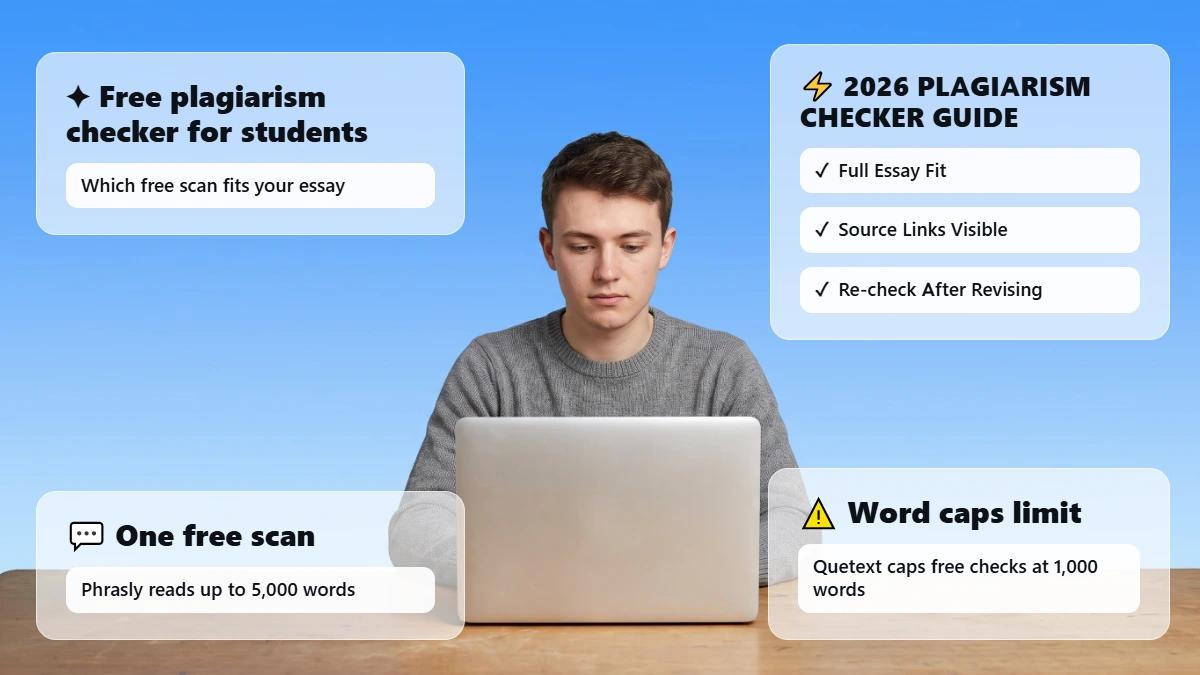
It’s always good to know if something is copied before using your AI assisted work. Phraslys plagiarism checker will detect your writing and give you sources. You can check these sources to see what may have been used.
Check My Draft for Matching Sources!
Is Using AI Plagiarism? The Short Answer
Using AI is not plagiarism by itself. If you copy something from a source and use AI to help you reword it. Then yes, it would be considered plagiarism.
If you’re not copying anything, then it’s just you using unauthorized AI assistance or breaching disclosure if allowed by your professor or employer.
Rather than try to find one answer that can apply to everything, use these 3 questions. They will help you determine is AI plagiarism, and is AI considered plagiarism on your work.
Question | If yes | If no |
Did the text copy or closely paraphrase a source without credit? | Potential plagiarism | Move to the next question |
Did the policy prohibit this type or level of AI help? | Potential unauthorized assistance or academic misconduct | Move to the next question |
Did the policy require disclosure that was skipped? | Potential disclosure or integrity violation | The use is likely acceptable if the work is accurate and properly sourced |
Similar to what most universities have implemented with their rules Princeton's guidance on disclosing AI use is to avoid work verbatim and claiming it as your own.
The College Board's 2026 guidance on AI tools for AP courses takes a similar stance, permitting some AI use while still requiring the final submission to be the student's own work.
And Harvard's generative AI guidance goes a step further, noting that policies can differ from class to class, so the responsibility to check the rules falls on the student.
Going over what your instructor allows you to use AI for and not disclosing that you used AI are all violations of academic integrity.
That is why a big reason is it plagiarism to use AI, and is using AI considered plagiarism does not have one set answer. You could get away with it in one class and not another, depending on what you disclose.
When Does Using AI Count as Plagiarism?
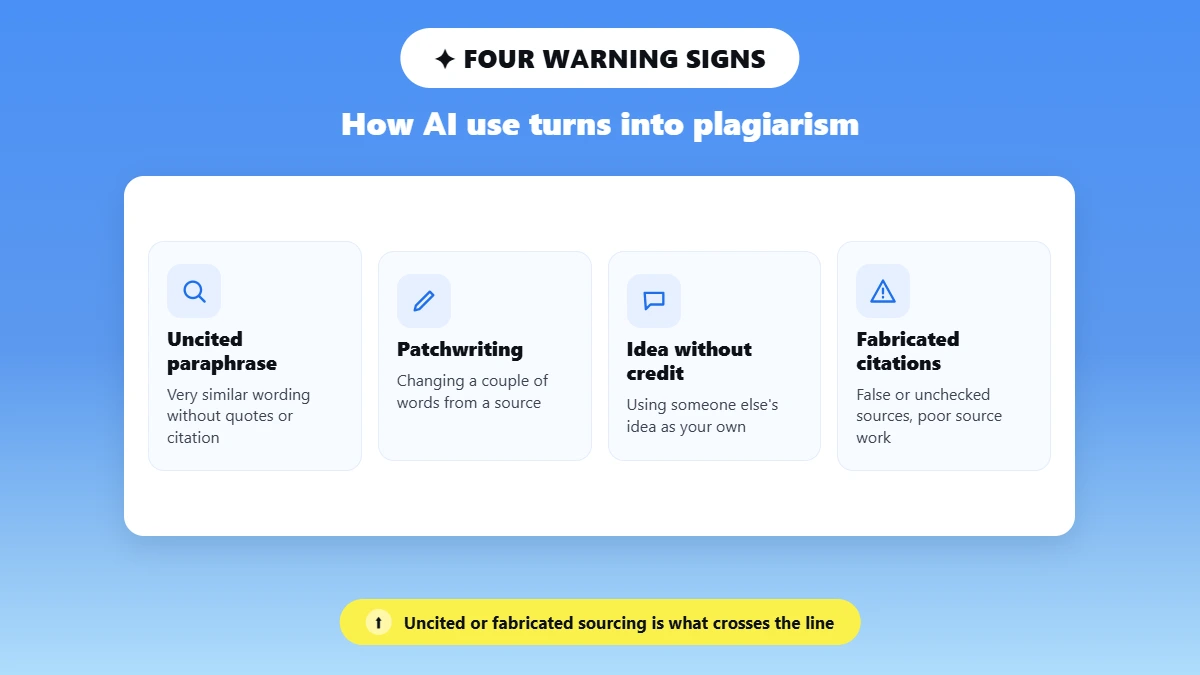
If you use AI and the response uses other people’s words/data. And you fail to cite it, that is considered plagiarism.
Even if you never knew you were copying someone's work. The language model may not give you an answer on where it got its information from.
It is very similar to what a source has said, so you would need quotes and to cite it. But there are no quotes or citations.
Can be considered taking from a source’s work and just changing a couple of words, also known as patchwriting.
Someone uses AI to generate a thought that may have been created by another person. So, you’re using their idea as your own.
If the writer uses citations made up by AI or false information, they may have plagiarized as well. This is considered poor source work.
The Broken Citation Chain
It's possible for a language model to provide you with sentences or information based on what it was trained on.
However, it will not be able to accurately tell you where it got that information from. This is why AI-assisted plagiarism is different from normal plagiarism. The author will probably not be able to find where the information originally came from.
But just because they don’t know does not mean they shouldn’t try to find it and give proper attribution.
This is what happens with many actual examples of AI plagiarism. Which is why AI-generated plagiarism and AI Writing Plagiarism can occur.
Fabricated or Unverified Citations
Another form of this is the AI generating a false work. Or if it uses a true source and you don't double check your work citation list, that is not following source integrity either. This can be seen as cheating if an instructor looks into your sources.
Understanding AI plagiarism meaning in a given course usually starts with the written AI plagiarism policy. Since that document decides which of these behaviors actually counts as a violation.
If you want to learn more about paraphrasing becoming plagiarism, see when AI-assisted paraphrasing becomes plagiarism.
For a related but distinct pattern where small changes accumulate across a paper, see incremental plagiarism (patchwriting).
When Is AI Use Usually Not Plagiarism?
When using AI is not considered plagiarism is if it is not placing someone else’s work into your paper and your policies allow you to use that form of assistance.
Most things you would use AI for fall under this category. You can still violate a policy by using AI but not have it be plagiarism.
Brainstorming topics, questions, or directions for the writer's own argument.
Asking for explanations, definitions, or practice quizzes to study a concept.
Checking grammar, clarity, or tone in text the writer already wrote.
Building an outline the writer then develops and writes independently, when outlining is allowed.
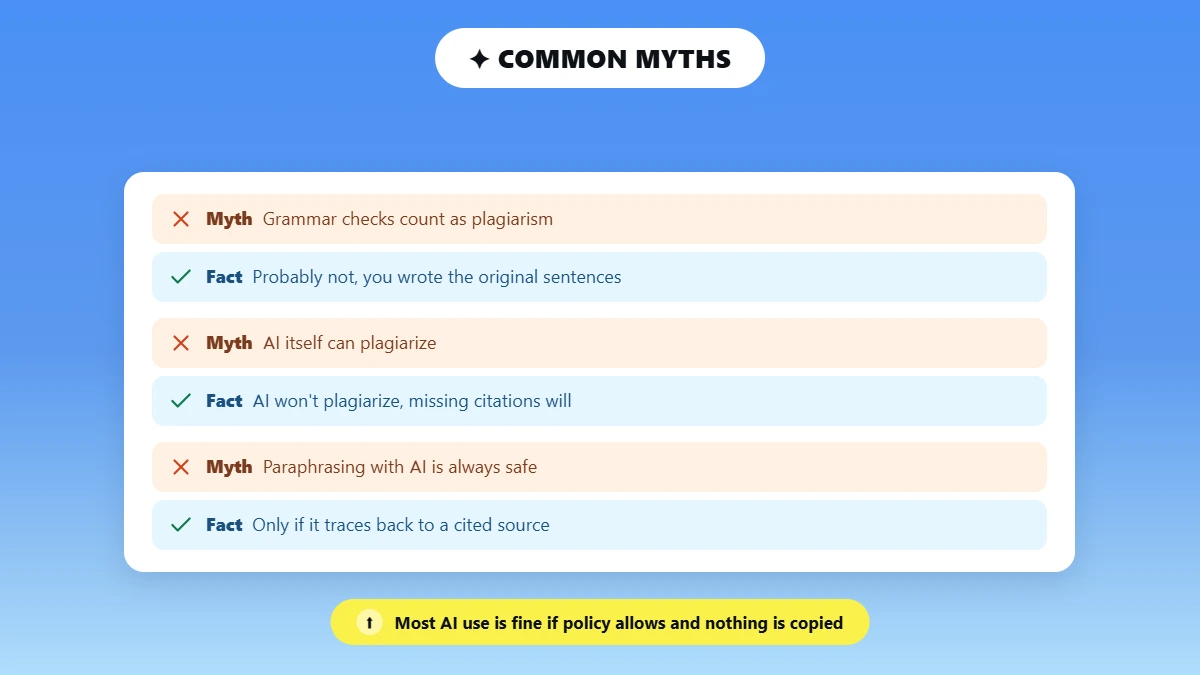
It all depends on the qualifier. You can have no sources match up, but it can still be considered cheating for that task. Is using AI for grammar plagiarism? Probably not, since you crafted the initial sentences and the AI just helped with the phrasing.
If your syllabus states no AI, then you can argue that its plagiarism as well by just running it through a grammar checker. Is using AI for paraphrasing plagiarism? Yes, and no, if the paraphrased information can be traced back to a cited work.
There is no definitive answer to either of those questions, just like there isn't one to can AI plagiarize and can AI be considered plagiarism. AI will not plagiarize, but using something without citation will.
Plagiarism, Unauthorized AI Use, AI Detection, and Copyright Are Not the Same
These four concepts get treated as one issue online. But they answer different questions. Plagiarism asks whether credit was given. Unauthorized AI assistance asks whether a rule was broken.
AI detection estimates whether text looks machine-written. Copyright asks whether protected expression was used unlawfully.
Concept | Core question | Example | What evaluates it |
Plagiarism | Were someone's words or ideas presented without enough credit? | An AI paraphrase of an article is submitted without a citation | Source review, citations, similarity checking, human judgment |
Unauthorized AI assistance | Did the writer use AI beyond what the rules allowed? | A course permits grammar help but bans generated outlines | The assignment, syllabus, instructor, or institutional policy |
AI detection | Does the text show patterns associated with machine-generated writing? | A detector flags a passage as likely AI-written | A probabilistic detector score, not proof of plagiarism or authorship |
Copyright infringement | Was protected expression copied in a legally actionable way? | Republishing large portions of protected text | Legal analysis, not a plagiarism percentage |
It should be noted that disclosure is not citation. The use of AI is different than citing your sources. Disclosing will inform the reader that AI was used to help complete your work.
Citing will credit human sources for what you have word for word or used from their research. You could properly disclose your use of AI and still plagiarize if you fail to cite your source.
You can cite all of your sources and not disclose that you used AI when required. This is not legal advice. There are many factors to consider when trying to figure out if something is copyright or not.
Some argue that using generated AI does not fall under copyright infringement but can still lead to plagiarism.
They each deal with separate aspects.
A University of Chicago Law Review essay on plagiarism, copyright, and AI makes exactly this point: Generative AI rarely infringes copyright in the legal sense.
But it is often bad at telling you where its ideas came from, which makes unattributed AI use a plagiarism problem even when it isn't a legal one.
Copyright deals with the work itself, and plagiarism has to do with giving credit for your words/ideas. Consider this a general outline of each topic, and not to be applied to a specific situation.
See different types of plagiarism for a full breakdown of plagiarism categories, and a Turnitin AI flag is not proof you plagiarized, and an AI-detection score and a plagiarism finding are not interchangeable.
Seven Common AI-Use Scenarios, With Verdicts
Student AI use has become the norm rather than the exception.
HEPI's 2026 student generative AI survey found that the overwhelming majority of undergraduates now use AI in some form for work.
Nearly every legitimate question is using AI plagiarism can be grouped into several common situations. Rather than trying to find one solution that applies to everything, it's typically better to compare your scenario to a particular case.
Scenario | Plagiarism? | Other integrity risk? | Safer action |
AI corrects grammar in text the student wrote | Usually no | Possible if the assignment bans all AI | Check the policy; disclose if required |
AI brainstorms topics or research questions | Usually no | Possible unauthorized assistance | Confirm brainstorming is allowed; build the argument independently |
AI writes a full essay submitted as the student's work | Not necessarily source plagiarism in every passage | High risk of misrepresentation or nondisclosure | Do not submit; follow the permitted-use rules instead |
AI paraphrases a journal article and the article is not cited | Yes, or high risk | Also, possible unauthorized AI use | Read and cite the original; write a genuine paraphrase |
AI summarizes a source that is properly credited | Usually not, if the source is cited | Possible disclosure issue | Verify the summary against the original; follow disclosure rules |
AI invents a citation the writer submits unverified | Source-integrity violation | High | Remove it; verify every reference manually |
AI revises workplace copy under an employer-approved process | Usually no | Confidentiality or workplace-policy risk | Follow internal rules; never paste confidential data into an unapproved tool |
Schools do not necessarily call these situations by the same name, so consider these rulings as trends instead of absolutes that will occur at your school.
It's also why AI plagiarism in schools is based on each syllabus. This is why checking the specific policy in front of you matters more than any general rule.
Can AI-Generated Text Still Copy Existing Sources?
Yes! AI-generated text can repeat known wording, closely rewrite a source text, present information without a verifiable citation path, or fabricate a citation.
However, just because a text is AI-worded does not mean the text is copied, and a machine-written detector score is not proof of source overlap on its own.
Does AI show up as plagiarism, and does AI come up as plagiarism? It’s not through plagiarism detection, but with a thorough source-by-source analysis of your draft. Before submitting work that the AI touched, check for:
Distinctive phrases that sound unusually polished or oddly specific compared with the rest of the draft.
Claims that include numbers, dates, direct quotations, or named research.
Any reference the AI supplied on its own, especially one the writer has not opened and read.
Text copied from a source that the writer pasted into the tool, causing potential for paraphrasing risk even if you don't copy whole sentences verbatim.
A detector score will not tell you if a passage comes from a known source, or whether your instructor knows you used AI assistance.
❌ A detector score cannot tell you whether a passage matches an existing source, and it cannot tell you whether your instructor approved the AI help you used.
If AI helped draft or paraphrase part of the document, scan the final version for matching passages, then open and read each flagged source yourself. A match is a reason to investigate, not an automatic plagiarism verdict.
How to Use AI Without Plagiarizing: A 7-Step Workflow
How to use AI and not get plagiarized? Treat your AI tool as an editing or brainstorming partner, not a research aid or finished prose.
Double-check every point it makes, every citation it includes, and every grammar rule it tries to apply before you hand something in. Following steps will help you develop this mindset into an easy process.
Intent isn't to conceal use of AI or slip past a checker. How to avoid AI plagiarism, how to avoid plagiarism when using AI, and how to prevent AI plagiarism all lead back to one practice.
Treat AI as a tool you declare and fact-check, not a loophole you exploit. Policies also vary by how much discretion is left to the instructor.
The University of Arizona's library guidance on AI and academic integrity is a good example, since it leaves the specific rules for a given assignment up to the instructor while holding every student to the school's broader Code of Academic Integrity.
The same principle applies whether the question is how to use AI for essays without plagiarizing a single source, or how to write a research paper with AI without plagiarizing dozens of them.
There isn't a magical trick that will give you AI without plagiarize on command. The workflow below is the magical trick that actually works:
Read the assignment and the AI policy first. Sort the rule into red (no AI), yellow (limited AI), or green (broadly permitted).
Specify precisely how much help AI can provide. Grammar suggestions, brainstorming ideas, research, outlining, drafting, and complete rewrites are all levels of assistance. Your policy can permit one and prohibit another.
Retain access to the original sources throughout the process. Don't rely on an AI response as your source for a piece of information; use it as what it is, a hypothesis that needs further investigation.
Check your facts, quotes, and references. Go to each source listed and make sure it exists and verifies the information associated with it.
Write the intellectual work yourself. Your thesis, the analysis you use to support it, and your conclusions should be your own work, even if AI helps you phrase them.
Cite references and provide AI disclosure independently. Use proper citation format.
Follow citation guidelines provided by your instructor for disclosing use of AI tools.
Proof the final draft for repeated sources prior to submission instead of trusting AI written text is plagiarism free.
Sample disclosure line (adapt for your own course; do not treat this as a universal template): “I used [tool name] for [brainstorming, grammar feedback, or outline feedback]. I reviewed and revised the output, verified all factual claims against the cited sources, and wrote the submitted analysis myself.”
For a full walkthrough of turning a source-heavy draft into original writing, see rewrite an essay without plagiarizing.
How to Read a Plagiarism Report on AI-Assisted Writing?
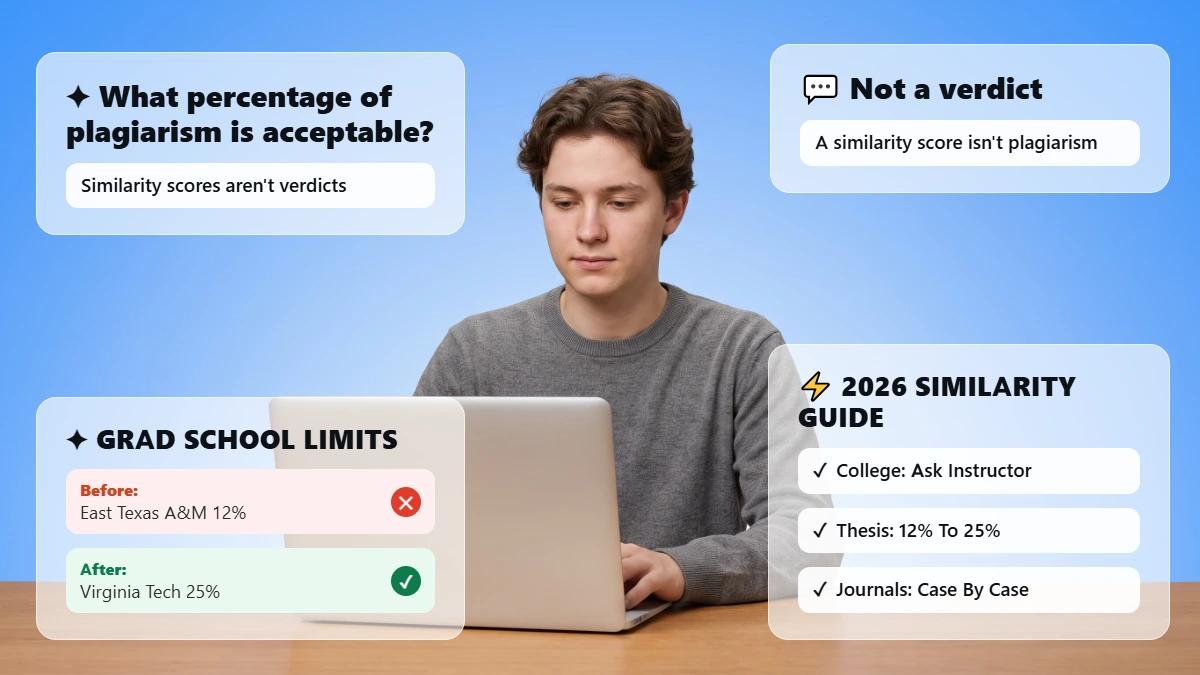
Matching percentage is not a plagiarism judgment. Quotes, citations, titles, and common phrases will all generate matches. Reports require human review; don't judge by the score alone.
How does AI check for plagiarism? A plagiarism detector analyzes text and highlights matches with online sources. An AI detector predicts the probability that text was written by a computer by analyzing writing patterns.
That’s the difference between an AI plagiarism checker vs AI detector. It’s also why your plagiarism score vs AI-writing score are different numbers that help you answer different questions.
Can AI be caught for plagiarizing? AI-written text can correspond to a source just like text written by a human can. It’s not the tool that gets flagged; it’s the text that matches.
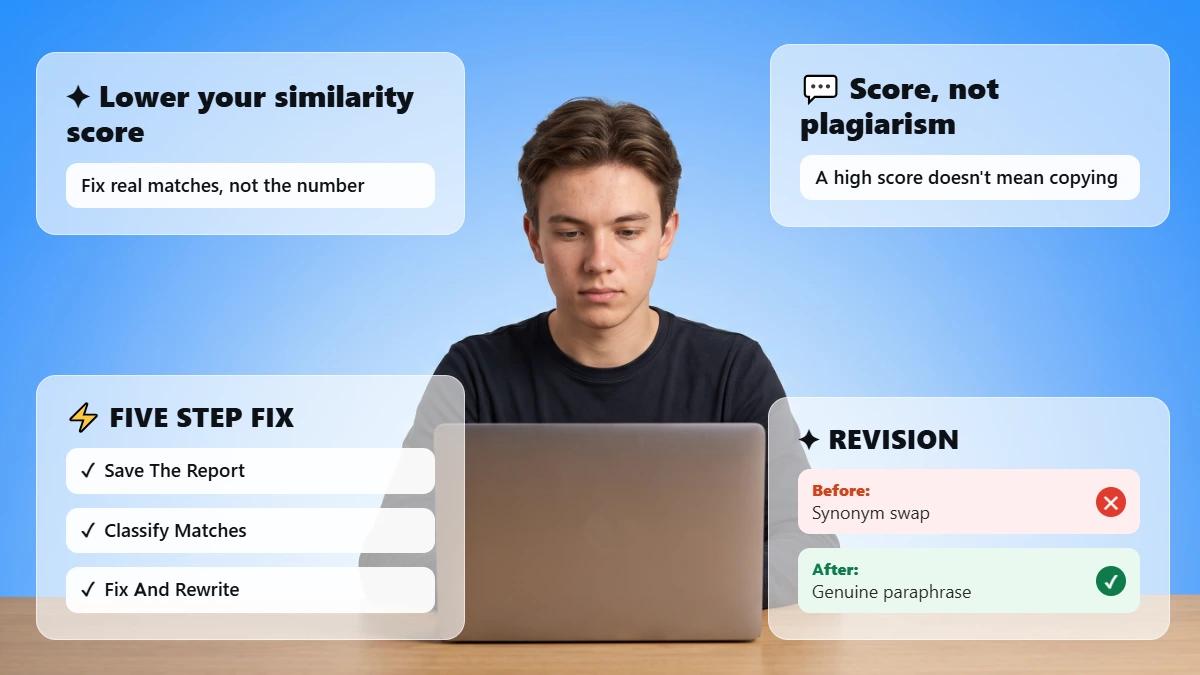
Open every source the report flags as a match, not just the ones with the highest similarity percentage.
Determine if each paired excerpt is a legitimate quotation, conventional phrasing, or verbatim plagiarism.
Add or correct attribution wherever a match traces back to a real, uncredited source.
Revise close paraphrases so the wording and structure are the writer's own, then re-run the check.
There is no magic safety percentage that works for all schools. Use the score as a starting point for evaluation, not a cutoff.
👊 Before submitting, run the revised draft back through Phrasly and open every remaining match. Fix missing citations or overly close paraphrases, then check the draft again until the flagged passages are properly credited or rewritten.
For more on why a general-purpose chatbot is not built for this kind of source-matching review, see why ChatGPT is not a dedicated plagiarism checker.
A Final 30-Second Decision Checklist
Before submitting anything AI-touched, run through seven quick questions. If any answer is no, go back and fix that piece before the draft goes anywhere.
Was this type of AI help explicitly allowed by the applicable policy?
Did I do the core thinking and writing myself?
Did I verify every AI-supplied fact and citation?
Did I credit the original sources for any borrowed words or ideas?
Did I disclose AI help in the required format?
Did I review matching passages instead of relying only on a similarity score?
Could I explain and defend every sentence in the final draft?
AI does not write for you. You are ultimately responsible for attributing sources, following guidelines and policies, checking facts, and your submitted work.
This applies if you search "is AI use plagiarism" or "is using AI plagiarism" or "AI plagiarism in schools".
Verify policy and confirm sources. Declare assistance and proofread draft in that order. It solves nearly every variation of this question more consistently than any yes/no rule ever will.
Frequently Asked Questions
Is using ChatGPT considered plagiarism?
Not necessarily! However, it can turn into plagiarism if the output copied or closely paraphrases another source without attribution.
It can also be considered unauthorized aid or a disclosure violation even when nothing is copied, depending on the policy of the course or workplace.
Is AI-generated content automatically plagiarism-free?
No! Generated text can include copied wording, common language, or near-direct paraphrasing from a source. It can also hide where the content originated from.
Claim validation and source matching should still be performed even if text sounds original.
Is using AI to correct grammar plagiarism?
Typically, no, if you provided the original writing and editing assistance is permitted by the relevant policy. There are assignments that ban all AI use no matter what you're doing, so the policy would override wanting a quick grammar check.
How much AI is considered plagiarism?
There isn't a specific threshold either way. Whether something is plagiarism depends on if words or ideas were used without attribution.
And whether something violates the AI policy depends on what the rules permit and whether you disclosed that you used AI, not what percentage of text the AI processed.
Does AI-generated text show up as plagiarism?
It might, if the submitted text has overlapping content with an existing source. However, AI-generated and plagiarized text are not synonymous.
A plagiarism detector searches for source matches. An AI detector predicts if writing patterns appear machine-generated. See how colleges check for AI for more on that distinction.
Can a plagiarism checker prove I used AI?
No! A similarity report indicates what parts of your text match with existing sources; it cannot tell who or what wrote your text, or whether you were allowed to use an AI tool.
If you're curious about how effective these tools are overall, see is Copyleaks accurate.

Written by
Muhammad Usman Ali
Pakistan
Muhammad Usman Ali is an experienced SEO content writer with 3+ years of professional writing experience. He specializes in AI tools, AI detection technologies, and search engine optimized content.