How to Read a Plagiarism Report: A Simple Guide for Students
12 min read
A plagiarism report highlights every phrase that matches another source, so even a carefully cited essay can come back covered in color. You learn how to read a plagiarism report by following one order: the overall similarity score, then the source list, then each highlighted passage. Each match then needs one of four actions: quote it, cite it, rewrite it, or leave it alone.
The percentage starts your review and gives no plagiarism verdict. Turnitin’s student guide states that Turnitin “does not check for plagiarism,” because it only highlights similar text for a person to judge (Turnitin, Understanding the Similarity Score for Students). We checked Turnitin’s help guides and Purdue OWL’s citation rules, then turned them into a match-by-match decision table that works in any checker.
Check Your Draft With Phrasly's Plagiarism Checker 👇
Paste or upload your draft to see your similarity score and the sources it matches. Your first scan is free.
How Do You Read a Plagiarism Report in 5 Steps?
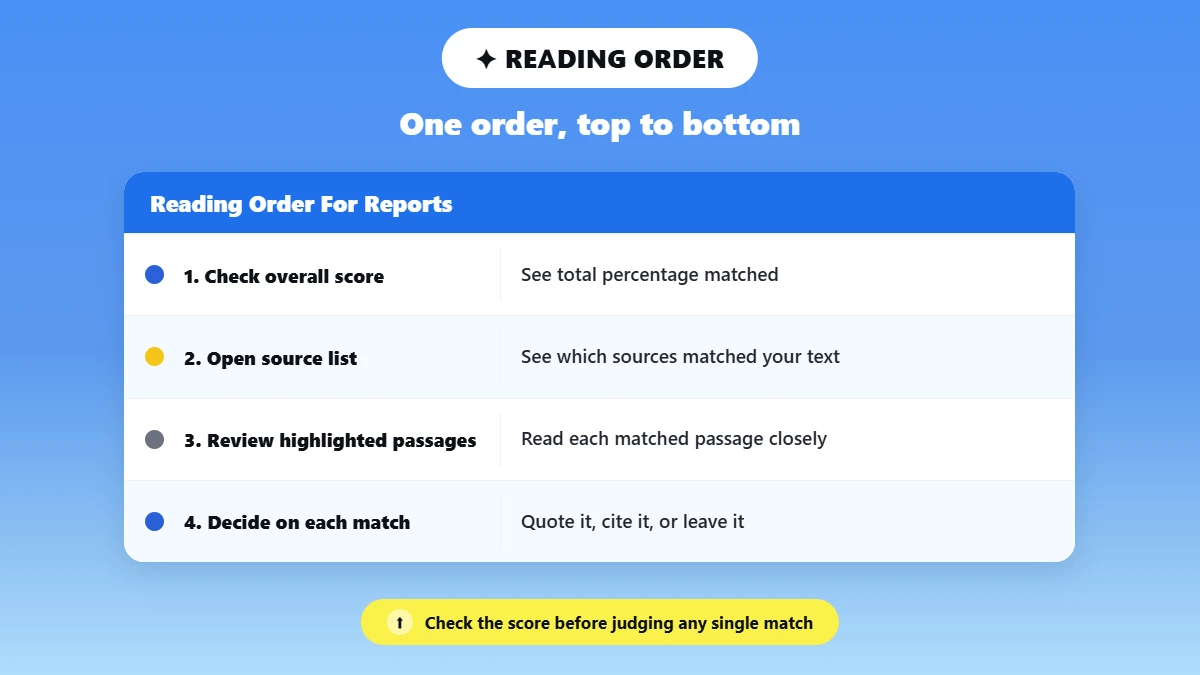
You can read any plagiarism report in five steps, moving from the overall percentage down to single sentences. The order matters because the score only tells you how much text matched, while the highlights show what matched and whether you credited it. The longest uncited matches get your attention first.
📊 Look at the overall percentage. Note the number as the amount of matching text you need to check.
📚 Open the source list. See which websites, publications, or student papers your text matches.
🔍 Read the highlighted passages, longest first. Long, distinctive matches carry more risk than short phrases.
✍️ Check attribution. Confirm that exact words have quotation marks, borrowed ideas have a citation, and each reference entry is accurate.
✅ Fix what needs fixing, then review the final draft. Recheck the revised version before you submit it.
These steps also show you how to interpret a plagiarism report under any name, since tools call it a similarity report, an originality report, or a plagiarism report.
What Does the Similarity Percentage Mean?
The similarity percentage is the share of your words that match text in the checker's sources. Turnitin's report overview says it divides the number of matching words by the total number of words in the document. Correct quotes and reference entries count as matches too, so the number measures overlap and says nothing about intent.
💡 Example (hypothetical): A 1,000-word essay with 180 matched words scores 18%. That figure means 180 words need a closer look, and it does not mean 18% of the essay was plagiarized. Real tools may treat overlaps, filters, and rounding differently.
A low score can still hide a problem, because a checker only finds sources in its own collection and an uncited idea in new words may match nothing. Turnitin's score guide adds two points about very low scores:
⚠️ Zero similarity can be a warning sign. It may mean the paper has no source-based evidence, which many assignments require.
🔢 A long document can round down to 0%. The report shows 0% while small matches still appear in the text.
Why Don't the Source Percentages Add Up?
Source percentages don't add up to the overall score because one highlighted passage can match several sources at once. Each source percentage shows how much of your document matches that one source, while the overall score counts each matched word once. Added together, the source numbers count the same words twice.
Turnitin lists the source with the most matched words first. When several sources match the same exact words, Turnitin ranks them in this order:
🌐 Internet sources
📰 Publications
🎓 Submitted Works, which are other students' papers
The View other sources option lists every source matched to the same text, and Show overlapping sources displays a separate card for each of them.
Does Excluding a Source Lower Your Overall Score?
A source exclusion may or may not lower your overall score, according to Turnitin's report overview. The words stay in the total when another source matches them too.
How Do You Check Highlighted Text Against Its Source?
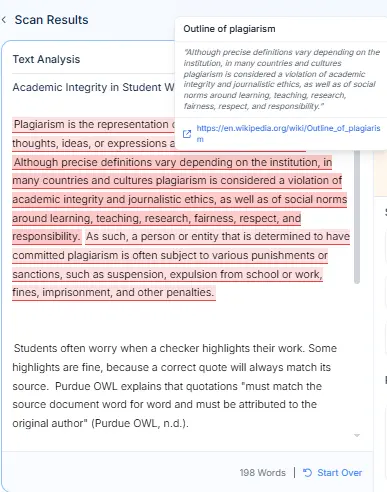
You check a highlight by clicking it, opening the matching source card or link, and reading both passages side by side. The comparison shows what matched, whose words or idea it is, and whether your credit is complete. Four questions guide each comparison.
🧐 What matched? It can be an exact sentence, a close paraphrase, a common phrase, a title, or a reference entry.
👤 Whose words or idea is it? The match can come from a source you used, a source that quotes the same material, your own earlier paper, or a page you have never seen.
📌 Is the credit correct? The source needs an in-text citation and an entry in your reference list.
❝ Are exact words in quotation marks? A citation alone does not turn copied wording into a paraphrase.
🚦 Fix matches in this priority order:
🔴 First: long, distinctive, uncited matches in the body of the paper
🟠 Second: close paraphrases of a source
🟢 Last: short or common matches
Short matches still deserve a look, because many small matches from one source can add up to incremental plagiarism, the slow build-up of uncredited borrowing across a paper. A checker highlights similarity, and a person decides what it means.
✏️ Still editing? Scan your draft to see each match with its source link, then fix your citations before you submit. 👇
Phrasly's score can differ from your school's checker, because the tools search different source collections.
Which Matches Need a Fix? A Decision Table With Examples
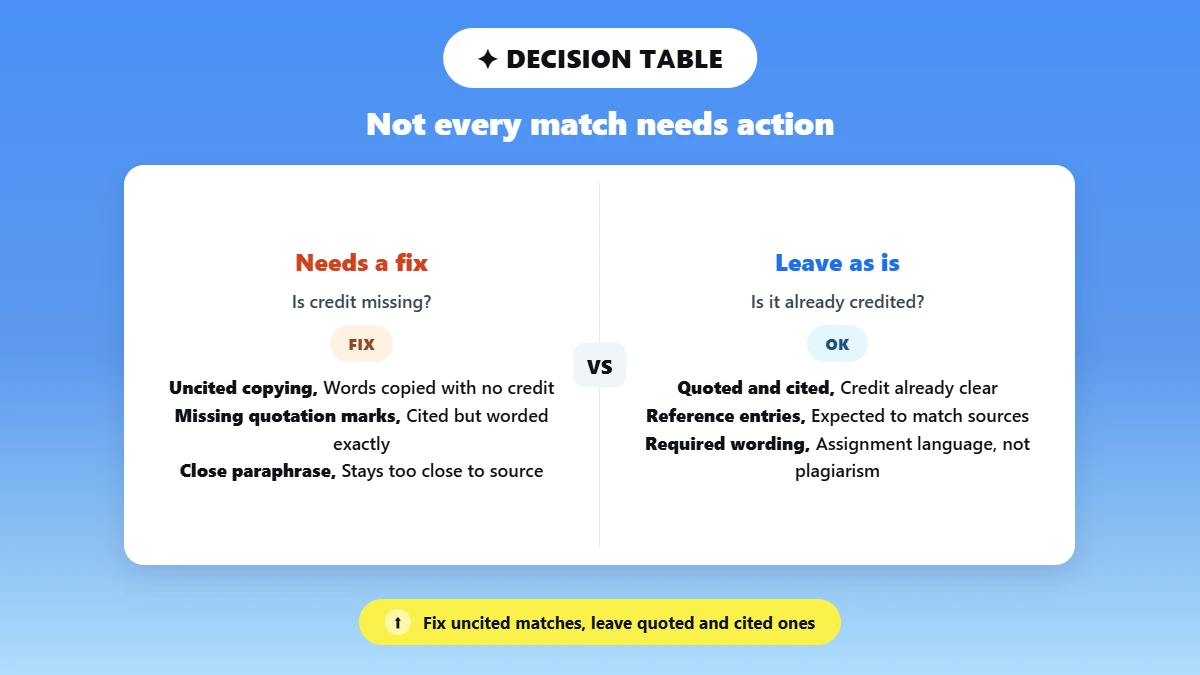
Fix any match where someone else's words or ideas appear without full credit, such as uncited copying, exact wording without quotation marks, quotes without a citation, and paraphrases that stay too close to the source. Leave correctly quoted and cited passages, reference entries, and required assignment wording as they are.
What you see | What it usually means | What to do |
|---|---|---|
A paragraph copied almost word for word, with no citation (Turnitin: Not Cited or Quoted) | Someone else's words and idea appear with no credit | 🚫 Fix first. Quote and cite it if the exact wording matters. Otherwise, explain the idea in your own words and cite it. |
Exact wording with a citation but no quotation marks (Turnitin: Missing Quotations) | The source gets credit, but the copied words read as yours | ⚠️ Add quotation marks, or rewrite the passage fully and keep the citation. |
Text in quotation marks with no citation (Turnitin: Missing Citation) | The text is marked as borrowed, but the source gets no credit | ⚠️ Add the in-text citation and the reference entry. |
New words that keep the source's structure and ideas, with a citation | Patchwriting, which is a paraphrase that stays too close to the source | ⚠️ Reread the source, close it, and rewrite it without plagiarizing from your own understanding. Keep the citation. |
A quote with quotation marks and a citation (Turnitin: Cited and Quoted) | An expected match | ✅ Keep it if it supports your point. Check the citation format and how much of the paper is quoted. |
Reference entries, titles, the assignment prompt, or a template | Standard text that many papers share | ✅ Usually leave it. Fix the formatting, and delete any assignment instructions left in the body by mistake. |
Your own earlier draft or paper | Resubmitted or reused work | ⚠️ Check the assignment's rules on reuse and tell your instructor. Never assume reuse is allowed. |
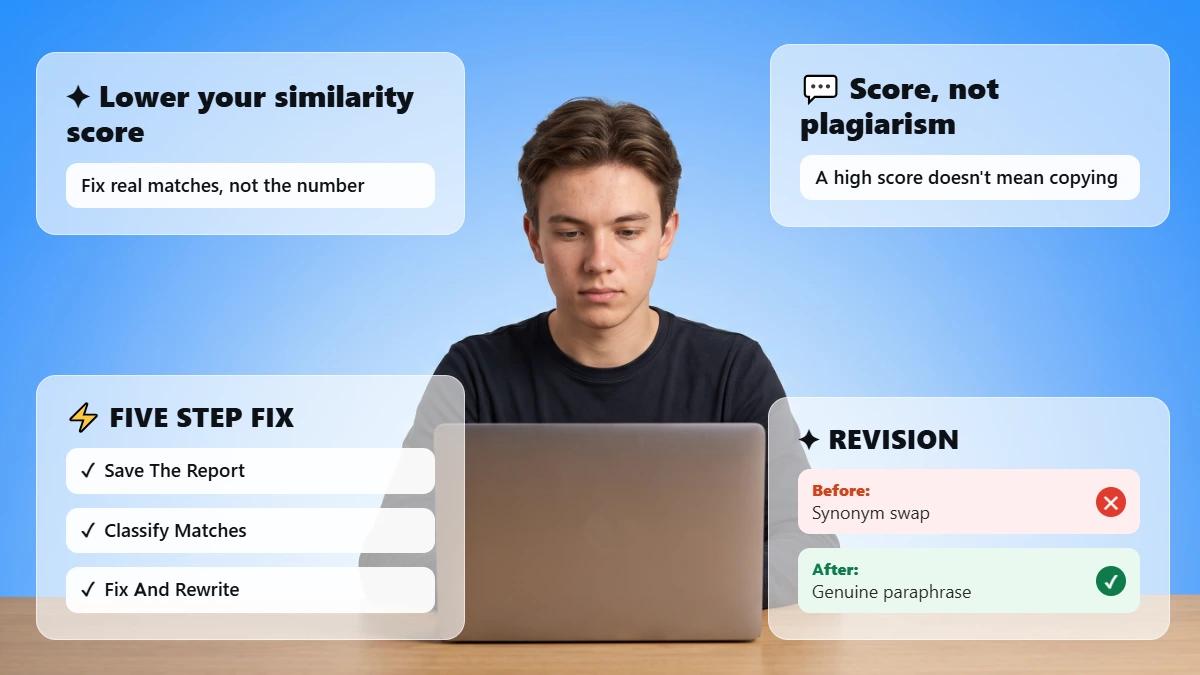
Short common phrases or technical terms | Coincidental overlap | ✅ Usually leave it. Never swap in synonyms just to lower the number. |
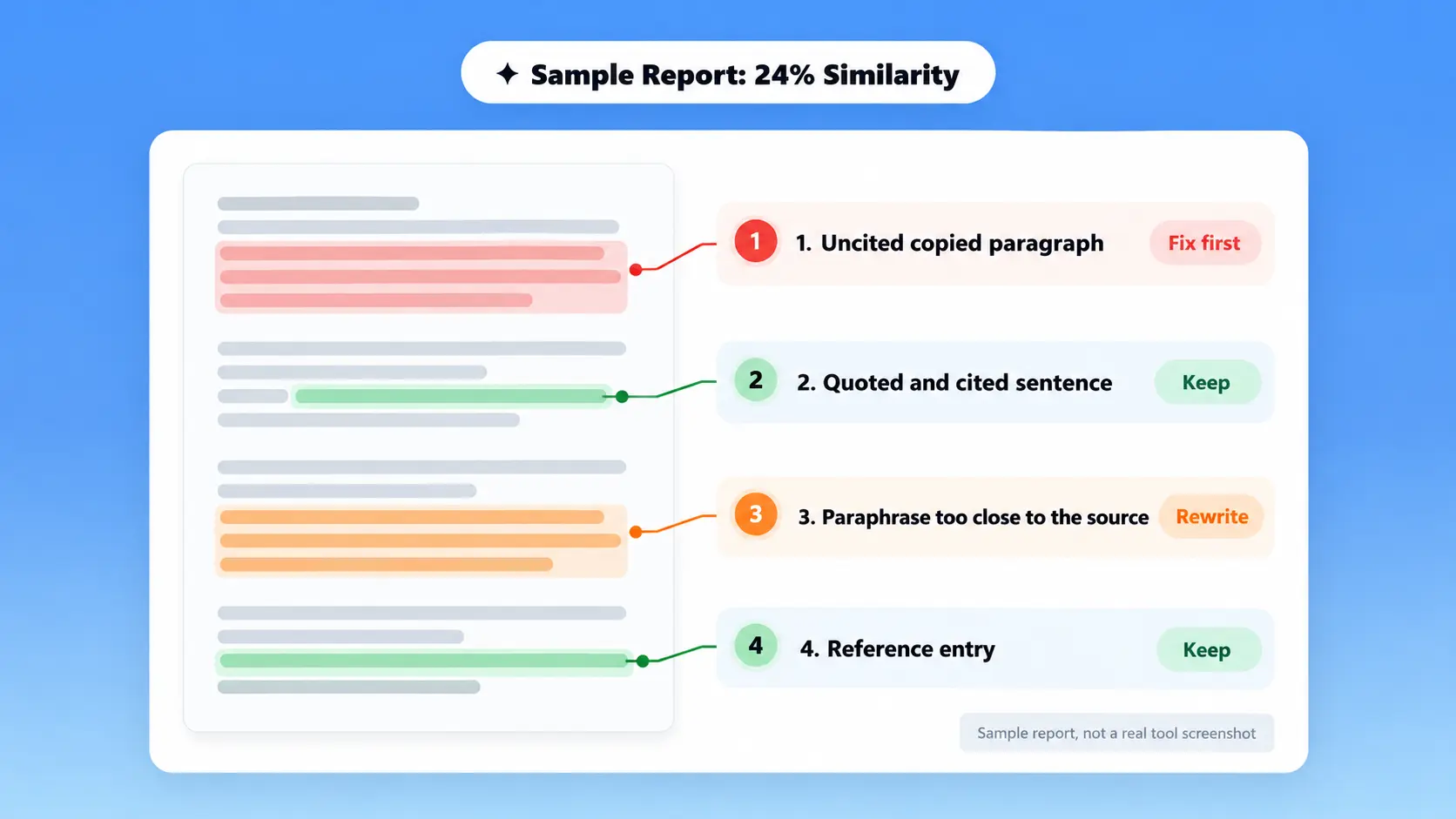
📄 Example report (fictional): a history essay comes back at 24% with four highlights.
❌ Highlight 1, an uncited copied paragraph: The student explains the idea in new words and adds a citation, because this is the only passage that presents someone else's work as theirs.
✅ Highlight 2, a quoted and cited sentence: The quotation marks and citation are correct, so the sentence stays.
⚠️ Highlight 3, a cited paraphrase that follows the source too closely: The student closes the source, rewrites the passage from their own understanding, and keeps the citation.
✅ Highlight 4, a reference entry: Reference entries match other papers by design, so this one stays.
Two highlights change and two stay. The uncited paragraph matters more than the 24% total, because a small score can still include one serious uncited passage.
Purdue OWL's guide to quoting and paraphrasing states that quotations "must match the source document word for word and must be attributed to the original author." It adds that paraphrases and summaries need attribution too, so new wording never removes the need for a citation. A paraphrase becomes plagiarism when the credit is missing or the wording stays too close to the source.
What Do Turnitin's Match Groups Mean?
Turnitin's match groups sort every match in the newer Similarity Report by how the text is credited. The first three groups usually need a fix, and the fourth usually needs only a formatting check. Each group lines up with a row in the decision table:
🔴 Not Cited or Quoted: the text has no quotation marks and no citation (row 1).
🟠 Missing Quotations: the text is cited, but the match is exact enough to need quotation marks (row 2).
🟡 Missing Citation: the text is in quotation marks but has no citation (row 3).
🟢 Cited and Quoted: the text has both quotation marks and a citation (row 5).
The groups help you choose what to fix first. You still read each passage, because Turnitin doesn't know your assignment's rules.
Should You Exclude Quotes, References, or Small Matches?
Filters for quotes, references, and small matches make a report easier to review, but they fix nothing in your paper. Turnitin's exclusions guide says the exclusions a student applies are temporary and don't change the official score the instructor sees. Use filters to find the real problems, then fix those problems in the text.
🔎 Small-match filter: Turnitin hides matches under a word count or percentage you set, and the lowest word threshold is 8 words.
📝 Quote and bibliography filters: two checkboxes remove quoted text and reference entries from your view of the report.
👩🏫 Official exclusions: contact your instructor if you think an exclusion should change the official score.
Compare the report before and after each filter, and check that your quotes and references are correct either way.
⚠️ Never delete references, DOIs, or quotation marks to lower a score. A DOI is a journal article's permanent ID number, and removing one turns a correct citation into a missing one.
What Is an Acceptable Plagiarism Percentage?
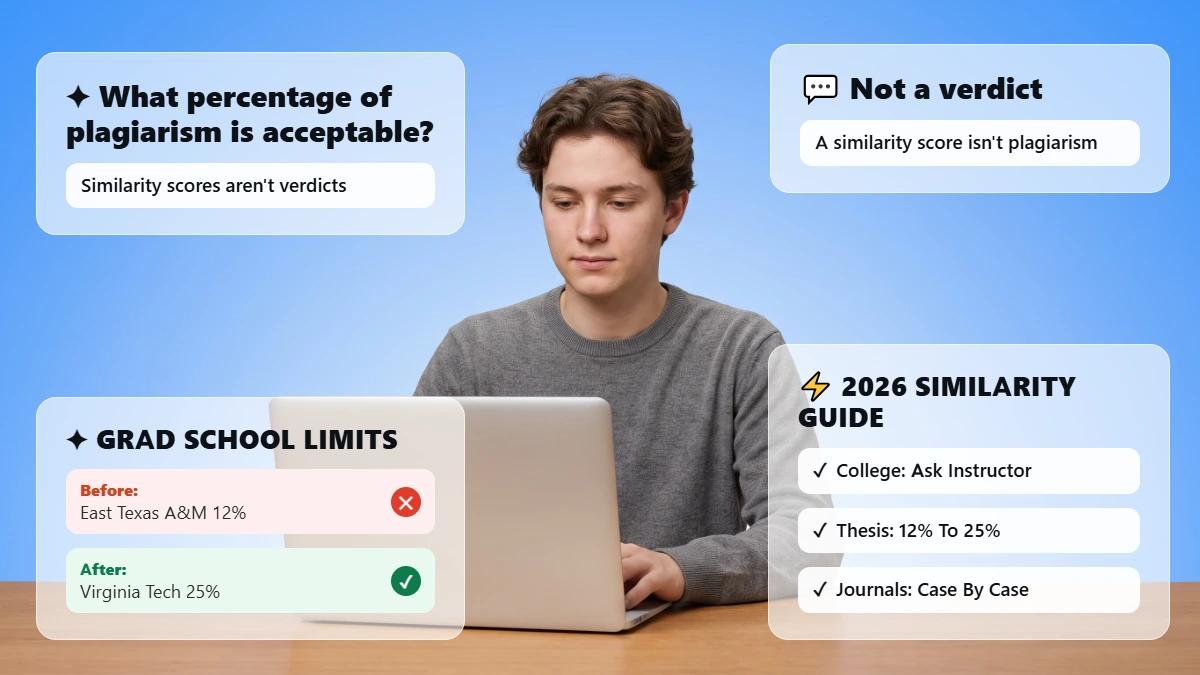
No universal acceptable plagiarism percentage exists. Turnitin's similarity score guide says there is "no fixed number" to aim for, because each school, instructor, and assignment can set its own expectation. Check your syllabus or ask your instructor, since a well-cited essay can score higher than one with a short but serious uncited passage.
Report colors show how much text matched, and they don't mean pass or fail. Turnitin's official ranges depend on the product your school uses:
Color | Feedback Studio and Originality Check | Similarity and SimCheck |
|---|---|---|
🔵 Blue | No matching text | 1-24% matching text |
🟢 Green | One word to 24% matching text | 0% matching text |
🟡 Yellow | 25-49% matching text | 25-49% matching text |
🟠 Orange | 50-74% matching text | 50-74% matching text |
🔴 Red | 75-100% matching text | 75-100% matching text |
Color ranges come from Turnitin's student score guide, checked in October 2026. Turnitin notes that colors vary by integration.
Why Does My Plagiarism Report Look Wrong?
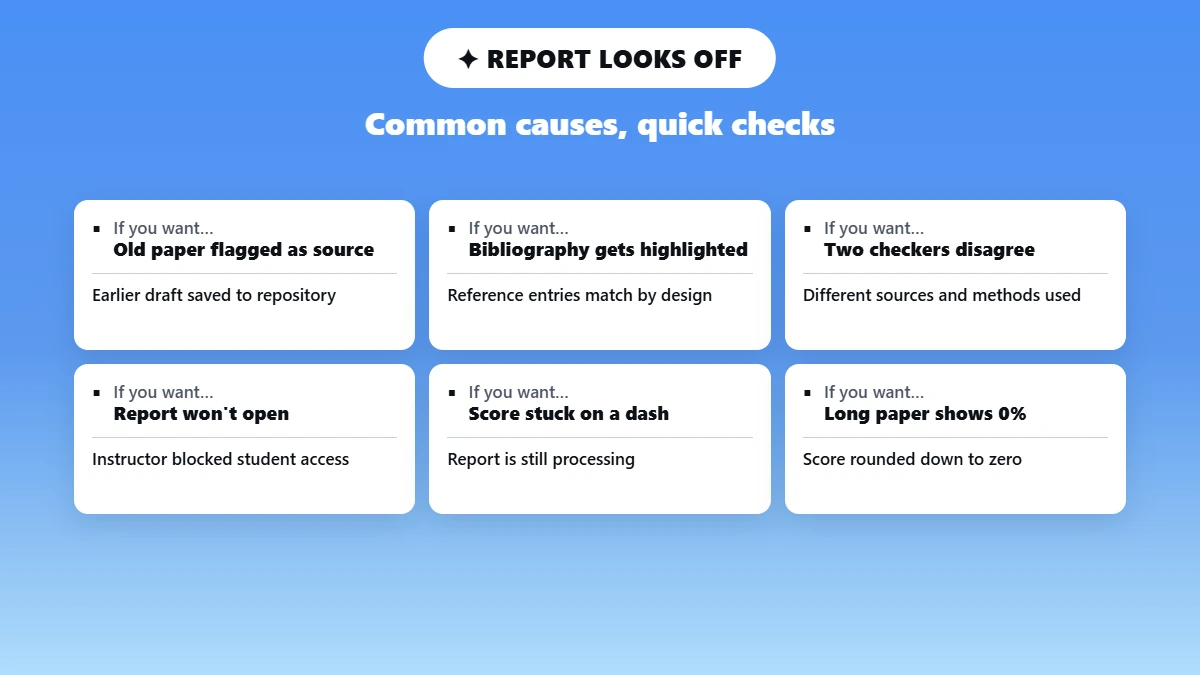
A plagiarism report usually looks wrong because of how the checker stores, matches, or rounds text, and the cause is often easy to confirm. Old drafts, correct quotes, rounding, and different source collections can all change what a report shows. Instructor settings can also block your access to the report.
My Own Old Paper Shows Up as a Source
Your old paper shows up when an earlier draft was saved to your school's repository, and Turnitin's own example shows this pushing a final draft to 100%. Turnitin also waits up to 24 hours before it creates a new report for an overwritten or resubmitted paper, so the new version doesn't match the previous draft. Tell your instructor which submission is the final one, and don't assume reuse is allowed.
My Bibliography or a Correct Quote Is Highlighted
A highlighted bibliography or correct quote is expected behavior, because reference entries and quoted text match their sources by design. Check your citation and quotation formatting, then turn on the quote and bibliography filters for a focused view if your checker offers them.
Two Checkers Give Different Percentages
Two checkers give different percentages because they search different source collections, use different matching methods, and apply different exclusion settings. Compare the matched passages instead of the numbers.
Our iThenticate vs Turnitin comparison shows how two Turnitin products differ in what they check. If you need a tool for drafts, the best plagiarism checkers roundup compares the options.
I Can't Open My Turnitin Report
A dash in the Similarity column on the Turnitin website means the report is still processing. A paper icon with a line through it means your instructor turned off student access, so ask your instructor for the report. If nothing opens when you click the score, Turnitin's access guide says to allow pop-ups from turnitin.com in your browser.
My Long Paper Shows 0% but Still Has Highlights
Your long paper shows 0% with highlights because Turnitin rounds a tiny similarity score down to 0% instead of showing the exact figure. Review those small matches anyway, since one missing citation still needs a fix at any score.
The Final Check Before You Submit
Your final check is a read of every match, because the number alone can't show whether every borrowed word and idea has credit. Copied words need quotation marks plus a citation, and borrowed ideas need a citation even after you reword them.
Your school's academic integrity policy and your instructor's rules decide what counts as acceptable, so follow them over any general guide.
Revised your draft? Scan the final version and confirm that every match is quoted, cited, or your own. 👇
Frequently Asked Questions About Plagiarism Reports
Is a 0% plagiarism report proof that my essay is original?
A 0% report only shows that the checker found no countable matches in the sources and settings it used. It can miss sources outside its collection, and rounding can hide tiny matches in a long paper, so your citations still need a manual check.
Why is a cited sentence still highlighted?
A citation credits the source, but it doesn't erase the text match, so the checker still highlights the words. If you copied the wording exactly, the sentence also needs quotation marks.
Should I delete my references to lower my score?
Keep every required reference, because a deleted reference creates a missing citation. Ask your instructor whether the bibliography can be excluded from the official score instead.
Does a similarity report detect AI-written text?
A similarity report doesn't detect AI writing, because it only measures how much text matches existing sources. AI results are a different metric with their own score. Our guides on whether using AI is plagiarism and Turnitin's AI score cover that question.
Will my Phrasly score match my Turnitin score?
Your Phrasly score can differ from your Turnitin score, because the tools check different source collections and use different matching methods. Turnitin also compares papers against student submissions stored by schools. Our list of Turnitin alternatives compares what other checkers search.
What should I fix first before I submit?
Start with long uncited passages, then exact wording presented as your own. After those, rework close paraphrases, add missing citations, and clean up the formatting.

Written by
Alina Shah
SEO Content Specialist · Karachi, Pakistan
She writes about AI so you don't have to guess. 8+ years in content strategy and editing. Now she puts AI writing tools and detection systems through real tests and shares what actually works.