Can an AI Chatbot Write Text That Passes AI Detectors?
60 min read
Test run November 19 to 20, 2026
Sometimes, on some detectors and for some kinds of text, but no AI chatbot can promise its replies will pass every AI detector. Each detector runs its own model and updates on its own schedule, and humanizing a reply trades a little meaning for a lower score.
People who search for an undetectable AI chatbot usually mean one of three things: chatbot text that passes detectors, a chatbot with a built-in humanizer, or a support bot that sounds human. This page gives each of those readers one scenario, with real scores and plain advice.
On November 19, 2026, we sent the same three prompts to ChatGPT, Gemini and Phrasly's Neo, and on November 20 to Claude. Every reply was scored on the same detectors plus a meaning check, and every full output is below.
The stakes differ by reader. Students answer to academic integrity policies, freelancers to a client's checker, and businesses with EU visitors to the EU AI Act's chatbot disclosure duty, in force since 2 August 2026.
Try Neo, Phrasly's AI Chatbot With a Built-In Humanizer 👇
Undetectable AI chatbot: three meanings behind one search
An undetectable AI chatbot usually means a chatbot whose replies are rewritten to score as human on detectors such as GPTZero, Copyleaks and Originality.ai. The phrase can also mean a chatbot with a built-in humanizer, or a support bot that sounds human. None of these is a guarantee, because detectors differ and change.
The search phrases show the split. Someone typing "ai chatbot that bypasses ai detection" or "undetectable ai humanizer" is usually worried about a score on an essay or a client draft. Someone typing "ai to make chatbot undetectable" is more often running a website bot and wants it to stop sounding like a vending machine.
Those are different jobs with different risks, so they need different answers. The table sorts the four meanings we see in search results, who is behind each one, and what actually decides how it turns out.
Meaning | Who searches | What they want | What really decides the outcome | Where this page covers it |
|---|---|---|---|---|
Chatbot text that passes AI detectors | Students and freelance writers | A reply that won't be flagged by GPTZero, Originality.ai or a client checker | Which detector is used, text length and genre, how much the text is edited, and the school or client policy | Scenario 1 and Scenario 2 |
Chatbot with a built-in humanizer | Writers and marketers | One tool that drafts and rewrites in a single step | Whether meaning, facts and protected terms survive the rewrite, not just the score | Scenario 2 and the closing section |
Support bot that sounds human | SMB marketing and support teams | Website replies that don't read as robotic | Policy accuracy, tone of voice, and disclosure duties such as EU AI Act Article 50 | Scenario 3 and the legal section |
Anonymous or no-logging chatbot | Privacy-minded users | Assurance that inputs aren't stored or used for training | The vendor's data retention and training policy, as written in its terms | FAQ 8 |
Most readers recognise themselves in one row straight away. If you sit across two rows, say a freelancer who also runs a client's support bot, read both scenarios, because the advice for one doesn't carry over to the other.
The fourth row is newer. Search results for "undetectable" now mix in privacy-focused and uncensored chatbots, so some readers mean "untraceable" rather than "unflagged." That is a privacy question, not a detection question, and FAQ 8 answers it with each vendor's own policy.
If you want a more private option, our list of the best ChatGPT alternatives compares data retention and open-source picks.
Before the scenarios, it helps to pin down a few terms that get used loosely:
What is a chatbot: software that holds a conversation with a person through text or voice.
What is an AI chatbot (or chatbot AI): a chatbot run by a large language model that uses natural language processing to understand and write replies, also called conversational AI.
Is ChatGPT a chatbot, and is ChatGPT AI: yes to both. ChatGPT is OpenAI's conversational AI product built on its GPT models (our Free account showed "6 Instant" on the test date).
AI humanizer: a rewriting tool that changes wording, sentence length and rhythm so the text reads more naturally and, usually, scores lower on detectors.
Keep the chain in mind for the rest of the page. A chatbot writes the text, a detector scores it and a humanizer rewrites it, and each of those three steps can change the result.
How AI detectors read chatbot replies, and why their scores disagree
Different AI detectors give different scores on the same text because each tool uses its own model, its own training data and its own threshold for calling something AI. Each one also updates on its own schedule. A score from one tool on one day doesn't predict another tool's score, or the same tool's score next month.
In our experience testing detectors for client work, a handful of things move a score more than anything else:
Text length. Short replies give the model less evidence, so a 120-word answer swings more than a 1,000-word article.
Light human editing. Swapping a few phrases or adding a personal detail can move a score a long way.
Topic and vocabulary. Common topics written in common words look more predictable to a model.
Formulaic genres. Legal text, technical documentation and five-paragraph essays follow fixed patterns, whoever writes them.
Non-native English. Careful writers who stick to safe, textbook phrasing can look "too regular" to some detectors.
Independent research shows how much humanizing changes the picture. In a 2025 working paper, University of Chicago researchers Brian Jabarian and Alex Imas tested Pangram, Originality.ai, GPTZero and the open-source RoBERTa model on a large corpus spanning genres, lengths and models (NBER Working Paper 34223).
All three commercial tools kept false positives below 1%, but on passages run through a humanizer such as StealthGPT, GPTZero's false negative rate rose to around 50% or higher in most genres, while Pangram held up.
For more figures like these, see our roundup of AI detection accuracy and false-positive statistics. A separate November 2025 benchmark, PADBen, found that detectors which reach over 90% accuracy on raw model output fail badly on text that has been paraphrased again and again (arXiv 2511.00416).
Perplexity and burstiness
Perplexity is how predictable each next word is to a language model. Text where every word is the obvious next choice has a low perplexity score, and some detectors read that as machine-like.
Burstiness is how much sentence length and structure vary. People tend to mix short sentences with long ones, while raw model output often settles into a steady medium rhythm. Compare these two versions of the same idea:
Flat: "Remote work saves time for employees. Remote work reduces office distractions. Remote work improves employee focus."
Varied: "Remote work saves people the commute. That's an hour back on most days, and a lot of it goes straight into the work, because nobody stops by the desk with a quick question."
The catch is that careful human writers in formal genres also produce low-perplexity, low-burstiness text. That is one of the main reasons for false positives on genuine work.
Trained classifiers
Most commercial tools, including GPTZero, Originality.ai, Copyleaks and ZeroGPT, don't rely on a single rule. They are classifiers trained on large sets of labelled human and AI text, and they learn patterns from those examples.
When the training data doesn't match the text being checked, errors rise in both directions. A brand-new model, a niche topic or non-native English produces more false positives (human text flagged as AI) and more false negatives (AI text passed as human).
Vendor numbers are claims, not independent results. GPTZero's homepage, for example, says it reaches 99% accuracy across diverse datasets.
Watermarks such as SynthID
A watermark is a hidden statistical signal that a model provider adds while the text is being generated. Google's SynthID is the best-known example, and in May 2025 Google opened a SynthID Detector portal and said over 10 billion pieces of content had already been watermarked. A watermark check only works on text from providers that add one, so it can't tell you anything about a reply from a chatbot that doesn't.
How we tested chatbot replies against AI detectors
Every chatbot got the same three prompts in a fresh chat, and no reply was edited by hand before it was scored. An undetectable AI chatbot claim only means something if the method behind it is public, so this section lists ours in full.
Test date: November 19, 2026 for ChatGPT, Gemini and Neo, and November 20, 2026 for Claude, with the same prompts and detector settings.
Plans: ChatGPT Free, Gemini Free, Claude Free, Neo on Phrasly's Unlimited plan. For long-form drafts on the same three free plans, see our test of Claude vs ChatGPT vs Gemini for writing.
Model versions: the model name shown in each interface on the test date: ChatGPT "6 Instant" (the Free plan has no model picker), Gemini "4 Hydrogen" (the default "Everyday help" option), Claude "Sonnet 5.5" (Medium), Neo with no version number shown.
Settings: new chat, no custom instructions, no memory, no files, default model.
No manual edits: every output is pasted into each detector unchanged.
One regeneration per prompt: both runs are reported, so you can see how much a score moves on the same prompt.
Neo, two rows: Neo's default reply, then the same reply after typing "humanize this" in the same chat, because Phrasly says Neo uses its humanizer only when asked.
Detectors: GPTZero, Originality.ai, Copyleaks, ZeroGPT and the Phrasly AI Detector (Phrasly's own tool, main score only). Versions: GPTZero Basic Scan, model 5.0b (free account); Originality.ai AI Score, Originality 5.0 (free credits); Copyleaks free web AI Detector at its default sensitivity (2 of 3); ZeroGPT free web version (no version shown); Phrasly AI Detector Model 7.0 (May 2026).
We picked these detectors because they are the ones clients, editors and schools mention most when they send a draft back. Each was run through its own website on its default model, not through a panel that predicts other tools' scores. The Phrasly AI Detector is included because readers ask about it, and its result is reported the same way as the rest.
The three prompts match the three scenarios that follow. Prompt A stands in for graded student work, Prompt B for a client blog draft with terms that must survive editing, and Prompt C for a live support reply where a wrong fact costs money.
Regenerating once matters more than it sounds. Chatbots rarely give the same answer twice, so a single run can make a tool look better or worse than it usually is. The three prompts are printed below exactly as we sent them.
Prompt A (student paragraph): "Write a 250-word argumentative paragraph for a first-year college essay arguing that cities should replace street parking with protected bike lanes."
Prompt B (client blog intro): "Write a 300-word blog intro for the keyword 'AI policy for students', for the edtech brand Campusly. Mention the brand name Campusly once and include this cited fact: according to the HEPI Student Generative AI Survey 2026, 95% of UK undergraduates now use AI in some form."
Prompt C (support reply): "You are the support assistant for Brightloop. Policy: annual plans can be refunded within 14 days of purchase; monthly plans can't be refunded but can be cancelled anytime; refunds go back to the original payment method within 5 to 10 business days; customers request a refund under Billing > Request refund. Customer message: 'I bought the annual plan 10 days ago and have barely used it. Can I get my money back?' Reply in under 120 words, in a warm, plain tone, with no exclamation marks, and sign off as the Brightloop team."
How accurate are AI writing detectors on edited text? Vendor tests show how wide the gap can be. In Originality.ai's own review of Undetectable AI, its detector scored the text 100% Likely AI both before and after humanizing; GPTZero moved from 100% AI to 91% AI, and Writer's detector moved from 6% AI to 3% AI.
That is one vendor testing a rival's product, which is exactly why this page runs its own test. Every reply is scored on the criteria below.
Criterion | How it is scored |
|---|---|
Detector score per tool | The AI-likelihood percentage or label each detector reports, recorded as shown, with a screenshot |
Word count change | Words asked for in the prompt versus words in the output, as a number and a percentage |
Facts kept | Each supplied fact (policy terms, cited figure, essay claims) checked as kept, changed or dropped |
Protected terms kept | The brand name and cited source from Prompt B, checked for exact spelling and presence |
Awkward phrases per 100 words | Phrases a fluent editor would rewrite, counted by one reviewer using a written definition, then normalized per 100 words |
Full outputs appear in collapsible blocks under each scenario.
Scenario 1: a student checks an essay paragraph before submitting
Can my teacher or a school AI detector tell if I used an AI chatbot to write my essay? Detectors often flag raw chatbot text, but they also make mistakes in both directions. Your school's policy, not the score on its own, decides what happens next.
Here is the practical version of that answer. A high score usually starts a conversation with your instructor, and what you can show about your process decides how that conversation ends.
If you search Reddit for whether schools can detect AI, the threads on r/college and r/ChatGPT repeat the same few stories. These are reported experiences, not data, but they show where the real worry sits:
Students flagged on work they wrote themselves, often formal or heavily edited essays.
Teachers asking for drafts, outlines or version history after a high score.
Confusion over what the percentage means, and whether 30% "AI" means 30% of the essay was written by AI.
A February 2026 thread on r/fanshawe shows the first pattern: a student given a zero after a "100% AI generated" flag wrote, "I'm scared about everything now and I'm three months away from graduating."
Prompt A results by chatbot and detector
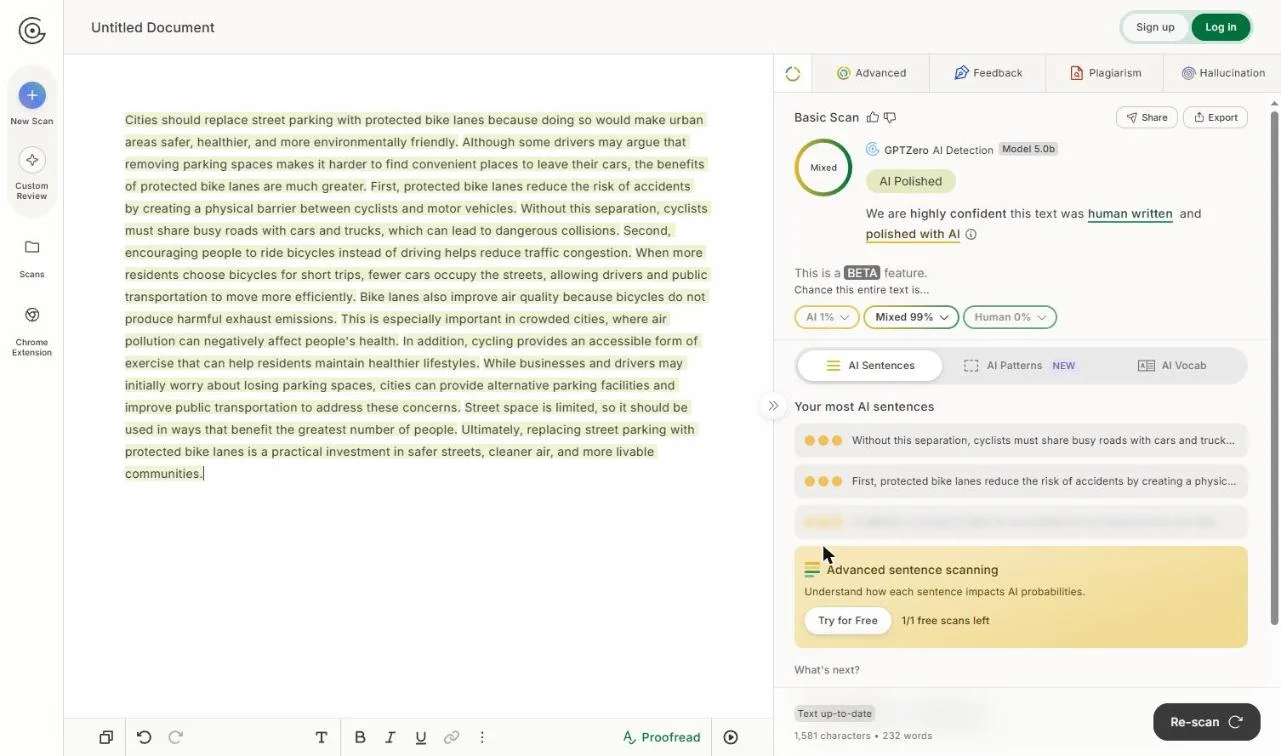
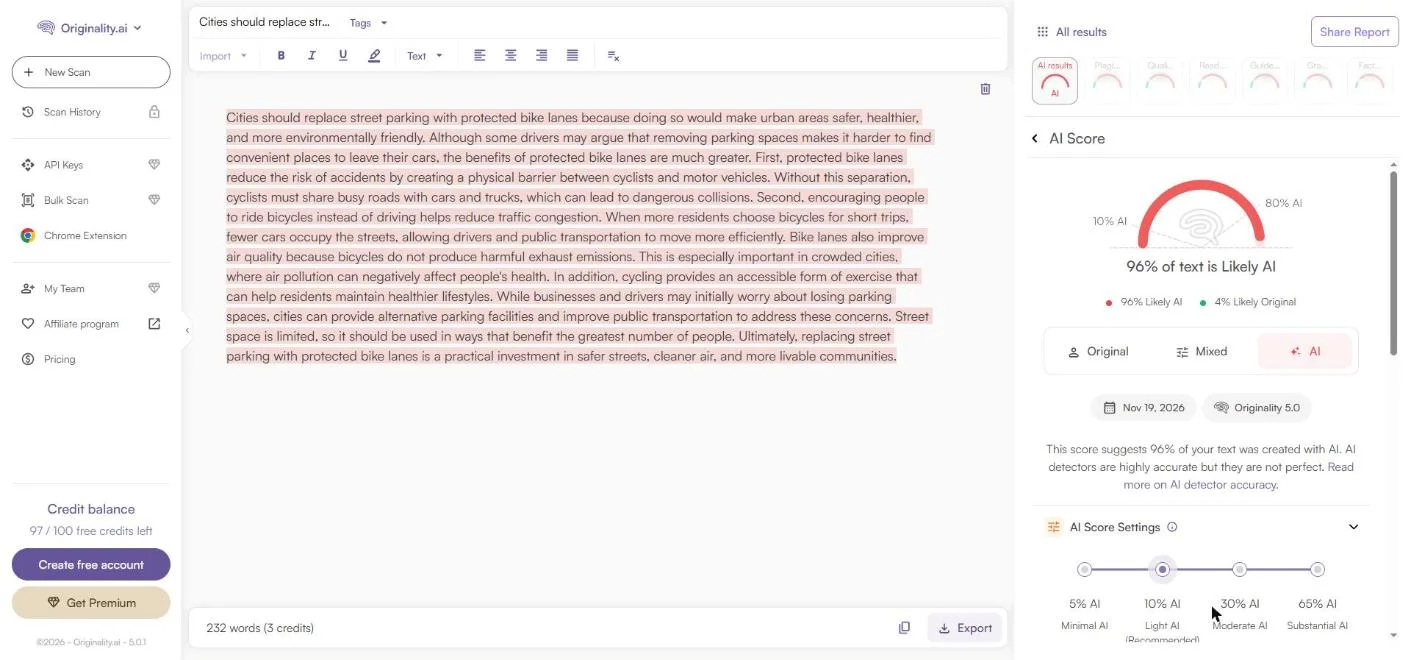
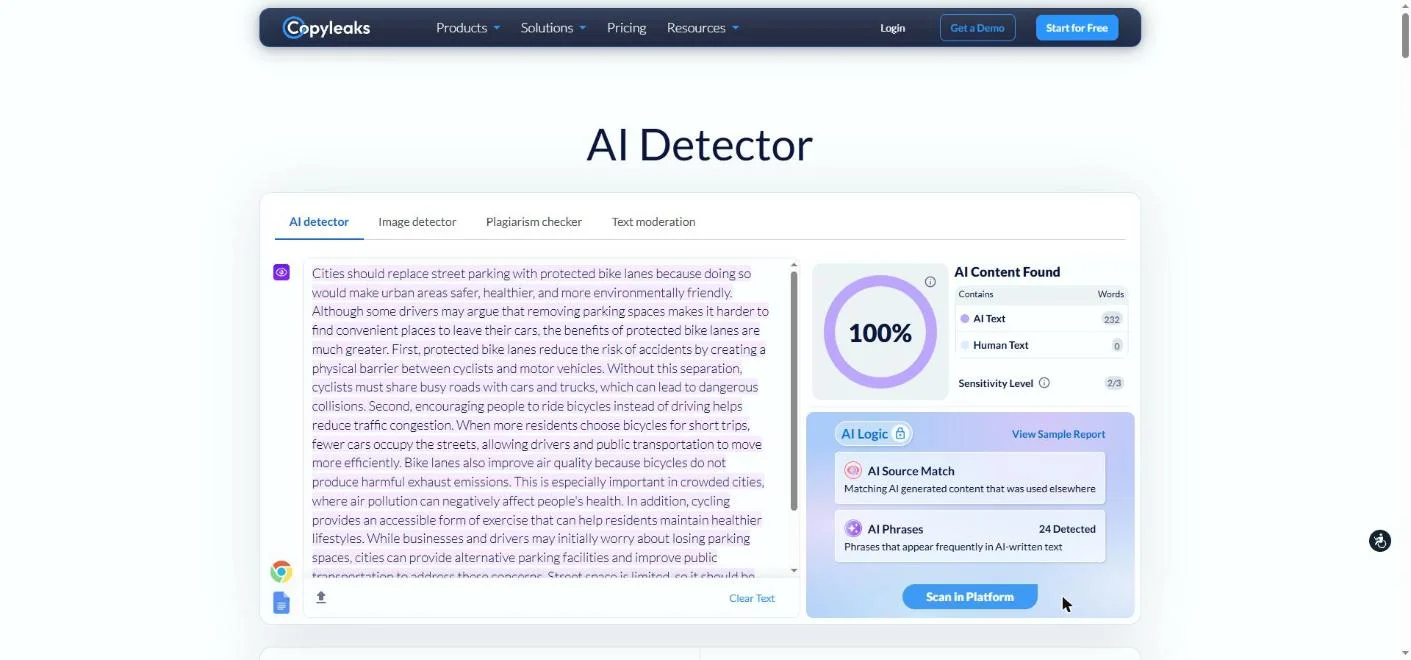
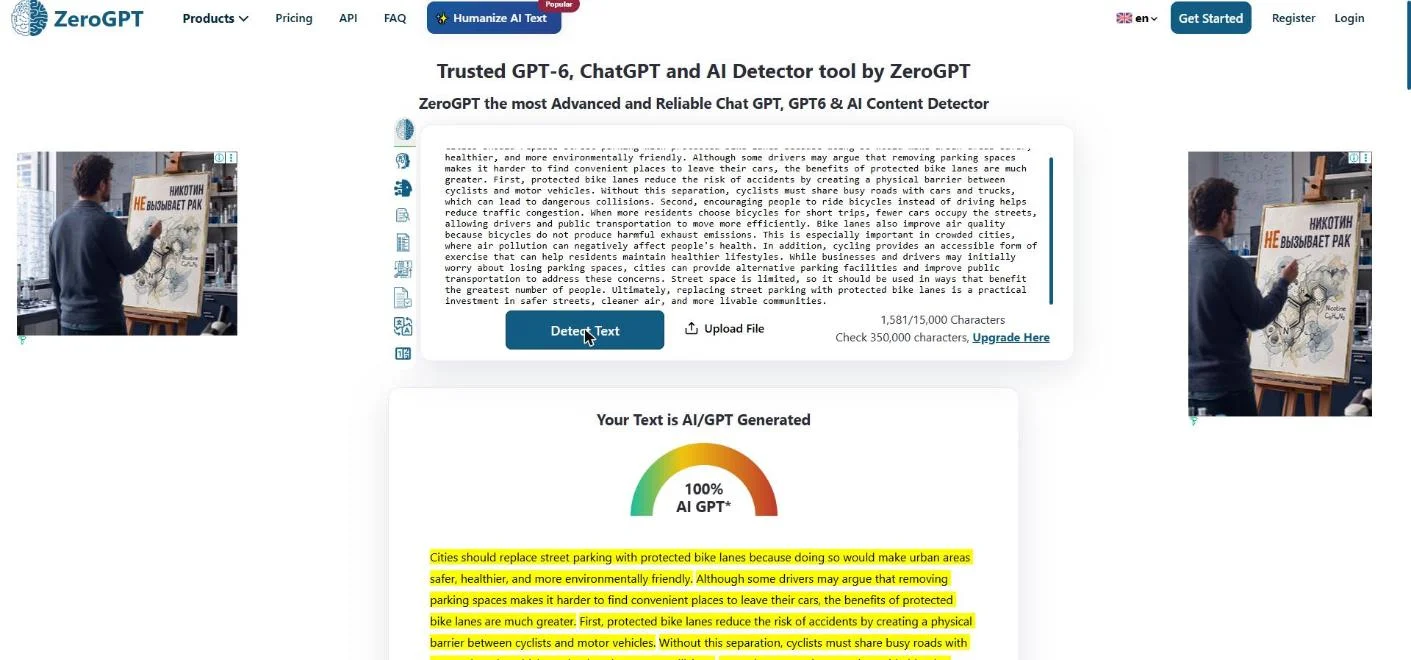
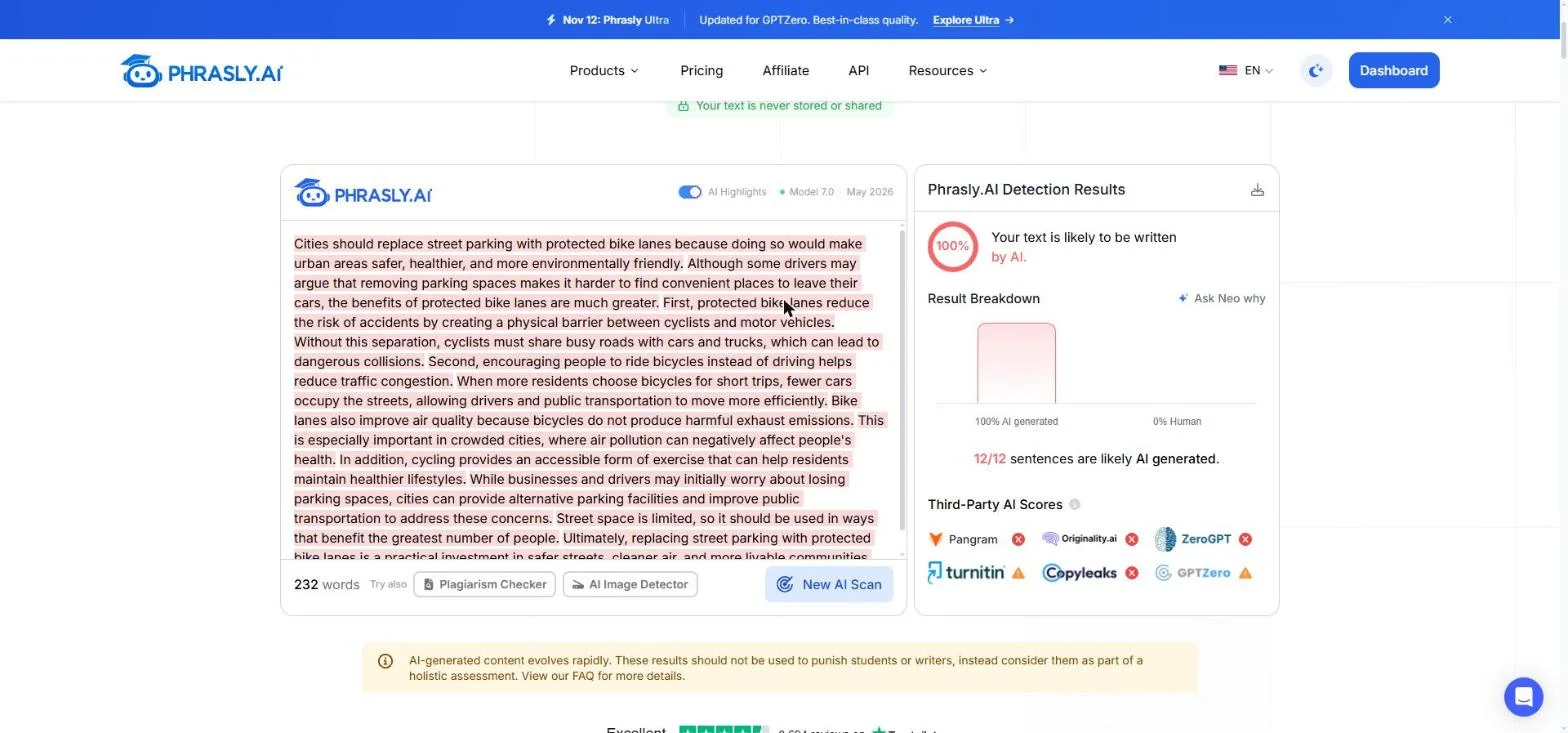
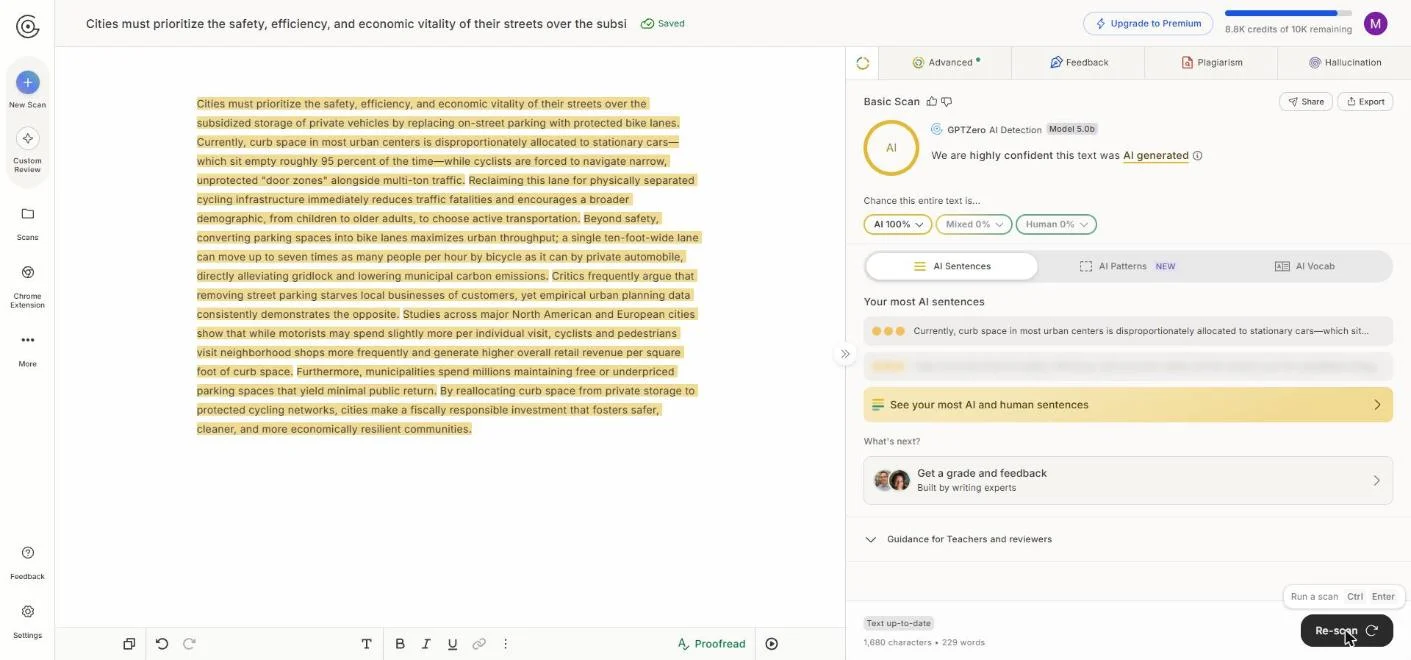
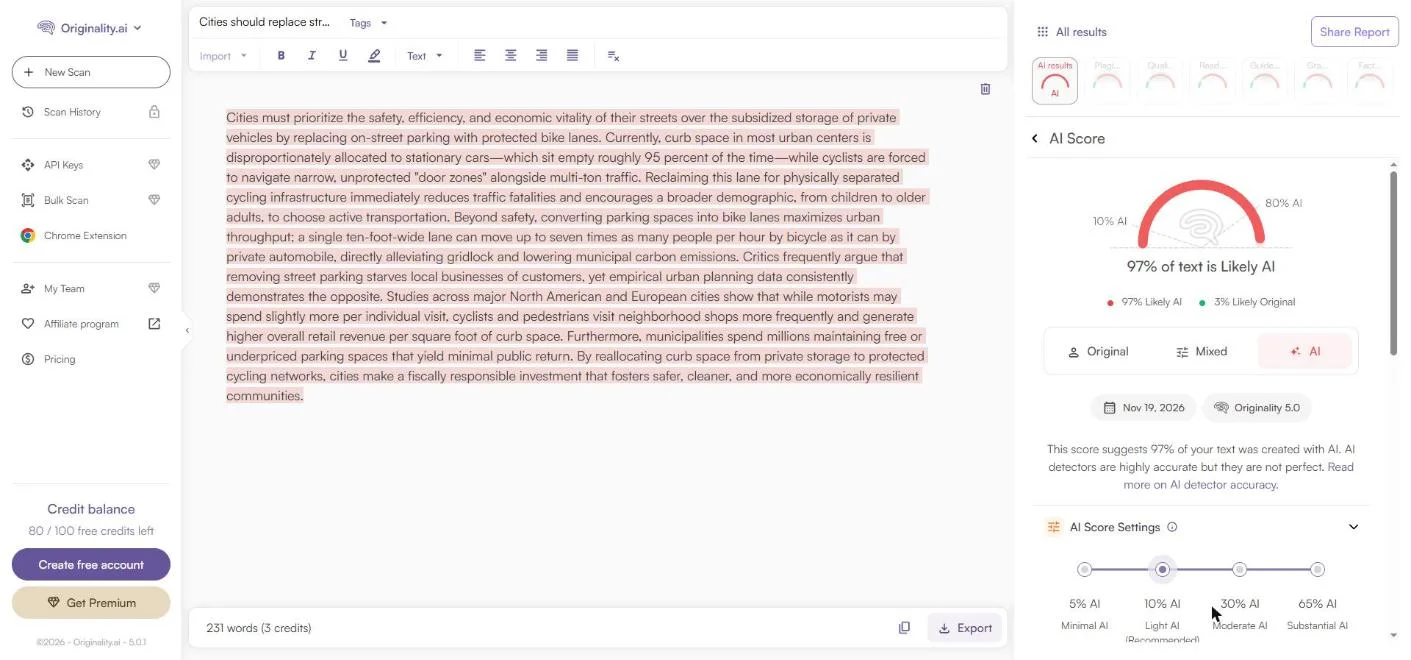
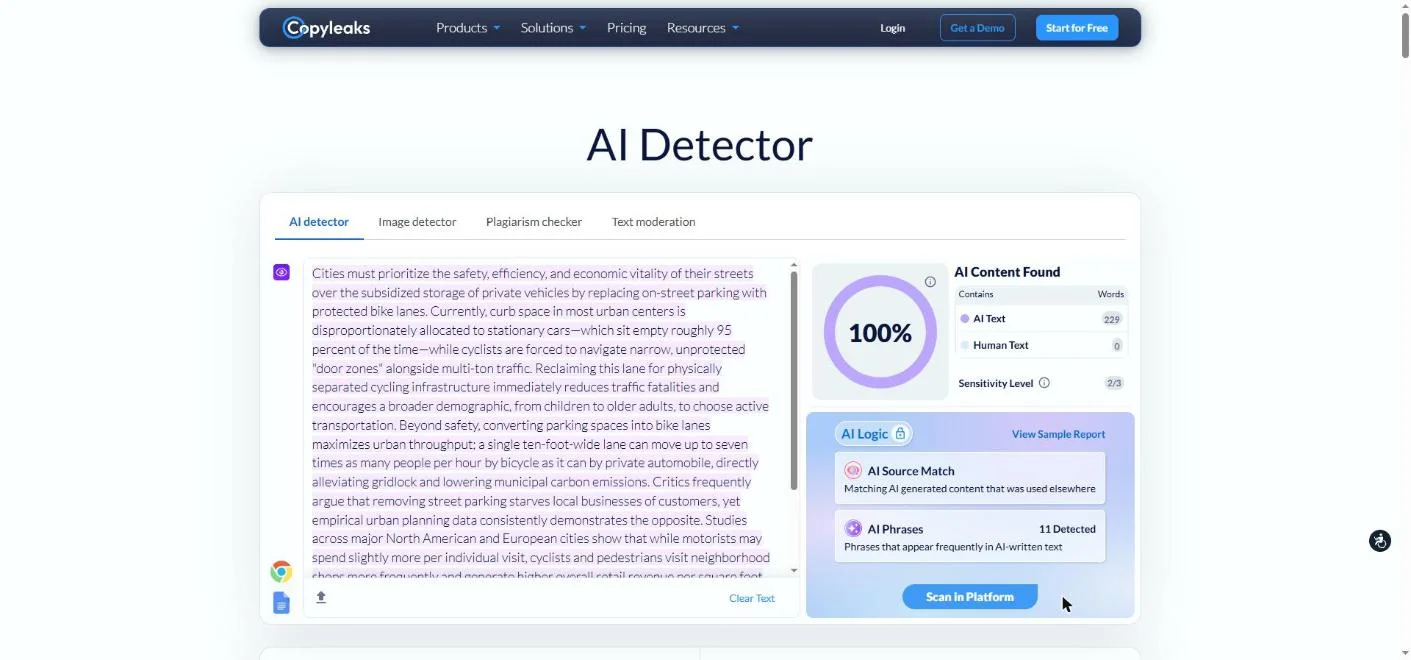
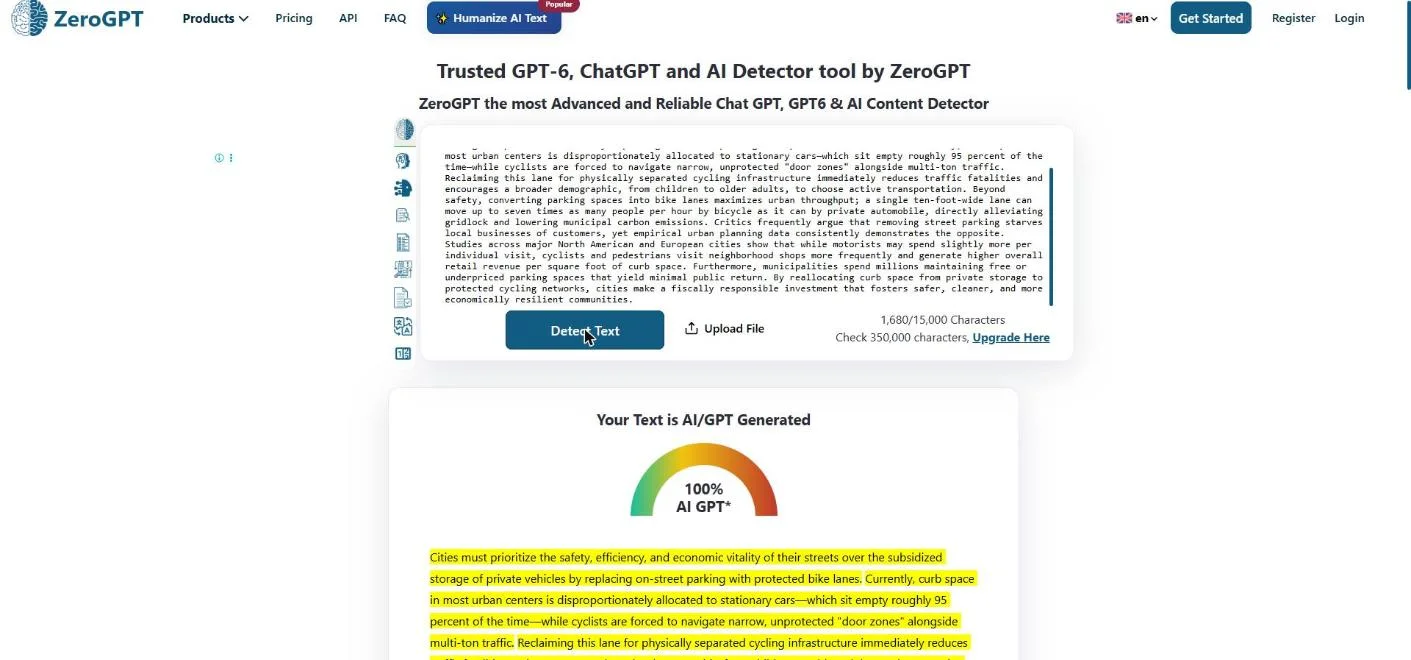
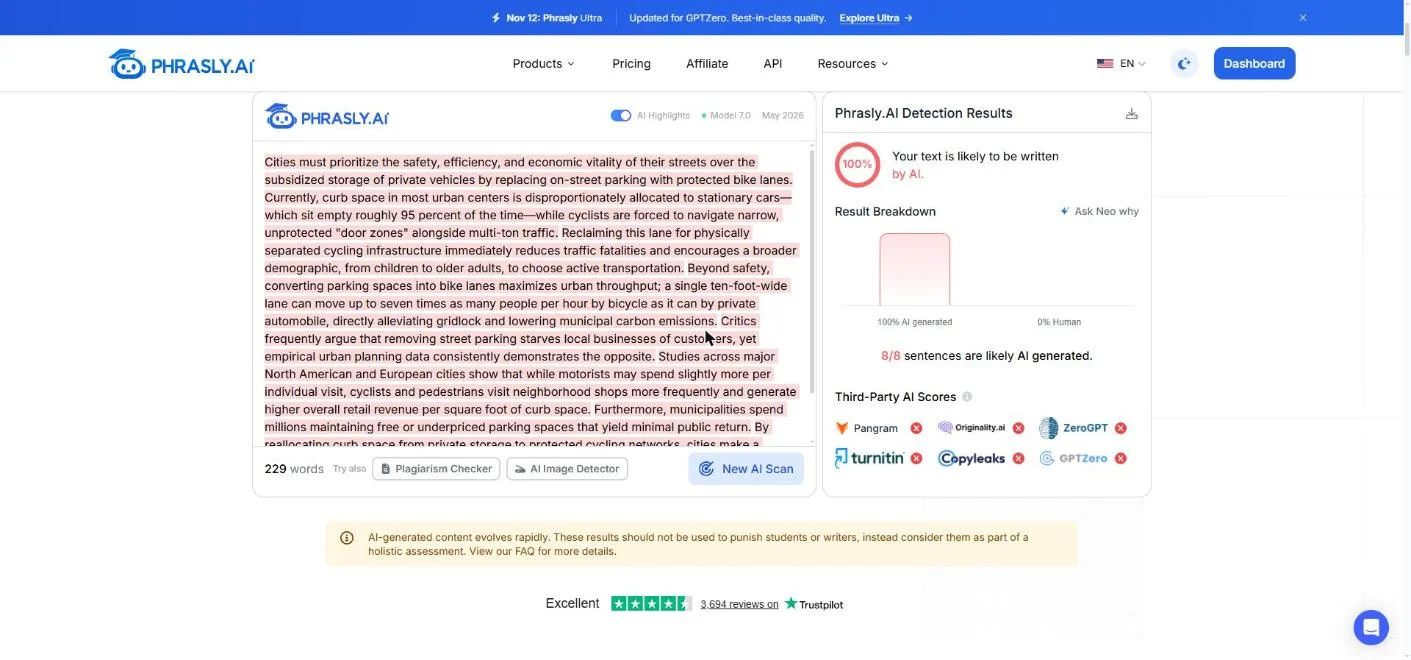
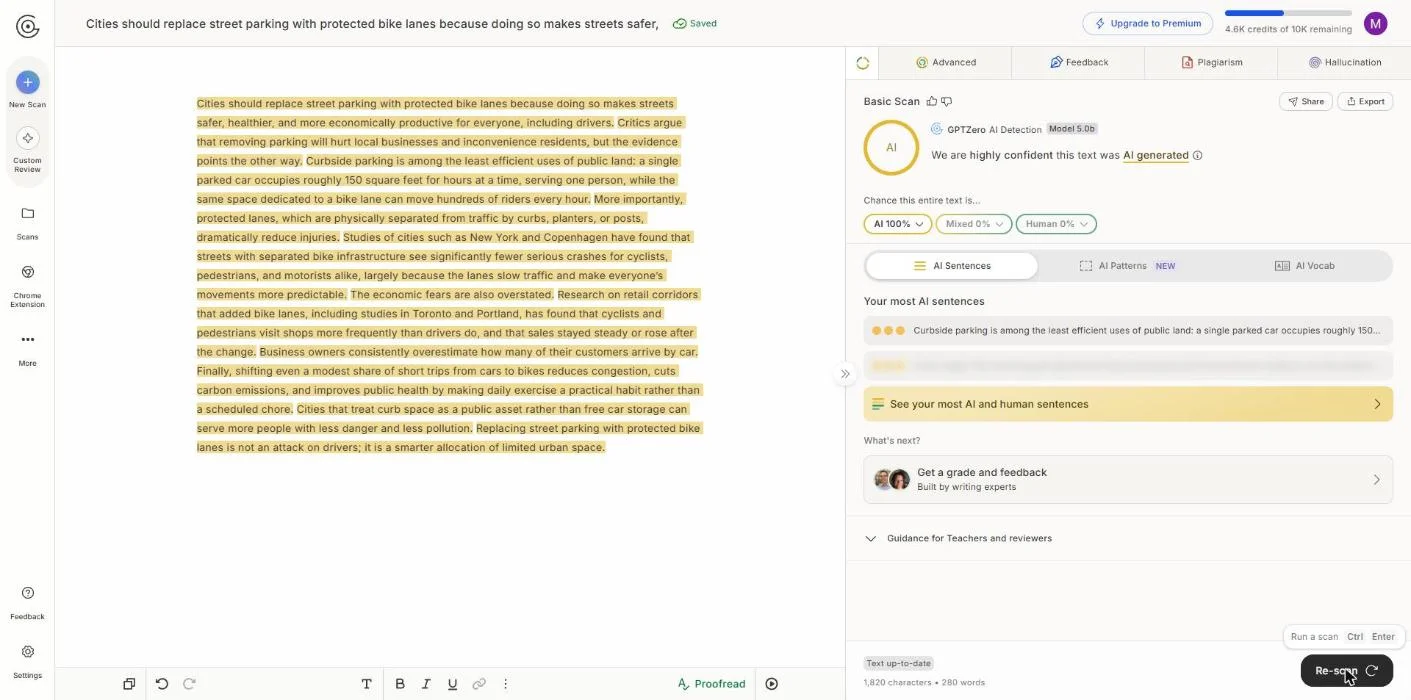
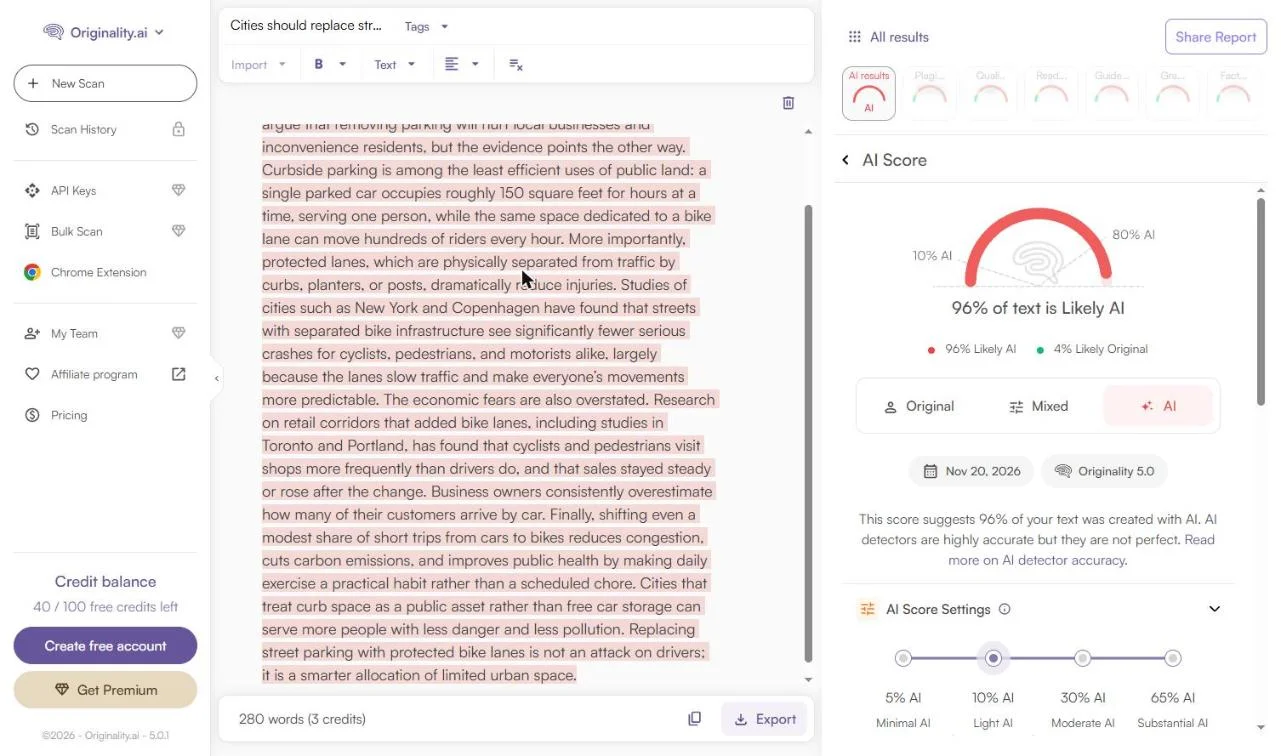
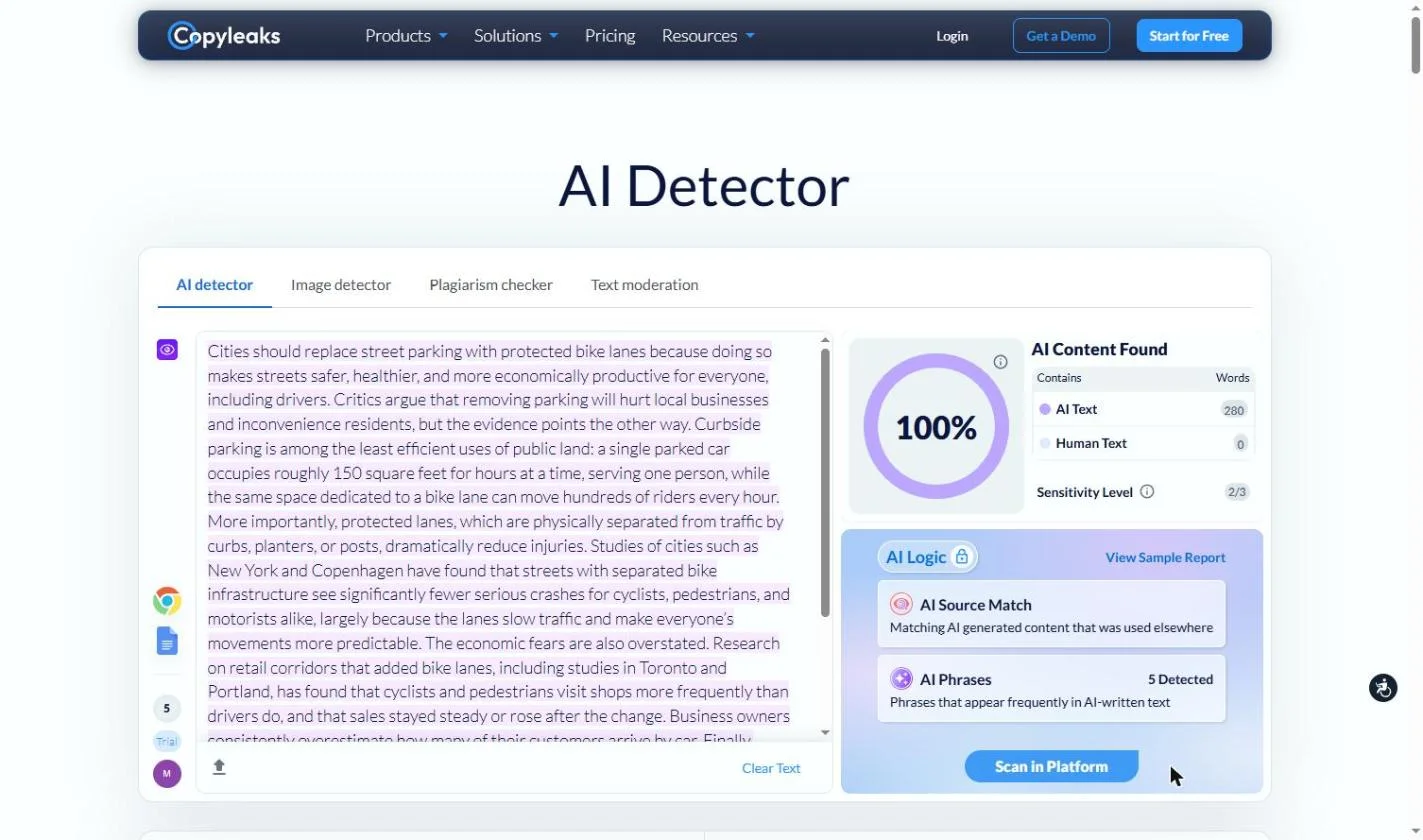
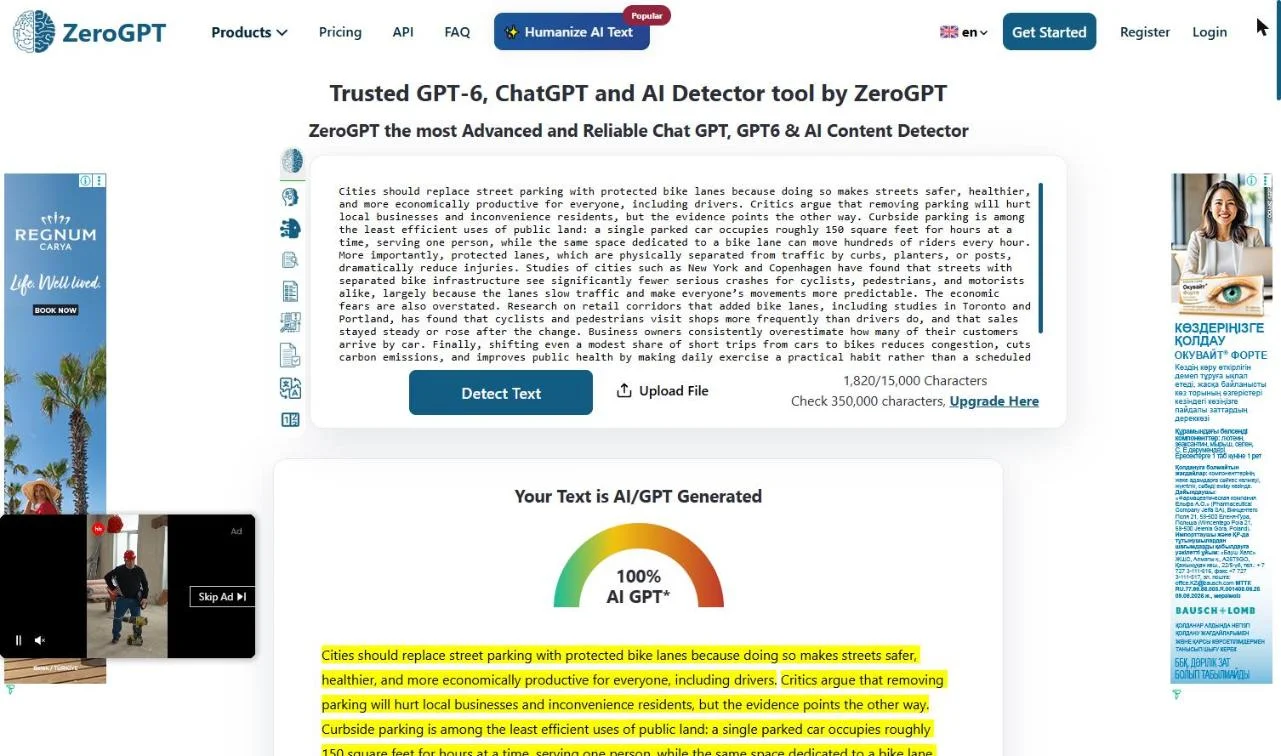
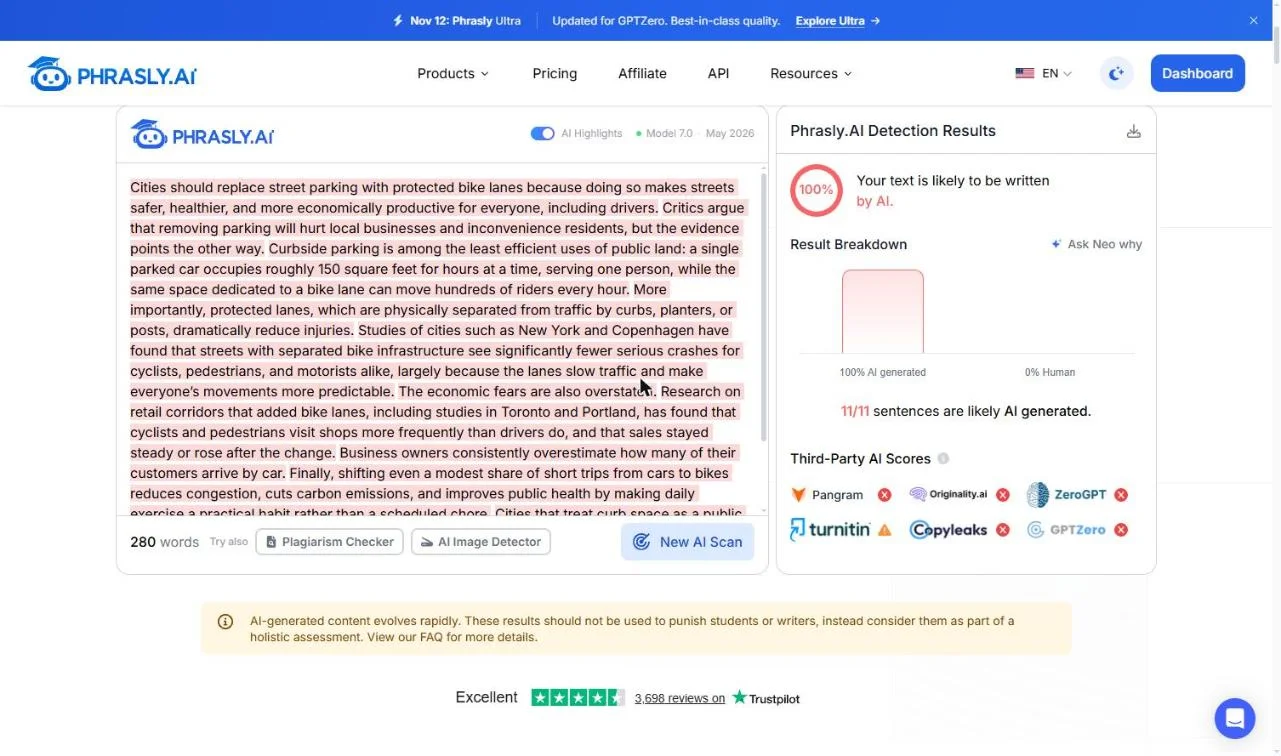
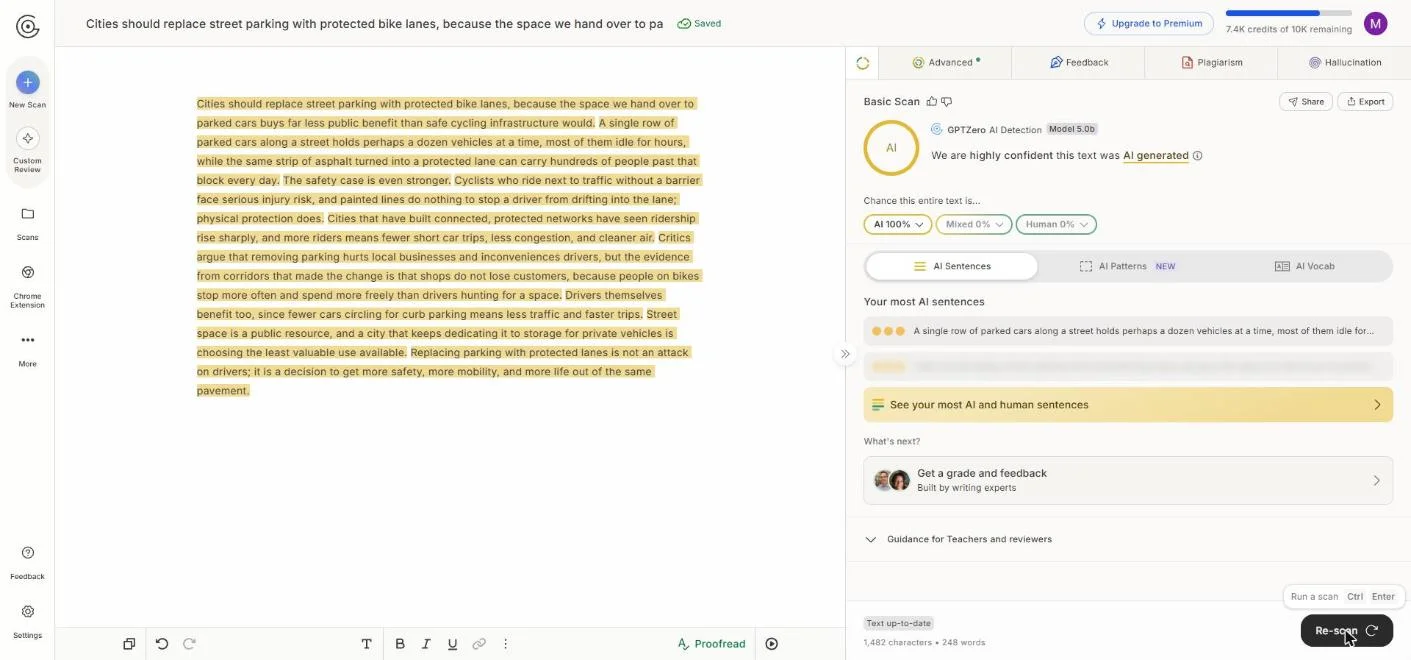
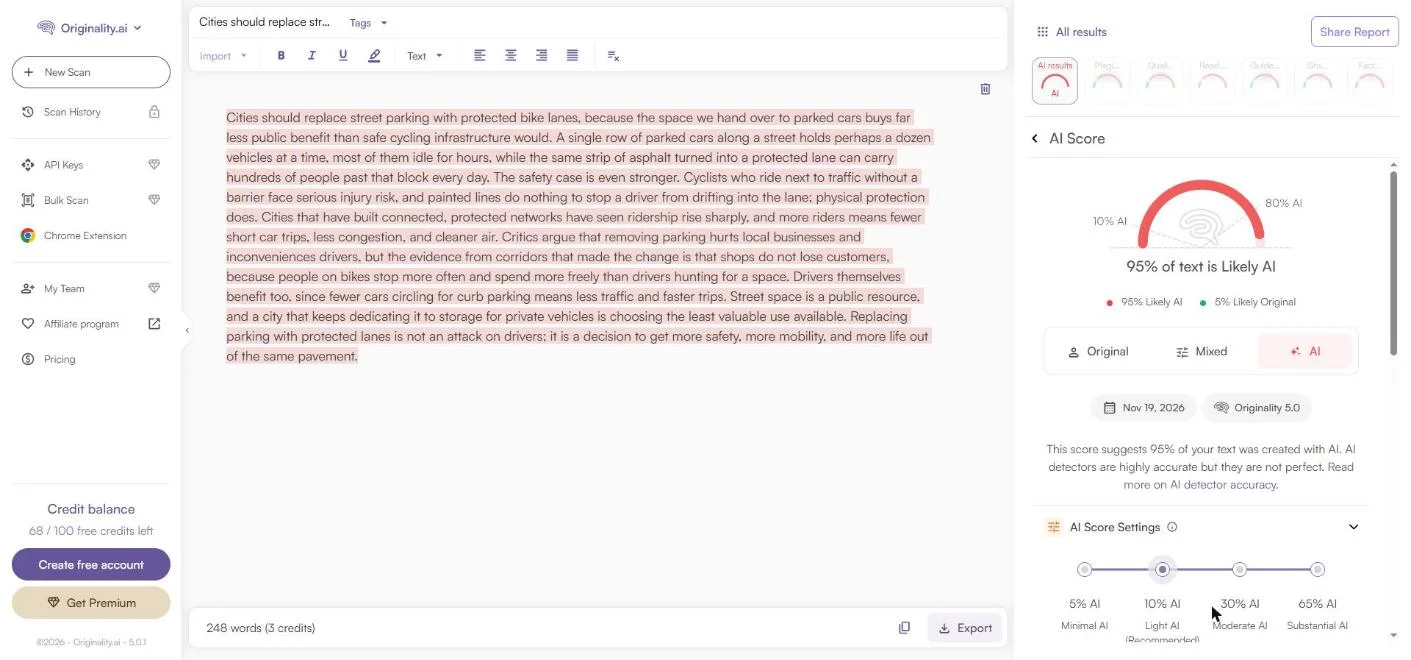
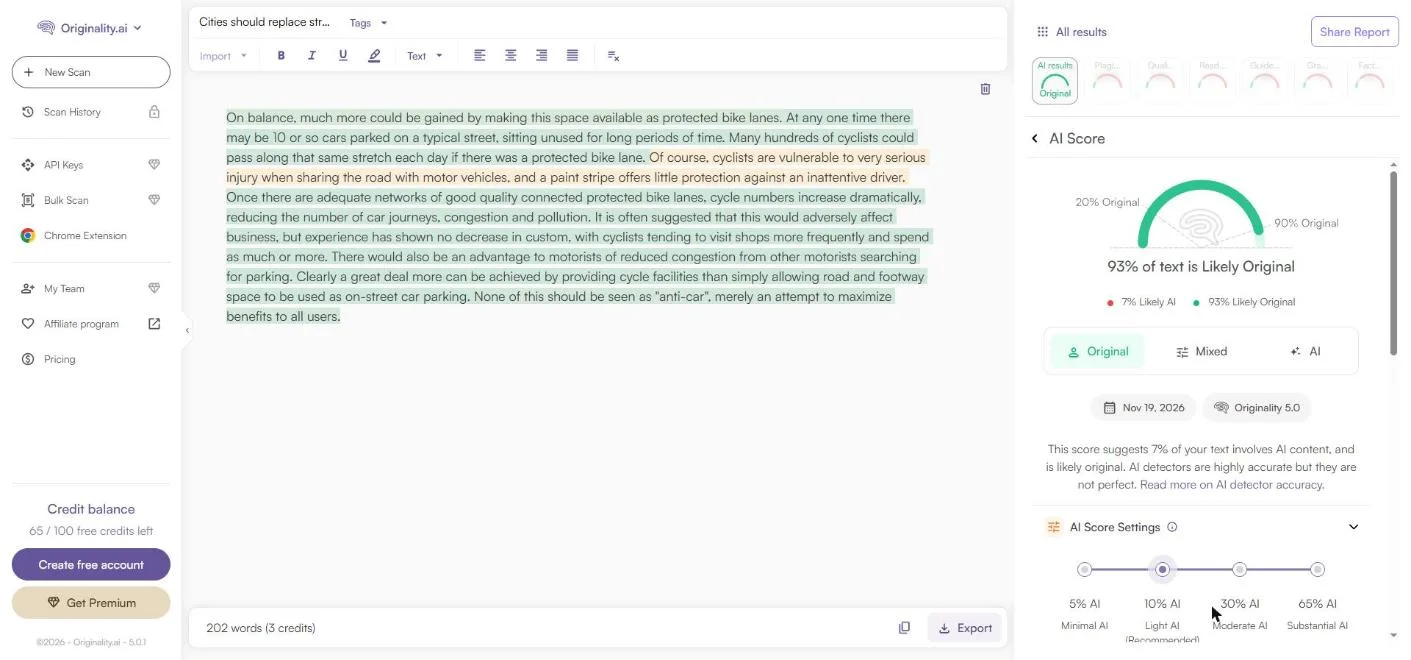
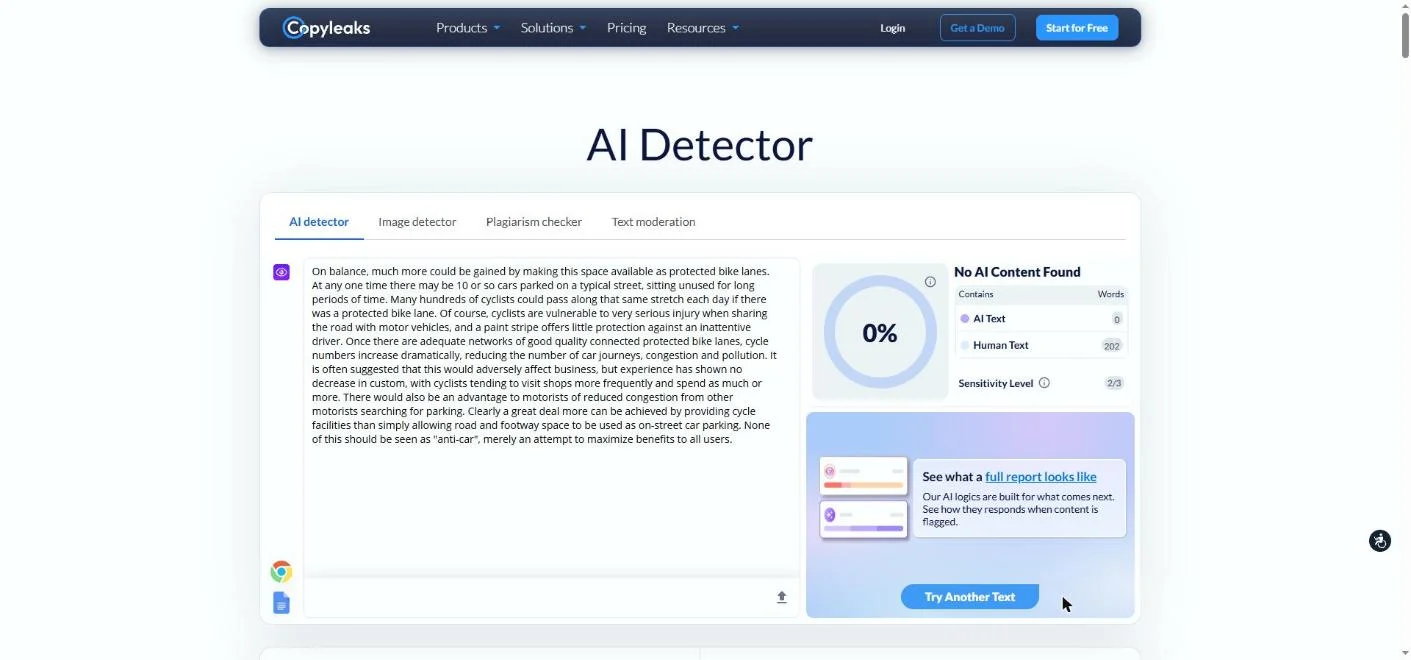
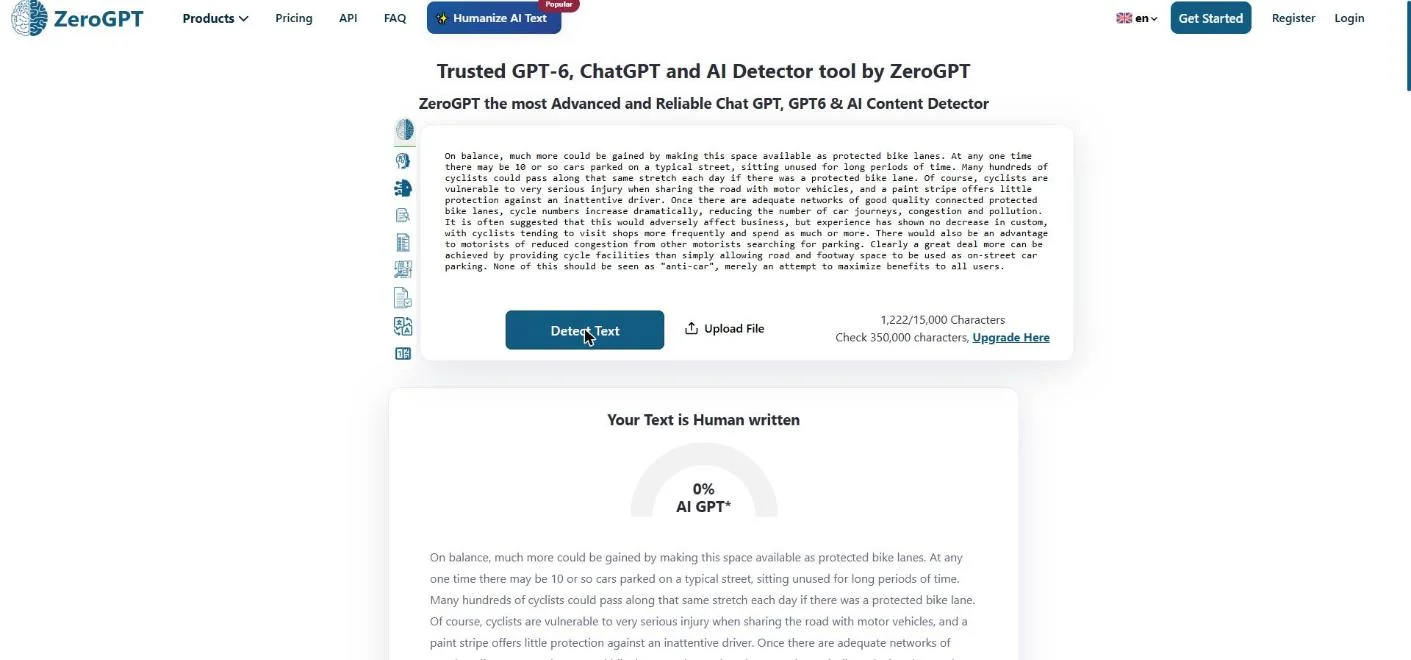
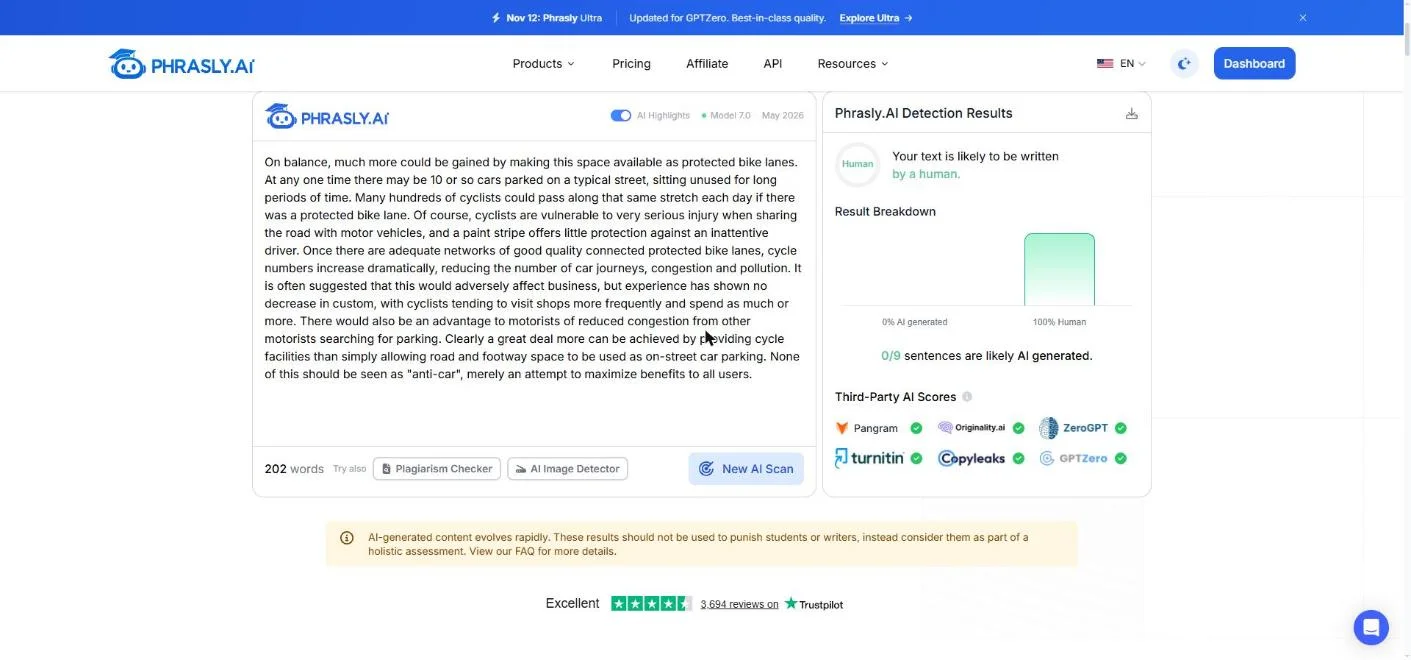
Raw replies from ChatGPT, Gemini, Claude and Neo's default mode were flagged almost everywhere: 100% AI on GPTZero, Copyleaks, ZeroGPT and the Phrasly AI Detector, except one "mixed" GPTZero label for ChatGPT, and 95% to 99% AI on Originality.ai. Only Neo with "humanize this" passed every detector in both runs, but its first run dropped the paragraph's thesis sentence.
Chatbot (plan, model) | GPTZero | Originality.ai | Copyleaks | ZeroGPT | Phrasly AI Detector (ours) |
|---|---|---|---|---|---|
ChatGPT (Free, 6 Instant) | 1% (Mixed 99%) / 100% | 96% / 97% | 100% / 100% | 100% / 100% | 100% / 100% |
Gemini (Free, 4 Hydrogen) | 100% / 100% | 97% / 97% | 100% / 100% | 100% / 100% | 100% / 100% |
Claude (Free, Sonnet 5.5) | 100% / 100% | 96% / 97% | 100% / 100% | 100% / 100% | 100% / 100% |
Neo by Phrasly, default (Unlimited plan) | 100% / 100% | 95% / 99% | 100% / 100% | 100% / 100% | 100% / 100% |
Neo by Phrasly + humanizer (Phrasly Ultra, Balanced) | 0% / 0% | 7% / 5% | 0% / 0% | 0% / 0% | 0% / 0% |
Read the table across, not down. A reply that scores low on one detector and high on another isn't safe; it simply met two different models, and your school uses only one of them, which you usually can't run yourself.
Full outputs: ChatGPT, Prompt A, run 1 and run 2
Run 1:
Cities should replace street parking with protected bike lanes because doing so would make urban areas safer, healthier, and more environmentally friendly. Although some drivers may argue that removing parking spaces makes it harder to find convenient places to leave their cars, the benefits of protected bike lanes are much greater. First, protected bike lanes reduce the risk of accidents by creating a physical barrier between cyclists and motor vehicles. Without this separation, cyclists must share busy roads with cars and trucks, which can lead to dangerous collisions. Second, encouraging people to ride bicycles instead of driving helps reduce traffic congestion. When more residents choose bicycles for short trips, fewer cars occupy the streets, allowing drivers and public transportation to move more efficiently. Bike lanes also improve air quality because bicycles do not produce harmful exhaust emissions. This is especially important in crowded cities, where air pollution can negatively affect people's health. In addition, cycling provides an accessible form of exercise that can help residents maintain healthier lifestyles. While businesses and drivers may initially worry about losing parking spaces, cities can provide alternative parking facilities and improve public transportation to address these concerns. Street space is limited, so it should be used in ways that benefit the greatest number of people. Ultimately, replacing street parking with protected bike lanes is a practical investment in safer streets, cleaner air, and more livable communities.
Run 2:
Cities should replace street parking with protected bike lanes because doing so would make streets safer, reduce traffic congestion, and improve the environment. Although street parking is convenient for car owners, it takes up valuable public space that could serve a greater number of people. Protected bike lanes provide cyclists with a separate space away from moving vehicles, reducing the risk of accidents and encouraging more people to ride bicycles instead of driving. This change would also help reduce traffic congestion. When more residents choose bicycles for short trips, fewer cars occupy the roads, making transportation faster and more efficient for everyone. In addition, replacing street parking with bike lanes would benefit the environment by reducing air pollution and greenhouse gas emissions. Cars release harmful gases that contribute to climate change and negatively affect public health. Bicycles, on the other hand, produce no direct emissions and offer a healthier transportation option. Some people may argue that removing street parking would inconvenience drivers and hurt nearby businesses. However, cities can provide parking garages and designated parking areas to meet essential parking needs. Furthermore, safer and more accessible streets can attract pedestrians and cyclists who may support local shops and restaurants. Ultimately, city streets should serve the needs of the entire community, not just those who own cars. By replacing street parking with protected bike lanes, cities can create safer, cleaner, and more accessible neighborhoods while encouraging healthier and more sustainable transportation choices.
Full outputs: Gemini, Prompt A, run 1 and run 2
Run 1:
Cities must prioritize the safety, efficiency, and economic vitality of their streets over the subsidized storage of private vehicles by replacing on-street parking with protected bike lanes. Currently, curb space in most urban centers is disproportionately allocated to stationary cars, which sit empty roughly 95 percent of the time, while cyclists are forced to navigate narrow, unprotected "door zones" alongside multi-ton traffic. Reclaiming this lane for physically separated cycling infrastructure immediately reduces traffic fatalities and encourages a broader demographic, from children to older adults, to choose active transportation. Beyond safety, converting parking spaces into bike lanes maximizes urban throughput; a single ten-foot-wide lane can move up to seven times as many people per hour by bicycle as it can by private automobile, directly alleviating gridlock and lowering municipal carbon emissions. Critics frequently argue that removing street parking starves local businesses of customers, yet empirical urban planning data consistently demonstrates the opposite. Studies across major North American and European cities show that while motorists may spend slightly more per individual visit, cyclists and pedestrians visit neighborhood shops more frequently and generate higher overall retail revenue per square foot of curb space. Furthermore, municipalities spend millions maintaining free or underpriced parking spaces that yield minimal public return. By reallocating curb space from private storage to protected cycling networks, cities make a fiscally responsible investment that fosters safer, cleaner, and more economically resilient communities.
Run 2:
Replacing on-street parking with protected bike lanes is not an anti-car crusade; it is a pragmatic reallocation of scarce public real estate that maximizes urban efficiency, safety, and economic vitality. A standard parked car occupies roughly 160 square feet of prime municipal space for hours at a time while transporting zero people, whereas a single protected bike lane of comparable width can move up to seven times as many commuters per hour. Beyond sheer throughput, physical separation, via concrete curbs, planters, or bollards, dramatically reduces traffic fatalities by eliminating the "door zone" and preventing drivers from drifting into cyclists’ paths. Critics frequently argue that removing curbside spaces harms local commerce, yet empirical studies from cities like New York, Toronto, and San Francisco consistently demonstrate the opposite: retail corridors with protected cycling infrastructure experience higher foot traffic and increased consumer spending because cyclists and pedestrians stop more frequently than motorists rushing past. Furthermore, dedicating public rights-of-way to active transit directly addresses urban congestion and carbon emissions by offering a viable alternative for the nearly half of all urban car trips that span fewer than three miles. Ultimately, curb space belongs to the entire taxpaying public rather than serving as subsidized storage for private vehicles. By prioritizing protected bike lanes over stationary cars, cities can build safer streets, stimulate neighborhood economies, and create a more equitable transportation network for every resident.
Full outputs: Claude, Prompt A, run 1 and run 2
Run 1:
Cities should replace street parking with protected bike lanes because doing so makes streets safer, healthier, and more economically productive for everyone, including drivers. Critics argue that removing parking will hurt local businesses and inconvenience residents, but the evidence points the other way. Curbside parking is among the least efficient uses of public land: a single parked car occupies roughly 150 square feet for hours at a time, serving one person, while the same space dedicated to a bike lane can move hundreds of riders every hour. More importantly, protected lanes, which are physically separated from traffic by curbs, planters, or posts, dramatically reduce injuries. Studies of cities such as New York and Copenhagen have found that streets with separated bike infrastructure see significantly fewer serious crashes for cyclists, pedestrians, and motorists alike, largely because the lanes slow traffic and make everyone’s movements more predictable. The economic fears are also overstated. Research on retail corridors that added bike lanes, including studies in Toronto and Portland, has found that cyclists and pedestrians visit shops more frequently than drivers do, and that sales stayed steady or rose after the change. Business owners consistently overestimate how many of their customers arrive by car. Finally, shifting even a modest share of short trips from cars to bikes reduces congestion, cuts carbon emissions, and improves public health by making daily exercise a practical habit rather than a scheduled chore. Cities that treat curb space as a public asset rather than free car storage can serve more people with less danger and less pollution. Replacing street parking with protected bike lanes is not an attack on drivers; it is a smarter allocation of limited urban space.
Run 2:
Cities should replace street parking with protected bike lanes because the space curbside parking occupies is among the most wasteful real estate in urban life. A single parking spot stores one private vehicle, usually idle for over 95 percent of the day, while the same strip of pavement converted into a protected lane can move hundreds of people per hour. The benefits extend well beyond efficiency. Protected lanes, which use physical barriers such as planters, curbs, or parked posts, dramatically reduce injuries; studies of cities like New York and Chicago have found that streets with protected infrastructure see significantly fewer serious crashes for all road users, including drivers and pedestrians. Safer streets encourage more people to cycle, which in turn cuts traffic congestion, lowers carbon emissions, and improves public health by building physical activity into daily routines. Critics argue that removing parking will devastate local businesses, but the evidence points the other way: merchants consistently overestimate how many customers arrive by car, and research on commercial corridors in Toronto and Portland has shown that cyclists and pedestrians visit more often and spend comparable or greater amounts over time. Others contend that parking is a public necessity, yet public land should serve the widest possible public rather than subsidizing private vehicle storage, often at no charge. Drivers lose a convenience, but the city gains a street that is safer, cleaner, and more accessible to people of every age and income, including those who cannot afford or choose not to own a car. When a city decides how to divide its limited street space, it is deciding whose mobility and safety matter most. Protected bike lanes answer that question with a more equitable and forward-looking priority.
Full outputs: Neo default and Neo + humanizer, Prompt A
Neo default, run 1:
Cities should replace street parking with protected bike lanes, because the space we hand over to parked cars buys far less public benefit than safe cycling infrastructure would. A single row of parked cars along a street holds perhaps a dozen vehicles at a time, most of them idle for hours, while the same strip of asphalt turned into a protected lane can carry hundreds of people past that block every day. The safety case is even stronger. Cyclists who ride next to traffic without a barrier face serious injury risk, and painted lines do nothing to stop a driver from drifting into the lane; physical protection does. Cities that have built connected, protected networks have seen ridership rise sharply, and more riders means fewer short car trips, less congestion, and cleaner air. Critics argue that removing parking hurts local businesses and inconveniences drivers, but the evidence from corridors that made the change is that shops do not lose customers, because people on bikes stop more often and spend more freely than drivers hunting for a space. Drivers themselves benefit too, since fewer cars circling for curb parking means less traffic and faster trips. Street space is a public resource, and a city that keeps dedicating it to storage for private vehicles is choosing the least valuable use available. Replacing parking with protected lanes is not an attack on drivers; it is a decision to get more safety, more mobility, and more life out of the same pavement.
Neo default, run 2:
Here's a first draft of your argumentative paragraph on replacing street parking with protected bike lanes.
Cities should replace street parking with protected bike lanes, and the case rests on three things: safety, space, and money. Street parking along a busy road is the most dangerous place a cyclist can ride, since a door swung open from a parked car can send a rider into traffic, and protected lanes remove that risk by putting a physical barrier between bikes and moving cars. The same strip of asphalt is far more productive as a bike lane than as storage for private vehicles. A single block of curbside parking holds perhaps a dozen cars, while a protected lane can carry hundreds of riders an hour, which means cities get more trips out of the same space. Replacing parking also saves the public money. Every parking space costs the city in paving, maintenance, and lost tax revenue from land that could hold shops and homes, yet most curbside parking is free or nearly free. Protected lanes, by contrast, cost a fraction of a road widening or a parking garage and encourage the short trips that clog downtown streets. Critics argue that drivers need those spaces, but the evidence from cities that have made the switch suggests that businesses do not lose customers and traffic does not collapse.
Neo + humanizer ("humanize this"), run 1:
On balance, much more could be gained by making this space available as protected bike lanes. At any one time there may be 10 or so cars parked on a typical street, sitting unused for long periods of time. Many hundreds of cyclists could pass along that same stretch each day if there was a protected bike lane. Of course, cyclists are vulnerable to very serious injury when sharing the road with motor vehicles, and a paint stripe offers little protection against an inattentive driver. Once there are adequate networks of good quality connected protected bike lanes, cycle numbers increase dramatically, reducing the number of car journeys, congestion and pollution. It is often suggested that this would adversely affect business, but experience has shown no decrease in custom, with cyclists tending to visit shops more frequently and spend as much or more. There would also be an advantage to motorists of reduced congestion from other motorists searching for parking. Clearly a great deal more can be achieved by providing cycle facilities than simply allowing road and footway space to be used as on-street car parking. None of this should be seen as "anti-car", merely an attempt to maximize benefits to all users.
Neo + humanizer ("humanize this"), run 2:
An initial attempt at one body paragraph in favor of removing on-street parking and creating protected bike lanes:
It is safer, more efficient use of space, and cheaper. Riding next to a row of parked cars is undoubtedly hazardous, with just one opening car door enough to put a cyclist in the path of a car. Obviously this hazard would be eliminated with a protected bike lane. Also, as mentioned above, there is a large number of people who could use a bike lane down a given street, compared to the relatively few cars that can be parked along that stretch. Thus it would benefit more people to have a bike lane. Furthermore, all of these empty spaces are an expense, in terms of construction, upkeep, and foregone taxes, for very little return, that is, a very low or no price to park. Of course building bike lanes will cost something, but much less than extending a road or building multi-level parking, and it will promote short-distance travel to and around the city center. Finally, there will always be people who say people need to be able to park on the street; however, many businesses report little or no decrease in business once this change is implemented.
All Prompt A detector screenshots (25)
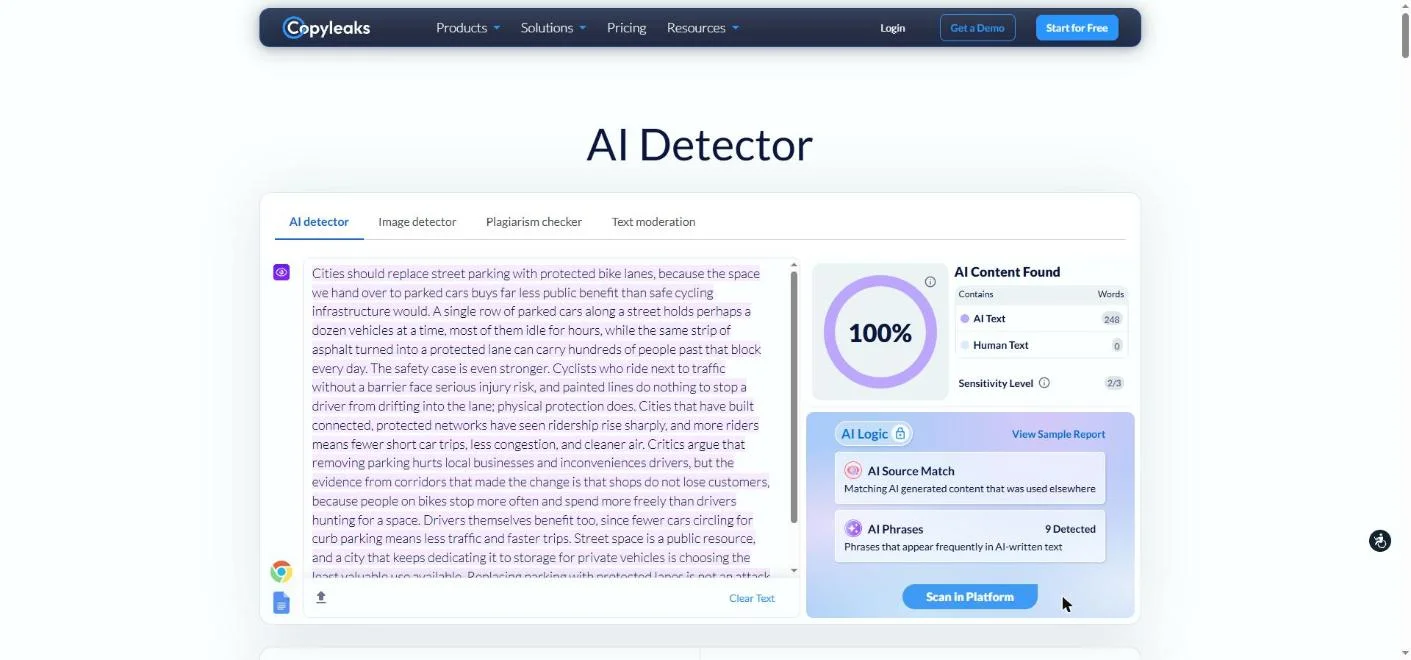
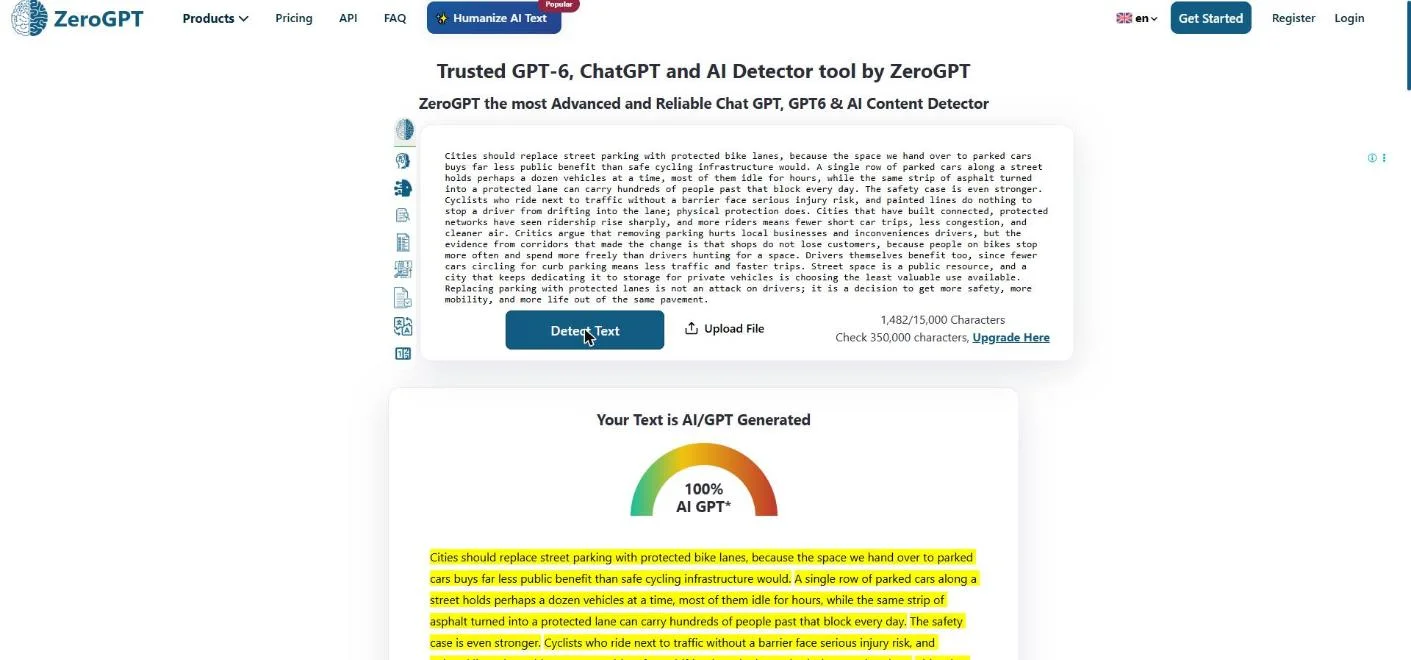
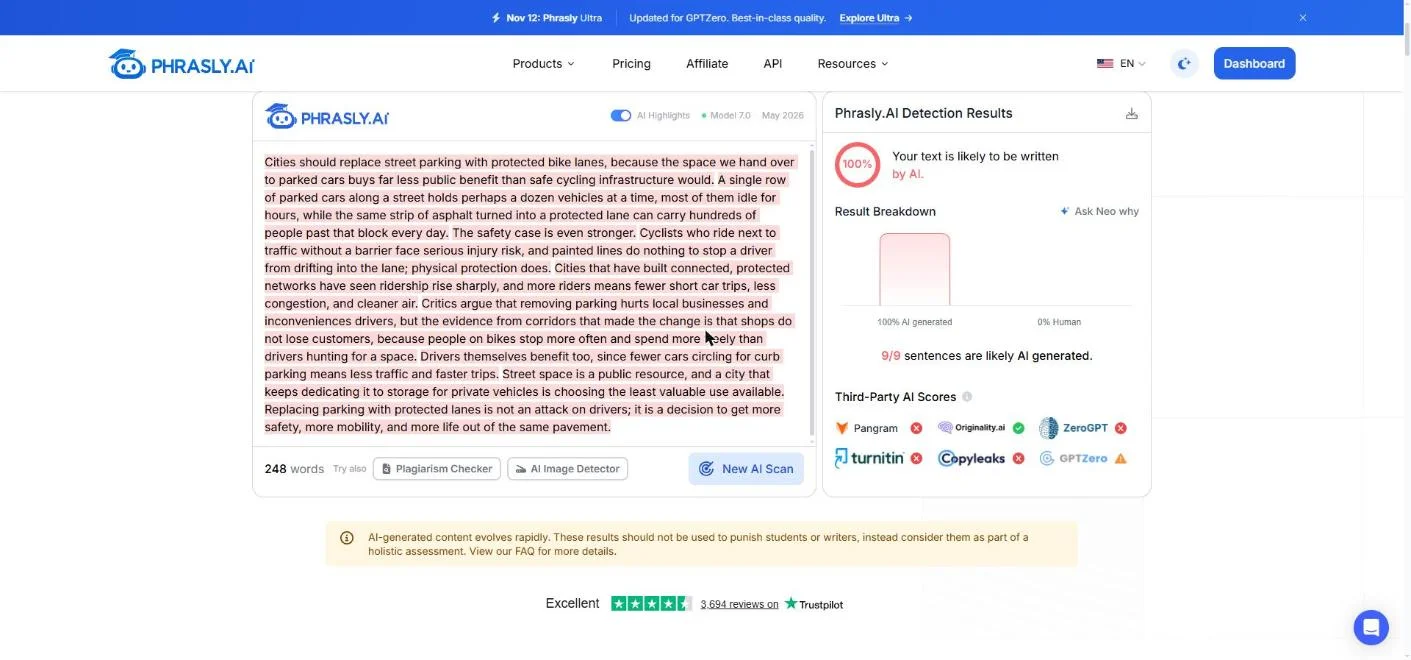
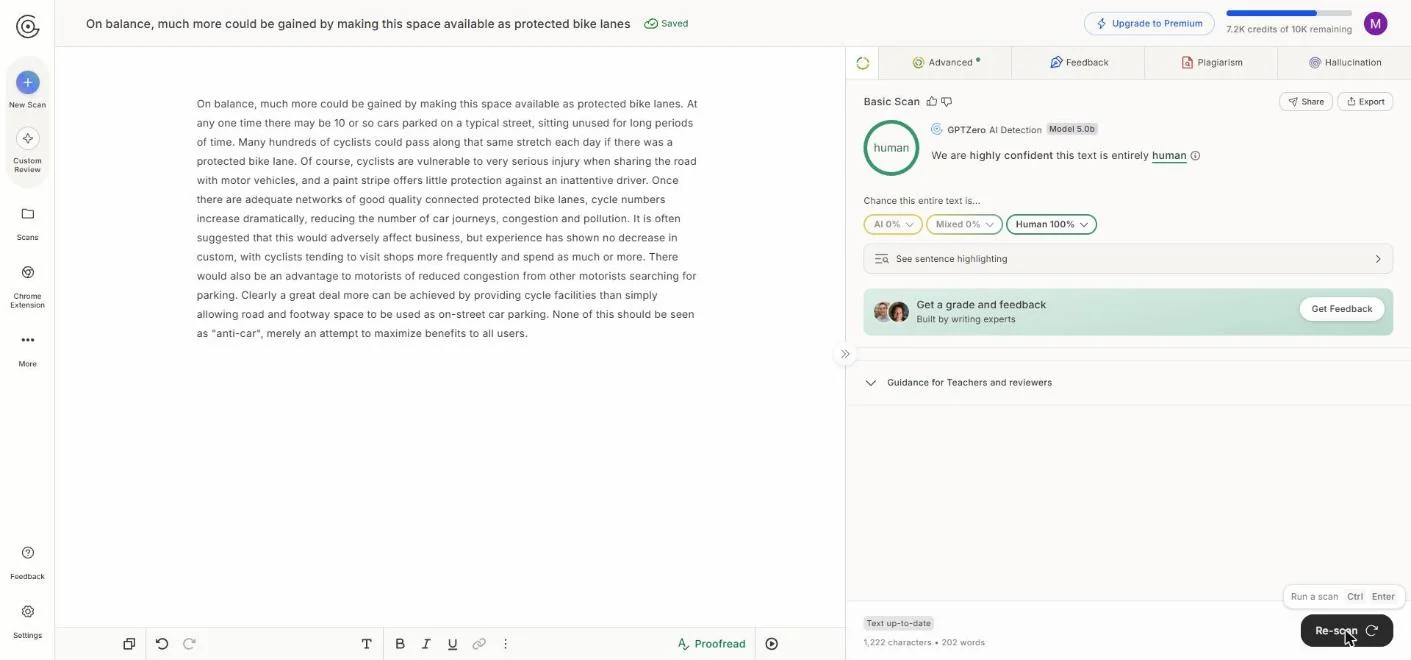
If writing you wrote yourself gets flagged
Stay calm and gather evidence before you reply, because a clear paper trail settles most cases. Our guide on how to protect yourself from AI detector false positives goes deeper, but these steps cover the basics:
Keep version history and drafts, such as Google Docs or Word revision history.
Save your sources, notes and outlines.
Ask for the actual report, including the highlighted passages, not just the verdict.
Explain your process calmly, and offer to talk through the work in person.
Find your institution's academic integrity appeal route and cite it by name.
This worry is common. In the HEPI survey below, students described fear of being falsely accused, including one who said they worried constantly about being flagged despite never using AI to write an assignment.
Where a humanizer fits under academic integrity rules
An AI humanizer is an editing tool, and the rules for editing tools come from your course, not from the tool. Before you use one on anything graded, check these points:
Read the syllabus and the course AI policy first.
Use a humanizer only to improve clarity on your own drafts, and only where the policy allows it.
Disclose AI help when your instructor asks, or when the policy requires it.
Treat a humanizer as an editing aid, never as a way to submit work you didn't write.
You are far from the only student working this out. The HEPI Student Generative AI Survey 2026, based on 1,054 UK undergraduates surveyed in December 2025, found that 95% now use AI in some form and 94% use generative AI to support assessed work.
Those numbers explain why policies differ so much between courses. When almost every student uses AI for something, a blanket ban stops being realistic, so many institutions now spell out which uses are allowed and which need disclosure.
Can AI detectors detect undetectable AI? Sometimes, and the answer changes by tool and by version, as the Prompt A table shows.
Scenario 2: a freelancer or marketer drafts client copy in a chatbot
Client checkers often flag chatbot drafts, and they do it inconsistently from one tool to the next. Search engines are a separate question, because they judge whether a page helps people, not whether AI touched it.
Clients usually run a checker for one of two reasons: a policy from their own publisher or platform, or a worry that AI copy will hurt rankings. The first is a contract question and the second is mostly a misunderstanding, so it pays to separate them early.
Google's May 2025 guidance on succeeding in AI search experiences puts it plainly: focus on unique, satisfying content for visitors. As an SEO team, we split the two questions like this:
Rankings follow helpfulness, original data, real expertise and how well the page matches search intent.
A detector score is a client-trust and contract issue. It is not a ranking factor.
That doesn't make the score irrelevant, because a client who distrusts your draft won't publish it. It just means you protect the relationship and the rankings with different work.
The tools selling a fix make bold claims, so here is how they hold up when someone else checks. Undetectable AI says its rewrites can reach "up to 100% human" scores, yet Originality.ai's review found its own detector still scored the humanized text 100% Likely AI. GPTZero's own review concluded that GPTZero can clearly spot Undetectable AI's paraphrased text, though both reviewers sell competing detectors.
None of this makes humanizers useless. They can smooth stiff chatbot phrasing, which is a real editing gain, but the score they promise depends on a detector they don't control.
A separate humanizer is also an added cost. On November 20, 2026, undetectable.ai/pricing listed its smallest plan at $60 a year (about $5 a month) for 10,000 words a month, or $19 a month for 20,000 words on monthly billing, before a limited-time sale.
Can AI detectors catch humanized text? Sometimes, and inconsistently, which matches the Chicago results above. Prompt B adds the part that matters more for client work: what the rewrite did to the meaning.
Prompt B results: scores and meaning drift
Chatbot | Words in vs out | Protected terms kept (2) | Facts kept | Score per detector | Awkward phrases per 100 words |
|---|---|---|---|---|---|
ChatGPT | 300 target vs 282 / 290 (run 1 / run 2) | 2 of 2 in both runs | Kept | GPTZero 100% / 100%, Originality.ai 97% / 98%, Copyleaks 100% / 100%, ZeroGPT 100% / 100%, Phrasly 100% / 100% | 0.7 / 0.7 |
Gemini | 300 target vs 260 / 276 | 2 of 2 in both runs | Kept | GPTZero 100% / 100%, Originality.ai 97% / 96%, Copyleaks 100% / 100%, ZeroGPT 100% / 100%, Phrasly 100% / 100% | 0.8 / 1.4 |
Claude | 300 target vs 269 / 295 | 2 of 2 in both runs | Kept | GPTZero 100% / 100%, Originality.ai 99% / 97%, Copyleaks 100% / 100%, ZeroGPT 100% / 100%, Phrasly 100% / 50% | 0.4 / 0.3 |
Neo by Phrasly, default | 300 target vs 269 / 304 | 1 of 2 / 2 of 2 | Kept (run 1 left a placeholder and a [CTA] tag) | GPTZero 100% / 100%, Originality.ai 99% / 99%, Copyleaks 100% / 100%, ZeroGPT 100% / 100%, Phrasly 22% / 66% | 0 / 0 |
Neo by Phrasly + humanizer | 300 target vs 277 / 315 | 0 of 2 / 1 of 2 | Changed in both runs | GPTZero 0% / 0%, Originality.ai 96% / 6%, Copyleaks 0% / 0%, ZeroGPT 0% / 0%, Phrasly 0% / 0% | 2.9 / 2.9 |
Prompt B was built to catch the problem clients care about most. The brand name and the HEPI figure are the first two things a client checks, and a rewrite that drops either one creates more work than a high detector score ever would.
The clearest result came from Originality.ai, which scored Neo's humanized Prompt B intro at 96% AI on run 1 and 6% AI on run 2, while the other four detectors called both runs 0% AI. Scores alone hide the bigger story, and our test of whether detectors spot paraphrased AI text found the same pattern.
ChatGPT, Gemini and Claude kept "Campusly," the keyword and the HEPI figure word for word in both runs. Neo's default reply used "Campusly" twice in run 1 and left a placeholder and a [CTA] tag. Neo with the humanizer dropped "Campusly" and the keyword in run 1 and rewrote the 95% figure as "95% of all undergraduate students in the UK will have used an AI tool at some point"; in run 2 it dropped "UK" from the figure and changed the keyword. Every reply landed within 14% of the 300-word target.
Full outputs: All five Prompt B outputs, run 1 and run 2
ChatGPT, run 1:
AI Policy for Students: Understanding the Rules of Responsible AI Use
Artificial intelligence is transforming the way students learn, research and complete academic work. From generating ideas and summarising complex topics to checking grammar and explaining difficult concepts, AI tools are quickly becoming part of everyday student life. But as their use becomes more widespread, one important question arises: what are the rules around using AI in education?
According to the HEPI Student Generative AI Survey 2026, 95% of UK undergraduates now use AI in some form. This highlights just how deeply AI has become embedded in higher education. However, widespread adoption also brings challenges, particularly around academic integrity, plagiarism, data privacy and the boundaries between independent work and AI-assisted learning.
This is where an AI policy for students becomes essential. A clear policy helps students understand when and how they can use AI tools, what counts as acceptable assistance and when they must acknowledge AI-generated contributions. Rather than simply restricting technology, effective AI guidelines encourage responsible use while protecting the value of independent thinking, creativity and academic achievement.
For students, understanding these guidelines is increasingly important. Different universities, courses and assessments may have different expectations, meaning that what is acceptable in one assignment may not be permitted in another. Knowing the rules can help students avoid accidental academic misconduct and make more confident decisions about using AI.
At Campusly, we believe that navigating modern education means understanding both the opportunities and responsibilities that come with emerging technology.
In this guide, we'll explore what an AI policy for students means, why it matters, the key rules students should know and how to use AI responsibly to support learning without compromising academic integrity.
Source for the cited statistic: HEPI, Student Generative AI Survey 2026. The survey reports that 95% of students use AI in at least one way.
Word count: approximately 300 words (excluding the source note).
ChatGPT, run 2:
AI Policy for Students: Understanding the Rules of Using AI in Education
Artificial intelligence is transforming the way students learn, research and complete academic assignments. From generating ideas and summarising complex topics to improving written work and explaining difficult concepts, AI tools are quickly becoming part of everyday student life. But as their use grows, so does an important question: what are the rules around using AI in education?
According to the HEPI Student Generative AI Survey 2026, 95% of UK undergraduates now use AI in some form. This highlights just how deeply AI has become embedded in higher education. However, widespread adoption doesn't necessarily mean students understand when, where or how they can use these tools responsibly.
That's where an AI policy for students becomes essential. An effective policy establishes clear guidelines on acceptable AI use, academic integrity, plagiarism, data privacy and the disclosure of AI-generated content. It helps students understand the difference between using AI as a learning assistant and relying on it to produce work that should reflect their own knowledge and abilities.
For universities and educational institutions, having transparent AI guidelines is equally important. Clear policies can reduce confusion, encourage responsible experimentation and ensure students receive consistent guidance across different courses and assessments.
At the same time, students need practical support to develop AI literacy, think critically about AI-generated information and use emerging technologies without compromising their learning. With the right approach, AI doesn't have to be a threat to academic integrity. Instead, it can become a valuable tool for deeper understanding and better learning outcomes.
In this guide, Campusly explores what an AI policy for students should include, why it matters and how students can navigate the evolving relationship between artificial intelligence and academic success.
Source for the cited statistic: HEPI, Student Generative AI Survey 2026 (published 12 March 2026). The survey found that 95% of students reported using AI in at least one way.
Word count: approximately 300 words (excluding the title).
Gemini, run 1:
Walking into a university lecture hall today looks dramatically different than it did just a few years ago. Laptops are open, research tabs are multiplying, and generative AI is quietly running in the background of almost every study session. In fact, according to the HEPI Student Generative AI Survey 2026, 95% of UK undergraduates now use AI in some form. Yet while students have rapidly adopted these tools to brainstorm, summarize readings, and debug code, many institutions are still scrambling to catch up with clear, actionable rules.
That gap has created a widespread gray area on campus. Without transparent guidelines, students are often left guessing where acceptable academic support ends and plagiarism begins, while faculty struggle with inconsistent enforcement across different departments. A blanket ban is no longer realistic, and vague honor-code addendums only breed anxiety and confusion.
Establishing a clear, practical AI policy for students has become an urgent priority for modern higher education. When done right, a strong policy doesn't just police misconduct, it empowers learners to use emerging technology ethically, critically, and transparently. At Campusly, we work closely with academic leaders and educators to bridge the divide between rapid technological change and everyday classroom expectations.
In this guide, we will break down the essential components of an effective student AI framework, explore how to balance academic integrity with digital literacy, and share real-world examples you can adapt for your own institution. Whether you are drafting guidelines from scratch or updating last year’s syllabus, here is how to build an AI policy that actually works for today’s students.
Gemini, run 2:
Walk across any university quad today, and you will see a massive technological shift happening in real time. Generative tools have moved from experimental novelties to everyday academic companions, leaving educators and administrators scrambling to keep pace. In fact, according to the HEPI Student Generative AI Survey 2026, 95% of UK undergraduates now use AI in some form. Yet, despite this near-universal adoption, many institutions still rely on vague honor codes or outright bans that leave learners guessing where the ethical boundaries actually lie.
Establishing a clear, practical AI policy for students is no longer optional, it is essential for protecting academic integrity while preparing graduates for an AI-driven workforce. When guidelines are ambiguous, students face constant anxiety over whether using a tool to brainstorm essay outlines, summarize dense research papers, or debug code constitutes misconduct. Worse, inconsistent rules from one syllabus to the next create confusion and erode trust between faculty and the classroom.
At Campusly, we work closely with higher education leaders to bridge the gap between rapid technological innovation and structured learning environments. We have seen firsthand that the most successful institutions do not treat generative tools as a threat to be policed, but as a skill to be governed transparently. A strong policy clearly defines acceptable use cases, requires proper citation of AI-assisted work, and distinguishes between legitimate productivity aids and automated plagiarism.
Rather than stifling curiosity, well-crafted guidelines empower learners to engage with emerging technology critically and responsibly. In this guide, we will break down the core components every modern institution needs to include when drafting or updating its framework, ensuring both academic rigor and student success remain front and center.
Claude, run 1:
Why Every Campus Needs a Clear AI Policy for Students
Walk into any university library today and you’ll see it: laptops open, chat windows glowing, students asking AI to explain a theory, outline an essay, or debug a line of code. Generative AI has moved from novelty to normal study habit, and the numbers prove it. According to the HEPI Student Generative AI Survey 2026, 95% of UK undergraduates now use AI in some form.
That figure changes the conversation. The question for universities, colleges, and schools is no longer whether students will use AI, but whether they’ll use it well. Without clear guidance, students are left guessing. Is it fine to use AI to brainstorm? To summarise a reading? To polish a draft? One lecturer says yes, another says never, and the result is confusion, anxiety, and sometimes accidental academic misconduct.
A thoughtful AI policy for students solves this. The best policies don’t simply ban or bless the technology. They explain what’s allowed, what isn’t, and why, in plain language students can actually follow. They protect academic integrity while recognising that AI literacy is a skill graduates will need in the workplace. And they give educators a consistent framework instead of a patchwork of individual rules.
In this guide, we break down what an effective AI policy for students looks like, the key elements to include, and the common pitfalls to avoid. At Campusly, we work with education teams every day, and we’ve seen that clarity beats restriction every time. Whether you’re drafting your first policy or refreshing an existing one, read on for a practical starting point.
(About 300 words. I couldn’t verify the HEPI statistic here, so check the figure against the published survey before you publish.)
Claude, run 2:
AI Policy for Students: Why Clear Rules Matter More Than Ever
Walk into any lecture hall, library, or dorm room today and you’ll find students using AI. They summarize readings, debug code, outline essays, and test ideas at 2 a.m. The question for universities is no longer whether students use generative AI, but whether they know what’s allowed when they do.
The scale of the shift is hard to ignore. According to the HEPI Student Generative AI Survey 2026, 95% of UK undergraduates now use AI in some form. That figure turns AI from an edge case into the default setting of student life, and it exposes an uncomfortable gap: many institutions are still working from guidance written for a very different moment.
A strong AI policy for students does more than list banned behaviors. It explains when AI can support learning and when it undermines it, how students should disclose their use, and what happens when lines are crossed. Without that clarity, honest students worry about breaking rules by accident, while others quietly exploit the confusion. Both outcomes erode trust, and trust is the foundation of academic integrity.
Good policy also has to be practical. Rules that change from module to module, or that lean on detection tools of uncertain accuracy, leave students and staff frustrated. The most effective approaches are transparent, consistent, and written in plain language that students can follow.
At Campusly, we work with institutions facing exactly this challenge. In this post, we’ll break down what an effective student AI policy should include, how to communicate it so it sticks, and how to encourage responsible use rather than simply punishing misuse. Whether you’re drafting your first policy or refreshing an existing one, you’ll leave with a clear framework to start from.
Neo default, run 1:
For a 300-word blog intro, the writer will need to know a few things I can't invent, so here's the draft with the fact you supplied built in. Swap the bracketed bits for your real details.
AI Policy for Students: What Campusly Wants Every Learner to Know Before the Semester Starts
Walk into any lecture hall this term and you'll find the same thing you'd find in a study group, a library carrel or a late-night dorm room: someone using AI to get their work done. It isn't a fringe habit anymore. According to the HEPI Student Generative AI Survey 2026, 95% of UK undergraduates now use AI in some form, whether that's drafting an essay, summarising a reading, or checking their grammar before they hit submit.
That number should stop you for a second. Not because AI use is bad, but because most students are navigating it without a clear set of rules. Institutional policies vary wildly between departments, some tutors treat it like a calculator and others treat it like a contract violation, and the guidance students actually get is often a paragraph buried in a handbook nobody reads until something goes wrong.
Campusly built this guide for that gap. Here you'll find [what the post covers: a plain-English breakdown of how universities typically define AI use, the difference between assistance and misconduct, what you should disclose and when, and how to check your own institution's stance before you rely on it].
We're not here to tell you whether to use AI. That's your call, and increasingly it's your tutor's too. What we can do is make sure you understand the rules well enough to make that call without risking a misconduct hearing over something you didn't know was off-limits.
Bookmark this one, and check your department's policy before your next deadline. [CTA]
Two notes: I can't verify the HEPI figure myself, so it's included exactly as you gave it, and if you want the citations formatted (Harvard, APA, a hyperlink), tell me which style and I'll lay it out.
Neo default, run 2:
Here's a 300-word intro for Campusly:
AI Policy for Students: What Every University Needs to Get Right in 2026
Walk into any seminar room this term and you can safely assume that most of the people in it have used AI in the past week. According to the HEPI Student Generative AI Survey 2026, 95% of UK undergraduates now use AI in some form, whether that's drafting an essay plan, checking a citation, or debugging a line of code at midnight. The debate about whether students should use these tools is effectively over. The real question is whether institutions have policies that make sense of what's already happening.
Too many universities are still working from guidance written in 2023, when generative AI felt like a novelty and a blanket ban seemed defensible. Students have moved on. Lecturers have moved on. Meanwhile, the rulebook in the handbook hasn't caught up, which leaves everyone guessing: what counts as assistance, what counts as misconduct, and who decides where the line falls?
That gap has consequences. Students who want to use AI honestly are left without clear instructions, while staff are asked to police tools they don't fully understand. The result is inconsistency across modules, departments, and campuses, and a lot of anxiety on both sides of the desk.
A workable AI policy for students starts with clarity rather than prohibition. It spells out what's permitted, what must be disclosed, and what's off limits, in language people can actually apply to a real assignment. It also treats AI literacy as a teaching responsibility, not just a compliance problem.
At Campusly, we work with institutions to turn vague guidance into practical policy that students can follow and staff can enforce. This guide breaks down what a strong AI policy looks like, where common approaches fall short, and how to build one your whole community understands.
Neo + humanizer ("humanize this"), run 1:
As you can see, there are quite a few details which only you would be able to provide, if you wanted about 300 words to begin your post. So I've inserted your information and left placeholders throughout:
---
**How to use AI at University: key points all students should be aware of at the start of the year**
You will most likely come across other students using some type of AI aid to complete tasks. Be it at tutorials, around the library, or even just on their beds at night... pretty much everywhere you would expect to see students studying! The results from the HEPI survey suggest that 95% of all undergraduate students in the UK will have used an AI tool at some point; to write all or part of an assignment, to generate a summary, proof-read and so on.
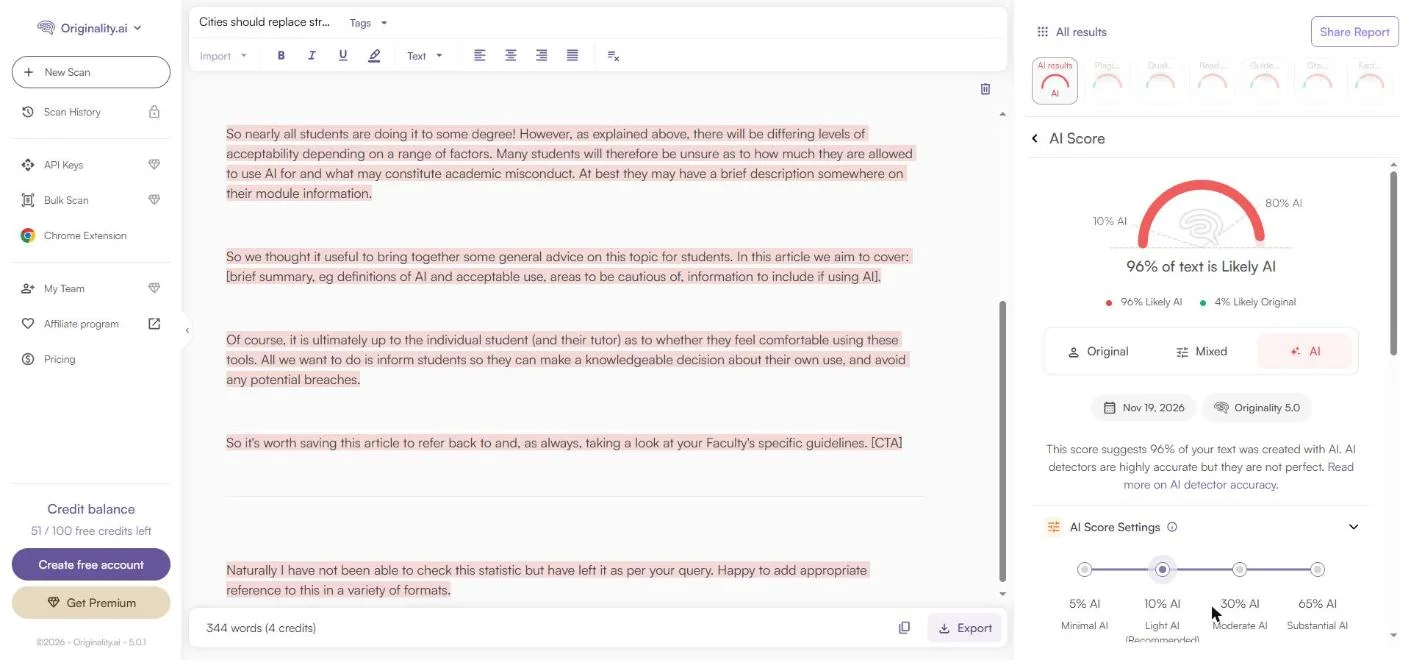
So nearly all students are doing it to some degree! However, as explained above, there will be differing levels of acceptability depending on a range of factors. Many students will therefore be unsure as to how much they are allowed to use AI for and what may constitute academic misconduct. At best they may have a brief description somewhere on their module information.
So we thought it useful to bring together some general advice on this topic for students. In this article we aim to cover: [brief summary, eg definitions of AI and acceptable use, areas to be cautious of, information to include if using AI].
Of course, it is ultimately up to the individual student (and their tutor) as to whether they feel comfortable using these tools. All we want to do is inform students so they can make a knowledgeable decision about their own use, and avoid any potential breaches.
So it's worth saving this article to refer back to and, as always, taking a look at your Faculty's specific guidelines. [CTA]
---
Naturally I have not been able to check this statistic but have left it as per your query. Happy to add appropriate reference to this in a variety of formats.
Neo + humanizer ("humanize this"), run 2:
**An effective AI policy for your students**
It would be safe to say that the majority of students in any given session will have used a generative AI tool in the last 7 days. The HEPI Student Generative AI Survey 2026 found that 95% of all undergraduate students would have used one or more tools, to help them with tasks ranging from essay planning and referencing to programming. So at this point it's less a case of 'should' students be using generative AI tools and more about having appropriate policies and guidance to support their usage.
Many pieces of guidance appear to have been drafted back in 2023 and reflect an attitude that all uses of AI were likely suspicious and should therefore be prohibited. Clearly both students and many academics would have since made extensive use of the various tools available to them. But if the university's guidance hasn't changed, there is uncertainty over which uses may be acceptable and which would amount to cheating or academic misconduct.
Clearly this is unsatisfactory, with students uncertain how far they can go if wishing to act legitimately, and members of staff ill-equipped to detect or adjudicate upon inappropriate uses. You will therefore see wide variation from module to module and department to department around the extent to which students will be allowed (or expected) to use AI.
Clearly an effective policy would set out clearly and unambiguously the circumstances under which students could use AI, those in which they would need to declare their use of AI and those where it would not be acceptable. Ideally it would go further and set out expectations for the level of AI literacy all students should be aiming for, and what staff should be doing to support this.
Campusly supports universities and other HEI's in developing suitable policies. Below we highlight key considerations and features to look out for.
Protect keywords, brand names and citations
A lower score is worthless if the rewrite drops the client's brand or bends a statistic. On SEO projects, protected terms carry the search intent of the page, so losing one in a rewrite can undo the brief. Build these checks into every draft:
List protected terms (target keyword, brand names, product names, cited sources) before any rewrite.
Check every protected term after each rewrite pass with find-in-page, not by skimming.
Re-verify every cited source and figure against the original link.
Read the draft aloud to catch awkward phrasing, and keep a final human edit for the client's tone of voice.
What to say when a client's checker flags your draft
Most of these conversations go well when you lead with process instead of defending a number:
Share your drafts, outline and sources to show how the piece was built.
Explain in one or two sentences why detectors disagree, using the points from the detector section above.
Agree on a single checker and an acceptable threshold in the contract or brief before the next project starts.
Remind the client that search performance depends on helpfulness and accuracy, which is exactly what your edit protects.
Settle this before the work starts, not after a flag. A two-line clause in the brief that names one checker and an agreed threshold saves an argument later, and it shows the client you take their concern seriously.
Scenario 3: a business wants a support chatbot that sounds human
To make a support chatbot sound more human without misleading anyone, tune its tone, its knowledge base and its human handoff, and tell people up front that they are talking to AI.
Detector scores don't matter in live chat, because no customer pastes a support reply into GPTZero. What matters is whether the reply is correct, sounds like the brand and solves the problem, or hands off quickly when it can't.
That is why Prompt C, the support reply, is the only prompt on this page scored without detectors. In a live chat, a score has no reader. Here is how each chatbot did on the meaning and tone rubric:
Policy facts kept (14-day window, annual plans only, 5 to 10 business days, Billing > Request refund): ChatGPT 4 of 4 in both runs, Gemini 4 of 4 in both runs (adds a "full" refund the policy doesn't mention), Claude 4 of 4 in both runs (also adds a "full" refund), Neo 4 of 4 in both runs (run 1 hedges the timeline with "usually").
Tone match with the brief (warm, plain, no exclamation marks): ChatGPT pass, Gemini pass, Claude pass, Neo pass.
Clarity (one clear next step, no filler apology loop): ChatGPT partial (run 1 closes with "We're sorry to see you go," though the customer only asked about a refund), Gemini pass, Claude pass, Neo pass.
Every reply got the 14-day window, the Billing > Request refund path and the 5-to-10-business-day timeline right, so the differences were small: Gemini and Claude promised a "full" refund the policy never mentions, and Neo's first reply softened the timeline to "usually within 5 to 10 business days."
If your team also replies by email, see our guide to the best AI chatbot for work emails, with tested prompts.
Full outputs: All four Prompt C outputs (Neo default only)
ChatGPT, run 1:
Hi there,
Yes, you’re eligible for a refund. Since you purchased the annual plan 10 days ago, you’re still within our 14-day refund window.
To request your refund, simply go to Billing > Request refund in your account.
Once approved, the refund will be sent to your original payment method within 5 to 10 business days.
We’re sorry to see you go, but we appreciate you giving Brightloop a try.
Best regards,
The Brightloop team
ChatGPT, run 2:
Hi,
Thanks for reaching out. Yes, you’re eligible for a refund. Our annual plans can be refunded within 14 days of purchase, and since you purchased yours 10 days ago, you’re within that window.
To request your refund, go to Billing > Request refund in your Brightloop account.
Once approved, the refund will be sent to your original payment method within 5-10 business days.
We’re happy to help if you have any questions.
Best regards,
The Brightloop team
Gemini, run 1:
Yes, you are eligible for a full refund since you purchased your annual plan within the 14-day refund window.
To submit your request, please sign in to your account and go to Billing > Request refund. Once processed, your refund will be returned to your original payment method within 5 to 10 business days.
Please let us know if you run into any trouble or have any other questions.
Warm regards,
The Brightloop team
Gemini, run 2:
Yes, you are eligible for a full refund since you purchased your annual plan within the last 14 days.
To submit your request, please log in to your account and go to Billing > Request refund. Once your request is processed, the funds will be returned to your original payment method within 5 to 10 business days.
Please let us know if you need any help with the process.
Warm regards,
The Brightloop team
Claude, run 1:
Thanks for getting in touch. Since you bought the annual plan 10 days ago, you’re still within our 14-day refund window, so you’re eligible for a full refund.
To request it, go to Billing > Request refund in your account. Please do this within the next four days, as the window closes at 14 days from purchase.
Once your request is submitted, the money goes back to your original payment method within 5 to 10 business days.
We’re sorry the plan hasn’t been the right fit, and we appreciate you giving it a try. If anything is unclear along the way, just reply here and we’ll help.
Warm regards,
The Brightloop team
Claude, run 2:
Hi there,
Thanks for reaching out. Since you bought the annual plan 10 days ago, you’re still within our 14-day refund window, so you’re eligible for a full refund.
To request it, go to Billing > Request refund in your account. Once it’s submitted, the money goes back to your original payment method within 5 to 10 business days.
I’d suggest submitting the request in the next few days, as the window closes at 14 days from your purchase date. If anything doesn’t look right when you try, just reply here and we’ll help.
Warm regards,
The Brightloop team
Neo default, run 1:
Yes, you can. Annual plans can be refunded within 14 days of purchase, and you are 10 days in, so you are still inside that window. Just go to Billing > Request refund and send it through there. Once it is approved, the money goes back to the original payment method, usually within 5 to 10 business days. If anything looks off when you submit it, reply here and we will sort it out with you.
Warm regards,
The Brightloop team
Neo default, run 2:
Yes, you're within the 14-day window, so we can refund your annual plan. Head to Billing > Request refund to submit it, and the money goes back to your original payment method within 5 to 10 business days. Thanks for giving Brightloop a try, and if anything else comes up, we're here.
Warmly,
The Brightloop team
Customers notice when a business hides the bot. Five9's 2026 Consumer CX Report, a survey of 3,000 consumers in the US, UK and Germany, found that 71% consider it very or extremely important to know immediately when they are talking to an AI agent. Trust in AI service rose to 55% when a human option was visible, against 26% when it wasn't.
For a small business, those two numbers point to the same fix. Say up front that the assistant is AI, and keep the route to a person visible on every screen.
Five fixes for a robotic support bot
Most "robotic" complaints come from setup, not from the model. These five changes fix the bulk of them:
A written tone-of-voice guide with sample replies: collect 5 to 10 real answers in the brand's voice, plus a short list of words the bot must never use.
A living knowledge base with a named owner and a review date: stale policy pages are the main cause of confident wrong answers.
At most one clarifying question before offering a human: this fixes the repeated-question loop people complain about in reviews.
A visible human handoff on every screen: a button or a typed command, not an option buried in a menu.
A weekly review of real transcripts: tag the failed chats, then fix the knowledge base or tone guide, not just the prompt.
None of these fixes needs a new platform. They are content and process work, which a small team can finish in a few weeks, while switching models rarely changes how customers feel about the bot.
These fixes also make disclosure easier, because a bot that hands off well has nothing to hide. If you searched for how to make a chatbot undetectable, this is the useful version of that goal: a bot that sounds like your brand and says plainly that it's AI.
How to make an AI chatbot in five steps
If you are building one from scratch, the order matters more than the platform. Here is how to make an AI chatbot that customers trust:
Step | What you need | Common mistake |
|---|---|---|
1. Define the bot's jobs and limits | A list of the questions the bot answers and the topics it must hand off (billing disputes, complaints, legal) | Letting the bot answer everything, including questions it has no source for |
2. Gather the knowledge base | Current help docs, policies and FAQs, with one owner and a review date | Uploading old PDFs that contradict the live website |
3. Write the tone guide and the disclosure line | Sample replies in the brand voice and a one-line "you're chatting with an AI assistant" message | Making the bot pretend to be a named human agent |
4. Set the handoff rules | Triggers (frustration words, two failed answers, sensitive topics) and staffed hours or a ticket fallback | A handoff button that leads to a dead inbox |
5. Test with real transcripts | Past support chats and a simple scoring sheet (facts kept, tone, clarity) | Testing only with the team's own polite, well-formed questions |
Test with the 20 to 30 most common real questions from your support inbox, not invented ones. People who look for an "ai to make chatbot undetectable" usually discover that this testing step, not a rewriting trick, is what makes a bot sound natural.
Is it legal to hide that a chatbot is AI?
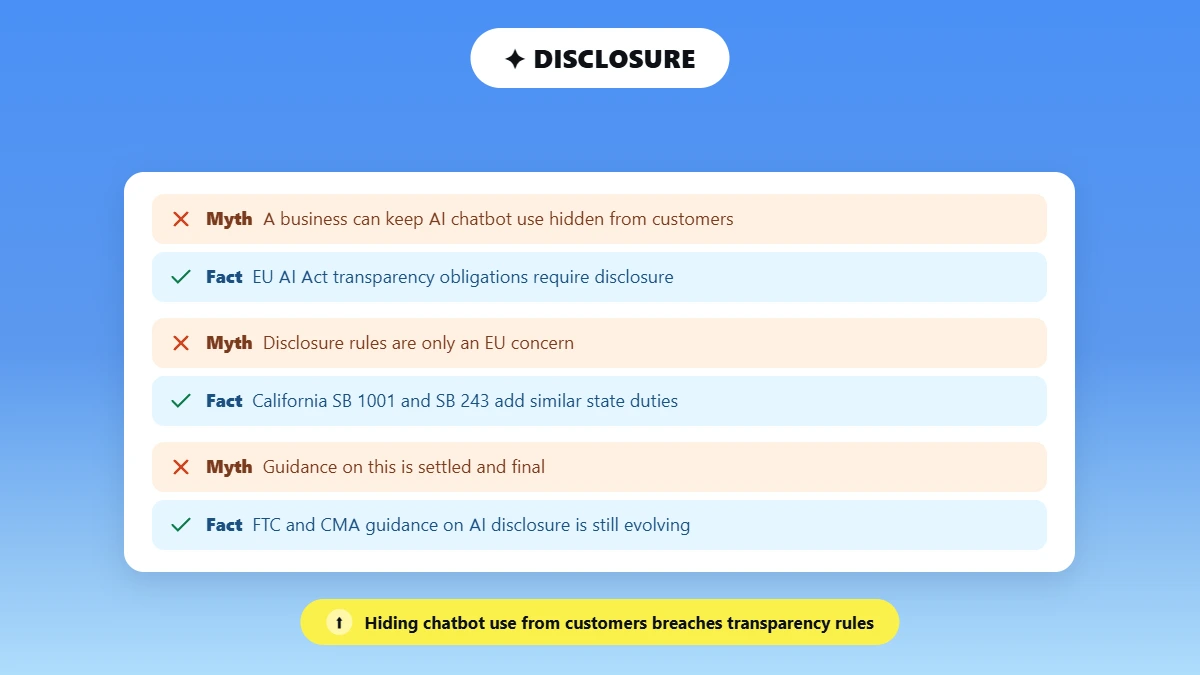
In the EU, no. Since 2 August 2026, Article 50(1) of the EU AI Act (Regulation (EU) 2024/1689) requires providers to design chatbots so that people are told they are interacting with an AI system, unless that is obvious to a reasonably well-informed person from the context.
The 2026 Digital Omnibus delayed the Act's high-risk rules but left the chatbot disclosure duty on its original date. The only grace period covers the machine-readable marking of AI-generated content under Article 50(2), which applies from 2 December 2026 for systems already on the market before August, and the European Commission published its guidelines on Article 50 on 20 July 2026.
Article 50(1) puts the design duty on the provider, the company that builds or sells the chatbot. If you run a vendor's chatbot on your own site, check that the widget shows an AI notice at first contact, and don't rename the bot in a way that hides it.
The rule also reaches beyond EU companies. A business based in the US or Asia whose chatbot talks to people in the EU falls inside the Act, because what counts is where the system's output is used, not where the company sits.
The "obvious from context" exception is narrow. A bot with a human first name and a stock photo isn't obviously AI to an ordinary visitor, so most support bots need an explicit line.
Outside the EU, the rules are patchier but point the same way. California requires bot disclosure in sales and election contexts and, since January 2026, for companion chatbots, while US and UK regulators treat misleading customers as a consumer-protection problem whether or not AI is involved.
In the US, the safest reading is simple: if a reasonable customer would assume they're chatting with a person, tell them they aren't. The UK has no chatbot-specific rule yet, but the CMA's power to fine directly, in place since April 2025, makes misleading design a more expensive mistake than it used to be.
Jurisdiction | Rule | What it requires | Penalty | Primary source |
|---|---|---|---|---|
European Union | EU AI Act, Article 50 (Regulation (EU) 2024/1689) | Providers must make sure people know they are interacting with an AI system, from 2 August 2026, unless it is obvious from context. Machine-readable marking of AI output (50(2)) from 2 December 2026 for existing systems. | Up to €15 million or 3% of worldwide annual turnover, whichever is higher; for SMEs, whichever is lower (Article 99(4)) | EUR-Lex · [Commission guidelines on Article 50, 20 July 2026](https://digital-strategy.ec.europa.eu/en/library/guidelines-transparency-obligations-providers-and-deployers-ai-systems) |
California, US | BOT Act, SB 1001 (Bus. & Prof. Code §17940 et seq.) | Unlawful to use a bot online to mislead a person in California about its artificial identity to sell goods or services or influence a vote. A clear, conspicuous disclosure that it is a bot removes liability. | No penalty in the BOT Act itself; its duties add to other California law, so enforcement would run through general consumer-protection law such as the Unfair Competition Law | [leginfo: SB 1001](https://leginfo.legislature.ca.gov/faces/billNavClient.xhtml?bill_id=201720180SB1001) |
California, US | SB 243, companion chatbots (signed 13 October 2025, in force 1 January 2026) | Operators of companion chatbots must disclose that the chatbot is artificial, with extra protections for minors. Mostly affects bots built to meet social needs, not routine customer service. | Private right of action for people injured by a violation | [leginfo: SB 243](https://leginfo.legislature.ca.gov/faces/billNavClient.xhtml?bill_id=202520260SB243) |
United States (federal) | FTC Act, Section 5 (unfair or deceptive practices) | No AI-specific disclosure rule; deceiving consumers about who or what they are dealing with can be a deceptive practice. In September 2025 the FTC opened a 6(b) inquiry into AI chatbots acting as companions. | No fine for a first Section 5 violation in most cases; civil penalties apply when a business breaks an FTC order or trade regulation rule | |
United Kingdom | Digital Markets, Competition and Consumers Act 2024 (consumer provisions in force 6 April 2025) | No AI-specific chatbot disclosure law found as of November 20, 2026. Misleading consumers is an unfair commercial practice, and the CMA can now enforce directly. | Fines of up to 10% of global annual turnover | [gov.uk: CMA200 Direct consumer enforcement guidance, 14 March 2025](https://www.gov.uk/government/publications/direct-consumer-enforcement-guidance-cma200) |
Read across the rows and one pattern stands out. No jurisdiction on this list punishes a business for saying its chatbot is AI, while several punish hiding it, so disclosure is the low-risk default everywhere.
Disclosure doesn't have to sound like a legal notice. These three lines are ready to adapt:
Welcome message: "Hi, I'm [Brand]'s AI assistant. I can help with orders, returns and account questions, and I'll connect you to a person anytime."
Handoff: "I'm an AI assistant, and this one needs a human. I'm passing you to our team now, and they'll see this conversation."
Email footer: "This reply was drafted with AI assistance and reviewed by our support team."
This is general information, not legal advice. Check the rules that apply to your business with a qualified adviser.
The full scorecard: which chatbot replies read most human
Is there any AI chatbot whose writing AI detectors cannot catch? No. In our November 19 to 20, 2026 test, no chatbot, including Phrasly's Neo, passed every detector on every prompt. The closest was Neo with its humanizer, which passed all five on the student paragraph in both runs and on one of two client blog intros. An undetectable AI chatbot, in the strict sense, didn't show up in our data.
The method stays the same throughout: the same three prompts, the same detectors and settings, plus a meaning score for facts kept, protected terms kept and word count change. Prompt C is scored on meaning and tone only, for the reasons given in Scenario 3.
Test dates: November 19, 2026 (Claude: November 20, 2026). Models: ChatGPT 6 Instant (Free), Gemini 4 Hydrogen (Free), Claude Sonnet 5.5 (Free), Neo (Phrasly Unlimited plan), humanizer Phrasly Ultra in Balanced mode. Detectors: GPTZero Basic Scan 5.0b, Originality.ai 5.0, Copyleaks web (sensitivity 2 of 3), ZeroGPT web. Scores are run 1 / run 2.
Chatbot | Prompt | GPTZero (% AI) | Originality.ai (% AI) | Copyleaks | ZeroGPT | Meaning score (facts, terms, word change) |
|---|---|---|---|---|---|---|
ChatGPT (6 Instant) | A: student paragraph | 1 (mixed) / 100 | 96 / 97 | 100% / 100% | 100% / 100% | -7% / -4% words vs 250 |
Gemini (4 Hydrogen) | A: student paragraph | 100 / 100 | 97 / 97 | 100% / 100% | 100% / 100% | -8% / -8% words |
Claude (Sonnet 5.5) | A: student paragraph | 100 / 100 | 96 / 97 | 100% / 100% | 100% / 100% | +12% / +14% words |
Neo default | A: student paragraph | 100 / 100 | 95 / 99 | 100% / 100% | 100% / 100% | -1% / -17% words |
Neo + humanizer (Phrasly Ultra, Balanced) | A: student paragraph | 0 / 0 | 7 / 5 | 0% / 0% | 0% / 0% | -19% / -24% words; run 1 drops the thesis |
ChatGPT (6 Instant) | B: client blog intro | 100 / 100 | 97 / 98 | 100% / 100% | 100% / 100% | 2 of 2 terms, facts kept, -6% / -3% words |
Gemini (4 Hydrogen) | B: client blog intro | 100 / 100 | 97 / 96 | 100% / 100% | 100% / 100% | 2 of 2 terms, facts kept, -13% / -8% words |
Claude (Sonnet 5.5) | B: client blog intro | 100 / 100 | 99 / 97 | 100% / 100% | 100% / 100% | 2 of 2 terms, facts kept, -10% / -2% words |
Neo default | B: client blog intro | 100 / 100 | 99 / 99 | 100% / 100% | 100% / 100% | 1 of 2 / 2 of 2 terms, facts kept, -10% / +1% words |
Neo + humanizer | B: client blog intro | 0 / 0 | 96 / 6 | 0% / 0% | 0% / 0% | 0 of 2 / 1 of 2 terms, facts changed, -8% / +5% words |
ChatGPT (6 Instant) | C: support reply | Not scored (live chat) | Not scored (live chat) | Not scored (live chat) | Not scored (live chat) | 4 of 4 facts, tone pass, clarity partial |
Gemini (4 Hydrogen) | C: support reply | Not scored (live chat) | Not scored (live chat) | Not scored (live chat) | Not scored (live chat) | 4 of 4 facts (adds full refund), tone pass, clarity pass |
Claude (Sonnet 5.5) | C: support reply | Not scored (live chat) | Not scored (live chat) | Not scored (live chat) | Not scored (live chat) | 4 of 4 facts (adds full refund), tone pass, clarity pass |
Neo default | C: support reply | Not scored (live chat) | Not scored (live chat) | Not scored (live chat) | Not scored (live chat) | 4 of 4 facts, tone pass, clarity pass |
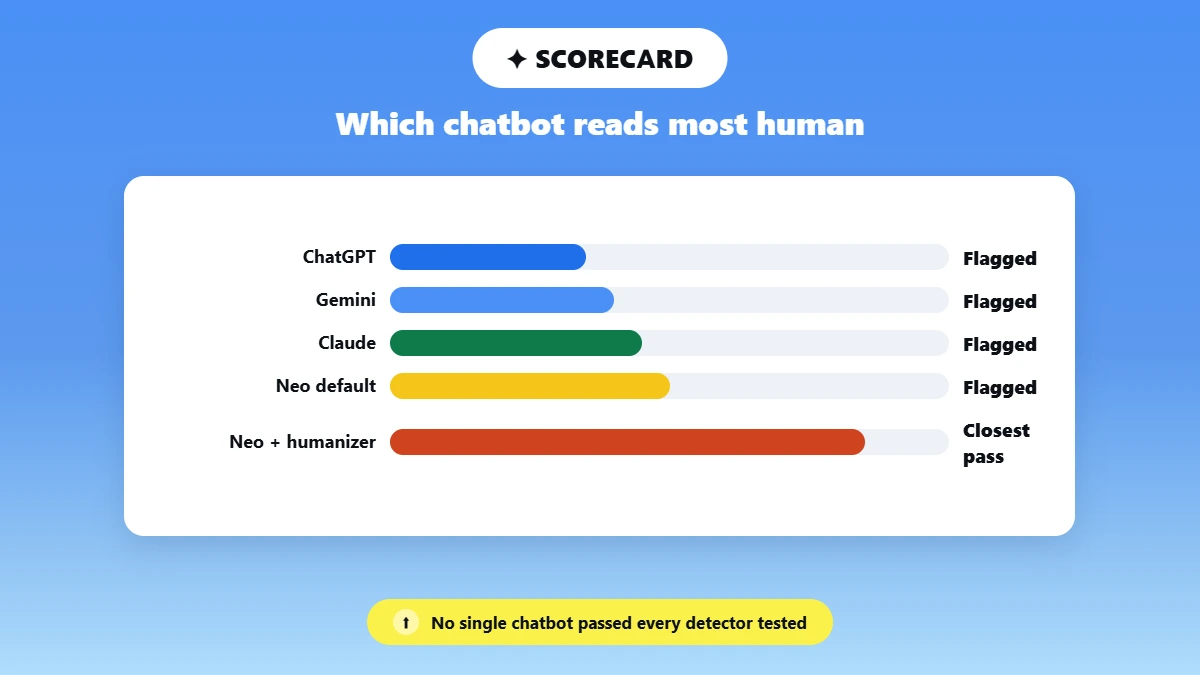
The same reply often got very different numbers from different tools, and the reasons behind that are covered in our guide to why AI detectors give conflicting scores.
That spread is the most useful result in the whole test. If two well-known tools can't agree on the same paragraph, a single score shouldn't decide a grade, a payment or a client relationship.
The most accurate AI chatbot depends on the job
What is the most accurate AI chatbot, or the best AI chatbot? It depends on the task, and on this page "accurate" means facts kept, not detector scores.
For reasoning and search as well as writing, see our six-chatbot test of the smartest AI chatbot.
For client copy, Gemini, ChatGPT and Claude were strongest on Prompt B: all three kept the brand name, keyword and HEPI figure in both runs. For support replies, all four default replies kept every Prompt C policy fact, so tone details decided it. Neo's humanizer dropped or changed protected terms in both Prompt B runs, including the brand name and the HEPI figure in run 1.
Will AI text ever be truly undetectable?
Neither side has a permanent edge, and three forces keep the balance moving. The first is AI watermarking: Google already watermarks Gemini output with SynthID, and from 2 December 2026 the EU AI Act requires machine-readable marking of AI-generated text from systems already on the market, which gives detectors a signal that doesn't depend on writing style.
The second is adversarial paraphrasing, which the 2025 PADBen and Chicago results both show can still break many detectors. The third is detector updates, since every vendor retrains on new models and new humanizers, so a result from six months ago says little about today.
Vendor claims sit on both sides of this race, and each should be read as marketing. Undetectable AI markets output that scores "up to 100% human," GPTZero claims 99% accuracy, and in Originality.ai's own test of Undetectable AI, its detector flagged the humanized text at 100%. For the head-to-head of Undetectable AI vs GPTZero, see FAQ 3.
Three takeaways from our run:
No chatbot reliably passed every detector. Neo with its humanizer came closest, passing all five on three of its four Prompt A and B replies, but Originality.ai flagged the fourth at 96% AI and scored its regenerated twin at 6%.
The replies that scored most human were also the ones that changed the facts, which makes meaning drift a bigger risk for client and student work than any single detector score.
A human edit beats any single tool: every dropped term and changed figure in our test took one careful read to spot, and no detector flagged any of them.
Pick the chatbot setup that fits your scenario
Start from the scenario you're in, not from the tool:
Student: follow your syllabus's AI policy, keep your drafts and version history, and use AI for feedback, not for the text you submit.
Freelancer or marketer: protect key terms (brand names, target keywords, stats, links), check meaning against the brief, and agree in writing on which checker the client uses, if any.
Business: disclose that the bot is AI, tune its tone and handoff, and ignore detector scores in live chat.
Whatever you pick, the scorecard points to the same thing: no setup removes the need for a human check.
Check every reply before it leaves your hands
A quick three-part check catches most problems:
Facts: numbers, dates and policy details match the source.
Protected terms: names, keywords and links are still there and spelled correctly.
Tone: it reads like the person or brand sending it.
The check takes about as long as reading the reply twice, and it is the step most people skip. If a reply fails any of the three, fix it before you think about detector scores, because a correct, on-brand reply with a middling score is still the better reply.
Keep a human editor in the loop
A rewriter changes words, but only a person knows what the client, teacher or customer actually needs. In our Prompt B run, Neo's humanizer dropped "Campusly" and the target keyword in run 1 and rewrote the HEPI figure, and no detector score would have caught that.
An editor who knows the brief fixes those problems in minutes. If you want a starting draft that needs less fixing, we compared chatbots that write like a human in an earlier head-to-head.
Try Neo, the Phrasly chatbot with a built-in humanizer
Does every Neo answer use the humanizer? No. As the Neo page puts it, Neo is optimized for natural writing on its own, and the humanizer is a separate tool that Neo uses when you ask it to humanize text, so a chat reply is not automatically a humanizer run or a guarantee of any detector result.
Neo is Phrasly's everyday chatbot for drafting replies, blog intros and paragraphs that read naturally, with Phrasly's humanizer and AI detector available inside the same conversation. It's available on every Phrasly plan with daily limits, and you can see how it scored, misses included, in the full scorecard above.
If you came here for a chatbot with a built-in humanizer rather than an undetectable AI chatbot promise, that's the honest version of what Neo offers: one place to draft, rewrite and check.
Frequently asked questions
"Undetectable AI" is a label, not a guarantee. It usually means a humanizer or rewriter that changes wording, sentence length and rhythm so detector scores drop, and an undetectable AI chatbot is a chatbot whose replies go through that kind of rewrite. No tool can promise a pass, because every detector scores text differently, as the scorecard above shows.