Best AI Chatbot for Writing That Sounds Human (2026 Test)
19 min read
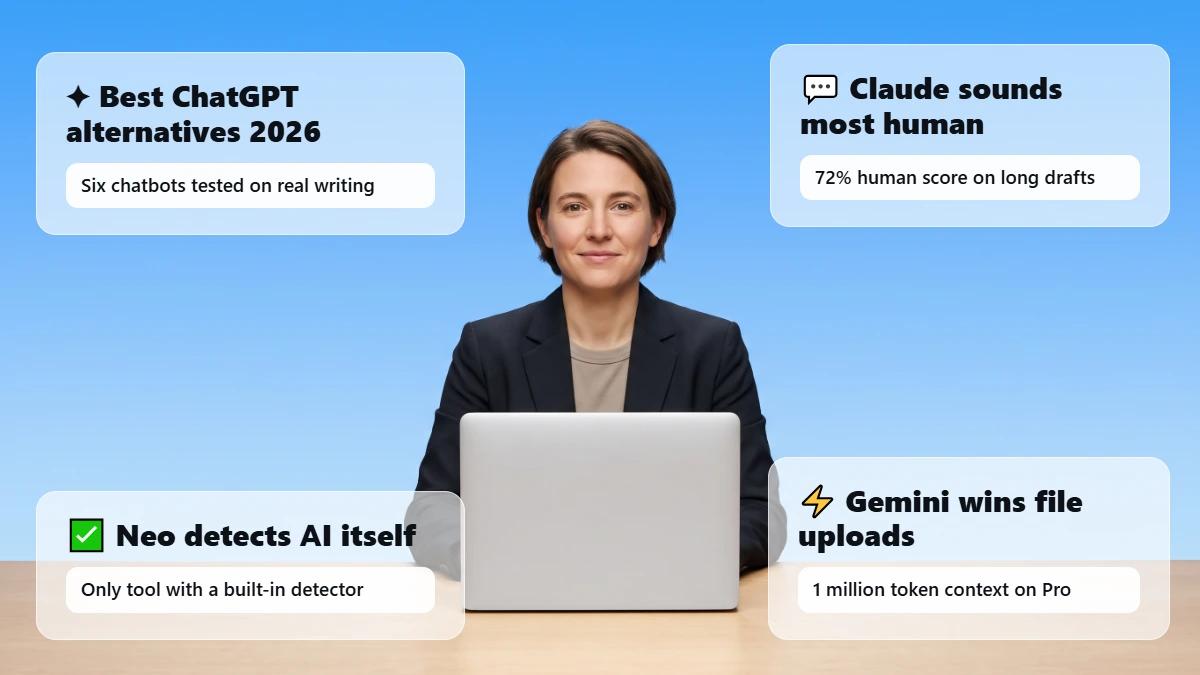
Four chatbots, three prompts, zero edits. If you want an ai that writes like a human, the honest answer depends on the task, not the brand name, and no chatbot won every round in our test. In our scoring, Phrasly Neo had the lowest average AI score (40%) and Gemini came second (65%), ahead of Claude (71%) and ChatGPT (100%), though Claude wrote the only output rated human.
We sent the same essay paragraph, blog intro and professional email prompt to ChatGPT, Claude, Gemini and Phrasly Neo with identical settings and no manual cleanup. Every output is shown in full, scored by AI detectors and followed by a plain note on whether it sounds human.
No cherry-picking and no regenerations: each result is the first answer the tool gave, with one disclosed exception (a ChatGPT email rerun with a word limit, see Round 3). Phrasly publishes this post, and Neo got the same prompts and scoring as the other three, so you can rerun any round with your own account.
💡 Neo had the lowest average AI score in our test, 40%, against 65% to 100% for the other three chatbots. Paste your own prompt, then ask Neo to check the reply for AI in the same chat 👇
Why AI Writing Still Sounds Robotic
AI drafts sound robotic because models repeat a small set of habits that readers and detectors both learn to spot. These five tells come up in every round below:
Filler phrases: hedging openers like "it is important to note" and padding words like "overall" that people rarely use in a first draft.
Nominalizations: verbs turned into noun phrases, so "decide" becomes "make a decision" and the sentence loses energy.
Em dash overuse: clauses glued together with dashes instead of a new sentence or a comma.
Flat sentence rhythm: one medium-length sentence after another, with none of the short-long contrast people write with naturally.
Rule of three triads: exactly three examples or three adjectives, again and again.
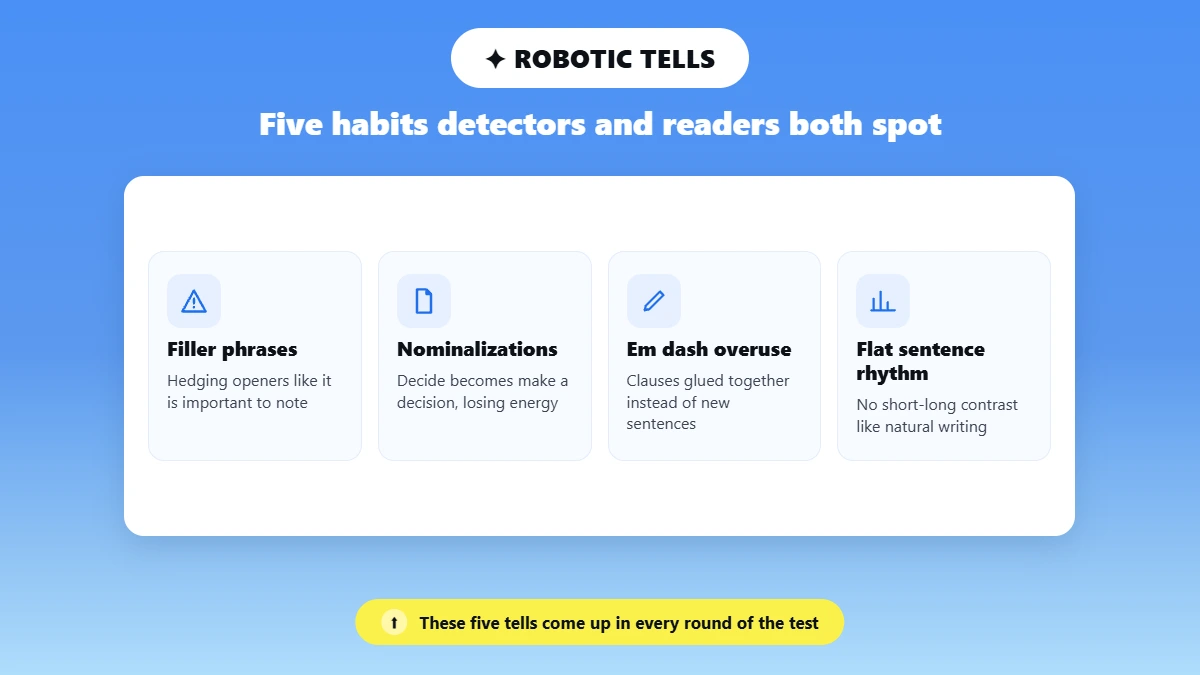
These habits are why a detector score and a reader's gut feeling usually agree. So each round pairs the score with a tone note that names the tells we found.
The Test: Same Prompt, Four Chatbots, No Edits
Each chatbot got the same three prompts, pasted verbatim into a new chat on its default model. We used no custom instructions, no system prompt changes and no regenerations, and we recorded the first reply. We ran ChatGPT, Gemini and Neo on November 3, 2026: ChatGPT Free on its default GPT-6 model in Instant mode (the app labels it "6 Instant"), Gemini on its default Flash model, Neo on Phrasly Neo and Claude on its free plan with Sonnet 5.5.
Every output went through more than one detector. Some detectors measure perplexity and burstiness, meaning how predictable each word is and how much sentence length varies, while others are trained classifiers that learn AI patterns from labelled examples. We scored every output with the Phrasly AI Detector (Model 7.0, May 2026), which reports the share of text likely written by AI from 0% to 100%, and logged the six third-party checks it shows: Pangram, Originality.ai, ZeroGPT, Turnitin, Copyleaks and GPTZero.
We also noted AI watermark signals where a detector reports them. Google has published SynthID watermarking, which covers text, so some patterns can survive light edits.
Essay prompt: "Write one 150-word paragraph for a first-year college essay arguing that remote work improves productivity."
Blog prompt: "Write a 120-word intro for a blog post about remote work burnout, for freelancers."
Email prompt: "Write a short professional email declining a meeting request and proposing another time. Polite but firm."
Detector scores below are the share of text flagged as AI, so lower means more human.
Round 1: Essay Paragraph Showdown
Which ai that writes like a human handles essays best? Neo scored best at 68% AI, while ChatGPT, Claude and Gemini were all flagged at 100%. The prompt above went to all four tools unchanged, and the full paragraphs follow.
Essay scores deserve a caution. A Stanford study found that seven popular detectors flagged more than half of TOEFL essays by non-native English writers as AI, 61% on average. Students facing Turnitin detection should treat any single score as a signal, not a verdict.
ChatGPT (GPT-6)
Remote work improves productivity because it allows employees to work in a comfortable and flexible environment while saving time and energy. One major advantage is that workers do not have to commute to an office every day, which gives them more time to focus on important tasks. For example, instead of spending hours traveling, employees can use that time to complete assignments or plan their schedules. Additionally, working from home can reduce distractions caused by noisy offices and unnecessary conversations. As a result, people may concentrate better and finish their work more efficiently. Remote work also gives employees the opportunity to organize their schedules according to their personal needs, helping them maintain a healthy balance between work and personal life. When people feel comfortable and less stressed, they are often more motivated and productive. Therefore, remote work can improve productivity by providing flexibility, reducing stress, and creating better working conditions.
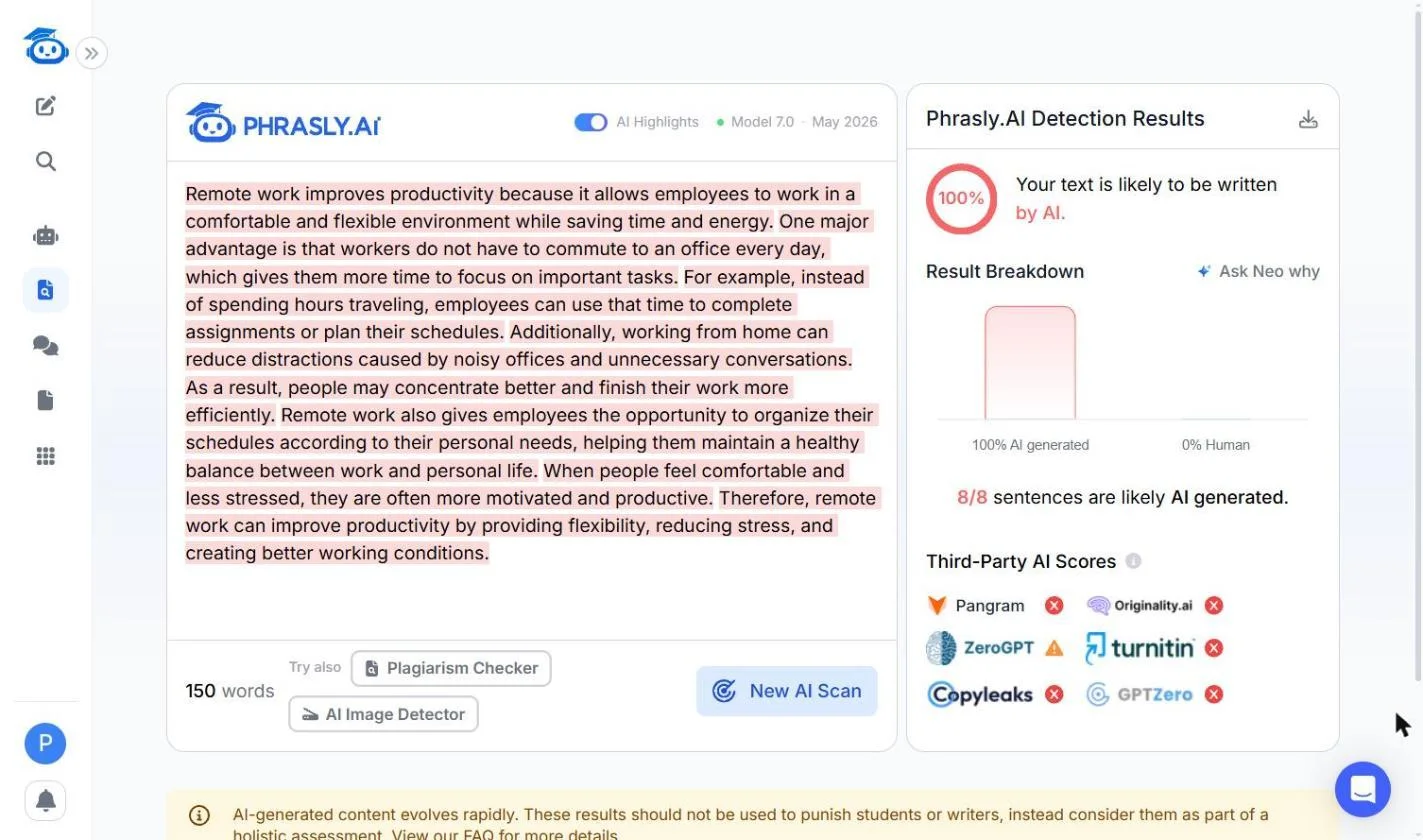
Detector score: 100% AI (8 of 8 sentences flagged), and five of the six third-party checks flagged it, with ZeroGPT showing a warning. The tone is textbook AI: sentences open with transitions like "Additionally," "As a result" and "Therefore," and the rhythm never changes. It closes on a triad (flexibility, reducing stress, better working conditions) and leans on stock phrases like "healthy balance between work and personal life."
Claude (Anthropic)
Remote work boosts productivity by giving employees control over the conditions in which they do their best work. Without a daily commute, workers reclaim hours that can go toward focused tasks, rest, or family, which reduces fatigue and burnout. Home environments also allow people to cut the constant interruptions of open offices, such as impromptu conversations and unnecessary meetings, so deep, uninterrupted work becomes far easier to achieve. Studies like Stanford economist Nicholas Bloom’s experiment with a Chinese travel agency found that remote employees completed more calls and quit at lower rates than their office-based peers. Flexibility also lets individuals schedule demanding work around their natural energy peaks, whether early morning or late evening, rather than a rigid nine-to-five. Finally, companies that offer remote options can hire from a much wider talent pool, matching skilled people to roles more effectively. Together, these advantages show that when trusted to manage their own time, workers produce more and do so more sustainably.
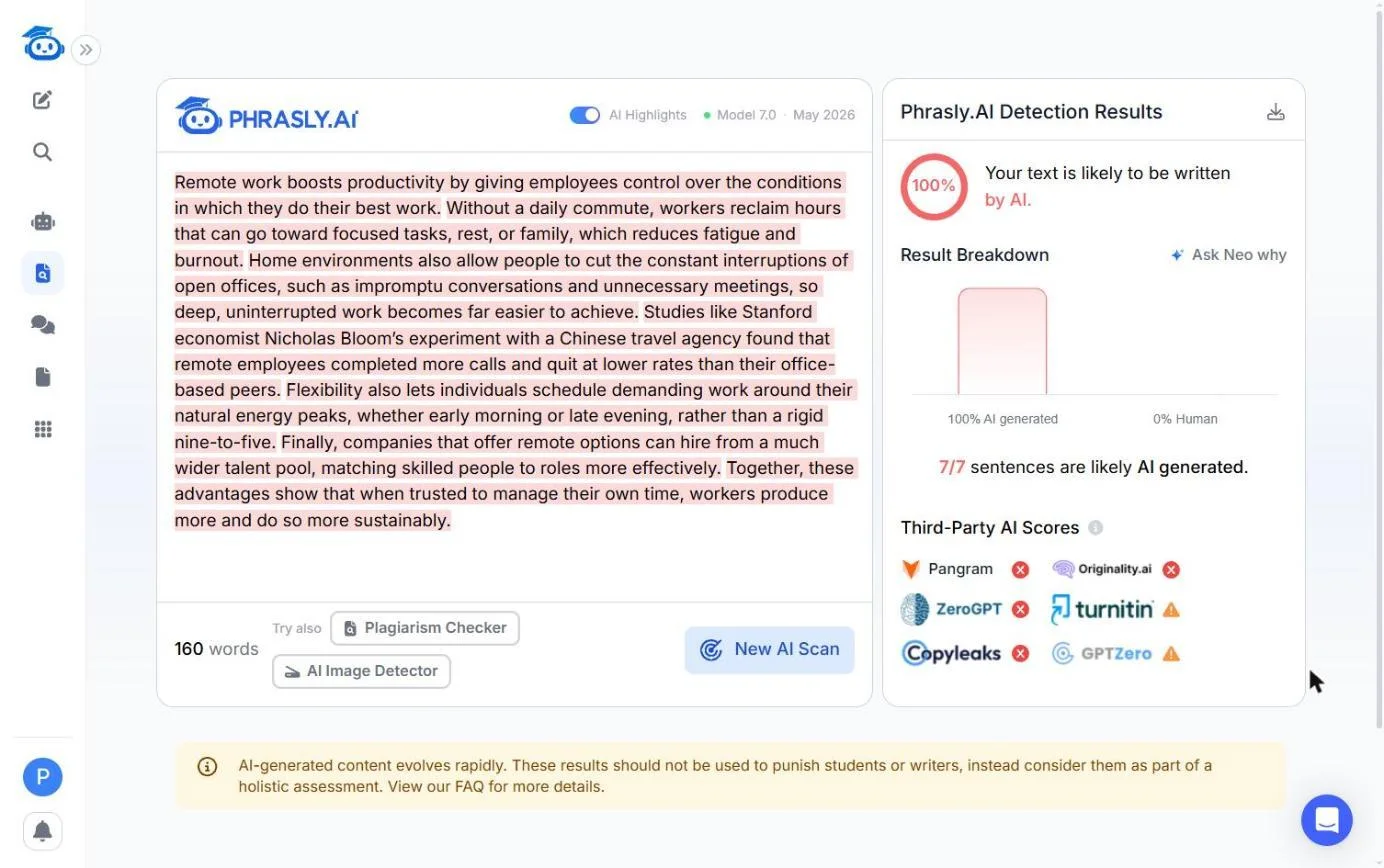
Claude Anthropic's chatbot came in with the strongest reputation, since Zapier's tester says most people find its default style more natural than ChatGPT's. Detector score: 100% AI (7 of 7 sentences flagged), with Turnitin and GPTZero showing warnings and the other four checks flagging it. On the essay, the reputation did not hold up on the detector: it is the most specific paragraph in the round, citing Nicholas Bloom's Stanford study, but it runs on signposts like "also" and "Finally" and closes on a tidy summary line, so it reads polished, not like a first-year student.
Gemini (Google)
Although remote work is often criticized for disrupting traditional workplace collaboration, the transition to telecommuting consistently enhances overall employee productivity by eliminating daily friction and creating tailored working environments. Without hours spent commuting through rush-hour traffic, workers save valuable time and mental energy, allowing them to start their days focused and unexhausted.
Furthermore, home environments enable individuals to minimize ambient office distractions, such as unscheduled desk drop-ins and noisy open-plan layouts, leading to sustained periods of deep, uninterrupted concentration. Modern asynchronous communication tools, such as project management platforms and collaborative docs, further streamline workflows, ensuring that task completion relies on tangible results rather than physical desk presence.
Rather than fostering isolation, remote work grants employees autonomy over their optimal peak performance hours. Ultimately, when organizations trust remote staff to manage their time, productivity rises alongside employee satisfaction and retention.
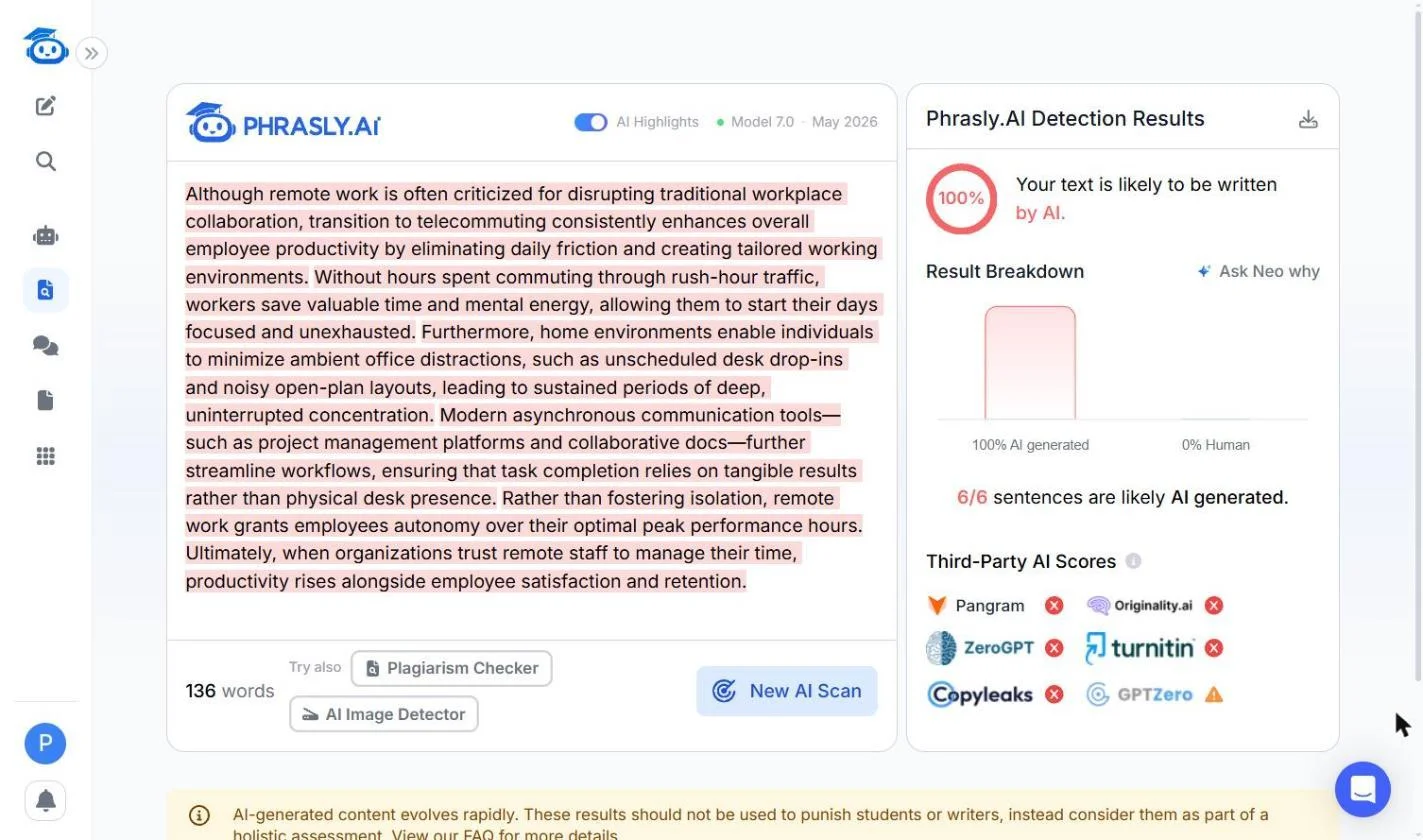
Detector score: 100% AI (6 of 6 sentences flagged), and only GPTZero stopped at a warning. Gemini sounds more academic than ChatGPT but stiffer, with heavy nominalizations ("transition to telecommuting," "task completion"), "Furthermore" and "Ultimately" as signposts, and two em dashes in one sentence. It reads like a polished template, not a first-year student.
Neo (Phrasly)
Remote work has quietly reshaped how productive people can actually be, and the evidence keeps stacking up in its favor. Without a commute eating an hour or more out of every day, employees reclaim time they can put straight back into their work or their rest, which shows up in sharper focus rather than sheer hours logged. Offices also carry constant interruptions: a colleague stopping by, a meeting that could have been an email, background noise that breaks concentration. Working from home lets people shape their own environment, protect deep-focus blocks, and handle tasks when their energy peaks instead of when a manager happens to walk past. Studies of remote teams repeatedly find output holding steady or rising, while absenteeism drops. Productivity, after all, was never really about being seen at a desk; it's about what gets finished.
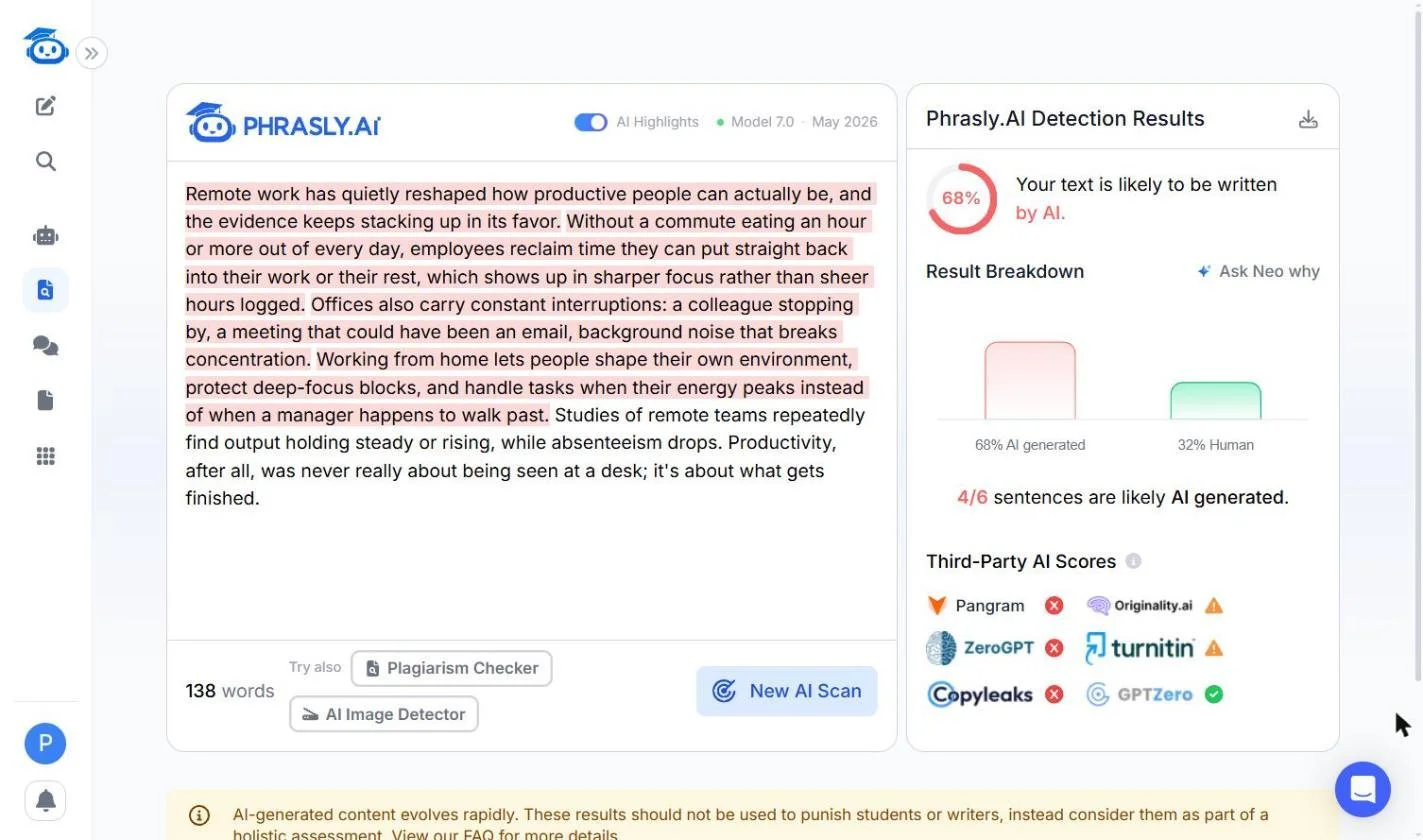
Detector score: 68% AI (4 of 6 sentences flagged), the lowest in Round 1, with GPTZero passing it and Originality.ai and Turnitin showing warnings. The rhythm varies more than ChatGPT's or Gemini's, and the closing line ("never really about being seen at a desk") sounds like a person. It still slips into one triad (shape, protect, handle) and cites "studies" without naming any, which a student would need to fix, yet Claude's more specific essay still scored 100%, so Neo kept the lowest essay score.
Tool | Detector score (Round 1) | Natural-sounding note |
|---|---|---|
ChatGPT (GPT-6) | 100% | Transition-heavy, flat rhythm, triad close |
Claude (Anthropic) | 100% | Specific, cites a study, signpost-heavy |
Gemini (Google) | 100% | Formal, heavy nominalizations, em dashes |
Neo (Phrasly) | 68% | Varied rhythm, human closing line, one triad |
Which is better for human-like writing, Claude or ChatGPT? On the essay, the ChatGPT vs Claude human-like writing gap was 0 points, so pick by the tone note rather than the brand. For an AI that writes essays like a human, that note matters more than a few points of score.
Round 2: Blog Intro Showdown
For blog intros, the ai that writes like a human is the one with a real hook and a voice, not just a low score. Neo won this round at 24% AI, ahead of Gemini at 56%, with ChatGPT and Claude both at 100%. Settings matched Round 1 exactly.
Blog intros reward personality more than essay paragraphs do, so the tone note weighs more here. We also judged each intro by the content editing workflow it would need: a light touch-up or a full rewrite.
ChatGPT (GPT-6)
Remote Work Burnout: How Freelancers Can Find Balance and Reclaim Their Energy
Freelancing offers freedom, flexibility, and the opportunity to be your own boss. But behind the perks of working remotely lies a growing challenge: burnout. When your home becomes your office, deadlines never seem to end, and the pressure to find your next client is always present; switching off can feel almost impossible. Long hours, blurred boundaries, financial uncertainty, and isolation can gradually drain your motivation and creativity. If you're a freelancer feeling exhausted, overwhelmed, or constantly connected, you're not alone. In this post, we'll explore the common signs of remote work burnout, why freelancers are particularly vulnerable, and practical strategies to protect your well-being while building a sustainable freelance career.
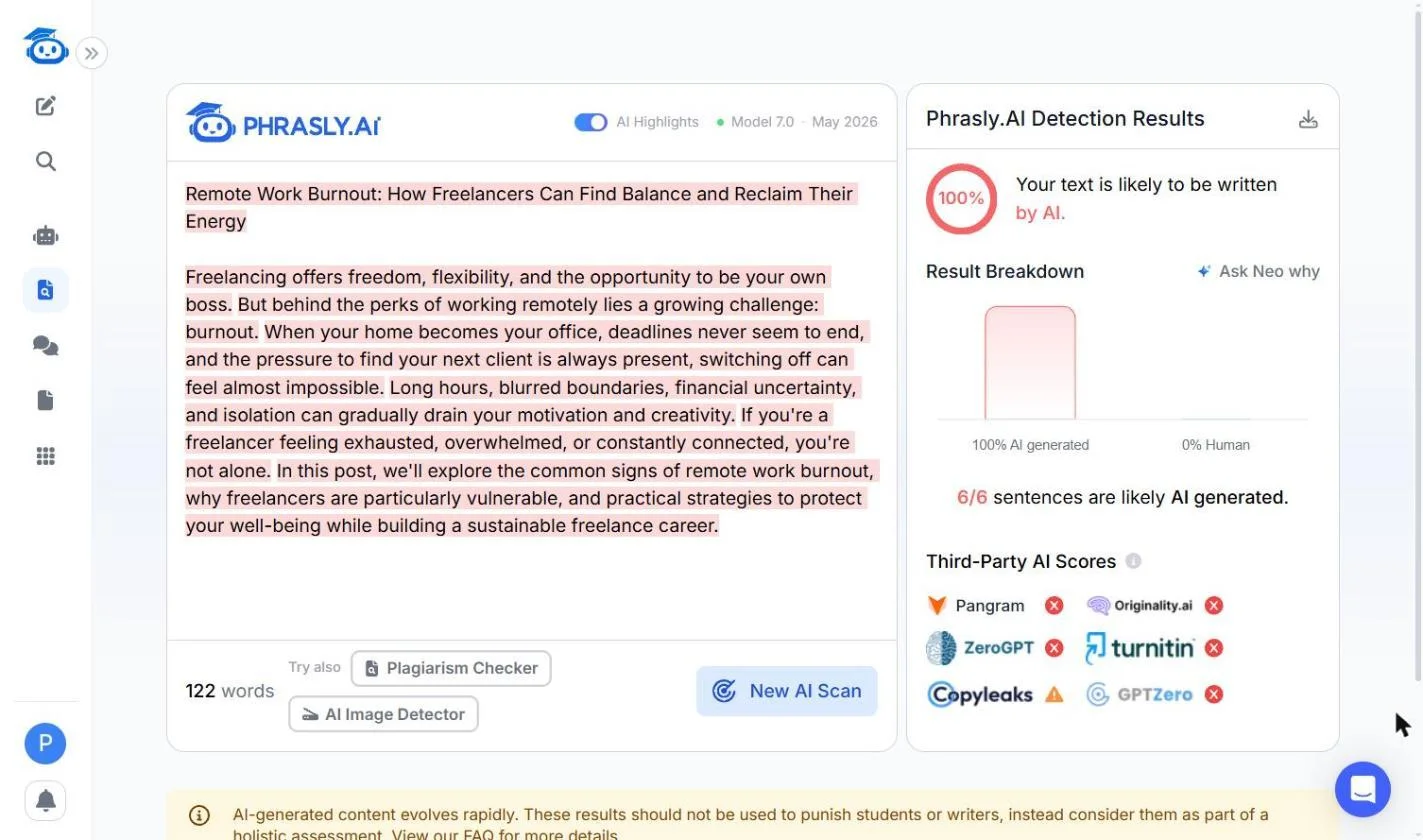
Detector score: 100% AI (6 of 6 sentences flagged), with only Copyleaks stopping at a warning. ChatGPT added a title nobody asked for and stacked triads ("freedom, flexibility, and the opportunity," "exhausted, overwhelmed, or constantly connected") before a stock "In this post, we'll explore" line, so it would need a full rewrite to sound like a person. Some users layer custom GPTs built to humanize text on top of raw ChatGPT output, but this test used plain ChatGPT only.
Claude (Anthropic)
Working alone, you’re the whole company: the one who finds clients, delivers the work, sends the invoices, and answers the late-night messages. Remote work promises freedom, but for many freelancers it quietly turns into a life where the office never closes and rest feels like falling behind.
Burnout rarely arrives with a bang. It creeps in through skipped breaks, blurred boundaries, and the constant hum of “I should be working.” If you’ve felt that exhaustion lately, you’re far from alone. In this post, we’ll look at why remote freelancers are especially vulnerable, the warning signs worth catching early, and practical ways to recover your energy.
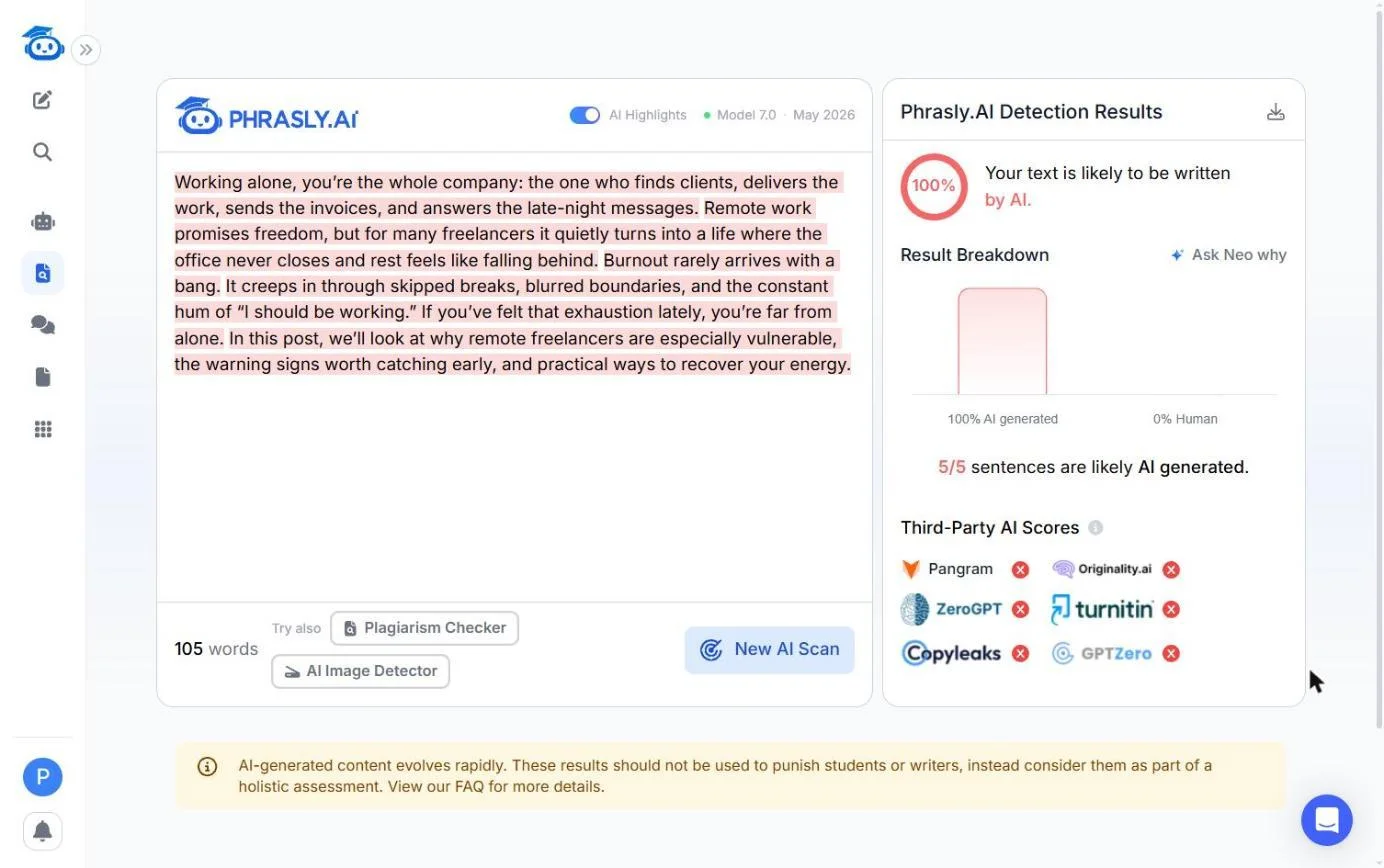
Detector score: 100% AI (5 of 5 sentences flagged), with all six third-party checks flagging it. The voice is strong ("the constant hum of 'I should be working'") and the short "Burnout rarely arrives with a bang" line adds rhythm, but it stacks two triads and ends on the same "In this post, we'll look at" formula as ChatGPT, even though many readers would call it human. A natural voice does not hide every signal, which is why AI watermarks break most humanizers.
Gemini (Google)
The freedom of freelancing is unmatched, until the boundary between your living room and your office completely disappears. When you are the boss, the employee, and the sole administrator of your business, "hitting the wall" hits differently. Freelancer burnout isn't just standard fatigue; it is a quiet, compounding exhaustion fueled by constant hustle, unyielding deadlines, and the persistent anxiety of an unpredictable income stream.
Because off-the-clock time feels like lost revenue, taking a break often carries an absurd sense of guilt. But running on fumes is bad for business and worse for your health. If you are waking up dreading the client queue you once loved, it is time to reassess, re-establish your boundaries, and reclaim your balance.
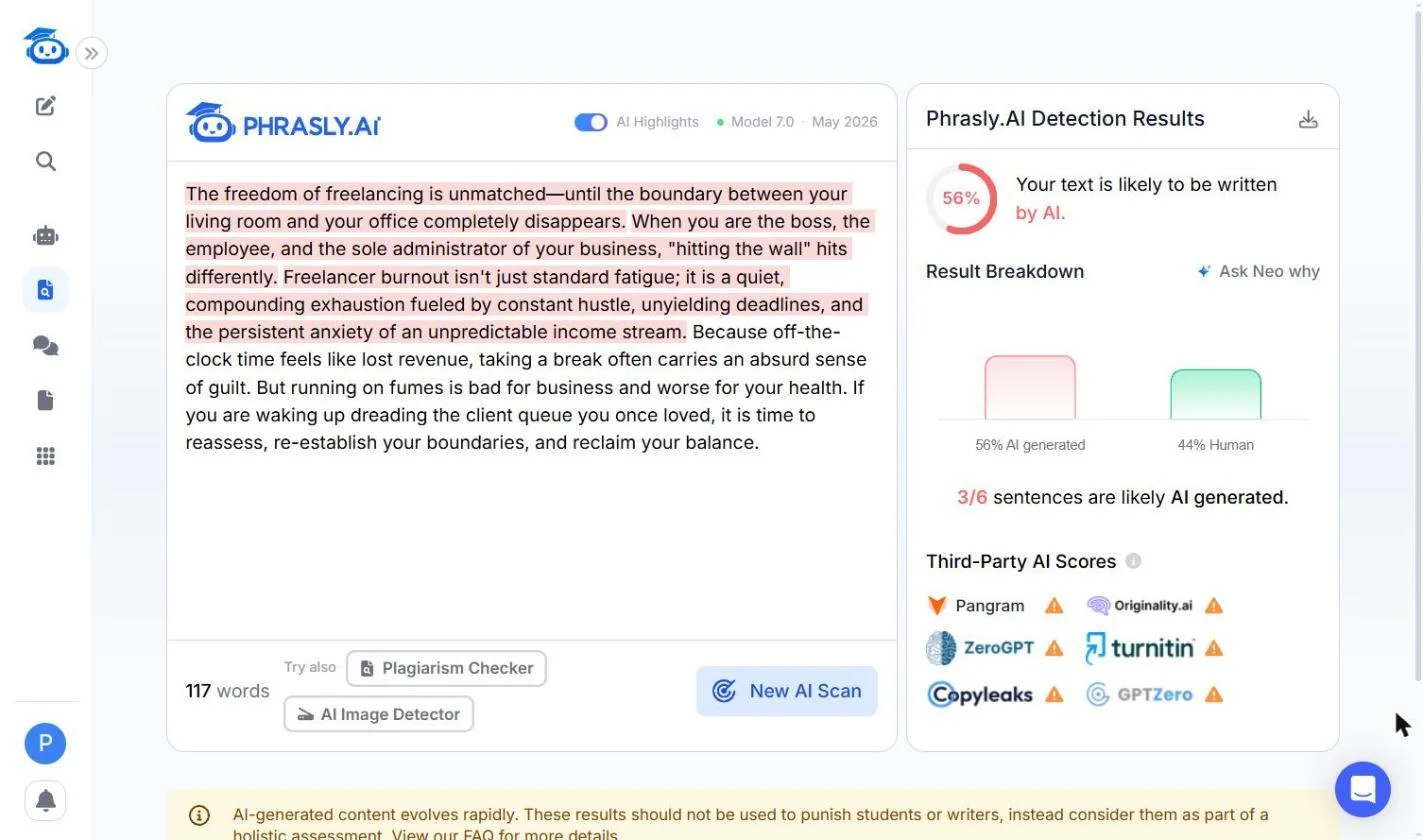
Detector score: 56% AI (3 of 6 sentences flagged), with all six third-party checks showing warnings. The opening leans on a dash and the closing on a triad ("reassess, re-establish your boundaries, and reclaim your balance"), but the middle has real voice, like the line about breaks feeling like lost revenue. A light edit of the first and last sentences would fix most of it.
Neo (Phrasly)
Remote work sounded like freedom. No commute, no cubicle, no one hovering over your shoulder. For freelancers, though, that freedom has a habit of curving back on itself. The office never closes when the office is your kitchen table. Client messages arrive at midnight. Boundaries blur until you cannot tell whether you are resting or just between tasks.
Burnout creeps in quietly for people who work alone: no colleague notices you skipping lunch for the fourth day running, no manager sends you home. This post looks at why remote work burnout hits freelancers so hard, what the early warning signs actually look like, and the practical ways to protect your energy before the crash arrives.
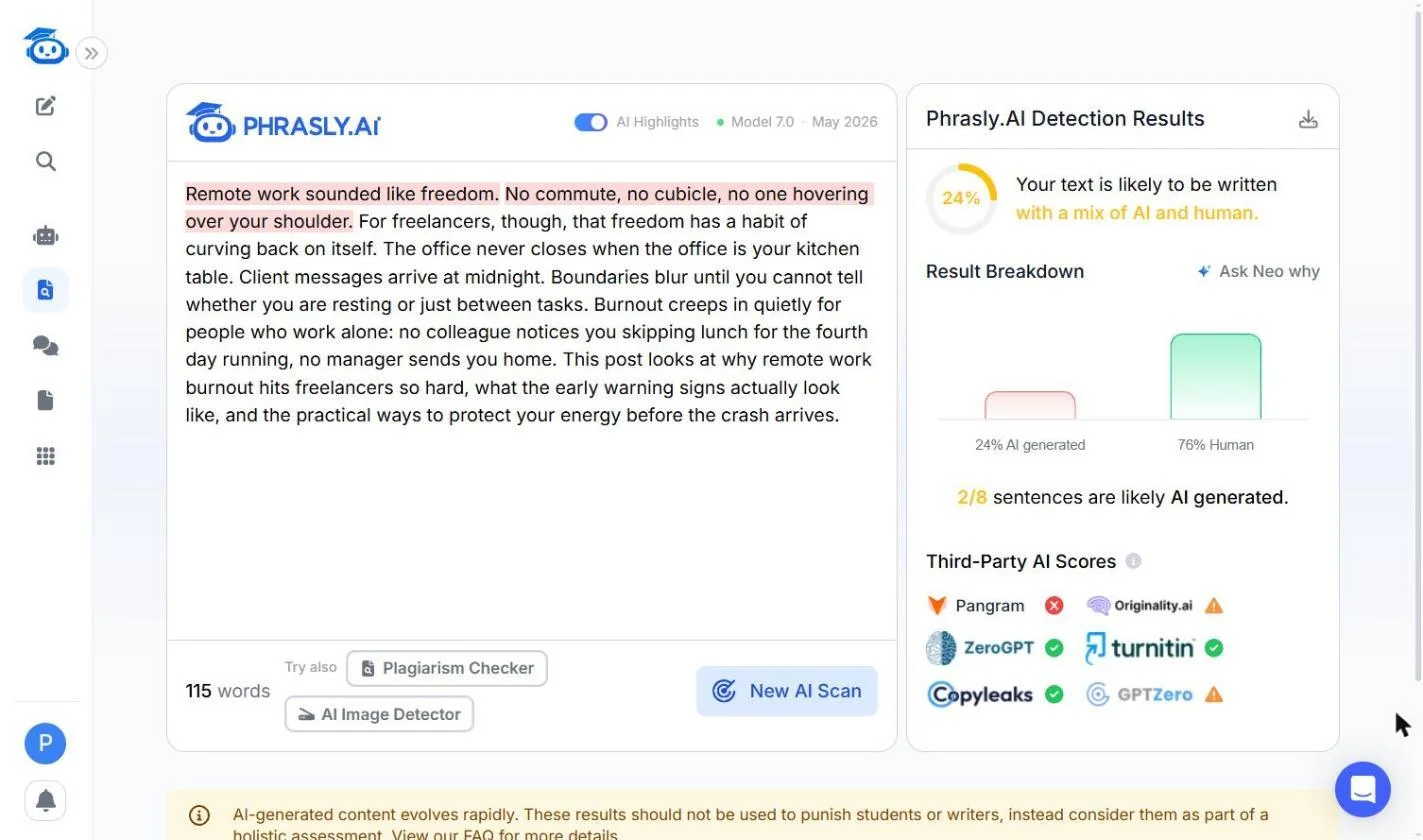
Detector score: 24% AI (2 of 8 sentences flagged), the only intro rated a mix of AI and human, with ZeroGPT, Turnitin and Copyleaks passing it. Short sentences and concrete details (the kitchen table, midnight client messages, skipping lunch for the fourth day) give it the short-long contrast people write with, so it needs only a light touch-up. Phrasly describes Neo as optimized for natural writing, so this round tests that claim directly.
Can you recommend an AI tool that sounds natural and not robotic? For blog intros, the most human-like AI writing tool in this round was Phrasly Neo, because its intro needed only light edits and was the only one rated a mix of AI and human.
Round 3: Professional Email Showdown
Email shows tone control best, because readers notice stiff corporate phrasing in two lines. Claude won this round at 14% AI, rated likely human, ahead of Neo at 28% and Gemini at 40%, with ChatGPT at 100%. Every tool got the same request: decline a meeting, propose another time, stay polite but firm.
Tone customization matters more here than in essays, since freelancers send emails in their own voice every day. Each tool offers some brand voice customization:
ChatGPT: custom instructions and saved personality settings.
Claude: built-in writing styles, plus custom styles from a sample of your writing.
Gemini: Gems with saved instructions for a repeat task.
Neo: ask for a tone, length or level of detail in the chat, then ask Neo to humanize it, with Light and stronger modes on Phrasly Ultra (paid plans and trial).
ChatGPT (GPT-6)
Subject: Meeting Request
Dear [Name],
Thank you for the invitation. Unfortunately, I won’t be able to attend the proposed meeting time due to a prior commitment. I would be happy to meet on Thursday at 2:00 PM instead. Please let me know if this alternative works for you.
Thank you for your understanding.
Best regards,
[Your Name]
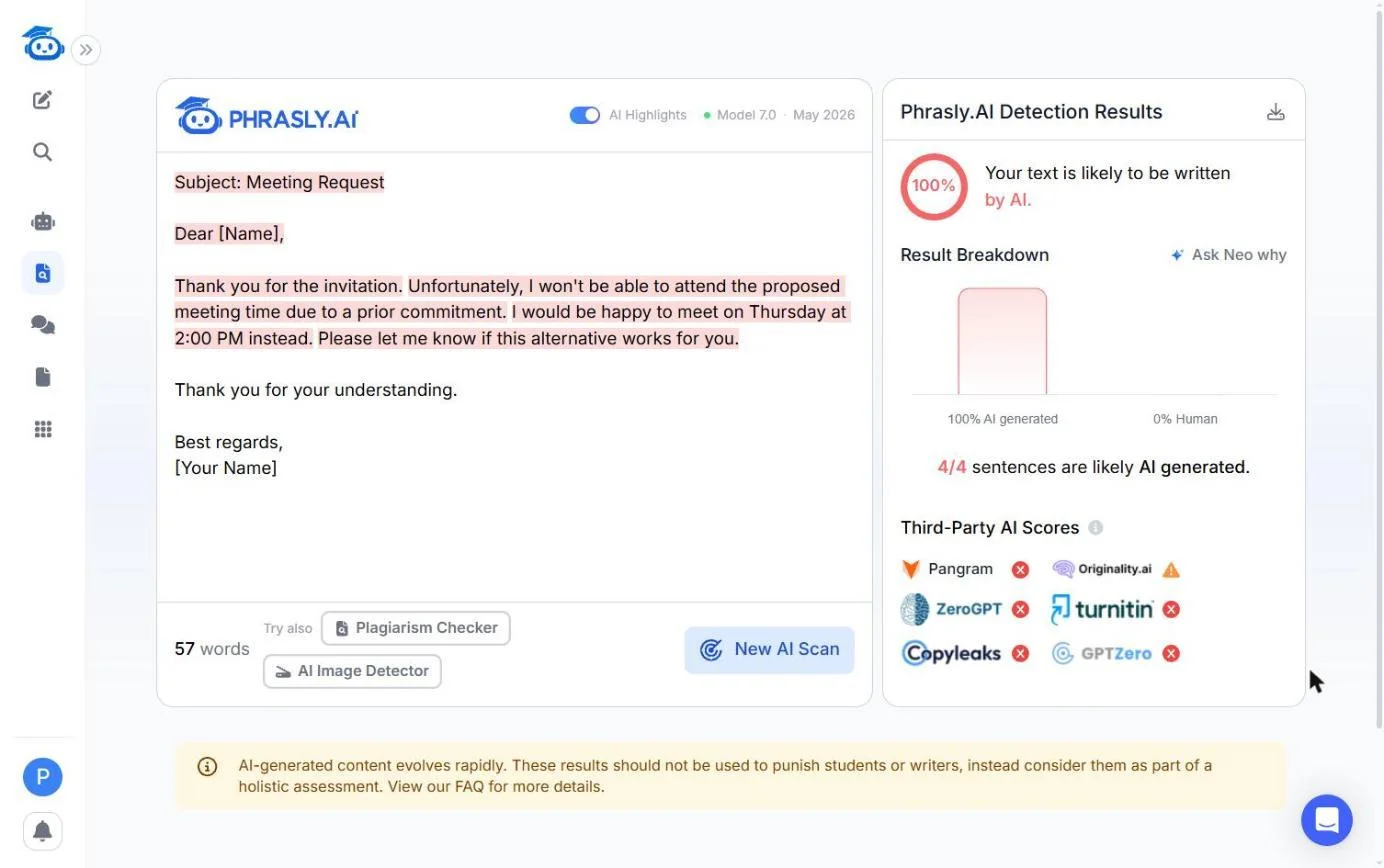
Detector score: 100% AI (4 of 4 sentences flagged), with only Originality.ai stopping at a warning. The default prompt gave a 42-word email, under the Phrasly detector's 50-word minimum, so for ChatGPT only we added "(50-55 words)" to the prompt in a new chat. The rerun is polite but generic, leaning on a "prior commitment" excuse and stock lines like "Thank you for your understanding."
Claude (Anthropic)
Subject: Re: Meeting request, proposing an alternative time
Hi [Name],
Thank you for reaching out. Unfortunately, I won’t be able to attend the meeting as scheduled, as it conflicts with existing commitments.
I’d be glad to meet at another time. I’m available on [Day, Date] at [Time] or [Day, Date] at [Time]. If neither works, please send over a couple of options and I’ll do my best to accommodate.
To make the most of our time, it would help to have a brief agenda in advance.
Thank you for understanding.
Best regards,
[Your Name]
The draft is above. It declines clearly, offers two alternative slots, and asks for an agenda, which keeps it firm without sounding cold. Fill in the bracketed names, dates and times before sending. If you’d like a shorter or more formal version, tell me and I’ll adjust it.
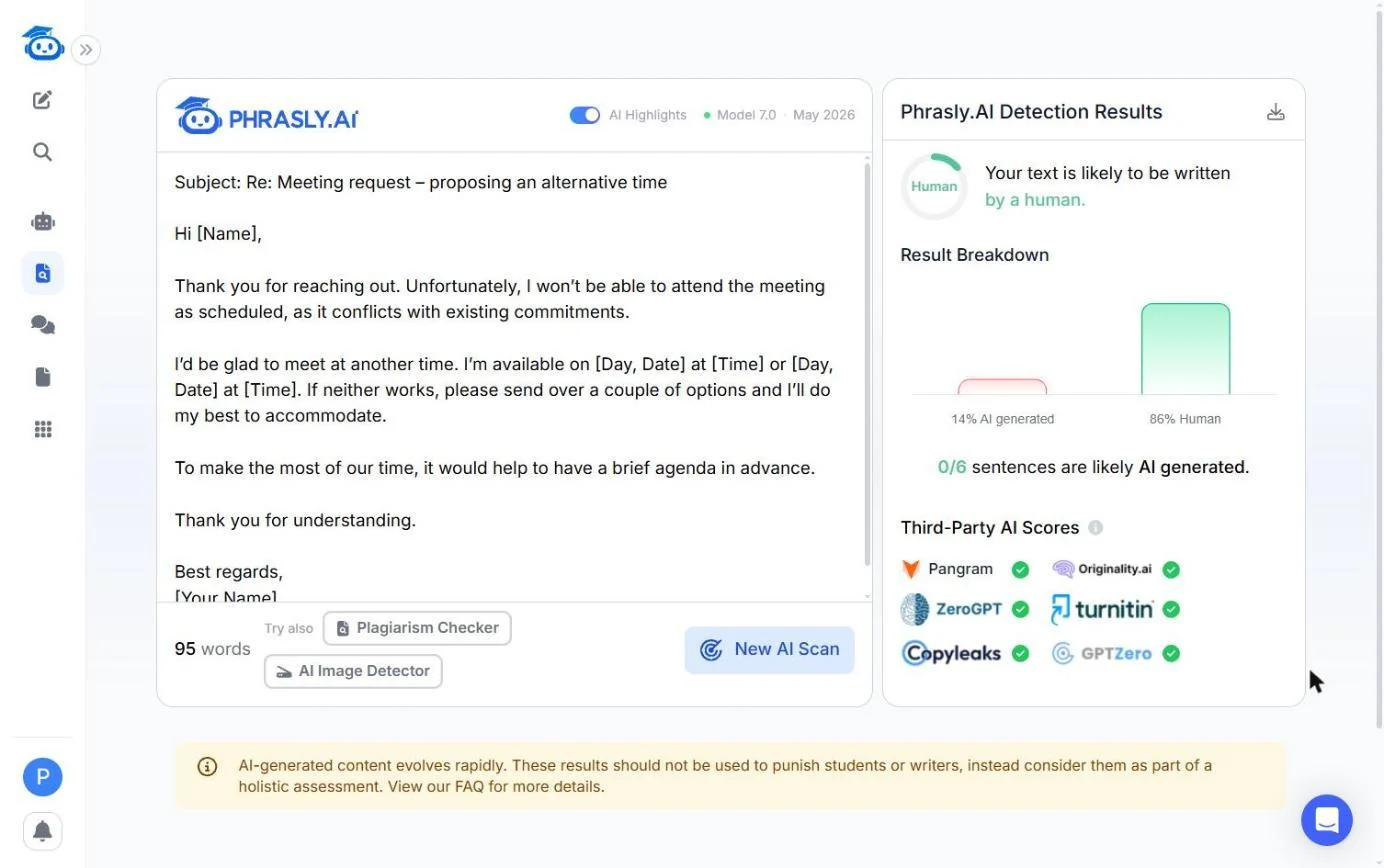
Detector score: 14% AI (0 of 6 sentences flagged), rated likely human, with all six third-party checks passing it, the best score in the whole test. It is firm and specific: two time slots, a fallback and a request for an agenda, without stiff corporate filler. Claude also added a short note on how to adjust the draft, as Neo did.
Gemini (Google)
Subject: Rescheduling our meeting, [Topic/Project Name]
Hi [Name],
Thank you for reaching out. Unfortunately, I have a scheduling conflict at the proposed time and won't be able to make it work.
I would still like to connect on this. Would either of the following times work for you instead?
[Day, Date] at [Time] [Time Zone]
[Day, Date] at [Time] [Time Zone]
If neither of those options works, please feel free to send over a few alternatives that suit your schedule.
Best regards,
[Your Name]
[Your Title]
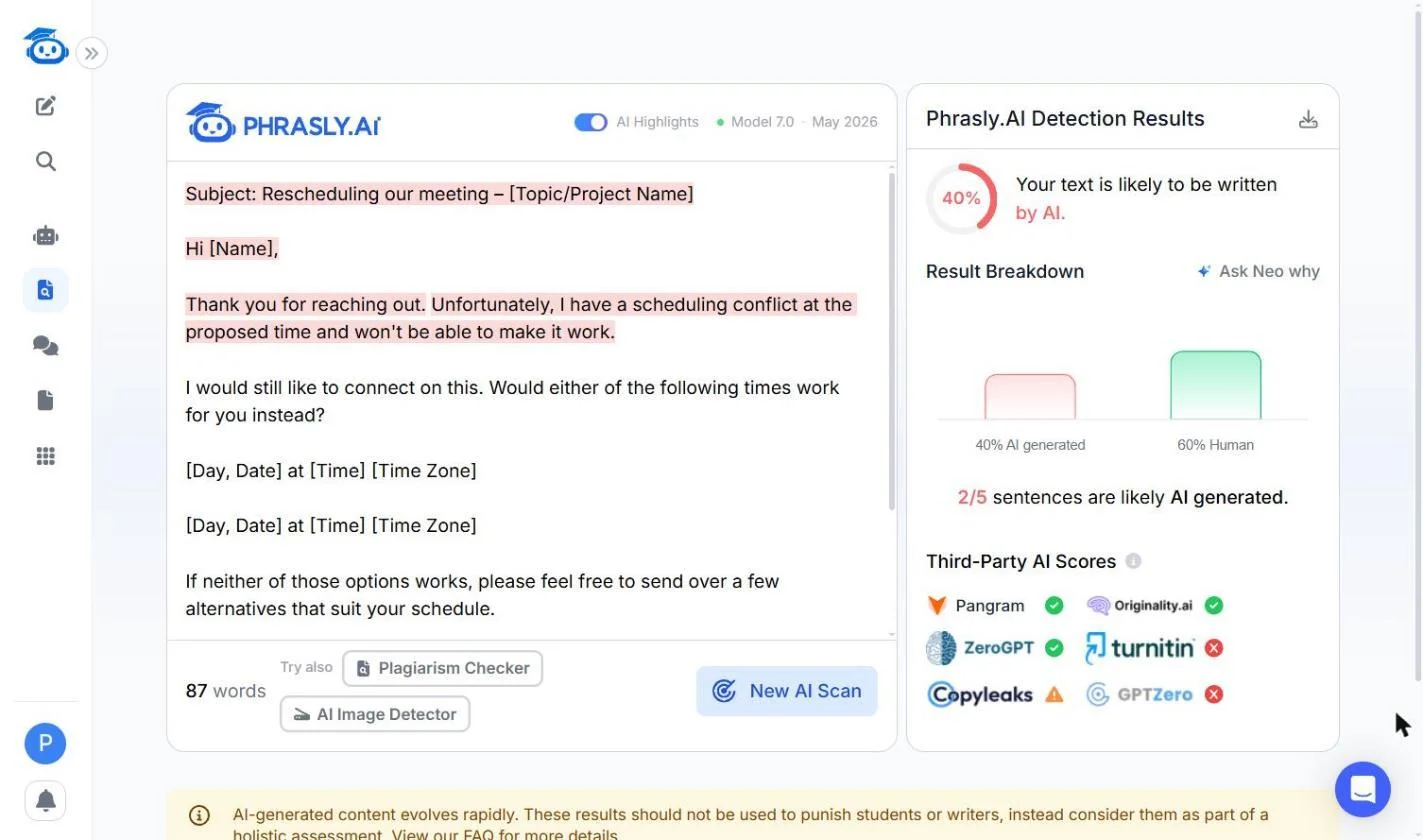
Detector score: 40% AI (2 of 5 sentences flagged), with Pangram, Originality.ai and ZeroGPT passing it. Gemini first asked for Gmail access instead of writing the email, so we declined and sent one follow-up line ("Just write the email text here in the chat"). The result is clear and offers two slots, but "scheduling conflict" and "please feel free" sound like a template, and we did not test a pasted writing sample.
Neo (Phrasly)
Here's a draft you can adapt:
Subject: Re: Meeting request
Hi [Name],
Thanks for reaching out and for thinking of me for this. Unfortunately, I won't be able to make the time you proposed.
I'd still like to have the conversation, though. Would [day, time] or [day, time] work instead? If neither suits, send over a couple of options that fit your schedule and I'll do my best to match one.
Best regards,
[Your name]
Swap the bracketed bits for the real names and times, and if you want it a touch firmer, drop the second sentence of the middle paragraph and just offer your two slots.
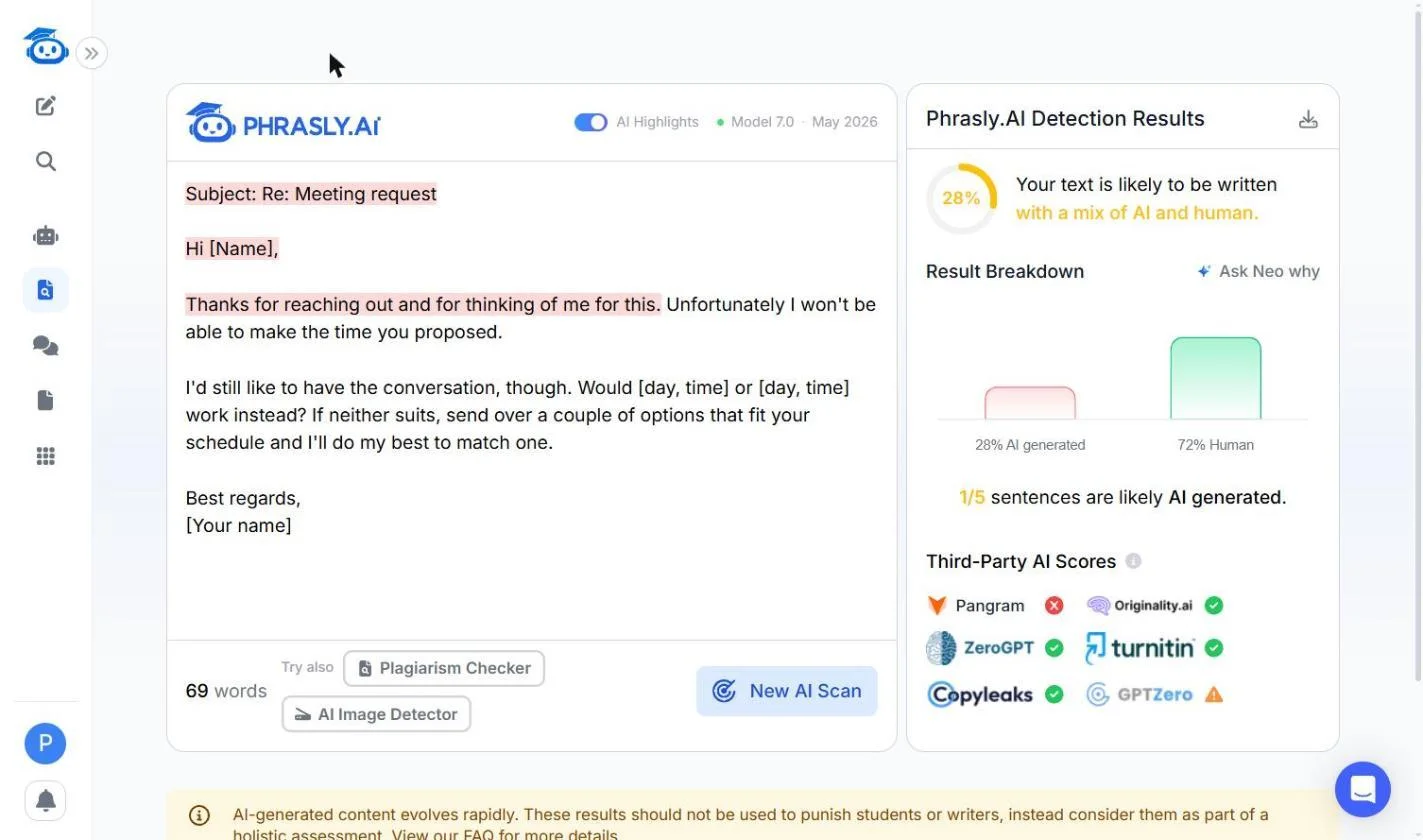
Detector score: 28% AI (1 of 5 sentences flagged), rated a mix of AI and human, with four of six third-party checks passing it. It sounds the most like a real person ("I'd still like to have the conversation, though") and offers two slots plus a fallback, which keeps it firm. Neo also added a one-line tip on making it firmer, which ChatGPT and Gemini skipped, though Claude's 14% email pushes Neo to second place in this round.
Is there a way to make AI generated text undetectable? Not reliably. No undetectable AI writer can promise a pass, and Pangram reports that its newest model catches AI in humanized text 98.83% of the time, so editing in your own voice is the safer route.
Comparing dedicated humanizers instead of chatbots? Read our Phrasly vs Undetectable AI comparison, then try the email prompt yourself in Phrasly Neo.
Scorecard: Every Chatbot's Detector Score and Human Rating
Which AI writes the most like a human in 2026? In our test, Phrasly Neo had the lowest average detector score and the best tone notes.
📊 Detection results: average AI score across all three rounds (lower = more human)
Phrasly Neo: 40% (essay 68%, blog intro 24%, email 28%)
Gemini: 65% (essay 100%, blog intro 56%, email 40%)
Claude: 71% (essay 100%, blog intro 100%, email 14%, the only output rated likely human)
ChatGPT: 100% (flagged as AI in every round)
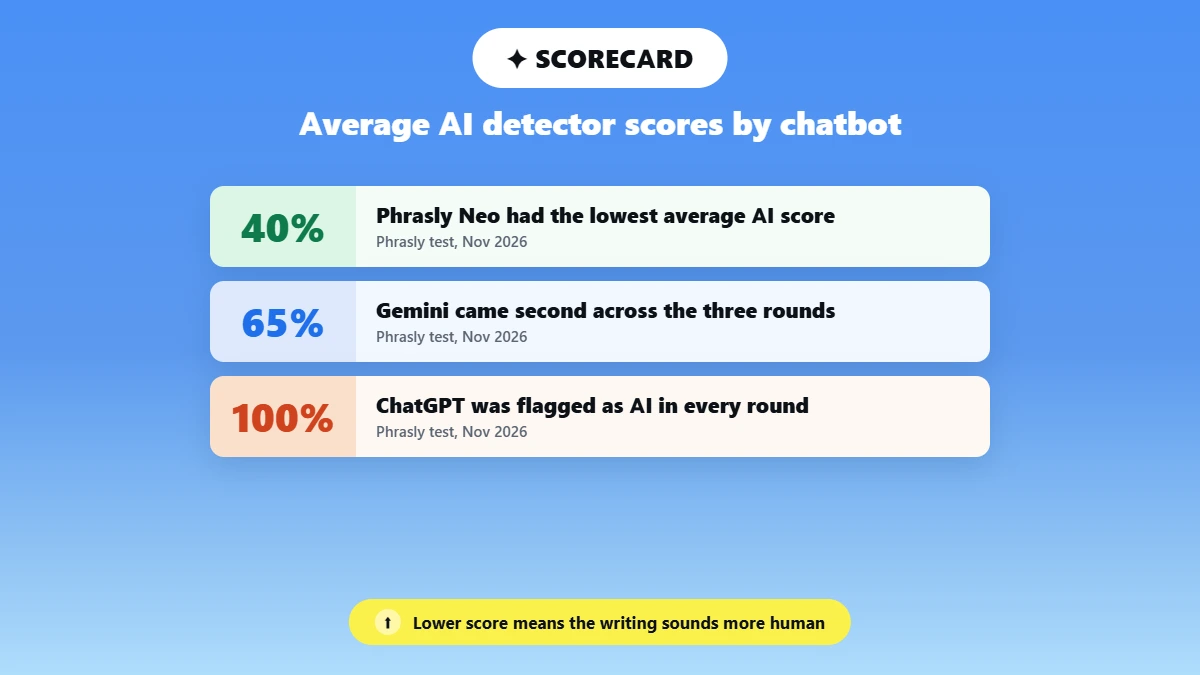
Each row pulls the three round scores into one place, with a simple average and a natural-sounding rating from the tone notes. The models are the ones the free plans served on test day: ChatGPT GPT-6 family, Claude Anthropic's default model and Gemini Google's default model, plus Neo. On November 3, 2026, ChatGPT Free ran GPT-6 in Instant mode, Gemini ran Flash and Claude's free plan ran Sonnet 5.5.
Chatbot | Essay score | Blog intro score | Email score | Average | Natural-sounding rating |
|---|---|---|---|---|---|
ChatGPT (GPT-6) | 100% | 100% | 100% | 100% | Robotic: stock transitions and triads |
Claude (Anthropic) | 100% | 100% | 14% | 71% | Natural voice, but only the email passed |
Gemini (Google) | 100% | 56% | 40% | 65% | Mixed: stiff essay, livelier intro and email |
Neo (Phrasly) | 68% | 24% | 28% | 40% | Most natural: reads human in blog and email |
Detector results depend on the detector. A University of Chicago study found GPTZero missed about half or more of humanized AI passages in most genres, while Pangram stayed robust. A low score on one tool is not an AI writing detector bypass on another.
Ranking on one detector also says little about meaning. Paraphrasing tools can lower a score while bending facts, so check the rewrite against the original.
This post compares chatbots, not standalone rewriters. If you are shopping for the best AI humanizer 2026 has to offer, see our guide to the best AI humanizer tools.
Which Chatbot Wins for Essays, Blogs, and Free Use?
Here is the short version, tied to the scorecard above:
Best overall: Phrasly Neo, with a 40% average, ahead of Gemini (65%), Claude (71%) and ChatGPT (100%).
Best for essays: Phrasly Neo (68%), though its essay still needs a source for the studies it mentions, while Claude's cited a real study but scored 100%.
Best for blog posts: Phrasly Neo (24%), with Gemini a usable second after a light edit.
Best free option: Phrasly Neo on its daily allowance, with Gemini the strongest general chatbot on average and Claude the pick for emails. All four chatbots have a free plan, and Neo's free use comes with a daily allowance.
If you want an AI that writes like a human free of charge, start with the winner's free plan before paying. Search AI writing tool that sounds human reddit and the top advice repeats: pick a tool, then edit, as in this r/humanizing thread on free humanizers. Keep the Stanford finding in mind before trusting any single detector score.
The Prompt Formula for Human-Sounding Output
What prompt should I use to make ChatGPT sound more human? A good prompt to make AI writing sound human has four parts: the task, a real-world constraint, a specific tone and a short ban list. That beats long prompt engineering for most drafts.
Try this: "Write a two-paragraph blog intro about remote work burnout, like a tired freelancer venting to a friend, no 'in conclusion' or 'moreover'." Add one personal detail or a specific example so the draft can't stay generic.
Then run the output through a detector and change one thing at a time: tone, length or the example. If you would rather humanize AI text free online than rewrite the prompt, see how Phrasly Ultra rewrites drafts to sound like you.
Frequently asked questions
Vary sentence length, swap generic statements for specific details, and cut hedging and filler phrases. Read the draft aloud to catch flat rhythm and repeated triads. A humanizer, or a chatbot like Phrasly Neo with one built in, can also adjust tone and sentence variety, but a final pass in your own words still matters before you publish anything.