Smartest AI Chatbot in 2026: Reasoning, Writing and Search Compared
33 min read
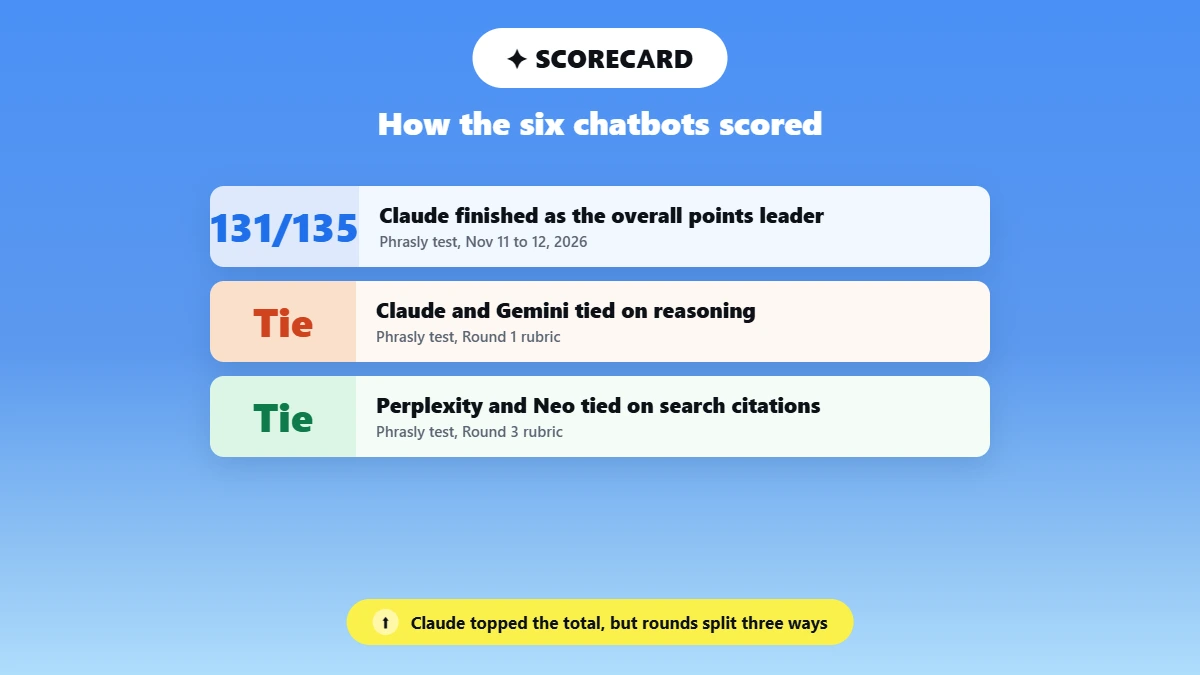
There is no single smartest AI chatbot in November 2026. In our same-prompt test of six chatbots, Claude and Gemini tied on reasoning, Claude won writing, and Perplexity and Neo tied on search with the most reliable citations. Claude finished as the overall points leader, and the score each bot earned is in the scorecard below.
We tested ChatGPT, Claude, Gemini, Perplexity, Microsoft Copilot and Neo on November 11, 2026, giving each one the same nine prompts across three rounds and one 45-point rubric per round. Every vendor says its model tops the benchmarks, so we stopped reading the claims and ran the prompts instead. If you want the most intelligent AI chatbot for a specific job, the round winners matter more than the total.
Phrasly makes Neo, one of the six chatbots tested. Neo got the same prompts and rubric as every other bot and is ranked only by its scores. For this test, "smart" means three things you can check:
Reaching the right answer on multi-step problems (reasoning).
Following a writing brief precisely (writing).
Citing current facts to sources that actually support them (search).
The 6 AI Chatbots in the Head-to-Head
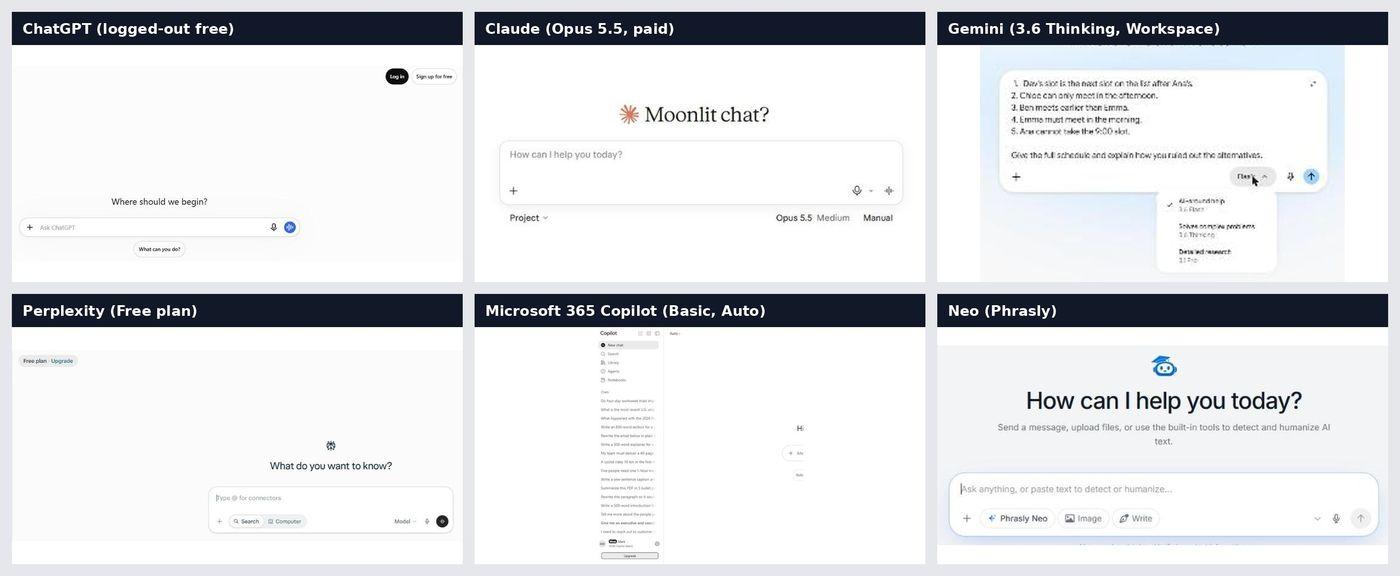
ChatGPT is still where most people start: in a February 2026 Pew Research Center survey, 44% of U.S. adults said they use it, up from 34% a year earlier. We picked six chatbots so the best AI chatbot 2026 question, and the narrower one of whether ChatGPT, Claude or Gemini is actually the smartest right now, could be settled by tests instead of claims, with each bot defending a different strength: all-round answers, long-form writing, Google Workspace, citations, Microsoft 365 and an in-house entry.
1a. ChatGPT (OpenAI): The All-Round Baseline
OpenAI's ChatGPT is the bot every other one gets measured against, and Google's AI Overview for this search treats it as the reasoning and all-round leader. We treated that as a claim to check, not a verdict.
We ran ChatGPT logged out, so it used the default free large language model with no model picker, and we logged whether web search fired unprompted (it did on every Round 3 prompt). If you're already weighing a switch, see our list of ChatGPT alternatives for writers.
Model and mode tested: not shown when logged out (OpenAI's Free Tier FAQ names GPT-5.6 Luna as the free model); no thinking toggle on the web
Plan tier tested: Free, logged out
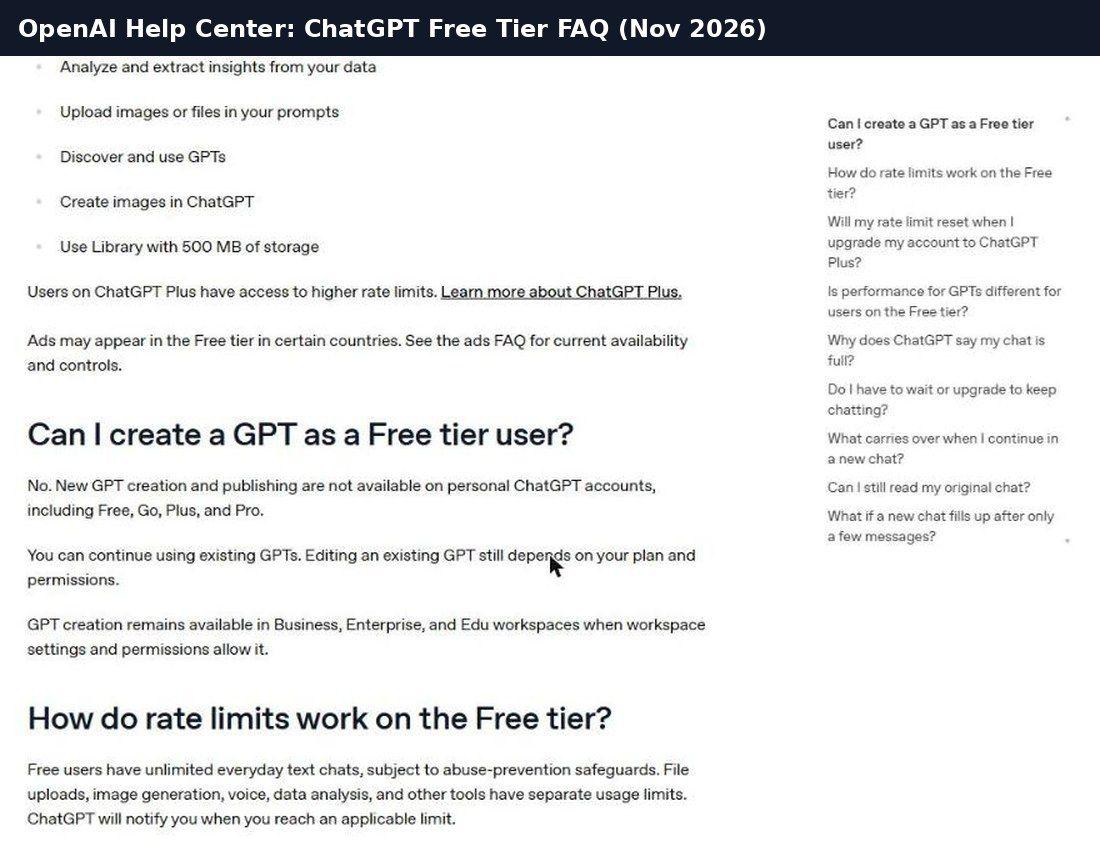
Free plan headline: unlimited everyday text chats, with separate caps on files, images, voice and data analysis (see the free plan table)
One thing we watched for: confident answers without sources when search was off
1b. Claude (Anthropic): Structured Reasoning and Long-Form Writing
Anthropic's Claude is the chatbot people recommend most often for long-form writing, the kind of draft that has to keep its structure for 1,500 words. Round 2 and the free-plan test further down check that reputation directly.
We recorded the model and plan exactly as the interface showed them, because Anthropic's free and paid plans don't always serve the same model. We also watched how Claude handled awkward edge cases, such as the budget trade-off in Round 1.
Model and mode tested: Opus 5.5 at Medium effort, as shown in the picker
Plan tier tested: paid organization plan
Free plan headline: a session-based usage limit that resets every five hours (see the free plan table)
One thing we watched for: refusals or heavy hedging on edge-case prompts, such as Round 1, Prompt 3
1c. Gemini (Google): Built for Google Workspace
Google Gemini's main pitch is how neatly it fits into Gmail, Docs and Drive, but we tested the standalone Gemini app only. So if Workspace integration is your reason for choosing it, none of the scores below measure that.
Google promotes its newest Gemini models on its own pages, yet the model the consumer app serves can differ by plan and region. That's why we logged the version shown on screen rather than the one in the press release.
Model and mode tested: 3.6 Thinking for Round 1, Round 2 and the start of Round 3; the app switched to 3.6 Flash after our account hit its Thinking limit
Plan tier tested: Google Workspace work account
Free plan headline: free without a Google AI plan, with limits Google says may change (see the free plan table)
One thing we watched for: whether Round 3 answers showed sources, and whether those sources were clickable
1d. Perplexity: Research With Source Citations
Perplexity built its name on answers with numbered source citations, and Google's AI Overview credits it with leading research. Round 3 puts that to the test by counting every citation and opening a sample of links to see whether they support the claim beside them.
Perplexity also ran the reasoning and writing rounds on equal terms, so you can see whether its search strength carries over. Results change by mode, so we logged the model and search mode for every prompt.
Model and mode tested: default model (picker left on "Model"), with a free preview of Pro Search that switched on by itself
Plan tier tested: Free plan
Free plan headline: free search with citations in every answer and "limited daily usage," per Perplexity's pricing page, which gives no exact daily number (see the free plan table)
One thing we watched for: citations to thin pages, and summaries that list sources without resolving conflicts between them
1e. Microsoft Copilot (Microsoft): Built for Microsoft 365
Microsoft sells Copilot on its Office integration, but two products share the name. The free Copilot app is a general chat assistant, while Copilot in Microsoft 365 lives inside Word, Excel and Outlook and needs a subscription.
We scored only the chat experience in Microsoft 365 Copilot Chat on a work account, not the consumer Copilot app, so nothing here measures how it works inside your documents. We also checked whether its web grounding showed sources.
Model and mode tested: Auto
Plan tier tested: M365 Copilot (Basic)
Free plan headline: a limited free version, subject to available capacity and limits (see the free plan table)
One thing we watched for: whether answers changed when web grounding was on or off
1f. Neo (Phrasly): The Disclosed In-House Entry
Phrasly makes Neo. Its product page describes it as an everyday AI chat model optimized for human writing and natural conversation, one that answers simple questions quickly and takes more time with harder problems.
Under "Adaptive thinking," the page says Neo keeps the whole chat in mind, so each follow-up builds on the last reply, and you don't pick a thinking mode by hand. Web search is listed as a paid-plan feature, so we noted the plan for Round 3.
Model and mode tested: Phrasly Neo, no mode picker; it showed "Thought for 1s" to "Thought for 8s" on reasoning prompts and searched the web on its own in Round 3
Plan tier tested: our team's paid Phrasly plan (web search available)
Free plan headline: available on every Phrasly plan, including the free account, with daily limits; web search needs a paid plan (see the free plan table)
One thing we watched for: the same failure modes as the other five, scored with the same strictness
Round 1: Reasoning, Same 3 Prompts for Every Chatbot
Reasoning, in this test, means reaching the right answer on a problem that takes several steps, which is the first part of our definition of "smart." Each prompt was scored 0 to 5 on three criteria, for 15 points per prompt and 45 for the round:
Correct final answer: 5 for exactly right, 0 for wrong.
Sound working: are the steps valid, or did a right answer come from broken logic?
Checks and assumptions: did it catch the trap, or state what it assumed?
All three prompts are original and written for this test. A famous puzzle could sit in a model's training data, and then we'd be scoring memory instead of reasoning.
2a. How We Scored the Reasoning Round
We wrote every prompt from scratch and pasted it word for word, rather than building it with AI prompt generators, so each chatbot saw exactly the same text. The rules were identical for all six bots:
A fresh chat for every prompt, with no custom instructions or memory.
The prompt pasted verbatim, with nothing added.
Thinking or reasoning mode switched on where available, and the mode recorded.
One scored run per prompt. A second run only if an answer looked like a fluke, with both runs reported.
The same 0 to 5 rubric on all three criteria.
Time to final answer, from pressing send to the end of the response.
2b. Side-by-Side Reasoning Results
Prompt 1: Multi-Step Scheduling Logic
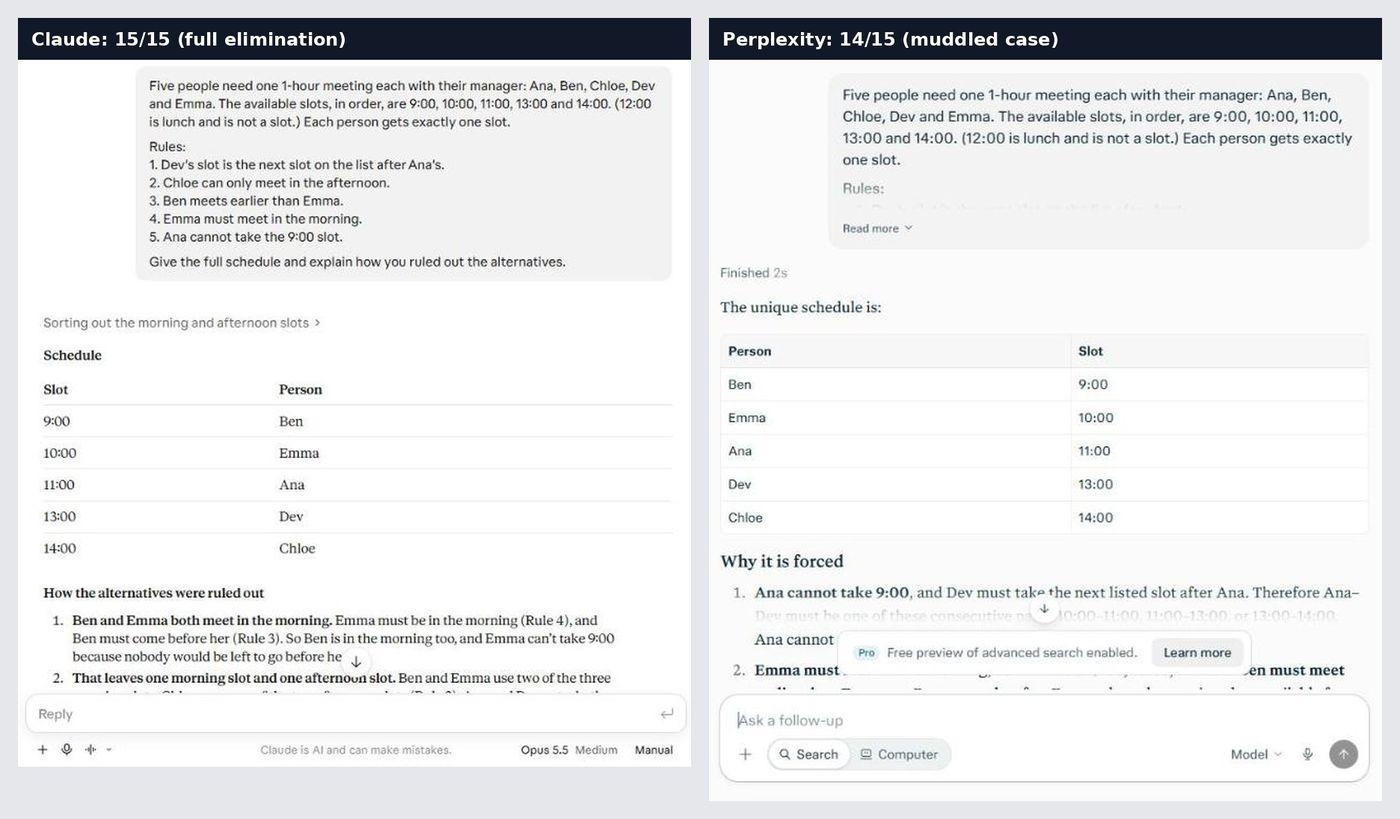
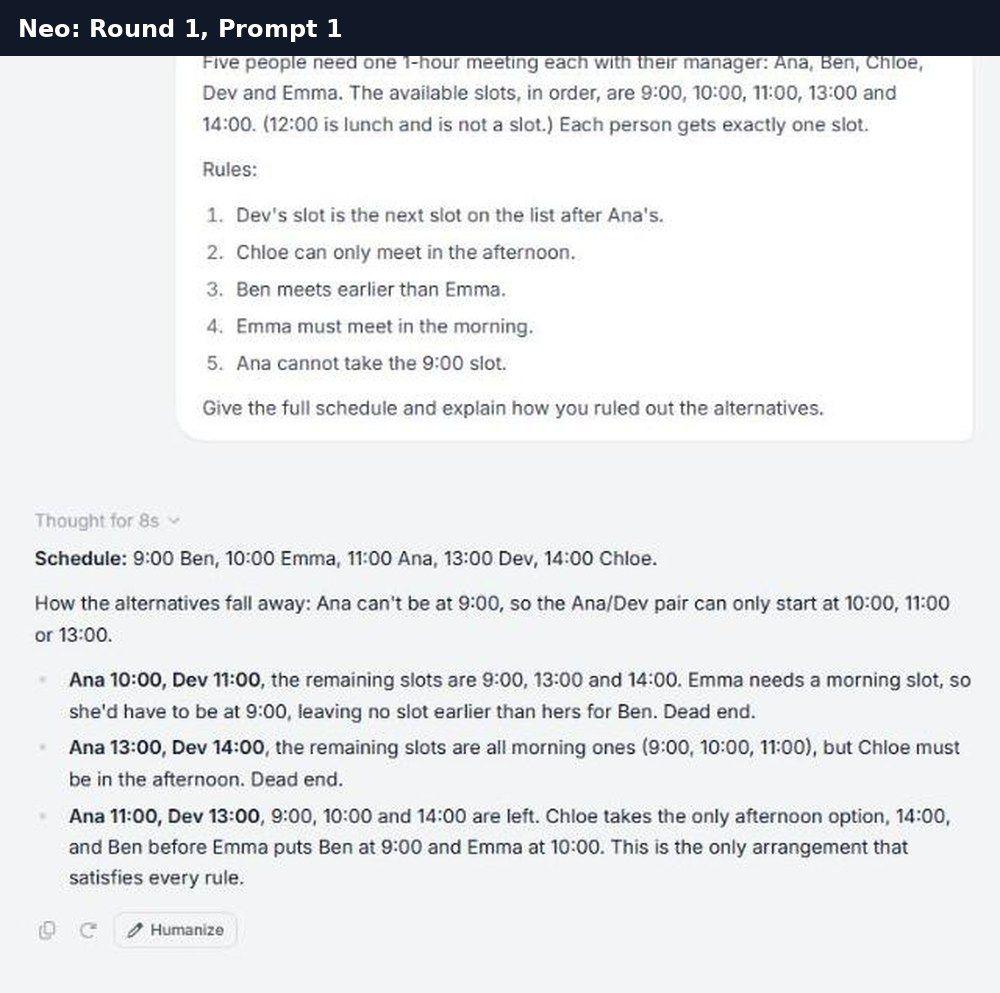
Five people, five meeting slots and five rules, with exactly one schedule that satisfies all of them. The lunch break is the quiet trap here. A bot that treats 11:00 and 13:00 as "not next to each other" will decide the puzzle has no answer.
Prompt 1
Five people need one 1-hour meeting each with their manager: Ana, Ben, Chloe, Dev and Emma. The available slots, in order, are 9:00, 10:00, 11:00, 13:00 and 14:00. (12:00 is lunch and is not a slot.) Each person gets exactly one slot.

Rules:
1. Dev's slot is the next slot on the list after Ana's.
2. Chloe can only meet in the afternoon.
3. Ben meets earlier than Emma.
4. Emma must meet in the morning.
5. Ana cannot take the 9:00 slot.

Give the full schedule and explain how you ruled out the alternatives.
Verified correct answer
Ben 9:00, Emma 10:00, Ana 11:00, Dev 13:00, Chloe 14:00. We checked all 120 possible orderings with a script, and this is the only one that passes all five rules.
Chatbot | Final answer excerpt | Correct? | Score /15 | Time to answer |
|---|---|---|---|---|
ChatGPT | "The only valid schedule is" Ben 9:00, Emma 10:00, Ana 11:00, Dev 13:00, Chloe 14:00 | Yes | 15/15 | 13 sec |
Claude | "Ana and Dev must split across lunch... So Ana gets 11:00 and Dev gets 13:00." | Yes | 15/15 | 10 sec |
Gemini | "Only remaining option: Ana takes 11:00 and Dev takes 13:00." | Yes | 15/15 | 24 sec |
Perplexity | "The unique schedule is" Ben 9:00, Emma 10:00, Ana 11:00, Dev 13:00, Chloe 14:00 (one muddled elimination step) | Yes | 14/15 | 20 sec |
Microsoft Copilot | "Therefore Ana and Dev must be 11:00 and 13:00." (paraphrased from its case table) | Yes | 15/15 | 14 sec |
Neo (made by Phrasly) | "Schedule: 9:00 Ben, 10:00 Emma, 11:00 Ana, 13:00 Dev, 14:00 Chloe." | Yes | 15/15 | 14 sec |
Prompt 2: A Word Problem With a Unit Trap
Halfway through, the units switch from kilometers to miles per hour. Two wrong answers are easy to land on: averaging the two speeds, or skipping the conversion. Only a bot that checks its own work gets this one right.
Prompt 2
A cyclist rides 10 km in the first 40 minutes. She then rides for another 1 hour and 20 minutes at a steady 12 miles per hour. What was her average speed for the whole ride, in km/h? Use 1 mile = 1.609 km and round to one decimal place.Verified correct answer
17.9 km/h. The second leg is 12 x 1.609 x 4/3 = 25.744 km, so the total is 35.744 km over 2 hours. Averaging the two leg speeds gives 17.2 (wrong), and skipping the conversion gives 13.0 (wrong).
Chatbot | Final answer excerpt | Correct? | Score /15 | Time to answer |
|---|---|---|---|---|
ChatGPT | "Final answer: 17.9 km/h" | Yes | 14/15 | 8 sec |
Claude | "Her average speed was 17.9 km/h." | Yes | 14/15 | 4 sec |
Gemini | "Her average speed for the whole ride was 17.9 km/h." | Yes | 14/15 | 22 sec |
Perplexity | "Her average speed for the whole ride was 17.9 km/h." | Yes | 14/15 | 27 sec |
Microsoft Copilot | "Rounded to one decimal place: 17.9 km/h" | Yes | 14/15 | 7 sec |
Neo (made by Phrasly) | "...so her average speed was 17.9 km/h." | Yes | 14/15 | 11 sec |
Prompt 3: Budget vs Deadline Trade-Off
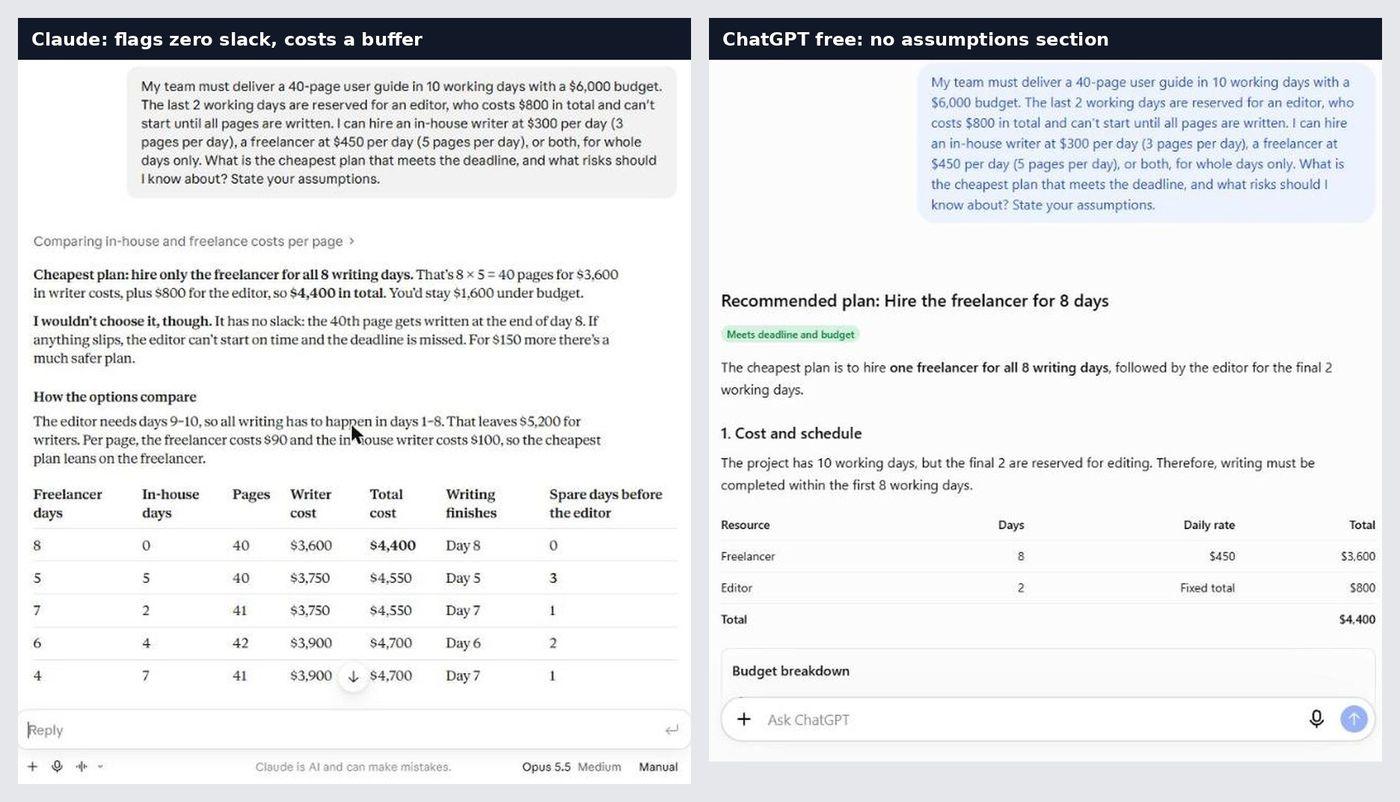
There's no trick arithmetic in this one, but it rewards a bot that notices the higher day rate is actually the cheaper option. A strong answer also states its assumptions and warns that the cheapest plan leaves no room for a sick day.
Prompt 3
My team must deliver a 40-page user guide in 10 working days with a $6,000 budget. The last 2 working days are reserved for an editor, who costs $800 in total and can't start until all pages are written. I can hire an in-house writer at $300 per day (3 pages per day), a freelancer at $450 per day (5 pages per day), or both, for whole days only. What is the cheapest plan that meets the deadline, and what risks should I know about? State your assumptions.Verified correct answer
The freelancer alone for all 8 writing days: 40 pages for $3,600, or $4,400 with the editor. The freelancer costs $90 per page against $100 for the in-house writer, so the higher day rate is the cheaper choice. The risk is zero slack: running both writers for 5 days costs $4,550 and finishes 3 days early, so $150 buys a buffer.
Chatbot | Final answer excerpt | Correct? | Score /15 | Time to answer |
|---|---|---|---|---|
ChatGPT | "The cheapest plan is to hire one freelancer for all 8 writing days" ($4,400); reply cut off mid risk table | Yes | 13/15 | not logged (stalled) |
Claude | "Cheapest plan: hire only the freelancer for all 8 writing days... I wouldn't choose it, though." Recommends $4,550 for a 3-day buffer | Yes | 15/15 | not logged |
Gemini | "The cheapest plan that meets the deadline costs $4,400"; offers the $4,550 parallel plan with 3 spare days | Yes | 15/15 | 39 sec |
Perplexity | "The cheapest feasible plan is to hire the freelancer for all 8 available writing days." Claims any writer mix needs more than 8 days | Yes | 14/15 | not logged |
Microsoft Copilot | "Total cost: $4,400"; full assumptions, but one infeasible row in its options table | Yes | 14/15 | 18 sec |
Neo (made by Phrasly) | "Cheapest plan: hire only the freelancer for all 8 writing days." Says finishing early "buys you nothing" | Yes | 14/15 | 22 sec |
Time to answer is reported but not scored, because a slow answer that's right beats a fast one that's wrong. Claude was fastest (4 seconds on Prompt 2), and Gemini in Thinking mode was usually slowest, up to 39 seconds on Prompt 3. Times are approximate, from pressing send to the last on-screen update.
2c. Round 1 Verdict: The Smartest AI Chatbot for Reasoning
Claude and Gemini tied as the smartest AI chatbot for reasoning in our test, with 44 of 45 each. Copilot and Neo were one point behind on 43, so the winners were decided by score, not reputation.
Round 1 standings
Claude: 44/45 (tied 1st). Perfect on Prompts 1 and 3, and it recommended the $4,550 two-writer plan as a buffer.
Gemini: 44/45 (tied 1st). Same result as Claude, including the buffer plan, though it was usually the slowest to answer.
Microsoft Copilot: 43/45. Clear elimination steps on Prompt 1, but one row in its Prompt 3 options table wouldn’t actually work.
Neo (made by Phrasly): 43/45. Lost a point on Prompt 3 for saying that finishing early “buys you nothing.”
ChatGPT: 42/45. Its free reply stopped mid-answer on Prompt 3.
Perplexity: 42/45. One muddled step on Prompt 1, and on Prompt 3 it wrongly said any mix of writers needs more than 8 days.
What each prompt showed
Prompt 1 (scheduling): No bot called the puzzle unsolvable because of the lunch break. Claude, Gemini and Copilot laid out the clearest elimination steps.
Prompt 2 (unit trap): This didn’t split the field. All six bots converted the miles and got 17.9 km/h, but none warned that averaging the two speeds is the trap.
Prompt 3 (budget vs deadline): No bot reached a right answer with broken logic, but their judgment differed. Only Claude and Gemini recommended paying $150 extra for a 3-day buffer.
Does thinking mode make a difference?
AI reasoning models use chain-of-thought reasoning: they work through intermediate steps before committing to an answer. That should matter most on Prompts 1 and 2, where one skipped step breaks everything. We kept thinking on wherever a picker offered it and didn’t run a thinking-off comparison, so we can’t credit it with a measurable difference here.
Neo has no thinking picker, and its product page says it takes more time on harder problems. That showed up in our test: it thought for 8 seconds on Prompts 1 and 3 and for 1 second on Prompt 2.
Best for complex, multi-step reasoning at work?
On our three prompts, it’s a tie between Claude and Gemini. But a reasoning win isn’t an overall win, so check the final scorecard before you decide.
Round 2: Writing, From Brief to Publishable Draft
A draft that ignores the brief has to be rewritten, however polished it sounds, so this round scores instruction-following first and style second. Each prompt was scored 0 to 5 on three criteria, using the same fresh-chat, paste-verbatim, one-run rules as Round 1:
Constraints met: every instruction in the brief followed.
Accuracy: no factual errors, and a word count within 10% of the target.
Tone fit: right for the requested audience and style.
We counted words with a single tool, a simple JavaScript word counter that splits text on spaces (titles and headings included), for all 18 outputs, because different counters disagree by several words.
3a. The Three Writing Prompts
These three tasks mirror what people actually ask a chatbot to write at work: a short explainer, a cleanup of someone else's email, and a section that must match a house style. The first stacks five constraints, the second checks whether a bot can simplify without dropping facts, and the third hands over a style guide.
Writing Prompt 1: 300-word explainer with five constraints
Write a 300-word explainer for a general audience on what an AI chatbot's "context window" is. Rules:
1. Write at a grade 8 reading level.
2. Do not use the word "token" anywhere.
3. Include one real-world example from everyday life.
4. Include exactly one bulleted list with 3 items.
5. Stay between 270 and 330 words.
Writing Prompt 2: plain-English rewrite (keep every request and date)
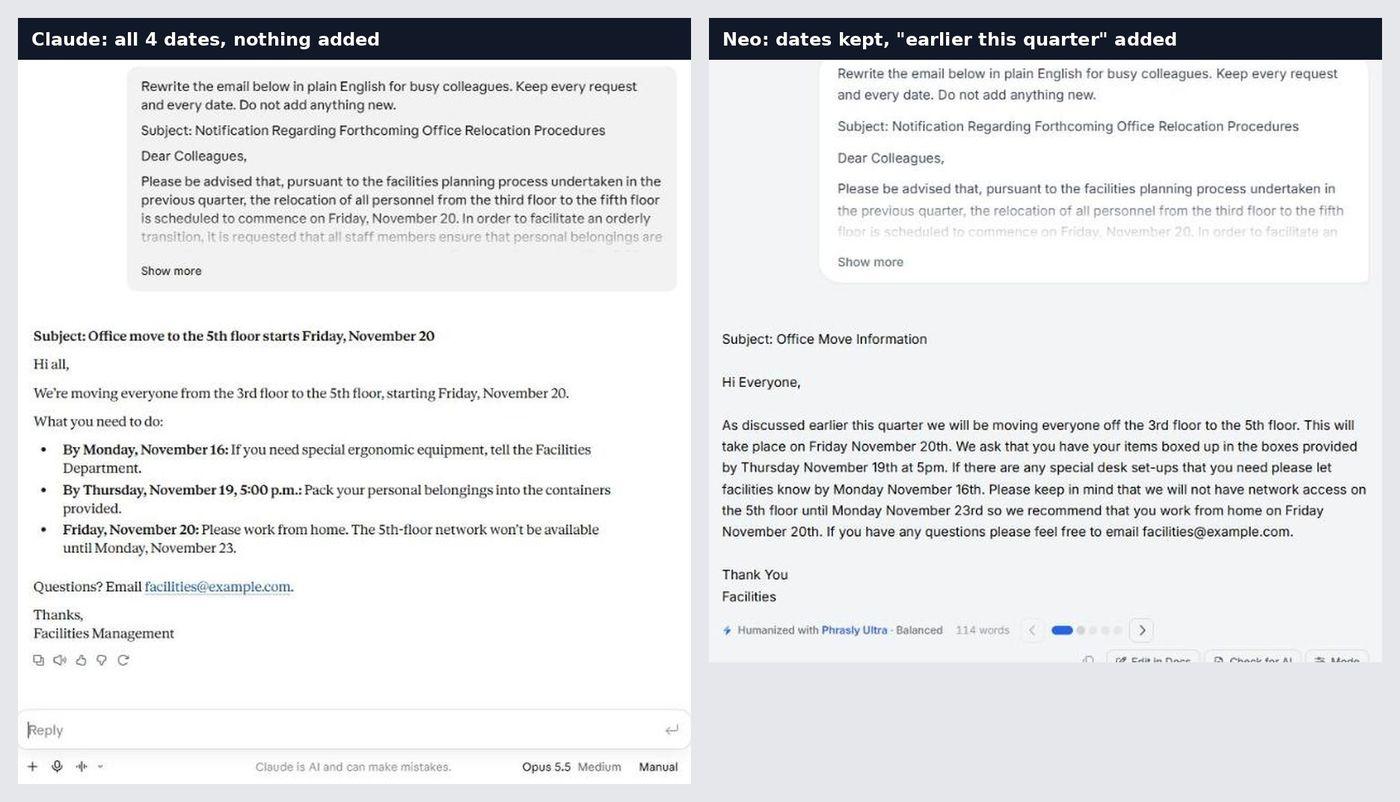
Rewrite the email below in plain English for busy colleagues. Keep every request and every date. Do not add anything new.

Subject: Notification Regarding Forthcoming Office Relocation Procedures

Dear Colleagues,

Please be advised that, pursuant to the facilities planning process undertaken in the previous quarter, the relocation of all personnel from the third floor to the fifth floor is scheduled to commence on Friday, November 20. In order to facilitate an orderly transition, it is requested that all staff members ensure that personal belongings are packed into the provided containers no later than Thursday, November 19 at 5:00 p.m. Furthermore, it would be appreciated if individuals requiring specialized ergonomic equipment would notify the Facilities Department of such requirements by Monday, November 16. Kindly note that network access on the fifth floor will not be available until Monday, November 23, and employees are therefore encouraged to work remotely on Friday, November 20. Should any questions arise, please do not hesitate to direct them to [email protected].

Regards,

Facilities Management
Verified correct answer
Answer key for Prompt 2: three requests (pack by Thursday, November 19 at 5:00 p.m.; tell Facilities about ergonomic equipment by Monday, November 16; work remotely on Friday, November 20), one contact address, and four dates that must survive unchanged (Nov 16, 19, 20 and 23).
Writing Prompt 3: 800-word section that follows a style guide
Write an 800-word section for a small-business blog titled "How small teams should back up their files." Follow this style guide exactly:
1. Address the reader as "you." Never use "we."
2. Keep every sentence under 25 words.
3. No paragraph longer than 3 sentences.
4. Use sentence case for headings, and add one H3 subheading every 200 to 250 words.
5. Never use these phrases: "at the end of the day," "it goes without saying," "peace of mind."
6. End with a 3-item checklist.
3b. Side-by-Side Writing Results
Chatbot | Constraints met (Prompt 1, x of 5) | Word count (actual vs target, P1 / P3) | Factual errors (all prompts) | Tone fit (0 to 5) | Score /45 (P1 / P2 / P3) |
|---|---|---|---|---|---|
ChatGPT | 4/5 | 345 vs 300 / about 1,090 vs 800 | 0 | 4 | 35 (11 / 14 / 10) |
Claude | 5/5 | 305 vs 300 / 819 vs 800 | 0 | 5 | 45 (15 / 15 / 15) |
Gemini | 5/5 | 283 vs 300 / about 785 vs 800 | 1 | 4 | 40 (14 / 13 / 13) |
Perplexity | 3/5 | 474 vs 300 / about 1,030 vs 800 | 0 | 3 | 30 (8 / 14 / 8) |
Microsoft Copilot | 5/5 | 318 vs 300 / about 835 vs 800 | 0 | 4 | 41 (14 / 14 / 13) |
Neo (made by Phrasly) | 5/5 | 305 vs 300 / about 760 vs 800 | 1 | 4 | 38 (15 / 11 / 12) |
Tone fit is where the bots pulled furthest apart: Claude and Neo read most naturally on Prompt 1, while Copilot's explainer felt textbook-stiff and Perplexity's answers were cluttered with citation tags. On Prompt 3, Neo's sentences got so short they read as choppy. If a human-sounding voice matters most to you, our guide to the AI chatbot for writing that sounds human goes deeper on that one trait.
A draft that ran long lost points once, under Accuracy, and nowhere else, so a single slip couldn't sink an otherwise strong answer.
We logged factual errors separately from tone, because that column is where hallucination rate shows up in writing tasks. We logged two errors, both on Prompt 2. Neo, which routed the pasted email through Phrasly's built-in Humanizer, opened with "As discussed earlier this quarter" when the email said the previous quarter, and Gemini told staff to email the generic address about ergonomic equipment instead of telling the Facilities Department.
Output excerpts (the line that best shows a constraint met or missed)
ChatGPT: "A context window is the chatbot's working memory." (Prompt 1: 345 words, over the 330-word cap)
Claude: "Picture that busy waiter, and help him out by repeating what matters most." (Prompt 1: 305 words, then it checked its own draft against all five rules)
Gemini: "Think of it like a small desk where you study." (Prompt 1: 283 words, all five rules met)
Perplexity: "An AI chatbot's context window is like its short-term working memory." (Prompt 1: 474 words with citation tags, well over the cap)
Microsoft Copilot: "You can think of it as the chatbot's temporary workspace." (Prompt 1: 318 words, all five rules met)
Neo (made by Phrasly): "It is not ignoring you. Its desk is simply full." (Prompt 1: 305 words, all five rules met)
3c. Round 2 Verdict: The Best AI Chatbot for Writing
Claude won the writing round with a perfect 45 of 45. Copilot came second with 41.
Round 2 standings
Claude: 45/45 (1st). The only bot to pass all six style-guide rules on Prompt 3, and it landed close to every word target.
Microsoft Copilot: 41/45. Kept all five constraints on Prompt 1, though its explainer read textbook-stiff.
Gemini: 40/45. Kept all five constraints on Prompt 1, but on Prompt 2 it told staff to email the generic address instead of the Facilities Department.
Neo (made by Phrasly): 38/45. Perfect on Prompt 1, but Phrasly’s built-in Humanizer rewrite changed a detail on Prompt 2, and its paragraphs ran too long on Prompt 3.
ChatGPT: 35/45. Ran past the word cap on Prompt 1 and past 1,000 words on Prompt 3.
Perplexity: 30/45. Ran well past the cap on Prompts 1 and 3, and citation tags cluttered its answers.
What each prompt showed
Prompt 1 (five-constraint explainer): Claude, Gemini, Copilot and Neo kept all five constraints. ChatGPT and Perplexity ran past the 330-word cap.
Prompt 2 (email rewrite): No bot dropped a date, but Neo and Gemini each changed a detail.
Prompt 3 (style guide): Only Claude passed all six rules. ChatGPT and Perplexity ran past 1,000 words, with a subheading every 100 to 170 words. Neo wrote paragraphs longer than three sentences.
ChatGPT vs Claude vs Gemini: who writes best?
Claude was the strongest writer of the three with 45, ahead of Gemini on 40 and ChatGPT on 35.
Writing on a free plan?
Paid plans don’t tell the whole story for writers. The free-plan long-form test further down compares Claude and ChatGPT without a subscription.
Round 3: Search and Research With Source Citations
The third part of our definition is the hardest to fake: smart means citing current facts to sources that actually support them. Each prompt was scored 0 to 5 on three criteria:
Citation accuracy: links open and support the claim they sit next to.
Freshness: the bot searched live instead of answering from its knowledge cutoff.
Synthesis: it resolved conflicts between sources instead of simply listing them.
We opened a sample of cited links from every bot and checked each one against the specific sentence it was attached to, not just the general topic.
4a. The Three Search Prompts
Each prompt has an answer we recorded before running it, so we could tell a correct citation from a confident one. Prompt 1 tests freshness, Prompt 2 tests whether a bot finds the one official source instead of a blog repeating it, and Prompt 3 tests synthesis, since four-day week studies don't all agree.
Search Prompt 1: recent news
What happened with the 2026 Nobel Memorial Prize in Economic Sciences announcement on October 12, 2026? Give the key facts and link every source you used.Search Prompt 2: one official number
What is the most recent U.S. unemployment rate published by the Bureau of Labor Statistics, which month does it cover, and where on the BLS website is it stated? Link the page.Verified correct answer
Answer key for Search Prompt 2: 4.1 percent for October 2026, published November 6, 2026 in the Employment Situation Summary (bls.gov/news.release/empsit.nr0.htm), in the first paragraph and in Summary table A. Search Prompt 1 answer key: Robert E. Hall and Michael Woodford, "for microeconomic foundations of macroeconomic stabilisation," sharing SEK 12 million.
Search Prompt 3: research that needs synthesis
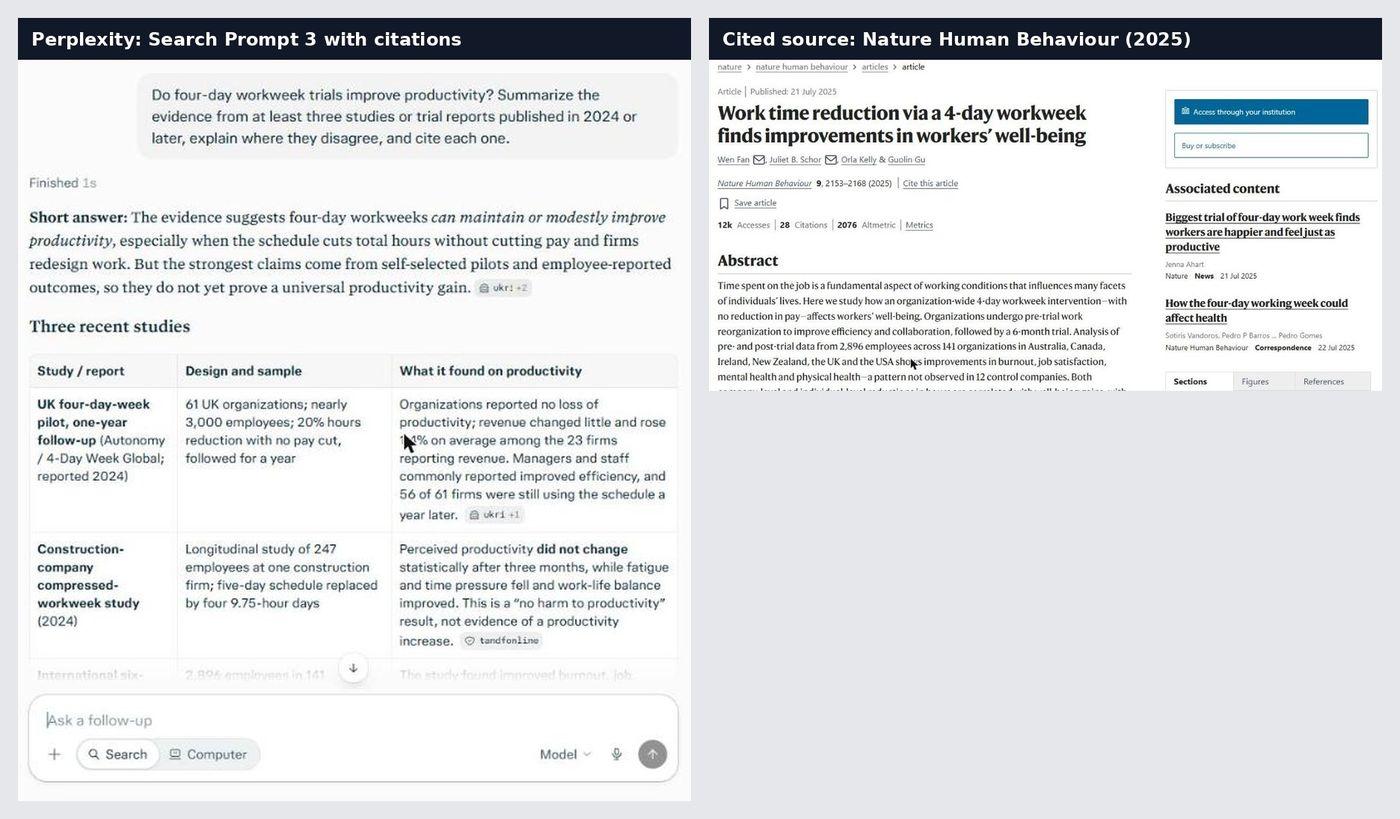
Do four-day workweek trials improve productivity? Summarize the evidence from at least three studies or trial reports published in 2024 or later, explain where they disagree, and cite each one.4b. Citation Check Results
Chatbot | Citations given | Resolve and support claim (x of y) | Invented facts | Live search or knowledge cutoff | Score /45 (P1 / P2 / P3) |
|---|---|---|---|---|---|
ChatGPT | 16 | 3 of 4 opened (one off-topic Medium blog) | 0 | Live | 41 (13 / 14 / 14) |
Claude | 31 | 2 of 2 opened; also leaned on LinkedIn reposts | 0 | Live | 42 (13 / 15 / 14) |
Gemini | 6 | 1 of 2 opened (its Nature DOI does not exist) | 1 | Live (3.6 Flash after the Thinking cap) | 34 (13 / 12 / 9) |
Perplexity | 30 | 2 of 2 opened | 0 | Live | 43 (14 / 15 / 14) |
Microsoft Copilot | 14 | 3 of 3 opened | 0 | Live | 42 (14 / 15 / 13) |
Neo (made by Phrasly) | 10 | 2 of 2 opened | 0 | Live | 43 (14 / 14 / 15) |
A citation counted as supporting its claim only if the page stated that fact directly, not if it simply covered the same topic. Paywalled pages we couldn't open counted as unresolved, and we noted each one.
A bot that gave no sources and missed the recent event in Prompt 1 is marked "cutoff" rather than "live," because it was answering from its training data. None did here: all six searched live on every Round 3 prompt, and all six named the right Nobel laureates and the right BLS figure.
Neo's product page lists web search as a paid-plan feature, so Neo ran this round on our team's paid Phrasly plan, where web search was available.
4c. Round 3 Verdict: The Best AI Chatbot for Research
Perplexity and Neo tied as the best AI chatbot for research in our test, with 43 of 45 each. Claude and Copilot finished one point behind on 42.
Round 3 standings
Perplexity: 43/45 (tied 1st). Every link we opened loaded and backed its sentence.
Neo (made by Phrasly): 43/45 (tied 1st). Every link we opened checked out, and it was the only bot with a perfect score on the synthesis prompt.
Claude: 42/45. Its links held up, but it leaned on LinkedIn reposts.
Microsoft Copilot: 42/45. All 3 links we opened supported their claims.
ChatGPT: 41/45. One citation led to an off-topic Medium blog.
Gemini: 34/45. Our account hit its Thinking limit, and the app switched to 3.6 Flash, which then invented a Nature citation.
Which one to use
Most accurate answers for research: Perplexity or Neo. Every link we opened from either one loaded and supported the sentence beside it.
Fact-checking with citations: Perplexity. It tags almost every sentence with a source, so you can trace each claim to a page that actually says it.
Why you should still click the links
Search-enabled chatbots use retrieval-augmented generation: they pull live sources first and then write the answer from them. That lowers hallucination risk but doesn’t remove it, because a bot can still attach a real link to a claim the page never makes.
Did the AI Overview get it right?
Mostly. The AI Overview names Perplexity as the research leader, and Perplexity did tie for the top Round 3 score. But Neo matched it, and Claude and Copilot were only one point behind.
Final Scorecard: The Smartest AI Chatbot by Round
Chatbot (ordered by total) | Model and plan tested | Reasoning /45 | Writing /45 | Search /45 | Total /135 | Best for |
Claude | Opus 5.5 (Medium) | 44 | 45 | 42 | 131 | Writing and all-round work |
Microsoft Copilot | Microsoft 365 Copilot Chat, Basic, Auto mode | 43 | 41 | 42 | 126 | Microsoft 365 users who want steady all-round answers |
Neo (made by Phrasly) | Phrasly Neo | 43 | 38 | 43 | 124 | Research with sources (tied first in search) |
ChatGPT | Default free model | 42 | 35 | 41 | 118 | Quick answers and research on a free plan |
Gemini | 3.6 Thinking, then 3.6 Flash after the Thinking cap | 44 | 40 | 34 | 118 | Reasoning (tied first in Round 1) |
Perplexity | Default model with free Pro Search preview, Free plan | 42 | 30 | 43 | 115 | Research and fact-checking (tied first in search) |
Best AI chatbot 2026 scorecard. Test date: November 11, 2026. Models and plans tested: ChatGPT free, logged out (no picker); Claude Opus 5.5, Medium; Gemini 3.6 Thinking, then 3.6 Flash after the cap; Perplexity Free, default model; Microsoft 365 Copilot Chat (Basic), Auto; Neo on a paid Phrasly plan. Thinking stayed on wherever a picker offered it. Phrasly makes Neo. Scores are out of 45 per round and 135 in total.
Changelog: November 11 to 12, 2026, first run (nine prompts on six chatbots, plus the free-plan long-form test on Claude and ChatGPT). Next refresh: February 2027, when we rerun all nine prompts on current models (quarterly).
Area | Winner | Score |
|---|---|---|
Reasoning | Claude and Gemini (tie) | 44/45 |
Writing | Claude | 45/45 |
Search | Perplexity and Neo (tie) | 43/45 |
Overall points leader | Claude | 131/135 |
Among ChatGPT, Claude and Gemini, Claude, with 131 of 135, came out on top overall. So what is the smartest AI chatbot? By points, Claude, yet the smartest AI chatbot in the world for your work is the one that wins the round you care about.
A researcher should weight the Search column, and a writer should weight Writing, because a bot can lead the total while losing the round that matters to you. Which is the smartest AI chatbot for a mixed workload? Look for the bot with no weak round, and call the points leader the best AI chatbot only if its lead holds across all three.
Need the short version? Here is our best AI chatbot ranking as a quick comparison of the top 5 AI chatbots by total score:
Claude: 131/135, strongest in writing (a perfect 45/45).
Microsoft Copilot: 126/135, strongest in reasoning (43/45).
Neo (made by Phrasly): 124/135, strongest in search (43/45, tied first).
ChatGPT: 118/135, strongest in reasoning (42/45).
Gemini: 118/135, strongest in reasoning (44/45, tied first).
Free Plan Usage Limits Compared for Each Chatbot
Free tiers often run a lighter model, or switch to one after a usage cap. So a bot's round score above may come from a model that free users only get for a few messages, or not at all.
Three limits shape what you actually get for free:
Usage cap: how many messages, searches or "advanced" queries you get per day or per window.
Context window: how much text the model can hold in one conversation, a bit like its working memory. Anthropic says the free Claude plan's context window and usage limit can vary with demand.
Knowledge cutoff: the date the model's training data stops, which matters less once web search is on.
Some free plans don't stop you at the cap; they drop you to a lighter model instead, so a long session can quietly get weaker partway through. Our own run showed it: after our Workspace account hit Gemini's Thinking limit mid-test, the app switched to 3.6 Flash until the limit reset, and its Round 3 score dropped with it.
Chatbot | Free plan? | Model on the free plan | Usage cap | File uploads | Web search on free | Official source (as of Nov 11, 2026) |
|---|---|---|---|---|---|---|
ChatGPT | Yes | GPT-5.6 Luna, per OpenAI's Free Tier FAQ (no picker when logged out) | Unlimited everyday text chats, subject to abuse-prevention safeguards; files, images, voice and data analysis capped separately | Yes, limited | Yes | |
Claude | Yes | Sonnet 5.5 (default) and Haiku 5.5; Opus 5.5 and Fable 5.2 need a paid plan (model picker, Nov 12, 2026) | Session-based limit that resets every five hours; context window and usage can vary with demand | Yes | Yes (Web search toggle on by default) | Anthropic: About Free Claude Usage; How do I increase my usage limits? |
Gemini | Yes (no Google AI plan) | Gemini Auto (the picker default on a free account, Nov 12, 2026) | Limits may change and are shown in the app's usage settings | Yes (Upload files and Add from Drive) | Yes | |
Perplexity | Yes | Basic models, picked automatically; no model selection on Free | Limited daily usage; the pricing page lists web answers as "Limited" and gives no daily number | Limited | Yes | |
Microsoft Copilot | Yes, with a Microsoft account | Not publicly specified by Microsoft for the free tier | Limited by available capacity and usage limits; Microsoft publishes no fixed message quota | Yes: up to 20 files per conversation, 50 MB per file | Yes: real-time answers based on web search | Microsoft: Free Copilot vs. Microsoft 365 Copilot; File upload in Microsoft Copilot; Copilot pricing for individuals |
Neo (Phrasly) | Yes: available on every Phrasly plan, including the free account | Phrasly Neo (no model picker) | Daily limits apply; no number published | Yes: PDFs, scans, images and audio | Paid plans only, per phrasly.ai/chatbot | phrasly.ai/chatbot |
Every cell links to the vendor's own help or pricing page. Checked November 11 and 12, 2026.
If you're comparing plans to find the best AI chatbot free option, remember that these caps change often, which is why every row carries a check date. Model mismatch check: Claude won writing and shared reasoning on Opus 5.5 through a paid plan, a model the free plan doesn't include: free users get Sonnet 5.5 and Haiku 5.5. Gemini's reasoning tie came on 3.6 Thinking, which our account capped mid-test. Perplexity's search tie came on the Free plan itself, and Neo's on a paid plan.
Based on our November 2026 results, Perplexity is the smartest free AI chatbot for research, because we tested it on the Free plan itself and it still tied for the Round 3 win.
Is Claude Better Than ChatGPT for Long-Form Writing on a Free Plan?
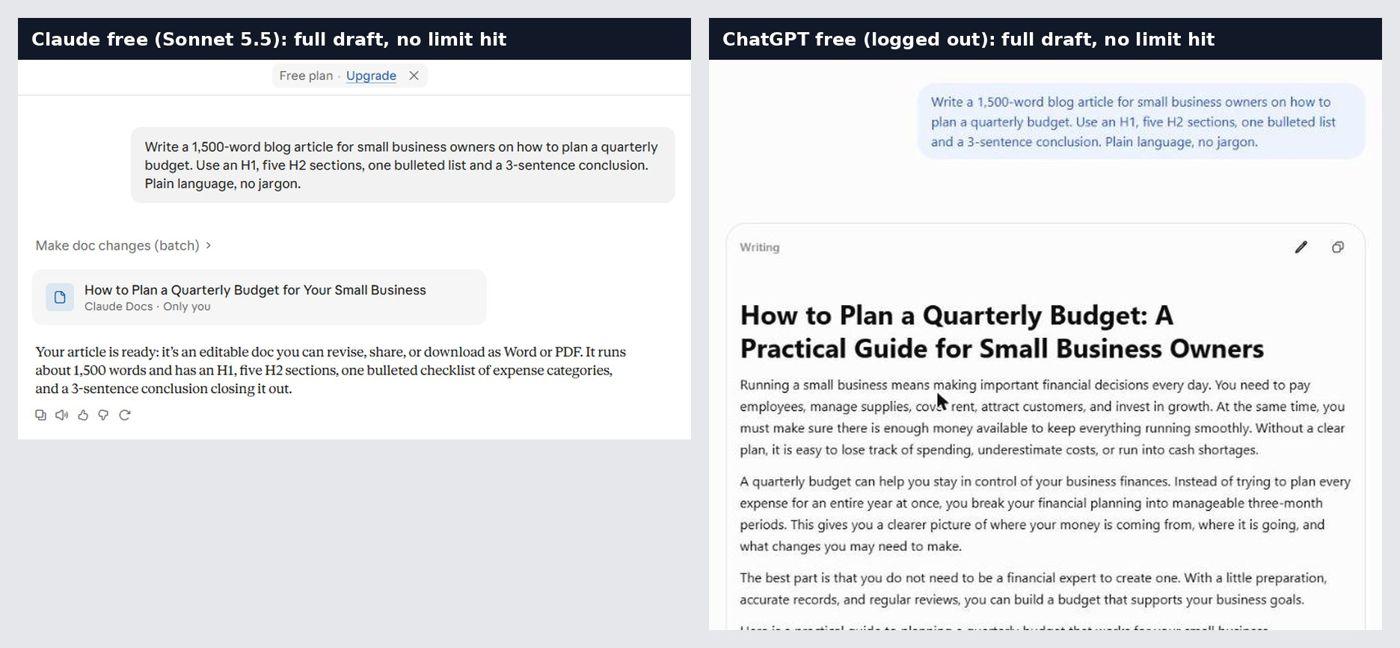
On free plans, Claude handled our 1,500-word article test better, mainly because it followed every structural rule and landed within 2% of the word target, while ChatGPT ran about 37% long and used three bulleted lists instead of one. Neither hit a limit or needed a "continue" prompt.
Both free plans got the same article prompt on November 11 (ChatGPT) and November 12, 2026 (Claude), followed by one identical revision request. Claude ran on a logged-in free account with no trial, on Sonnet 5.5 at Medium effort as its picker showed, and ChatGPT ran logged out on its default free model, with no picker shown.
Free-plan long-form prompt, then the revision request
Write a 1,500-word blog article for small business owners on how to plan a quarterly budget. Use an H1, five H2 sections, one bulleted list and a 3-sentence conclusion. Plain language, no jargon.

Revision request (sent next, in the same chat): Rewrite section 3 to be more concrete and add one worked example. Leave every other section unchanged.
Here is what we compared between the two free plans:
When each one hit a message or length limit, and what the limit message said.
Whether it needed a "continue" prompt to finish the draft.
Whether it kept the five-H2 plan and the list format all the way through.
How many words it delivered against the 1,500 target.
Whether the revision changed only section 3, or quietly rewrote more.
Criterion | Claude free | ChatGPT free |
|---|---|---|
Hit a message or length limit? | No | No, logged out on the free tier |
Needed a "continue" prompt? | No | No |
Structure consistent across sections? | Yes: H1, five H2s, one bulleted list (8 items) and a 3-sentence conclusion | Yes: H1, five H2s and a 3-sentence conclusion, but three bulleted lists instead of one |
Words delivered vs 1,500 | 1,471 (2% under) | About 2,050 (roughly 37% over) |
Revision request handled | Rewrote only section 3 and added a worked example table (a design studio's January to March income); every other section unchanged | Returned only a rewritten section 3 with a worked example table; other sections untouched |
Published free limits | Session-based limit, resets every five hours (Anthropic) | Unlimited everyday text chats, tools capped separately (OpenAI) |
The published limits explain part of the result. OpenAI says free ChatGPT users get unlimited everyday text chats, with separate caps on tools such as file uploads, while Anthropic describes a session-based limit on free Claude that resets every five hours.
Pick Claude free if you need a draft that follows your structure and length on the first try (it also saved the article as an editable doc you can download as Word or PDF). Pick ChatGPT free if you want a longer, more exhaustive first draft and don't mind trimming it. For the Gemini side of the "which is smartest" question, the scorecard shows it at 118 of 135, tied for fourth, and paid-tier writing results are in Round 2.
Long-form work rarely ends with one prompt. If you publish on a schedule, our guide to writing SEO-friendly blog posts with AI covers the outline, draft and edit loop that keeps a free plan's limits from stopping you halfway. Whichever bot won here, the best AI chatbot free plan for long-form is the one that finishes the draft without making you start over.
How to Judge the Most Intelligent AI Chatbot Beyond Benchmark Claims
Benchmark wins are real, but they measure different things, which is how every vendor can call its model the most intelligent AI chatbot. Three ideas make those claims easier to read, and a short checklist lets you test any bot yourself.
8a. Benchmark Scores vs Your Own Prompts
Benchmark scores come from standardized tests in math, coding ability, reasoning and multimodality, where models are graded and ranked. A model can lead one leaderboard and trail on another, depending on the test, the date and the version. Stanford's AI Index 2026 found the top four labs on the Arena leaderboard within 25 Elo points of each other as of March 2026, so a small lead rarely predicts which bot handles your task better.
8b. Proprietary vs Open-Weight Models
Proprietary models keep their weights private, and you reach them only through the vendor's app or API. Open-weight models publish their weights so anyone can run or adapt them, as with DeepSeek, Llama and Mistral, which we left out because this test covers consumer chatbots people sign up for. The same AI Index chapter puts the top closed model 3.3% ahead of the top open-weight one as of March 2026, up from 0.5% in August 2024.
For transparency, Neo's product page says it builds on open-source models that Phrasly optimizes.
8c. Hallucination Rate and Knowledge Cutoff
Hallucination rate is how often a model states something false with confidence, and our survey on how people rank each AI model's strengths and weaknesses shows regular users notice it. A knowledge cutoff is the date a model's training data stops, so without search it can miss recent events.
Live search solves the cutoff problem but adds a new one, links that still need checking, which is why Round 3 scored citations. AI reasoning models that think longer can cut some errors, but they don't remove the need to verify. Before you trust any chatbot with real work, ask four questions:
Does it reach the right answer on a problem you've already solved?
Does it follow every constraint in your brief?
Do its links open and support the claim next to them?
Does it say so when it doesn't know?
Pick the Smartest AI Chatbot for Your Task
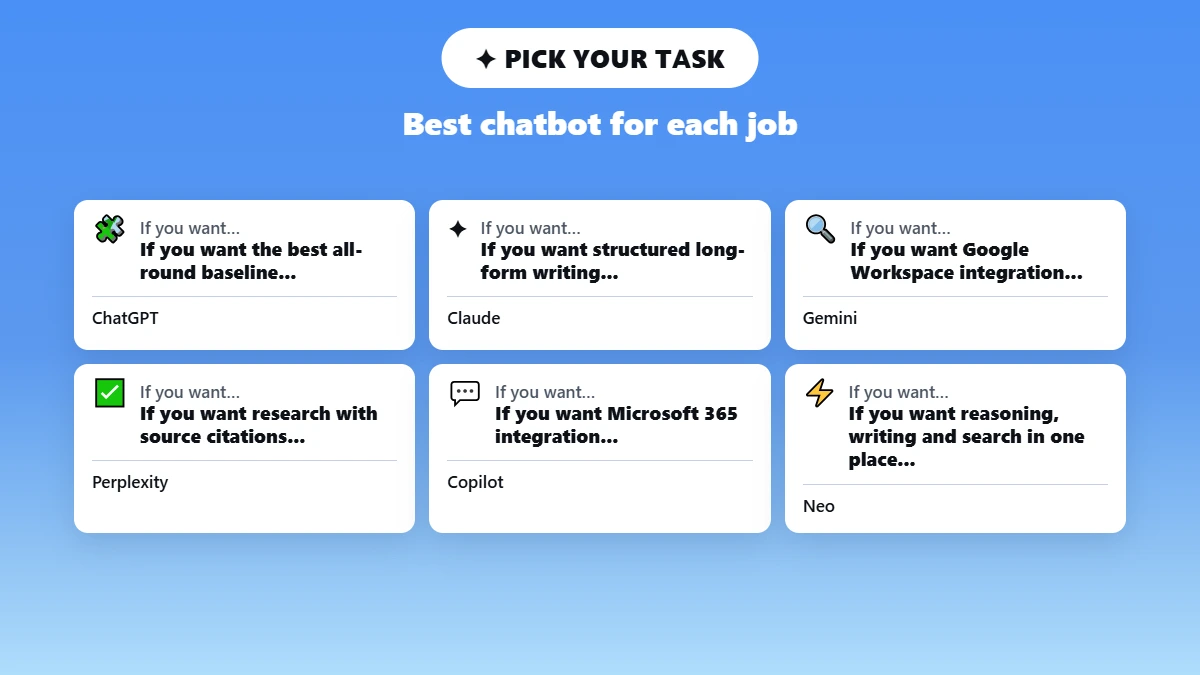
What is the best AI chatbot for you? It depends on your task, the tools you already use and your budget, so start from the round closest to your daily work:
Research and fact-checking: Perplexity or Neo (tied), the best AI chatbots for research in our test, because every link we opened from either one backed the claim beside it.
Complex reasoning: Claude or Gemini (tied).
Long-form writing: Claude, plus the free-plan result above if you aren't paying.
Microsoft 365 users: Copilot, if you already work in Microsoft's apps.
Google Workspace users: Gemini, if your files and email live in Google.
No budget: Perplexity for research, tested on its Free plan.
Content teams: read our guide to using AI for content creation before you standardize on one tool.
Reasoning, writing and search in one place: Neo by Phrasly, with web search on paid plans.
The best AI chatbot for you is the one that won the round closest to your daily work, not the one with the loudest launch.
Try Neo for Reasoning, Writing and Search in One Place
Phrasly makes Neo, and in our test it tied for first in the search round and placed third overall with 124 of 135. If you want reasoning, writing and search in one chatbot, run our nine prompts on Neo and compare the answers with your current pick.
Frequently asked questions
By total score, Claude was the smartest AI chatbot in our test on November 11, 2026, though no bot won every round. Rankings shift with each model release, so compare our scorecard with the live LMArena leaderboard for newer models.