How Marketers Are Accidentally Creating Content Plagiarizing. Here's the Data from 50 Scans
7 min read
Most content teams have a plagiarism policy because, whether intentional or unintentional, copying content can result in negative consequences.
To ensure that content is original or that references are correct, writers tend to use plagiarism-checking tools and set an ideal percentage.
We wanted to know what a "normal" score actually looks like, which formats are riskiest, and where the overlapping language is actually coming from.
To find out what's actually happening, rather than guessing, we pulled 50 pieces of live, publicly published content and ran them through Phrasly Plagiarism Checker.
If you write, edit, or approve content, see what we found out about plagiarism.
Detect For Plagiarism Now 👇
How We Ran the Content Plagiarism Study
Plagiarism is “Presenting work or ideas from another source as your own, with or without consent of the original author, by incorporating it into your work without full acknowledgment”, according to the University of Oxford.
Phrasly plagiarism checker detects copied, paraphrased, and restructured content, matches it with an existing source, and provides a detailed plagiarism report.
Here is how we conducted this study:
Sample Set, and What We Measured
We collected 50 samples across four content categories:
Blog posts (20 samples): company and independent blog articles;
Articles and web pages (11 samples): publisher and brand editorial content, including long-form magazine-style articles;
LinkedIn posts (10 samples): individual and company page posts;
Academic writing (9 samples): a mix of theses, journal articles, and research papers.
Samples were selected using topic-based keyword searches (e.g., "digital marketing," "content marketing") so that, as much as possible, each format group wrote about comparable subject matter.
Word counts ranged from 276 words on the short end to nearly 5,000 words on the long end.
Methodology
Every sample was run through the Phrasly Plagiarism Checker, which returns a Plagiarism Match Total, the percentage of the text that overlaps with existing published content on the web, along with the specific external URLs and phrases responsible for the flag.
One methodology note: because this was manual, human-driven data collection, every sample was first located and read at its original source URL.
That naturally produces a match to the original link. We stripped that "match to the original link" figure out of every calculation in this report.
Every piece of data in this resource overlaps with other, unrelated pages, the kind of overlap a plagiarism check would actually flag as a problem.
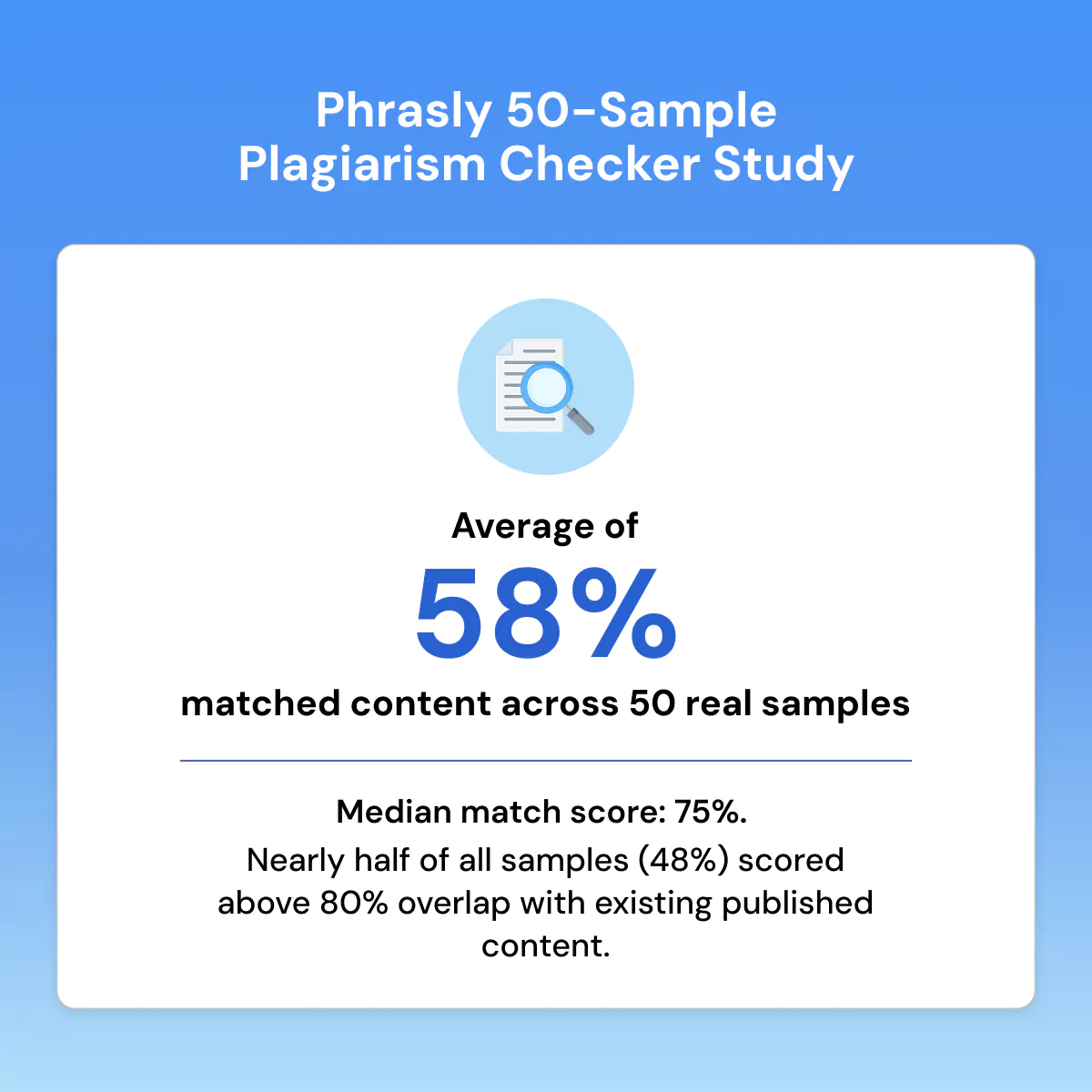
In the study, the average is dragged in different directions by wildly different format-level behavior, which is where the real story starts.
💡Understand incremental plagiarism, explore real-world examples, and learn practical tips to create authentic, properly cited content.
Which Content Formats Get Flagged Most For Plagiarism
Across samples of blog posts, LinkedIn posts, academic articles, and reports, we noticed the following.
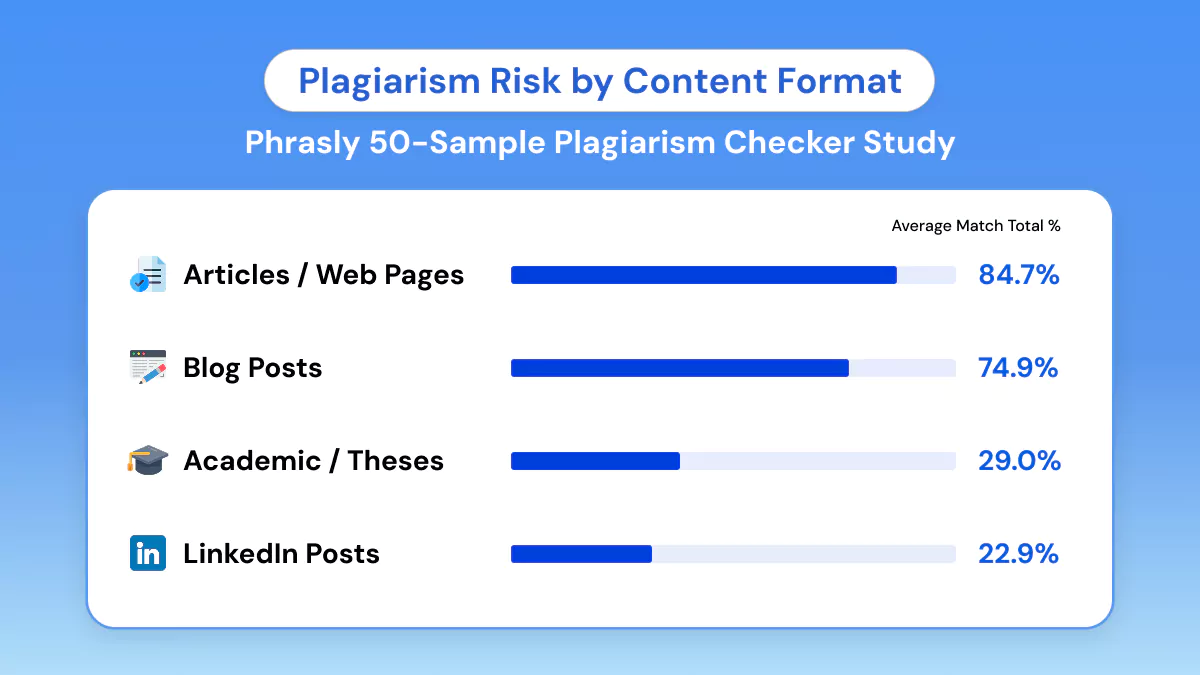
Format | Avg. Match Total | Sample size |
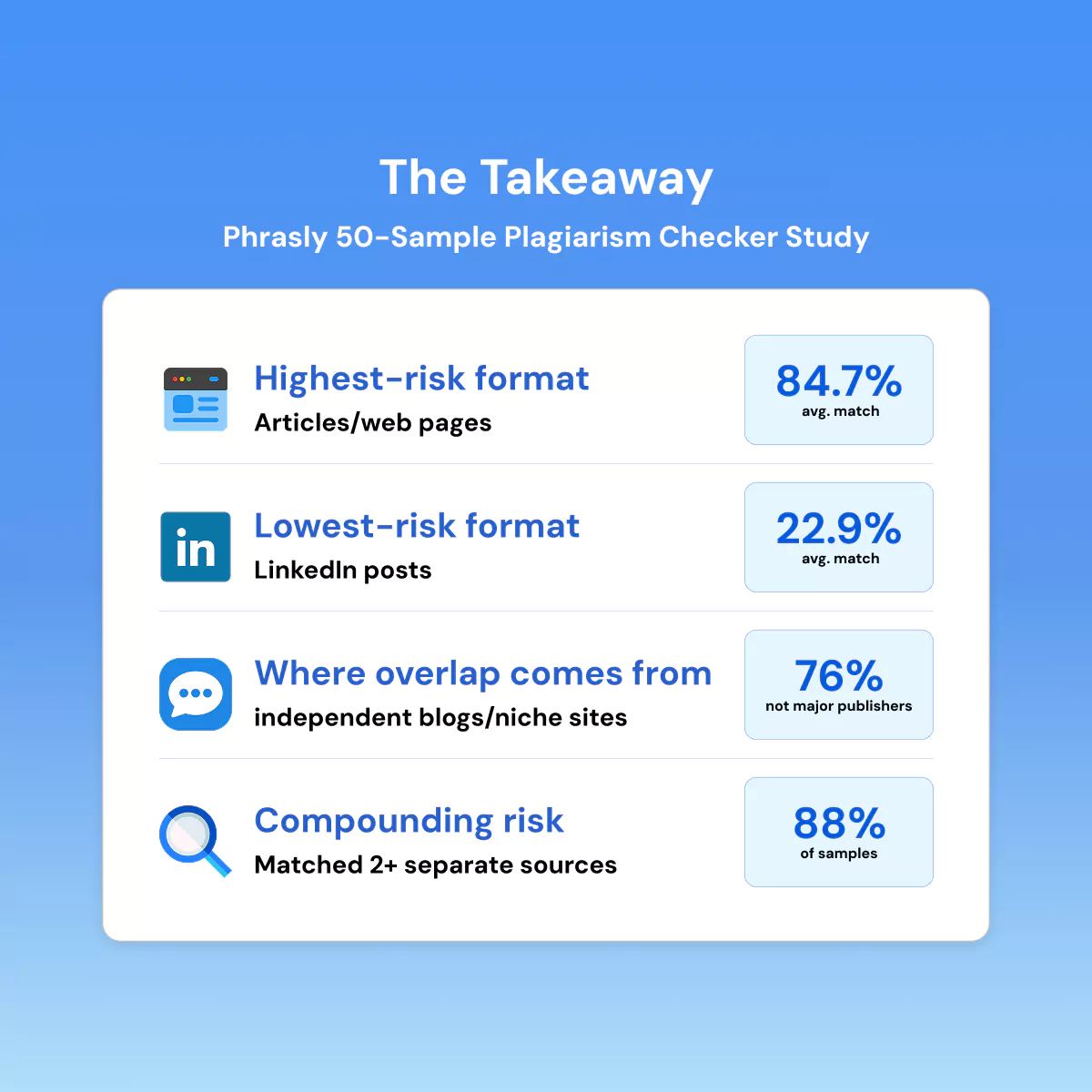
Articles/web pages | 84.7% | 11 |
Blog posts | 74.9% | 20 |
Academic / theses | 29.0% | 9 |
LinkedIn posts | 22.9% | 10 |
Articles and blog posts, the two content formats content teams publish most, have the highest average match total for plagiarism by a wide margin.
LinkedIn posts, a type of content with a shorter engagement lifespan than the other samples, actually came back the cleanest. Meaning, fewer plagiarism flags and matchers.
Academic writing trailed not far behind.
Why the difference in the formats?
Articles and blogs tend to be written to inform about well-covered, heavily searched topics. They also intend to establish authority and build audience trust, but to do so, there’s a need to publish.
This can lead to repetitive content, where other writers have already said the same things, in similar order, using similar phrasing.
Blog posts and web articles are often created by reading what's already ranking, extracting the key messages, and rearranging those messages into a new piece.
This process is also how convergent phrasing happens.
LinkedIn posts, by contrast, tend to be shorter, more personal, and more opinion-driven, which leads to authenticity.
While academic writing requires original content, many matches happen due to proper citations.
The Most Common Sources of Overlap: Where the Matched Content Actually Comes From
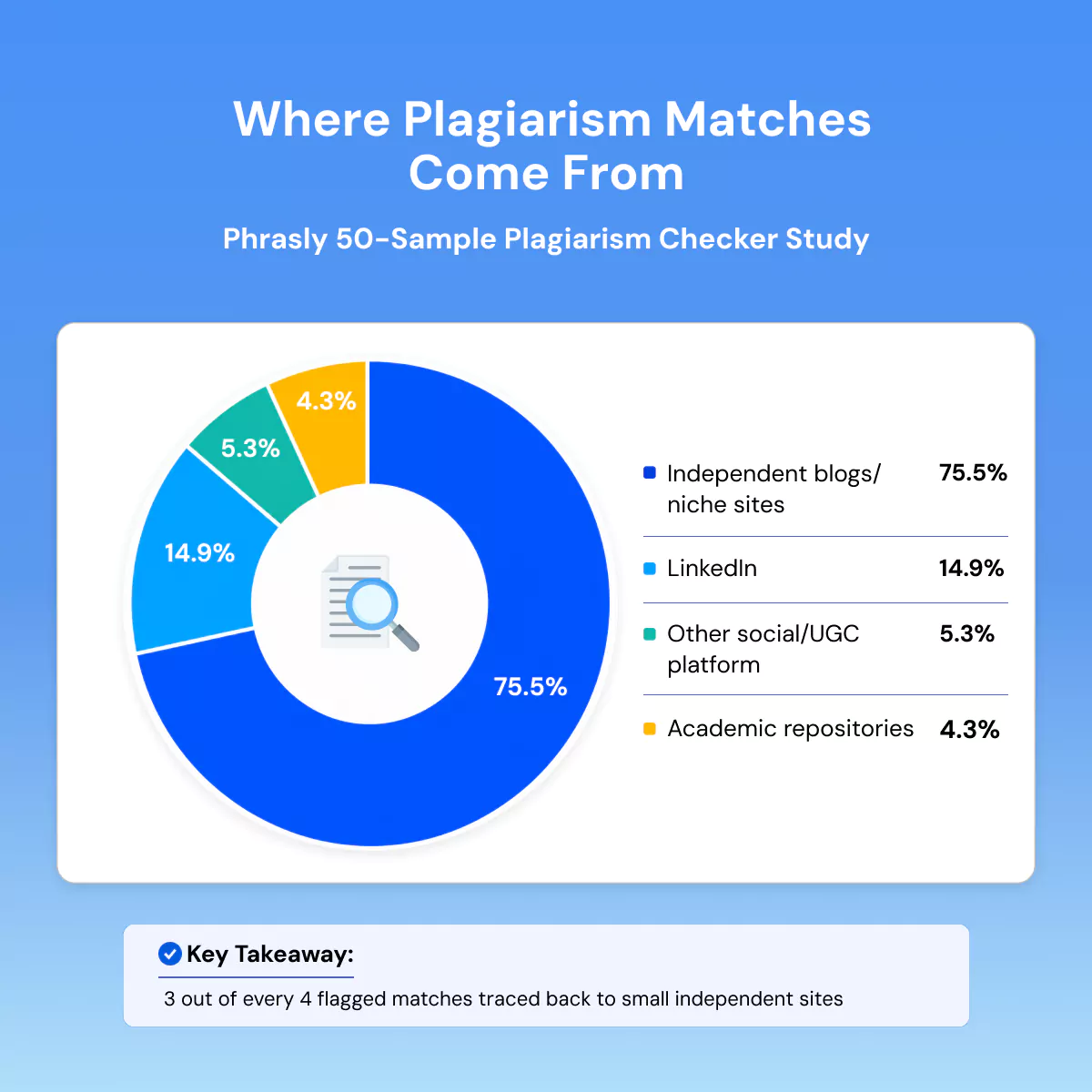
Across the 50 samples, the checker returned multiple flagged matches. We categorized the two highest flagged URLs by the type of site it came from.
Source type | Share of all flagged matches |
Independent blogs / niche websites | 75.5% |
14.9% | |
Other social / UGC platforms (Facebook, Wattpad, etc.) | 5.3% |
Academic repositories | 4.3% |
The biggest takeaway here: the overlap is not primarily coming from high-authority publishers and sources. It's coming from a long tail of small, often SEO-driven independent sites and blogs.
LinkedIn showed up often enough (appearing as a matched source in roughly 1 out of every 7 flags) to be worth watching in its own right, especially for B2B and marketing content that frequently gets copy-pasted across posts.
The second layer of this question is how many separate sources each piece of content was overlapping with.
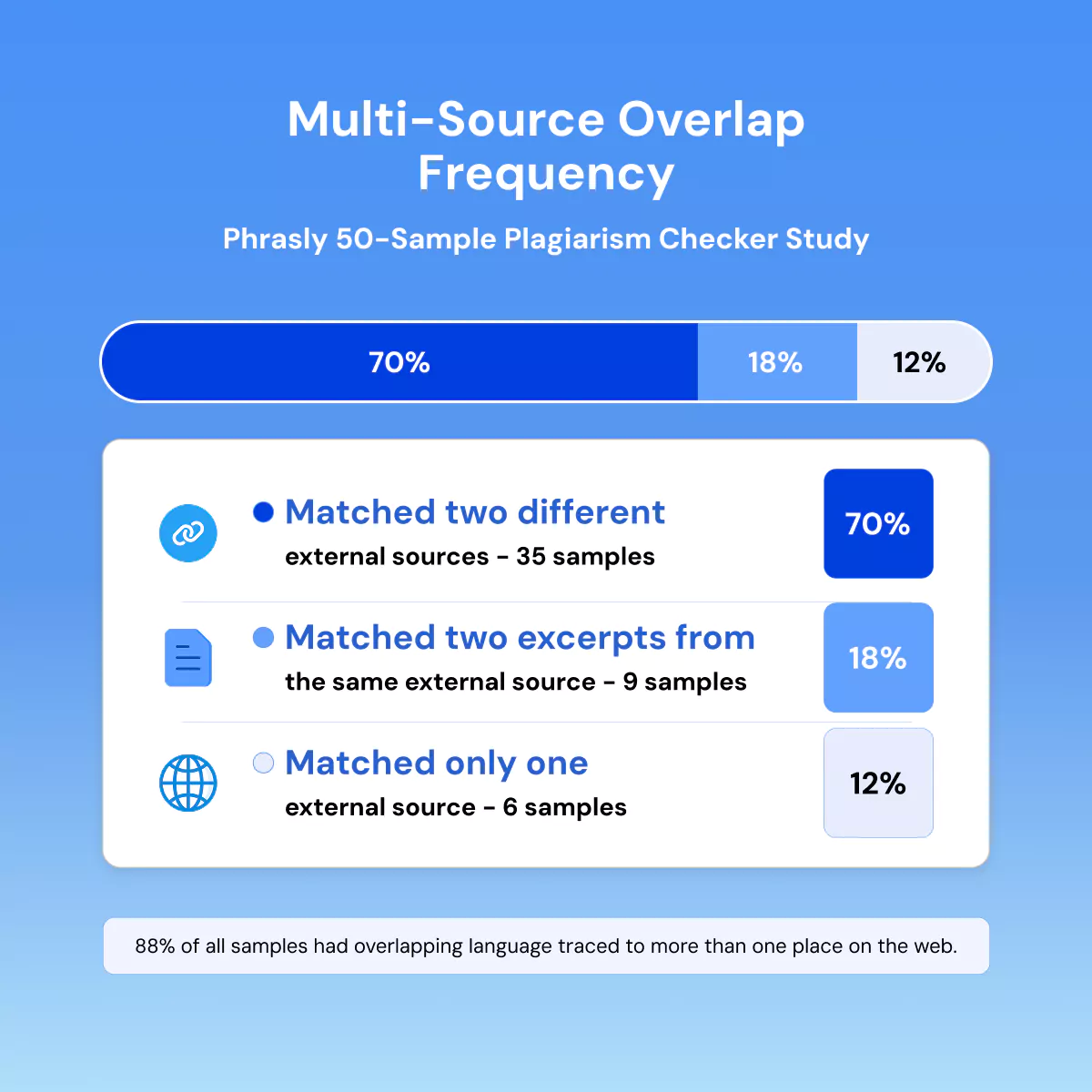
When a plagiarism checker flags your content, it's rarely an isolated coincidence. In this dataset, close to 9 out of 10 pieces had overlapping phrasing detectable from at least two separate links.
This is a strong signal that the underlying ideas, structure, or phrasing are being recycled, not just cited from one source.
Discover why copywriters get false AI detection flags and the best practices to review, improve, and defend your work.
How Much Overlap Is "Normal"? Breaking Down Match Percentages Across the Sample
When marketers run a plagiarism checker, they expect a few scattered phrases to light up, maybe a common industry cliché or a widely cited statistic.
What they don't expect is to see half their document highlighted in red.
Nearly half of all samples, 48%, scored between 81% and 100% overlap with existing sources.
Match Total range | # of samples | Share of total |
0-20% | 12 | 24.0% |
21-40% | 3 | 6.0% |
41-60% | 6 | 12.0% |
61-80% | 5 | 10.0% |
81-100% | 24 | 48.0% |
The data raised an important question: at what point does "inspiration" become replication, and at what point does replication become a compliance risk?
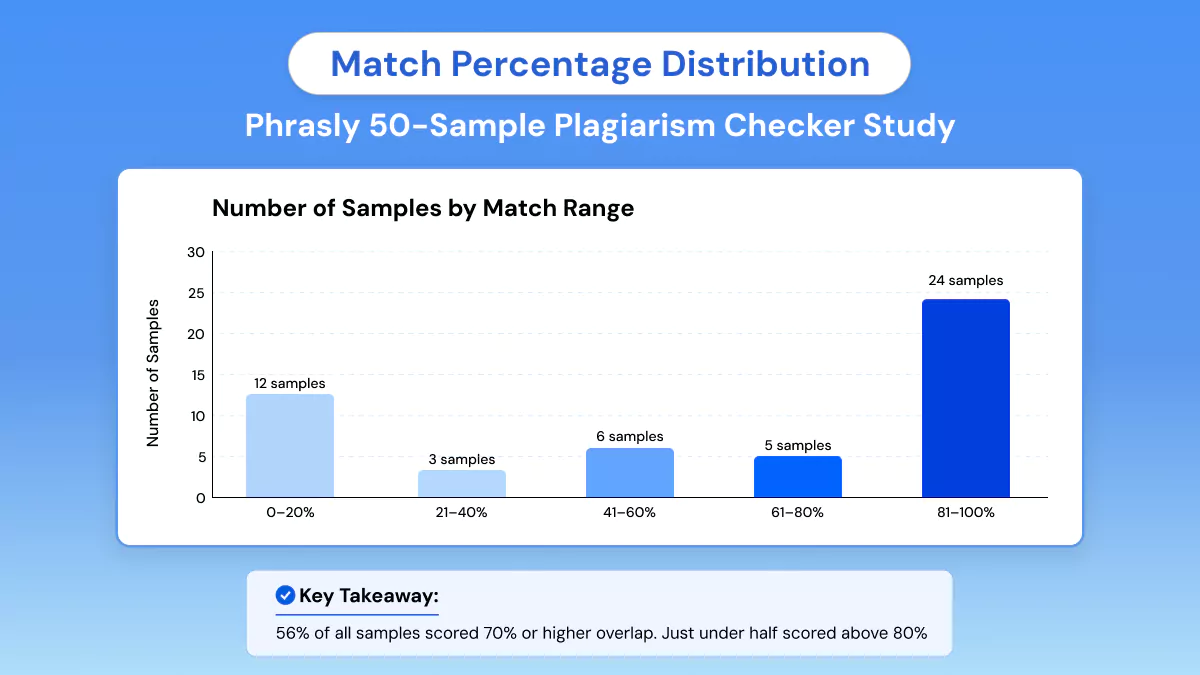
This has immediate implications for how teams should interpret their plagiarism checker results.
A score of 75% overlap shouldn't be dismissed as "probably just common phrasing" when the data shows that's the modal outcome.
Check our practical guide to using AI content idea generators to brainstorm faster, create stronger content, and never run out of topics again.
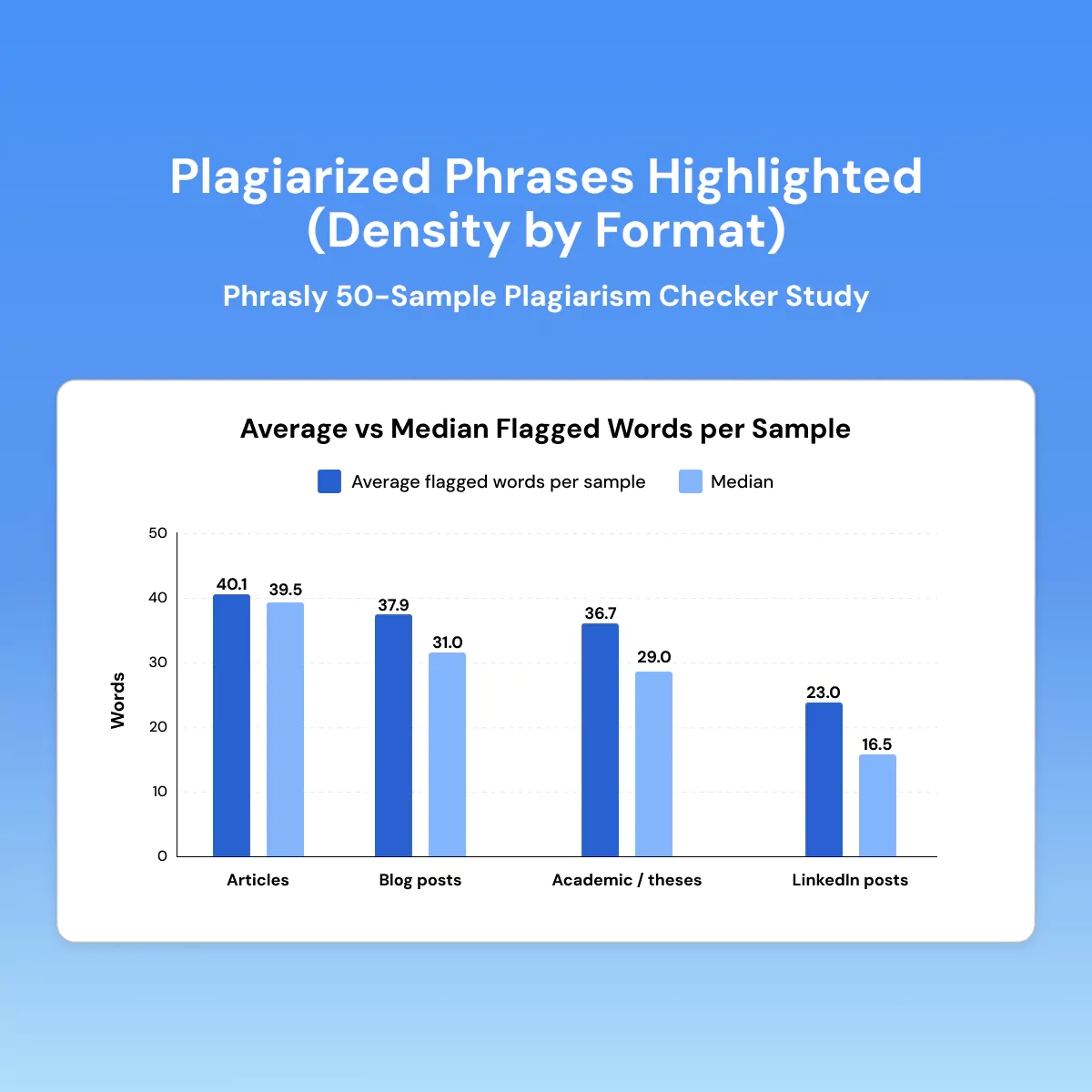
Articles and blog posts score higher overlap, and the actual flagged passages run nearly twice as long as those on LinkedIn.
Learn the academic, professional, legal, and SEO consequences of plagiarism, and how to protect your work with proper citation and originality.
Word Count, Length, and Plagiarism Risk: Is Longer Content Safer or Riskier?
There's a common assumption in content marketing that longer, more comprehensive content is inherently more "original".
If you write 3,000 words on a topic, you have to bring your own analysis, examples, and perspective. While short pieces are the ones at risk of sounding like everyone else.
But our 50-sample scan doesn't support that.
The real surprise? The shortest content performed best. Pieces under 1,000 words averaged just 27.0% overlap, less than half the rate of mid-length content.
In practice, brevity may be forcing writers to express their own thinking.
The infographic below maps this relationship across all four word count ranges.
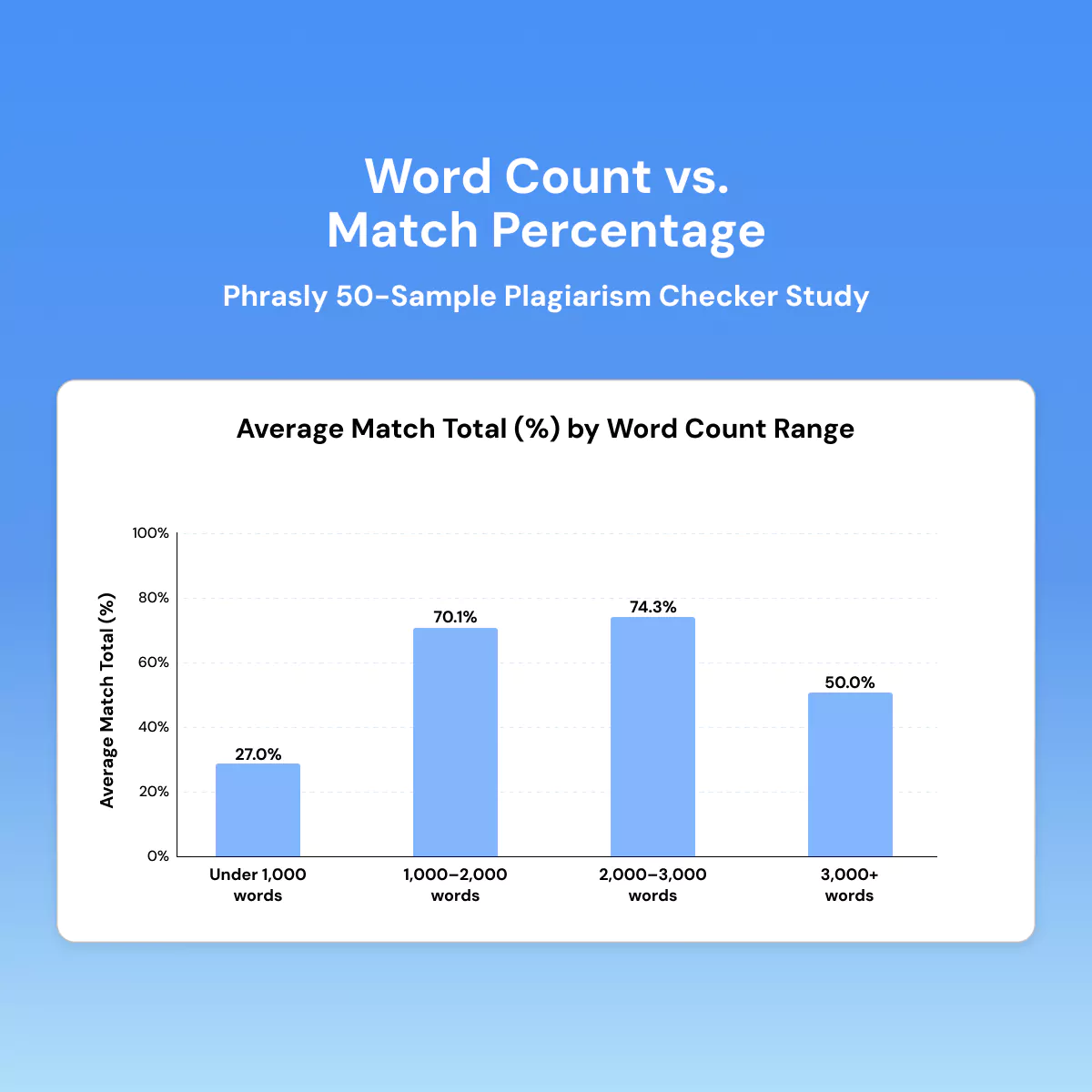
The relationship between length and originality isn't linear. And the honest conclusion: length is not a meaningful predictor of plagiarism risk in this dataset.
What predicts risk is format and, underneath format, the writing habits that come with it.
Patterns Behind the Flags: Style, Structure, and Habits That Predict a Match
Analyzing the data, a few consistent patterns emerge about why certain content ends up flagged:
Topic saturation drives most overlap. Articles and blog posts about heavily covered topics (like "digital marketing") are competing with hundreds of nearly identical explainer pages.
Format is related to the writing process, and the writing process is predictive of risk.
LinkedIn posts are most often created entirely new and in one's own voice, with less research-and-synthesize workflows.
Articles and blogs were more commonly built off of multiple existing sources, which was the workflow most likely to produce overlapping language.
More than three-quarters of flagged matches traced to small, independent blogs and niche sites, rather than the authoritative or top-ranking sources on the topic.
Explore a step-by-step workflow for humanizing AI copy, refining brand voice, and turning generic drafts into persuasive marketing content.
What This Means for Content Teams: Turning the Data Into a Publishing Safeguard
Across this sample set, high overlap was the norm for a large share of content, particularly for two formats: blog posts and articles.
Check a complete guide to avoiding Google penalties with actionable tips on content quality, E-E-A-T, technical SEO, AI content, and user experience.
To prevent plagiarism flags, here are a few takeaways for a publishing workflow:
Treat plagiarism checks as a pre-publish gate for high-saturation topics.
Watch blog posts and articles more closely than LinkedIn content.
Don't rely on word count as a proxy for originality.
Investigate multiple matches. A single flagged match might be coincidental phrasing.
Two or more independent matches, which happened in 88% of samples here, is a signal that the underlying structure or sourcing process needs a closer look.
Ready to see where your content actually stands?
Run it through the Phrasly Plagiarism Checker, it detects copied, paraphrased, and restructured content, matches it with existing sources, and gives you a detailed report with exact overlap percentages and traced URLs.
Don't wait for a client, search engine, or competitor to flag it first.
Frequently asked questions
Does a high match percentage always mean someone copied on purpose?
No. Most of the overlap in this study wasn't intentional lifting, it was convergent phrasing, writers researching the same top-ranking pages and landing on similar language and structure.
If I write longer content, does that lower my plagiarism risk?
Not based on this data. Content under 1,000 words averaged 27.0% overlap, while 1,000–3,000 word content averaged 70–74%. Length gives you more room to add original analysis, but it doesn't guarantee you'll use it.
Where does most of the overlapping content actually come from?
75.5% of flagged matches traced back to independent blogs and niche websites, not major publishers or authoritative sources. LinkedIn accounted for another 14.9%.

Written by
Gabriela Cofre
Gabriela Cofre is a content strategist and writer specializing in SEO, inbound marketing, and B2B, B2C content with +7 years of experience.