Top 20 Reasons Your Content is Getting Penalized by Google
19 min read
You know how hard it is to publish a new content piece. There’s ideation, research, outlining, writing, and editing that can take you hours. Therefore, it's only natural to expect that such content will justify the effort by delivering good traffic and ranking keywords.
Following Google’s guidelines on how to make your site interesting and useful - through organized content, original writing, and updated information, is one of the best ways to improve visibility in search.
But if you’re experiencing drops in organic traffic, ranking losses for keywords, deindexation of key pages, or content simply never gains traction and don’t know why, this guide is for you.
In this practical guide, you’ll learn about the top 20 reasons why your content is getting penalized by Google (or Search Engines), organized into clear categories, and not a random list.
We have also separated relevant information to help you create content that drives quality traffic.
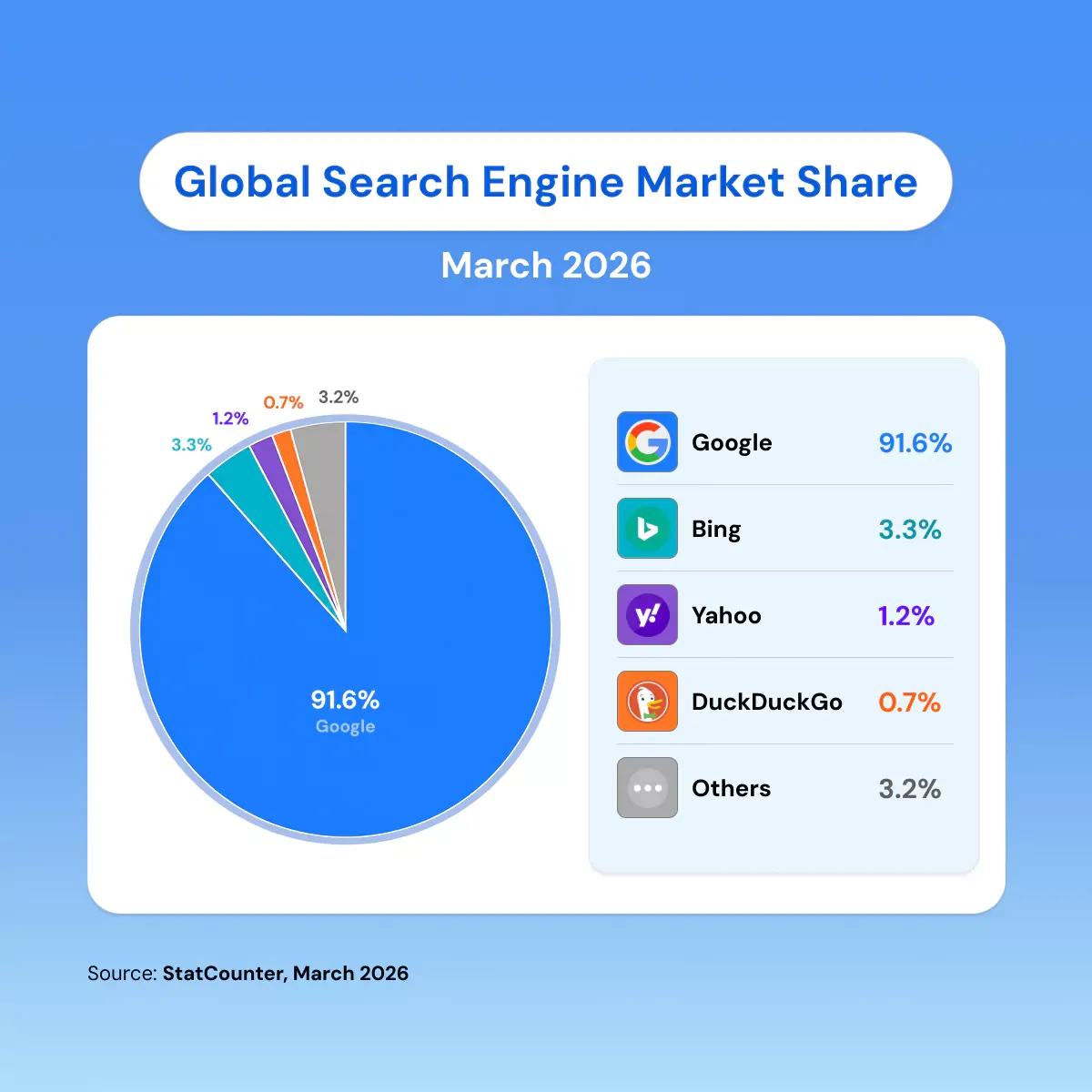
Google's 91.6% grip on global search (Sharkplatform) means a penalty here isn't a setback, it's an existential threat to your organic visibility.
Check Your Work for AI Detection Here 👇
Content Quality & Helpfulness Issues
Google's Helpful Content System and core quality algorithms are designed to surface content that genuinely captures the searcher's intent.
So when your content is no longer providing relevant information, it's underperforming, and it actively signals to Google that your site may not be being updated.
Have you noticed that some content pages that used to drive traffic to your site are not performing as well as before?
Here are some common critical failures in content quality:
1. Thin or Low-Value Content
This type of content covers a topic superficially, repeats what already exists elsewhere without adding any new value, or fails to answer the user's next logical question.
The Web is growing, but 96.55% of all pages on the internet receive zero organic search traffic from Google (Ahrefs), largely due to a lack of backlinks and alignment with search intent.
And keep in mind that it is not about length, because this can happen in pages with high word counts that don’t really say much. This is especially prevalent in AI generated content due to the way that LLMs work.
They are designed to answer your questions and perform tasks but not to generate original and unique ideas.
How to fix thin content: Build your content around original content, with a unique perspective that answers the readers' questions. In this instance, we suggest using AI as a co-pilot, not the captain of the ship.
If you’re running out of ideas, try Phrasly's free AI content idea generator, which turns any niche, topic, or keyword into ready-to-use blog titles, social post angles, YouTube concepts, and email subject lines in seconds.
2. Search-Engine-First Writing
The name says it all: content created to rank for keywords rather than provide value.
This includes awkward keyword stuffing, clickbait headlines, intros that repeat the query 3x before providing value, and, in general, writing structured-by-machine desires rather than user logic.
That's a risky approach, especially since Google's Helpful Content System evaluates your entire site 24/7.
Don’t let half your pages sound like they were written for the search engine first, or your whole site could be penalized.
How to fix search-engine-first writing: focus on people-first content. Write the headline and first 200 words for a human who needs an answer immediately.
Write for humans, then add your SEO elements (meta descriptions, header tags, internal links, etc.) on top.
Search-Engine-First Writing
Here are the 10 best project management software for remote teams:
1. Asana, Best project management software for remote teams.
2. Trello, Best project management software for remote teams.
3. Monday.com, Best project management software for remote teams…
People-First Writing
Here are the best project management software for remote teams:
- If your team is under 10 people and mostly async: Notion or Trello. Simple, flexible, no learning curve.
- If you manage client work across time zones: Asana or Monday.com. Built-in proofing and client portals reduce "where's the feedback?" loops.
- If you're scaling past 50 people: ClickUp or Wrike. Custom workflows and resource management prevent chaos at volume…
3. Lack of Original Insight or Experience
Content that is generic, advice that could have been written by anyone, anywhere, without direct experience is damaging your traffic.
Google’s raters are looking specifically for “evidence of first-hand experience”; this can include original images, specific case details, personal lessons learned, or professional expertise that surfaces in the recommendations.
So copy that has been paraphrased from elsewhere or generated entirely by AI without human oversight will increasingly struggle to rank.
How to fix lack of original insight in content: Include evidence of experience: screenshots of tools you’ve used, metrics from your campaigns, quotes from other practitioners you interviewed, or straightforward declarations of process (“We tested this on 12 client sites for half a year”).
Strong experience-based content
“We tested 48 subject lines across 12 B2B campaigns over a six-month period and found that including a prospect's company name increased open rates by 17% on average.“
4. Outdated Content
The content you produced 12 months ago was accurate when published, but it may now be irrelevant.
Your article may be considered outdated if it links to tools that are no longer available, includes outdated statistics, promotes expired offers, or recommends practices that are no longer considered best practices.
How to fix outdated content: Create a content maintenance calendar. Review top-performing pages each quarter for accuracy, update the publish date when large updates are made, and redirect/remove content that can’t be updated.
Keep in mind: Freshness matters, but authority takes time to build. In fact, 72.9% of pages in Google’s top 10 are more than 3 years old (Ahrefs).
While 76.4% of ChatGPT’s most frequently cited pages feature regular data updates within the last 30 days (Ahrefs), making constant accuracy verification a requirement for visibility.
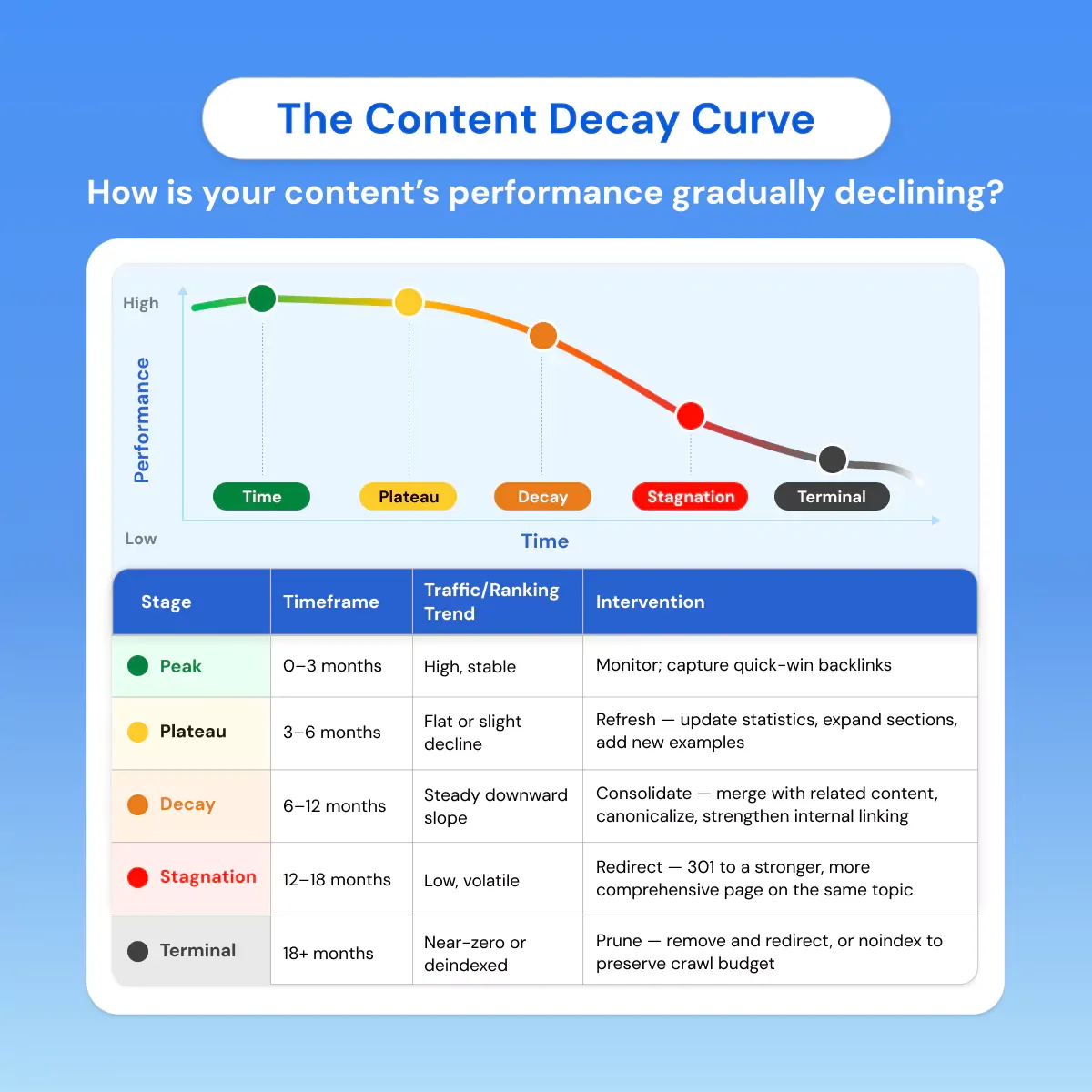
To help you understand how rankings and organic traffic naturally decline when content is left untouched, and where strategic updates can reverse the trend, see the infographic below.
AI-Generated & Low-Effort Content Red Flags
The line between efficient content production and algorithmic penalty has never been thinner.
Google's March 2024 core update explicitly targeted scaled content abuse, regardless of whether it was produced by AI, humans, or a combination of both.
To make AI-generated content sound more natural, read How to Make ChatGPT Content Undetectable: 8 Effective Methods and learn whether AI-humanization tools actually work in practice.
The problem, again, is a lack of quality in addressing the search intent. Here are some reasons why your content might be penalized by Google:
5. Mass-Produced AI Content Without Human Review
Using generative AI to publish hundreds or thousands of articles with minimal oversight, fact-checking, or editorial refinement.
If your website receives this penalty, you can experience sudden site-wide drops in traffic from Google without seeing any manual action in Search Console
This often overlaps with programmatic SEO done poorly, automating page creation at scale using templates, data feeds, or AI generation to target thousands of keyword variations without human judgment.
If your website receives this penalty, you can experience sudden site-wide drops in traffic from Google without seeing any manual action in Search Console.
Beyond search engines, users themselves are becoming more skeptical of low-quality AI content. According to a survey by Gartner, 49% of U.S. consumers believe generative AI has made the quality of available content worse, and among Gen Z and millennial consumers, that figure rises to 57%.
How to fix: By now you know that writing complete pieces with AI without reviewing is not profitable, so use AI-generated content for assistance.
Every blog post still needs to go through a human editor to check for factual errors, tone and clarity, structural sense, and the insights that only a human can add.
Failures that AI outputs repeatedly:
- Cite a study or resource that did not exist.
- Recommend tools that had been discontinued.
- Uses identical transition phrases ("Moreover," "Furthermore," "In today's digital landscape") in most intros.
- Included "expert tips" with no named expert or supporting evidence.
Teams deciding between polishing AI text and fully rewriting it may also benefit from understanding the difference between AI text improvers and enhancers.
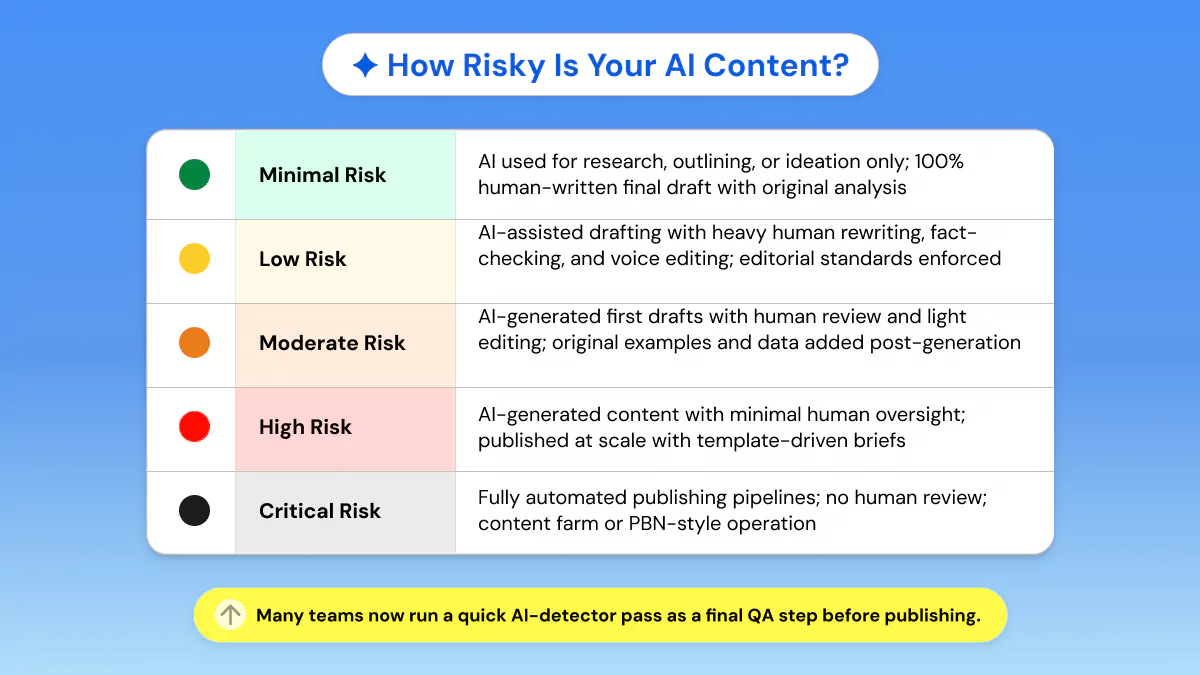
If you're evaluating detection tools, this review of Writer's detector explains its strengths and limitations.
6. Scaled Content Abuse (Beyond AI)
Don’t think AI-written articles are the only thing able to cause penalties.
Human-written content generated at scale, whether by content farms or templated briefs churned out with little variation to create hundreds of duplicate articles around variations of a keyword, can also catch Google’s attention.
Publishing content at scale has never been easier, thanks to the rise of AI solutions.
According to Ahrefs' The State of AI in Content Marketing report, companies using AI publish 42% more content each month, with a median output of 17 articles per month, compared to 12 articles for companies that do not use AI.
While increased production is not inherently bad, volume becomes an issue when it exceeds quality assurance and editing processes.
Some signals Google will use to identify this kind of manipulation include coverage of the same topics with very little variation between pages and an unnatural publication rate that wouldn’t be possible without automation.
How to fix content abuse from scaling: Consider merging some of your keyword-variant pages into pillar pages and publishing in-depth content.
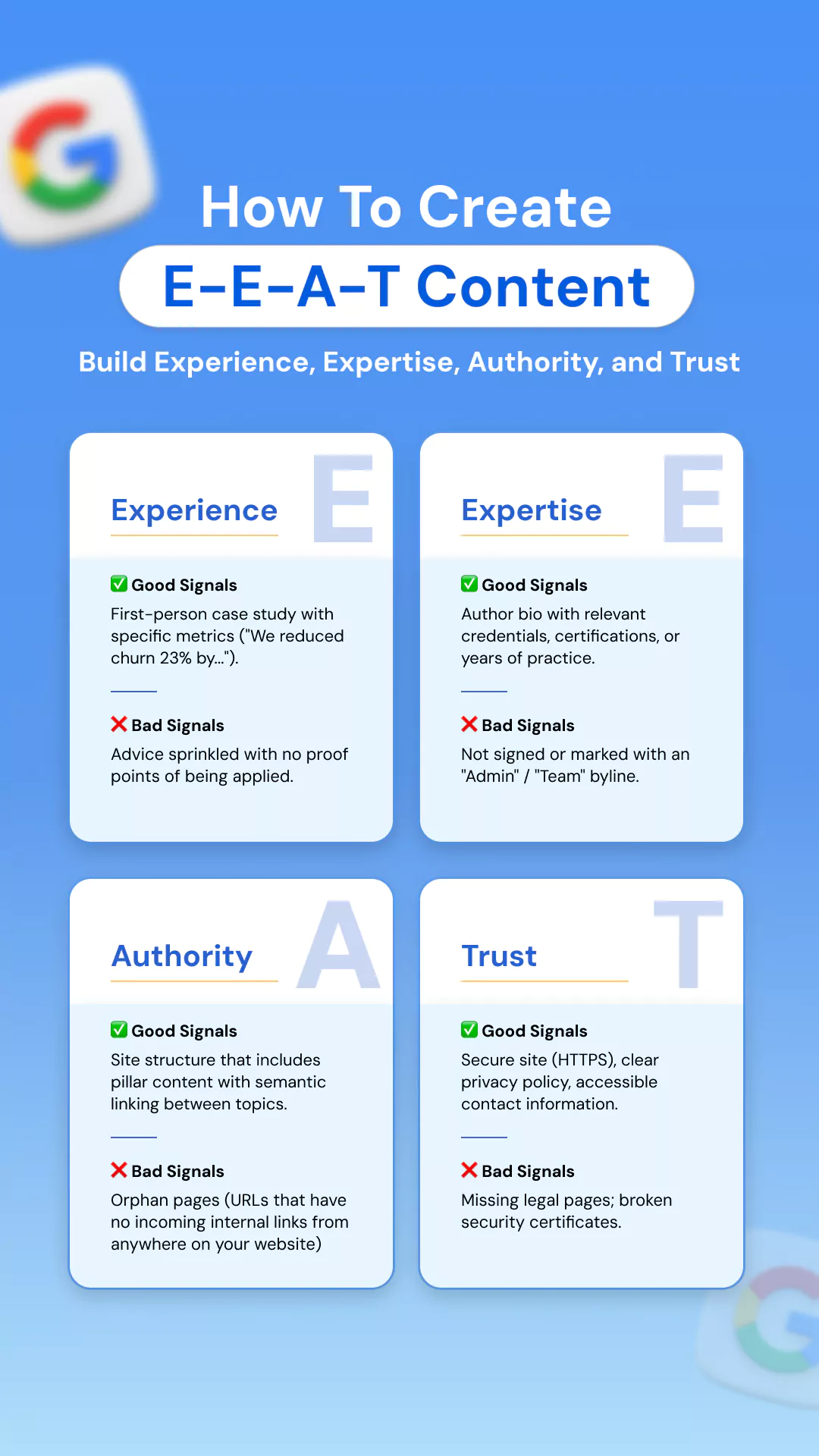
7. Lack of E-E-A-T Signals
Content that fails to demonstrate E-E-A-T (Experience, Expertise, Authoritativeness, or Trustworthiness), one of Google’s main ranking factors, often struggles to compete in search results.
Check out how to create high-quality, rankable content.
8. Generic, Repetitive, or “Templated” Phrasing Patterns Across Multiple Pages
A “templated” pattern is when dozens of pages on a site open with the same structural pattern, or use identical transition phrases, while repeating the same sentence structures.
This can look like an intro with "In today's fast-paced digital world, [topic] is more important than ever..." or publishing 8 articles where only the target keyword changes ("best CRM for small business," "best CRM for startups," "best CRM for teams") with identical structure.
How to fix "templated" phrasing patterns across multiple pages: One of the easiest audits you can run yourself is by skim-reading half a dozen pages in succession and noticing any patterns that can be considered too repetitive and generic.
Technical & Structural SEO Problems
Even genuinely good content can underperform if the technical foundation around it works against the page rather than for it.
9. Duplicate or Near-Duplicate Content (Across Your Site or Copied From Elsewhere)
Whether unintentional or malicious, Google treats duplication harshly: it removes copies from search results, splits ranking signals across versions, and sometimes manually penalizes scraped/stolen content.
And despite its seriousness, this is a very common problem. 52% of sites have duplicate content (no canonical), making it the most common indexing issue (Searchlab).
Duplicate content forces Google to choose one version to rank, and penalties can result from internal or external duplication.
Internal duplication happens on your own site: identical product descriptions across different categories (www vs. non-www, HTTP vs. HTTPS, URL parameters, printer-friendly pages).
External duplication is content copied from other sites: scraped pages, plagiarized articles, unlicensed syndication.
How to fix duplicated content: you can identify duplicate content in Google Search Console; the Page indexing report highlights duplicates and shows how Google interprets them.
You can also set up canonical tags, 301 redirects, and no-index tags.
10. Doorway Pages (Multiple Near-Identical Pages Targeting Slight Keyword Variations)
Doorway pages are one of the oldest tricks in the book, and one of Google’s most consistently enforced spam penalties.
A doorway page is intended to rank for a query and lead visitors to a different page than the one they landed on, rather than being useful itself.
Publish a set of pages that are extremely similar in structure and content (only changing the target keyword), and congratulations, you’ve created doorways, whether you know it or not.
How to fix doorway pages: merge keyword variants into comprehensive guides and differentiate content by intent, not just by keyword.
Doorway Pages
A local marketing agency creates separate pages targeting:
- SEO consultant in Chicago
- SEO consultant in Dallas
- SEO consultant in Miami
- SEO consultant in Denver
Each page follows the exact same template, reuses 95% of the copy, and only swaps out the city name.
Comprehensive Guide
One pillar page: /seo-consultant
Publish a single comprehensive page about the agency’s SEO consulting services or create genuinely localized pages that include city-specific case studies, testimonials, team members, and insights relevant to businesses in each market.
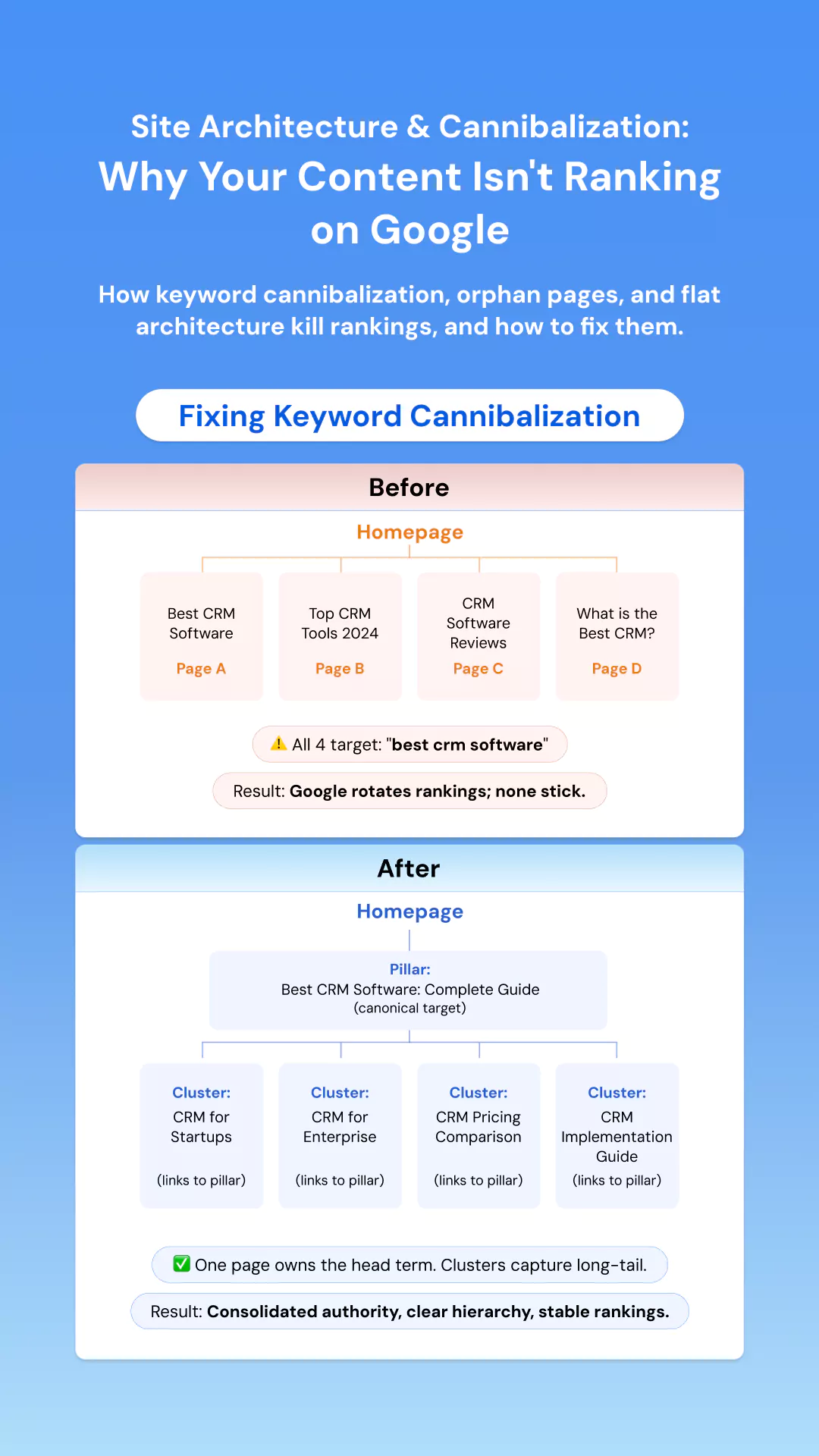
11. Poor Site Architecture Causing Keyword Cannibalization
Keyword cannibalization may sound like an advanced SEO issue, but it is often caused by poor site architecture and goes unnoticed by teams focused primarily on content production.
When your site lacks a clear topical hierarchy, multiple pages compete for the same query, split your backlink equity, and confuse both Googlebot and human readers about which page deserves to rank.
How to Identify Architecture Problems
Keyword Cannibalization
Multiple pages target the same query; Google can't decide which to rank, so it ranks neither.Orphan Pages
Pages with no internal links pointing to them. Googlebot never finds them; users never reach them.Flat Architecture
No topical hierarchy. Every page competes equally; none build cumulative authority.Deep Nesting
Critical content lives at domain.com/blog/category/subcategory/2023/03/title/. Too many clicks from homepage = low crawl priority
The infographic below illustrates how architecture issues dilute authority and outlines a practical framework for consolidating signals and improving visibility.
The Fix Checklist
How to Avoid Google Penalties from Architecture Issues:
Submit XML sitemaps. Ensure Googlebot knows what you want indexed, separate sitemaps for pages, posts, and media.
Canonicalize duplicates. Use rel="canonical" when similar pages must exist for UX reasons.
Flatten critical paths. Important content should be reachable in ≤3 clicks from homepage.
Fix orphan pages. Every piece of content needs at least 3-5 contextual internal links from relevant existing pages.
Map topical clusters. One pillar page per broad topic. Supporting pages link up, never compete.
Audit for cannibalization. Search site:yourdomain.com "target keyword", if multiple pages appear, consolidate or differentiate intent.
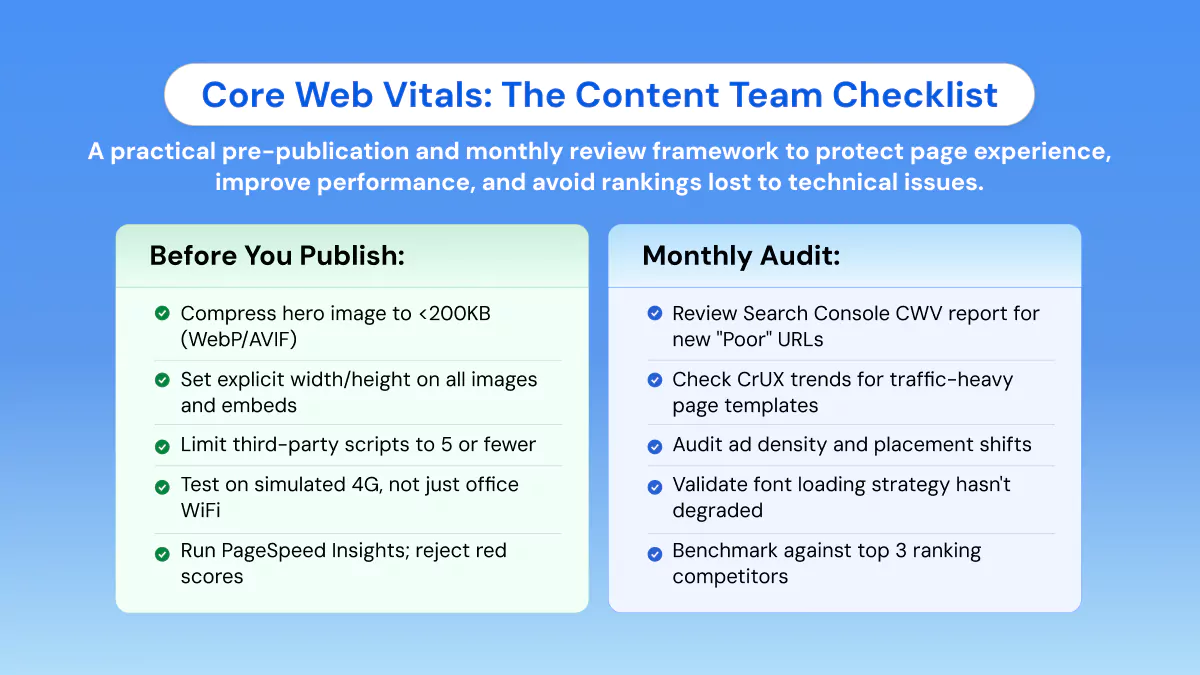
12. Slow Page Speed / Poor Core Web Vitals Undermining Content Performance
You can publish the most original, authoritative content in your niche, but if users abandon the page before it renders, Google never gets the chance to evaluate its quality.
Core Web Vitals (CWV) are Google's quantified measure of real-world page experience, and since 2021, they have been explicit ranking factors.
Core Web Vitals are:
Largest Contentful Paint (load speed, ideal under 2.5 seconds).
Interaction to Next Paint (page responsiveness, ideal less than 200 milliseconds).
Cumulative Layout Shift (CLS, visual stability, ideal less than .1).
Each is measured using the 75th percentile of recorded real visitors' experiences.
According to Google's performance studies, when a site meets the Core Web Vitals thresholds, users are 24% less likely to abandon the page load.
Trust, Authority & Credibility Gaps
Content can be accurate and still fail to rank if it gives Google and readers no way to verify that accuracy. Here are some practices that you need to avoid being penalized for.
13. Missing Author Bios or Expertise/Credential Signals
An unsigned article (or one attributed only to a "Team" or "Admin" account) leaves quality raters and algorithms with nothing to go on as to the author's reputation.
A brief bio connecting relevant experience or background with the topic it’s a primary signal Google uses to evaluate E-E-A-T, particularly for topics where expertise matters.
The bio is not a vanity element; it is evidence that a real person with relevant standing produced the advice, making it accountable and actionable.
How to fix: add a brief bio that connects relevant experience/background to the topic.
14. Unverifiable, Unsupported, or Exaggerated Claims
Trust is the invisible infrastructure of search rankings. Google instructs its quality raters to penalize content that asserts claims without supporting evidence, states opinions as facts, or uses exaggerated language to drive action.
Exaggerated Claims
"Our content strategy framework has helped over 50,000 businesses double their organic traffic in just 30 days. Industry experts agree this is the most effective approach ever developed. Unlike competitors, our method guarantees results with zero risk."
Verified Assertions
"We tested this framework with 47 SaaS companies between January and June 2025. Participants had a median monthly organic traffic of 12,000 sessions at baseline. After six months, 31 companies (66%) saw traffic increases; the median improvement was 34%. The full methodology and anonymized results are published here [link]."
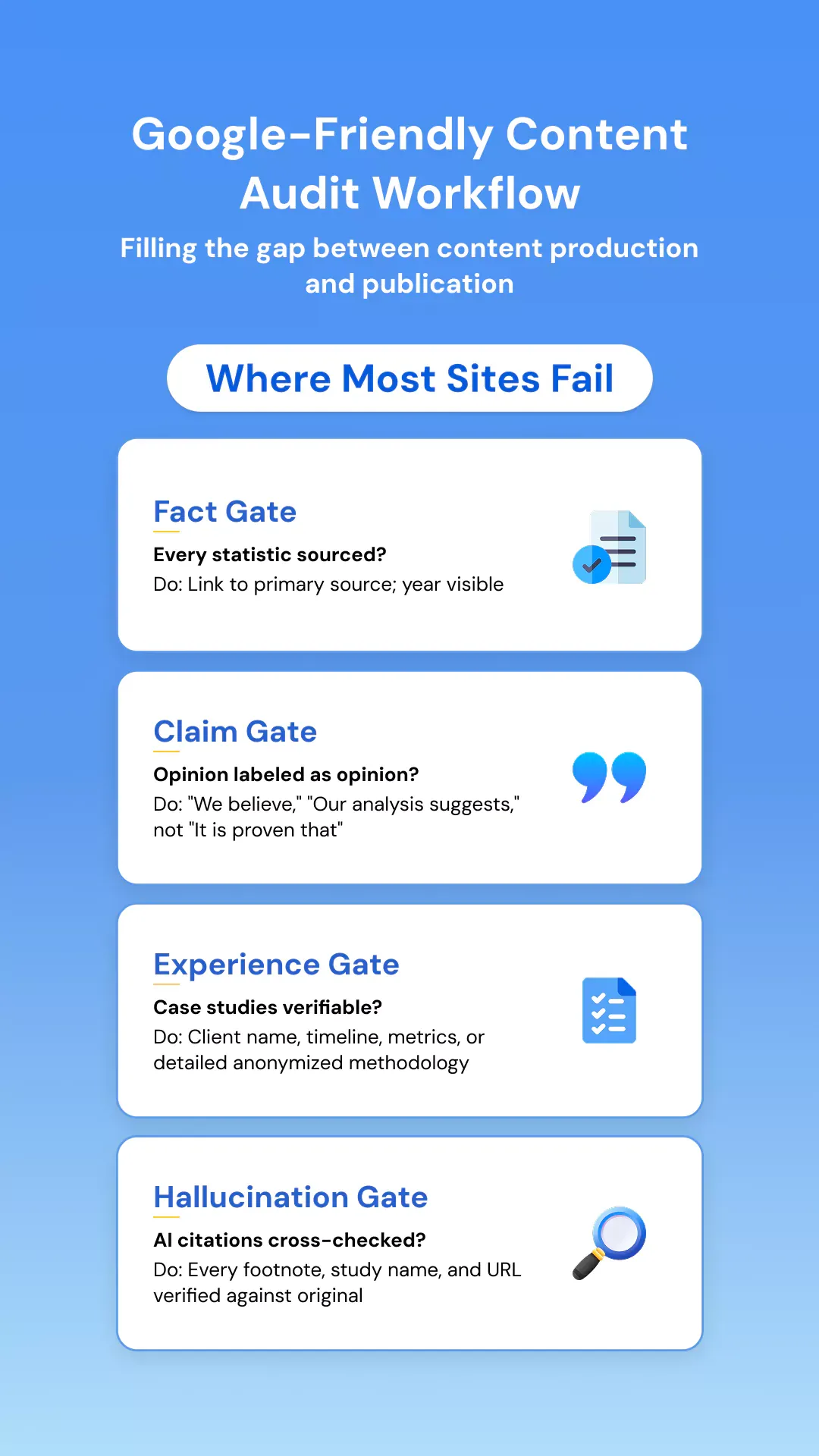
A structured audit process helps ensure every article meets Google's expectations for accuracy, transparency, and demonstrated experience before it goes live.
15. No Citations, or Citations to Outdated/Low-Quality Sources
Citations are trust signals that Google's algorithms and human raters use to evaluate expertise and authoritativeness.
That’s why statements that typically require support (statistics, research conclusions, legal/medical advice) read as unfounded without a source, and a citation to a low-authority blog or a study from a decade ago often does more harm than no citation at all, because it signals the writer didn't check for anything more current.
How to fix: Best practices include maintaining a source library and researching primary sources before writing the content.
16. YMYL (Your Money or Your Life) Content Published Without Proper Qualifications
YMYL topics are where Google's quality standards become non-negotiable.
Anything related to health, money, safety, or legal issues is treated much more strictly under Google's Search Quality Rater Guidelines, since errors on these pages can negatively impact users.
Publishing YMYL content without a qualified reviewer, or at least without clearly stating that the author was not a subject matter expert, is among the surest ways to have a page suppressed no matter how well written it is otherwise.
How to fix: Credential your authors; every YMYL piece needs an author byline with verifiable qualifications (MD, CFP, JD, relevant certifications).
Also, choose to cite regulatory and institutional sources and add disclaimer transparency.
Exaggerated Claims
"This supplement boosts brain function by 400% and is recommended by top doctors worldwide. Thousands of users report life-changing results within just one week.”
Verified Assertions
"A 2024 placebo-controlled study published in Neurology (312 adults aged 55-70) found that participants taking 300mg daily of [compound] showed 12% improvement on standardized memory tests over 16 weeks, compared to 3% in the placebo group.
The study was funded by [university]; the full protocol is available at [link].”
Manipulative Link & Promotional Practices
This category covers practices built explicitly to manipulate rankings rather than to inform or persuade readers, which is exactly the distinction Google's spam policies are designed to catch.
17. Unnatural Link Schemes or Link Spam (Paid Links, Link Farms, Excessive Exchanges)
When Google identifies a pattern of purchased, exchanged, or farmed links pointing to your site, it treats your entire domain as engaged in ranking manipulation.
The penalty isn't just about the links themselves; it's about the intent they signal.
According to Spam policies for Google web search, these are practices that qualify as link schemes:
Paid links, that are sponsored posts with do-follow links, "product review" placements with monetary compensation and link insertion services;
Link farms, with Private Blog Networks (PBNs), expired domain acquisitions for link equity, and automated directory submissions;
Excessive exchanges, with "link to me and I'll link to you" arrangements at scale and guest post networks with mandatory reciprocal links.
How to fix link spam: Audit your backlink profile quarterly. You can use Ahrefs, Semrush, or Google Search Console's Links report to check for sudden spikes, irrelevant referring domains, and exact-match anchor text patterns.
Also, maintain good guest posting practices, and if you sponsor content, use rel="sponsored" and no-follow attributes.
18. Excessive Affiliate/Promotional Content Without Proper Disclosure
Affiliate marketing is a legitimate business model.
Thin affiliate content that provides no additional value to what is already on the merchant's own page and is non-transparent about the financial relationship gives you both a Google quality signal penalty and may violate disclosure requirements established by the Federal Trade Commission (FTC).
Obvious, conspicuous disclosure and unique, helpful comparison or testing content remedies both.
How to fix: Be transparent, place affiliate disclaimers, use clear language, and prefer an affiliate strategy with a content-driven approach that prioritizes solving your audience's problems and providing genuine education over directly pitching products.
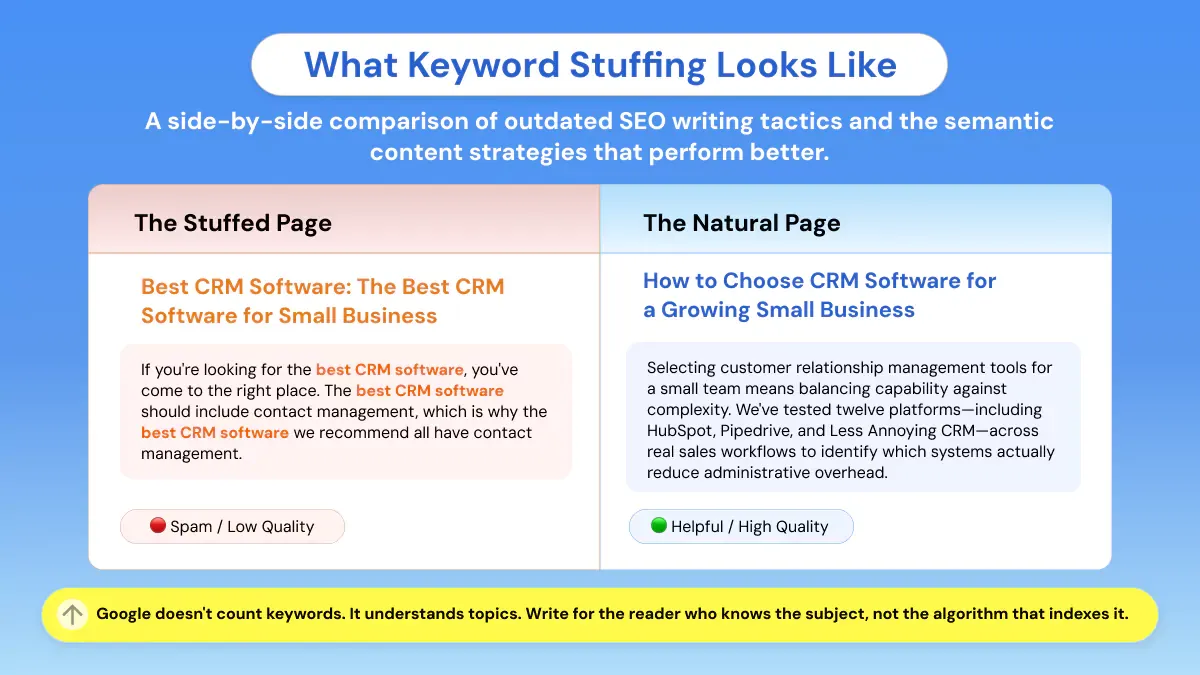
19. Keyword Stuffing or Unnatural Keyword Density
Keyword stuffing is repeating a target phrase unnaturally many times over what would be normal in human language, particularly in ways that make content hard to read.
Google's Natural Language Processing (NLP) evaluates content based on semantic coverage rather than keyword repetition.
This side-by-side comparison shows exactly what unnatural keyword density looks like.
User Experience & Engagement Signals
This final category covers how pages perform once a person actually arrives at it. This signal is softer than the others, but it’s also very reliable.
20. Intrusive Interstitials, Excessive Ads, or Poor Mobile UX That Disrupts Content Consumption
You know those annoying pop-ups that block the main content before you can see anything? Or the ad that pushes the actual article below the fold? Or visited a page where the layout breaks on mobile devices?
These practices cause one thing: frustrating users before they can access the information they came to your site to find.
In the first quarter of 2026, 58.67% of all website traffic worldwide comes from mobile phones (Statista). Data that shows that mobile-friendly content must be a priority.
In Google’s own words about page experience, this ranks as part of a site’s overall “assessment,” not a specific signal, and it includes a secure connection, mobile-friendliness, and whether the main content is easily identifiable among other ads and content on the page.
How to fix: Make sure you follow UX-first content design best practices, such as avoiding pop-unders, and adhere to ad standards.
You can also use Google Search Console's Mobile Usability report and test on actual devices, and measure real user metrics in PageSpeed Insights.
Reframe the Penalty: It's a Signal, Not a Sentence
Keep in mind that none of these 20 reasons work exclusively by themselves.
If you’re seeing rankings decline on most pages, it’s likely that two or three are compounding on each other rather than something you can point to and say "That's it, we found the problem."
That’s good news! It means you don’t have to guess which Google algorithm update you need to recover from.
It means going down a checklist, starting with the broadest-reaching likely causes (content quality and AI gaps) before diving into technical issues, trust signals, and UX-related issues.
It's also important to remember that Google does not automatically penalize content simply because AI was involved in its creation.
What matters most is quality, originality, and usefulness. Learn more: Does Google Penalize AI Content in 2026? What Google Actually Says.
Moving beyond the fear of Google penalties means spending less time worrying about algorithm updates and more time treating this list as an ongoing content audit framework.
Especially as AI-assisted drafting becomes a regular part of most content teams’ workflows. Make it a habit to run drafts through an AI detector before they go live.
Phrasly’s free AI detector assigns an AI Score to your content that indicates how AI-generated it may have been. It’s a helpful way to catch AI-generated content on the high-risk end of writing AI content before it ever becomes reason number five or six on this list.
Frequently Asked Questions
Does Google automatically penalize content just because it was written with AI?
No. Google does not penalize content solely because AI was involved in its creation. What matters is the quality, originality, and usefulness of the final output.
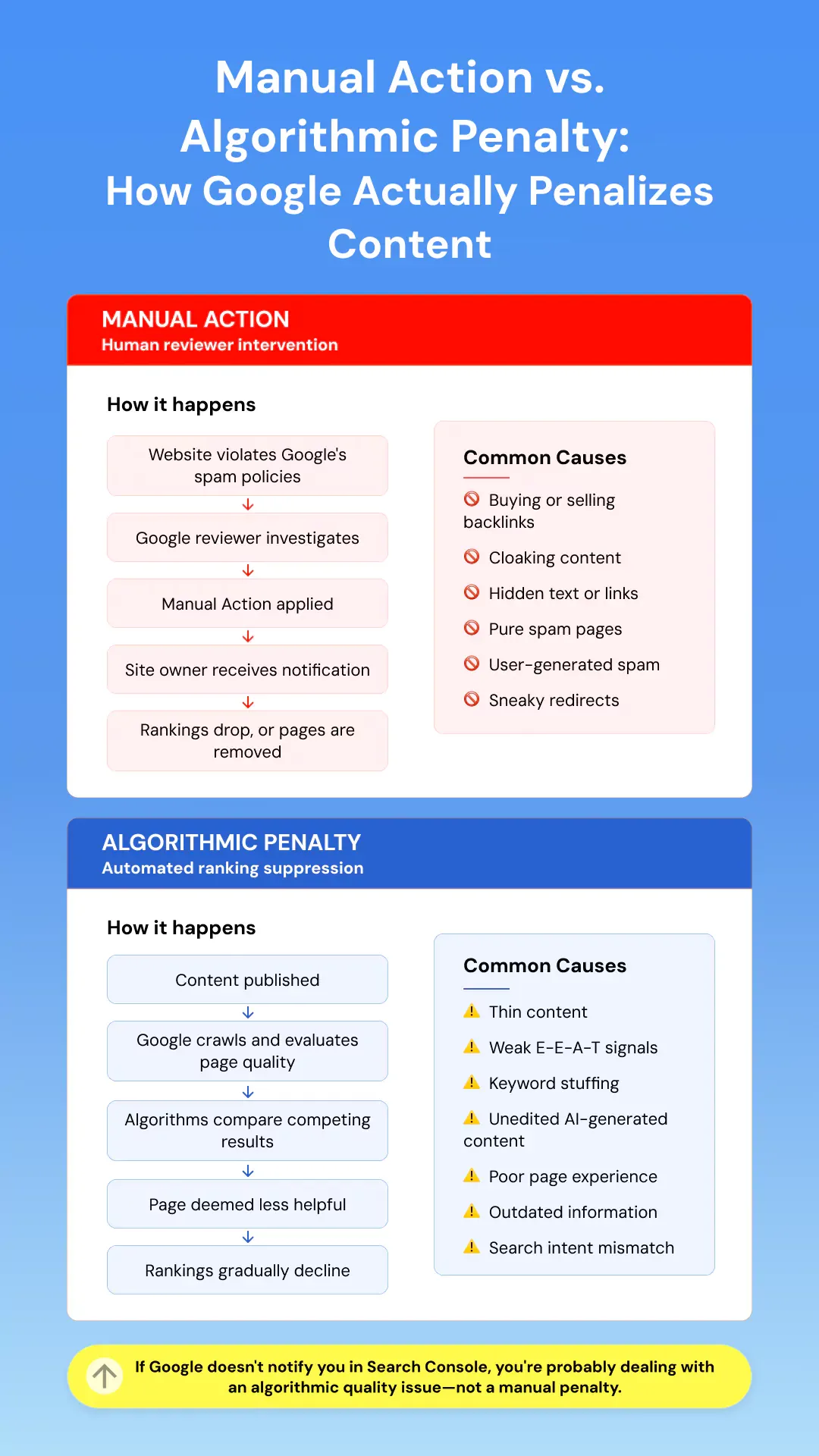
What's the difference between a manual action and an algorithmic penalty?
A manual action is issued by a human Google reviewer when your site violates spam policies (like buying links or cloaking content). You'll receive a notification in Google Search Console, and rankings may drop sharply or pages may be removed.
An algorithmic penalty is an automated ranking suppression that happens when Google's algorithms evaluate your page as less helpful than competing results. This causes gradual ranking declines with no notification in Search Console.
How can I tell if my site has keyword cannibalization?
Run a search for site:yourdomain.com "target keyword" in Google. If multiple pages from your site appear for the same query, you likely have cannibalization.
How often should I update old content to avoid penalties for outdated information?
Review your top-performing pages quarterly for accuracy, broken links, outdated statistics, and expired recommendations. Update the publish date when you make substantial changes.

Written by
Gabriela Cofre
Gabriela Cofre is a content strategist and writer specializing in SEO, inbound marketing, and B2B, B2C content with +7 years of experience.