
What Actually Happens When You Plagiarize? Every Consequence Covered
Most students think plagiarism just means a failing grade. It doesn't. From expulsion and lawsuits to Google penalties and career ruin, the real consequences go far beyond the classroom. Here's what actually happens, broken down by academic, professional, legal, and SEO impact.
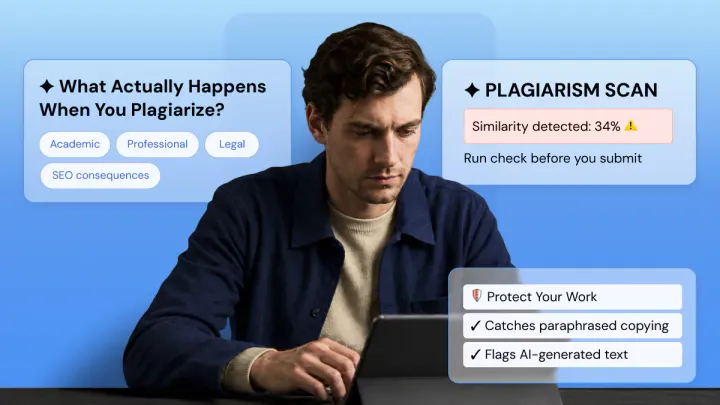
Most students believe plagiarism equals a failing grade. However, the consequences of plagiarism reach farther than the classroom and are far worse.
Are you a student who procrastinates until the last minute? A journalist with a deadline looming? A blogger hitting Publish on a daily basis? If so, it's real. And it happens quickly.
In this article, we’ll explore the consequences for plagiarizing in four different contexts (academic, professional, legal, and SEO), along with a framework for severity, a quick reference table organized by context, and ways to protect yourself.
Check Your Work for Plagiarism Here 👇
What Counts as Plagiarism? (And Why It May Be Wider Than You Think)
Plagiarism does not necessarily mean taking someone else's essay and copying it word for word.
It actually covers a larger set of actions than most suspect, and that's precisely the pathway to unintentional plagiarism.
There are four primary types:
- Direct copying without citation: It is the most obvious kind. Copying words verbatim without attribution.
- Paraphrasing without credit: Regardless of how you word it, paraphrasing someone else's thoughts without giving them credit is plagiarism.
- Self-plagiarism: Submitting your own previous work without disclosing it. A common violation in academic publishing.
The severity of the offense hinges on the specific transgression and its location. Academic integrity policies penalize them differently. So do employers, courts, and search engines.
Types of Plagiarism by Severity
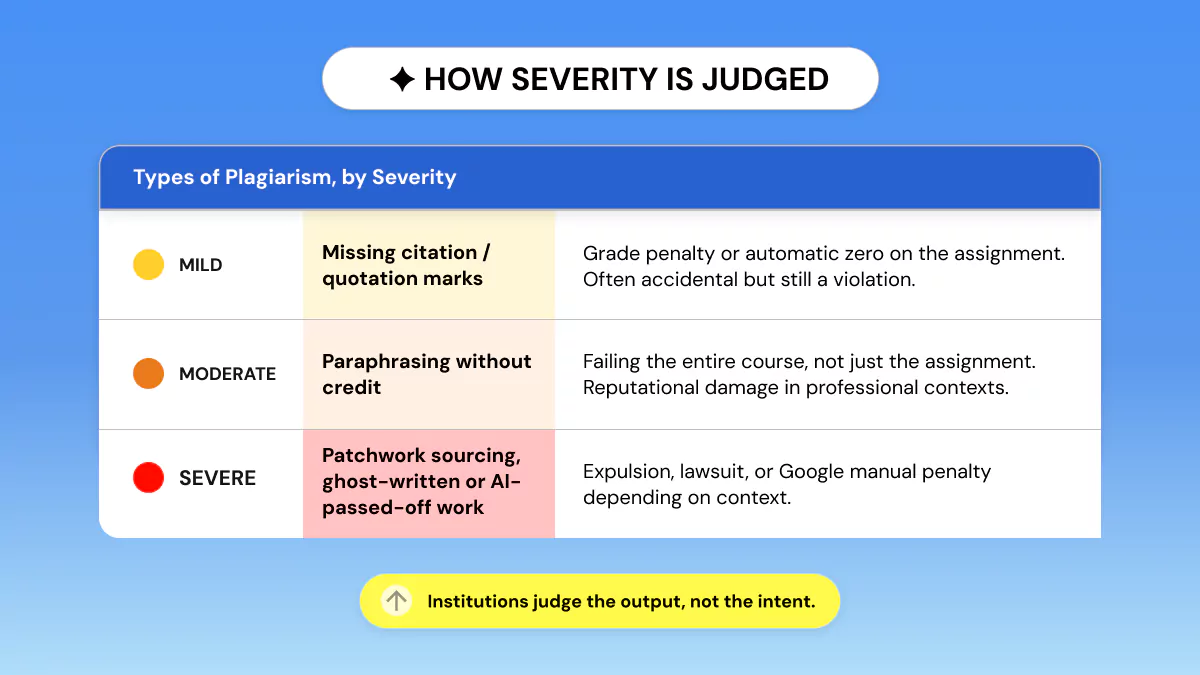
Categories of plagiarism don't all result in the same consequences.
Refer to the chart below to see what category your particular violation falls under prior to reading about potential consequences.
Mild Plagiarism
"Mild" violations typically include accidental plagiarism: forgetting to include a source in your reference list that is cited in your paper's body, or forgetting to place quotation marks around a quoted passage.
These kinds of things really can be unintentional.
For a first mild violation, most schools will deduct points from your grade rather than expelling you.
However, "unintentional" does not mean "free punishment." Universities care about the output you turn in, not your intentions behind it. Whether intentionally or unintentionally, your work was still plagiarized.
Moderate Plagiarism
Moderate plagiarism is where using the excuse "I just put it in my own words" goes out the window. Copying sentences from a source but changing a few words, or paraphrasing a sentence without citation, are both examples.
Including what's known as incremental plagiarism, where small unattributed fragments accumulate across a document until the piece is no longer original underneath the surface.
This is why plagiarism in the workplace becomes a legitimate professional concern. In school, it usually goes from failing one assignment to failing the course.
Professional repercussions can include damage to one's standing, a formal review, and even dismissal based on the severity of the situation.
Severe Plagiarism
Severe forms of plagiarism involve patchwork plagiarism (piecing together material from different sources), submitting work that has been ghost-written, contract cheating, and submitting AI-generated content as if the student had written it themselves.
These are treated as deliberate acts of academic dishonesty. Institutions respond with academic probation, suspension, or permanent expulsion.
At the professional/publishing level, this moves into legal action: copyright infringement litigation. For SEO content teams, egregious copying can mean manual penalties and deindexing from Google.
Academic Consequences of Plagiarism
The consequences of plagiarism for students follow a clear escalation path. What starts as a forgotten citation can result in a permanent blemish on your record.
Grade Penalty or Automatic Zero
One penalty that’s applied more often than most. This is typically the standard consequence for a first, minor-moderate violation. Applied usually to one assignment or exam, not the whole course.
That being said, it will put a mark on your record at most schools. Future offenses, even if they are minor, will be viewed more harshly by academic integrity policies that track cumulative violations.
What Does the Record Mean for You?
A file gets created even if you receive only a grade penalty. A lot of students only find this out when they're applying to grad school or for professional certifications and have to disclose something about their integrity.
Failing the Entire Course
Moderate-to-severe plagiarism extends beyond the assignment. Failing the student for the entire course, not just the assignment, is common.
According to the University of Michigan's policy, a student might fail the entire course, as penalties are said to "range from a reduction in the grade on the work assessed to failure of the course, depending on the severity of the offense."
Grade Point Average (GPA) implications occur instantly. Scholarships based on academic performance are put at risk. Students receiving financial aid are placed on academic review.
Academic Probation and Disciplinary Action
Now the complaint moves out of the professor's hands and into an official Academic Integrity Board. A hearing is initiated, and a record is established.
Suspension or Expulsion
Severe plagiarism, particularly multiple offenses, will result in suspension or expulsion. The action will be recorded on the student’s transcript permanently.
University admissions offices for graduate programs check plagiarism and integrity violations. A notation on your transcript is career-changing, not just academic.
This risk has expanded with AI-written submissions: schools now run AI detection alongside plagiarism checks, and getting flagged can trigger the same disciplinary process: probation, a hearing, or expulsion for repeat or severe cases.
Some schools will prosecute fraudulent cases: bought papers, degree mill submissions, and falsified research.
Professional Consequences of Plagiarism
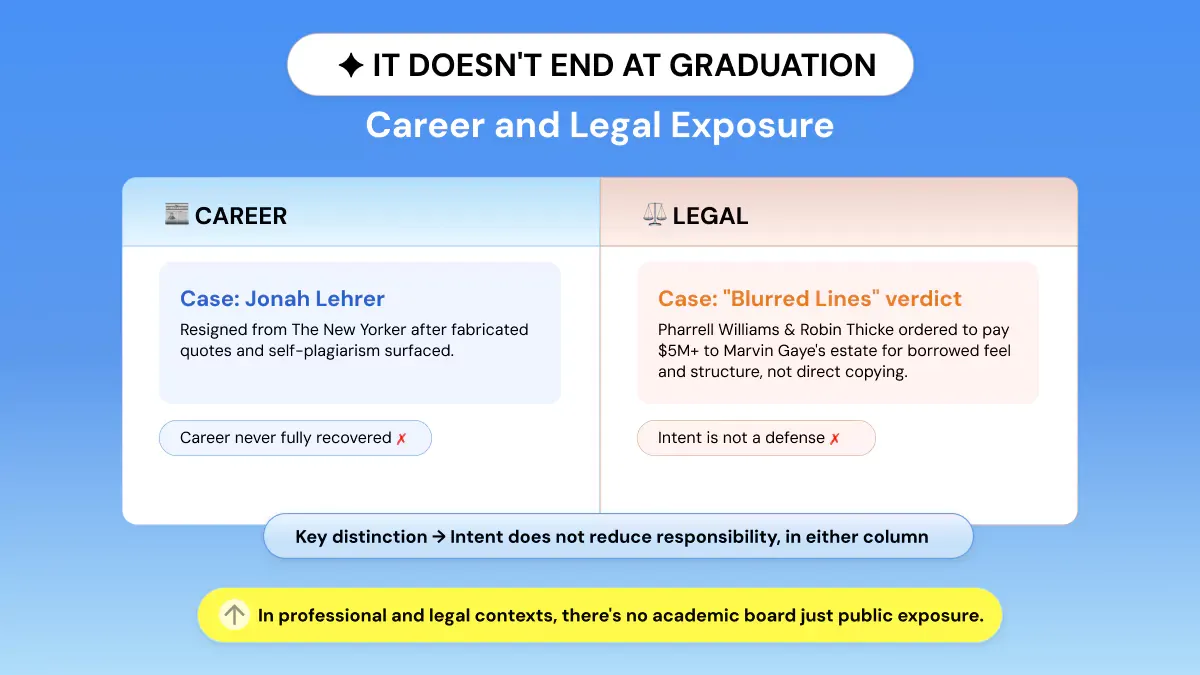
It works differently in the real world. With plagiarism in the workplace, you don't get an integrity board or a hearing of any kind. You simply get public exposure and immediate consequences.
Job Termination and Career Damage
The audience when you plagiarize as a professional is far larger than a professor or a classroom.
Jonah Lehrer resigned from The New Yorker when he was found to have fabricated quotes and self-plagiarized across multiple publications. He never regained his status as a leading science writer.
This is a cautionary example of how reputational damage compounds over time.
The plagiarism controversy surrounding Melania Trump's speech at the 2016 Republican convention made international news when full sentence structures and phrasings were lifted word-for-word from Michelle Obama's 2008 Democratic convention speech.
The incident shows how plagiarism, even when it is not directly word-for-word copying but copying of structure or ideas, can become public knowledge in your professional life forever.
Loss of Published Work, Grants, or Credentials
If you plagiarize, your published work can be retracted. These retractions are permanently recorded in journal archives, serving as a lasting, discoverable stain on one's record.
You can lose research grants. You can lose your university affiliation. They can even take your degree after you graduate. Retrospective inquiries are commonly launched by universities upon surfacing misconduct allegations.
A Note for Content Professionals
If you are a professional who publishes or creates content regularly, a plagiarism checker isn't optional. It's a career protection tool. Phrasly's plagiarism checker detects cumulative similarity before it can impact your credibility.
Legal Consequences of Plagiarism
When Plagiarism Becomes Copyright Infringement
Copyright infringement and plagiarism are not the same thing legally, but they do share a lot of similarities. In fact, there is rarely ever a situation where copying something will fall under plagiarism but not copyright infringement.
Can plagiarism be illegal? It can be. If you copy someone else's original work without permission, you can face a civil lawsuit. It doesn't matter if you're a student, a blogger, or a traditionally published author.
Intent doesn't matter under copyright law. You don't need to know you're infringing to be liable for infringement. Self-plagiarism in academic publishing can also be fraud if you submit the same work to more than one journal or grant applications.
Real Legal Cases and Financial Penalties
Arguably, the most referenced verdict when discussing content and publishing is the 2015 Blurred Lines decision.
The takeaway for bloggers and content marketers: You don't need to copy word-for-word to infringe. Copying structure/style has led to verdicts in the millions of dollars. You don't have to be a novelist/musician to be at risk.
Copyright lawsuits are public record. For documentation on individual cases, the Reuters Law archive or the U. S. Copyright Office (copyright.gov) are authoritative references.
SEO and Content Consequences of Plagiarism
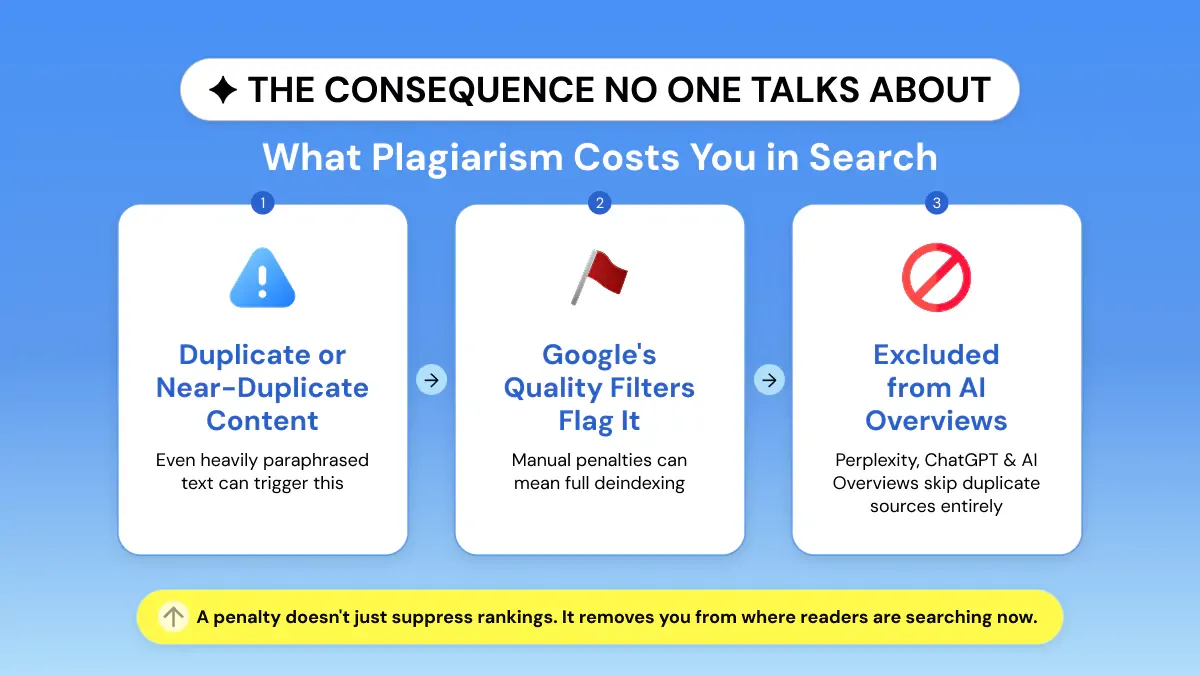
The duplicate content SEO penalty is real. It operates independently of any academic or legal consequences.
Google duplicate content filters remove pages that match existing content already indexed. Filters can be triggered by pages, even with extensive paraphrasing, if sufficient matching signals exist.
Google can also identify AI-generated content on a page, though its ranking systems are generally more concerned with thin or low-quality writing than with how the content was produced.
Google manual penalties from the spam team can mean no index at all, not just ranking suppression. The page no longer shows up in the search results at all.
AI Overviews and GEO search engines (Perplexity, ChatGPT) pull from original authoritative websites. Content that is plagiarized or duplicated is left out of AI answers. AI is becoming a large percentage of traffic for websites with content depth.
Domain reputation also suffers over time. Google's cumulative negative perception from sending signals about thin/duplicate content will hurt the entire site's SEO reputation, not just that page.
Agencies and content teams: a single instance of plagiarism can lead to a client PR crisis that eclipses the severity of a Google penalty. Your reputation will suffer longer than Google's algorithm will.
Plagiarism Consequences by Context: Quick Reference
Consequences depend on the severity of the violation and the circumstances surrounding it.
Omitting a citation on your first-year paper will have far less severe consequences than turning in a ghost-written research paper or republishing someone else's blog post.
How to Avoid Plagiarism Consequences?
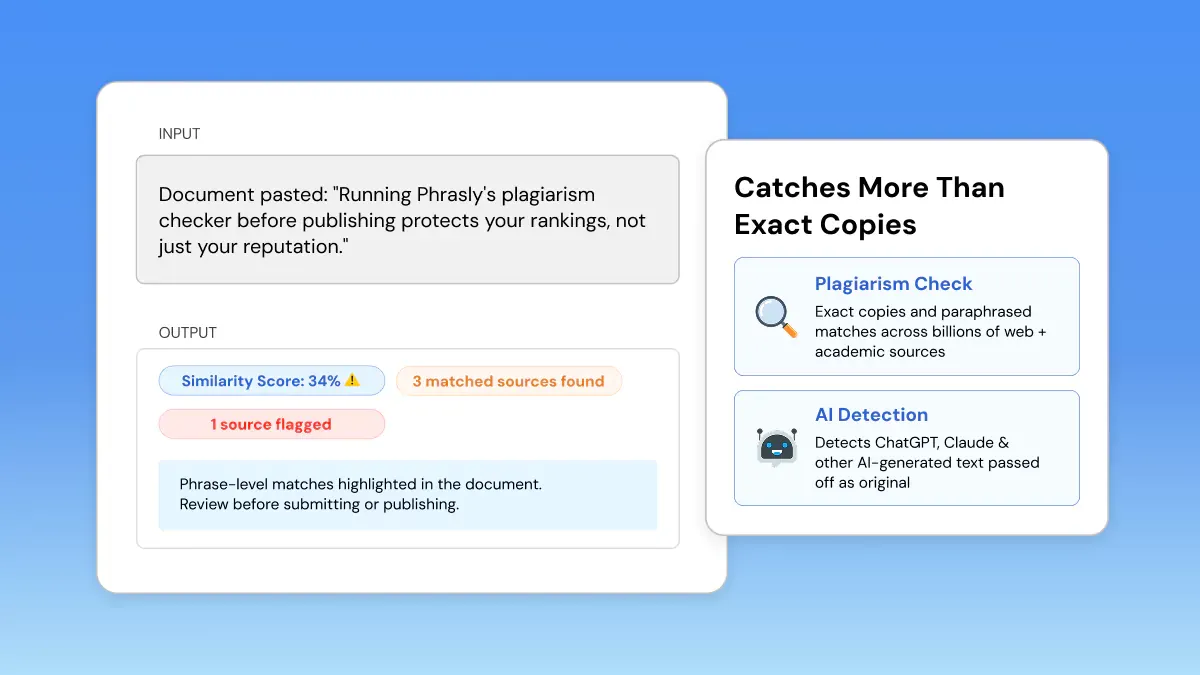
Here are four habits that will prevent most cases of plagiarism:
- Add citations while you write, not at the end. Most accidental plagiarism occurs when a writer intends to insert a citation later and simply forgets.
Citations created in real time are also more accurate than ones dredged up from memory.
- Paraphrase correctly: don't just change individual words. Rewrite the sentence so it has a different structure and words.
If yours reads exactly like mine, but with synonyms, that is considered plagiarism, and it will show up on plagiarism checkers.
- Put quotes around phrases. It doesn't matter if they're only three words long. You must give credit to words taken directly from another source. There is no threshold of words or characters.
- Don't run a plagiarism checker just before you submit or publish. Run it early well before you're ready to finalize so there's time to clean up problems.
Phrasly's checker catches cumulative similarity as well as exact matches, so you'll find incremental problems before they add up. If you draft in Google Docs, here's how to check your document for plagiarism without ever leaving the tab.
Plagiarism can be accidental, and it is one of the most common forms. Failure to cite a reference, paraphrasing improperly, and incorrectly recalling the source of information are examples of unintentional plagiarism, whether done intentionally or not.
Frequently Asked Questions
What are the consequences of plagiarism for students?
The consequences of plagiarism for students include going from losing points on an assignment to failing the assignment outright, failing the course, academic probation, suspension, and expulsion.
A notation will be placed on your transcript, which will go with you when you apply to graduate school and for professional licensure. Claiming you didn't mean to do it doesn't excuse the action.
Use tools such as Phrasly's plagiarism checker to catch plagiarism before you submit your paper.
Is plagiarism illegal?
It can be. Plagiarism and copyright infringement are similar concepts. Copying another's original work without consent can subject you to a civil lawsuit, regardless of whether you're a student, blogger, or professional.
Self-plagiarism of academic papers can be considered fraud when submitted to more than one journal. Intent does not factor into legal responsibility.
What are the consequences of plagiarism in the workplace?
Consequences of plagiarism in the workplace can be dismissal, public reputational damage, and loss of professional credentials.
For writers and journalists, plagiarism can result in your work being taken out-of-print and destroyed, along with career damage (i.e. Jonah Lehrer).
For Content teams, there are Google duplicate content SEO penalty ramifications to consider.
Can you plagiarize by accident?
Yes, and it is one of the most common forms. Accidental plagiarism includes forgetting to cite your source, paraphrasing poorly, and incorrectly remembering where you heard a fact or thought.
Whether you meant to do it won't change how wrong it is or how your school will handle it. Using a plagiarism checker before you turn something in will catch these mistakes before they become offenses.
What percentage of plagiarism is acceptable?
There is no agreed-upon threshold score. Institutions consider any similarity that isn't properly attributed to be misconduct. While some tools warn users when their similarity hits 10–15%, it is the institutions, not the tools, who determine this.
0% is the only safe percentage. Similarity scores are a starting point for review, not a fail/pass grade.
What is the most severe consequence of plagiarism?
In academic settings: permanent expulsion and transcript notation. In professional settings: career termination and public disgrace. Legally: copyright infringement lawsuits resulting in multi-million dollar verdicts.
The Blurred Lines case resulted in a $5M+ judgment for structural similarity alone. In SEO: deindexing and permanent ranking loss for the affected domain.


Keep reading

Copyleaks Plagiarism Checker: Tested, Rated & Compared
Copyleaks Plagiarism Checker review: we tested verbatim, minor-change, and paraphrased content to see how its 3-layer detection performs. See pricing, AI-detection accuracy (77%-96%), free plan limits, and how it compares to Phrasly in a head-to-head scan before you subscribe.
Does Canvas Have a Plagiarism Checker? What It Uses, How It Works & What Students Should Do
Canvas has no built-in plagiarism checker. It relies on instructor-enabled tools like Turnitin or Copyleaks. Learn how scanning actually works, whether Canvas detects AI writing (ChatGPT, Claude, Gemini), and how to check your paper for plagiarism and AI content before you submit.