
How to Make AI Marketing Copy Sound Human, Not Robotic
Learn how to make AI marketing copy sound human with practical line-level edits. Fix robotic phrasing, protect your brand voice, and keep every CTA accurate.
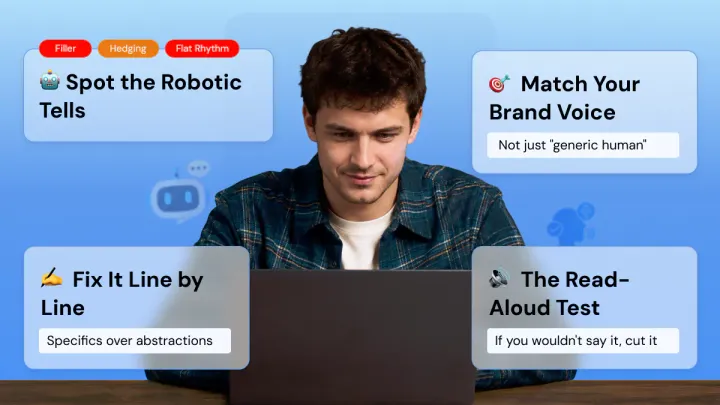
To make AI marketing copy sound human, cut the tells that flag it as machine-written, like uniform sentence length, hedging, and openers such as "in today's fast-paced world," then replace them with specifics, varied rhythm, and your brand's real voice. This comes down to line-level editing rather than a better prompt.
HubSpot's 2026 data shows 56% of marketers say the internet is flooded with AI content, and 65% say consumers are getting better at recognizing it. Generic AI copy no longer reads flat; it gets skipped.
Most marketers can spot AI copy but struggle to fix it without flattening the message or losing their brand voice. This guide solves that: what makes copy read robotic, how to fix each tell, and how to keep every future draft on-brand at scale.
Why AI Marketing Copy Sounds Robotic
AI marketing copy sounds robotic because language models predict the most statistically likely wording, which pulls drafts toward safe, familiar phrasing. Without customer language, product proof, or defined voice rules, the output lands on even sentence rhythm, vague benefits, recycled transitions, and a neutral tone any brand could publish.
Models build text by predicting plausible next words from training data. Strip out customer language, product evidence, and channel context, and they fall back on conventional phrasing that could sell anything. OpenAI's prompting guidance ties output quality to relevant context, precise instructions, and representative examples.
A 2024 study comparing human news writing with output from six language models found human sentences spread across a wide range of lengths, while model sentences clustered in a narrow band. The authors call this register leveling: stylistic differences flatten until the writing turns uniform (Muñoz-Ortiz, Gómez-Rodríguez and Vilares, 2024).
In marketing copy, that sameness shows up as recognizable tells:
- Prefabricated openings. "In today's fast-paced digital landscape" stalls before the message starts and fits almost any company.
- Abstract benefits without proof. "Streamline operations," "unlock growth," and "drive meaningful results" name no outcome a reader can picture.
- Uniform sentence length. Similar structures back to back create a steady rhythm with no emphasis, so nothing reads as the point.
- Repeated three-part lists. Tidy tricolons like "save time, improve efficiency, and accelerate growth" feel manufactured once they keep repeating.
- Excessive hedging or unsupported certainty. Hedged copy softens every claim with "can help" and "may improve." Overconfident copy swings to "will transform your business" with nothing behind it. Both erode credibility.
- Detached third-person language. Copy about "businesses," "organizations," or "today's marketers" holds the reader at arm's length and skips the word "you."
- Generic CTAs. "Learn More" and "Get Started" never tell readers what they will see, get, or do after the click.
Treat these as editing signals rather than proof that a machine wrote the passage. A 2026 analysis of 284 linguistic features across 27 models and ten writing domains found most proposed AI-writing markers shift with the model and the context. Lexical richness was the main exception that stayed reliable (El Attar et al., 2026).
Conversational does not mean forcing jokes, slang, sentence fragments, or grammar mistakes into every line. A brand can sound conversational while staying serious, technical, or premium.
Before and After: 7 Edits That Make AI Copy Sound Human
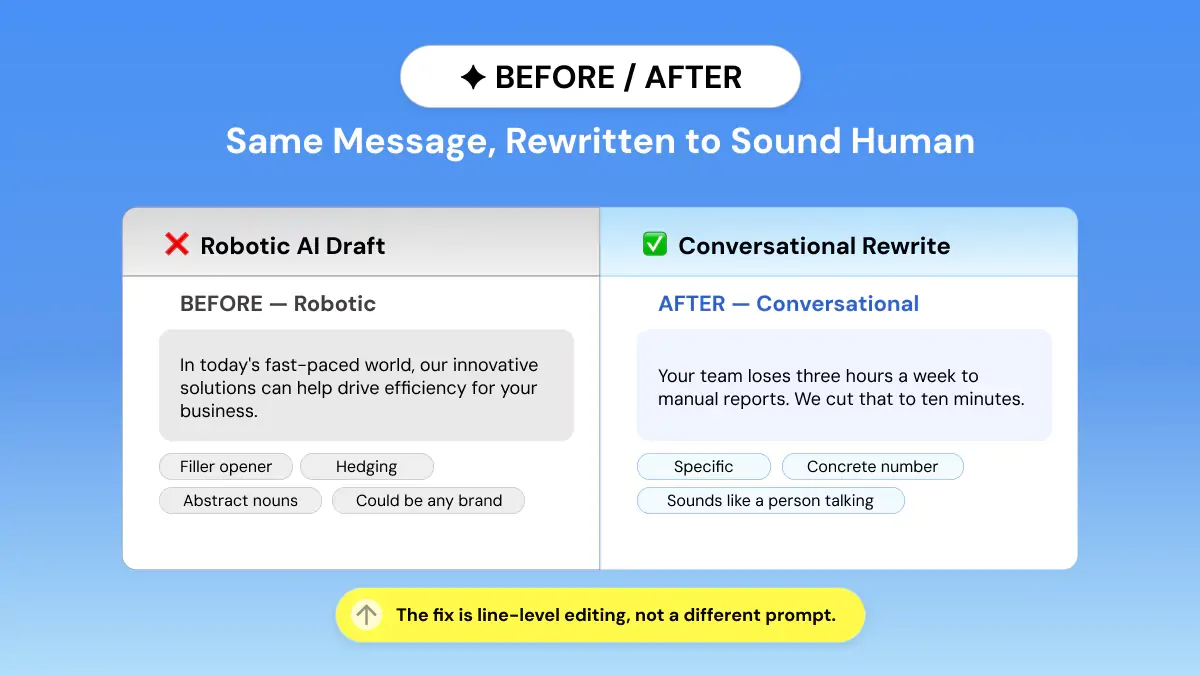
The best way to humanize AI marketing copy is to edit it in layers. Fix the opening, specificity, customer language, claim strength, rhythm, point of view, and CTA separately. This gives you more control than asking an AI tool to “make it sound human” and accepting another generic rewrite.
The example below describes an unnamed fictional campaign-reporting product. Its features are illustrative and should not be treated as claims about any real product.
Original AI-generated paragraph:
1. Delete the Generic Opening
The phrase “in today’s fast-paced digital landscape” does not identify a customer, problem, or reason to continue reading. The same opening could introduce software, consulting, banking, or almost any other service.
Replace it with a situation the intended customer recognizes:
The rewrite reaches the problem immediately. Microsoft’s writing guidance recommends leading with the important information instead of padding copy with unnecessary introductions.
2. Replace Abstract Benefits With Concrete Outcomes
“Streamline workflows,” “improve collaboration,” and “drive better results” sound positive, but they do not explain what the product changes.
Replace broad benefits with concrete nouns and actions:
The reader can now picture the product’s function. For a real campaign, every concrete feature must match the live product. Do not add integrations, automation, time savings, or performance numbers simply to make the copy sound more convincing.
3. Use Language Customers Actually Use
AI drafts often refer to “businesses,” “organizations,” and “modern teams.” Those labels describe an audience from a distance. Conversational copy addresses readers directly and reflects how they describe the task.
For real copy, collect this language from customer interviews, sales calls, support tickets, search queries, surveys, and reviews. Do not manufacture customer quotes or pretend an invented phrase came from research.
4. Remove Unnecessary Hedging, but Keep Necessary Qualifiers
AI copy frequently relies on phrases such as “can help,” “may enable,” and “has the potential to.” These phrases weaken straightforward descriptions of confirmed product functions.
The revision describes the function without promising that the software will automatically produce better decisions.
Do not remove qualifiers that keep a claim accurate. Terms such as “up to,” “typically,” “for eligible customers,” or “results vary” may be necessary when supported by evidence or required by advertising rules. The FTC states that objective advertising claims need a reasonable evidentiary basis before publication.
5. Break the Uniform Sentence Rhythm
AI drafts often place several polished, medium-length sentences beside one another. The result is smooth but monotonous.
A 2024 study comparing human writing with output from six language models found that human sentence lengths were more widely distributed, while model-generated sentences appeared within a narrower range (Muñoz-Ortiz, Gómez-Rodríguez and Vilares, 2024).
Create emphasis by mixing short and longer sentences:
The short opening lands the main idea. The next sentence explains it. Sentence variation should improve emphasis and readability, not create random fragments in every paragraph.
6. Add a Recognizable Point of View
Human-sounding marketing copy does more than list features. It communicates what the company believes about the customer’s problem.
The revision takes a clear position: reporting should support action rather than become a separate burden. Another company might express that idea more formally, analytically, or playfully. The point is not to force humor into the copy. It is to make the perspective recognizable.
7. Replace the Generic CTA With a Specific Next Action
“Get Started” does not tell readers what will happen after they click. A stronger CTA describes the immediate action or destination.
Apple’s interface guidance recommends short button labels that begin with a verb and describe the action being performed.
The CTA must also match the destination. If visitors cannot immediately build a report, use an accurate alternative such as “View a Sample Report,” “Book a Demo,” or “Explore Reporting Features.”
Complete Line-by-Line Teardown
Final version:
CTA: Build your first campaign report.
If you are editing paid campaigns or landing pages, this guide on how to edit AI ad copy shows the same process applied to hooks, proof, and conversion sections.
Make It Sound Like Your Brand, Not "Generic Human"
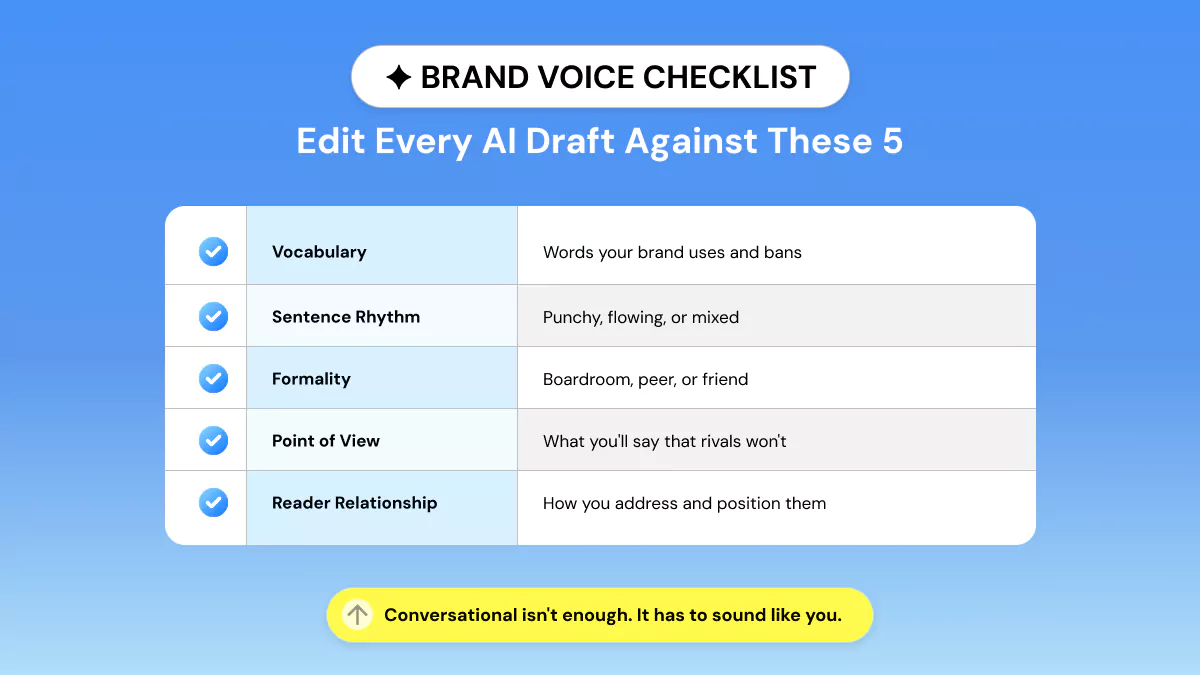
To make AI writing match your brand voice, translate that voice into observable rules covering vocabulary, rhythm, reader relationship, point of view, and boundaries. Vague adjectives like "friendly" or "authentic" only help once you show what they mean at the sentence level. Then check every AI draft against those rules.
Conversational and recognizable are two separate goals. A rewrite can read smooth and human while still sounding like every other brand in the category. Mailchimp's style guide frames it: voice is the steady personality behind the writing, and tone flexes with the situation and the reader's mood.
Marketing copy reads as conversational when it speaks to one reader with "you," uses customer words, varies sentence length, and carries a clear point of view. Smoothness alone does not get it there. Those concrete choices do.
An ACL 2026 study had 81 participants post-edit LLM drafts for writing where personal style mattered. Editing moved the text toward each person's natural style, yet it stayed closer to the model's output than to their own unassisted writing and showed less stylistic variety. Human review helps, but editors still need specific voice criteria to push against.
Build a Five-Point Brand Voice Card
Write a one-page voice card before you edit. Make each rule clear enough that two editors reviewing the same paragraph would reach similar calls.
"Friendly" only helps once it becomes instructions like "use contractions, address the reader as you, and skip formal greetings." "Confident" only works once it means "state verified product functions plainly and qualify any performance claim that depends on evidence or customer circumstances."
Test the Draft Against the Card
Run each AI draft through five checks:
- Confirm the copy establishes the intended relationship with the reader.
- Check whether the vocabulary could belong to a competitor.
- Match the rhythm against approved brand examples.
- Verify the point of view stays consistent.
- Decide whether the humor and confidence level fit this situation.
Adobe's 2026 consumer research found 70% of customers consider it very or moderately important that personalized offers and recommendations feel human rather than automated or robotic.
That supports the case for natural communication, though it does not prove voice editing alone lifts conversions or revenue. The final test: the copy should sound like something your brand would knowingly say to this audience in this situation.
A Repeatable Workflow for Conversational AI Copy
A reliable workflow keeps the marketer responsible for the message while AI speeds up production. Use AI to build the first draft, lock anything that must not change, make the high-impact edits yourself, run a humanizer over the remaining robotic phrasing, then verify the final version.
1. Draft for Structure
Use Phrasly’s AI Writer as a content generator for the first draft, not the final brand voice. Add your prompt, audience, writing purpose, word count, and automatic citations when the copy needs source-backed claims.
For copywriters, this helps build a researched structure faster while keeping the human editor in charge of every source, stat, offer, and CTA. Once the message is accurate, move to the Humanizer to polish tone, rhythm, and brand voice.
Before polishing sentences, confirm the draft follows the right argument:
- It opens with a real customer problem.
- Each benefit connects to a confirmed product feature.
- Proof sits next to the claim it supports.
- The CTA matches the reader's stage and the destination page.
Fix the positioning first. A natural-sounding paragraph cannot rescue the wrong message.
2. Lock the Elements That Must Not Change
Before rewriting anything, build a short message lock listing every detail the final copy must keep.
Keep this list beside the source draft. If a rewrite changes one of these, restore the approved version rather than treating the new wording as equivalent.
3. Make the Seven High-Impact Edits Yourself
Apply the edits from the teardown before reaching for another tool:
- Remove the prefabricated opening.
- Replace abstract benefits with concrete outcomes.
- Use verified customer language.
- Remove unnecessary hedging while keeping required qualifiers.
- Vary the sentence rhythm.
- Add the brand's point of view.
- Make the CTA specific.
These calls depend on your knowledge of the customer, product, evidence, and campaign. A humanizer can improve how copy reads, but it should not decide what the brand believes or which promise it can legally support.
4. Humanize the Remaining Robotic Phrasing
Once positioning, facts, and CTA are correct, run the AI Humanizer over formulaic wording, predictable transitions, and repetitive sentence structures.
Phrasly offers three humanization strengths:
- Easy: a light polish for copy that is already accurate and close to the intended voice.
- Medium: a balanced rewrite when several sentences feel stiff or repetitive.
- Aggressive: deeper restructuring for drafts that still sound templated.
Start with Easy and review the result beside the source. Move to Medium only if the copy still reads mechanically. Use Aggressive when the draft needs substantial restructuring, since stronger rewriting also creates more chances for a key phrase or conversion element to shift.
Phrasly Humanizer improves tone, cadence, sentence structure, and natural flow while preserving the original meaning. That makes it a refinement step that supports marketing judgment rather than replacing it. Final responsibility for every claim, CTA, keyword, and personalization token stays with the marketer.
5. Compare the Rewrite With the Message Lock
An AI humanizer can preserve marketing claims and CTAs when you lock those elements first and verify them after the rewrite. The tool improves phrasing, but it does not know which figures are verified or which promise you can legally make. The marketer confirms every claim, token, and CTA against the source.
Compare the rewrite with the source line by line. A better-sounding version still has to match the lock. Confirm the Humanizer has not:
- Changed a price, date, percentage, or product limitation
- Strengthened a qualified claim into a guarantee
- Altered a brand or product name
- Removed an important search term
- Rewritten a merge tag as ordinary text
- Changed the meaning or urgency of the CTA
- Added a testimonial, result, or capability that was not in the source
Check length and format too. A longer rewrite can break an ad limit, mobile email layout, landing-page hierarchy, or button label even when the prose reads stronger.
6. Read It Aloud and Fact-Check It
Read the final copy aloud at normal speaking speed. If you run out of breath, stumble over a transition, or would never say a phrase to a customer, revise it. Microsoft's accessibility guidance also recommends reading text aloud when reviewing for clear, focused writing.
Finish with a separate accuracy pass:
- Open every cited source.
- Confirm every number and quotation.
- Test every link and CTA.
- Preview merge tags with sample data.
- Check prices and offer terms against the live page.
- Read the copy once in its final format rather than only in the editor.
The workflow is done when the copy sounds natural, follows the brand-voice card, preserves the approved message, and gives the reader a clear next step.
What Humanizing Should Never Change
Humanizing should change how copy sounds without changing what it means. Product claims, prices, qualifiers, calls to action, personalization fields, and the customer problem stay locked while you revise tone, rhythm, and sentence structure. Treat the humanized version as an edited draft that still needs approval, then compare it with the source against this checklist.
These are not minor editorial details. In the United States, the FTC requires advertisers to back objective claims with appropriate evidence and to make necessary qualifications clear and conspicuous. A guarantee or disclaimer cannot rescue a claim that lacks evidence, and requirements vary by market, so regulated or legally sensitive copy should go through internal review.
CTAs need semantic accuracy as much as stronger wording. A button label should describe its action, so changing "View pricing" to "Start saving today" would mislead readers if the destination only shows plan information.
Personalization tokens need the same care. Merge-tag syntax can be audience-specific, and a missing value or formatting error can expose the raw tag to the recipient. Mailchimp recommends setting fallback values and previewing or testing personalized content before it sends.
Do Not Fake "Human" Writing
Humanizing copy does not mean adding imperfections for effect. Avoid:
- Invented customer anecdotes or personal experiences
- Random slang that does not belong to the brand
- Deliberate spelling or grammar errors
- Mechanical synonym swapping
- Unsupported emotional or performance claims
- One casual voice stamped onto every brand
Authenticity comes from accurate details, recognizable customer language, and a consistent point of view. A bank, a healthcare platform, and a streetwear label can all sound human while sounding nothing alike.
Before approving the revision, confirm three things: every claim is still accurate, the CTA still promises the correct next step, and the copy still sounds like your brand solving the same customer problem. If any of these is unclear, return to the locked source copy.
Making AI marketing copy sound human comes down to a repeatable process you can run on every draft. Cut the tells, protect the facts and the CTA, and check the result against your brand voice. Do that consistently, and AI becomes a speed advantage instead of the reason your copy gets skipped. Turn robotic drafts into copy that sounds like you.
Frequently Asked Questions
Should Conversational Marketing Copy Always Sound Casual?
No. Conversational means clear and human, and the right tone depends on the audience and the situation. A bank, a law firm, and a streetwear brand can all read conversational while staying serious, formal, or playful. Match tone to context while keeping one recognizable brand voice.
Should I Add Slang or Intentional Mistakes to AI Copy?
No. Deliberate typos, random slang, and forced casual phrasing do not make copy sound human; they make it look careless and can cost you trust. Real authenticity comes from accurate details, customer language, and a clear point of view rather than manufactured imperfection.
Which Parts of Marketing Copy Should I Lock Before Humanizing It?
Lock every element that must stay exact: product facts and statistics, prices and legal qualifiers, brand and product names, SEO keywords, personalization tokens, and the CTA text and destination. Also lock the core customer problem. Revise tone and phrasing around these, then verify each one against the source.
Can Humanizing AI Copy Change Its Meaning or CTA?
Yes. A rewrite can soften a claim, alter a price, break a merge tag, or change what the CTA promises, especially at stronger settings. Lock those elements first, then compare the output against the source line by line. The AI Humanizer improves phrasing, but final accuracy stays with you.
Does the Same Process Work for Emails, Ads, and Landing Pages?
Yes. The same workflow applies: lock the essentials, edit the tells, humanize, then verify. Only the format limits change. Google responsive search ads cap headlines at 30 characters and descriptions at 90 (Google Ads Help), emails hinge on the subject line and preview text, and landing pages depend on scannable hierarchy. Check length and layout after every rewrite. For a dedicated email workflow, see Best AI Humanizer for Email Marketing Copy in 2026.
How Should Marketers Measure Whether Humanized Copy Performs Better?
A/B test the humanized version against the original, changing only the copy so the result stays clean. Track the metric tied to the copy's job: click-through rate, conversion rate, reply rate, or opens for subject lines. Run it until you have enough conversions for a reliable read rather than calling it after a few days.


Keep reading

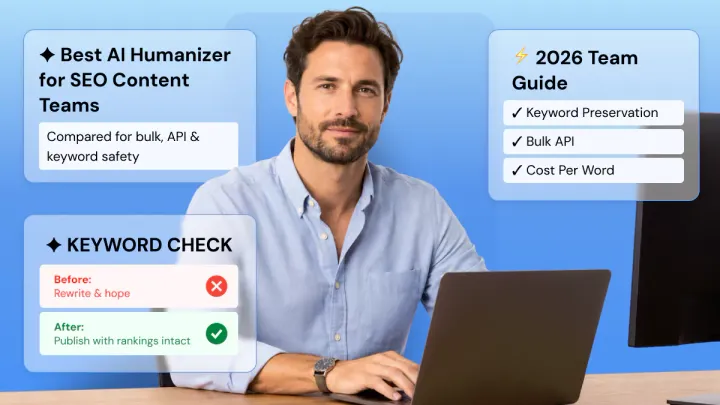
Best AI Humanizer for SEO Content Teams in 2026
Comparing AI humanizers for SEO content teams? Phrasly, Undetectable AI, and Humbot lead for bulk use, but keyword preservation is the real risk. Learn what to test before running your content calendar through any tool, plus true cost-per-word at scale and picks by team size.
Rewriting AI Drafts for Client Deliverables Without Losing Your Voice
AI can draft your client copy in minutes, but that's not what clients pay for. Learn how to treat AI drafts as scaffolding, not final copy, rewrite for both your voice and your client's brand guidelines, cut hedge words, vary rhythm, and proofread before delivery so nothing generic ships.