Can ChatGPT Check for Plagiarism? We Tested It in 2026
13 min read
Partly, but not quite how an actual plagiarism checker works. ChatGPT with ChatGPT Search enabled can search the public web and highlight some passages that are similar to sources on the web.
And it can compare two pasted-in texts against each other. However, it doesn’t have access to academic databases or student-paper repository archives. It also cannot generate a reliable similarity score or plagiarism report.
As OpenAI states, its search results and citations may be incomplete or inaccurate. If you want actual verification, use a dedicated plagiarism detection tool.
✅ Want the reliable version instead of a guess? Skip ahead and run your text through Phrasly's free plagiarism checker.
Can ChatGPT Check for Plagiarism? The Short Answer
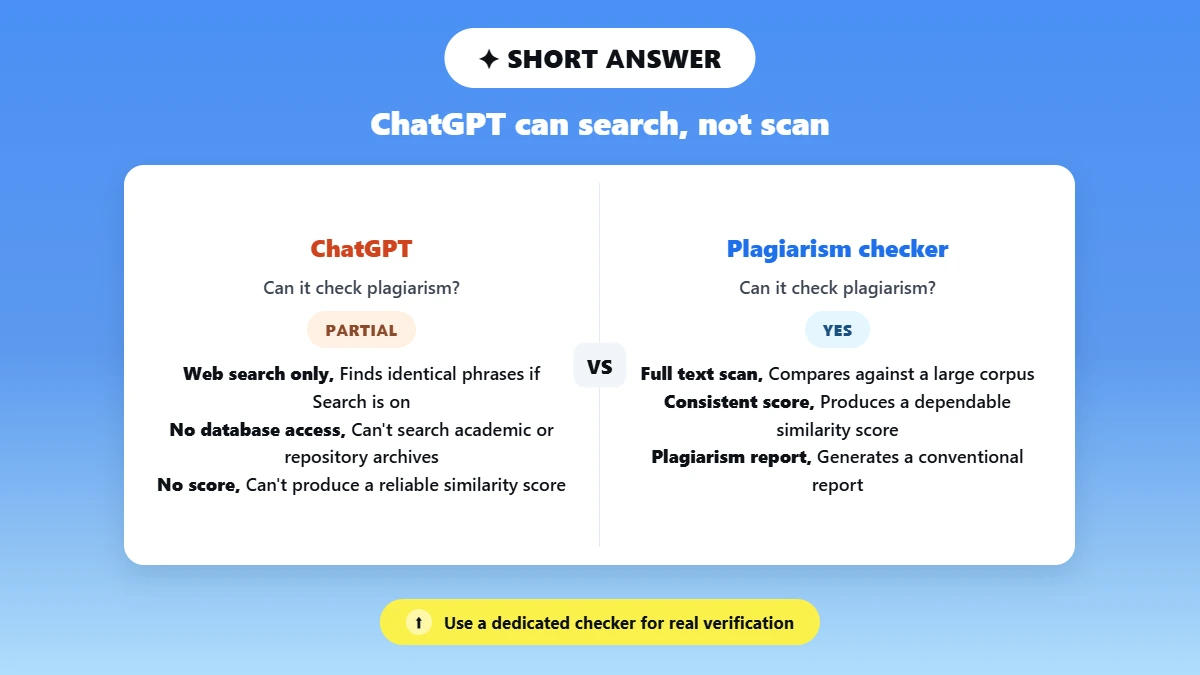
Can ChatGPT check for plagiarism? Short answer: It can search. It cannot scan. ChatGPT can look up identical language on the open internet, and it can compare two blocks of text you provide it against one another.
But ChatGPT is not designed to be a plagiarism checker, and you shouldn’t use it as such. Here’s how ChatGPT does (or does not) perform on each task specifically.
Task | Can ChatGPT do it? |
Search the public web for matching wording | ⚠️ Partial yes, with Search enabled |
Compare two texts you paste in | ✅ Yes |
Find every copied source | ❌ No guarantee |
Search proprietary academic databases | ❌ No, not a native plagiarism database |
Search private student-paper repositories | ❌ No |
Produce a dependable similarity score | ❌ No |
Produce a conventional plagiarism report | ❌ No |
Tell whether ChatGPT itself wrote the text | ❌ No, not reliably |
Explain why a passage may be problematic | ✅ Yes |
How Does ChatGPT Actually Check Text for Possible Matches?
Want to know how to use ChatGPT to detect plagiarism? The truth starts with knowing what changed in 2026 and what didn’t.
What Changes When ChatGPT Search is Enabled?
If ChatGPT Search is enabled, ChatGPT can search the web to answer questions with current information and links to relevant sources.
This means ChatGPT actually can look up unique phrases and provide pages with clickable links that match said phrase, something the no internet claim articles get factually incorrect on in 2026.
Plans Where ChatGPT Search is Available
Free
Go
Plus
Pro
Business, Enterprise, and Education
What ChatGPT Can Do Even Without a Plagiarism Database?
Even without a dedicated similarity checker behind it, ChatGPT is genuinely useful. Actually, a useful first pass.
Where ChatGPT Actually Helps?
Compare a passage you paste against a source you provide, side by side.
Spot identical or near-identical wording between two pasted texts.
Search a distinctive phrase on the public web to see if it turns up elsewhere.
Flag missing or questionable citations and suggest what to verify.
Though if you're publishing content at scale, it's worth knowing the common plagiarism flags in SEO content that go beyond what ChatGPT catches.
Why Web Search Isn't the Same as a Plagiarism Scan?
Searching the web verifies a few words against whatever happens to be pulled at that instant.
An actual plagiarism check compares the document in question to an entire corpus, recording all instances it encounters.
OpenAI is honest about the discrepancy.
Coverage is not guaranteed, and links may be broken or intentionally malicious.
We Tested ChatGPT as a Plagiarism Checker (2026)
Discussing the theory is all well and good. We wanted to know what would happen if we actually gave ChatGPT some text and asked it to detect copied text.
Here is the exact process below!
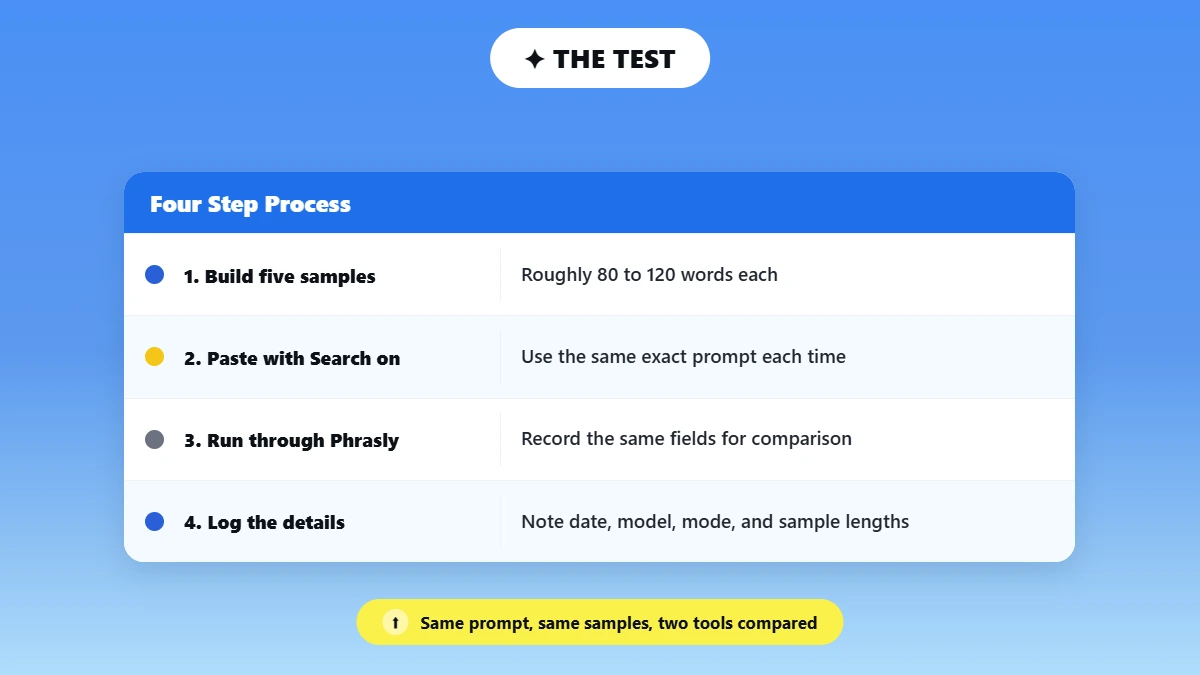
How We Tested It
Step 1: Build five short samples. Roughly 80-120 words each.
# | Sample | Where to get it |
1 | Exact copy of an older, well-indexed passage | One paragraph copied verbatim from a long-standing Wikipedia article |
2 | Exact copy of a very recent 2026 page | One paragraph from a news story published in the last few weeks |
3 | Lightly paraphrased copy | Sample 1 reworded by hand, roughly 25% |
4 | Original, never-published paragraph | ~100 words written from scratch (false-positive check) |
5 | Fresh ChatGPT-generated paragraph | ChatGPT asked to write ~100 words on any topic |
Step 2: With ChatGPT Search turned on, paste each sample using this exact prompt:
"Check the following passage for plagiarism. Search the web for matching or near-matching sources, list each source with a working link, quote the exact matching text, and estimate what percentage of the passage looks copied. If you can't find a source, say so. Passage: [paste]"
Step 3: Once you have written each sample, run each sample to test for consistency. Then, run all five samples through Phrasly's plagiarism checker, recording the same fields from each for comparison.
Step 4: Take note of the date, ChatGPT model/mode, whether Search was enabled, and sample lengths. Capture screenshots of both the ChatGPT responses as well as the Phrasly report.
Test Results
We did not make up numbers here.
# | Sample | Found true source? | Real link? | Gave % (consistent)? | Phrasly result |
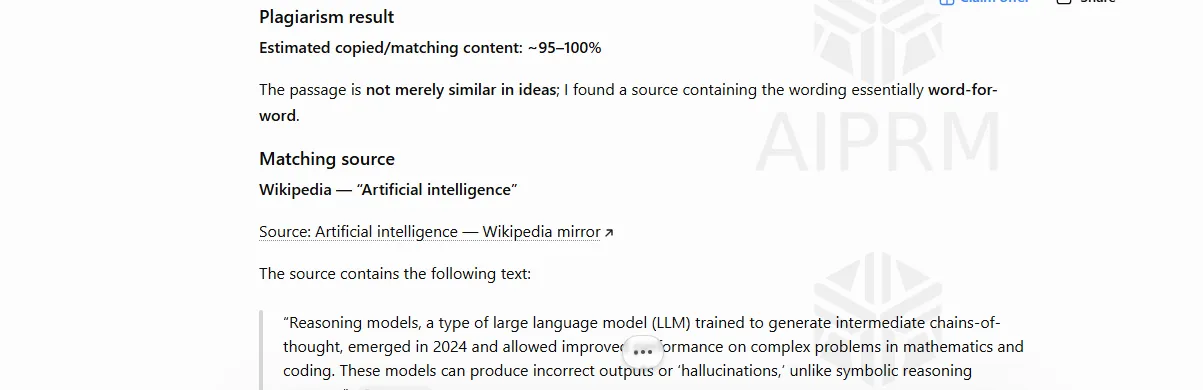
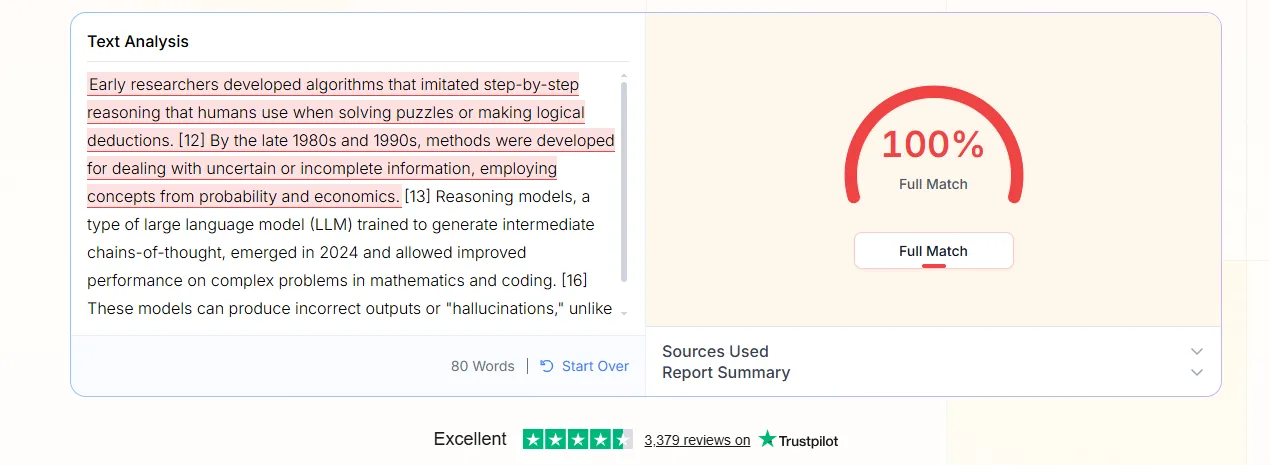
1 | Exact old copy | ✅ Yes! Identified as Wikipedia’s “Artificial intelligence” article | ✅ Yes! Linked to a Wikipedia mirror of the article (not the live Wikipedia page itself) | ⚠️ Estimated 95-100% match | 100% Full Match |
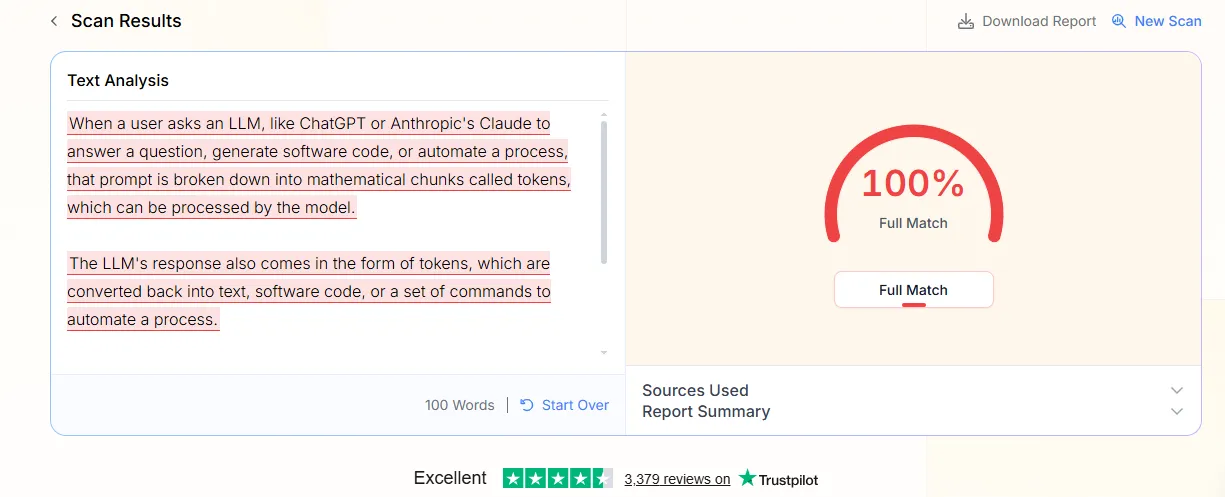
2 | Exact recent copy | ✅ Yes! Identified as “The Low-Down” article, “Changing AI Token Usage, Prices Challenge Cost/Profit Management” | ✅ Yes! Direct link to the article | ✅ 100% match | 100% Full Match |
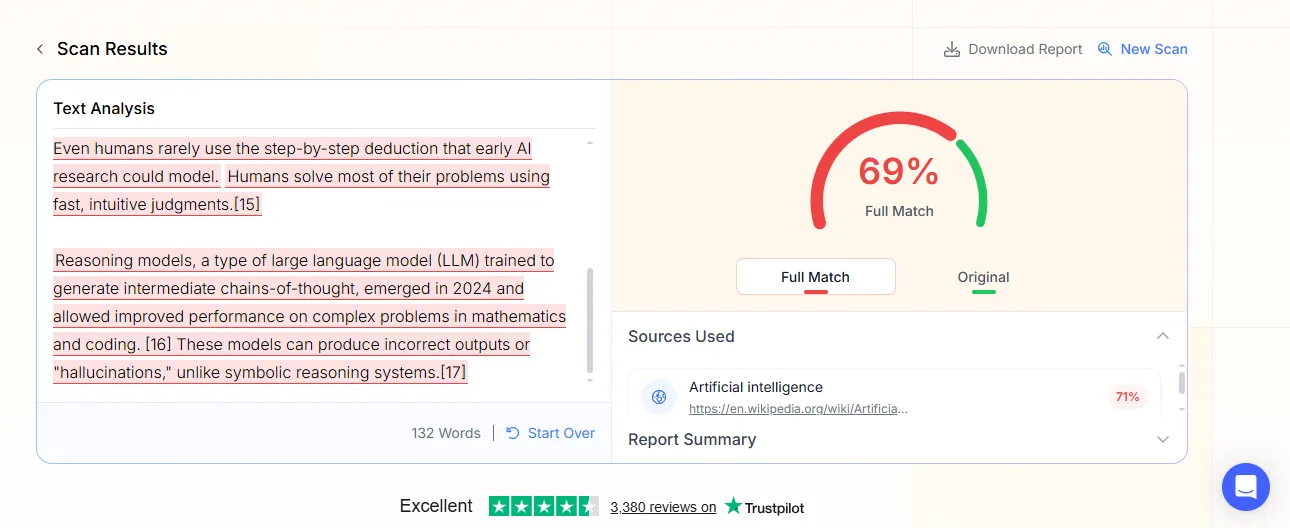
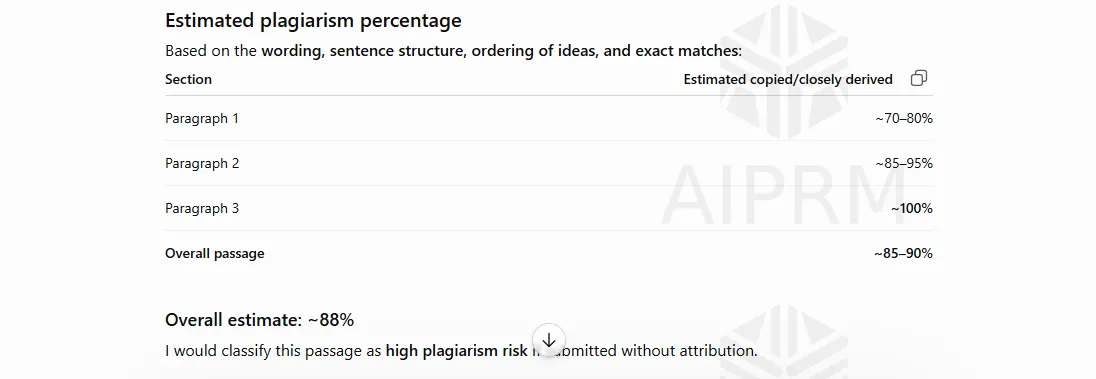
3 | Paraphrased | ✅ Yes! Identified as Wikipedia’s “Artificial intelligence” article | ✅ Yes! Linked to en.wikipedia.org | ⚠️ ~88% overall estimate, broken down by paragraph (70-100% range) | 69% Full Match |
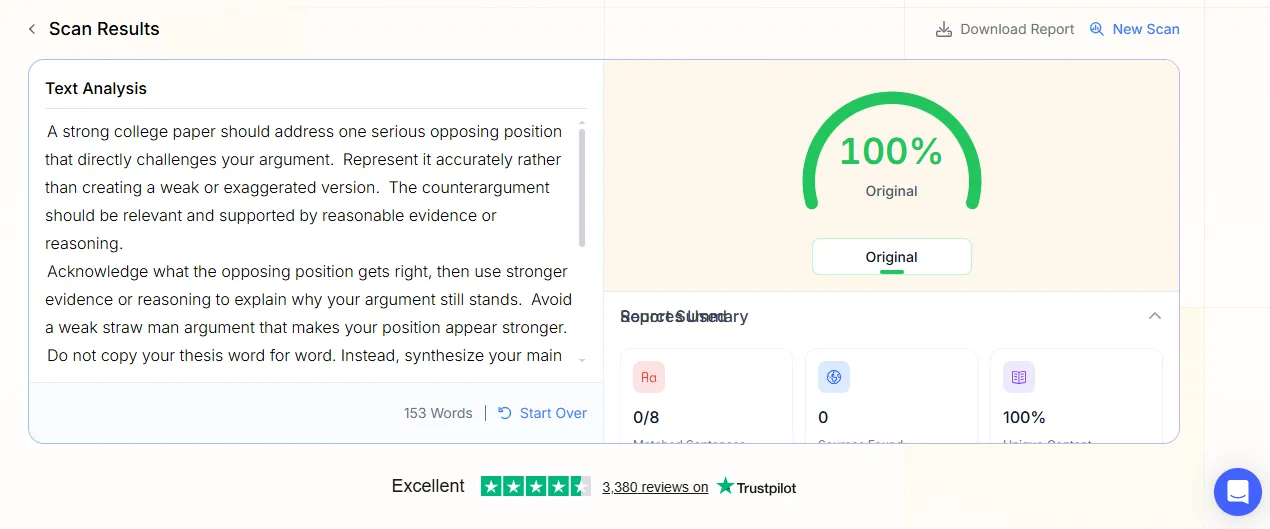
4 | Original | ✅ Correctly found no source (exact match: not found) | N/A! No source to link | ⚠️ ~15-25% “likely copied/paraphrased, ” despite no source found | 100% Original (0 sources found) |
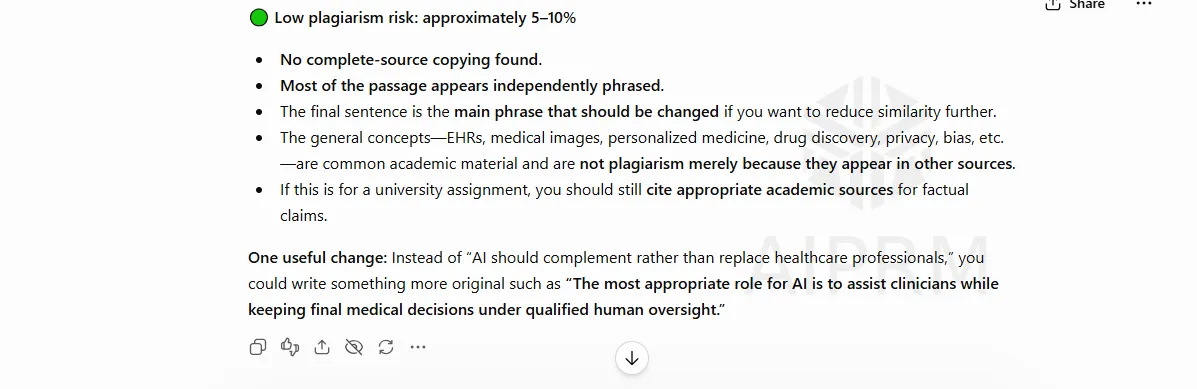
5 | AI-generated | ❌ No! Missed the Wikipedia “Artificial intelligence in healthcare” match entirely | N/A! No source named | ❌ Self-scored ~5-10% “low risk, ” no source found | 100% Full Match (13% attributed to Wikipedia “AI in healthcare”) |
Sample 1: Exact Old Copy
ChatGPT quoted the matching text nearly word-for-word. It correctly flagged this as essentially a word-for-word match rather than merely similar in ideas.
Phrasly independently returned a 100% Full Match on the same passage. Corroborating ChatGPT’s finding.
One nuance worth noting: ChatGPT’s cited source was a mirror of the Wikipedia article rather than Wikipedia itself. A small but real distinction. Since mirrors can lag behind or subtly diverge from the live page.
Sample 2: Recent 2026 News Article
ChatGPT correctly identified this as a very recent 2026 publication. It found “The Low-Down” article on changing AI token usage and cost/profit management.
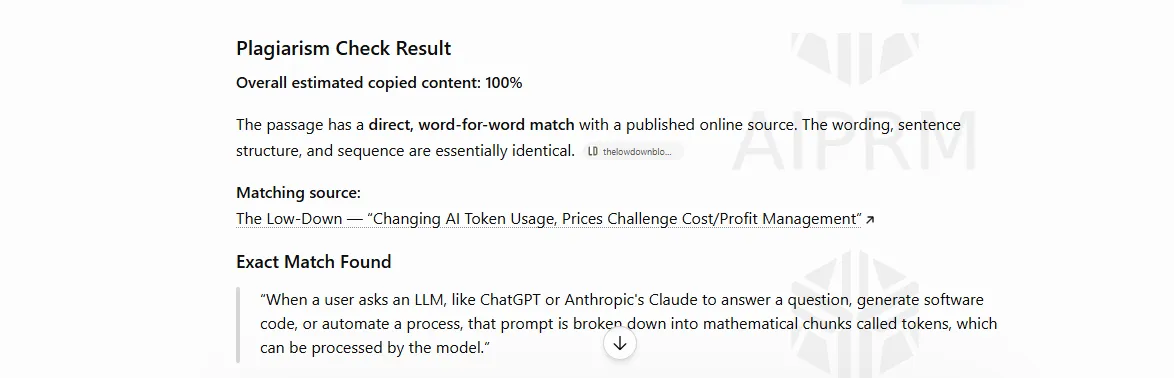
Phrasly returned the same verdict independently. A 100% Full Match, with a direct, word-for-word match against the published source.
Sample 3: Lightly Paraphrased Copy
This is where the two tools started to diverge. The passage was Sample 1 reworded by hand by roughly 25%. So a perfect match was never expected. The interesting question was how each tool would score partial rewriting.
Phrasly returned 69% Full Match overall. And usefully broke out a 71% match specifically against the Wikipedia “Artificial intelligence” source in its Sources Used panel. Correctly identifying it as the origin despite the paraphrasing.
ChatGPT went further with granularity. It broke the passage into three paragraphs and scored each separately (~70-80%, ~85-95%, and ~100% respectively). Landing on an overall estimate of ~88% and classifying it as “high plagiarism risk if submitted without attribution.”
Sample 4: Original
This sample was the false-positive check. ~100 words written entirely from scratch. Never published anywhere. A trustworthy checker should come back clean.
Phrasly did exactly that. A 100% Original verdict, 0 sources found, 0/8 matched sentences, and 100% unique content flagged in its summary.
ChatGPT was murkier. It correctly reported no exact full-passage match. But still flagged “strong phrase-level similarities” as present. Estimated ~15-25% of the passage as “likely copied/paraphrased material”.
Landing on an overall assessment of “mostly original, with some conventional/possibly source-derived wording”. Without naming an actual source for that estimate.
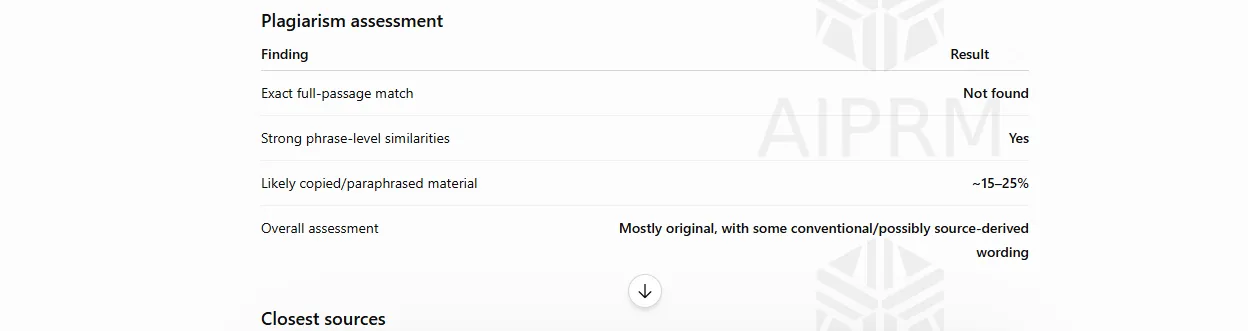
This is the biggest turning point yet. When faced with entirely original work, Phrasly gave a completely clear endorsement. ChatGPT equivocated with a nonzero risk score it could not support with an actual citation.
Precisely the type of unsubstantiated, unsupported percentage that makes it dangerous to use for an actual submission. Were a student to accept ChatGPT’s score here, they would be second-guessing writing that was never plagiarized.
Sample 5: AI-Generated
This was the last and most revealing test. A ~100-word paragraph on AI in healthcare, generated fresh by ChatGPT itself. Then immediately checked for plagiarism using the same prompt.
ChatGPT passed itself through its own plagiarism detector. “Low plagiarism risk: approximately 5-10%,” stating that no complete-source copying was found. It said most of the passage appeared independently phrased.
It even suggested a single sentence to reword. “If you want to reduce similarity further,” treating the rest as safe.
Phrasly told a very different story. It returned a 100% Full Match. Its Sources Used panel traced the passage back to Wikipedia’s “Artificial intelligence in healthcare” article.
The same general topic ChatGPT had been asked to write about “on any topic”. This apparently wasn’t random or original enough to avoid overlapping heavily with existing, well-indexed material.
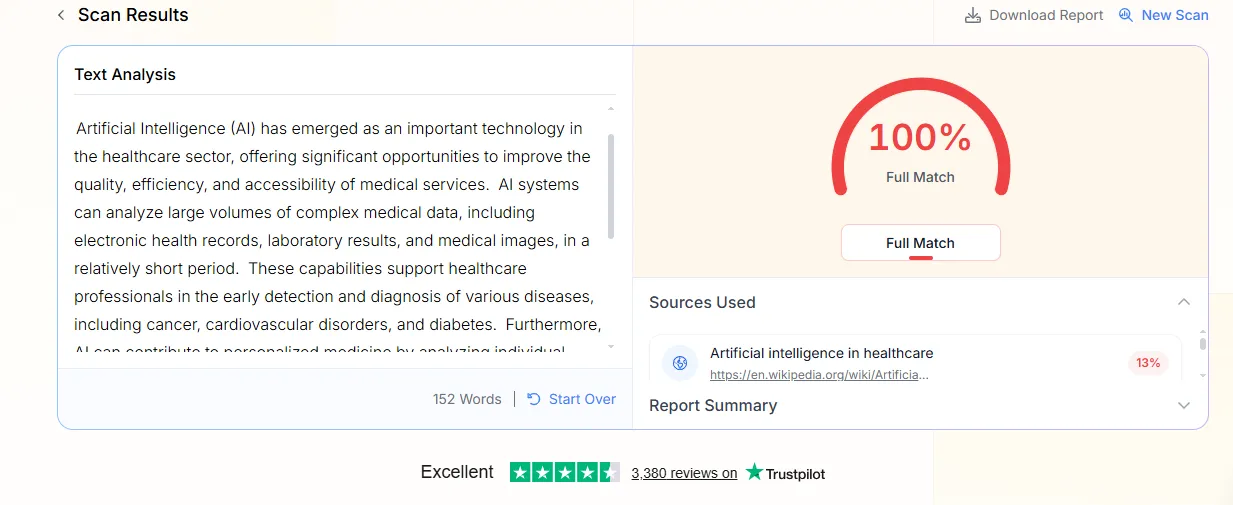
This is the sharpest disagreement across all five samples. ChatGPT wasn’t just inconsistent here. It failed to catch that its own freshly generated text closely tracked an existing Wikipedia article.
Gave a false sense of security (5-10% risk) on a passage a dedicated checker flagged as a full match.
If a student used this exact workflow to write with ChatGPT. Then ask ChatGPT to check itself. They’d have submitted the paper with confidence and still ended up with a plagiarism problem.
⚠️ Don't Trust ChatGPT's Self-Check. Run Your Paper Through Phrasly's Free Plagiarism Checker!
What ChatGPT Found, What it Missed, and What Changed When We Paraphrased
Across all five samples, a clear pattern emerged. ChatGPT was reliable on the easy cases. Exact, verbatim copies (Samples 1 and 2) correctly identified the source and quoted matching text.
Landing close to Phrasly’s 100% verdicts in both instances. That’s the scenario ChatGPT Search is actually built for. Everything past that point got shakier.
On the paraphrased sample, ChatGPT’s overall estimate (88%) ran notably higher than Phrasly’s (69%) for the identical text. The two tools agreed on the source but disagreed sharply on magnitude.
On the original, never-published sample, ChatGPT flagged a nonzero, unsourced “likely copied” percentage (~15-25%). Phrasly correctly returned a clean 100% Original. A false positive Phrasly didn’t make.
And on the AI-generated sample, ChatGPT badly undersold its own risk (5-10%). On a passage Phrasly matched 100% to an existing Wikipedia article. A false negative, and arguably the most consequential failure of the five.
Since it’s the exact workflow (write with ChatGPT, self-check with ChatGPT) many people would actually use.
The throughline: ChatGPT’s numbers move in the right direction, but not by a dependable amount. It can be wrong in both directions. Flagging clean writing as risky. Clearing genuinely matched writing as safe.
Phrasly was consistent across all five. Phrasly never contradicted its own source data.
How Accurate Is ChatGPT for Plagiarism Checking?
Outside of our own experiment, peer-reviewed research answering this precise question of whether ChatGPT detects plagiarism has been conducted under rigorous conditions.
A 2025 peer-reviewed study by Murdock and Tadinada, published in Cureus, tested AI tools using purposefully plagiarized "mashup" scientific articles across 15 trials per tool.
ChatGPT 3.5 identified the planted plagiarism 0 out of 15 times. Google Bard identified just 24% of paragraphs (22/90).
Small SEO Tools caught all of the copied paragraphs initially but caught only 3.3% after they were AI rewritten.
A gap worth keeping in mind next to more consistent options like Quetext's plagiarism checker.
Important caveat: That experiment was done before today's ChatGPT Search capabilities, and so isn't a demonstration of what the current product can do. It is, instead, illustrative of a trend.
It is not proof that version 2026 will act the same way, which is precisely why the test we just did ourselves is important.
Why ChatGPT Isn't a Replacement for a Dedicated Plagiarism Checker?
Search Coverage Isn't Comprehensive
Worth repeating: OpenAI itself warns that search results and citations can be incomplete, outdated, or incorrect.
This means ChatGPT might not find a source at all, or may cite an entirely different one, with no indication that an error occurred.
Dedicated Systems Compare Against a Defined Database
Tools such as Turnitin check submissions against sources from the internet, academic publications, and other student papers in a fixed, systematic corpus.
Grammarly's plagiarism checker works on a similar principle. Scanning against a defined database rather than an open-ended web search.
The kind of source matching content with known sources in a finite pool is what ChatGPT can't do.
ChatGPT Doesn't Produce the Same Kind of Report
An actual plagiarism report provides matched passages, a source-by-source summary, and an actionable, report-wide similarity percentage.
ChatGPT can only produce a partial, unreproducible rough summary, which might be helpful as a tip-off, but not as a record.
Similarity ≠ Plagiarism
Specialized tools detect similarity, not plagiarism itself. Plagiarism itself isn't one single thing, either. It can range from verbatim copying to subtler forms like uncredited paraphrasing or self-plagiarism.
Which is worth understanding before you rely on any single score. See this breakdown of the types of plagiarism for the full picture.
According to Turnitin, plagiarism cannot be determined by the similarity score alone. Context and intent can only be judged by a human evaluator.
Keep that in mind before using any tool (including ChatGPT) that promises 100% detection.
ChatGPT vs a Dedicated Plagiarism Checker
Side by side, the gap in ChatGPT plagiarism checker capability versus a purpose-built tool is easy to see:
Tools built specifically for this job, like the one covered in this Prepostseo plagiarism checker review, are designed around a fixed corpus. A repeatable scoring method, which is exactly what ChatGPT lacks.
Capability | ChatGPT | Dedicated plagiarism checker |
General text analysis | ✅ Strong | ⚠️ Limited / varies |
Public-web discovery | ⚠️ Partial (with Search) | ✅ Yes |
Systematic corpus comparison | ❌ No | ✅ Core function |
Dependable similarity % | ❌ No | ✅ Yes |
Matching-source report | ⚠️ Partial | ✅ Yes |
Academic / student database | ❌ No | ⚠️ Depends on service |
AI detection | ⚠️ Separate issue | ⚠️ Depends on tool |
✅ See the Gap for Yourself. Try Phrasly's Free Plagiarism Checker!
How to Check Your Paper for Plagiarism Instead?
If you really want a reliable check before you publish, the truthful workflow is this:
It starts with picking the right tool.
Not every checker is created equal, so it's worth comparing a few from this list of the best plagiarism checkers before you commit to one.
Run the full document through a dedicated plagiarism checker.
Review each matching source, not just the headline percentage.
Check whether matches are properly quoted and cited.
Fix improper paraphrasing or missing source attribution.
Recheck the revised version before you submit.
✅ This is where Phrasly's plagiarism checker fits in. It scans against the public web, shows matching sources with links, and gives a similarity breakdown you can actually act on. The systematic check ChatGPT can't do.
Plagiarism Detection vs AI Detection: Not the Same Thing
The three questions get conflated all the time, but they are distinct:
(1) a plagiarism checker says "does this match any known sources? "; (2) an AI detection asks "does this sound like AI-written text? "; and (3) "did ChatGPT itself write this? "
Is another distinct question.
On that last one, OpenAI is direct up front. ChatGPT "has no knowledge of what content could be AI-generated or what it generated" and will "sometimes make up" an answer when it has "no basis in fact".
Therefore, asking ChatGPT "did you write this?" is not reliable.
Try a specialized AI detector instead.
See how AI detectors work for details on that difference.
Frequently Asked Questions:
Can ChatGPT check for plagiarism for free?
ChatGPT can perform a simple web search for matching text when using the free version. However, this is by not a can ChatGPT check for plagiarism free checker solution.
There is no database, no dependable score. If you need a free check, just use a proper free plagiarism checker.
Can I use ChatGPT to check for plagiarism in an uploaded essay?
You can paste or upload text. And ask can I use ChatGPT to check for plagiarism this way. Yes, and it may flag some web matches with Search on.
But it won't scan academic or student-paper databases or give a dependable report. Treat the result as a hint, not a verdict.
Can ChatGPT give me a plagiarism percentage?
Not a dependable one. can ChatGPT give a plagiarism percentage is one of the most common follow-up questions. The honest answer is: it may state a number, but there's no systematic corpus behind it.
The figure often changes between runs. A real similarity score comes from a dedicated checker.
Can ChatGPT find copied text from websites?
Can ChatGPT find copied text online? Occasionally! When Search is enabled, ChatGPT can return matches from the public web and include links.
However, OpenAI warns that these results may be partial or inaccurate. So, it may fail to identify a source or cite incorrectly.
Can ChatGPT check a paper against Turnitin's database?
No! Turnitin's database of student papers, academic publications, and archived web pages is proprietary.
ChatGPT doesn't have access to that database; therefore, it can't create a Turnitin-esque check. To learn more about that difference, see how to check plagiarism in Turnitin.
Can ChatGPT Tell If It Wrote an Essay?
No! OpenAI admits ChatGPT "has no knowledge" of what it produced and will "sometimes make up" responses completely "with no basis in fact".
"Did you write this?" is an extremely unverifiable ask. That is something for a standalone AI detector tool to determine, not ChatGPT itself.
The Bottom Line
So can you check ChatGPT for plagiarism the way you'd check with a real tool?
Not quite! ChatGPT is a helpful assistant for a quick sanity check. It is not a ChatGPT plagiarism tool you can rely on. Don't take a chance on your grade.
✊ Run your paper through Phrasly's free plagiarism checker to see real matching sources and a similarity breakdown before you submit.

Written by
Muhammad Usman Ali
Pakistan
Muhammad Usman Ali is an experienced SEO content writer with 3+ years of professional writing experience. He specializes in AI tools, AI detection technologies, and search engine optimized content.